CHEMICAL BURNS
PRESENTER -DR RAHUL
MODERATOR -DR SANGIT
OCULAR BURNS
 Ocular burns constitute true ocular emergencies
 Both thermal and chemical burns represent
potentially blinding ocular injuries
 Thermal burns result from accidents associated with
-firework explosions
- steam
- boiling water
-molten metal (commonly aluminium)
Chemical burns
 Chemical burns may be caused by either alkaline or
acidic agents
 Alkali more frequently used in household cleaning
agents and many building materials
 So Alkali injuries occurs more frequently than acid
injuries
Causes
Common sources of alkali are as follows:
 Cleaning products (eg .ammonia) most serious
injury
 Fertilizers (eg, ammonia)
 Cement, plaster, (eg, lime)most common injury
 Fireworks (eg, magnesium hydroxide)
Pathophysiology
 Alkaline agents have both hydrophilic and lipophilic
properties
 which allow them to rapidly penetrate cell
membranes and enter the anterior chamber
 Alkali damage results from interaction of the
hydroxyl ions
Pathophysiology
 It causes saponification of cell membranes and cell
death along with disruption of the extracellular
matrix
 Cations react with carboxyl group of stromal collagen
And Glycosaminoglycans (GAGS)
 Hydration of Gagas result in loss of clarity of stroma
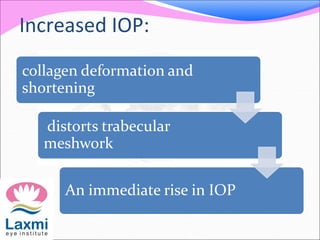
Increased IOP:
collagen deformation and
shortening
distorts trabecular
meshwork
An immediate rise in IOP
Pathophysiology
 Penetration into AC may be almost immediately after
ammonia
 Within 3-5 min after sodium hydroxide injury
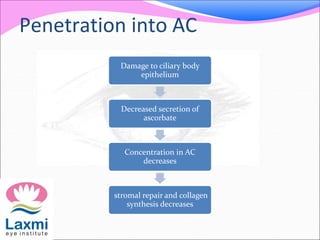
Penetration into AC
Damage to ciliary body
epithelium
Decreased secretion of
ascorbate
Concentration in AC
decreases
stromal repair and collagen
synthesis decreases
Acid injury
Common sources of acids are as follows:
 Battery acid (eg, sulfuric acid)
 Bleach (eg, sulfurous acid)
 Glass polish (eg, hydrofluoric; )
Pathophysiology
 Acids tend to cause less damage than alkalis
 corneal proteins bind acid and act as a chemical
buffer.
 coagulated tissue acts as a barrier to further
penetration of acid.
 Acid binds to collagen and causes fibril shrinkage
which can cause symblepharon formation
Classification
 There is no ideal classification or grading system for
ocular alkali burns
 The principal weakness of grading system is that
injuries to the cornea are not uniformly associated
with injuries to the surrounding tissues
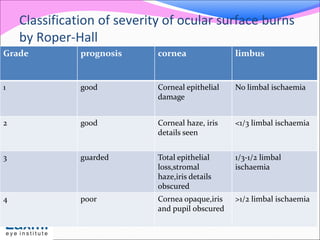
Classification of severity of ocular surface burns
by Roper-Hall
Grade prognosis cornea limbus
1 good Corneal epithelial
damage
No limbal ischaemia
2 good Corneal haze, iris
details seen
<1/3 limbal ischaemia
3 guarded Total epithelial
loss,stromal
haze,iris details
obscured
1/3-1/2 limbal
ischaemia
4 poor Cornea opaque,iris
and pupil obscured
>1/2 limbal ischaemia
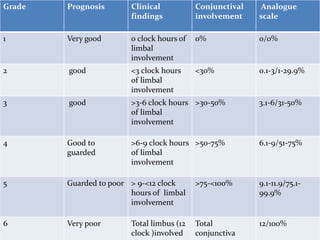
Grade Prognosis Clinical
findings
Conjunctival
involvement
Analogue
scale
1 Very good 0 clock hours of
limbal
involvement
0% 0/0%
2 good <3 clock hours
of limbal
involvement
<30% 0.1-3/1-29.9%
3 good >3-6 clock hours
of limbal
involvement
>30-50% 3.1-6/31-50%
4 Good to
guarded
>6-9 clock hours
of limbal
involvement
>50-75% 6.1-9/51-75%
5 Guarded to poor > 9-<12 clock
hours of limbal
involvement
>75-<100% 9.1-11.9/75.1-
99.9%
6 Very poor Total limbus (12
clock )involved
Total
conjunctiva
12/100%
Clinical stages
 The clinical course can be divided into three distinct
stages
I )Acute stage (immediate to 1 week)
II) Early repair stage (1-3week)
III) Late repair stage and sequel ( 3 weeks and
longer )
I )Acute stage (immediate to 1 week)
 In mild burns the corneal and conjunctival epithelium
have defects with sparing of limbal blood vessels
 in severe burns the epithelium is destroyed and there
is immediate limbal ischaemia due to damage to
blood vessels.
intraocular pressure
 Rise in intraocular pressure in a bimodal manner
 An initial peak is due to compression of the globe as a
result of hydration and longitudinal shortening of
collagen fibrils.
 The second peak due to impedence of aqueous humor
outflow
II Early repair stage (1-3week):
 This stage is characterized by replacement of
destroyed cells and extracellular matrix.
 In grade I and II chemical burns
- regeneration of epithelium
-neovascularization of cornea
-clearing of stroma
-beginning of synthesis of collagen glycosaminoglycans
 In grade III and IV
- regeneration of epithelium may not start and progress
- stroma remains hazy
- endothelium replaced by a retrocorneal membrane.
Cont..
 In this stage, corneal ulceration tends to occur.
 Stromal ulceration is due to action of digestive
enzymes such as collagenase,metalloprotinase
 released from regenerating corneal epithelium and
polymorphonuclear leukocytes.
III Late repair stage and sequele ( 3 weeks
and longer )
 This stage is characterized by completion of healing
 with a good prognosis (grade I and II )
 complication in those with a guarded visual prognosis
(grade III and IV)
 Complications are primary and secondary
Complications
Primary complications
 Conjunctival inflammation
 Corneal abrasions
 Corneal haze and edema
 Acute rise in IOP
 Corneal melting and perforations
Secondary complications
 Secondary glaucoma
 Secondary cataract
 Conjunctival scarring
 Corneal thinning and perforation
 Complete ocular surface disruption with corneal
scarring and vascularization
 Corneal ulceration (sterile or infectious)
 Complete globe atrophy (phthisis bulbi):
Clinical case
 4 yr boy presented to LEI with h/o plaster falling into
eyes while playing at construction site
 Eye wash given
History
 Most often, the patient gives a history of a liquid or a
gas being splashed or sprayed into the eyes or of
particles falling into the eyes.
 we have to ask the patient regarding the specific
nature of the chemical and the mechanism of injury
(eg, simple splash vs high-velocity blast).
Physical examination
 A thorough physical examination should be deferred
until the affected eye is irrigated copiously
 The pH of the ocular surface is neutralized.
 Topical anesthetic drops may be used to aid in
patient comfort and cooperation.
Cont..
 After irrigation, a thorough eye examination is
performed
 special attention given to
- clarity and integrity of the cornea
-degree of limbal ischemia
- IOP.
Physical manifestations
 Decreased visual acuity:
It can be decreased because of
-corneal epithelial defects,
-haze,
-increased lacrimation or discomfort.
Particles in the conjunctival fornices
- This finding is more common with particulate
injuries, such as plaster.
- If not removed the residual particles can serve as a
reservoir for continued chemical release and injury.
-These particles must be removed before ocular surface
healing can begin
Perilimbal ischemia:
-The degree of limbal ischemia (blanching)is the most
significant prognostic indicator for future corneal
healing
-The limbal stem cells are responsible for repopulating
the corneal epithelium.
-The greater the extent of blanching, the worse the
prognosis.
Cont..
 But, the presence of intact perilimbal stem cells does
not guarantee normal epithelial healing.
 The extent of blanching should be documented in
terms of clock hours involved
Corneal epithelial defect
 It can range from mild diffuse punctate epithelial
keratitis (PEK) to a complete epithelial defect.
 A complete epithelial defect may not take up
fluorescein dye rapidly , so, it may be missed.
Cont..
 If an epithelial defect is suspected but not found on
the initial evaluation, the eye should be reexamined
after several minutes.
 The size of the defect should be recorded so as to
document response to treatment on subsequent visits
Stromal haze:
Haze can range from a clear cornea (grade 0) to a
complete opacification (grade 5) with no view into the
anterior chamber.
Corneal perforation:
 A very rare finding at presentation
 it is more likely to occur after the initial presentation
(from days to weeks) in severely injured eyes that
have poor healing capacity.
A. c inflammatory reaction
 This can vary from trace cell and flare to a vigorous
fibrinoid anterior chamber reaction.
 Generally, this finding is more common with alkaline
injuries because of the greater depth of penetration
Adnexal damage/scarring:
 Similar to chemical injuries on other skin areas, it can
lead to severe exposure problems
 eyelid scarring prevents proper closure, exposing an
already damaged ocular surface
Medical Care
 Regardless of the underlying chemical involved,
common goals of management include
(1)removing the offending agent,
(2) promoting ocular surface healing
(3) controlling inflammation,
(4) preventing infection,
(5) controlling IOP.
Immediate therapy
 Immediate copious irrigation remains the single
most important therapy for treating chemical injuries.
 Ideally, the eye should be irrigated with a sterile
balanced buffered solution, such as normal saline
solution or Ringer's lactate solution.
 However, immediate irrigation with even plain tap
water is preferred without waiting for the ideal fluid.
 The irrigation solution must contact the ocular
surface.
 This is best achieved with a special irrigating tubing
(eg, Morgan lens) or a lid speculum.
 Irrigation should be continued until the pH of the
ocular surface is neutralized, usually requiring 1-2
liters of fluid.
 artificial tear supplements play an important role in
healing.
 Ascorbate plays a fundamental role in collagen
remodeling, leading to an improvement in corneal
healing.
 Placement of a therapeutic bandage contact lens
helpful in some patients.
Control inflammation
 Inflammatory mediators released from the ocular
surface at the time of injury cause tissue necrosis
 This inflammatory response not only inhibits
reepithelialization but also increases the risk of
corneal ulceration and perforation.
 Controlling inflammation with topical steroids can
help break this inflammatory cycle.
 .
 Citrate both promotes corneal wound healing and
inhibits PMNs via calcium chelation.
 Acetylcysteine (10% or 20%) can inhibit collagenase to
reduce corneal ulceration
Prevent infection
 When the corneal epithelium is absent, the eye is
susceptible to infection.
 Prophylactic topical antibiotics are warranted during
the initial treatment stages.
Control IOP
 The use of aqueous suppressants is advocated to
reduce IOP secondary to chemical injuries
 both as an initial therapy and during the later
recovery phase, if IOP is high (>30 mm Hg)
 Carbonic anhydrase inhibitors
 Topical beta-blockers
Control pain
 Severe chemical burns can be extremely painful.
 Ciliary spasm can be managed with the use of
cycloplegic agents
 however, oral pain medication may be necessary
initially to control pain
 Cycloplegic mydriatics
Surgical therapy
A)Promote Reepithelialization
B)Support repair and minimize ulceration
C)Late rehabilitation
A)Promote Reepithelialization
1)Conjunctival /tenons advancement (tenoplasty)
2)Limbal stem cell transplantation
3)Conjunctival transplantaion
4)keratoepithelioplasty
B)Support repair and minimize ulceration
1)Tenoplasty
2)Limbal stem cell transplantation
3)Large diameter therapeutic pk
4)Tissue adhesive
C)Late rehabilitation
1)Late stem cell transplantation
2)Conjunctival transplantation
3)Mucosal membrane grafts
4)PK
Prevention
 Education and training regarding the prevention of
chemical exposures in the workplace can help prevent
chemical injuries to the eye.
 Persons who may be exposed to chemicals in the
workplace are advised to wear safety goggles.
Patient Education
 If the injury resulted from a preventable accident,
proper safety instruction should be provided.
 If a patient is left functionally monocular from an
injury, the patient should be instructed in the use of
safety eyewear (eg, polycarbonate lens)

Chemical burns

  • 1.
    CHEMICAL BURNS PRESENTER -DRRAHUL MODERATOR -DR SANGIT
  • 2.
    OCULAR BURNS  Ocularburns constitute true ocular emergencies  Both thermal and chemical burns represent potentially blinding ocular injuries
  • 3.
     Thermal burnsresult from accidents associated with -firework explosions - steam - boiling water -molten metal (commonly aluminium)
  • 4.
    Chemical burns  Chemicalburns may be caused by either alkaline or acidic agents  Alkali more frequently used in household cleaning agents and many building materials  So Alkali injuries occurs more frequently than acid injuries
  • 5.
    Causes Common sources ofalkali are as follows:  Cleaning products (eg .ammonia) most serious injury  Fertilizers (eg, ammonia)  Cement, plaster, (eg, lime)most common injury  Fireworks (eg, magnesium hydroxide)
  • 6.
    Pathophysiology  Alkaline agentshave both hydrophilic and lipophilic properties  which allow them to rapidly penetrate cell membranes and enter the anterior chamber  Alkali damage results from interaction of the hydroxyl ions
  • 7.
    Pathophysiology  It causessaponification of cell membranes and cell death along with disruption of the extracellular matrix  Cations react with carboxyl group of stromal collagen And Glycosaminoglycans (GAGS)  Hydration of Gagas result in loss of clarity of stroma
  • 8.
    Increased IOP: collagen deformationand shortening distorts trabecular meshwork An immediate rise in IOP
  • 9.
    Pathophysiology  Penetration intoAC may be almost immediately after ammonia  Within 3-5 min after sodium hydroxide injury
  • 10.
    Penetration into AC Damageto ciliary body epithelium Decreased secretion of ascorbate Concentration in AC decreases stromal repair and collagen synthesis decreases
  • 11.
    Acid injury Common sourcesof acids are as follows:  Battery acid (eg, sulfuric acid)  Bleach (eg, sulfurous acid)  Glass polish (eg, hydrofluoric; )
  • 12.
    Pathophysiology  Acids tendto cause less damage than alkalis  corneal proteins bind acid and act as a chemical buffer.  coagulated tissue acts as a barrier to further penetration of acid.  Acid binds to collagen and causes fibril shrinkage which can cause symblepharon formation
  • 13.
    Classification  There isno ideal classification or grading system for ocular alkali burns  The principal weakness of grading system is that injuries to the cornea are not uniformly associated with injuries to the surrounding tissues
  • 14.
    Classification of severityof ocular surface burns by Roper-Hall Grade prognosis cornea limbus 1 good Corneal epithelial damage No limbal ischaemia 2 good Corneal haze, iris details seen <1/3 limbal ischaemia 3 guarded Total epithelial loss,stromal haze,iris details obscured 1/3-1/2 limbal ischaemia 4 poor Cornea opaque,iris and pupil obscured >1/2 limbal ischaemia
  • 15.
    Grade Prognosis Clinical findings Conjunctival involvement Analogue scale 1Very good 0 clock hours of limbal involvement 0% 0/0% 2 good <3 clock hours of limbal involvement <30% 0.1-3/1-29.9% 3 good >3-6 clock hours of limbal involvement >30-50% 3.1-6/31-50% 4 Good to guarded >6-9 clock hours of limbal involvement >50-75% 6.1-9/51-75% 5 Guarded to poor > 9-<12 clock hours of limbal involvement >75-<100% 9.1-11.9/75.1- 99.9% 6 Very poor Total limbus (12 clock )involved Total conjunctiva 12/100%
  • 17.
    Clinical stages  Theclinical course can be divided into three distinct stages I )Acute stage (immediate to 1 week) II) Early repair stage (1-3week) III) Late repair stage and sequel ( 3 weeks and longer )
  • 18.
    I )Acute stage(immediate to 1 week)  In mild burns the corneal and conjunctival epithelium have defects with sparing of limbal blood vessels  in severe burns the epithelium is destroyed and there is immediate limbal ischaemia due to damage to blood vessels.
  • 19.
    intraocular pressure  Risein intraocular pressure in a bimodal manner  An initial peak is due to compression of the globe as a result of hydration and longitudinal shortening of collagen fibrils.  The second peak due to impedence of aqueous humor outflow
  • 20.
    II Early repairstage (1-3week):  This stage is characterized by replacement of destroyed cells and extracellular matrix.  In grade I and II chemical burns - regeneration of epithelium -neovascularization of cornea -clearing of stroma -beginning of synthesis of collagen glycosaminoglycans
  • 21.
     In gradeIII and IV - regeneration of epithelium may not start and progress - stroma remains hazy - endothelium replaced by a retrocorneal membrane.
  • 22.
    Cont..  In thisstage, corneal ulceration tends to occur.  Stromal ulceration is due to action of digestive enzymes such as collagenase,metalloprotinase  released from regenerating corneal epithelium and polymorphonuclear leukocytes.
  • 23.
    III Late repairstage and sequele ( 3 weeks and longer )  This stage is characterized by completion of healing  with a good prognosis (grade I and II )  complication in those with a guarded visual prognosis (grade III and IV)  Complications are primary and secondary
  • 24.
    Complications Primary complications  Conjunctivalinflammation  Corneal abrasions  Corneal haze and edema  Acute rise in IOP  Corneal melting and perforations
  • 25.
    Secondary complications  Secondaryglaucoma  Secondary cataract  Conjunctival scarring  Corneal thinning and perforation  Complete ocular surface disruption with corneal scarring and vascularization  Corneal ulceration (sterile or infectious)  Complete globe atrophy (phthisis bulbi):
  • 26.
    Clinical case  4yr boy presented to LEI with h/o plaster falling into eyes while playing at construction site  Eye wash given
  • 27.
    History  Most often,the patient gives a history of a liquid or a gas being splashed or sprayed into the eyes or of particles falling into the eyes.  we have to ask the patient regarding the specific nature of the chemical and the mechanism of injury (eg, simple splash vs high-velocity blast).
  • 28.
    Physical examination  Athorough physical examination should be deferred until the affected eye is irrigated copiously  The pH of the ocular surface is neutralized.  Topical anesthetic drops may be used to aid in patient comfort and cooperation.
  • 29.
    Cont..  After irrigation,a thorough eye examination is performed  special attention given to - clarity and integrity of the cornea -degree of limbal ischemia - IOP.
  • 30.
    Physical manifestations  Decreasedvisual acuity: It can be decreased because of -corneal epithelial defects, -haze, -increased lacrimation or discomfort.
  • 31.
    Particles in theconjunctival fornices - This finding is more common with particulate injuries, such as plaster. - If not removed the residual particles can serve as a reservoir for continued chemical release and injury. -These particles must be removed before ocular surface healing can begin
  • 32.
    Perilimbal ischemia: -The degreeof limbal ischemia (blanching)is the most significant prognostic indicator for future corneal healing -The limbal stem cells are responsible for repopulating the corneal epithelium. -The greater the extent of blanching, the worse the prognosis.
  • 33.
    Cont..  But, thepresence of intact perilimbal stem cells does not guarantee normal epithelial healing.  The extent of blanching should be documented in terms of clock hours involved
  • 34.
    Corneal epithelial defect It can range from mild diffuse punctate epithelial keratitis (PEK) to a complete epithelial defect.  A complete epithelial defect may not take up fluorescein dye rapidly , so, it may be missed.
  • 35.
    Cont..  If anepithelial defect is suspected but not found on the initial evaluation, the eye should be reexamined after several minutes.  The size of the defect should be recorded so as to document response to treatment on subsequent visits
  • 36.
    Stromal haze: Haze canrange from a clear cornea (grade 0) to a complete opacification (grade 5) with no view into the anterior chamber. Corneal perforation:  A very rare finding at presentation  it is more likely to occur after the initial presentation (from days to weeks) in severely injured eyes that have poor healing capacity.
  • 37.
    A. c inflammatoryreaction  This can vary from trace cell and flare to a vigorous fibrinoid anterior chamber reaction.  Generally, this finding is more common with alkaline injuries because of the greater depth of penetration
  • 38.
    Adnexal damage/scarring:  Similarto chemical injuries on other skin areas, it can lead to severe exposure problems  eyelid scarring prevents proper closure, exposing an already damaged ocular surface
  • 39.
    Medical Care  Regardlessof the underlying chemical involved, common goals of management include (1)removing the offending agent, (2) promoting ocular surface healing (3) controlling inflammation, (4) preventing infection, (5) controlling IOP.
  • 40.
    Immediate therapy  Immediatecopious irrigation remains the single most important therapy for treating chemical injuries.  Ideally, the eye should be irrigated with a sterile balanced buffered solution, such as normal saline solution or Ringer's lactate solution.  However, immediate irrigation with even plain tap water is preferred without waiting for the ideal fluid.
  • 41.
     The irrigationsolution must contact the ocular surface.  This is best achieved with a special irrigating tubing (eg, Morgan lens) or a lid speculum.  Irrigation should be continued until the pH of the ocular surface is neutralized, usually requiring 1-2 liters of fluid.
  • 42.
     artificial tearsupplements play an important role in healing.  Ascorbate plays a fundamental role in collagen remodeling, leading to an improvement in corneal healing.  Placement of a therapeutic bandage contact lens helpful in some patients.
  • 43.
    Control inflammation  Inflammatorymediators released from the ocular surface at the time of injury cause tissue necrosis  This inflammatory response not only inhibits reepithelialization but also increases the risk of corneal ulceration and perforation.  Controlling inflammation with topical steroids can help break this inflammatory cycle.  .
  • 44.
     Citrate bothpromotes corneal wound healing and inhibits PMNs via calcium chelation.  Acetylcysteine (10% or 20%) can inhibit collagenase to reduce corneal ulceration
  • 45.
    Prevent infection  Whenthe corneal epithelium is absent, the eye is susceptible to infection.  Prophylactic topical antibiotics are warranted during the initial treatment stages.
  • 46.
    Control IOP  Theuse of aqueous suppressants is advocated to reduce IOP secondary to chemical injuries  both as an initial therapy and during the later recovery phase, if IOP is high (>30 mm Hg)  Carbonic anhydrase inhibitors  Topical beta-blockers
  • 47.
    Control pain  Severechemical burns can be extremely painful.  Ciliary spasm can be managed with the use of cycloplegic agents  however, oral pain medication may be necessary initially to control pain  Cycloplegic mydriatics
  • 48.
    Surgical therapy A)Promote Reepithelialization B)Supportrepair and minimize ulceration C)Late rehabilitation
  • 49.
    A)Promote Reepithelialization 1)Conjunctival /tenonsadvancement (tenoplasty) 2)Limbal stem cell transplantation 3)Conjunctival transplantaion 4)keratoepithelioplasty
  • 50.
    B)Support repair andminimize ulceration 1)Tenoplasty 2)Limbal stem cell transplantation 3)Large diameter therapeutic pk 4)Tissue adhesive
  • 51.
    C)Late rehabilitation 1)Late stemcell transplantation 2)Conjunctival transplantation 3)Mucosal membrane grafts 4)PK
  • 52.
    Prevention  Education andtraining regarding the prevention of chemical exposures in the workplace can help prevent chemical injuries to the eye.  Persons who may be exposed to chemicals in the workplace are advised to wear safety goggles.
  • 53.
    Patient Education  Ifthe injury resulted from a preventable accident, proper safety instruction should be provided.  If a patient is left functionally monocular from an injury, the patient should be instructed in the use of safety eyewear (eg, polycarbonate lens)