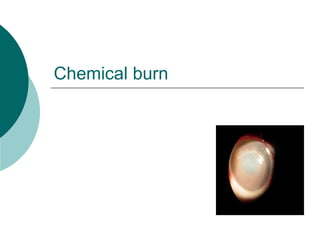
Chemical burn
 Chemical injuries of the eye may
produce extensive damage to the
ocular surface epithelium,cornea &
anterior segment,resulting in
permanent unilateral or bilateral
visual impairment
DEFINATION
INCIDENCE
 80% of ocular chemical burns were due to
industrial and/or occupational exposure
 Ocular burns are more common in males
than in females
 Lime burn(chunna) very common in India
ETIOLOGY- ALKALI
 Ammonia---Fertilizers,Refrigerants,cleaning
agents
 Lye(NaOH)- Drain cleaners
 Potassium hydroxide- Caustic potash
 Magnesium Hydoxide –Sparklers
 Lime-(Ca(OH)2- Plaster,whitewash,cement
 AMMONIA,LYE & LIME IS MOST SERIOUS BURNS
ETIOLOGY-ACID
 Sulfuric acid- Industrial cleaners,Battery
acid
 Sulfurous acid-Bleach,Refigerants
 Hydrofluoric acids-Glass polishing
 Acetic acids-Vinegars
 MOST SERIOUS IS HYDROFLUORIC ACID(Low molecular wt.)
BIO CHEMICAL CHANGES-Alkali
 Alkali substances are lipophilic and penetrate more
rapidly than acids.
 Saponification of cell membrane fatty acids
causes cell disruption and death. In addition, the
hydroxyl ion hydrolyzes intracellular
glycosaminoglycans and denatures collagen.
 Liquefactive necrosis, The damaged tissues
stimulate an inflammatory response, which
damages the tissue further by the release of
proteolytic enzymes .
 Alkali substances can pass into the anterior
chamber rapidly (approximately 5-15 min)
exposing the iris, ciliary body, lens, and trabecular
network to further damage. Irreversible damage
occurs at a pH value above 11.5.
BIO CHEMICAL CHANGES - Acid burns
 Acid burns cause protein
coagulation in the corneal
epithelium, which limits further
penetration.
 Thus, these burns usually are
nonprogressive and superficial.
 Hydrofluoric acid is an exception.
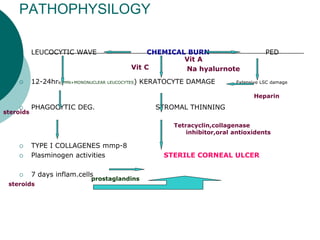
PATHOPHYSILOGY
 LEUCOCYTIC WAVE CHEMICAL BURN PED
 12-24hrs(PMN+MONONUCLEAR LEUCOCYTES) KERATOCYTE DAMAGE Extensive LSC damage
 PHAGOCYTIC DEG. STROMAL THINNING
 TYPE I COLLAGENES mmp-8
 Plasminogen activities STERILE CORNEAL ULCER
 7 days inflam.cells
Vit C
Vit A
Na hyalurnote
Heparin
Tetracyclin,collagenase
inhibitor,oral antioxidents
steroids
steroids
prostaglandins
Signs & Symptoms
 Pain
 Redness
 Irritation
 Tearing
 Inability to keep the eye open
 Sensation of something in the eye
 Swelling of the eyelids
 Blurred vision
EQUIPMENTS IN EMERGENCY
ROOM
 Saline bottle
 Drip set & Nasal Cannula
 pH strip or urine dip strips
 Fluroscein stain
 Edta
 Retractors
 Scleral conformer( sterilised)/Prokara rings
 Glass rods not used
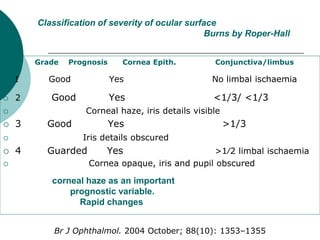
Classification of severity of ocular surface
Burns by Roper-Hall
 Grade Prognosis Cornea Epith. Conjunctiva/limbus
 I Good Yes No limbal ischaemia
 2 Good Yes <1/3/ <1/3
 Corneal haze, iris details visible
 3 Good Yes >1/3
 Iris details obscured
 4 Guarded Yes >1⁄2 limbal ischaemia
 Cornea opaque, iris and pupil obscured
corneal haze as an important
prognostic variable.
Rapid changes
Br J Ophthalmol. 2004 October; 88(10): 1353–1355
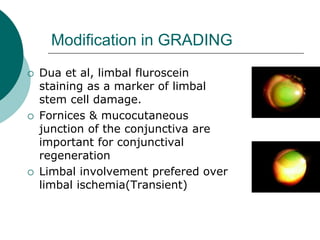
Modification in GRADING
 Dua et al, limbal fluroscein
staining as a marker of limbal
stem cell damage.
 Fornices & mucocutaneous
junction of the conjunctiva are
important for conjunctival
regeneration
 Limbal involvement prefered over
limbal ischemia(Transient)
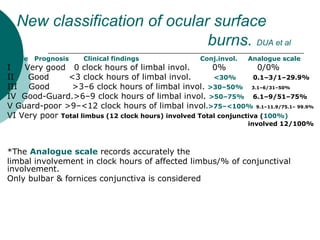
New classification of ocular surface
burns. DUA et al
Grade Prognosis Clinical findings Conj.invol. Analogue scale
 I Very good 0 clock hours of limbal invol. 0% 0/0%
 II Good <3 clock hours of limbal invol. <30% 0.1–3/1–29.9%
 III Good >3–6 clock hours of limbal invol. >30–50% 3.1–6/31–50%
 IV Good-Guard.>6–9 clock hours of limbal invol. >50–75% 6.1–9/51–75%
 V Guard-poor >9–<12 clock hours of limbal invol.>75–<100% 9.1–11.9/75.1– 99.9%
 VI Very poor Total limbus (12 clock hours) involved Total conjunctiva (100%)
involved 12/100%
 *The Analogue scale records accurately the
 limbal involvement in clock hours of affected limbus/% of conjunctival
involvement.
 Only bulbar & fornices conjunctiva is considered
Estimation of conjunctival injury. For example, 1/6th+1/6th = 1/3rd.
BULBAR2/3 & TARSAL 1/3
DIAGRAM
PROGNOSIS
 ALKALI
 pH > 11
 More then
2quadrent
ischemia
 Corneal anesthesia

 ACID
 pH < 2.5
 Corneal anesthesia
 Ischemia
 Severe iritis
 Lens opacification
Mc. CULLEY CLINICAL COURSE OF CHEMICAL INJURY
 Acute up to 1 week
 Early Repair 1-3weeks
 Late repair >3wks
 (Balance between collagen synthesis & collagen degradation)
Acute
1week
GRADE1
Heal with
no
damage
GRADE2
Early re-
epithelization
With slow
recovery of
stromal clarity
GRADE3
No
epithelization no
new vessels
GRADE4
No epithelization
no new vessels
Early Repair
1-3wks
Uneventfu
l
Slow recovery
of stroma
No
epithelization
(2nd wave of
inflammation)
No epithelization
Neurotropic ulcer
Anterior
seg.necrosis
Late Repair
>3wks
Mild
corneal
epitheliop
athy (goblet
cell damage)
Persistent
epith.defect.Su
perficial
vascular
pannus in area
of stemcell
loss
Conjunctivzation
of
cornea.Symbeph
eron,entropion,t
richiasis,scaring
of cornea
Corneal
melt,retrocornea
l memb.hypotony
&phthisis bulbi
Treatment AT,steroid
s e/d
AT,steroids
e/d,MPS
AT,steroids
e/d,MPS
LSCT & AMT
AT,steroids
e/d,MPS
Tenoplasty ,PK,
Keratoprosthosis
TREATMENT
 IMMEDIATE
 Eye Wash for 45min
 EDTA sol-0.01-0.05 molar sol
 Na.EDTA mechanical removal of
calcium
 REDUCE INFLAMMATION
 Pred.acetate intensive x10days
 MPS E/d 1% qid & depo 10mgs
weekly after 10days
 Citrate Topical10 mgs 2hourly
 Tab.Vit C 2gms QID
 Cycloplegic
 PROMOTE RE-EPITHELIZATION
 & TRANSDIFFERATION
 AT
 Retinoic acid 0.01%
 Sodium Hyaluronate(healon)
 REPAIR & MINIMIZE ULCERATION
 Ascorbate Tab & drops
 Tetracycline
 Collagenase inhibitors(Acetylcystine
10-20% & Na edta)
 Oral antioxidents
TREATMENT
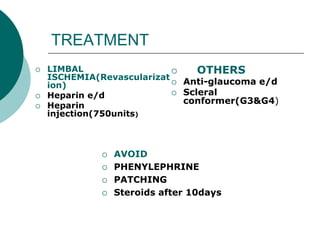
 LIMBAL
ISCHEMIA(Revascularizat
ion)
 Heparin e/d
 Heparin
injection(750units)
 OTHERS
 Anti-glaucoma e/d
 Scleral
conformer(G3&G4)
 AVOID
 PHENYLEPHRINE
 PATCHING
 Steroids after 10days
Pseudopterygium Mechanical scraping with 15#
BP blade,brush back to 5-
7mm from the limbus 2-3
times
Extensive limbal
damage.Proximal
conjunctival
damage(4)
Conj.tenons
advancement(tenoplasty)
reestablish limbal vascularity
& facilitate re-epithelialization
Equatorial Region
LSC damage (PED) Autograft,allograft,stem cell
transplant
PK/LK opaque
Keratoprosthosis Bilateral opaque with severe
dry eye
THANK YOU

Chemical-burn

  • 1.
  • 2.
     Chemical injuriesof the eye may produce extensive damage to the ocular surface epithelium,cornea & anterior segment,resulting in permanent unilateral or bilateral visual impairment DEFINATION
  • 3.
    INCIDENCE  80% ofocular chemical burns were due to industrial and/or occupational exposure  Ocular burns are more common in males than in females  Lime burn(chunna) very common in India
  • 4.
    ETIOLOGY- ALKALI  Ammonia---Fertilizers,Refrigerants,cleaning agents Lye(NaOH)- Drain cleaners  Potassium hydroxide- Caustic potash  Magnesium Hydoxide –Sparklers  Lime-(Ca(OH)2- Plaster,whitewash,cement  AMMONIA,LYE & LIME IS MOST SERIOUS BURNS
  • 5.
    ETIOLOGY-ACID  Sulfuric acid-Industrial cleaners,Battery acid  Sulfurous acid-Bleach,Refigerants  Hydrofluoric acids-Glass polishing  Acetic acids-Vinegars  MOST SERIOUS IS HYDROFLUORIC ACID(Low molecular wt.)
  • 6.
    BIO CHEMICAL CHANGES-Alkali Alkali substances are lipophilic and penetrate more rapidly than acids.  Saponification of cell membrane fatty acids causes cell disruption and death. In addition, the hydroxyl ion hydrolyzes intracellular glycosaminoglycans and denatures collagen.  Liquefactive necrosis, The damaged tissues stimulate an inflammatory response, which damages the tissue further by the release of proteolytic enzymes .  Alkali substances can pass into the anterior chamber rapidly (approximately 5-15 min) exposing the iris, ciliary body, lens, and trabecular network to further damage. Irreversible damage occurs at a pH value above 11.5.
  • 7.
    BIO CHEMICAL CHANGES- Acid burns  Acid burns cause protein coagulation in the corneal epithelium, which limits further penetration.  Thus, these burns usually are nonprogressive and superficial.  Hydrofluoric acid is an exception.
  • 8.
    PATHOPHYSILOGY  LEUCOCYTIC WAVECHEMICAL BURN PED  12-24hrs(PMN+MONONUCLEAR LEUCOCYTES) KERATOCYTE DAMAGE Extensive LSC damage  PHAGOCYTIC DEG. STROMAL THINNING  TYPE I COLLAGENES mmp-8  Plasminogen activities STERILE CORNEAL ULCER  7 days inflam.cells Vit C Vit A Na hyalurnote Heparin Tetracyclin,collagenase inhibitor,oral antioxidents steroids steroids prostaglandins
  • 9.
    Signs & Symptoms Pain  Redness  Irritation  Tearing  Inability to keep the eye open  Sensation of something in the eye  Swelling of the eyelids  Blurred vision
  • 10.
    EQUIPMENTS IN EMERGENCY ROOM Saline bottle  Drip set & Nasal Cannula  pH strip or urine dip strips  Fluroscein stain  Edta  Retractors  Scleral conformer( sterilised)/Prokara rings  Glass rods not used
  • 11.
    Classification of severityof ocular surface Burns by Roper-Hall  Grade Prognosis Cornea Epith. Conjunctiva/limbus  I Good Yes No limbal ischaemia  2 Good Yes <1/3/ <1/3  Corneal haze, iris details visible  3 Good Yes >1/3  Iris details obscured  4 Guarded Yes >1⁄2 limbal ischaemia  Cornea opaque, iris and pupil obscured corneal haze as an important prognostic variable. Rapid changes Br J Ophthalmol. 2004 October; 88(10): 1353–1355
  • 12.
    Modification in GRADING Dua et al, limbal fluroscein staining as a marker of limbal stem cell damage.  Fornices & mucocutaneous junction of the conjunctiva are important for conjunctival regeneration  Limbal involvement prefered over limbal ischemia(Transient)
  • 13.
    New classification ofocular surface burns. DUA et al Grade Prognosis Clinical findings Conj.invol. Analogue scale  I Very good 0 clock hours of limbal invol. 0% 0/0%  II Good <3 clock hours of limbal invol. <30% 0.1–3/1–29.9%  III Good >3–6 clock hours of limbal invol. >30–50% 3.1–6/31–50%  IV Good-Guard.>6–9 clock hours of limbal invol. >50–75% 6.1–9/51–75%  V Guard-poor >9–<12 clock hours of limbal invol.>75–<100% 9.1–11.9/75.1– 99.9%  VI Very poor Total limbus (12 clock hours) involved Total conjunctiva (100%) involved 12/100%  *The Analogue scale records accurately the  limbal involvement in clock hours of affected limbus/% of conjunctival involvement.  Only bulbar & fornices conjunctiva is considered
  • 14.
    Estimation of conjunctivalinjury. For example, 1/6th+1/6th = 1/3rd. BULBAR2/3 & TARSAL 1/3
  • 15.
  • 16.
    PROGNOSIS  ALKALI  pH> 11  More then 2quadrent ischemia  Corneal anesthesia   ACID  pH < 2.5  Corneal anesthesia  Ischemia  Severe iritis  Lens opacification
  • 17.
    Mc. CULLEY CLINICALCOURSE OF CHEMICAL INJURY  Acute up to 1 week  Early Repair 1-3weeks  Late repair >3wks  (Balance between collagen synthesis & collagen degradation)
  • 18.
    Acute 1week GRADE1 Heal with no damage GRADE2 Early re- epithelization Withslow recovery of stromal clarity GRADE3 No epithelization no new vessels GRADE4 No epithelization no new vessels Early Repair 1-3wks Uneventfu l Slow recovery of stroma No epithelization (2nd wave of inflammation) No epithelization Neurotropic ulcer Anterior seg.necrosis Late Repair >3wks Mild corneal epitheliop athy (goblet cell damage) Persistent epith.defect.Su perficial vascular pannus in area of stemcell loss Conjunctivzation of cornea.Symbeph eron,entropion,t richiasis,scaring of cornea Corneal melt,retrocornea l memb.hypotony &phthisis bulbi Treatment AT,steroid s e/d AT,steroids e/d,MPS AT,steroids e/d,MPS LSCT & AMT AT,steroids e/d,MPS Tenoplasty ,PK, Keratoprosthosis
  • 19.
    TREATMENT  IMMEDIATE  EyeWash for 45min  EDTA sol-0.01-0.05 molar sol  Na.EDTA mechanical removal of calcium  REDUCE INFLAMMATION  Pred.acetate intensive x10days  MPS E/d 1% qid & depo 10mgs weekly after 10days  Citrate Topical10 mgs 2hourly  Tab.Vit C 2gms QID  Cycloplegic  PROMOTE RE-EPITHELIZATION  & TRANSDIFFERATION  AT  Retinoic acid 0.01%  Sodium Hyaluronate(healon)  REPAIR & MINIMIZE ULCERATION  Ascorbate Tab & drops  Tetracycline  Collagenase inhibitors(Acetylcystine 10-20% & Na edta)  Oral antioxidents
  • 20.
    TREATMENT  LIMBAL ISCHEMIA(Revascularizat ion)  Heparine/d  Heparin injection(750units)  OTHERS  Anti-glaucoma e/d  Scleral conformer(G3&G4)  AVOID  PHENYLEPHRINE  PATCHING  Steroids after 10days
  • 21.
    Pseudopterygium Mechanical scrapingwith 15# BP blade,brush back to 5- 7mm from the limbus 2-3 times Extensive limbal damage.Proximal conjunctival damage(4) Conj.tenons advancement(tenoplasty) reestablish limbal vascularity & facilitate re-epithelialization Equatorial Region LSC damage (PED) Autograft,allograft,stem cell transplant PK/LK opaque Keratoprosthosis Bilateral opaque with severe dry eye
  • 22.