CHEMISTRY
TOPIC : STRUCTURE OF MOLECULES.
WHAT IS CHEMICAL BOND?
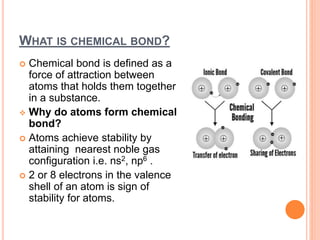
 Chemical bond is defined as a
force of attraction between
atoms that holds them together
in a substance.
 Why do atoms form chemical
bond?
 Atoms achieve stability by
attaining nearest noble gas
configuration i.e. ns2, np6 .
 2 or 8 electrons in the valence
shell of an atom is sign of
stability for atoms.
WHAT IS OCTET AND DUPLET RULE ?
 Octet rule
 Attaining of 8 electrons in the valence shell of an
atom is called octet rule.
 Duplet rule
 Attaining of two electrons in the valence shell of an
atom is called duplet rule.
 Elements like hydrogen and helium follow duplet
rule.
HOW DO ATOMS FOLLOW OCTET RULE?
 An atom can accommodate 8 electrons in its
valence shell in three ways.
 By giving valence shell electrons (if they are less
than three) to other atom.
 By gaining valence shell electron (if the valence
shell has 5 or more than 5 electrons)
 By sharing valence shell electrons.
TYPES OF CHEMICAL BOND
 Chemical bonds are of four types:
 Ionic bond
 Covalent bond
 Dative or coordinate covalent bond
 Metallic bond
BONDING AND NON BONDING ELECTRONS
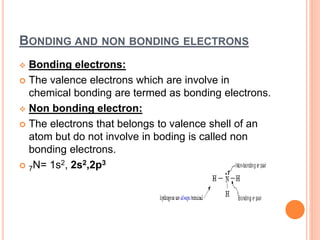
 Bonding electrons:
 The valence electrons which are involve in
chemical bonding are termed as bonding electrons.
 Non bonding electron:
 The electrons that belongs to valence shell of an
atom but do not involve in boding is called non
bonding electrons.
 7N= 1s2, 2s2,2p3
IONIC BOND
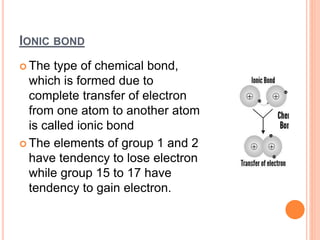
 The type of chemical bond,
which is formed due to
complete transfer of electron
from one atom to another atom
is called ionic bond
 The elements of group 1 and 2
have tendency to lose electron
while group 15 to 17 have
tendency to gain electron.
EXAMPLE OF IONIC BOND
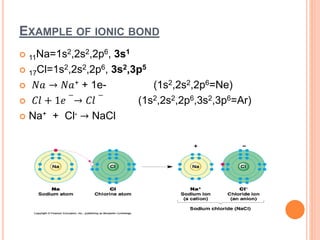
 11Na=1s2,2s2,2p6, 3s1
 17Cl=1s2,2s2,2p6, 3s2,3p5
 𝑁𝑎 → 𝑁𝑎+ + 1e- (1s2,2s2,2p6=Ne)
 𝐶𝑙 + 1𝑒
−
→ 𝐶𝑙
−
(1s2,2s2,2p6,3s2,3p6=Ar)
 Na+ + Cl- → NaCl
PROPERTIES OF IONIC COMPOUNDS
 Ionic compounds are solid in nature because they
are made up of positive and negative charges .
Theses charges held together with strong
electrostatic force of attraction.
 They have high melting and boiling point
 They are good conductor of heat and electricity in
molten or solution form
 They are mostly crystalline solid
 They are easily soluble in water.
COVALENT BOND
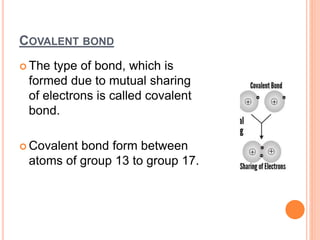
 The type of bond, which is
formed due to mutual sharing
of electrons is called covalent
bond.
 Covalent bond form between
atoms of group 13 to group 17.
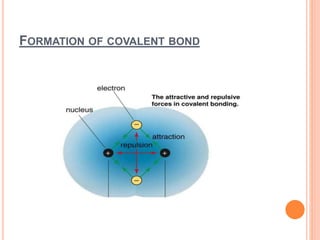
FORMATION OF COVALENT BOND
TYPES OF COVALENT BOND
 Depending upon number of bond pair covalent
bond divided in to three types.
 Single covalent bond
 Double covalent bond
 Triple covalent bond
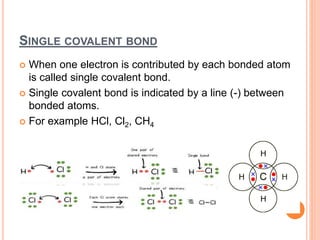
SINGLE COVALENT BOND
 When one electron is contributed by each bonded atom
is called single covalent bond.
 Single covalent bond is indicated by a line (-) between
bonded atoms.
 For example HCl, Cl2, CH4
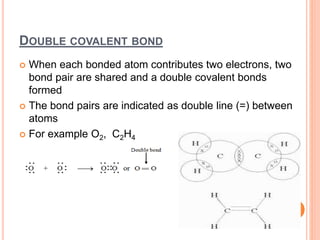
DOUBLE COVALENT BOND
 When each bonded atom contributes two electrons, two
bond pair are shared and a double covalent bonds
formed
 The bond pairs are indicated as double line (=) between
atoms
 For example O2, C2H4
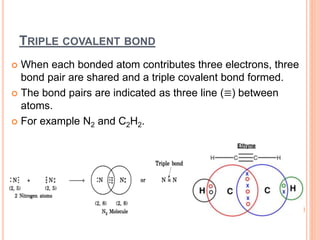
TRIPLE COVALENT BOND
 When each bonded atom contributes three electrons, three
bond pair are shared and a triple covalent bond formed.
 The bond pairs are indicated as three line (≡) between
atoms.
 For example N2 and C2H2.
PROPERTIES OF COVALENT COMPOUNDS
 They have usually low melting and boiling point. But
large molecules with three dimensional pattern are
stable and hard so they have high melting and
boiling point.
 They are bad conductors of heat and electricity but
compounds having polar character show
conductance when dissolve in polar solvent.
 They are insoluble in water but soluble in non
aqueous solution like benzene, ether etc.
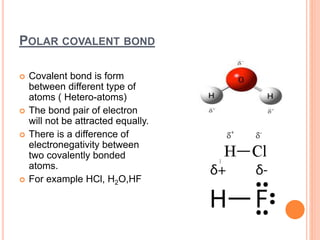
POLAR COVALENT BOND
 Covalent bond is form
between different type of
atoms ( Hetero-atoms)
 The bond pair of electron
will not be attracted equally.
 There is a difference of
electronegativity between
two covalently bonded
atoms.
 For example HCl, H2O,HF
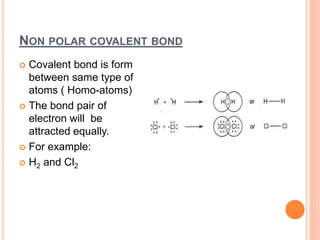
NON POLAR COVALENT BOND
 Covalent bond is form
between same type of
atoms ( Homo-atoms)
 The bond pair of
electron will be
attracted equally.
 For example:
 H2 and Cl2
DIFFERENTIATE BETWEEN POLAR AND NON
POLAR COMPOUNDS
 Polar compounds
dissolve in water.
 They are good
conductor of heat and
electricity when
dissolve in polar
compounds
 Non polar compounds
do not dissolve in
water.
 They are bad
conductors of heat and
electricity
Polar compounds Non polar compounds

Structure of molecule

  • 1.
  • 2.
    WHAT IS CHEMICALBOND?  Chemical bond is defined as a force of attraction between atoms that holds them together in a substance.  Why do atoms form chemical bond?  Atoms achieve stability by attaining nearest noble gas configuration i.e. ns2, np6 .  2 or 8 electrons in the valence shell of an atom is sign of stability for atoms.
  • 3.
    WHAT IS OCTETAND DUPLET RULE ?  Octet rule  Attaining of 8 electrons in the valence shell of an atom is called octet rule.  Duplet rule  Attaining of two electrons in the valence shell of an atom is called duplet rule.  Elements like hydrogen and helium follow duplet rule.
  • 4.
    HOW DO ATOMSFOLLOW OCTET RULE?  An atom can accommodate 8 electrons in its valence shell in three ways.  By giving valence shell electrons (if they are less than three) to other atom.  By gaining valence shell electron (if the valence shell has 5 or more than 5 electrons)  By sharing valence shell electrons.
  • 5.
    TYPES OF CHEMICALBOND  Chemical bonds are of four types:  Ionic bond  Covalent bond  Dative or coordinate covalent bond  Metallic bond
  • 6.
    BONDING AND NONBONDING ELECTRONS  Bonding electrons:  The valence electrons which are involve in chemical bonding are termed as bonding electrons.  Non bonding electron:  The electrons that belongs to valence shell of an atom but do not involve in boding is called non bonding electrons.  7N= 1s2, 2s2,2p3
  • 7.
    IONIC BOND  Thetype of chemical bond, which is formed due to complete transfer of electron from one atom to another atom is called ionic bond  The elements of group 1 and 2 have tendency to lose electron while group 15 to 17 have tendency to gain electron.
  • 8.
    EXAMPLE OF IONICBOND  11Na=1s2,2s2,2p6, 3s1  17Cl=1s2,2s2,2p6, 3s2,3p5  𝑁𝑎 → 𝑁𝑎+ + 1e- (1s2,2s2,2p6=Ne)  𝐶𝑙 + 1𝑒 − → 𝐶𝑙 − (1s2,2s2,2p6,3s2,3p6=Ar)  Na+ + Cl- → NaCl
  • 9.
    PROPERTIES OF IONICCOMPOUNDS  Ionic compounds are solid in nature because they are made up of positive and negative charges . Theses charges held together with strong electrostatic force of attraction.  They have high melting and boiling point  They are good conductor of heat and electricity in molten or solution form  They are mostly crystalline solid  They are easily soluble in water.
  • 10.
    COVALENT BOND  Thetype of bond, which is formed due to mutual sharing of electrons is called covalent bond.  Covalent bond form between atoms of group 13 to group 17.
  • 11.
  • 12.
    TYPES OF COVALENTBOND  Depending upon number of bond pair covalent bond divided in to three types.  Single covalent bond  Double covalent bond  Triple covalent bond
  • 13.
    SINGLE COVALENT BOND When one electron is contributed by each bonded atom is called single covalent bond.  Single covalent bond is indicated by a line (-) between bonded atoms.  For example HCl, Cl2, CH4
  • 14.
    DOUBLE COVALENT BOND When each bonded atom contributes two electrons, two bond pair are shared and a double covalent bonds formed  The bond pairs are indicated as double line (=) between atoms  For example O2, C2H4
  • 15.
    TRIPLE COVALENT BOND When each bonded atom contributes three electrons, three bond pair are shared and a triple covalent bond formed.  The bond pairs are indicated as three line (≡) between atoms.  For example N2 and C2H2.
  • 16.
    PROPERTIES OF COVALENTCOMPOUNDS  They have usually low melting and boiling point. But large molecules with three dimensional pattern are stable and hard so they have high melting and boiling point.  They are bad conductors of heat and electricity but compounds having polar character show conductance when dissolve in polar solvent.  They are insoluble in water but soluble in non aqueous solution like benzene, ether etc.
  • 17.
    POLAR COVALENT BOND Covalent bond is form between different type of atoms ( Hetero-atoms)  The bond pair of electron will not be attracted equally.  There is a difference of electronegativity between two covalently bonded atoms.  For example HCl, H2O,HF
  • 18.
    NON POLAR COVALENTBOND  Covalent bond is form between same type of atoms ( Homo-atoms)  The bond pair of electron will be attracted equally.  For example:  H2 and Cl2
  • 19.
    DIFFERENTIATE BETWEEN POLARAND NON POLAR COMPOUNDS  Polar compounds dissolve in water.  They are good conductor of heat and electricity when dissolve in polar compounds  Non polar compounds do not dissolve in water.  They are bad conductors of heat and electricity Polar compounds Non polar compounds