Bonds in a Solid
Dr. Fahmida Sharmin
Assistant Professor, NSc
PHY 4113
Structure of Matter, Electricity, Magnetism and Modern Physics
• A solid consists of atoms, ions, or molecules packed closely together
and forces that hold them in place give rise to the distinctive properties
of the various kind of solids.
• Three different types of primary or chemical bond are found in solids
ionic, covalent, and metallic.
• For each type, the bonding necessarily involves the valence electrons;
furthermore, the nature of the bond depends on the electron structures
of the constituent atoms.
• In general, each of these three types of bonding arises from the
tendency of the atoms to assume stable electron structures, like those
of the inert gases, by completely filling the outermost electron shell.
Secondary or physical forces and energies are also found in many solid
materials; they are weaker than the primary ones, but nonetheless
influence the physical properties of some materials.
Ionic Bonding
• Ionic bonding is perhaps the easiest to describe and visualize.
• It is always found in compounds that are composed of both metallic and
nonmetallic elements.
• Atoms of a metallic element easily give up their valence electrons to the
nonmetallic atoms. In the process all the atoms acquire stable or inert
gas configurations and, in addition, an electrical charge; that is, they
become ions.
• Sodium chloride (NaCl) is the classic ionic material. A sodium (Na 11)
atom can assume the electron structure of neon(Ne 10) (and a net single
positive charge) by a transfer of its one valence 3s electron to a chlorine
atom (Cl 17). After such a transfer, the chlorine ion has a net negative
charge and an electron configuration identical to that of argon (Ar 18).
• In sodium chloride, all the sodium and chlorine exist as ions.
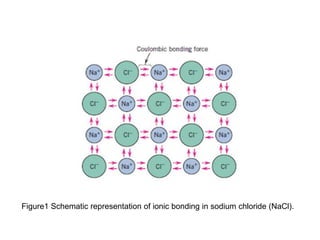
• This type of bonding is illustrated schematically in Figure 1. The attractive
bonding forces are coulombic; that is, positive and negative ions, by
virtue of their net electrical charge, attract one another.
Figure1 Schematic representation of ionic bonding in sodium chloride (NaCl).
• Covalent Bonding In covalent bonding, stable electron configurations are
assumed by the sharing of electrons between adjacent atoms.
• Two atoms that are covalently bonded will each contribute at least one
electron to the bond, and the shared electrons may be considered to
belong to both atoms.
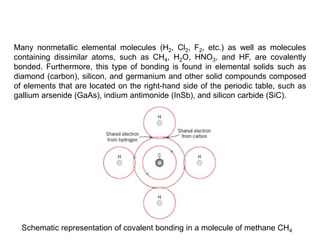
• Covalent bonding is schematically illustrated in Figure 2 for a molecule of
methane (CH4).
• The carbon atom (C 6) has four valence electrons, whereas each of the
four hydrogen atoms (H 1) has a single valence electron. Each hydrogen
atom can acquire a helium electron configuration (He 2) (two 1s valence
electrons) when the carbon atom shares with it one electron.
• The carbon now has four additional shared electrons, one from each
hydrogen, for a total of eight valence electrons, and the electron structure
of neon (Ne 10).
Covalent Bonding
Many nonmetallic elemental molecules (H2, Cl2, F2, etc.) as well as molecules
containing dissimilar atoms, such as CH4, H2O, HNO3, and HF, are covalently
bonded. Furthermore, this type of bonding is found in elemental solids such as
diamond (carbon), silicon, and germanium and other solid compounds composed
of elements that are located on the right-hand side of the periodic table, such as
gallium arsenide (GaAs), indium antimonide (InSb), and silicon carbide (SiC).
Schematic representation of covalent bonding in a molecule of methane CH4
Metallic Bonding
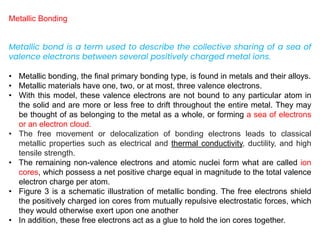
Metallic bond is a term used to describe the collective sharing of a sea of
valence electrons between several positively charged metal ions.
• Metallic bonding, the final primary bonding type, is found in metals and their alloys.
• Metallic materials have one, two, or at most, three valence electrons.
• With this model, these valence electrons are not bound to any particular atom in
the solid and are more or less free to drift throughout the entire metal. They may
be thought of as belonging to the metal as a whole, or forming a sea of electrons
or an electron cloud.
• The free movement or delocalization of bonding electrons leads to classical
metallic properties such as electrical and thermal conductivity, ductility, and high
tensile strength.
• The remaining non-valence electrons and atomic nuclei form what are called ion
cores, which possess a net positive charge equal in magnitude to the total valence
electron charge per atom.
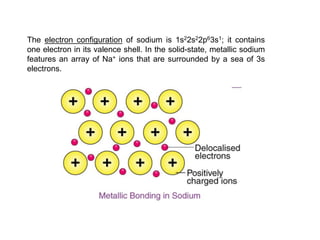
• Figure 3 is a schematic illustration of metallic bonding. The free electrons shield
the positively charged ion cores from mutually repulsive electrostatic forces, which
they would otherwise exert upon one another
• In addition, these free electrons act as a glue to hold the ion cores together.
The electron configuration of sodium is 1s22s22p63s1; it contains
one electron in its valence shell. In the solid-state, metallic sodium
features an array of Na+ ions that are surrounded by a sea of 3s
electrons.
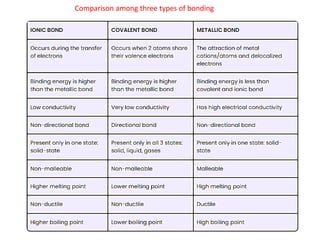
Comparison among three types of bonding
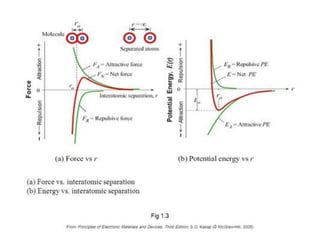
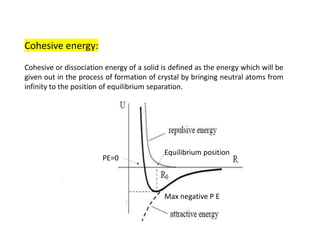
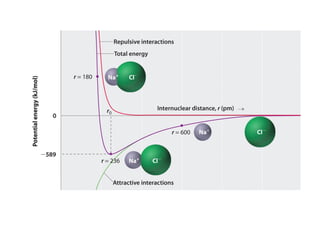
Cohesive energy:
Cohesive or dissociation energy of a solid is defined as the energy which will be
given out in the process of formation of crystal by bringing neutral atoms from
infinity to the position of equilibrium separation.
Max negative P E
Equilibrium position
PE=0
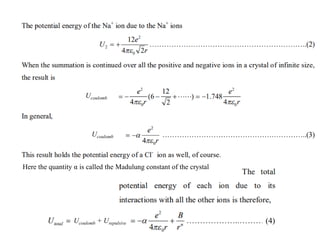
from
twelve
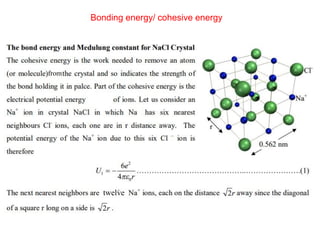
Bonding energy/ cohesive energy
Ucoulomb
Ucoulomb
(4)
Ucoulomb + Urepulsive
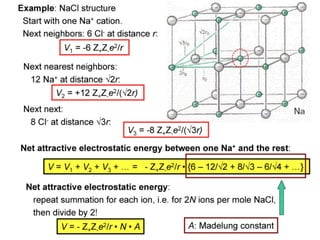
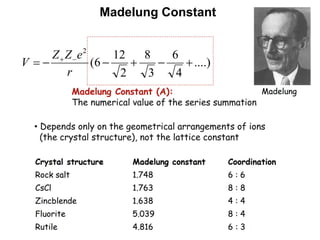
Here the quantity α is called the Madulung constant of the crystal
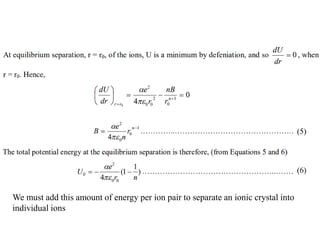
(5)
(6)
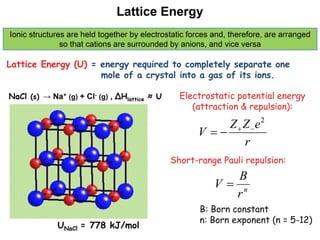
We must add this amount of energy per ion pair to separate an ionic crystal into
individual ions
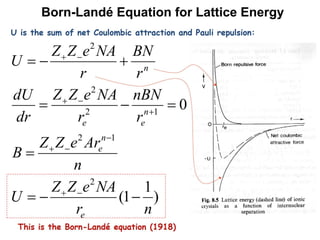
The Born-Landé equation is a concept originally formulated in 1918 by the
scientists Born and Landé and is used to calculate the lattice energy (measure
of the strength of bonds) of a compound. This expression takes into account
both the Born interactions as well as the Coulomb attractions. The Born-Lande
equation offers a simplified, theoretical way to estimate lattice energy, a
crucial factor in understanding ionic compound stability, melting points, and
solubility.
Bonds in a Solid………………………………………………...pdf

  • 1.
    Bonds in aSolid Dr. Fahmida Sharmin Assistant Professor, NSc PHY 4113 Structure of Matter, Electricity, Magnetism and Modern Physics
  • 2.
    • A solidconsists of atoms, ions, or molecules packed closely together and forces that hold them in place give rise to the distinctive properties of the various kind of solids. • Three different types of primary or chemical bond are found in solids ionic, covalent, and metallic. • For each type, the bonding necessarily involves the valence electrons; furthermore, the nature of the bond depends on the electron structures of the constituent atoms. • In general, each of these three types of bonding arises from the tendency of the atoms to assume stable electron structures, like those of the inert gases, by completely filling the outermost electron shell. Secondary or physical forces and energies are also found in many solid materials; they are weaker than the primary ones, but nonetheless influence the physical properties of some materials.
  • 3.
    Ionic Bonding • Ionicbonding is perhaps the easiest to describe and visualize. • It is always found in compounds that are composed of both metallic and nonmetallic elements. • Atoms of a metallic element easily give up their valence electrons to the nonmetallic atoms. In the process all the atoms acquire stable or inert gas configurations and, in addition, an electrical charge; that is, they become ions. • Sodium chloride (NaCl) is the classic ionic material. A sodium (Na 11) atom can assume the electron structure of neon(Ne 10) (and a net single positive charge) by a transfer of its one valence 3s electron to a chlorine atom (Cl 17). After such a transfer, the chlorine ion has a net negative charge and an electron configuration identical to that of argon (Ar 18). • In sodium chloride, all the sodium and chlorine exist as ions. • This type of bonding is illustrated schematically in Figure 1. The attractive bonding forces are coulombic; that is, positive and negative ions, by virtue of their net electrical charge, attract one another.
  • 4.
    Figure1 Schematic representationof ionic bonding in sodium chloride (NaCl).
  • 5.
    • Covalent BondingIn covalent bonding, stable electron configurations are assumed by the sharing of electrons between adjacent atoms. • Two atoms that are covalently bonded will each contribute at least one electron to the bond, and the shared electrons may be considered to belong to both atoms. • Covalent bonding is schematically illustrated in Figure 2 for a molecule of methane (CH4). • The carbon atom (C 6) has four valence electrons, whereas each of the four hydrogen atoms (H 1) has a single valence electron. Each hydrogen atom can acquire a helium electron configuration (He 2) (two 1s valence electrons) when the carbon atom shares with it one electron. • The carbon now has four additional shared electrons, one from each hydrogen, for a total of eight valence electrons, and the electron structure of neon (Ne 10). Covalent Bonding
  • 6.
    Many nonmetallic elementalmolecules (H2, Cl2, F2, etc.) as well as molecules containing dissimilar atoms, such as CH4, H2O, HNO3, and HF, are covalently bonded. Furthermore, this type of bonding is found in elemental solids such as diamond (carbon), silicon, and germanium and other solid compounds composed of elements that are located on the right-hand side of the periodic table, such as gallium arsenide (GaAs), indium antimonide (InSb), and silicon carbide (SiC). Schematic representation of covalent bonding in a molecule of methane CH4
  • 7.
    Metallic Bonding Metallic bondis a term used to describe the collective sharing of a sea of valence electrons between several positively charged metal ions. • Metallic bonding, the final primary bonding type, is found in metals and their alloys. • Metallic materials have one, two, or at most, three valence electrons. • With this model, these valence electrons are not bound to any particular atom in the solid and are more or less free to drift throughout the entire metal. They may be thought of as belonging to the metal as a whole, or forming a sea of electrons or an electron cloud. • The free movement or delocalization of bonding electrons leads to classical metallic properties such as electrical and thermal conductivity, ductility, and high tensile strength. • The remaining non-valence electrons and atomic nuclei form what are called ion cores, which possess a net positive charge equal in magnitude to the total valence electron charge per atom. • Figure 3 is a schematic illustration of metallic bonding. The free electrons shield the positively charged ion cores from mutually repulsive electrostatic forces, which they would otherwise exert upon one another • In addition, these free electrons act as a glue to hold the ion cores together.
  • 8.
    The electron configurationof sodium is 1s22s22p63s1; it contains one electron in its valence shell. In the solid-state, metallic sodium features an array of Na+ ions that are surrounded by a sea of 3s electrons.
  • 9.
    Comparison among threetypes of bonding
  • 11.
    Cohesive energy: Cohesive ordissociation energy of a solid is defined as the energy which will be given out in the process of formation of crystal by bringing neutral atoms from infinity to the position of equilibrium separation. Max negative P E Equilibrium position PE=0
  • 12.
  • 13.
    Ucoulomb Ucoulomb (4) Ucoulomb + Urepulsive Herethe quantity α is called the Madulung constant of the crystal
  • 14.
    (5) (6) We must addthis amount of energy per ion pair to separate an ionic crystal into individual ions
  • 20.
    The Born-Landé equationis a concept originally formulated in 1918 by the scientists Born and Landé and is used to calculate the lattice energy (measure of the strength of bonds) of a compound. This expression takes into account both the Born interactions as well as the Coulomb attractions. The Born-Lande equation offers a simplified, theoretical way to estimate lattice energy, a crucial factor in understanding ionic compound stability, melting points, and solubility.