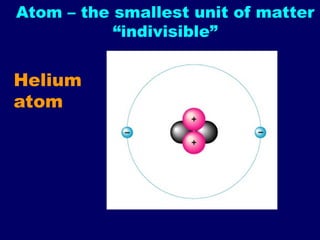
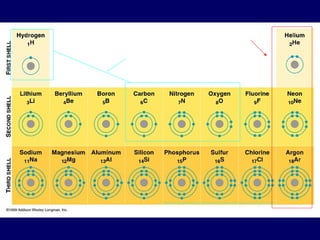
Atom – the smallest unit of matter
“indivisible”
Helium
atom
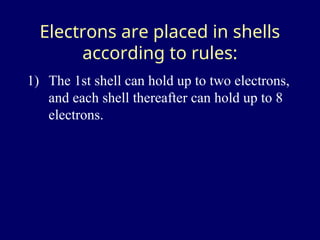
Electrons are placed in shells
according to rules:
1) The 1st shell can hold up to two electrons,
and each shell thereafter can hold up to 8
electrons.
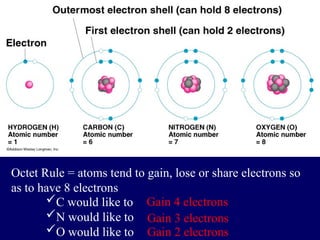
Octet Rule = atoms tend to gain, lose or share electrons so
as to have 8 electrons
C would like to
N would like to
O would like to
Gain 4 electrons
Gain 3 electrons
Gain 2 electrons
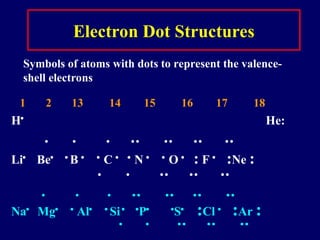
Electron Dot Structures
Symbols of atoms with dots to represent the valence-
shell electrons
1 2 13 14 15 16 17 18
H
He:
          
Li
Be 
B  
C  
N  
O 
: F 
:Ne :
       
          
Na
Mg 
Al 
Si 
P 
S
:Cl 
:Ar :
       
Chemical bonds: an attempt to fill electron
shells
1. Ionic bonds –
2. Covalent bonds –
3. Metallic bonds
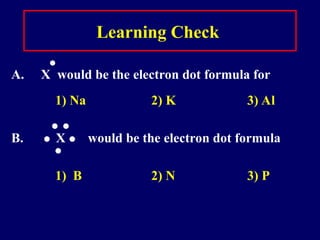
Learning Check

A. X would be the electron dot formula for
1) Na 2) K 3) Al
 
B.  X  would be the electron dot formula

1) B 2) N 3) P
IONIC BOND
bond formed between
two ions by the
transfer of electrons
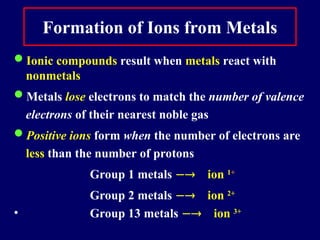
Formation of Ions from Metals
Ionic compounds result when metals react with
nonmetals
Metals lose electrons to match the number of valence
electrons of their nearest noble gas
Positive ions form when the number of electrons are
less than the number of protons
Group 1 metals  ion 1+
Group 2 metals  ion 2+
• Group 13 metals  ion 3+
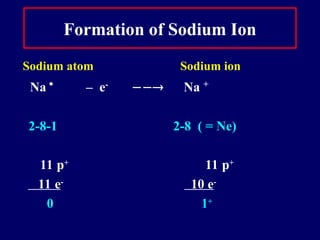
Formation of Sodium Ion
Sodium atom Sodium ion
Na 
– e
 Na +
2-8-1 2-8 ( = Ne)
11 p+
11 p+
11 e-
10 e-
0 1+
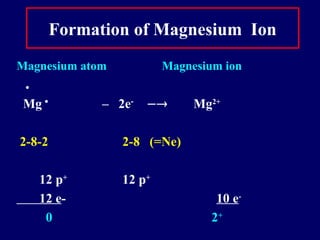
Formation of Magnesium Ion
Magnesium atom Magnesium ion

Mg 
– 2e
 Mg2+
2-8-2 2-8 (=Ne)
12 p+
12 p+
12 e- 10 e-
0 2+
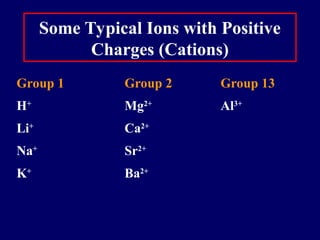
Some Typical Ions with Positive
Charges (Cations)
Group 1 Group 2 Group 13
H+
Mg2+
Al3+
Li+
Ca2+
Na+
Sr2+
K+
Ba2+
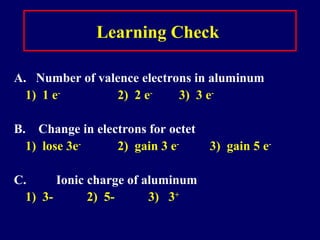
Learning Check
A. Number of valence electrons in aluminum
1) 1 e-
2) 2 e-
3) 3 e-
B. Change in electrons for octet
1) lose 3e-
2) gain 3 e-
3) gain 5 e-
C. Ionic charge of aluminum
1) 3- 2) 5- 3) 3+
Solution
A. Number of valence electrons in aluminum
3) 3 e-
B. Change in electrons for octet
1) lose 3e-
C. Ionic charge of aluminum
3) 3+
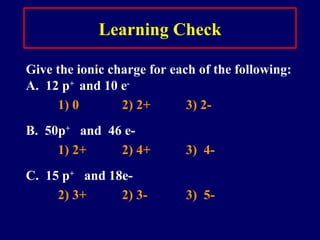
Learning Check
Give the ionic charge for each of the following:
A. 12 p+
and 10 e-
1) 0 2) 2+ 3) 2-
B. 50p+
and 46 e-
1) 2+ 2) 4+ 3) 4-
C. 15 p+
and 18e-
2) 3+ 2) 3- 3) 5-
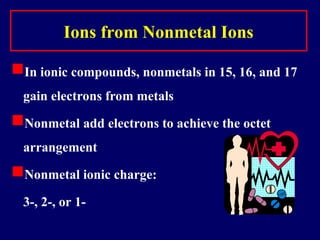
Ions from Nonmetal Ions
In ionic compounds, nonmetals in 15, 16, and 17
gain electrons from metals
Nonmetal add electrons to achieve the octet
arrangement
Nonmetal ionic charge:
3-, 2-, or 1-
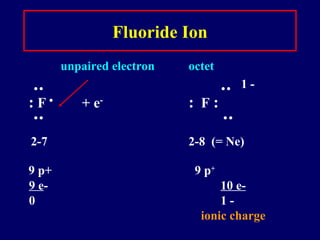
Fluoride Ion
unpaired electron octet
    1 -
: F 
+ e
: F :
   
2-7 2-8 (= Ne)
9 p+ 9 p+
9 e- 10 e-
0 1 -
ionic charge
Ionic Bond
• Between atoms of metals and nonmetals
with very different electronegativity
• Bond formed by transfer of electrons
• Produce charged ions all states. Conductors
and have high melting point.
• Examples; NaCl, CaCl2, K2O
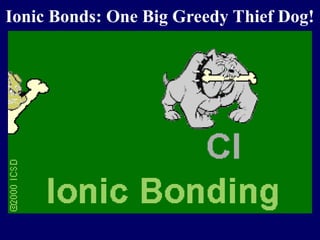
Ionic Bonds: One Big Greedy Thief Dog!
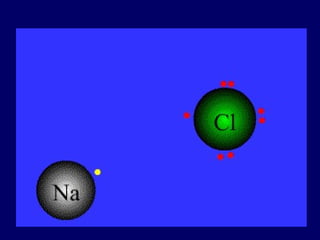
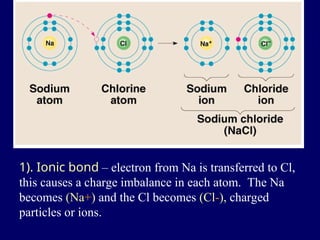
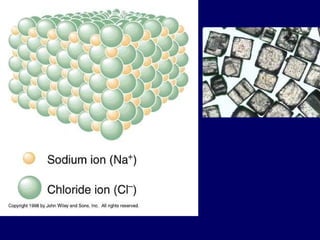
1). Ionic bond – electron from Na is transferred to Cl,
this causes a charge imbalance in each atom. The Na
becomes (Na+) and the Cl becomes (Cl-), charged
particles or ions.
COVALENT BOND
bond formed by the
sharing of electrons
Covalent Bond
• Between nonmetallic elements of similar
electronegativity.
• Formed by sharing electron pairs
• Stable non-ionizing particles, they are not
conductors at any state
• Examples; O2, CO2, C2H6, H2O, SiC
Bonds in all the
polyatomic ions
and diatomics are
all covalent bonds
when electrons are
shared equally
NONPOLAR
COVALENT BONDS
H2 or Cl2
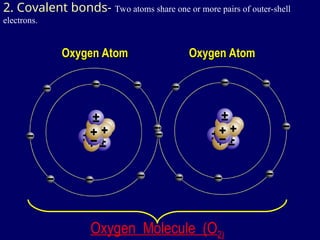
2. Covalent bonds- Two atoms share one or more pairs of outer-shell
electrons.
Oxygen Atom
Oxygen Atom Oxygen Atom
Oxygen Atom
Oxygen Molecule (O2)
when electrons are
shared but shared
unequally
POLAR COVALENT BONDS
H2O
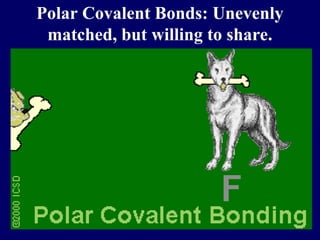
Polar Covalent Bonds: Unevenly
matched, but willing to share.
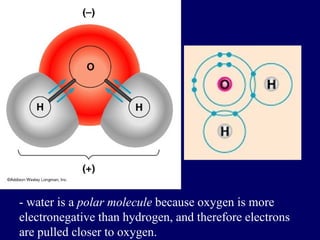
- water is a polar molecule because oxygen is more
electronegative than hydrogen, and therefore electrons
are pulled closer to oxygen.
METALLIC BOND
bond found in
metals; holds metal
atoms together
very strongly
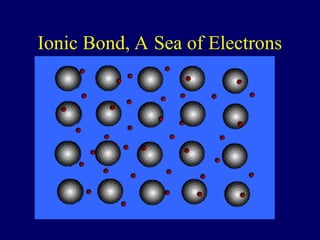
Metallic Bond
• Formed between atoms of metallic elements
• Electron cloud around atoms
• Good conductors at all states, lustrous, very
high melting points
• Examples; Na, Fe, Al, Au, Co
Ionic Bond, A Sea of Electrons
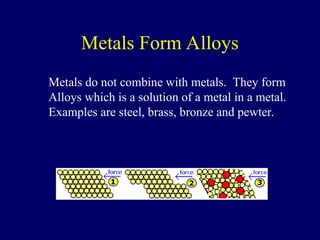
Metals Form Alloys
Metals do not combine with metals. They form
Alloys which is a solution of a metal in a metal.
Examples are steel, brass, bronze and pewter.
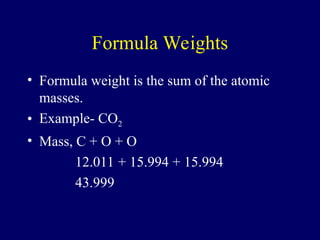
Formula Weights
• Formula weight is the sum of the atomic
masses.
• Example- CO2
• Mass, C + O + O
12.011 + 15.994 + 15.994
43.999
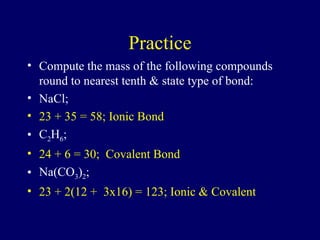
Practice
• Compute the mass of the following compounds
round to nearest tenth & state type of bond:
• NaCl;
• 23 + 35 = 58; Ionic Bond
• C2H6;
• 24 + 6 = 30; Covalent Bond
• Na(CO3)2;
• 23 + 2(12 + 3x16) = 123; Ionic & Covalent
chemical bonding/ionic/covalent/metallic.ppt

chemical bonding/ionic/covalent/metallic.ppt

  • 2.
    Atom – thesmallest unit of matter “indivisible” Helium atom
  • 3.
    Electrons are placedin shells according to rules: 1) The 1st shell can hold up to two electrons, and each shell thereafter can hold up to 8 electrons.
  • 4.
    Octet Rule =atoms tend to gain, lose or share electrons so as to have 8 electrons C would like to N would like to O would like to Gain 4 electrons Gain 3 electrons Gain 2 electrons
  • 6.
    Electron Dot Structures Symbolsof atoms with dots to represent the valence- shell electrons 1 2 13 14 15 16 17 18 H He:            Li Be  B   C   N   O  : F  :Ne :                    Na Mg  Al  Si  P  S :Cl  :Ar :        
  • 7.
    Chemical bonds: anattempt to fill electron shells 1. Ionic bonds – 2. Covalent bonds – 3. Metallic bonds
  • 8.
    Learning Check  A. Xwould be the electron dot formula for 1) Na 2) K 3) Al   B.  X  would be the electron dot formula  1) B 2) N 3) P
  • 9.
    IONIC BOND bond formedbetween two ions by the transfer of electrons
  • 10.
    Formation of Ionsfrom Metals Ionic compounds result when metals react with nonmetals Metals lose electrons to match the number of valence electrons of their nearest noble gas Positive ions form when the number of electrons are less than the number of protons Group 1 metals  ion 1+ Group 2 metals  ion 2+ • Group 13 metals  ion 3+
  • 11.
    Formation of SodiumIon Sodium atom Sodium ion Na  – e  Na + 2-8-1 2-8 ( = Ne) 11 p+ 11 p+ 11 e- 10 e- 0 1+
  • 12.
    Formation of MagnesiumIon Magnesium atom Magnesium ion  Mg  – 2e  Mg2+ 2-8-2 2-8 (=Ne) 12 p+ 12 p+ 12 e- 10 e- 0 2+
  • 13.
    Some Typical Ionswith Positive Charges (Cations) Group 1 Group 2 Group 13 H+ Mg2+ Al3+ Li+ Ca2+ Na+ Sr2+ K+ Ba2+
  • 14.
    Learning Check A. Numberof valence electrons in aluminum 1) 1 e- 2) 2 e- 3) 3 e- B. Change in electrons for octet 1) lose 3e- 2) gain 3 e- 3) gain 5 e- C. Ionic charge of aluminum 1) 3- 2) 5- 3) 3+
  • 15.
    Solution A. Number ofvalence electrons in aluminum 3) 3 e- B. Change in electrons for octet 1) lose 3e- C. Ionic charge of aluminum 3) 3+
  • 16.
    Learning Check Give theionic charge for each of the following: A. 12 p+ and 10 e- 1) 0 2) 2+ 3) 2- B. 50p+ and 46 e- 1) 2+ 2) 4+ 3) 4- C. 15 p+ and 18e- 2) 3+ 2) 3- 3) 5-
  • 17.
    Ions from NonmetalIons In ionic compounds, nonmetals in 15, 16, and 17 gain electrons from metals Nonmetal add electrons to achieve the octet arrangement Nonmetal ionic charge: 3-, 2-, or 1-
  • 18.
    Fluoride Ion unpaired electronoctet     1 - : F  + e : F :     2-7 2-8 (= Ne) 9 p+ 9 p+ 9 e- 10 e- 0 1 - ionic charge
  • 19.
    Ionic Bond • Betweenatoms of metals and nonmetals with very different electronegativity • Bond formed by transfer of electrons • Produce charged ions all states. Conductors and have high melting point. • Examples; NaCl, CaCl2, K2O
  • 21.
    Ionic Bonds: OneBig Greedy Thief Dog!
  • 22.
    1). Ionic bond– electron from Na is transferred to Cl, this causes a charge imbalance in each atom. The Na becomes (Na+) and the Cl becomes (Cl-), charged particles or ions.
  • 24.
    COVALENT BOND bond formedby the sharing of electrons
  • 25.
    Covalent Bond • Betweennonmetallic elements of similar electronegativity. • Formed by sharing electron pairs • Stable non-ionizing particles, they are not conductors at any state • Examples; O2, CO2, C2H6, H2O, SiC
  • 27.
    Bonds in allthe polyatomic ions and diatomics are all covalent bonds
  • 28.
    when electrons are sharedequally NONPOLAR COVALENT BONDS H2 or Cl2
  • 29.
    2. Covalent bonds-Two atoms share one or more pairs of outer-shell electrons. Oxygen Atom Oxygen Atom Oxygen Atom Oxygen Atom Oxygen Molecule (O2)
  • 30.
    when electrons are sharedbut shared unequally POLAR COVALENT BONDS H2O
  • 31.
    Polar Covalent Bonds:Unevenly matched, but willing to share.
  • 32.
    - water isa polar molecule because oxygen is more electronegative than hydrogen, and therefore electrons are pulled closer to oxygen.
  • 33.
    METALLIC BOND bond foundin metals; holds metal atoms together very strongly
  • 34.
    Metallic Bond • Formedbetween atoms of metallic elements • Electron cloud around atoms • Good conductors at all states, lustrous, very high melting points • Examples; Na, Fe, Al, Au, Co
  • 35.
    Ionic Bond, ASea of Electrons
  • 36.
    Metals Form Alloys Metalsdo not combine with metals. They form Alloys which is a solution of a metal in a metal. Examples are steel, brass, bronze and pewter.
  • 37.
    Formula Weights • Formulaweight is the sum of the atomic masses. • Example- CO2 • Mass, C + O + O 12.011 + 15.994 + 15.994 43.999
  • 38.
    Practice • Compute themass of the following compounds round to nearest tenth & state type of bond: • NaCl; • 23 + 35 = 58; Ionic Bond • C2H6; • 24 + 6 = 30; Covalent Bond • Na(CO3)2; • 23 + 2(12 + 3x16) = 123; Ionic & Covalent