NUCLEIC ACIDS
Structure and function
A brief history of nucleic acids
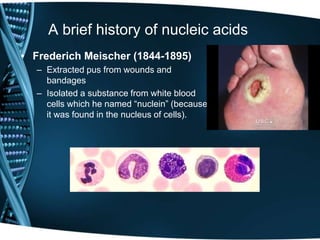
• Frederich Meischer (1844-1895)
– Extracted pus from wounds and
bandages
– Isolated a substance from white blood
cells which he named “nuclein” (because
it was found in the nucleus of cells).
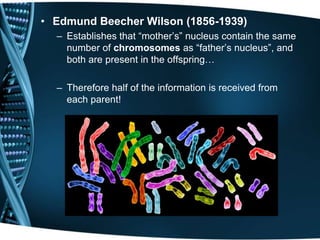
• Edmund Beecher Wilson (1856-1939)
– Establishes that “mother’s” nucleus contain the same
number of chromosomes as “father’s nucleus”, and
both are present in the offspring…
– Therefore half of the information is received from
each parent!
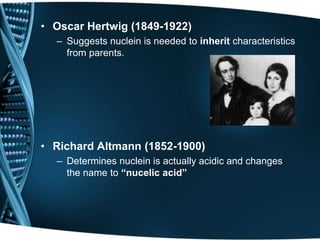
• Oscar Hertwig (1849-1922)
– Suggests nuclein is needed to inherit characteristics
from parents.

• Richard Altmann (1852-1900)
– Determines nuclein is actually acidic and changes
the name to “nucelic acid”
• Phoebus Aaron Levene (1869-1940)
– Suggested nucleic acids had
a highly repetitive sequence…
(although he could not describe
the repetition patterns)

• Albrecht Kossel (1853-1927)
– Worked with yeast (why?)
– Showed there were 2 types of nucleic acids
(and won a Nobel prize for this!)
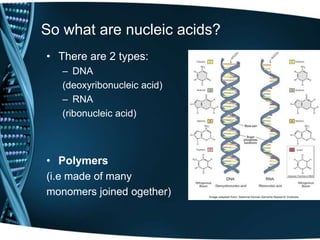
So what are nucleic acids?
• There are 2 types:
– DNA
(deoxyribonucleic acid)
– RNA
(ribonucleic acid)

• Polymers
(i.e made of many
monomers joined ogether)
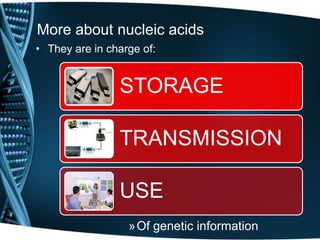
More about nucleic acids
• They are in charge of:

STORAGE

TRANSMISSION
USE
»Of genetic information
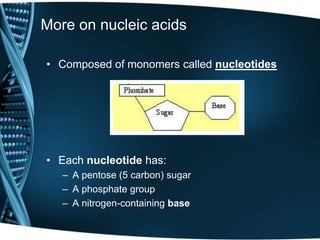
More on nucleic acids
• Composed of monomers called nucleotides

• Each nucleotide has:
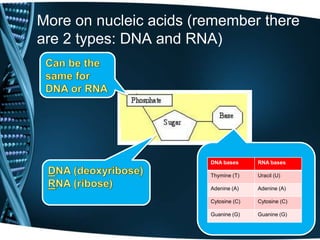
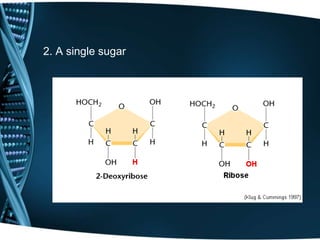
– A pentose (5 carbon) sugar
– A phosphate group
– A nitrogen-containing base
More on nucleic acids (remember there
are 2 types: DNA and RNA)

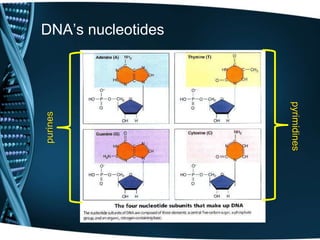
DNA bases

RNA bases

Thymine (T)

Uracil (U)

Adenine (A)

Adenine (A)

Cytosine (C)

Cytosine (C)

Guanine (G)

Guanine (G)
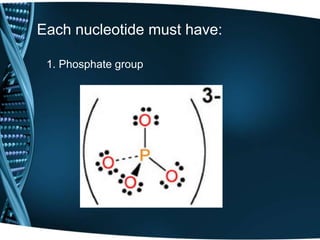
Each nucleotide must have:
1. Phosphate group
2. A single sugar
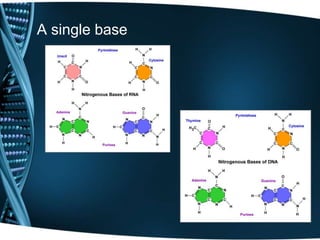
A single base
pyrimidines

purines

DNA’s nucleotides
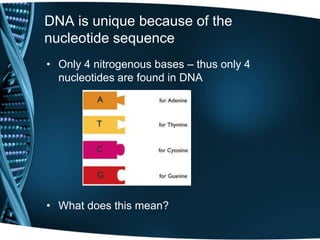
DNA is unique because of the
nucleotide sequence
• Only 4 nitrogenous bases – thus only 4
nucleotides are found in DNA

• What does this mean?
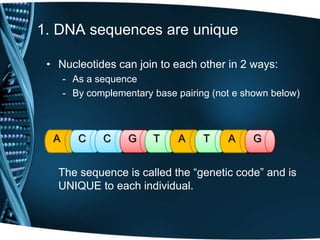
1. DNA sequences are unique
• Nucleotides can join to each other in 2 ways:
- As a sequence
- By complementary base pairing (not e shown below)

A

C

C

G

T

A

T

A

G

The sequence is called the “genetic code” and is
UNIQUE to each individual.
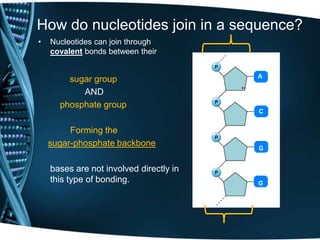
How do nucleotides join in a sequence?
•

Nucleotides can join through
covalent bonds between their

sugar group
AND
phosphate group

Forming the
sugar-phosphate backbone
bases are not involved directly in
this type of bonding.
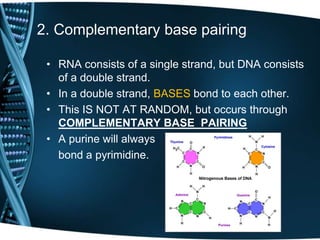
2. Complementary base pairing
• RNA consists of a single strand, but DNA consists
of a double strand.
• In a double strand, BASES bond to each other.
• This IS NOT AT RANDOM, but occurs through
COMPLEMENTARY BASE PAIRING
• A purine will always
bond a pyrimidine.
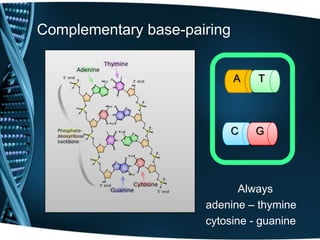
Complementary base-pairing
A

T

C

G

Always
adenine – thymine
cytosine - guanine
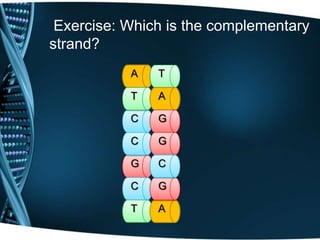
Exercise: Which is the complementary
strand?
A

T

T

A

C

G

C

G

G

C

C

G

T

A
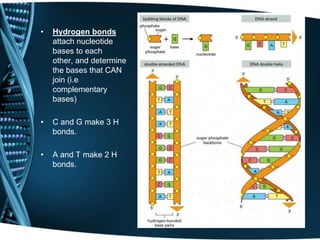
•

Hydrogen bonds
attach nucleotide
bases to each
other, and determine
the bases that CAN
join (i.e
complementary
bases)

•

C and G make 3 H
bonds.

•

A and T make 2 H
bonds.
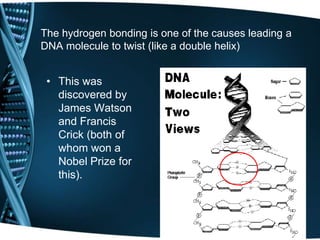
The hydrogen bonding is one of the causes leading a
DNA molecule to twist (like a double helix)

• This was
discovered by
James Watson
and Francis
Crick (both of
whom won a
Nobel Prize for
this).
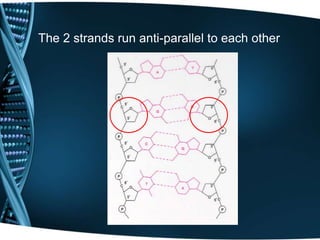
The 2 strands run anti-parallel to each other
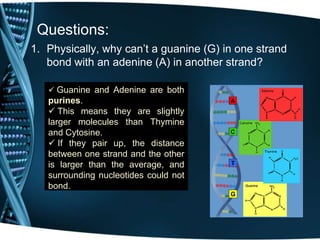
Questions:
1. Physically, why can’t a guanine (G) in one strand
bond with an adenine (A) in another strand?
 Guanine and Adenine are both

purines.
 This means they are slightly
larger molecules than Thymine
and Cytosine.
 If they pair up, the distance
between one strand and the other
is larger than the average, and
surrounding nucleotides could not
bond.
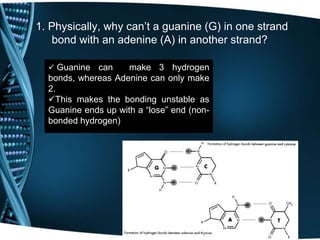
1. Physically, why can’t a guanine (G) in one strand
bond with an adenine (A) in another strand?
 Guanine

can
make 3 hydrogen
bonds, whereas Adenine can only make
2.
This makes the bonding unstable as
Guanine ends up with a “lose” end (nonbonded hydrogen)
Questions
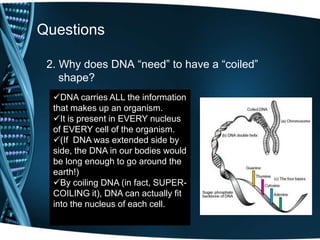
2. Why does DNA “need” to have a “coiled”
shape?
DNA carries ALL the information
that makes up an organism.
It is present in EVERY nucleus
of EVERY cell of the organism.
(If DNA was extended side by
side, the DNA in our bodies would
be long enough to go around the
earth!)
By coiling DNA (in fact, SUPERCOILING it), DNA can actually fit
into the nucleus of each cell.
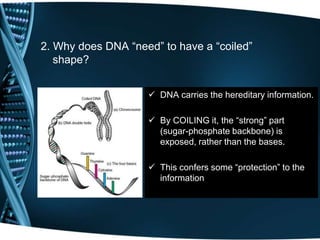
2. Why does DNA “need” to have a “coiled”
shape?
 DNA carries the hereditary information.
 By COILING it, the “strong” part
(sugar-phosphate backbone) is
exposed, rather than the bases.
 This confers some “protection” to the
information
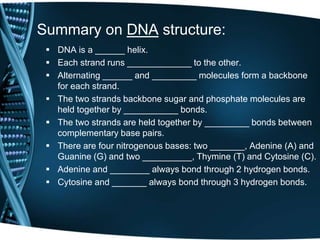
Summary on DNA structure:
 DNA is a ______ helix.
 Each strand runs _____________ to the other.
 Alternating ______ and _________ molecules form a backbone
for each strand.
 The two strands backbone sugar and phosphate molecules are
held together by ___________ bonds.
 The two strands are held together by _________ bonds between
complementary base pairs.
 There are four nitrogenous bases: two _______, Adenine (A) and
Guanine (G) and two __________, Thymine (T) and Cytosine (C).
 Adenine and ________ always bond through 2 hydrogen bonds.
 Cytosine and _______ always bond through 3 hydrogen bonds.
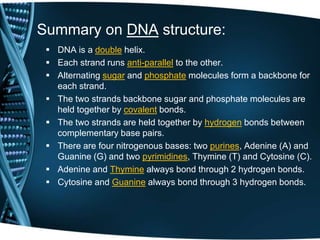
Summary on DNA structure:
 DNA is a double helix.
 Each strand runs anti-parallel to the other.
 Alternating sugar and phosphate molecules form a backbone for
each strand.
 The two strands backbone sugar and phosphate molecules are
held together by covalent bonds.
 The two strands are held together by hydrogen bonds between
complementary base pairs.
 There are four nitrogenous bases: two purines, Adenine (A) and
Guanine (G) and two pyrimidines, Thymine (T) and Cytosine (C).
 Adenine and Thymine always bond through 2 hydrogen bonds.
 Cytosine and Guanine always bond through 3 hydrogen bonds.
So how does DNA

STORE
TRANSMIT

USE
genetic information?

Nucleic acids

  • 1.
  • 2.
    A brief historyof nucleic acids • Frederich Meischer (1844-1895) – Extracted pus from wounds and bandages – Isolated a substance from white blood cells which he named “nuclein” (because it was found in the nucleus of cells).
  • 3.
    • Edmund BeecherWilson (1856-1939) – Establishes that “mother’s” nucleus contain the same number of chromosomes as “father’s nucleus”, and both are present in the offspring… – Therefore half of the information is received from each parent!
  • 4.
    • Oscar Hertwig(1849-1922) – Suggests nuclein is needed to inherit characteristics from parents. • Richard Altmann (1852-1900) – Determines nuclein is actually acidic and changes the name to “nucelic acid”
  • 5.
    • Phoebus AaronLevene (1869-1940) – Suggested nucleic acids had a highly repetitive sequence… (although he could not describe the repetition patterns) • Albrecht Kossel (1853-1927) – Worked with yeast (why?) – Showed there were 2 types of nucleic acids (and won a Nobel prize for this!)
  • 6.
    So what arenucleic acids? • There are 2 types: – DNA (deoxyribonucleic acid) – RNA (ribonucleic acid) • Polymers (i.e made of many monomers joined ogether)
  • 7.
    More about nucleicacids • They are in charge of: STORAGE TRANSMISSION USE »Of genetic information
  • 8.
    More on nucleicacids • Composed of monomers called nucleotides • Each nucleotide has: – A pentose (5 carbon) sugar – A phosphate group – A nitrogen-containing base
  • 9.
    More on nucleicacids (remember there are 2 types: DNA and RNA) DNA bases RNA bases Thymine (T) Uracil (U) Adenine (A) Adenine (A) Cytosine (C) Cytosine (C) Guanine (G) Guanine (G)
  • 10.
    Each nucleotide musthave: 1. Phosphate group
  • 11.
  • 12.
  • 13.
  • 14.
    DNA is uniquebecause of the nucleotide sequence • Only 4 nitrogenous bases – thus only 4 nucleotides are found in DNA • What does this mean?
  • 15.
    1. DNA sequencesare unique • Nucleotides can join to each other in 2 ways: - As a sequence - By complementary base pairing (not e shown below) A C C G T A T A G The sequence is called the “genetic code” and is UNIQUE to each individual.
  • 16.
    How do nucleotidesjoin in a sequence? • Nucleotides can join through covalent bonds between their sugar group AND phosphate group Forming the sugar-phosphate backbone bases are not involved directly in this type of bonding.
  • 17.
    2. Complementary basepairing • RNA consists of a single strand, but DNA consists of a double strand. • In a double strand, BASES bond to each other. • This IS NOT AT RANDOM, but occurs through COMPLEMENTARY BASE PAIRING • A purine will always bond a pyrimidine.
  • 18.
  • 19.
    Exercise: Which isthe complementary strand? A T T A C G C G G C C G T A
  • 20.
    • Hydrogen bonds attach nucleotide basesto each other, and determine the bases that CAN join (i.e complementary bases) • C and G make 3 H bonds. • A and T make 2 H bonds.
  • 21.
    The hydrogen bondingis one of the causes leading a DNA molecule to twist (like a double helix) • This was discovered by James Watson and Francis Crick (both of whom won a Nobel Prize for this).
  • 22.
    The 2 strandsrun anti-parallel to each other
  • 23.
    Questions: 1. Physically, whycan’t a guanine (G) in one strand bond with an adenine (A) in another strand?  Guanine and Adenine are both purines.  This means they are slightly larger molecules than Thymine and Cytosine.  If they pair up, the distance between one strand and the other is larger than the average, and surrounding nucleotides could not bond.
  • 24.
    1. Physically, whycan’t a guanine (G) in one strand bond with an adenine (A) in another strand?  Guanine can make 3 hydrogen bonds, whereas Adenine can only make 2. This makes the bonding unstable as Guanine ends up with a “lose” end (nonbonded hydrogen)
  • 25.
    Questions 2. Why doesDNA “need” to have a “coiled” shape? DNA carries ALL the information that makes up an organism. It is present in EVERY nucleus of EVERY cell of the organism. (If DNA was extended side by side, the DNA in our bodies would be long enough to go around the earth!) By coiling DNA (in fact, SUPERCOILING it), DNA can actually fit into the nucleus of each cell.
  • 26.
    2. Why doesDNA “need” to have a “coiled” shape?  DNA carries the hereditary information.  By COILING it, the “strong” part (sugar-phosphate backbone) is exposed, rather than the bases.  This confers some “protection” to the information
  • 27.
    Summary on DNAstructure:  DNA is a ______ helix.  Each strand runs _____________ to the other.  Alternating ______ and _________ molecules form a backbone for each strand.  The two strands backbone sugar and phosphate molecules are held together by ___________ bonds.  The two strands are held together by _________ bonds between complementary base pairs.  There are four nitrogenous bases: two _______, Adenine (A) and Guanine (G) and two __________, Thymine (T) and Cytosine (C).  Adenine and ________ always bond through 2 hydrogen bonds.  Cytosine and _______ always bond through 3 hydrogen bonds.
  • 28.
    Summary on DNAstructure:  DNA is a double helix.  Each strand runs anti-parallel to the other.  Alternating sugar and phosphate molecules form a backbone for each strand.  The two strands backbone sugar and phosphate molecules are held together by covalent bonds.  The two strands are held together by hydrogen bonds between complementary base pairs.  There are four nitrogenous bases: two purines, Adenine (A) and Guanine (G) and two pyrimidines, Thymine (T) and Cytosine (C).  Adenine and Thymine always bond through 2 hydrogen bonds.  Cytosine and Guanine always bond through 3 hydrogen bonds.
  • 29.
    So how doesDNA STORE TRANSMIT USE genetic information?