












CHARACTERISTICS OF LANGUAGE WHICH AFFECT TRANSLATION Meaning components are “packaged” into  lexical items, but they are “packaged” differently in one language than in another. E.g. Projector in the language of Chipaya of Bolivia is called  the thing that shows pictures on the wall.
In Indonesian, the translation is ‘proyektor’, a borrowed word from English.  If not borrowed, ??
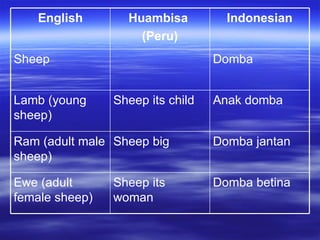
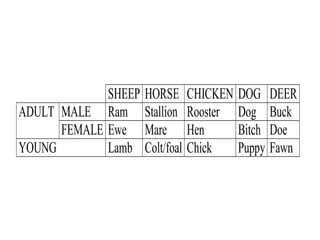
It is characteristic of languages that the same meaning component will occur in several surface structure lexical items (forms).
Domba betina Sheep its woman Ewe (adult female sheep) Domba jantan Sheep big Ram (adult male sheep) Anak domba Sheep its child Lamb (young sheep) Domba Sheep Indonesian Huambisa  (Peru) English
 
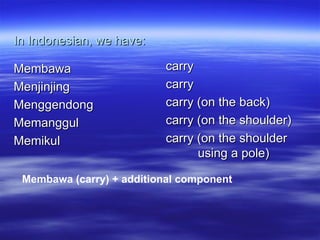
In Indonesian, we have: Membawa   Menjinjing   Menggendong   Memanggul  Memikul   carry carry carry (on the back) carry (on the shoulder) carry (on the shoulder    using a pole) Membawa (carry) + additional component
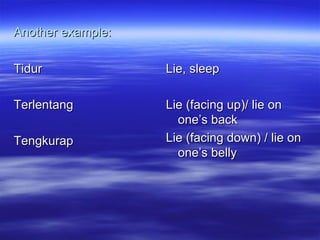
Another example: Tidur Terlentang Tengkurap Lie, sleep Lie (facing up)/ lie on one’s back Lie (facing down) / lie on one’s belly
3. One form will be used to represent  several  alternative meanings. There will be a primary meaning, the one which usually comes to mind when the word is said in isolation, and secondary meaning, the additional meaning which a word has in context with other words.
If you look up the word ‘run’ in a dictionary, we will find many meanings. For example, Oxford Dictionary gives 54 meanings for the English word ‘run’.
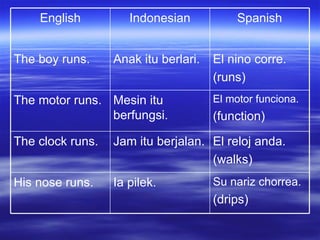
The boy runs.  The motor runs. The clock runs. His nose runs.    Anak itu berlari.   Mesin itu berfungsi.  Jam itu berjalan.  Ia pilek.
Su nariz chorrea. (drips) Ia pilek.  His nose runs.  El reloj anda. (walks) Jam itu berjalan.   The clock runs.  El motor funciona. (function) Mesin itu berfungsi.  The motor runs.   El nino corre. (runs) Anak itu berlari.   The boy runs.  Spanish Indonesian English
I dressed myself. I dressed a chicken. I dressed timber. The soldiers dressed rank. I dressed the wound. I put my clothes on. I defeathered a chicken and took its innards out. I made the logs smooth. The soldiers lined up in straight rows. I put medicine on and bandaged the wound.
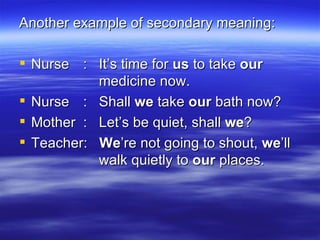
Another example of secondary meaning:  Nurse :  It’s time for  us  to take  our     medicine now. Nurse :  Shall  we  take  our  bath now? Mother :  Let’s be quiet, shall  we ? Teacher:  We ’re not going to shout,  we ’ll    walk quietly to  our  places.
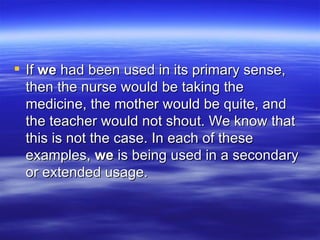
If  we  had been used in its primary sense, then the nurse would be taking the medicine, the mother would be quite, and the teacher would not shout. We know that this is not the case. In each of these examples,  we  is being used in a secondary or extended usage.
Whole sentences may also have  several  functions. A question  form  may be used for a nonquestion.  E.g . “ Mary, why don’t you wash the dishes?” The above sentence has the form of a question, but it is often used with the  meaning  of command or suggestion, rather than a real question.
The preposition  on  is used in English to signal  a variety  of meanings.
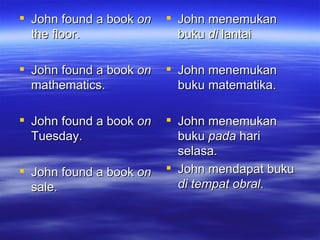
John found a book  on  the floor.  John found a book  on  mathematics.  John found a book  on  Tuesday.   John found a book  on  sale.  John menemukan buku  di  lantai John menemukan buku matematika. John menemukan buku  pada  hari selasa. John mendapat buku  di   tempat obral .
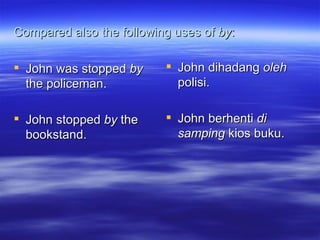
Compared also the following uses of  by : John was stopped  by  the policeman. John stopped  by  the bookstand. John dihadang  oleh  polisi. John berhenti  di samping  kios buku.
Conclusion It is meaning which is to be carried over from the source language to the receptor language, not the linguistic form. The goal of a translator should be to produce a receptor language text ( a translation) which is idiomatic, that is, one which has the same meaning as the source language but is expressed in a natural form of the receptor language. The meaning, not the form, is retained.
Example: Story originally told in the Quiche language of Guatemala.


Dear Sir, You will not be paid Job Search Allowance because your wife’s income is higher than the amount allowed under the Income Test. Yours Faithfully,   John Smith District Manager
Tuan yang terhormat, Tuan tidak akan dibayar Tunjangan Pencarian Kerja karena pendapatan isteri Tuan lebih tinggi dibandingkan jumlah yang dibolehkan menurut Uji Pendapatan. Dengan sesungguhnya,   John Smith   Manajer Daerah
Dengan hormat, Bapak tidak dapat memperoleh Tunjangan Mencari Kerja karena pendapatan isteri Bapak lebih tinggi dari jumlah yang diperbolehkan menurut Peraturan mengenai Pendapatan. Hormat saya,   John Smith Manajer Distrik

Characteristics Of Language Which Affect Translation

  • 1.
    CHARACTERISTICS OF LANGUAGEWHICH AFFECT TRANSLATION Meaning components are “packaged” into lexical items, but they are “packaged” differently in one language than in another. E.g. Projector in the language of Chipaya of Bolivia is called the thing that shows pictures on the wall.
  • 2.
    In Indonesian, thetranslation is ‘proyektor’, a borrowed word from English.  If not borrowed, ??
  • 3.
    It is characteristicof languages that the same meaning component will occur in several surface structure lexical items (forms).
  • 4.
    Domba betina Sheepits woman Ewe (adult female sheep) Domba jantan Sheep big Ram (adult male sheep) Anak domba Sheep its child Lamb (young sheep) Domba Sheep Indonesian Huambisa (Peru) English
  • 5.
  • 6.
    In Indonesian, wehave: Membawa Menjinjing Menggendong Memanggul Memikul carry carry carry (on the back) carry (on the shoulder) carry (on the shoulder using a pole) Membawa (carry) + additional component
  • 7.
    Another example: TidurTerlentang Tengkurap Lie, sleep Lie (facing up)/ lie on one’s back Lie (facing down) / lie on one’s belly
  • 8.
    3. One formwill be used to represent several alternative meanings. There will be a primary meaning, the one which usually comes to mind when the word is said in isolation, and secondary meaning, the additional meaning which a word has in context with other words.
  • 9.
    If you lookup the word ‘run’ in a dictionary, we will find many meanings. For example, Oxford Dictionary gives 54 meanings for the English word ‘run’.
  • 10.
    The boy runs. The motor runs. The clock runs. His nose runs. Anak itu berlari. Mesin itu berfungsi. Jam itu berjalan. Ia pilek.
  • 11.
    Su nariz chorrea.(drips) Ia pilek. His nose runs. El reloj anda. (walks) Jam itu berjalan. The clock runs. El motor funciona. (function) Mesin itu berfungsi. The motor runs. El nino corre. (runs) Anak itu berlari. The boy runs. Spanish Indonesian English
  • 12.
    I dressed myself.I dressed a chicken. I dressed timber. The soldiers dressed rank. I dressed the wound. I put my clothes on. I defeathered a chicken and took its innards out. I made the logs smooth. The soldiers lined up in straight rows. I put medicine on and bandaged the wound.
  • 13.
    Another example ofsecondary meaning: Nurse : It’s time for us to take our medicine now. Nurse : Shall we take our bath now? Mother : Let’s be quiet, shall we ? Teacher: We ’re not going to shout, we ’ll walk quietly to our places.
  • 14.
    If we had been used in its primary sense, then the nurse would be taking the medicine, the mother would be quite, and the teacher would not shout. We know that this is not the case. In each of these examples, we is being used in a secondary or extended usage.
  • 15.
    Whole sentences mayalso have several functions. A question form may be used for a nonquestion. E.g . “ Mary, why don’t you wash the dishes?” The above sentence has the form of a question, but it is often used with the meaning of command or suggestion, rather than a real question.
  • 16.
    The preposition on is used in English to signal a variety of meanings.
  • 17.
    John found abook on the floor. John found a book on mathematics. John found a book on Tuesday. John found a book on sale. John menemukan buku di lantai John menemukan buku matematika. John menemukan buku pada hari selasa. John mendapat buku di tempat obral .
  • 18.
    Compared also thefollowing uses of by : John was stopped by the policeman. John stopped by the bookstand. John dihadang oleh polisi. John berhenti di samping kios buku.
  • 19.
    Conclusion It ismeaning which is to be carried over from the source language to the receptor language, not the linguistic form. The goal of a translator should be to produce a receptor language text ( a translation) which is idiomatic, that is, one which has the same meaning as the source language but is expressed in a natural form of the receptor language. The meaning, not the form, is retained.
  • 20.
    Example: Story originallytold in the Quiche language of Guatemala.
  • 21.
  • 22.
  • 23.
  • 24.
    Dear Sir, Youwill not be paid Job Search Allowance because your wife’s income is higher than the amount allowed under the Income Test. Yours Faithfully, John Smith District Manager
  • 25.
    Tuan yang terhormat,Tuan tidak akan dibayar Tunjangan Pencarian Kerja karena pendapatan isteri Tuan lebih tinggi dibandingkan jumlah yang dibolehkan menurut Uji Pendapatan. Dengan sesungguhnya, John Smith Manajer Daerah
  • 26.
    Dengan hormat, Bapaktidak dapat memperoleh Tunjangan Mencari Kerja karena pendapatan isteri Bapak lebih tinggi dari jumlah yang diperbolehkan menurut Peraturan mengenai Pendapatan. Hormat saya, John Smith Manajer Distrik