LEARNING
Starts when one is born
• Habits, knowledge, attitude and skills.
• Ways of doing things and adjustment to situations
• Progressive change
Both vertical and
horizontal
• Vertical
• Precision is increased or information is added to that
already learned
• Horizontal
• What is learned is integrated and organized as a part of a
functioning unit of expanding experience
• Quality and quantity
To change
• Simple skill to complicated mechanical performance and
application
• Its is caused partly or wholly by experience
• Includes change of behavior in emotional sphere
To understand the world
CHARACTERISTICS OF
LEARNING
Unitary
• The learner responds as a whole person in a unified way
to the whole situation of learning.
• Intellectually
• Emotionally
• Physically
• spiritually
• The individual learner reacts to the whole learning
situation rather than to single situations in a unified way.
Individual
• Each learner differs from each other and hence the teaching-
learning situation is approached differently by each learner
and with different goal & different level of result
achievement.
• The factors influencing at the individual are many such as:
• Hereditary
• home environment
• religious background
• educational opportunity
• financial soundness
• Health
• work experience
• environmental factors
• learner’s ability
Social
• Learning occurs in response to the environment in
which there are other individuals.
• Social maturity takes place with opportunities and
develops into actual achievement.
Self-active
• Learning is a personal process. Each person develops his own
habits of learning.
• The teacher can set a pattern for the student to imitate learning
processes. The intellect is perfected not by knowledge but by
activity.
• Learning is a process of self- activity, self-direction, and self-
realization of an individual’s highest potentialities.
• The various forms of self-activity are:
• Listening
• Visualizing
• Memorizing
• Reasoning
• Judgment
• Thinking.
Purposive
• Learning is directed towards a goals and goals are determined by
motives and incentives. Motives takes a variety of forms (energy,
arousing activity).
• Learning experiences become meaningful when they are related to
the individual’s interests, when involved in his living & purpose of
life.
• Goal setting comprises both momentary and long terms goals.
• Short term goals refers to the specific task at hand, interlocking
and over lapping the immediate goal into a goal system, thus
establishing a series of progressive goals.
• Through a progressive goal setting the learning process itself
becomes the motivation for more learning and goals are placed on
increasingly mature levels.
• Learning is influenced by the intention or will to learn, as man has a
will and can choose the action he wishes to take.
• Factors include religion, philosophy.
Creative
• Human learning is both selective and creative.
• Teaching involves the mind’s activity on the part of
the learner & intellectual guidance on the part of the
teacher.
• The learner is the primary force and the teacher is the
secondary force. Learning is a process of personal choice
making.
• The learner has the power to vary his responses to the
demands of the situation & to change responses at will
and thus create a new forms of response.
Transferable
• Transfer refers to the application of knowledge, skill
gained in one context to affect another situation.
• The factors that influence the amount and permanency of
learning are as follows:
• Intellectual ability
• Background experience of the learner.
• The explicitness & definiteness of goals.
• Relationship between the activities of the learner and the
goals.
• The whole heartedness of the learner’s approach.
By Yoakman and Simpson
Learning is:
• Growth
• Adjustment
• Purposeful
• Experience
• Intelligent
• Active
• Individual and social
• The product of the environment
• Affects the conduct of the learner
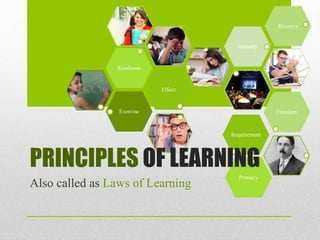
Also called as Laws of Learning
Exercise
Effect
Readiness
Recency
Intensity
Freedom
Primacy
Requirement
PRINCIPLES OF LEARNING
• Discovered
• Tested
• Used in practical situations.
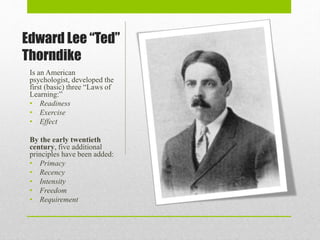
Edward Lee “Ted”
Thorndike
Is an American
psychologist, developed the
first (basic) three “Laws of
Learning:”
• Readiness
• Exercise
• Effect
By the early twentieth
century, five additional
principles have been added:
• Primacy
• Recency
• Intensity
• Freedom
• Requirement
Readiness
• This principle states that motivation is needed to
develop an association or display changed
behavior
• This implies the preparedness and eagerness to learn
• Individual learn best when they are in all aspects –
physically, mentally and emotionally ready to learn.
• There must be a reason in what they are going to learn in
which the teacher stresses the importance to show the
value of the subject and provides mental or physical
challenge.
• Satisfying the basic needs (Maslow’s hierarchy) of
students before they are ready or capable of learning.
Exercise
• This principle states that those things most often
repeated are best remembered.
• It has two parts:
• Law of use - strength
• Law of disuse - weakness
• The teacher must repeat important items of subject matter
at reasonable intervals
• Recall, review and summary
• Manual drill and physical applications
Effect
• The principle states that learning is strengthen with
pleasant or satisfying feeling while unpleasant tend to
do otherwise.
• Based one emotional reaction and motivation of the student.
• Positive Reinforcement
• Recognize and commend feedback
• Be cautious of using punishment
• Evidence of progress and achieve some degree of success
• a problem or task, although difficult, is within their capability
Primacy
• The state of being first, often creates a strong, almost
unshakable, impression.
• Things learned first creates a strong impression in the mind
• Learning should be done correctly for the first time since it is
difficult to “unlearn” or change an incorrectly learned material
• example, a student learns a faulty technique, the instructor will
have a difficult task correcting bad habits and “reteaching”
correct ones
• be positive, functional, and lay the foundation for all that is to
follow.
• logical order, step by step,
Recency
• This principles states that things most recently learned
are best remembered
• Frequent review and summarization help fix in the mind
the material covered
Intensity
• The more intense something is taught, the more likely
it will be retained
• A student will learn more from the real thing than a
substitute
Freedom
• Things freely learned are the best learned
• The greater the freedom enjoyed by the students in the
class, the greater the intellectual and moral advancement
enjoyed by them
• The greater the freedom enjoyed by the students in the
class, the greater the intellectual and moral advancement
enjoyed by them
Requirement
• This principles states that we must have something to
obtain or do something.
• It can be an ability, skill, instrument or anything that may
help us to learn or gain something.
• For example, if you want to draw a person, you need to
have the materials with which to draw, and you must
know how to draw a point, a line, a figure and so on until
you reach your goal, which is to draw a person.
Source:
• http://www.preservearticles.com/201105206847/nature-
of-learning.html
• https://en.wikipedia.org/wiki/Principles_of_learning
• Others from the internet
• Pictures: zerochan.net and google.com

Characteristics and Principles of learning

  • 1.
  • 2.
    Starts when oneis born • Habits, knowledge, attitude and skills. • Ways of doing things and adjustment to situations • Progressive change
  • 3.
    Both vertical and horizontal •Vertical • Precision is increased or information is added to that already learned • Horizontal • What is learned is integrated and organized as a part of a functioning unit of expanding experience • Quality and quantity
  • 4.
    To change • Simpleskill to complicated mechanical performance and application • Its is caused partly or wholly by experience • Includes change of behavior in emotional sphere
  • 5.
  • 6.
  • 7.
    Unitary • The learnerresponds as a whole person in a unified way to the whole situation of learning. • Intellectually • Emotionally • Physically • spiritually • The individual learner reacts to the whole learning situation rather than to single situations in a unified way.
  • 8.
    Individual • Each learnerdiffers from each other and hence the teaching- learning situation is approached differently by each learner and with different goal & different level of result achievement. • The factors influencing at the individual are many such as: • Hereditary • home environment • religious background • educational opportunity • financial soundness • Health • work experience • environmental factors • learner’s ability
  • 9.
    Social • Learning occursin response to the environment in which there are other individuals. • Social maturity takes place with opportunities and develops into actual achievement.
  • 10.
    Self-active • Learning isa personal process. Each person develops his own habits of learning. • The teacher can set a pattern for the student to imitate learning processes. The intellect is perfected not by knowledge but by activity. • Learning is a process of self- activity, self-direction, and self- realization of an individual’s highest potentialities. • The various forms of self-activity are: • Listening • Visualizing • Memorizing • Reasoning • Judgment • Thinking.
  • 11.
    Purposive • Learning isdirected towards a goals and goals are determined by motives and incentives. Motives takes a variety of forms (energy, arousing activity). • Learning experiences become meaningful when they are related to the individual’s interests, when involved in his living & purpose of life. • Goal setting comprises both momentary and long terms goals. • Short term goals refers to the specific task at hand, interlocking and over lapping the immediate goal into a goal system, thus establishing a series of progressive goals. • Through a progressive goal setting the learning process itself becomes the motivation for more learning and goals are placed on increasingly mature levels. • Learning is influenced by the intention or will to learn, as man has a will and can choose the action he wishes to take. • Factors include religion, philosophy.
  • 12.
    Creative • Human learningis both selective and creative. • Teaching involves the mind’s activity on the part of the learner & intellectual guidance on the part of the teacher. • The learner is the primary force and the teacher is the secondary force. Learning is a process of personal choice making. • The learner has the power to vary his responses to the demands of the situation & to change responses at will and thus create a new forms of response.
  • 13.
    Transferable • Transfer refersto the application of knowledge, skill gained in one context to affect another situation. • The factors that influence the amount and permanency of learning are as follows: • Intellectual ability • Background experience of the learner. • The explicitness & definiteness of goals. • Relationship between the activities of the learner and the goals. • The whole heartedness of the learner’s approach.
  • 14.
    By Yoakman andSimpson Learning is: • Growth • Adjustment • Purposeful • Experience • Intelligent • Active • Individual and social • The product of the environment • Affects the conduct of the learner
  • 15.
    Also called asLaws of Learning Exercise Effect Readiness Recency Intensity Freedom Primacy Requirement PRINCIPLES OF LEARNING
  • 16.
    • Discovered • Tested •Used in practical situations.
  • 17.
    Edward Lee “Ted” Thorndike Isan American psychologist, developed the first (basic) three “Laws of Learning:” • Readiness • Exercise • Effect By the early twentieth century, five additional principles have been added: • Primacy • Recency • Intensity • Freedom • Requirement
  • 18.
    Readiness • This principlestates that motivation is needed to develop an association or display changed behavior • This implies the preparedness and eagerness to learn • Individual learn best when they are in all aspects – physically, mentally and emotionally ready to learn. • There must be a reason in what they are going to learn in which the teacher stresses the importance to show the value of the subject and provides mental or physical challenge. • Satisfying the basic needs (Maslow’s hierarchy) of students before they are ready or capable of learning.
  • 19.
    Exercise • This principlestates that those things most often repeated are best remembered. • It has two parts: • Law of use - strength • Law of disuse - weakness • The teacher must repeat important items of subject matter at reasonable intervals • Recall, review and summary • Manual drill and physical applications
  • 20.
    Effect • The principlestates that learning is strengthen with pleasant or satisfying feeling while unpleasant tend to do otherwise. • Based one emotional reaction and motivation of the student. • Positive Reinforcement • Recognize and commend feedback • Be cautious of using punishment • Evidence of progress and achieve some degree of success • a problem or task, although difficult, is within their capability
  • 21.
    Primacy • The stateof being first, often creates a strong, almost unshakable, impression. • Things learned first creates a strong impression in the mind • Learning should be done correctly for the first time since it is difficult to “unlearn” or change an incorrectly learned material • example, a student learns a faulty technique, the instructor will have a difficult task correcting bad habits and “reteaching” correct ones • be positive, functional, and lay the foundation for all that is to follow. • logical order, step by step,
  • 22.
    Recency • This principlesstates that things most recently learned are best remembered • Frequent review and summarization help fix in the mind the material covered
  • 23.
    Intensity • The moreintense something is taught, the more likely it will be retained • A student will learn more from the real thing than a substitute
  • 24.
    Freedom • Things freelylearned are the best learned • The greater the freedom enjoyed by the students in the class, the greater the intellectual and moral advancement enjoyed by them • The greater the freedom enjoyed by the students in the class, the greater the intellectual and moral advancement enjoyed by them
  • 25.
    Requirement • This principlesstates that we must have something to obtain or do something. • It can be an ability, skill, instrument or anything that may help us to learn or gain something. • For example, if you want to draw a person, you need to have the materials with which to draw, and you must know how to draw a point, a line, a figure and so on until you reach your goal, which is to draw a person.
  • 27.