Web 2.0 and Social
      Media for Business
Chapter 6: Wikis and Other Collaborative Documents


            Roger McHaney, Kansas State University
Web 2.0 concepts may have
emerged with Wikis
                                        Overview of Wikis
‘Wiki’ is derived from the Hawaiian
language and means quick

Represents a class of applications
with tools for the collaborative
development of documents

Includes tools to facilitate multiple
authoring

Provides features to edit content,
develop topics, link pages, add
tags, and cross reference material        Many Wikis are free
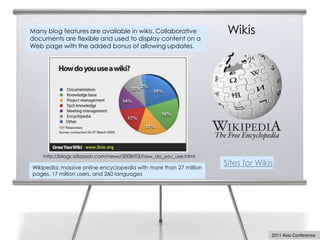
Many blog features are available in wikis. Collaborative            Wikis
documents are flexible and used to display content on a
Web page with the added bonus of allowing updates.


    http://blogs.atlassian.com/news/2008/03/how_do_you_use.html

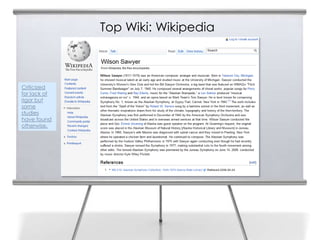
Wikipedia: massive online encyclopedia with more than 27 million
                                                                   Sites for Wikis
pages, 17 million users, and 260 languages


                                                                                 2011 Axio Conference
Top Wiki: Wikipedia
4


    Criticized
    for lack of
    rigor but
    some
    studies
    have found
    otherwise.
User Rights
5
    Wikis and collaborative documents may have a variety of user
    rights. Some offer open viewing and editing (public). Others limit
    access to particular editors and selected readers (private). Semi-
    public Wikis require users to register and obtain a user name and
    password prior to access.
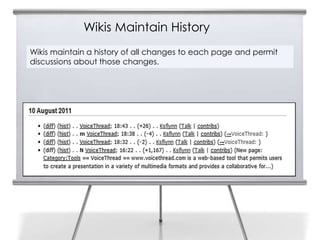
Wikis Maintain History
6
    Wikis maintain a history of all changes to each page and permit
    discussions about those changes.
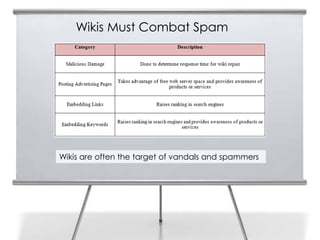
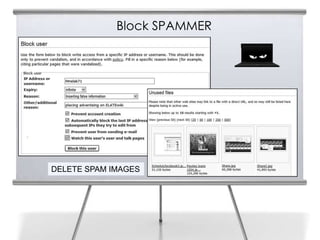
Wikis Must Combat Spam
7


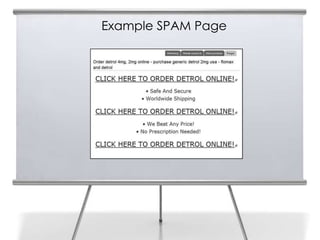
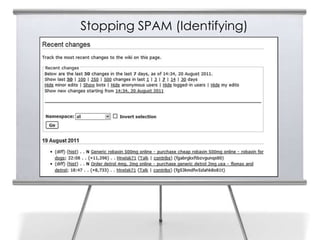
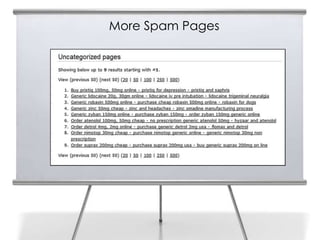
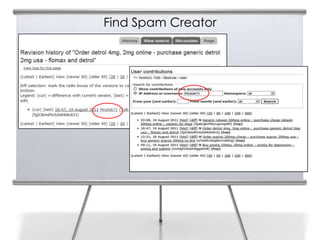
    Wikis are often the target of vandals and spammers
Example SPAM Page
Stopping SPAM (Identifying)
More Spam Pages
Find Spam Creator
Block SPAMMER


DELETE SPAM IMAGES
Example Wiki Uses
     Medicine and science: Information posting that requires high editorial
13   standards. Material must be accurate. Uses expert-moderated approach.

     Business: Internal collaborative documents, knowledge repositories, internal
     documentation and software application information. Customers may help
     produce documentation of products.

     Academics: collaborative grant writing, academic unit documentation,
     committee reports, strategic planning documentation, and knowledge
     repositories.

     Classroom: Collaborative student projects, exam study guide development.

     Government : internal procedures, public reporting, so constituents can post
     and answer questions.
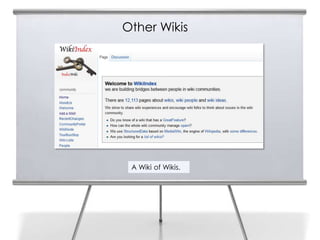
Other Wikis
14


      A Wiki of Wikis.
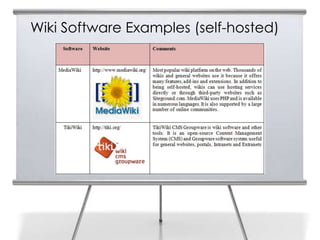
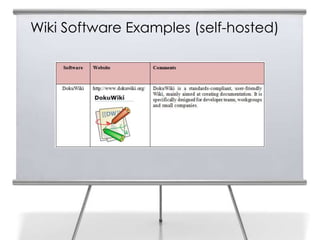
Wiki Software Examples (self-hosted)
15
Wiki Software Examples (self-hosted)
16
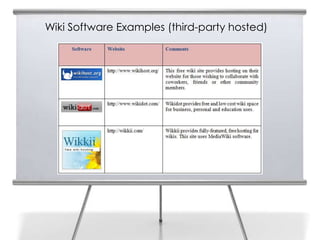
Wiki Software Examples (third-party hosted)
17
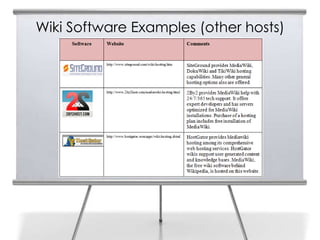
Wiki Software Examples (other hosts)
18
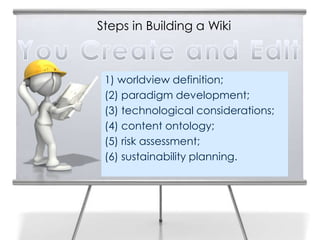
Steps in Building a Wiki
19


      1) worldview definition;
      (2) paradigm development;
      (3) technological considerations;
      (4) content ontology;
      (5) risk assessment;
      (6) sustainability planning.
Worldview: Wiki Purpose?
     Decision regarding how content will be viewed, developed, and
20   used by its community

     Private, semi-private or completely open

     Use Web 2.0 concepts to facilitate sharing intellectual resources
     and encourage contribution

     Users understand contributions will remain available with a
     Creative Commons license

     Ensure Wiki will be used as a communal construction of
     knowledge, online discussion, and reflection for an interacting
     group of users
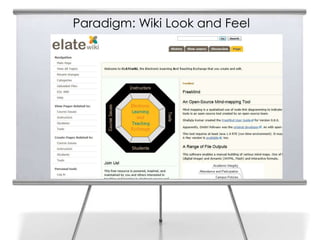
Paradigm: Wiki Look and Feel
21
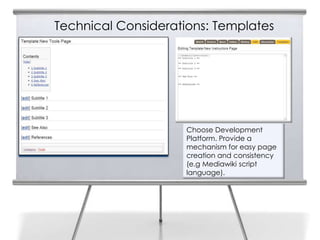
Technical Considerations: Templates
22


                          Choose Development
                          Platform. Provide a
                          mechanism for easy page
                          creation and consistency
                          (e.g Mediawiki script
                          language).
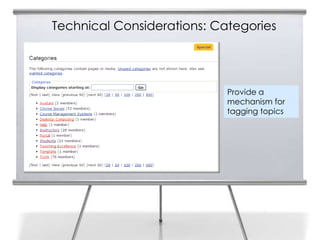
Technical Considerations: Categories
23


                                 Provide a
                                 mechanism for
                                 tagging topics
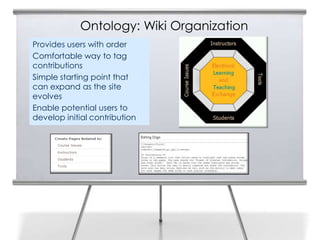
Ontology: Wiki Organization
     Provides users with order
24
     Comfortable way to tag
     contributions
     Simple starting point that
     can expand as the site
     evolves
     Enable potential users to
     develop initial contribution
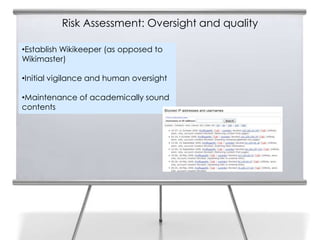
Risk Assessment: Oversight and quality

•Establish Wikikeeper (as opposed to
Wikimaster)

•Initial vigilance and human oversight

•Maintenance of academically sound
contents
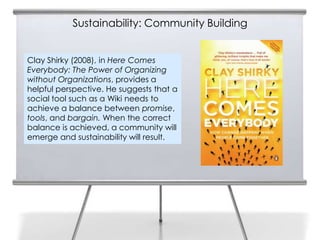
Sustainability: Community Building


Clay Shirky (2008), in Here Comes
Everybody: The Power of Organizing
without Organizations, provides a
helpful perspective. He suggests that a
social tool such as a Wiki needs to
achieve a balance between promise,
tools, and bargain. When the correct
balance is achieved, a community will
emerge and sustainability will result.
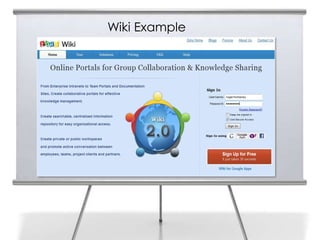
Wiki Example
27
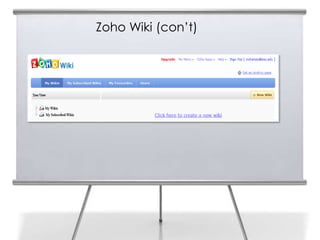
Zoho Wiki (con’t)
28
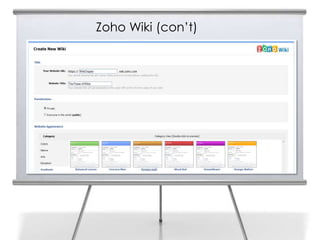
Zoho Wiki (con’t)
29
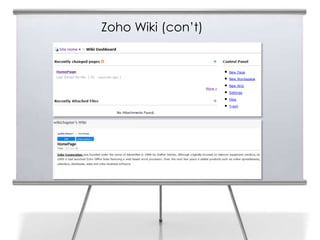
Zoho Wiki (con’t)
30
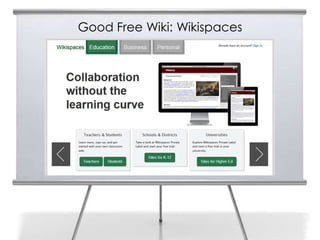
Good Free Wiki: Wikispaces
31
Other Collaborative Documents
32

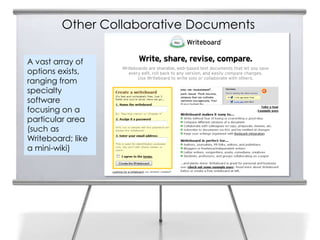
     A vast array of
     options exists,
     ranging from
     specialty
     software
     focusing on a
     particular area
     (such as
     Writeboard; like
     a mini-wiki)
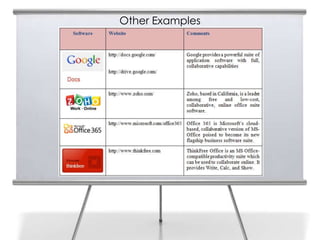
Other Examples

33
Summary
Web 2.0 collaborative document concepts emerged and took shape with Wikis.

Collaborative document systems provide features to co-create and edit content, develop
topics areas, link pages, add tags, and create cross references.

Additional tools permit document owners to determine who can access material, what
type of access is granted and how material is distributed.

Most collaborative documents serve as work spaces and become knowledge repositories.
Slide Media from:
Slides Prepared by Professor Roger McHaney
Kansas State University                      PresenterMedia.com
Twitter: @mchaney                            support@presentermedia.com
Blog: http://mchaney.com
Email : mchaney@ksu.edu
                                             4416 S. Technology Dr
                                             Sioux Falls, SD 57106

Chapter6 McHaney

  • 1.
    Web 2.0 andSocial Media for Business Chapter 6: Wikis and Other Collaborative Documents Roger McHaney, Kansas State University
  • 2.
    Web 2.0 conceptsmay have emerged with Wikis Overview of Wikis ‘Wiki’ is derived from the Hawaiian language and means quick Represents a class of applications with tools for the collaborative development of documents Includes tools to facilitate multiple authoring Provides features to edit content, develop topics, link pages, add tags, and cross reference material Many Wikis are free
  • 3.
    Many blog featuresare available in wikis. Collaborative Wikis documents are flexible and used to display content on a Web page with the added bonus of allowing updates. http://blogs.atlassian.com/news/2008/03/how_do_you_use.html Wikipedia: massive online encyclopedia with more than 27 million Sites for Wikis pages, 17 million users, and 260 languages 2011 Axio Conference
  • 4.
    Top Wiki: Wikipedia 4 Criticized for lack of rigor but some studies have found otherwise.
  • 5.
    User Rights 5 Wikis and collaborative documents may have a variety of user rights. Some offer open viewing and editing (public). Others limit access to particular editors and selected readers (private). Semi- public Wikis require users to register and obtain a user name and password prior to access.
  • 6.
    Wikis Maintain History 6 Wikis maintain a history of all changes to each page and permit discussions about those changes.
  • 7.
    Wikis Must CombatSpam 7 Wikis are often the target of vandals and spammers
  • 8.
  • 9.
  • 10.
  • 11.
  • 12.
  • 13.
    Example Wiki Uses Medicine and science: Information posting that requires high editorial 13 standards. Material must be accurate. Uses expert-moderated approach. Business: Internal collaborative documents, knowledge repositories, internal documentation and software application information. Customers may help produce documentation of products. Academics: collaborative grant writing, academic unit documentation, committee reports, strategic planning documentation, and knowledge repositories. Classroom: Collaborative student projects, exam study guide development. Government : internal procedures, public reporting, so constituents can post and answer questions.
  • 14.
    Other Wikis 14 A Wiki of Wikis.
  • 15.
    Wiki Software Examples(self-hosted) 15
  • 16.
    Wiki Software Examples(self-hosted) 16
  • 17.
    Wiki Software Examples(third-party hosted) 17
  • 18.
    Wiki Software Examples(other hosts) 18
  • 19.
    Steps in Buildinga Wiki 19 1) worldview definition; (2) paradigm development; (3) technological considerations; (4) content ontology; (5) risk assessment; (6) sustainability planning.
  • 20.
    Worldview: Wiki Purpose? Decision regarding how content will be viewed, developed, and 20 used by its community Private, semi-private or completely open Use Web 2.0 concepts to facilitate sharing intellectual resources and encourage contribution Users understand contributions will remain available with a Creative Commons license Ensure Wiki will be used as a communal construction of knowledge, online discussion, and reflection for an interacting group of users
  • 21.
  • 22.
    Technical Considerations: Templates 22 Choose Development Platform. Provide a mechanism for easy page creation and consistency (e.g Mediawiki script language).
  • 23.
    Technical Considerations: Categories 23 Provide a mechanism for tagging topics
  • 24.
    Ontology: Wiki Organization Provides users with order 24 Comfortable way to tag contributions Simple starting point that can expand as the site evolves Enable potential users to develop initial contribution
  • 25.
    Risk Assessment: Oversightand quality •Establish Wikikeeper (as opposed to Wikimaster) •Initial vigilance and human oversight •Maintenance of academically sound contents
  • 26.
    Sustainability: Community Building ClayShirky (2008), in Here Comes Everybody: The Power of Organizing without Organizations, provides a helpful perspective. He suggests that a social tool such as a Wiki needs to achieve a balance between promise, tools, and bargain. When the correct balance is achieved, a community will emerge and sustainability will result.
  • 27.
  • 28.
  • 29.
  • 30.
  • 31.
    Good Free Wiki:Wikispaces 31
  • 32.
    Other Collaborative Documents 32 A vast array of options exists, ranging from specialty software focusing on a particular area (such as Writeboard; like a mini-wiki)
  • 33.
  • 34.
    Summary Web 2.0 collaborativedocument concepts emerged and took shape with Wikis. Collaborative document systems provide features to co-create and edit content, develop topics areas, link pages, add tags, and create cross references. Additional tools permit document owners to determine who can access material, what type of access is granted and how material is distributed. Most collaborative documents serve as work spaces and become knowledge repositories.
  • 35.
    Slide Media from: SlidesPrepared by Professor Roger McHaney Kansas State University PresenterMedia.com Twitter: @mchaney support@presentermedia.com Blog: http://mchaney.com Email : mchaney@ksu.edu 4416 S. Technology Dr Sioux Falls, SD 57106