
Wiki on Library  Perspectives By  Champeswar Mishra IIM Kozhikode
Agenda Web Generation : Brief Introduction Library 2.0 :What, Why and How? Wiki : An Overview Wiki Engines Wiki Software Wiki Vs Blog Wiki : Advantages and Disadvantages Wiki : Role in Library Wiki : Practicing Wiki For Library Practical Issues  Wiki : Criterias on Choosing Wiki Software Conclusion
Web Generation It can be broadly divided into three generation ……… Web 1.0  Web 2.0 Web 3.0 More Coming….
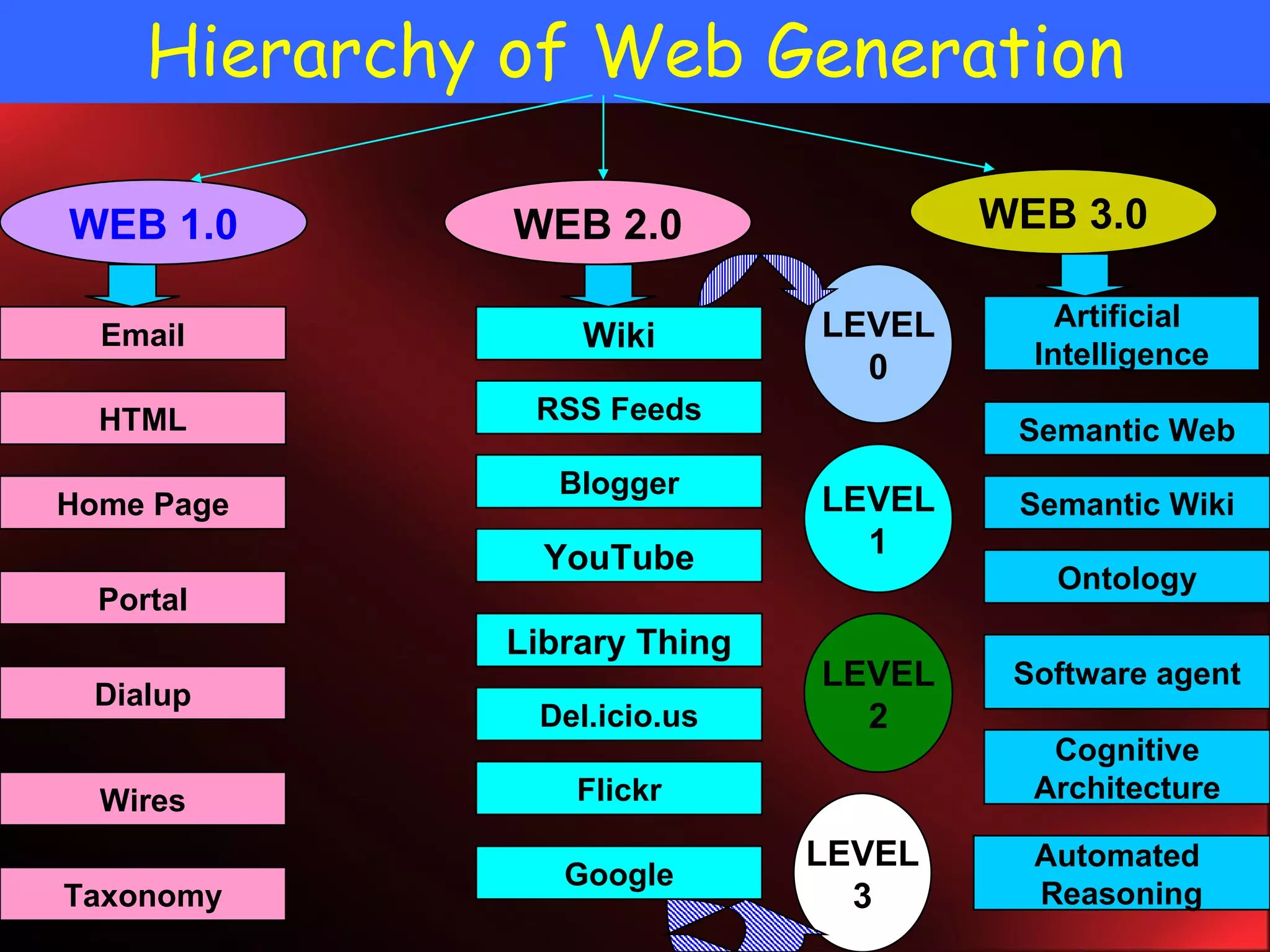
Hierarchy of Web Generation WEB 1.0 WEB 2.0 WEB 3.0 Email HTML Home Page Google Del.icio.us Flickr Library Thing YouTube Blogger RSS Feeds Wiki Portal Dialup Wires Taxonomy Automated  Reasoning Cognitive Architecture Software agent Ontology Semantic Wiki Semantic Web Artificial  Intelligence LEVEL 0 LEVEL 1 LEVEL 2 LEVEL 3
Web 2.0 : What Does It Means… Is the second generation of web based  communities and hosted services that facilitate collaboration and sharing resources in Web world. It means achieving the original vision of the web in the next phase – the real transformation rather than this past period. By Tim O’Reilly in 2003 and Popularized by First web 2.0 conference in 2004. More Definition…………….
More Definition……. “ Web 2.0 is a term often applied to a perceived ongoing transition of the World Wide Web from a collection of websites to a full-fledged computing platform serving web applications to end users. Ultimately Web 2.0 services are expected to replace desktop computing applications for many purposes.”
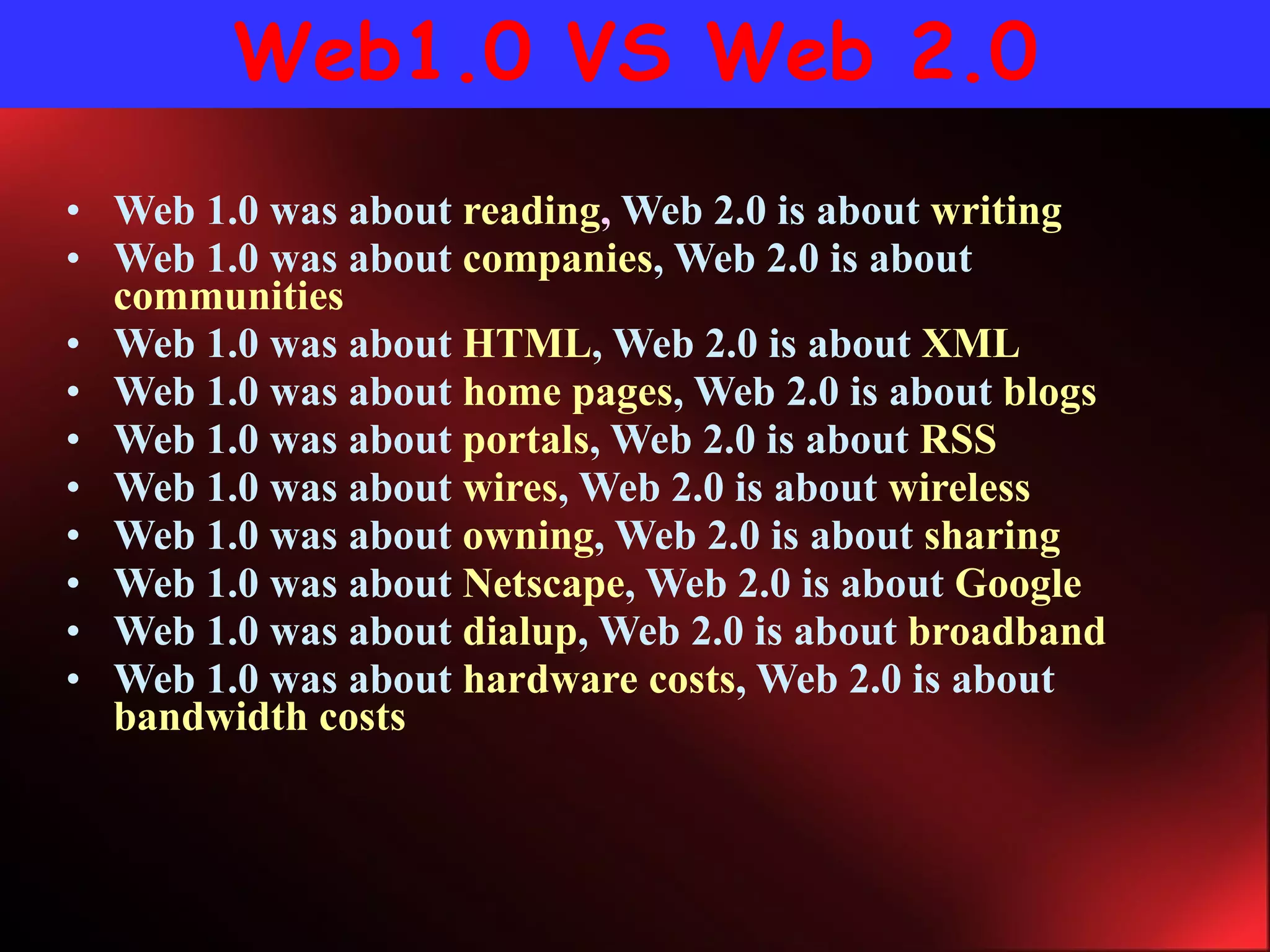
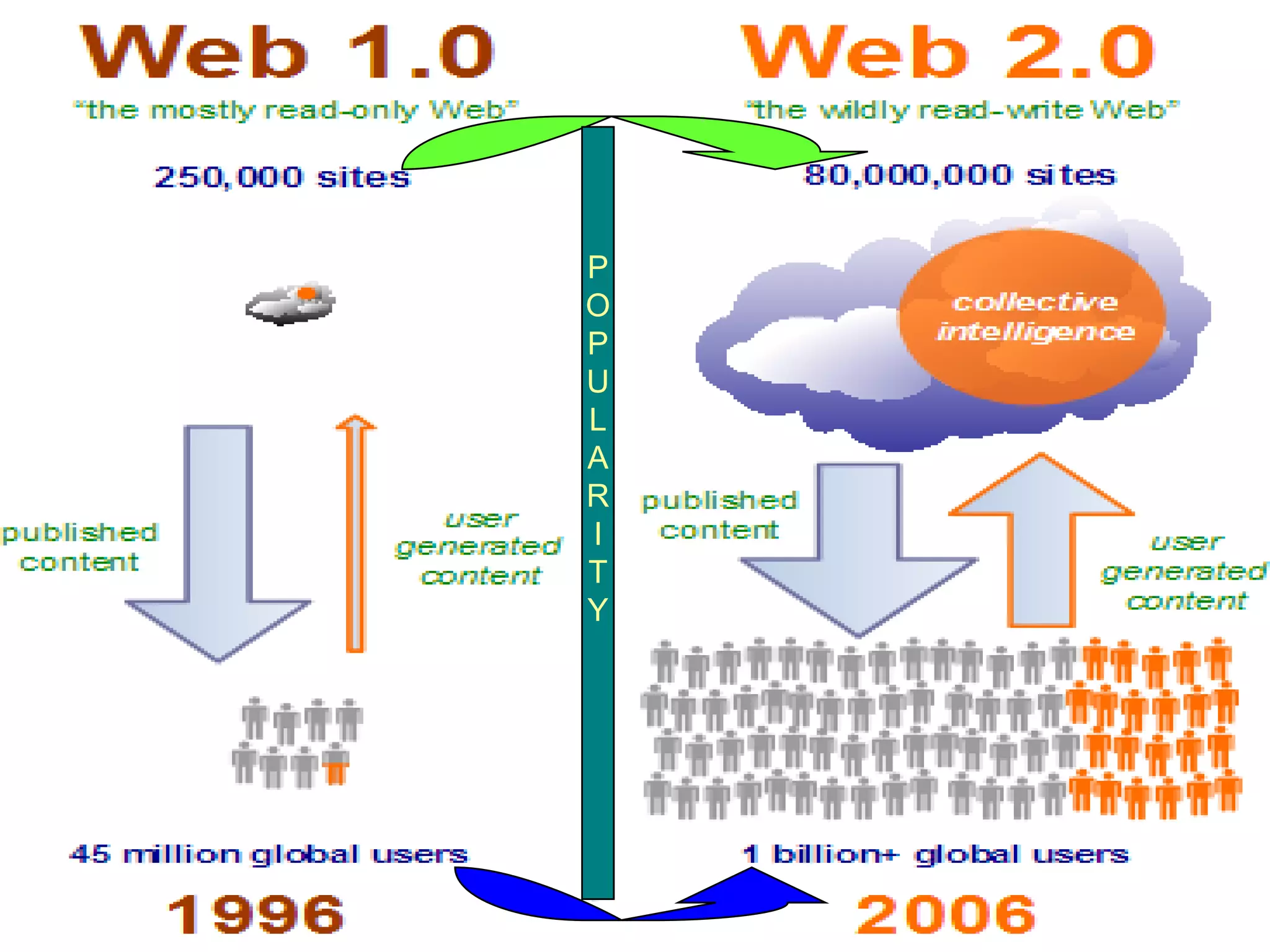
Web1.0 VS Web 2.0 Web 1.0 was about  reading ,  Web 2.0 is about  writing   Web 1.0 was about  companies , Web 2.0 is about  communities   Web 1.0 was about  HTML , Web 2.0 is about  XML  Web 1.0 was about  home pages , Web 2.0 is about  blogs  Web 1.0 was about  portals , Web 2.0 is about  RSS   Web 1.0 was about  wires , Web 2.0 is about  wireless  Web 1.0 was about  owning , Web 2.0 is about  sharing   Web 1.0 was about  Netscape , Web 2.0 is about  Google  Web 1.0 was about  dialup , Web 2.0 is about  broadband  Web 1.0 was about  hardware costs , Web 2.0 is about  bandwidth costs
P O P U L A R I T Y
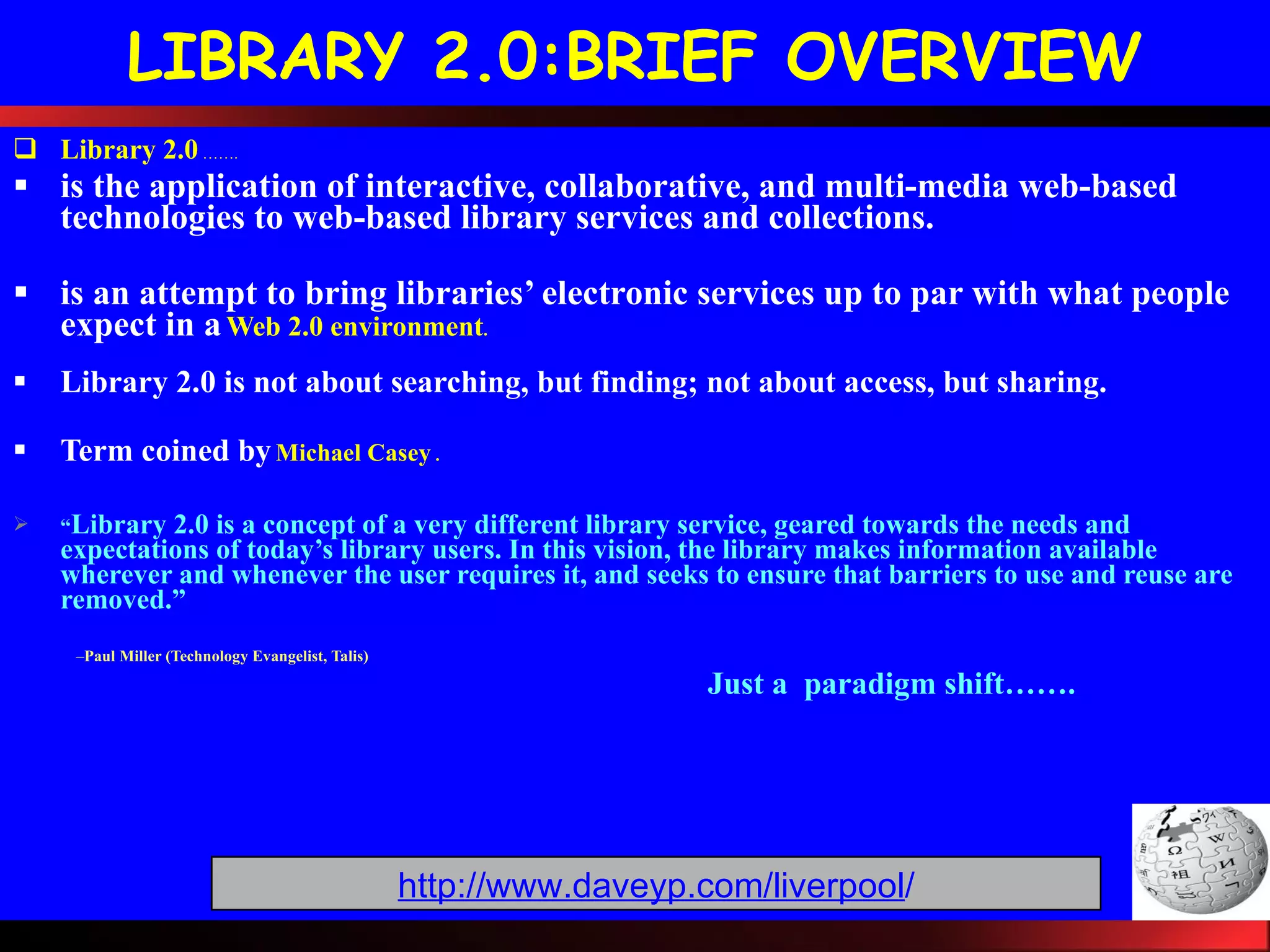
LIBRARY 2.0:BRIEF OVERVIEW Library 2.0  ……. is the application of interactive, collaborative, and multi-media web-based technologies to web-based library services and collections. is an attempt to bring libraries’ electronic services up to par with what people expect in a   Web 2.0 environment . Library 2.0 is not about searching, but finding; not about access, but sharing.   Term coined  by   Michael Casey  . “ Library 2.0 is a concept of a very different library service, geared towards the needs and expectations of today’s library users. In this vision, the library makes information available wherever and whenever the user requires it, and seeks to ensure that barriers to use and reuse are removed.” Paul Miller (Technology Evangelist, Talis) Just a  paradigm shift……. http://www.daveyp.com/liverpool /
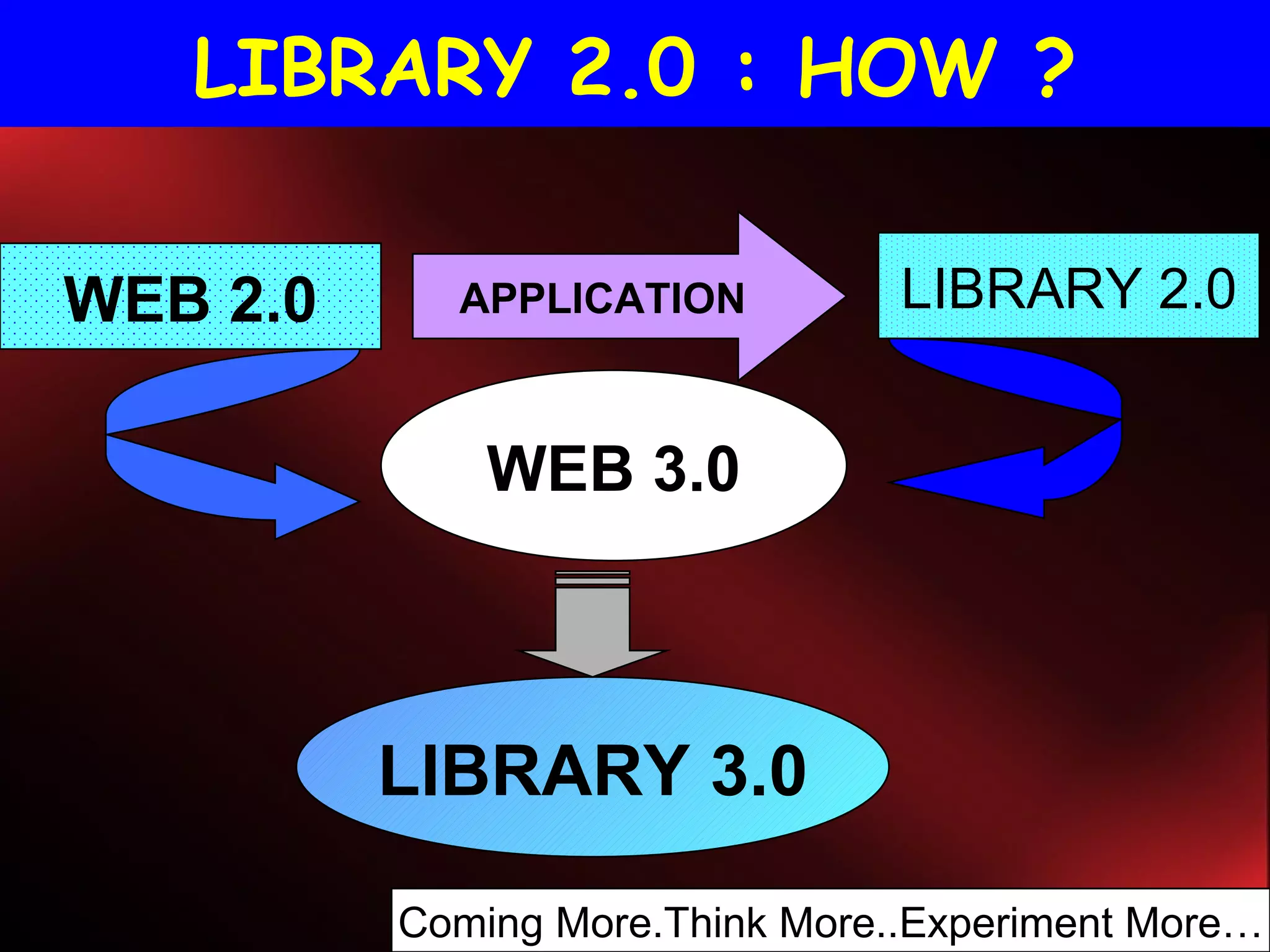
LIBRARY 2.0 : HOW   ? WEB 2.0 APPLICATION LIBRARY 2.0 LIBRARY 3.0 WEB 3.0 Coming More.Think More..Experiment More…
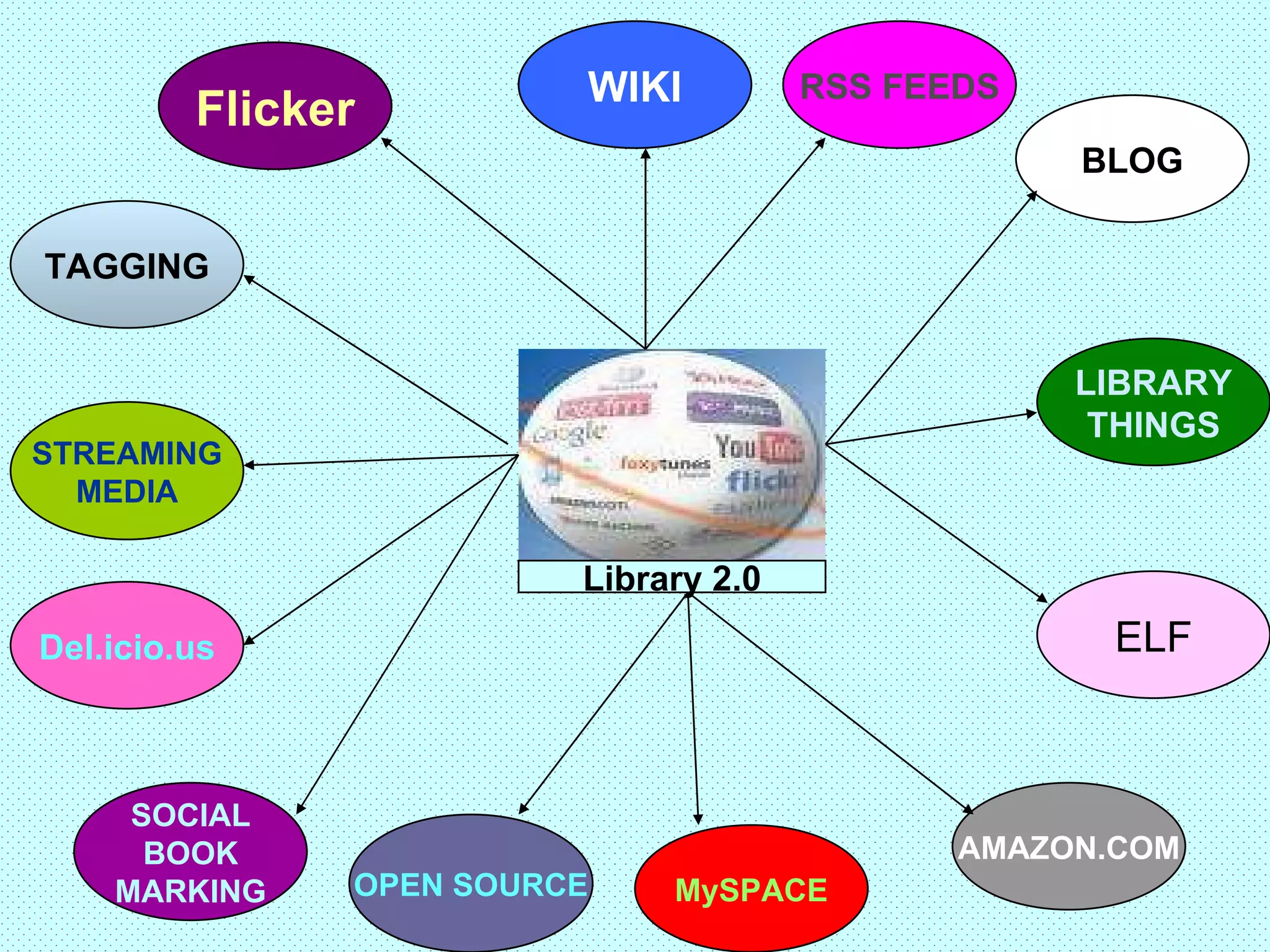
Library 2.0 WIKI MySPACE RSS FEEDS BLOG LIBRARY THINGS AMAZON.COM ELF OPEN SOURCE Flicker TAGGING Del.icio.us SOCIAL BOOK MARKING STREAMING MEDIA
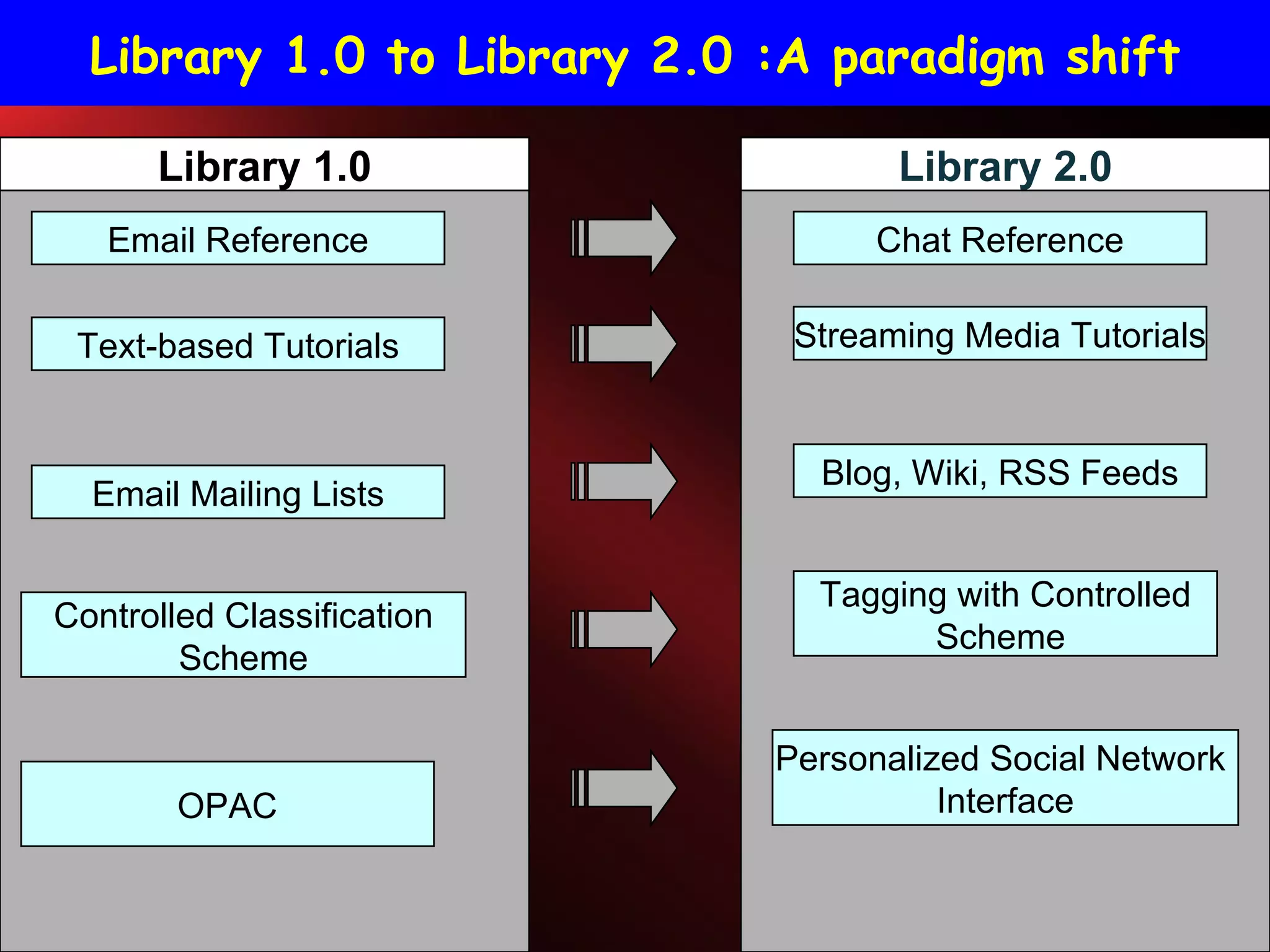
Library 1.0 to Library 2.0 :A paradigm shift Library 1.0 Library 2.0 Email Reference Text-based Tutorials Email Mailing Lists Controlled Classification Scheme OPAC Personalized Social Network  Interface Tagging with Controlled Scheme  Blog, Wiki, RSS Feeds Streaming Media Tutorials Chat Reference
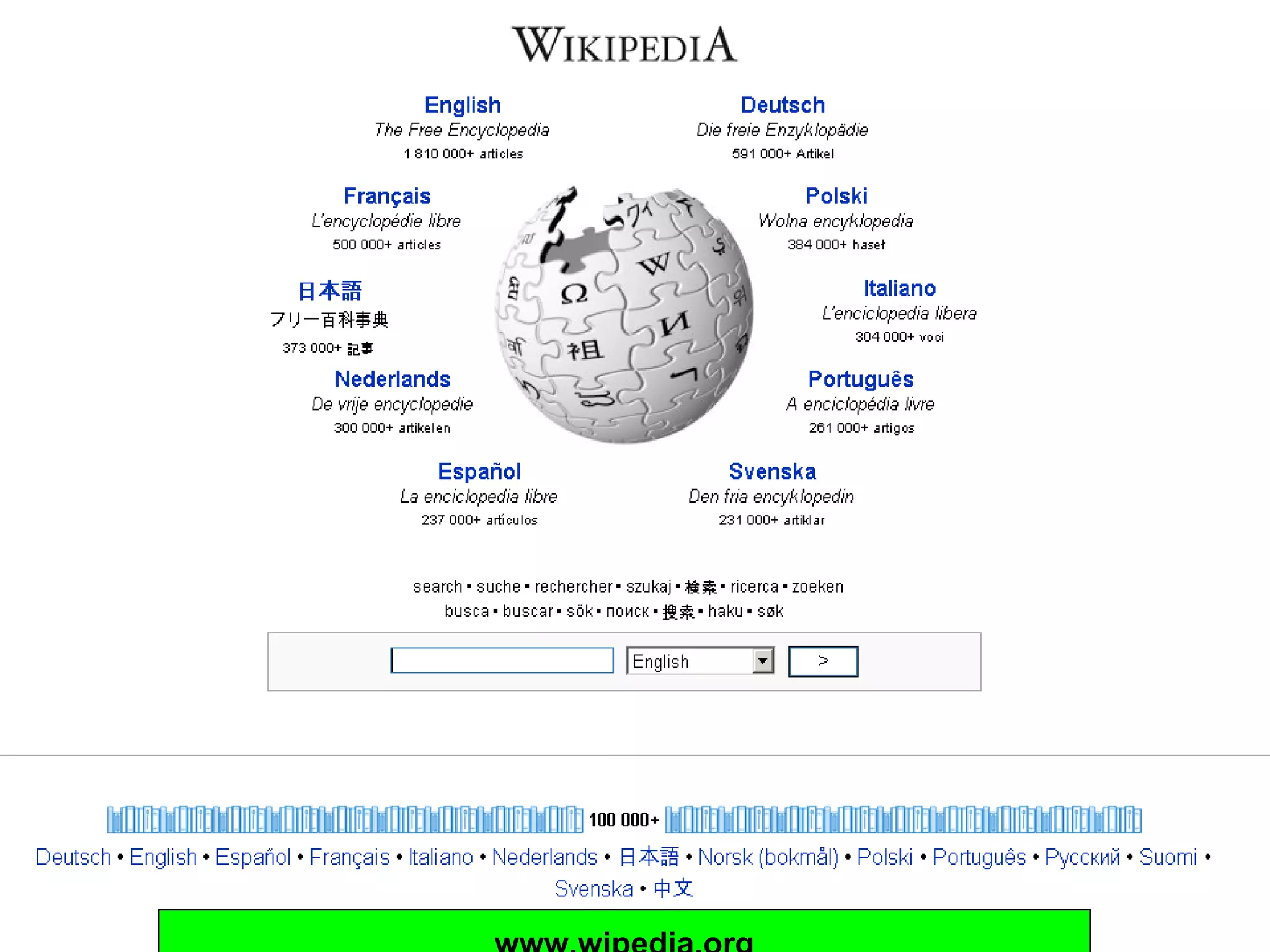
Wiki A freely expandable collection of interlinked web pages, a hypertext for storing and modifying information . A tool that allows a group of people to quickly create and edit a website together . Best example is   Wikipedia Explored by   Ward Cunningham   ( Father of Wiki )  in   1995.
www.wipedia.org
Wiki : Why significant? Easy to create, add and customized content More room for content and content edition Organize by categorizes More Collaboration  Searchable Huge potential for building community View recently changes pages at the movement Quick installation and quick creation of community page
Wiki : Features Wikis  maximize interplay .   Wikis are  democratic   Wikis work in  real time .  Wiki technology is  text-based.   Wikis permit  public document construction  . Wikis  complicate the evaluation of writing  . Wikis promote  negotiation . Wikis permit  collaborative  document editing, or  open editing .  Wikis make  feedback intensely public  and potentially durable.  Wikis work on  volunteer collaboration . Wikis endorse  particular ways of writing .   Wikis enable  complete anonymity .
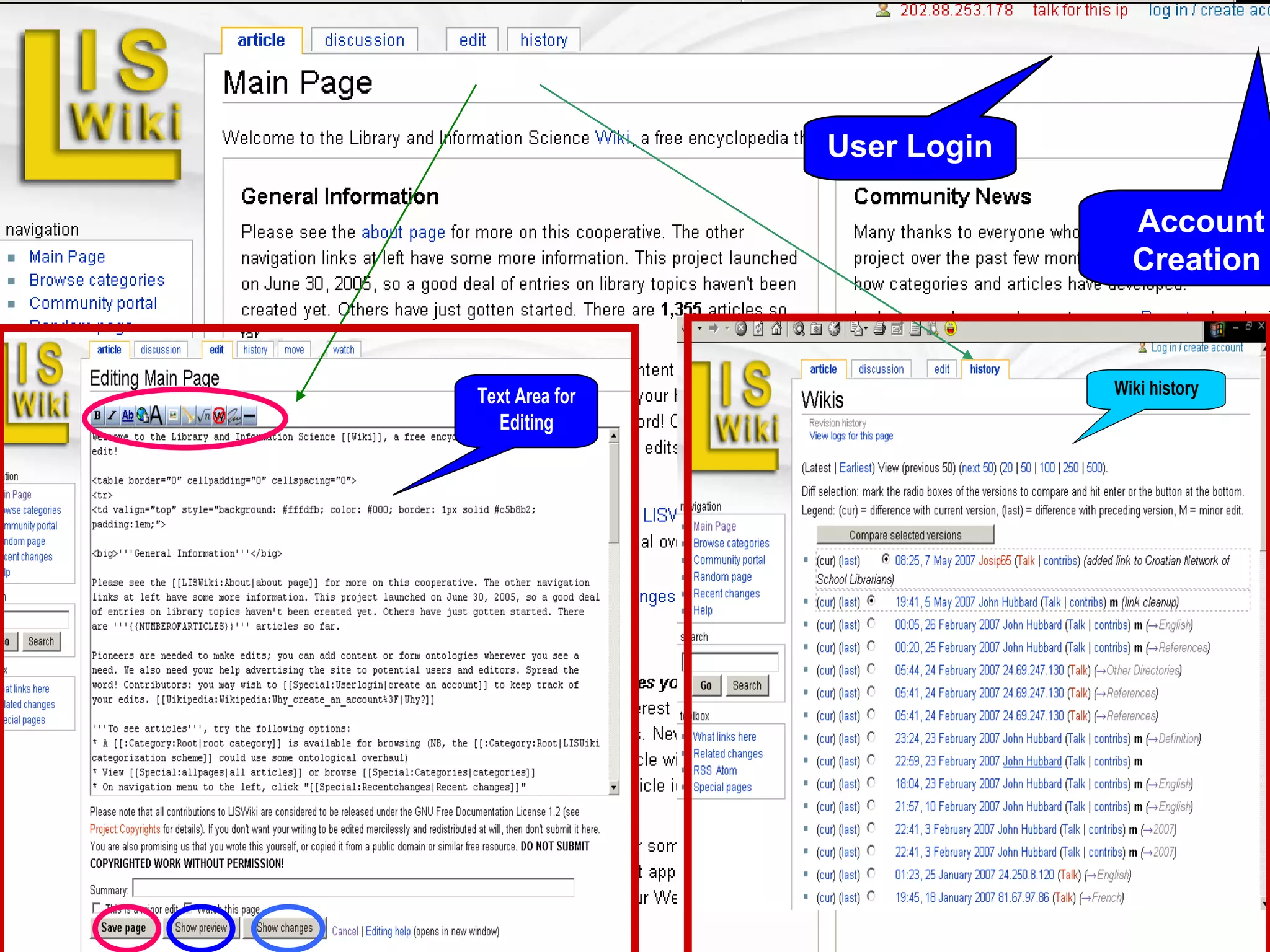
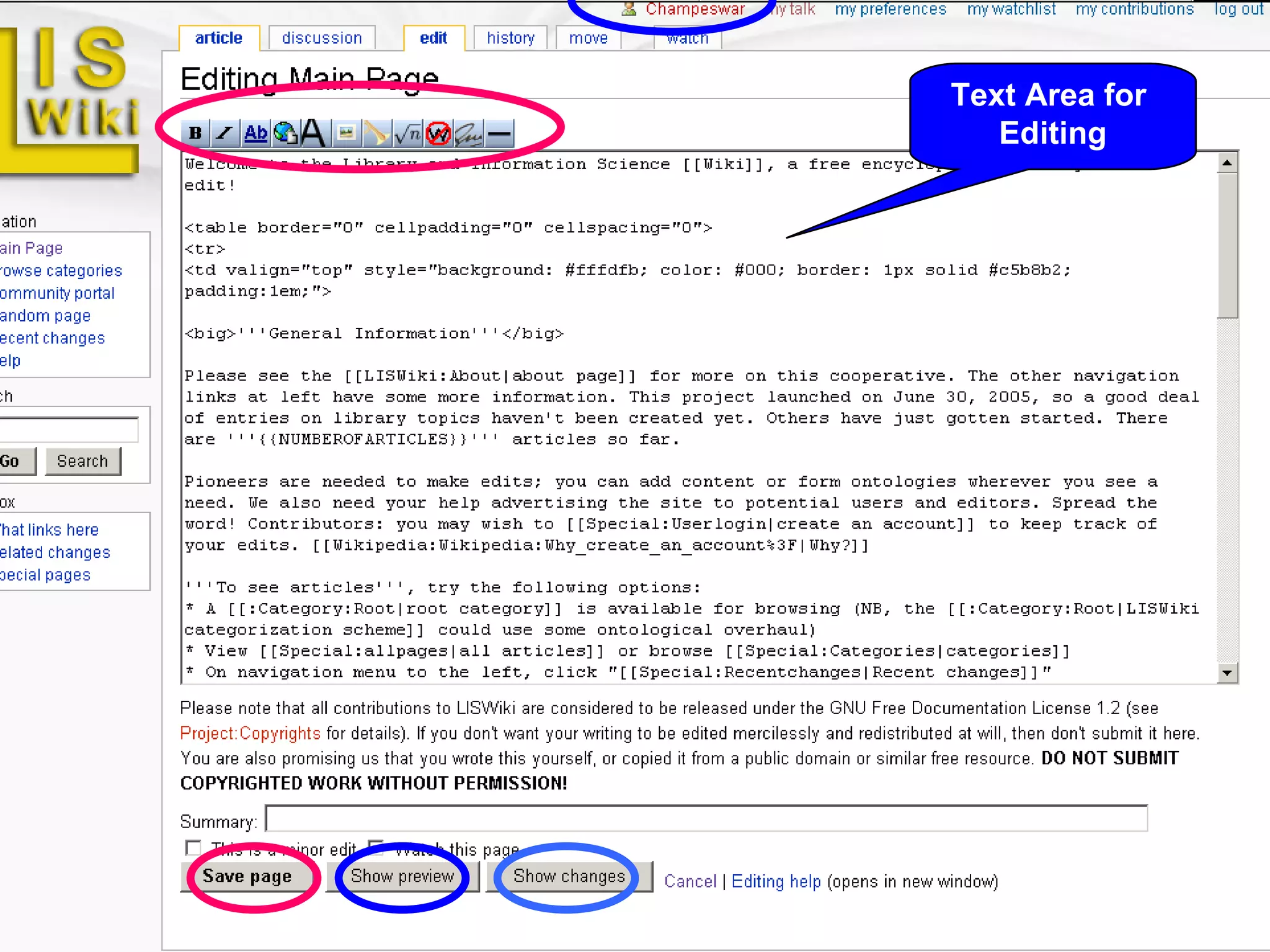
Account Creation  User Login
Text Area for  Editing
Wiki Offers You… Asynchronous benefit of incorporating the  assistance of experts, peers and other professionals Facilitate the  exchange of ideas  for small group  projects Provides for a more  creative environment and expanding knowledgebase  in project management   Increase  communication efficiency and productivity  over ‘back-and-forth’ exchanges of e-mail attachments and discussion boards Provide a way to  get everyone on the same page  through the writable Web Harness the power of  diverse individuals  to create collaborative works  provide individuals with a forum for improving  knowledge and advancing thought processes Form  collaborative social research communities  with respect to project management, and  provide innovative  reference repositories  for all aspects of planning, operation, and implementation Resource support  to faculty, students and professionals Online collaboration  in e-learning environment.
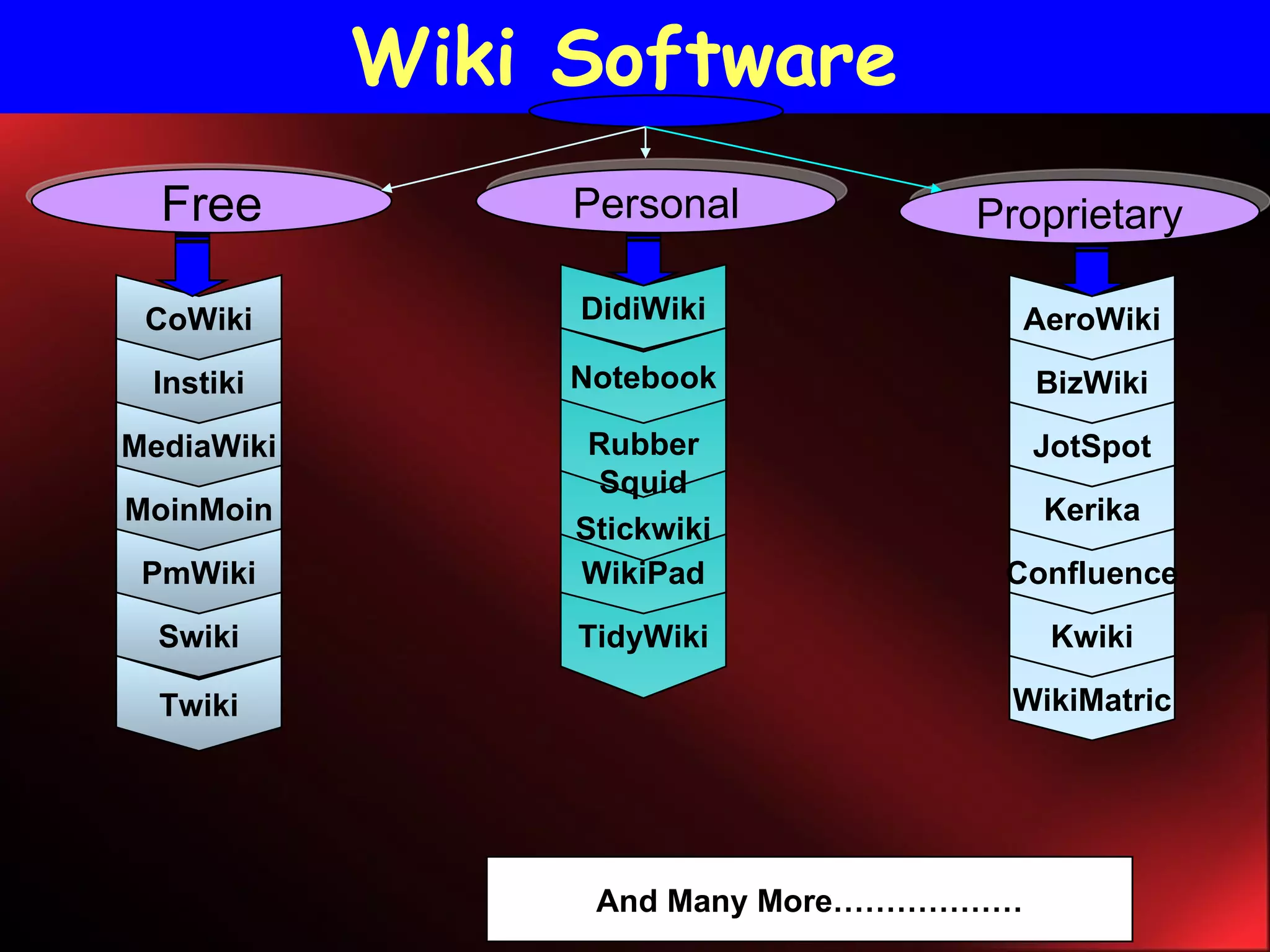
Wiki Software   Personal Proprietary Free TidyWiki WikiPad Stickwiki Rubber Squid Notebook DidiWiki Kwiki Confluence Kerika JotSpot BizWiki AeroWiki WikiMatric Swiki PmWiki MoinMoin MediaWiki Instiki CoWiki Twiki And Many More………………
Some Top Wiki Engines.. Mediawiki http://en.wikipedia.org/wiki/MediaWiki   PmWiki http://www.pmichaud.com/wiki/PmWiki/   MoinMoin http://moinmoin.wikiweb.de/ TikiWiki http://tikiwiki.org/tiki-index.php   UseModWiki http://www.usemod.com/cgi-bin/wiki.pl
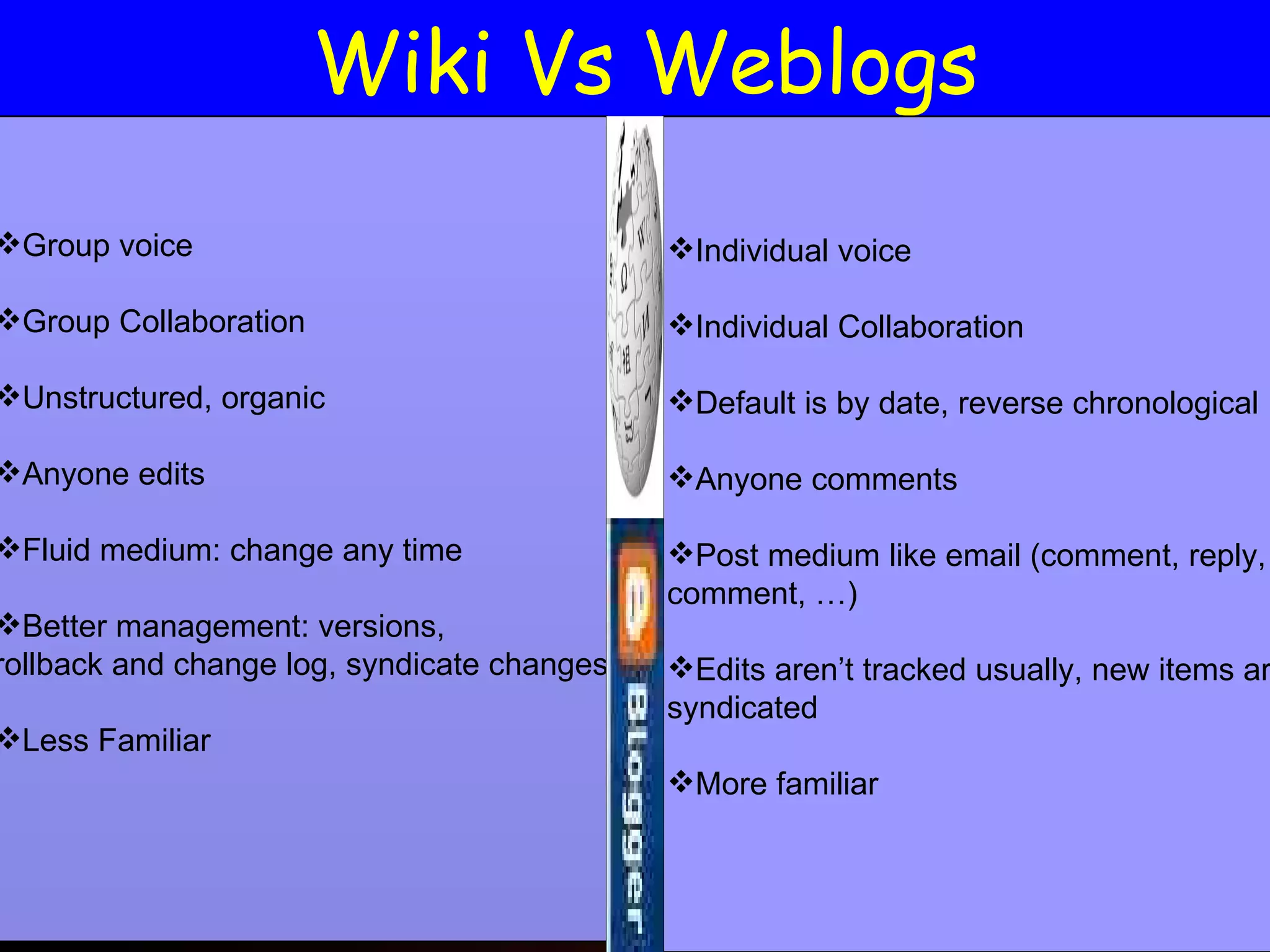
Wiki Vs Weblogs Group voice Group Collaboration Unstructured, organic Anyone edits Fluid medium: change any time Better management: versions,  rollback and change log, syndicate changes Less Familiar Individual voice Individual Collaboration  Default is by date, reverse chronological Anyone comments Post medium like email (comment, reply,  comment, …) Edits aren’t tracked usually, new items are  syndicated More familiar
Wiki Designing Principles Open  -  Should a page be found to be incomplete or poorly organized, any reader can edit it as they see fit.  Incremental  - Pages can cite other pages, including pages that have not been written yet.  Organic  - The structure and text content of the site are open to editing and evolution. Observable  - Activity within the site can be watched and reviewed by any other visitor to the site.  More Principles……..  http://www.c2.com/cgi/wiki?WikiDesignPrinciples
Wiki Selection Criteria Cost -  open source , license fees Complexity - online technical support, email help, user community Control - user registration, password protection, level of user, user  participation Clarity - pages creation, page deletion ,page hierarchic Features - langauges support,text editing,hyperlinking insertion, search facility, spell check, RSS
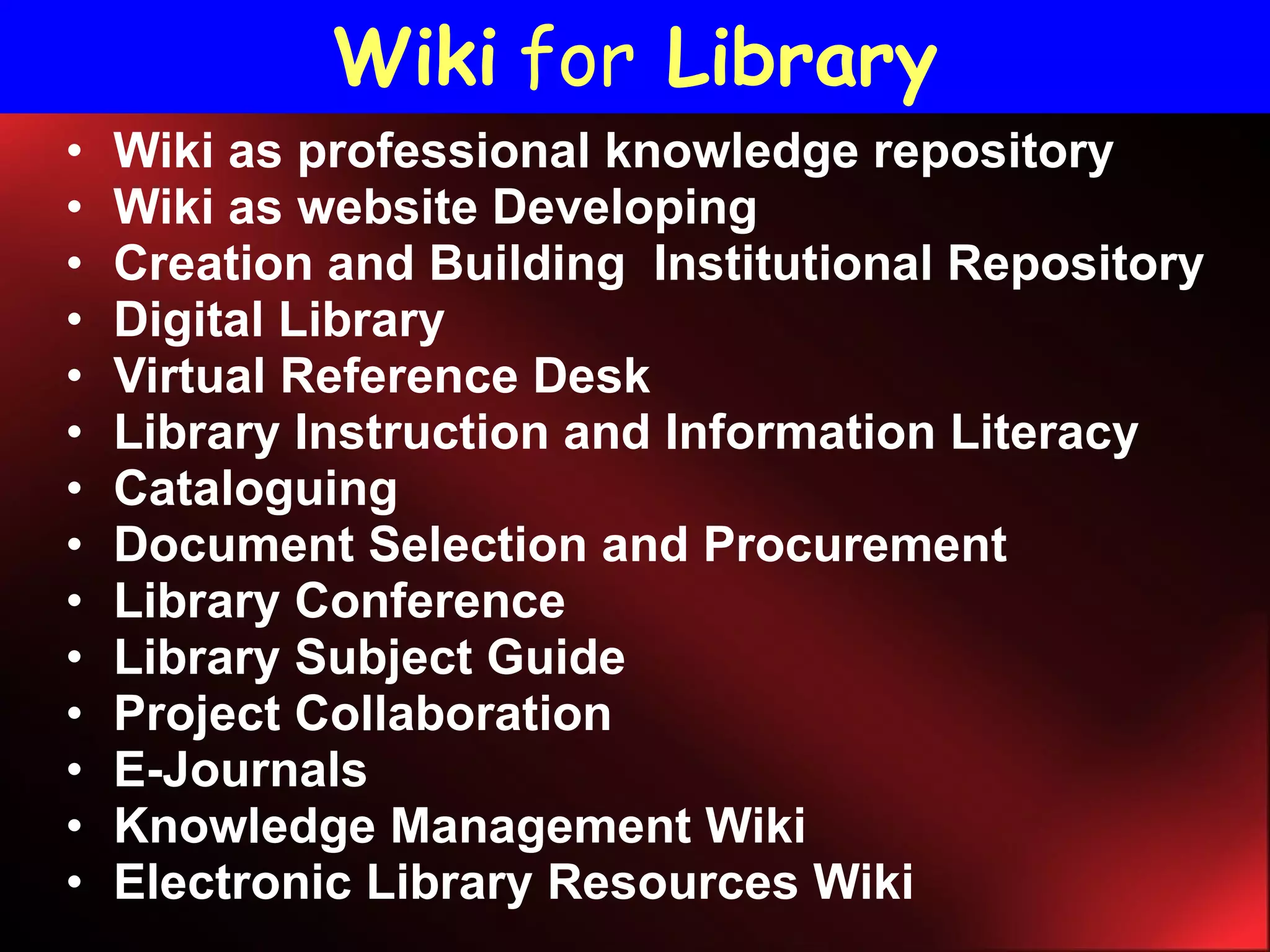
Wiki as professional knowledge repository Wiki as website Developing Creation and Building  Institutional Repository Digital Library  Virtual Reference Desk Library Instruction and Information Literacy Cataloguing  Document Selection and Procurement Library Conference Library Subject Guide Project Collaboration E-Journals  Knowledge Management Wiki Electronic Library Resources Wiki Wiki   for   Library
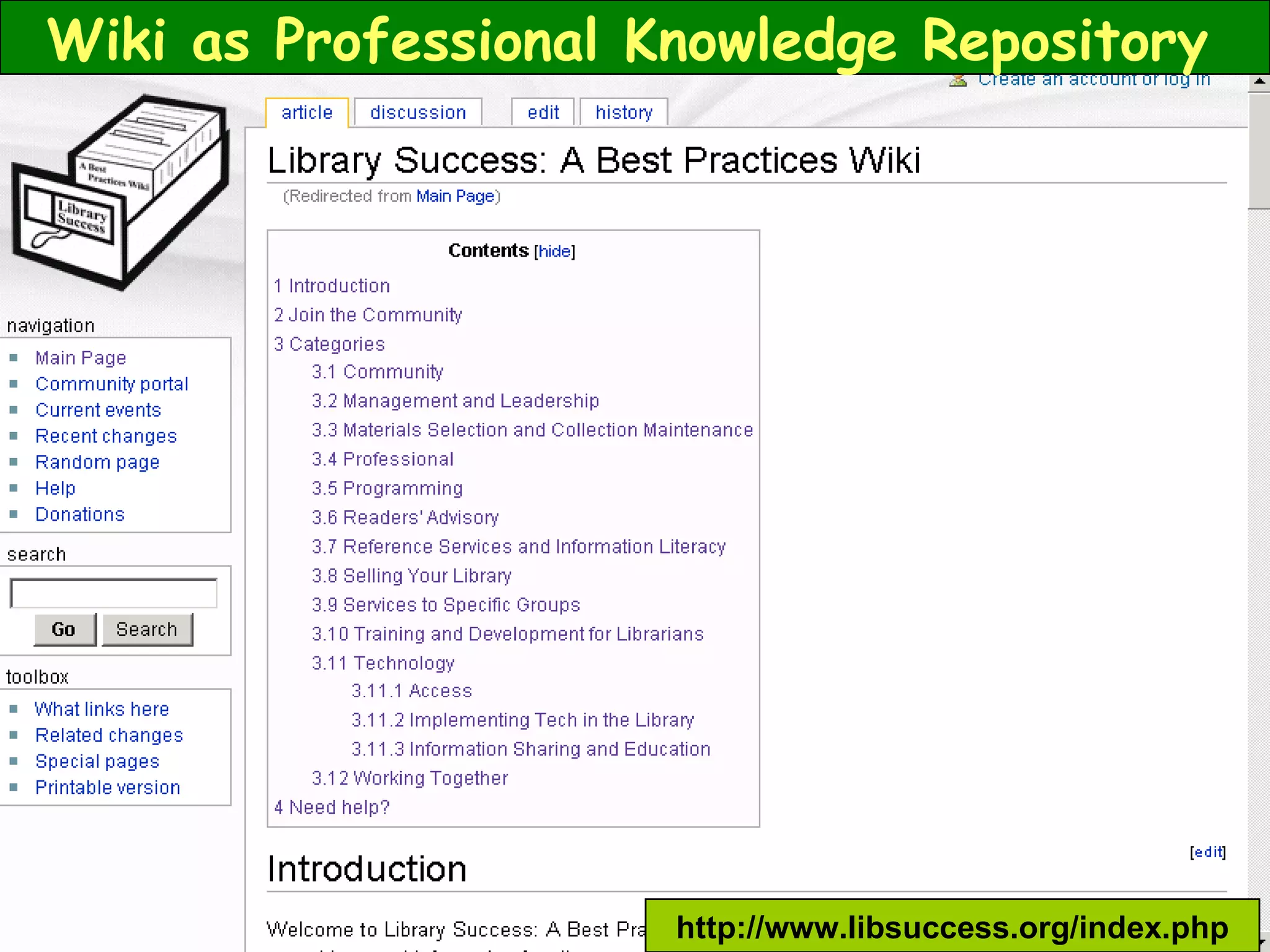
Wiki as Professional Knowledge Repository   http://www.libsuccess.org/index.php
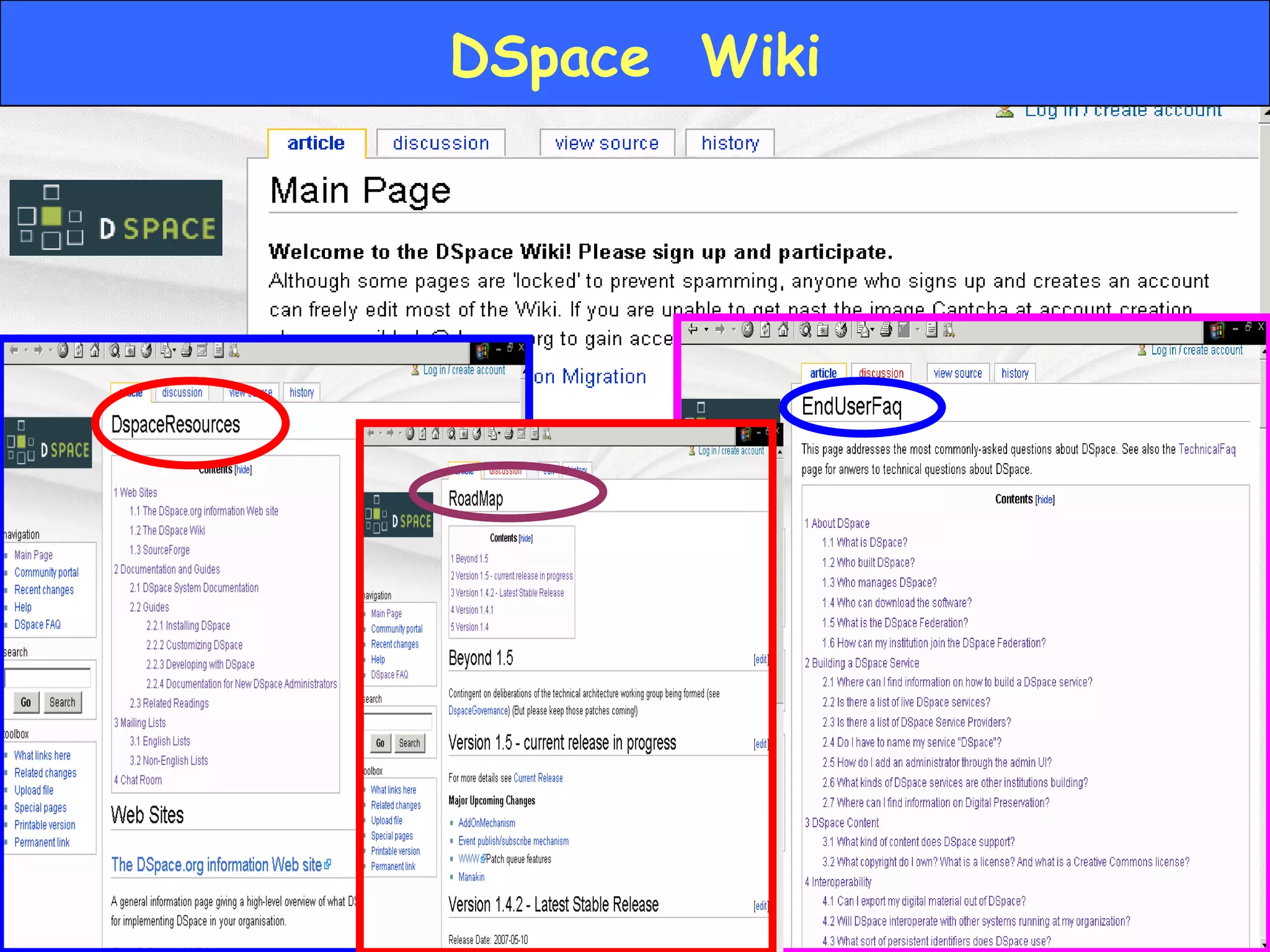
DSpace  Wiki
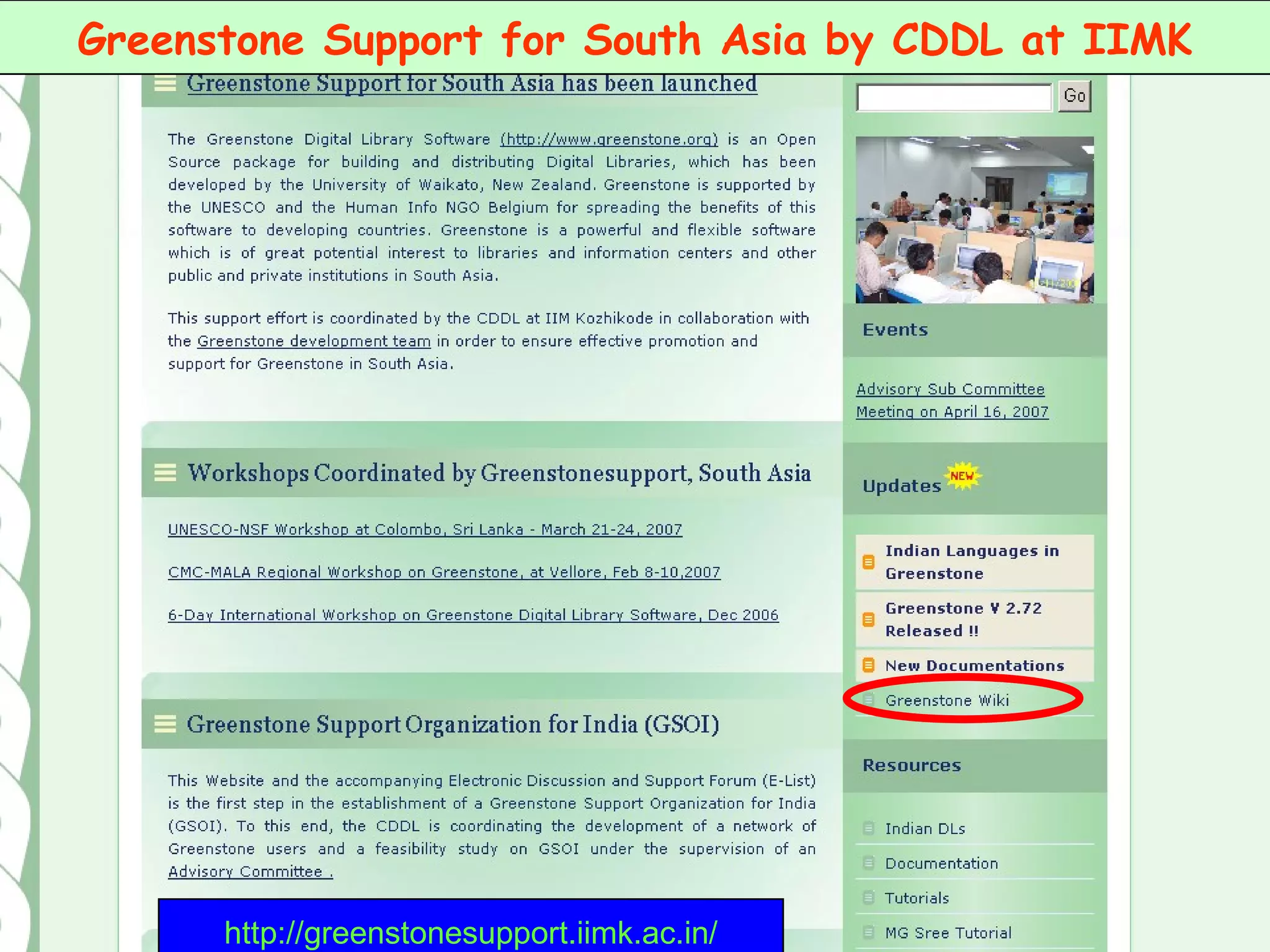
Greenstone Support for South Asia by CDDL at IIMK http://greenstonesupport.iimk.ac.in/
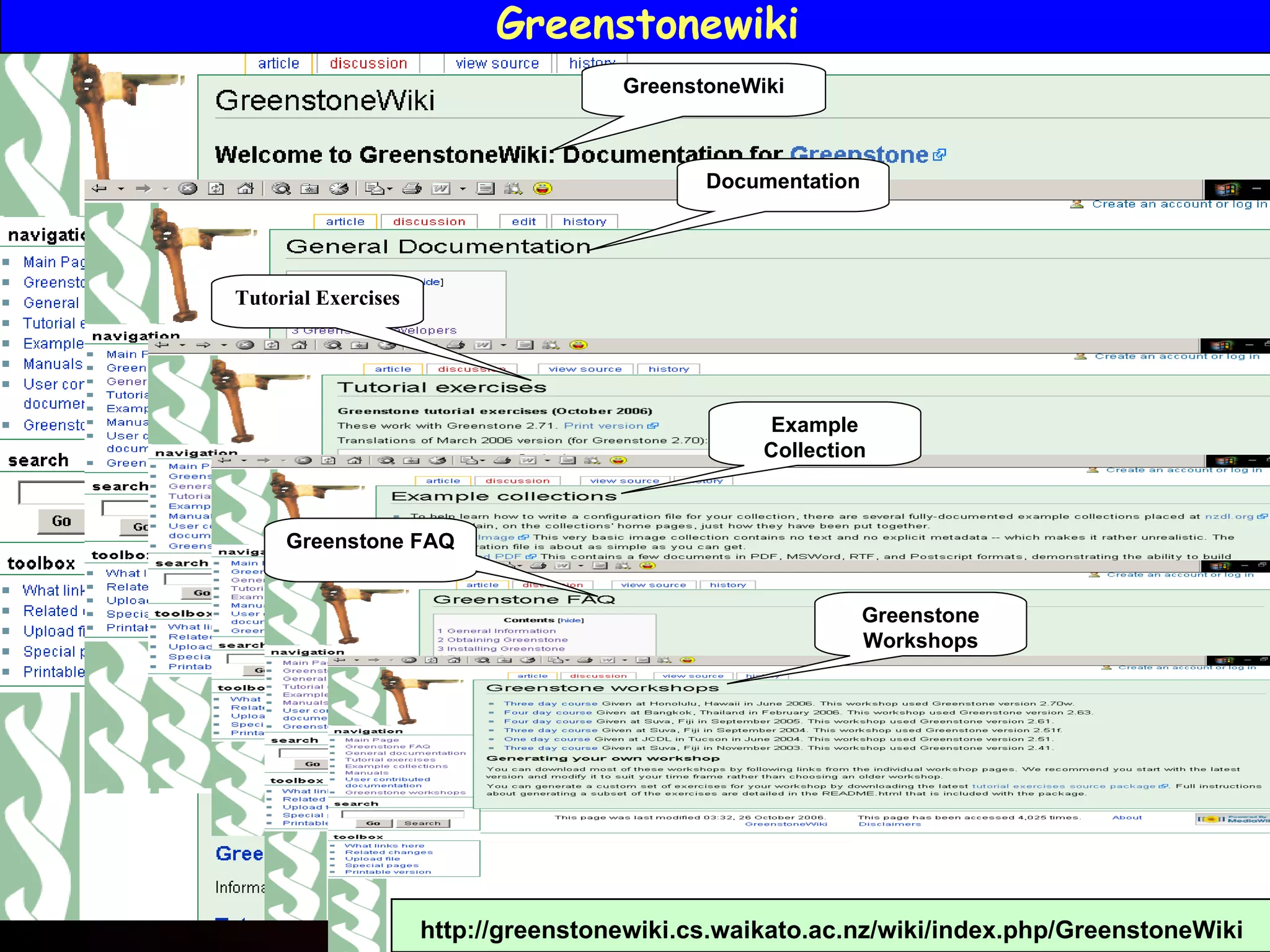
GreenstoneWiki Documentation Example Collection Greenstone FAQ Greenstone Workshops Tutorial Exercises Greenstonewiki  http://greenstonewiki.cs.waikato.ac.nz/wiki/index.php/GreenstoneWiki
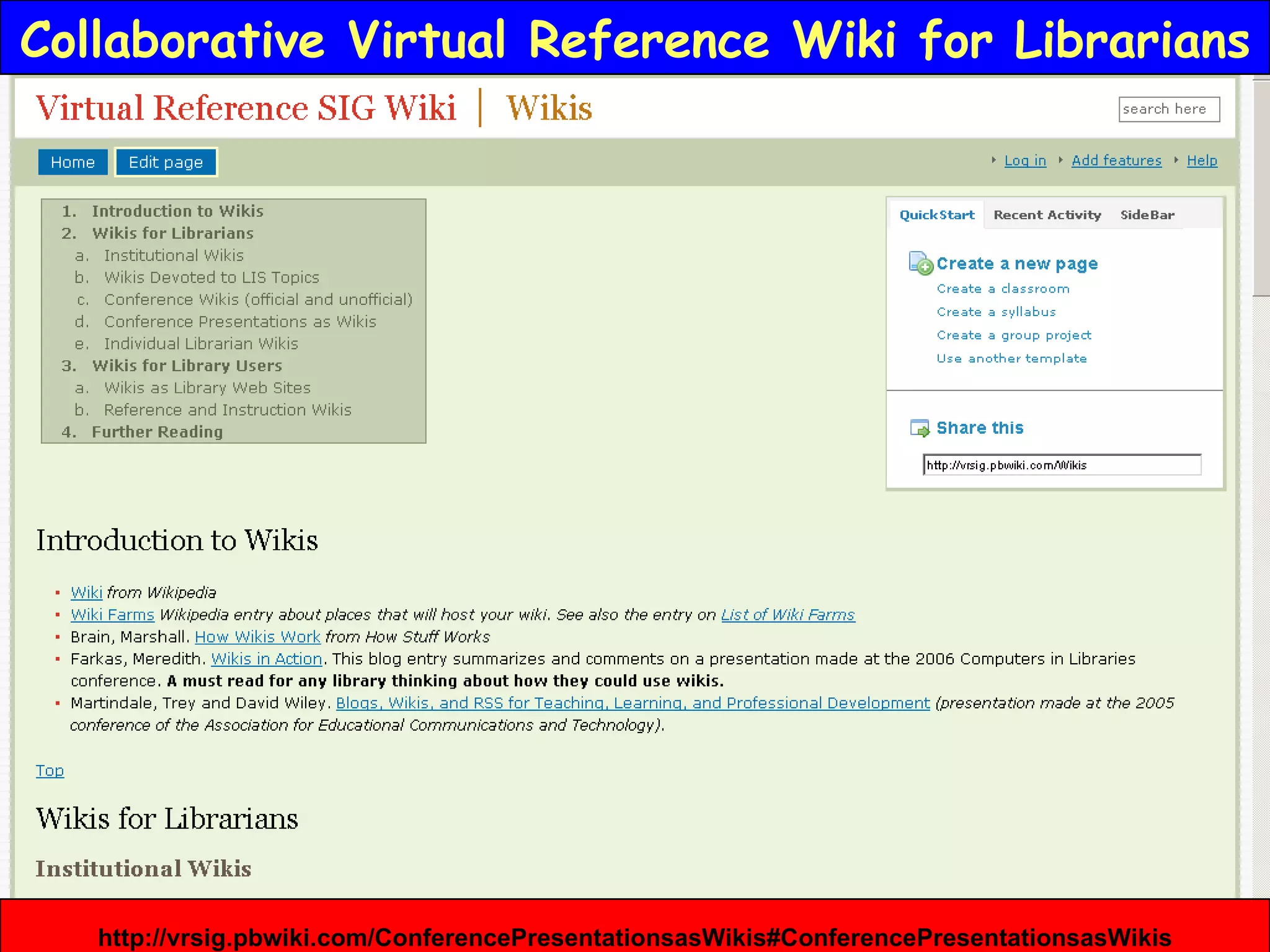
Collaborative Virtual Reference Wiki for Librarians http://vrsig.pbwiki.com/ConferencePresentationsasWikis#ConferencePresentationsasWikis
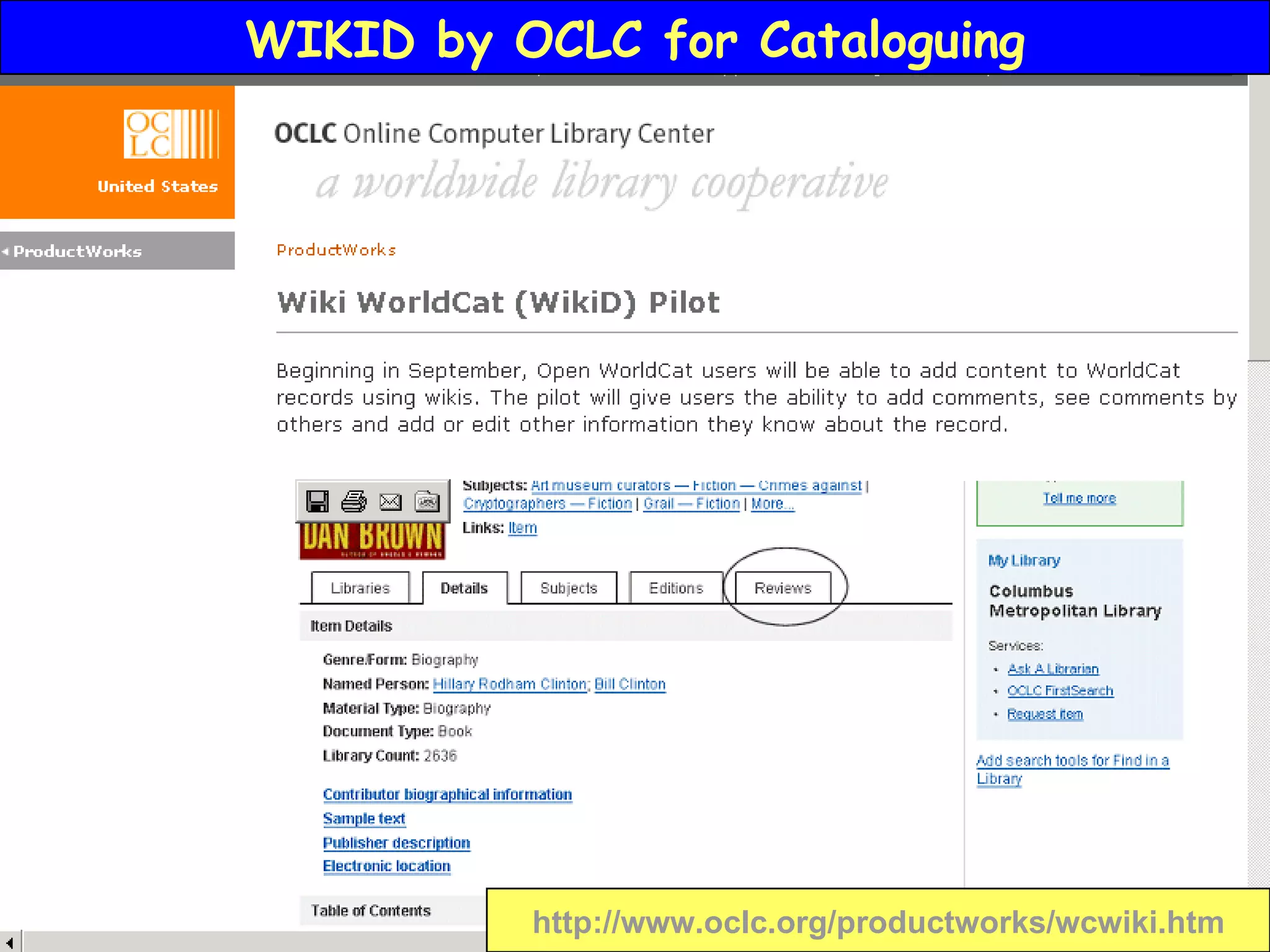
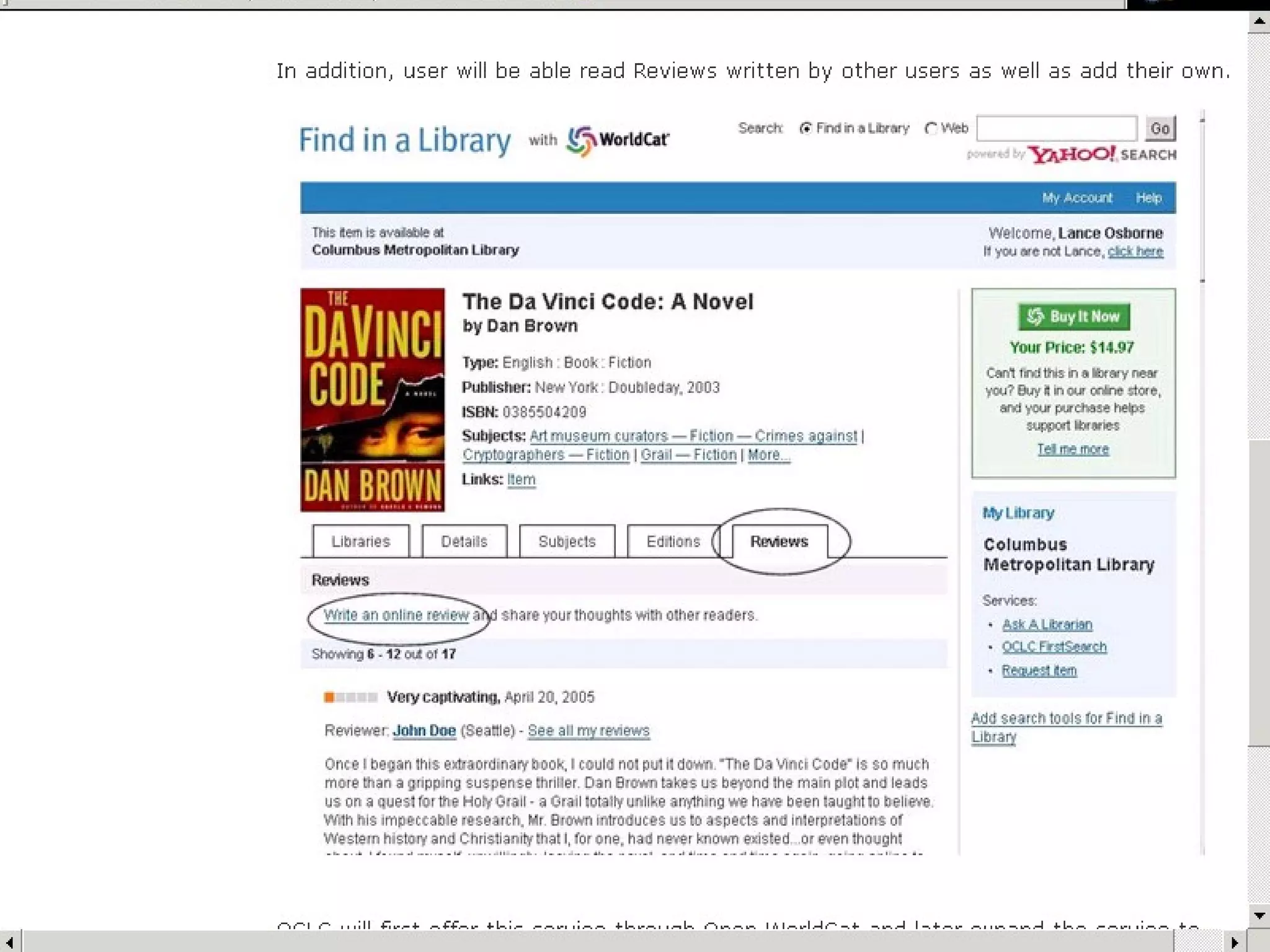
WIKID by OCLC for Cataloguing http://www.oclc.org/productworks/wcwiki.htm
 
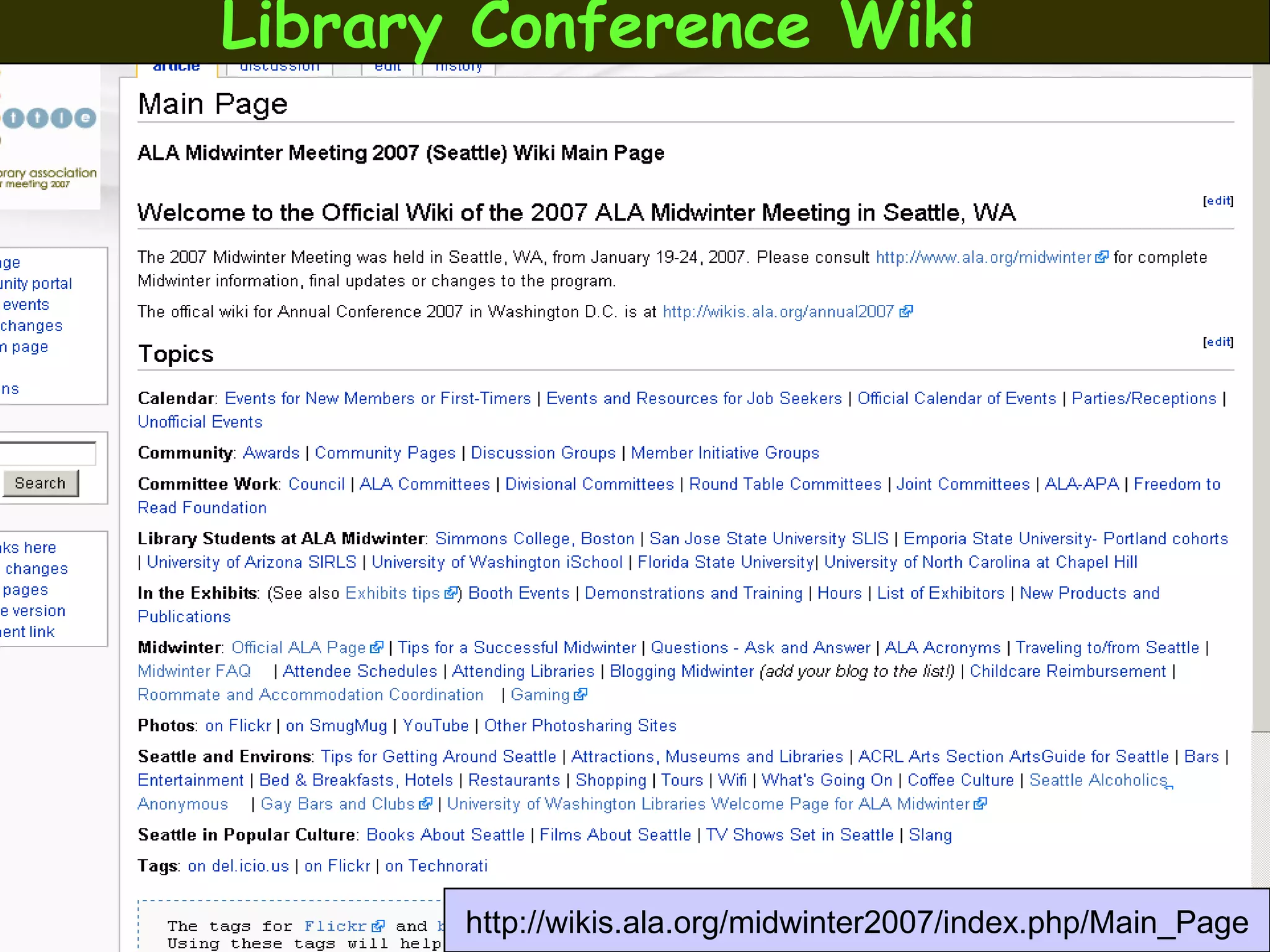
Library Conference Wiki http://wikis.ala.org/midwinter2007/index.php/Main_Page
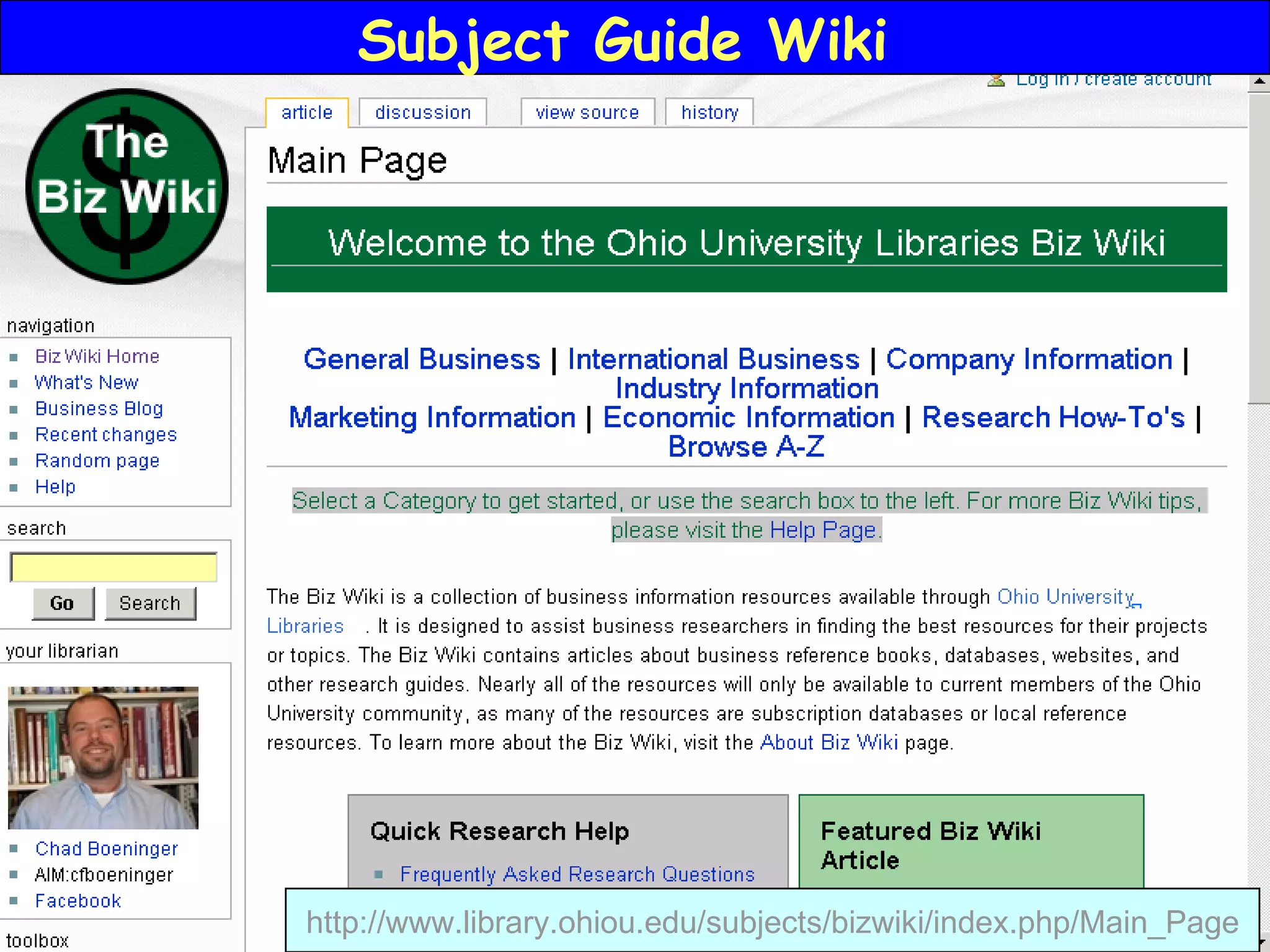
Subject Guide Wiki  http://www.library.ohiou.edu/subjects/bizwiki/index.php/Main_Page
 
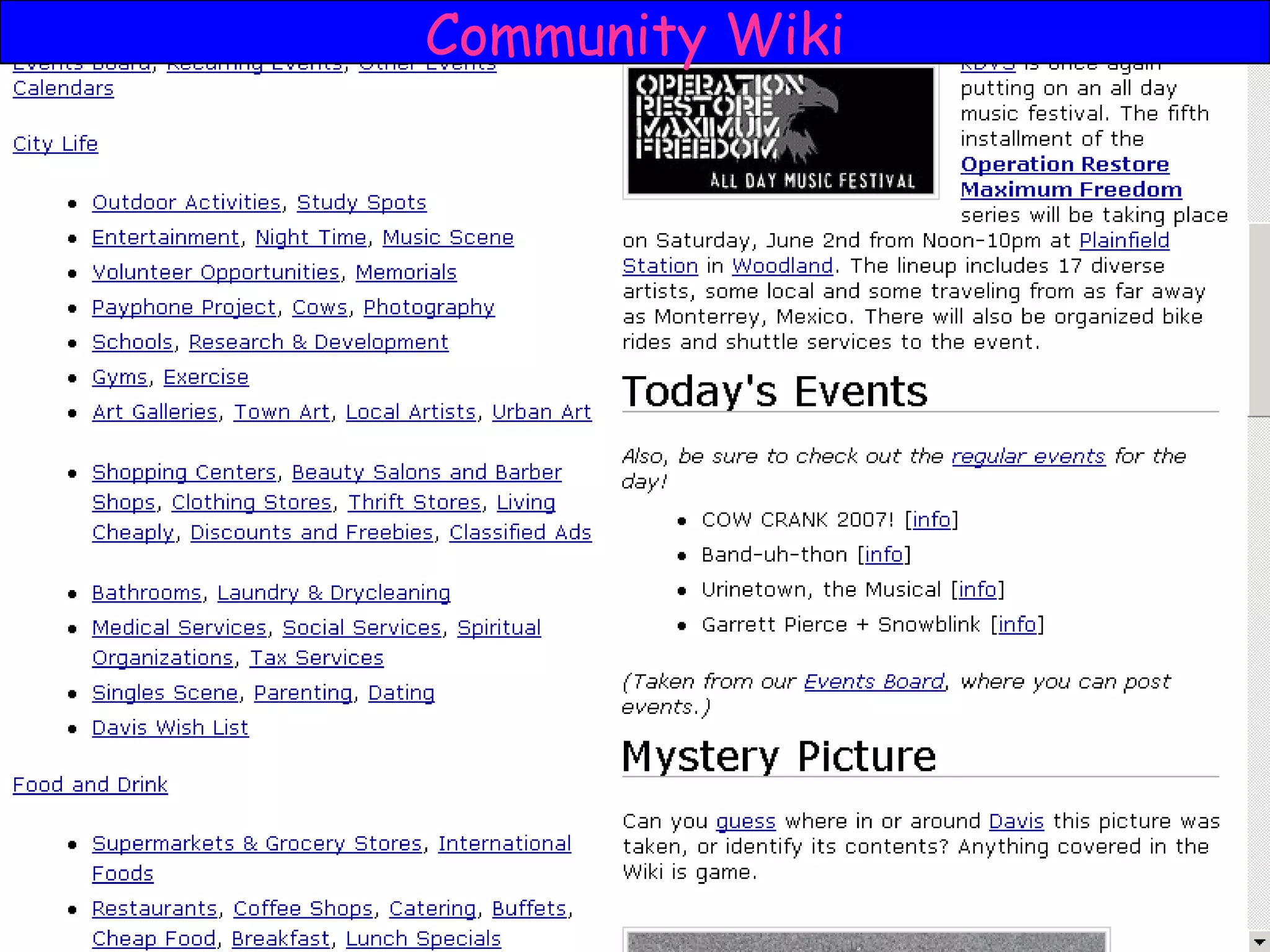
Community Wiki
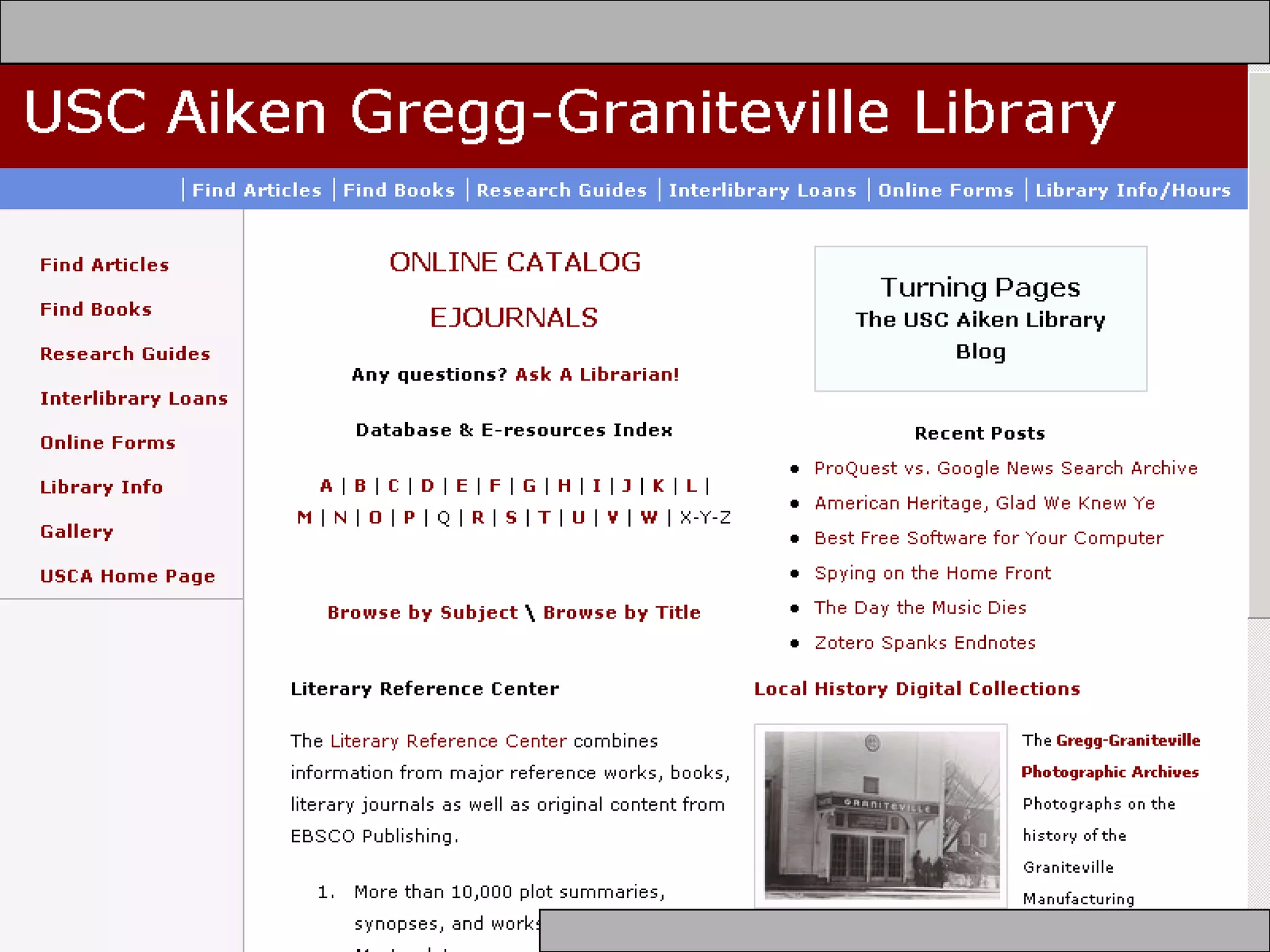
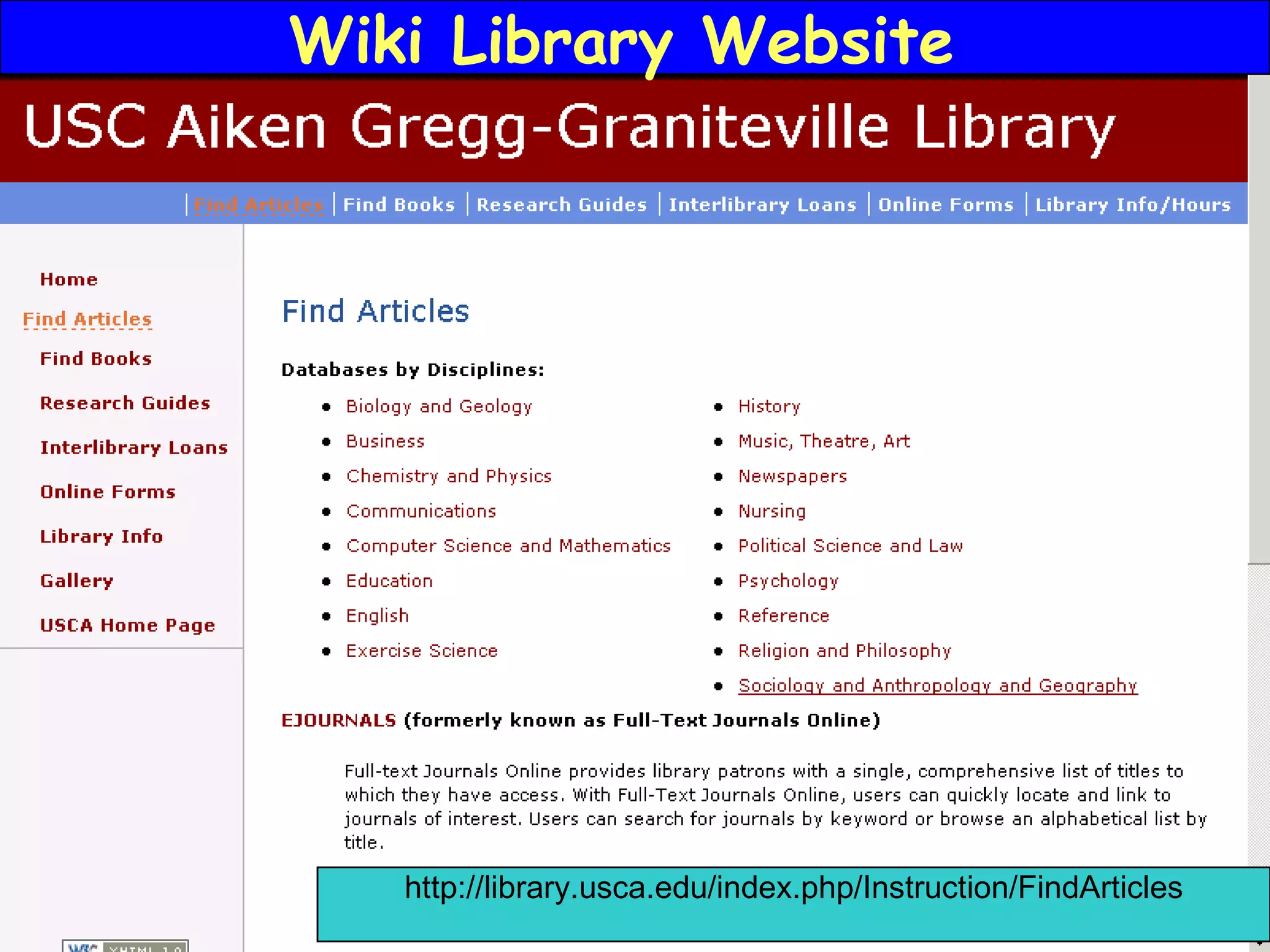
Wiki Library Website  http://library.usca.edu/index.php/Instruction/FindArticles
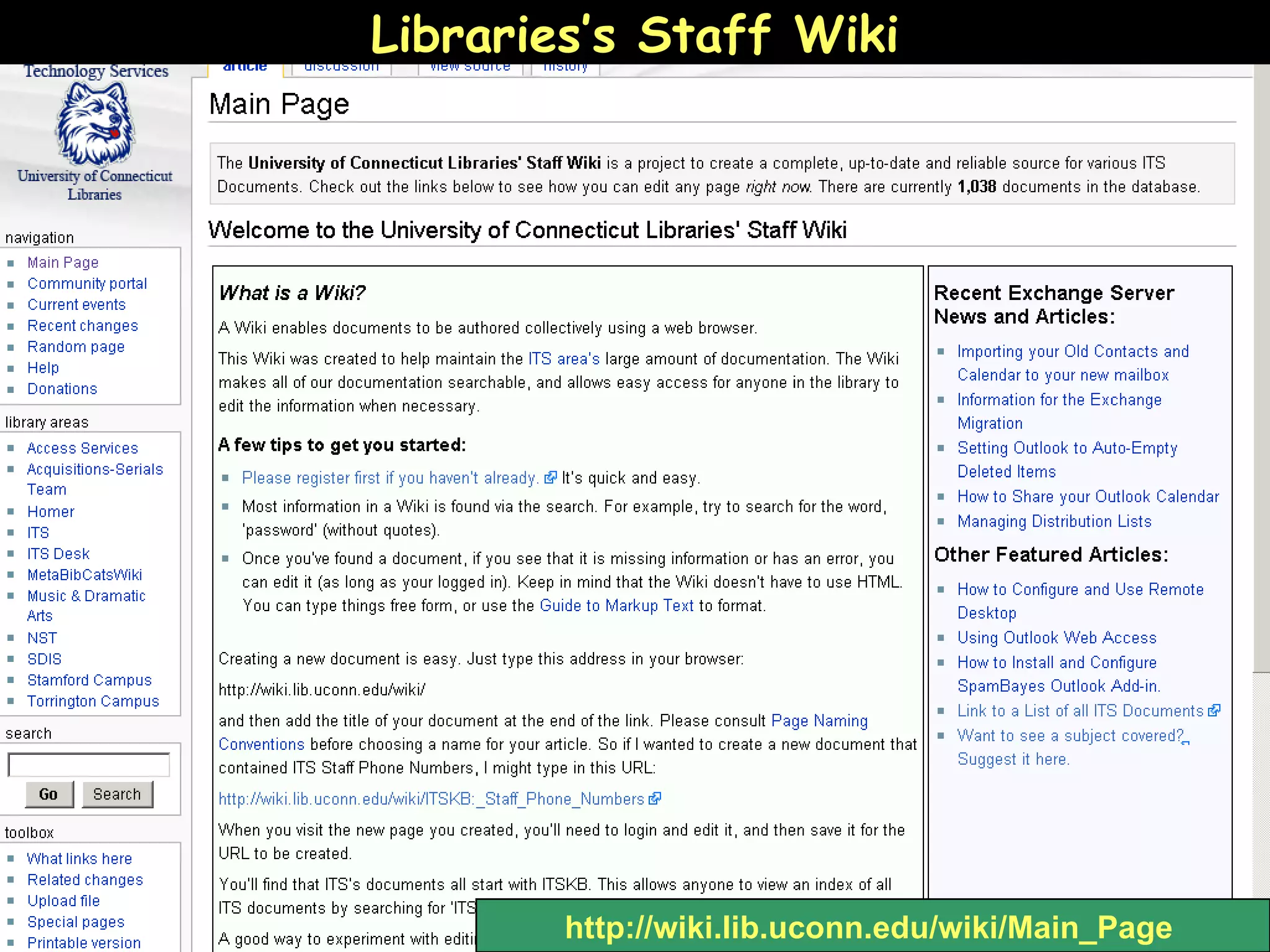
Libraries’s Staff Wiki http://wiki.lib.uconn.edu/wiki/Main_Page
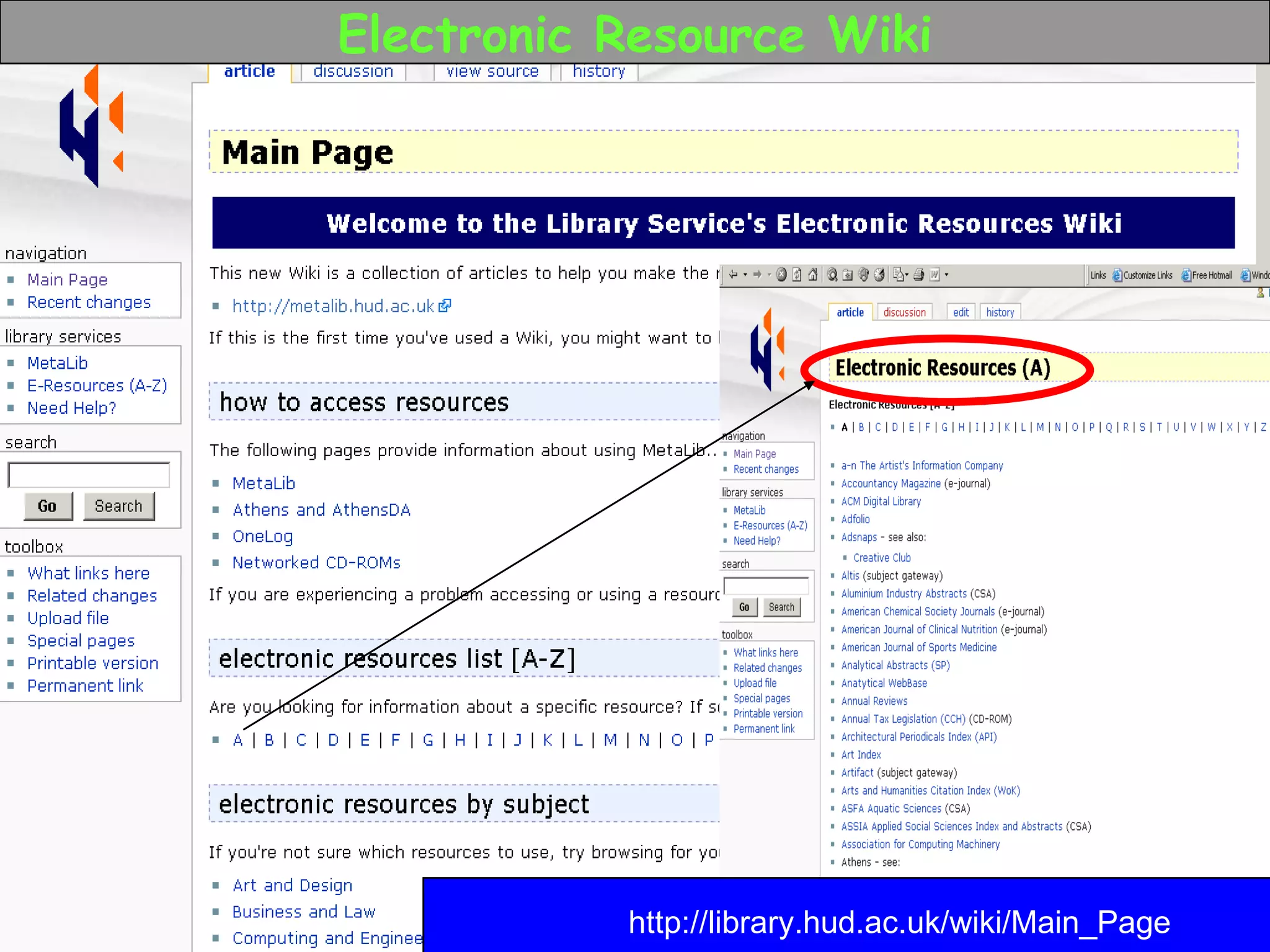
Electronic Resource Wiki http://library.hud.ac.uk/wiki/Main_Page
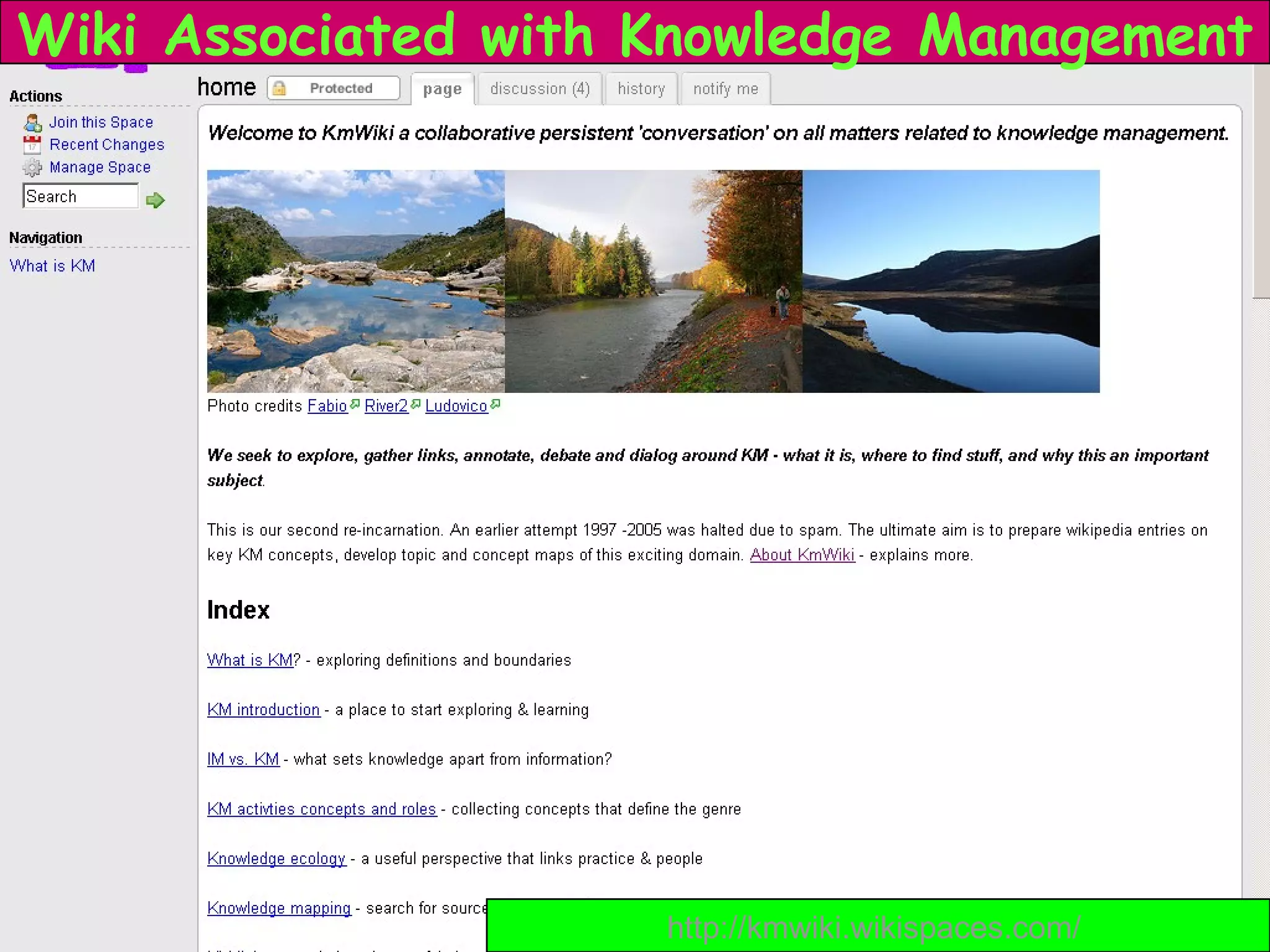
Wiki Associated with Knowledge Management http://kmwiki.wikispaces.com/
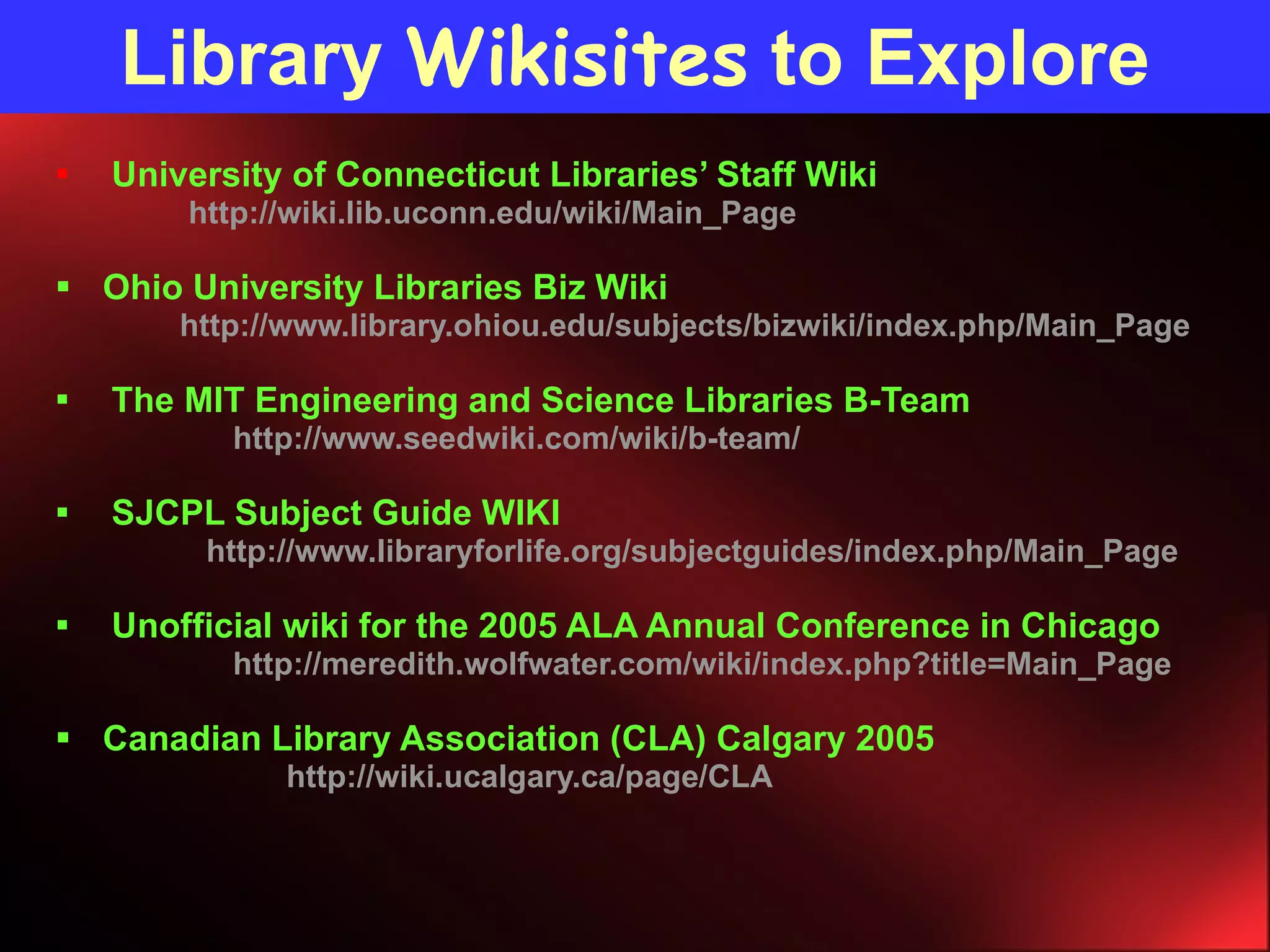
Library  Wikisites  to Explore University of Connecticut Libraries’ Staff Wiki http://wiki.lib.uconn.edu/wiki/Main_Page Ohio University Libraries Biz Wiki http://www.library.ohiou.edu/subjects/bizwiki/index.php/Main_Page The MIT Engineering and Science Libraries B-Team http://www.seedwiki.com/wiki/b-team/ SJCPL Subject Guide WIKI http://www.libraryforlife.org/subjectguides/index.php/Main_Page Unofficial wiki for the 2005 ALA Annual Conference in Chicago http://meredith.wolfwater.com/wiki/index.php?title=Main_Page Canadian Library Association (CLA)  Calgary 2005 http://wiki.ucalgary.ca/page/CLA
Library Wiki: Some Key Considerations Wiki must have some specific purposes Advertised and Market your wiki before user Be very explicit in your instruction and disclaimers Think and avoid spam Wiki administrators must have self control for accessing and editing wiki Be specific while choosing software
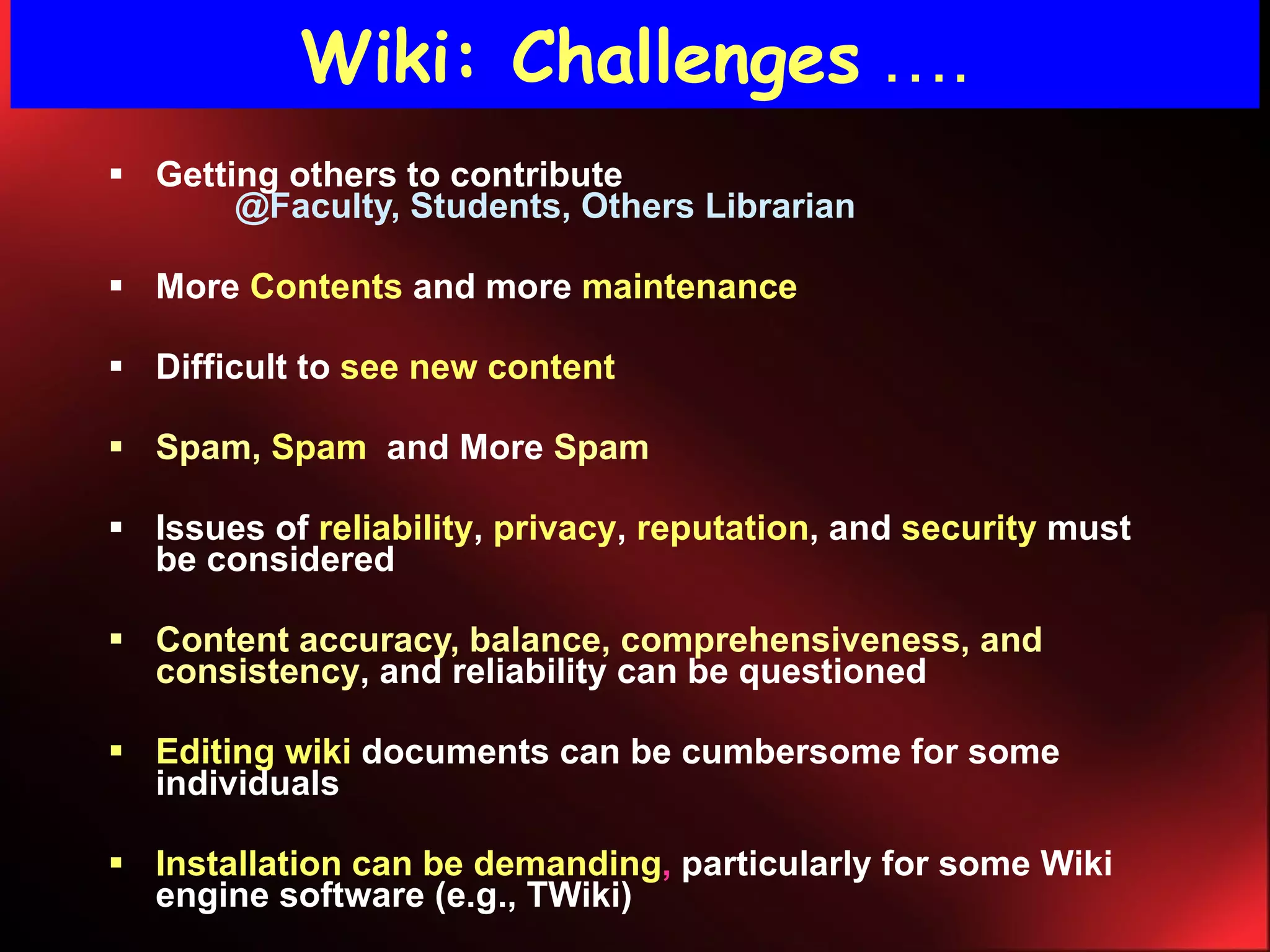
Wiki: Challenges   …. Getting others to contribute  @Faculty, Students, Others Librarian More   Contents   and more   maintenance   Difficult to   see new content Spam,   Spam   and More   Spam Issues of   reliability ,   privacy ,   reputation , and   security  must be considered Content accuracy, balance, comprehensiveness, and consistency , and reliability can be questioned Editing wiki   documents can be cumbersome for some individuals  Installation can be demanding ,  particularly for some Wiki engine software (e.g., TWiki)
Wiki Summary Wiki help support collaboration Tools are simple, quick and inexpensive Need more and more experiment Master before use Think for diverse workplaces @ Diverse users @ Diverse needs @ Diverse software choices Perhaps web 2.0 ‘s most relevant feature for the future of the “ virtual Library”
Thank You
Any Question ?

Wiki on Library Perspective

  • 1.
    Wiki on Library Perspectives By Champeswar Mishra IIM Kozhikode
  • 2.
    Agenda Web Generation: Brief Introduction Library 2.0 :What, Why and How? Wiki : An Overview Wiki Engines Wiki Software Wiki Vs Blog Wiki : Advantages and Disadvantages Wiki : Role in Library Wiki : Practicing Wiki For Library Practical Issues Wiki : Criterias on Choosing Wiki Software Conclusion
  • 3.
    Web Generation Itcan be broadly divided into three generation ……… Web 1.0 Web 2.0 Web 3.0 More Coming….
  • 4.
    Hierarchy of WebGeneration WEB 1.0 WEB 2.0 WEB 3.0 Email HTML Home Page Google Del.icio.us Flickr Library Thing YouTube Blogger RSS Feeds Wiki Portal Dialup Wires Taxonomy Automated Reasoning Cognitive Architecture Software agent Ontology Semantic Wiki Semantic Web Artificial Intelligence LEVEL 0 LEVEL 1 LEVEL 2 LEVEL 3
  • 5.
    Web 2.0 :What Does It Means… Is the second generation of web based communities and hosted services that facilitate collaboration and sharing resources in Web world. It means achieving the original vision of the web in the next phase – the real transformation rather than this past period. By Tim O’Reilly in 2003 and Popularized by First web 2.0 conference in 2004. More Definition…………….
  • 6.
    More Definition……. “Web 2.0 is a term often applied to a perceived ongoing transition of the World Wide Web from a collection of websites to a full-fledged computing platform serving web applications to end users. Ultimately Web 2.0 services are expected to replace desktop computing applications for many purposes.”
  • 7.
    Web1.0 VS Web2.0 Web 1.0 was about reading , Web 2.0 is about writing Web 1.0 was about companies , Web 2.0 is about communities Web 1.0 was about HTML , Web 2.0 is about XML Web 1.0 was about home pages , Web 2.0 is about blogs Web 1.0 was about portals , Web 2.0 is about RSS Web 1.0 was about wires , Web 2.0 is about wireless Web 1.0 was about owning , Web 2.0 is about sharing Web 1.0 was about Netscape , Web 2.0 is about Google Web 1.0 was about dialup , Web 2.0 is about broadband Web 1.0 was about hardware costs , Web 2.0 is about bandwidth costs
  • 8.
    P O PU L A R I T Y
  • 9.
    LIBRARY 2.0:BRIEF OVERVIEWLibrary 2.0 ……. is the application of interactive, collaborative, and multi-media web-based technologies to web-based library services and collections. is an attempt to bring libraries’ electronic services up to par with what people expect in a Web 2.0 environment . Library 2.0 is not about searching, but finding; not about access, but sharing. Term coined by Michael Casey . “ Library 2.0 is a concept of a very different library service, geared towards the needs and expectations of today’s library users. In this vision, the library makes information available wherever and whenever the user requires it, and seeks to ensure that barriers to use and reuse are removed.” Paul Miller (Technology Evangelist, Talis) Just a paradigm shift……. http://www.daveyp.com/liverpool /
  • 10.
    LIBRARY 2.0 :HOW ? WEB 2.0 APPLICATION LIBRARY 2.0 LIBRARY 3.0 WEB 3.0 Coming More.Think More..Experiment More…
  • 11.
    Library 2.0 WIKIMySPACE RSS FEEDS BLOG LIBRARY THINGS AMAZON.COM ELF OPEN SOURCE Flicker TAGGING Del.icio.us SOCIAL BOOK MARKING STREAMING MEDIA
  • 12.
    Library 1.0 toLibrary 2.0 :A paradigm shift Library 1.0 Library 2.0 Email Reference Text-based Tutorials Email Mailing Lists Controlled Classification Scheme OPAC Personalized Social Network Interface Tagging with Controlled Scheme Blog, Wiki, RSS Feeds Streaming Media Tutorials Chat Reference
  • 13.
    Wiki A freelyexpandable collection of interlinked web pages, a hypertext for storing and modifying information . A tool that allows a group of people to quickly create and edit a website together . Best example is Wikipedia Explored by Ward Cunningham ( Father of Wiki ) in 1995.
  • 14.
  • 15.
    Wiki : Whysignificant? Easy to create, add and customized content More room for content and content edition Organize by categorizes More Collaboration Searchable Huge potential for building community View recently changes pages at the movement Quick installation and quick creation of community page
  • 16.
    Wiki : FeaturesWikis maximize interplay . Wikis are democratic Wikis work in real time . Wiki technology is text-based. Wikis permit public document construction . Wikis complicate the evaluation of writing . Wikis promote negotiation . Wikis permit collaborative document editing, or open editing . Wikis make feedback intensely public and potentially durable. Wikis work on volunteer collaboration . Wikis endorse particular ways of writing . Wikis enable complete anonymity .
  • 17.
  • 18.
    Text Area for Editing
  • 19.
    Wiki Offers You…Asynchronous benefit of incorporating the assistance of experts, peers and other professionals Facilitate the exchange of ideas for small group projects Provides for a more creative environment and expanding knowledgebase in project management Increase communication efficiency and productivity over ‘back-and-forth’ exchanges of e-mail attachments and discussion boards Provide a way to get everyone on the same page through the writable Web Harness the power of diverse individuals to create collaborative works provide individuals with a forum for improving knowledge and advancing thought processes Form collaborative social research communities with respect to project management, and provide innovative reference repositories for all aspects of planning, operation, and implementation Resource support to faculty, students and professionals Online collaboration in e-learning environment.
  • 20.
    Wiki Software Personal Proprietary Free TidyWiki WikiPad Stickwiki Rubber Squid Notebook DidiWiki Kwiki Confluence Kerika JotSpot BizWiki AeroWiki WikiMatric Swiki PmWiki MoinMoin MediaWiki Instiki CoWiki Twiki And Many More………………
  • 21.
    Some Top WikiEngines.. Mediawiki http://en.wikipedia.org/wiki/MediaWiki PmWiki http://www.pmichaud.com/wiki/PmWiki/ MoinMoin http://moinmoin.wikiweb.de/ TikiWiki http://tikiwiki.org/tiki-index.php UseModWiki http://www.usemod.com/cgi-bin/wiki.pl
  • 22.
    Wiki Vs WeblogsGroup voice Group Collaboration Unstructured, organic Anyone edits Fluid medium: change any time Better management: versions, rollback and change log, syndicate changes Less Familiar Individual voice Individual Collaboration Default is by date, reverse chronological Anyone comments Post medium like email (comment, reply, comment, …) Edits aren’t tracked usually, new items are syndicated More familiar
  • 23.
    Wiki Designing PrinciplesOpen - Should a page be found to be incomplete or poorly organized, any reader can edit it as they see fit. Incremental - Pages can cite other pages, including pages that have not been written yet. Organic - The structure and text content of the site are open to editing and evolution. Observable - Activity within the site can be watched and reviewed by any other visitor to the site. More Principles…….. http://www.c2.com/cgi/wiki?WikiDesignPrinciples
  • 24.
    Wiki Selection CriteriaCost - open source , license fees Complexity - online technical support, email help, user community Control - user registration, password protection, level of user, user participation Clarity - pages creation, page deletion ,page hierarchic Features - langauges support,text editing,hyperlinking insertion, search facility, spell check, RSS
  • 25.
    Wiki as professionalknowledge repository Wiki as website Developing Creation and Building Institutional Repository Digital Library Virtual Reference Desk Library Instruction and Information Literacy Cataloguing Document Selection and Procurement Library Conference Library Subject Guide Project Collaboration E-Journals Knowledge Management Wiki Electronic Library Resources Wiki Wiki for Library
  • 26.
    Wiki as ProfessionalKnowledge Repository http://www.libsuccess.org/index.php
  • 27.
  • 28.
    Greenstone Support forSouth Asia by CDDL at IIMK http://greenstonesupport.iimk.ac.in/
  • 29.
    GreenstoneWiki Documentation ExampleCollection Greenstone FAQ Greenstone Workshops Tutorial Exercises Greenstonewiki http://greenstonewiki.cs.waikato.ac.nz/wiki/index.php/GreenstoneWiki
  • 30.
    Collaborative Virtual ReferenceWiki for Librarians http://vrsig.pbwiki.com/ConferencePresentationsasWikis#ConferencePresentationsasWikis
  • 31.
    WIKID by OCLCfor Cataloguing http://www.oclc.org/productworks/wcwiki.htm
  • 32.
  • 33.
    Library Conference Wikihttp://wikis.ala.org/midwinter2007/index.php/Main_Page
  • 34.
    Subject Guide Wiki http://www.library.ohiou.edu/subjects/bizwiki/index.php/Main_Page
  • 35.
  • 36.
  • 37.
    Wiki Library Website http://library.usca.edu/index.php/Instruction/FindArticles
  • 38.
    Libraries’s Staff Wikihttp://wiki.lib.uconn.edu/wiki/Main_Page
  • 39.
    Electronic Resource Wikihttp://library.hud.ac.uk/wiki/Main_Page
  • 40.
    Wiki Associated withKnowledge Management http://kmwiki.wikispaces.com/
  • 41.
    Library Wikisites to Explore University of Connecticut Libraries’ Staff Wiki http://wiki.lib.uconn.edu/wiki/Main_Page Ohio University Libraries Biz Wiki http://www.library.ohiou.edu/subjects/bizwiki/index.php/Main_Page The MIT Engineering and Science Libraries B-Team http://www.seedwiki.com/wiki/b-team/ SJCPL Subject Guide WIKI http://www.libraryforlife.org/subjectguides/index.php/Main_Page Unofficial wiki for the 2005 ALA Annual Conference in Chicago http://meredith.wolfwater.com/wiki/index.php?title=Main_Page Canadian Library Association (CLA) Calgary 2005 http://wiki.ucalgary.ca/page/CLA
  • 42.
    Library Wiki: SomeKey Considerations Wiki must have some specific purposes Advertised and Market your wiki before user Be very explicit in your instruction and disclaimers Think and avoid spam Wiki administrators must have self control for accessing and editing wiki Be specific while choosing software
  • 43.
    Wiki: Challenges …. Getting others to contribute @Faculty, Students, Others Librarian More Contents and more maintenance Difficult to see new content Spam, Spam and More Spam Issues of reliability , privacy , reputation , and security must be considered Content accuracy, balance, comprehensiveness, and consistency , and reliability can be questioned Editing wiki documents can be cumbersome for some individuals Installation can be demanding , particularly for some Wiki engine software (e.g., TWiki)
  • 44.
    Wiki Summary Wikihelp support collaboration Tools are simple, quick and inexpensive Need more and more experiment Master before use Think for diverse workplaces @ Diverse users @ Diverse needs @ Diverse software choices Perhaps web 2.0 ‘s most relevant feature for the future of the “ virtual Library”
  • 45.
  • 46.

Editor's Notes

  • #21 Wiki software is a type of collaborative software that runs a Wiki system. It is usually implemented as a server-side script that runs on one or more Web servers, with the content generally stored in a relational database management system.
  • #22 A WikiEngine is software based on the WikiPrinciples .
  • #27 Wiki as a professional Knowledge repository
  • #28 http://wiki.dspace.org/index.php/Main_Page
  • #32 Beginning in September, Open WorldCat users will be able to add content to WorldCat records using wikis. The pilot will give users the ability to add comments, see comments by others and add or edit other information they know about the record. http://www.oclc.org/productworks/wcwiki.htm
  • #35 Subject Guide Wiki http://www.library.ohiou.edu/subjects/bizwiki/index.php/Main_Page The Biz Wiki is a collection of business information resources available through Ohio University Libraries . It is designed to assist business researchers in finding the best resources for their projects or topics. The Biz Wiki contains articles about business reference books, databases, websites, and other research guides.
  • #36 http://library.usca.edu/Main/HomePage
  • #37 http://daviswiki.org/Front_Page Community Wiki Powered by Wikimedia
  • #38 http://library.usca.edu/index.php/Instruction/FindArticles