Wikis: Disruptive Technologies for Dynamic PossibilitiesGerry McKiernanScience and Technology LibrarianIowa State University LibraryAmes, IowaUSAhttp://www.public.iastate.edu/~gerrymck/TICER2005.ppt
TICER 2005WHATDigital Libraries à la Carte: Choices for the FutureModule 2. Technological Developments: Threats and Opportunities for LibrariesWHEREUniversity of Tilburg, The NetherlandsWHEN August 23 2005 | 9:00 – 10:30 |http://www.ticer.nl/05carte/
DISCLAIMER (1)The screen prints selected for this presentation are for educational purposes.Their inclusion does not constitute 	anendorsement of an associated 	product, service, place, or institution.
DISCLAIMER (2)The views and opinions expressed in this presentation are those of the presenter and do not constitute an endorsement by Iowa State University or its Library.
 ! THANK YOU !Hans Geleijnse Chief Information Officer and Director IT Services and Librarian, Tilburg UniversityJola PrinsenDeputy Manager Ticer B.V.Hans RoesSenior consultant Ticer B.V.David Mattison British Columbia Archives and Records Service
<Quote> (1)“The basic [idea] of the Web is that [it is] an information space through which people can [not only] communicate [in general], but communicate in a special way: communicate by sharing their knowledge in a pool.
<Quote> (2)The idea was not just that it should be a big browsing medium. The idea was that everybody would be putting their ideas in, as well as taking them out.”					 	Tim Berners-LeeFather of the Webhttp://www.w3.org/1999/04/13-tbl.html
Table of Contents (1)PART ONEWikisDefinitionFeatures and functionalitiesAdvantages / DisadvantagesWiki enginesDisruptive TechnologiesDefinitionExamples
Table of Contents (2)PART ONEDynamic PossibilitiesCorporate Higher educationLibraries
Table of Contents (3)PART TWODisruptive ScholarshipDefinitionAuthoring ReviewingRevising Publishing
 PART ONEWikis
 Disruptive Technologies
 Dynamic Possibilities Wiki (1) “A wiki is a freely-expandable collection of interlinked Web 'pages‘, a hypertext system for storing and modifying information - a database, where each page is easily editable by any user … .”(Leuf and Cunningham 2001, 14)
Wiki (2) “Wiki is a … collaborative space … because of its total freedom, ease of access, and use, [and] simple and uniform navigational conventions … .” “[It] ... is also a way to organize and cross-link knowledge … .”Ward CunninghamFather of the Wiki(Leuf and Cunningham 2001, 16)
Wiki (3) The original Wiki - the Portland Pattern Repository -was created by Ward Cunningham in 1995 (c2.com/cgi/wiki?WikiHistory).'Wiki wiki' (pronounced ‘wicky’, ‘weekee’ or ‘veekee’) (encyclopedia.laborlawtalk.com/Wiki#Pronunciation)is a Hawaiian term for 'quick' or 'super-fast' (en.wikipedia.org/wiki/Wiki).
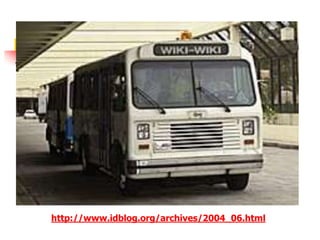
Wiki (4) “Cunningham coined the term ‘Wiki’ after the ‘wiki wiki’ or ‘quick’ shuttle buses at Honolulu Airport” (en.wikipedia.org/wiki/Wiki#History).	The wiki concept reflects his view that a Web-based database should be simple to create and easy to use (en.wikipedia.org/wiki/Ward_Cunningham).
http://www.idblog.org/archives/2004_06.html
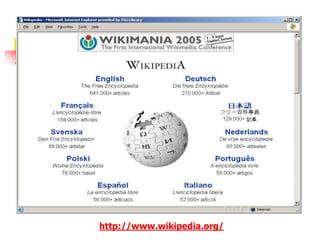
http://www.wikipedia.org/
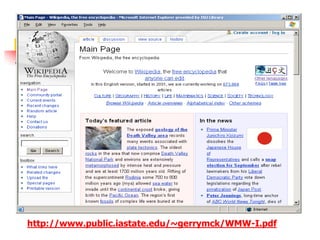
http://www.public.iastate.edu/~gerrymck/WMW-I.pdf
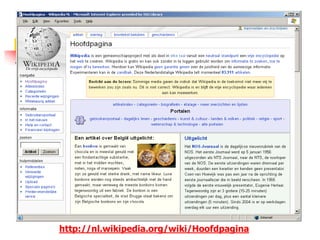
http://nl.wikipedia.org/wiki/Hoofdpagina
Features and Functionalities (1)Most wikis provide the user with a set ofnavigation or utility tools such as:Ability to edit a page View recently changes pages ‘History’ feature to view or roll back to 	a previous version of a page (Peterson 2004, 14)
Features and Functionalities (2)‘Discuss’ offline changes or proposed changes to a page A ‘backlinks’ function (view all the 	pages that link to the page currently 	displayed)Search function(Peterson 2004, 14)
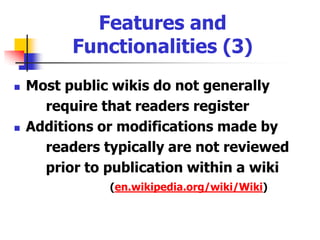
Features and Functionalities (3)Most public wikis do not generally	 	require that readers registerAdditions or modifications made by 		readers typically are not reviewed 		prior to publication within a wiki (en.wikipedia.org/wiki/Wiki)
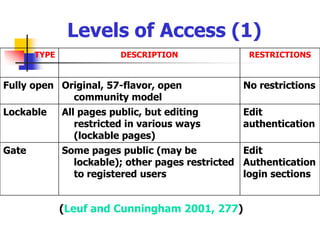
Levels of Access (1)(Leuf and Cunningham 2001, 277)
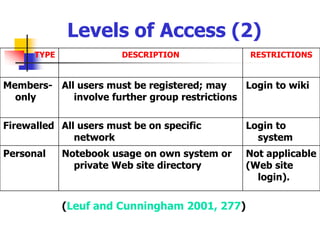
Levels of Access (2)(Leuf and Cunningham 2001, 277)
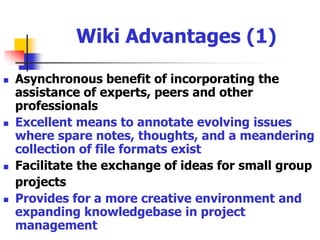
Wiki Advantages (1)Asynchronous benefit of incorporating the assistance of experts, peers and other professionalsExcellent means to annotate evolving issues where spare notes, thoughts, and a meandering collection of file formats existFacilitate the exchange of ideas for small group 	projectsProvides for a more creative environment and expanding knowledgebase in project management
Wiki Advantages (2)Level the playing field and allow all opinions to be heard  Increase communication efficiency and productivity over ‘back-and-forth’ exchanges of e-mail attachments and discussion boardsProvide a way to get everyone on the same page through the writable WebHarness the power of diverse individuals to create collaborative works
Wiki Advantages (3)Wikis have the potential toprovide individuals with a forum for improving knowledge and advancing thought processesform collaborative social research communities with respect to project management, andprovide innovative reference repositories forall aspects of planning, operation, and implementation(Bean and Hott 2005, 8)
Wiki Advantages (4)Wikis Have the Potential and Power to Change How We Think About How We Live and Work.(Bean and Hott 2005, 6-7)
Wiki Disadvantages (1)Installation can be demanding, particularly for some Wiki engine software (e.g., TWiki)Editing wiki documents can be cumbersome for some individualsOvercoming cultural hurdles of hierarchy, control, and a sense of lack of accountability Issues of legal liability, privacy, reputation, and security must be considered
Wiki Disadvantages (2)Content accuracy, balance, comprehensiveness, and consistency, and reliability can be questionedWikis are cumulative rather than serialArticles, by design, are always in flux, editable, and have a mixed degree of quality and finality					(Bean and Hott 2005, 7)						(Bean and Hott 2005, 7)
Wiki Engines “Wiki software is a type of collaborative software that runs a Wiki system. It is usually implemented as a server-side script that runs on one or more Web servers, with the content generally stored in a relational database management system, although some implementations use the server's file system instead.”http://en.wikipedia.org/wiki/Wiki_engine
Top Wiki Engines (1)MediaWikihttp://en.wikipedia.org/wiki/MediaWikiFeature-rich wiki implementationWritten in PHP and uses an underlying MySQL relational database management systemGNU General Public LicenseUsed in Wikipedia [http://en.wikipedia.org/] MoinMoinhttp://moinmoin.wikiwikiweb.de/Implemented in PythonFlat file GNU General Public License
Top Wiki Engines (2)PmWikihttp://www.pmichaud.com/wiki/PmWiki/Developed by Patrick MichaudUses PHP scripting languageFlat fileGNU General Public LicenseTikiWikihttp://tikiwiki.org/tiki-index.phpOpen source content management system (CMS) and Groupware that can be used to create Web applications, sites, portals, intranets and extranetsBased on Linux, Apache, MySQL and PHP
Top Wiki Engines (3)UseModWikihttp://www.usemod.com/cgi-bin/wiki.plWritten by Clifford Adams in the Perl programming languageFlat fileGNU General Public Licensehttp://c2.com/cgi/wiki?TopTenWikiEngines
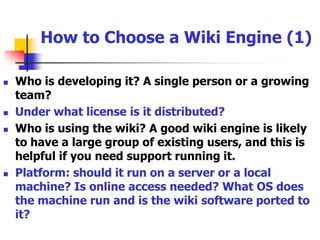
How to Choose a Wiki Engine (1)Who is developing it? A single person or a growing team? Under what license is it distributed? Who is using the wiki? A good wiki engine is likely to have a large group of existing users, and this is helpful if you need support running it. Platform: should it run on a server or a local machine? Is online access needed? What OS does the machine run and is the wiki software ported to it?
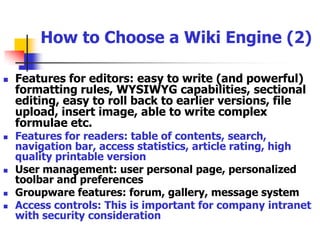
How to Choose a Wiki Engine (2)Features for editors: easy to write (and powerful) formatting rules, WYSIWYG capabilities, sectional editing, easy to roll back to earlier versions, file upload, insert image, able to write complex formulae etc.Features for readers: table of contents, search, navigation bar, access statistics, article rating, high quality printable versionUser management: user personal page, personalized toolbar and preferences Groupware features: forum, gallery, message systemAccess controls: This is important for company intranet with security consideration
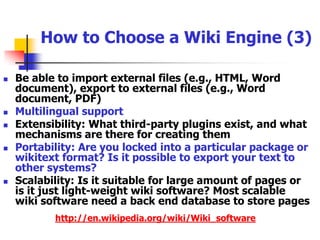
How to Choose a Wiki Engine (3)Be able to import external files (e.g., HTML, Word document), export to external files (e.g., Word document, PDF)Multilingual supportExtensibility: What third-party plugins exist, and what mechanisms are there for creating them Portability: Are you locked into a particular package or wikitext format? Is it possible to export your text to other systems?Scalability: Is it suitable for large amount of pages or is it just light-weight wiki software? Most scalable wiki software need a back end database to store pageshttp://en.wikipedia.org/wiki/Wiki_software
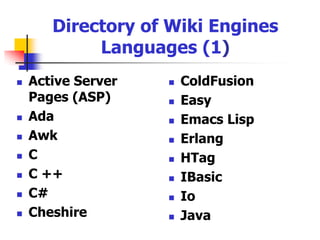
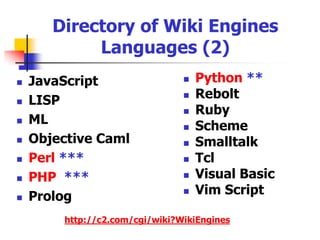
Directory of Wiki EnginesLanguages (1)Active Server Pages (ASP)Ada AwkCC ++C#CheshireColdFusionEasy Emacs LispErlangHTagIBasicIoJava
Directory of Wiki EnginesLanguages (2)JavaScriptLISPMLObjective CamlPerl***PHP***Prolog Python **ReboltRuby SchemeSmalltalkTclVisual BasicVim Scripthttp://c2.com/cgi/wiki?WikiEngines
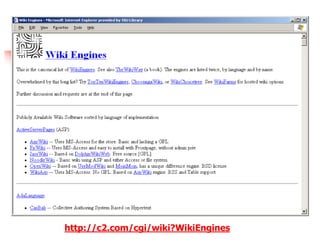
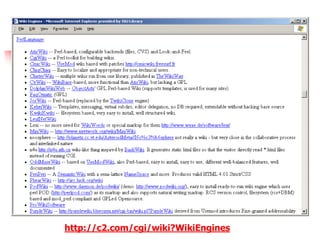
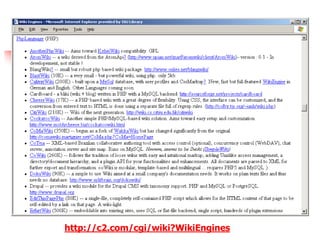
http://c2.com/cgi/wiki?WikiEngines
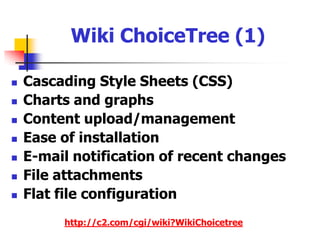
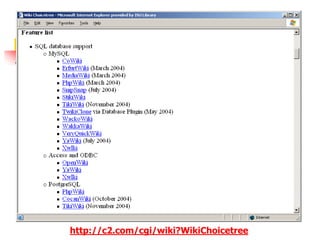
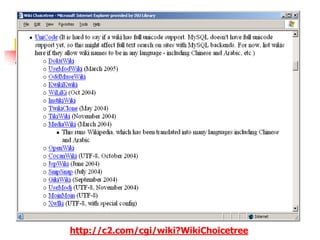
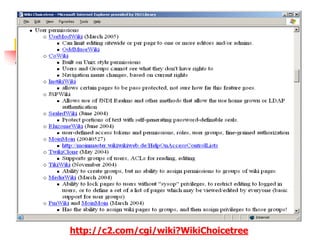
Wiki ChoiceTree (1)Cascading Style Sheets (CSS)Charts and graphsContent upload/managementEase of installationE-mail notification of recent changesFile attachmentsFlat file configuration http://c2.com/cgi/wiki?WikiChoicetree
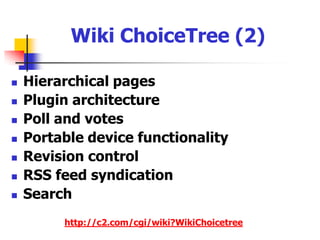
Wiki ChoiceTree (2)Hierarchical pagesPlugin architecturePoll and votesPortable device functionalityRevision control RSS feed syndicationSearchhttp://c2.com/cgi/wiki?WikiChoicetree
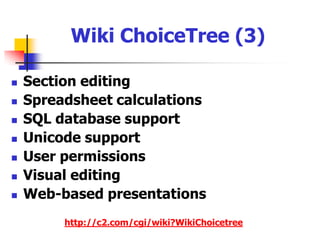
Wiki ChoiceTree (3)Section editingSpreadsheet calculationsSQL database supportUnicode supportUser permissionsVisual editingWeb-based presentationshttp://c2.com/cgi/wiki?WikiChoicetree
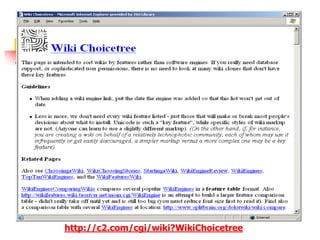
http://c2.com/cgi/wiki?WikiChoicetree
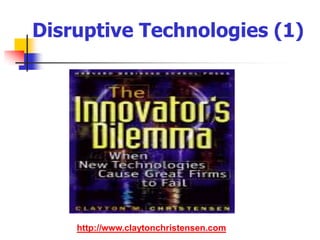
Disruptive Technologies (1) http://www.claytonchristensen.com
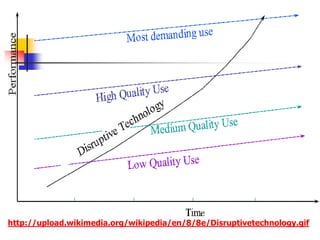
 Disruptive Technologies (2)“A Disruptive Technology is a new technological innovation, product, or service that eventually overturns the existing dominant technology in the market,despite the fact that the disruptive technology is both radically different than the leading technology and that it often initially performs worse than the leading technology according to existing measures of performance.http://en.wikipedia.org/wiki/Disruptive_technology
Disruptive Technologies (3)The term ‘Disruptive Technology’ was coined by Clayton M. Christensen and described in his 1997 book The Innovator's Dilemma. In his sequel, The Innovator's Solution, Christensen replaced the term with the term ‘Disruptive Innovation’ because he recognized that few technologies are intrinsically disruptive or sustaining in character. It is strategy that creates the disruptive impact.”http://en.wikipedia.org/wiki/Disruptive_technology
http://upload.wikimedia.org/wikipedia/en/8/8e/Disruptivetechnology.gif
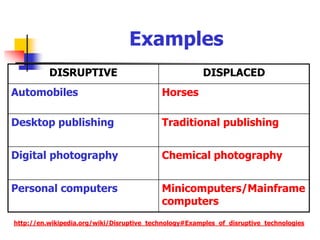
Exampleshttp://en.wikipedia.org/wiki/Disruptive_technology#Examples_of_disruptive_technologies
Dynamic Possibilities (1) CorporateAgendaDocumentationMinutesProject managementReports
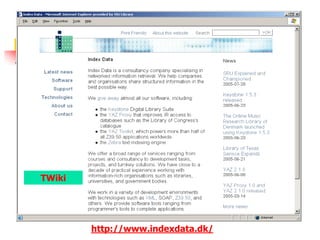
TWikihttp://www.indexdata.dk/
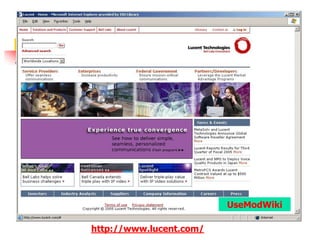
UseModWikihttp://www.lucent.com/
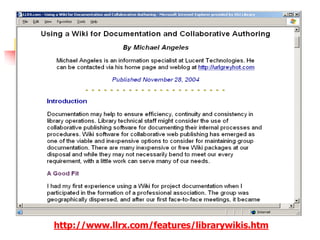
http://www.llrx.com/features/librarywikis.htm
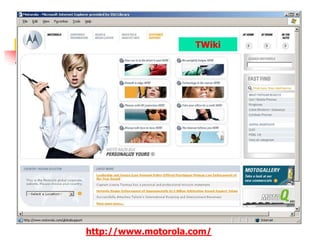
TWikihttp://www.motorola.com/
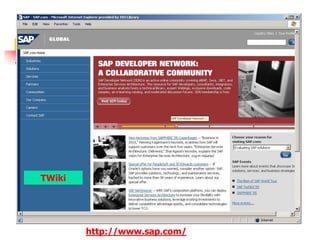
TWikihttp://www.sap.com/
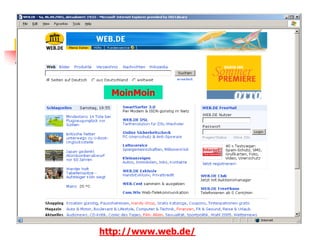
MoinMoinhttp://www.web.de/
Commercial ServicesAtlassianhttp://www.atlassian.com/Jotspothttp://www.jotspot.com/Socialtexthttp://www.socialtext.com/
Dynamic Possibilities (2) Higher EducationCoursesInformation servicesProgramsResearch projectsUniversity portal
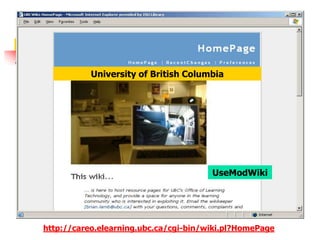
University of British Columbia UseModWikihttp://careo.elearning.ubc.ca/cgi-bin/wiki.pl?HomePage
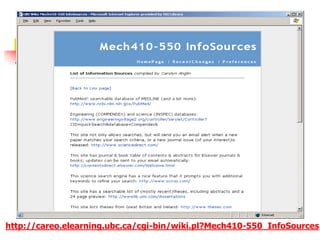
http://careo.elearning.ubc.ca/cgi-bin/wiki.pl?Mech410-550_InfoSources
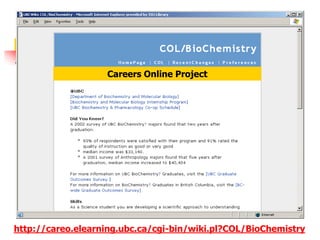
Careers Online Projecthttp://careo.elearning.ubc.ca/cgi-bin/wiki.pl?COL/BioChemistry
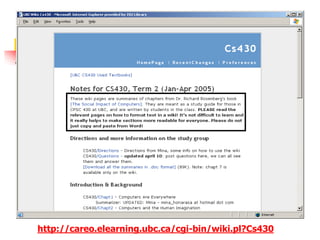
http://careo.elearning.ubc.ca/cgi-bin/wiki.pl?Cs430
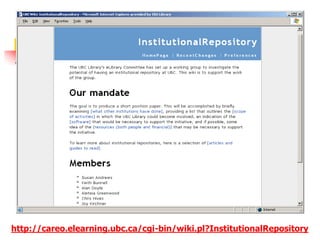
http://careo.elearning.ubc.ca/cgi-bin/wiki.pl?InstitutionalRepository
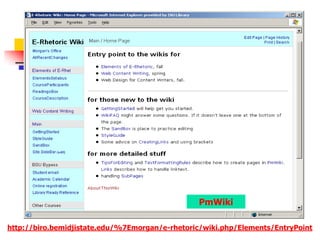
PmWikihttp://biro.bemidjistate.edu/%7Emorgan/e-rhetoric/wiki.php/Elements/EntryPoint
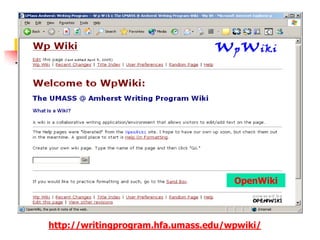
OpenWikihttp://writingprogram.hfa.umass.edu/wpwiki/
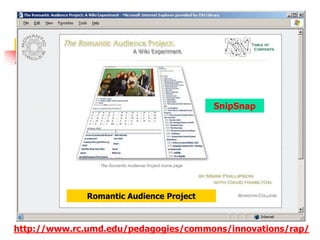
SnipSnapRomantic Audience Project http://www.rc.umd.edu/pedagogies/commons/innovations/rap/
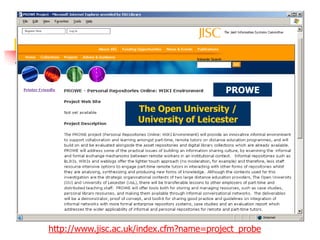
PROWEThe Open University / University of Leicesterhttp://www.jisc.ac.uk/index.cfm?name=project_probe
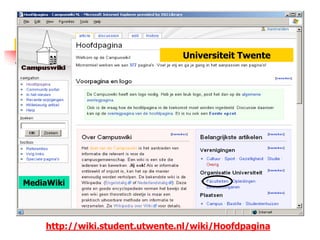
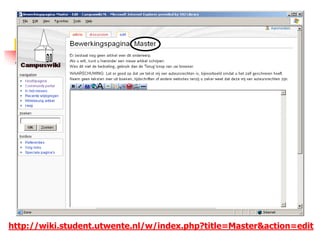
Universiteit TwenteMediaWikihttp://wiki.student.utwente.nl/wiki/Hoofdpagina
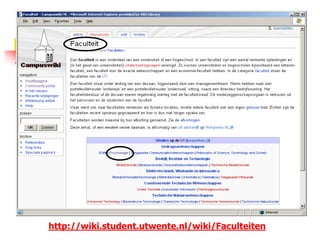
http://wiki.student.utwente.nl/wiki/Faculteiten
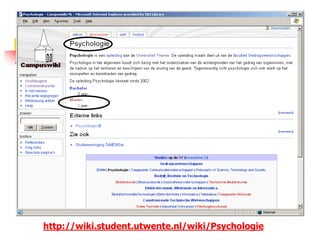
http://wiki.student.utwente.nl/wiki/Psychologie
http://wiki.student.utwente.nl/w/index.php?title=Master&action=edit
Commercial ServicesConfluence (Atlassian)Cornell UniversityJohns Hopkins UniversityMITOregon State UniversityStanfordUniversity of Michiganhttp://www.atlassian.com/software/confluence/
Dynamic Possibilities (3) LibrariesCollection developmentConferencesOrganizational ProfessionalProjectsReference services
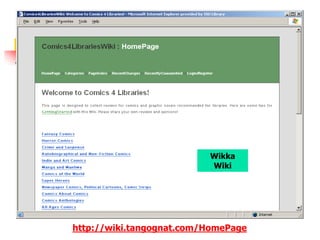
Wikka Wikihttp://wiki.tangognat.com/HomePage
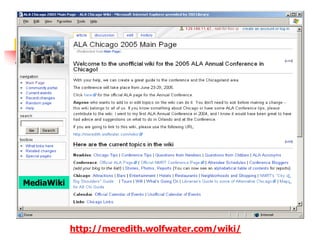
MediaWikihttp://meredith.wolfwater.com/wiki/
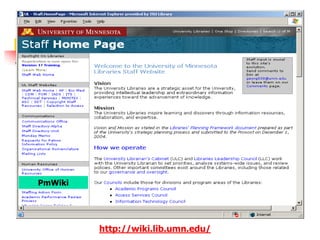
PmWikihttp://wiki.lib.umn.edu/
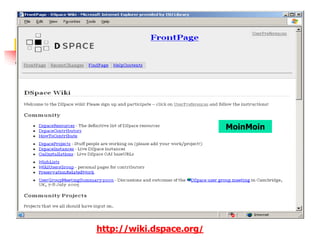
MoinMoinhttp://wiki.dspace.org/
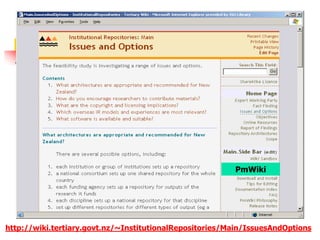
PmWikihttp://wiki.tertiary.govt.nz/~InstitutionalRepositories/Main/IssuesAndOptions
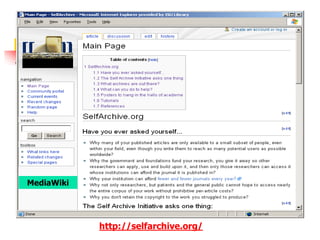
MediaWikihttp://selfarchive.org/
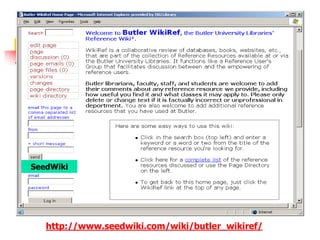
SeedWikihttp://www.seedwiki.com/wiki/butler_wikiref/
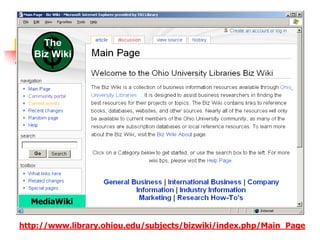
MediaWikihttp://www.library.ohiou.edu/subjects/bizwiki/index.php/Main_Page
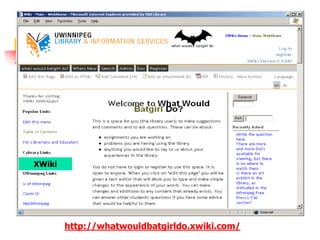
XWikihttp://whatwouldbatgirldo.xwiki.com/
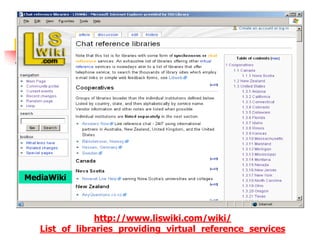
MediaWikihttp://www.liswiki.com/wiki/List_of_libraries_providing_virtual_reference_services
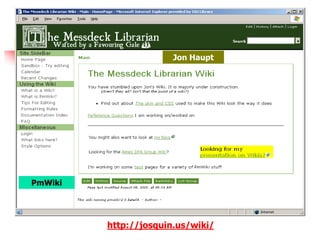
Jon HauptPmWikihttp://josquin.us/wiki/
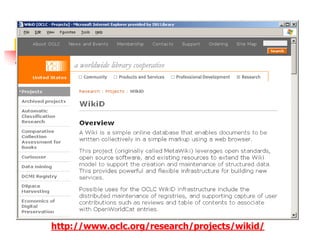
http://www.oclc.org/research/projects/wikid/
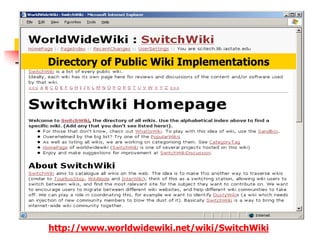
Directory of Public Wiki Implementationshttp://www.worldwidewiki.net/wiki/SwitchWiki
Cited WorksLuAnn Bean and David D. Hott, “Wiki: A Speedy New Tool to Manage Projects,” Journal of Corporate Accounting & Finance  16, no. 5 (July/August 2005):3-8.Bo Leuf and Ward Cunningham, The Wiki Way: Quick Collaboration on the Web. Boston: Addison-Wesley, 2001. Gerry McKiernan, “WikimediaWorlds: Part I. Wikipedia,” Library Hi Tech News 22, no. 8 (September/October 2005): 46-54. Billie Peterson, "Tech Talk: Wiki,” Library Instruction Round Table News  27,  no. 1 (September 2004): 13-15.
Sandboxhttp://osiecka.webd.pl/sandboxlog.jpg
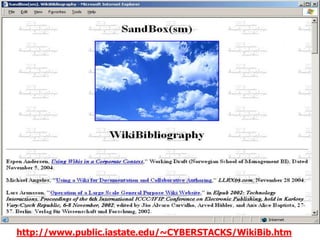
http://www.public.iastate.edu/~CYBERSTACKS/WikiBib.htm
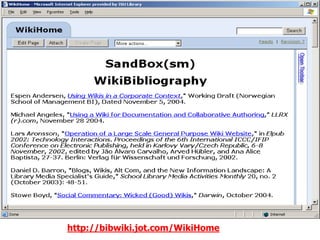
http://bibwiki.jot.com/WikiHome
 PART TWO Disruptive ScholarshipConversational Technologies (1)Discussion forums, wikis, and weblogsKnowledge creation and sharing is carried out through a process of discussion with questions and answers (discussion forum), collaborative editing (wikis), or through the process of storytelling (weblogs)Conversational systems capture and represent conversations and accommodates contextualization, search, and communityOffer ease and efficiency of representation and sharinghttp://wagnernet.com/tiki/tiki-download_file.php?fileId=7
Conversational Technologies (2)“The wiki … has as its basic information unit the 	Comment-on-Topic. Neither time nor user are relevant (for information presentation), and the information unit in its most updated form represents the best and most timely version of thoughts on that topic. Wikis thus permit incremental improvement of an information unit.”Christian Wagner and Narasimha Bolloju, “Supporting Knowledge Management in Organization with Conversation Technologies: Discussion Forums, Weblogs, and Wikis,” Journal of Database Management 16, no. 2 (April-June 2005): i-viii.http://wagnernet.com/tiki/tiki-download_file.php?fileId=7
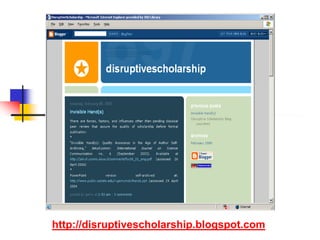
http://disruptivescholarship.blogspot.com
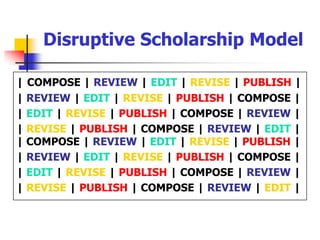
Disruptive Scholarship (1)In view of its collaborative features and functionalities, and the nature and character of alternative methods of quality management outlined, the Wiki environment could provide an outstanding framework for 		* PREPARING		* EDITING		* REVIEWING 		* ASSESSING		* PUBLISHING	for a range of scholarly work, including manuscripts, articles, journals, and monographs.
Disruptive Scholarship (2)		In one possible wiki-based publication scenario, an author would prepare a manuscript draft using locally-installed wiki engine software (or institutional wiki) that best suits his/her needs or preferences. 		In a first stage review, colleagues would be invited to participate in a review of the draft.  At this stage, the author can choose to allow first-stage reviewers to edit the text, or limit participation to a discussion space.
Disruptive Scholarship (3)At a second stage, known specialists in the field(s) covered by the manuscript could be invited to review the revised first stage version.As in the first stage review, second stage reviewers would be granted open permission to edit the manuscript text, or be restricted to commenting on its content. At a third – and perhaps final stage - the author could request that others (such members of a professional electronic discussion list) review and edit and/or comment on the new, revised version.
Disruptive Scholarship (4)After final review, the revised final stage version could be locked from future discussion or editing. The locking of the final version could constitute formal publication of the work.Alternatively, the author/editor in chief at some later time could unlock the published version and invite any reader to discuss and/or edit it, thereby creating a ‘living’, dynamic, potentially ever-changing-and improving document, by doing so.
Disruptive Scholarship Model
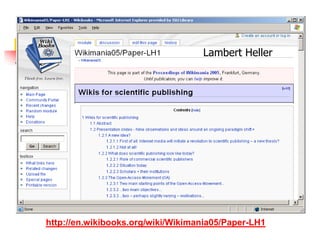
Lambert Heller http://en.wikibooks.org/wiki/Wikimania05/Paper-LH1
David Mattison“I think a wiki is highly appropriate for scholarly communication if all the scholars trust one another and are collaborating on a text …, and security and rollback mechanisms are in place.”>>>http://lists.webjunction.org/wjlists/web4lib/2004-August/000993.html
“Wikis are just another tool [of the] Collaborative Web … .The question of whether what emerges from that collaboration is authoritative or scholarly depends on other factors often above and beyond the collaborative process itself.”http://lists.webjunction.org/wjlists/web4lib/2004-August/000993.html
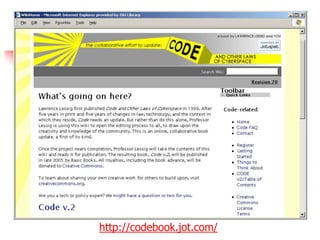
http://codebook.jot.com/
</EndQuote> (1)“The Medium is 	the Message,…the Audience is the Content.”Marshall McLuhan[SOURCE]http://www.marshallmcluhan.com/
</EndQuote> (2)“Hot media are … low in participation, Cool mediaare high in participation or completion by the audience.”Marshall McLuhanUnderstanding Media:  The Extensions of Man. (New York: McGraw-Hill, 1964), 23.
</EndQuote> (3)“We become what we behold.We shape our toolsand thereafter our tools shape us.”Marshall McLuhanUnderstanding Media (1964)http://www.brainyquote.com/quotes/quotes/m/marshallmc141113.html/
AfterThoughtIs Wiki Method/Methodology the Full/True MeansOf Achieving/CreatingReal Open Access?
! THANK YOU !FOR YOUR  ATTENTION
REVISEDOctober  14, 20059:30

Ticer2005