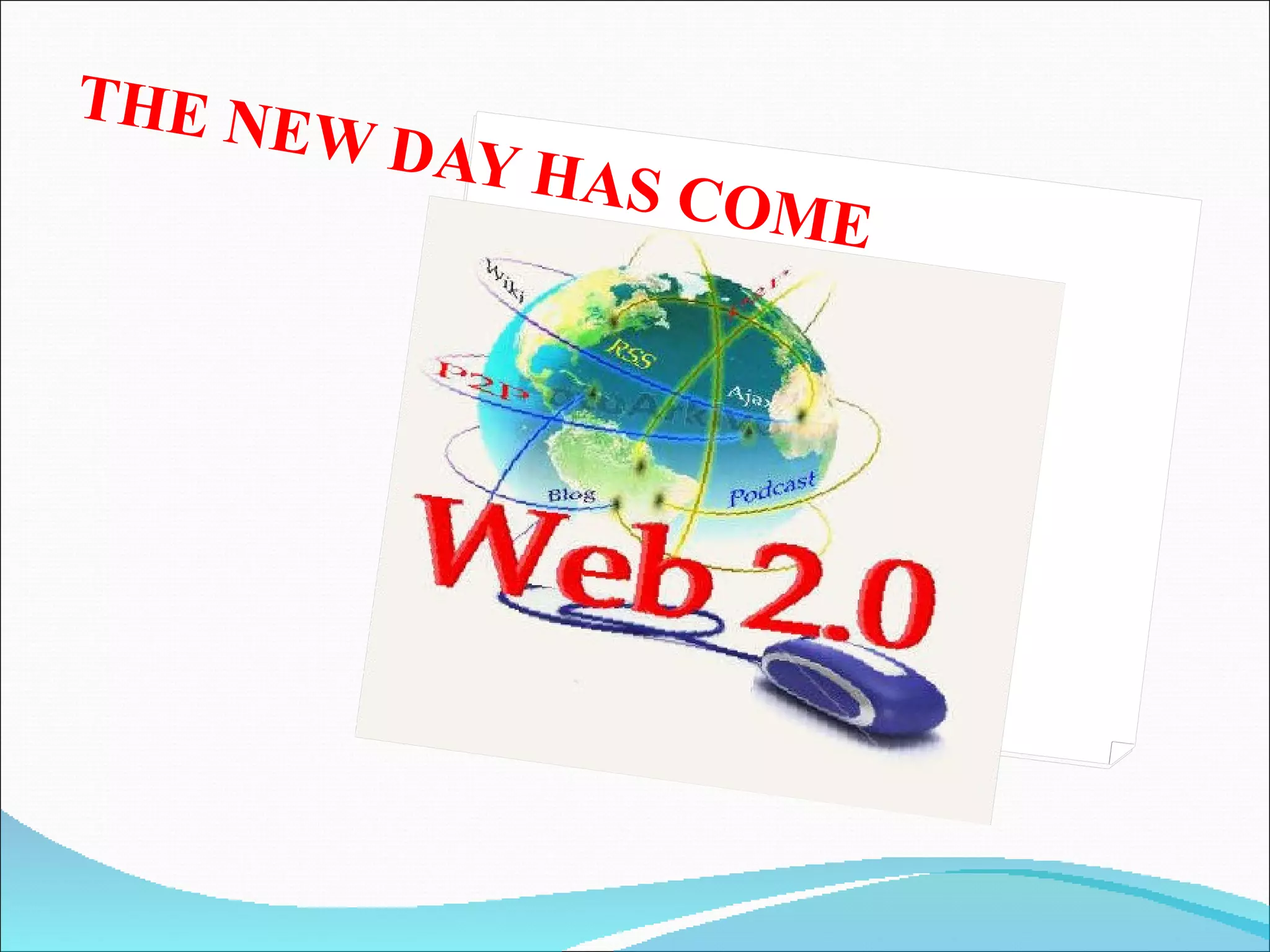
THE NEW DAY HAS COME
The concept of Web 2.0 began with a conference brainstorming session with Tim O´Reilly and Medialive international.
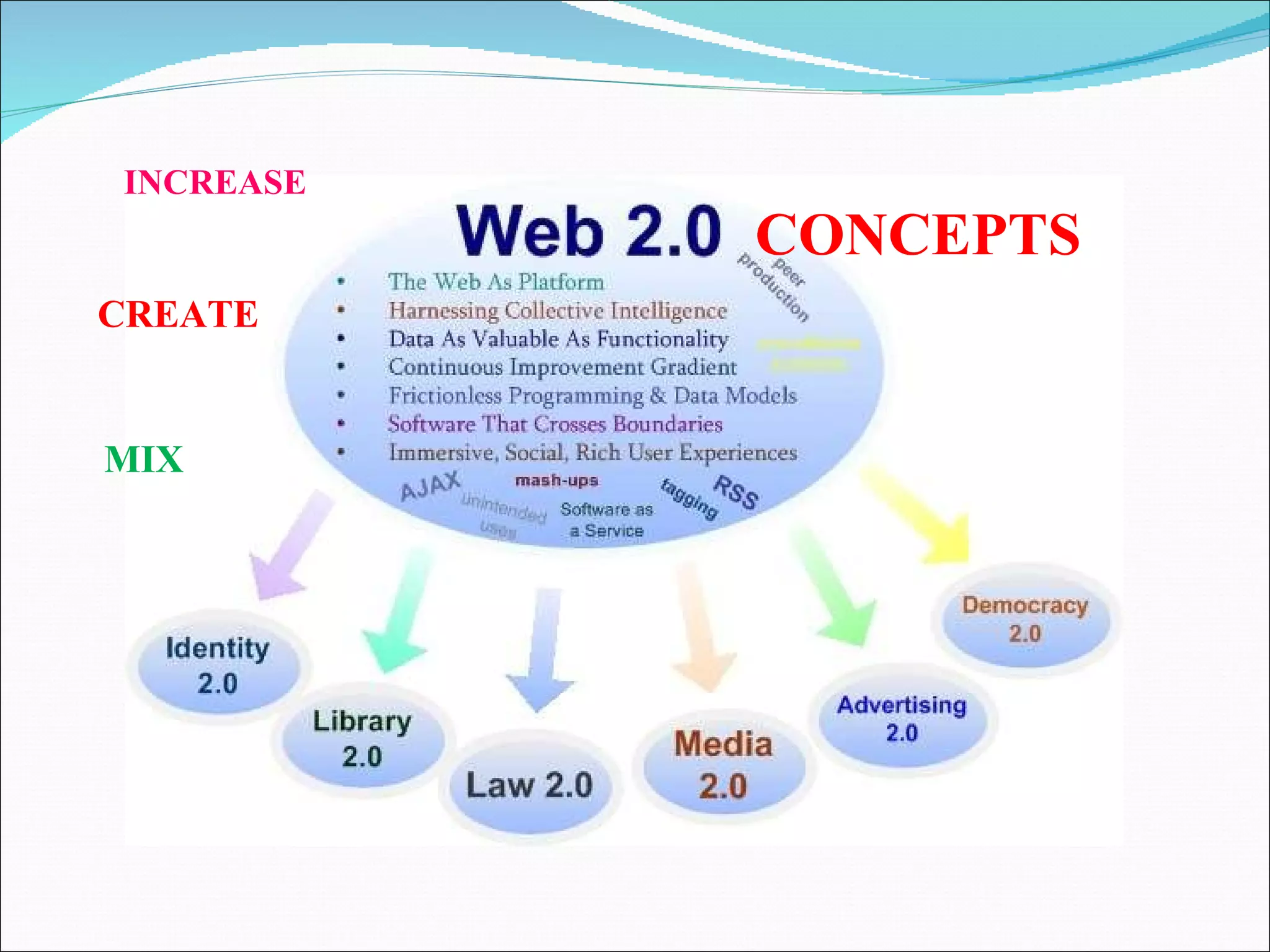
SHARE CREATE  MIX  INCREASE   CONCEPTS
What is web 2.0? The term  Web 2.0  is associated with web applications that facilitate participatory  information sharing,  interoperability, user-centered design, and collaboration on the World Wide Web. A Web 2.0 site allows users to interact and collaborate with each other in a social media dialogue as creators (prosumers) of user-generated content in a virtual community, in contrast to websites where users (consumers) are limited to the passive viewing of content that was created for them. Examples of Web 2.0 include social networking sites, blogs, wikis, video sharing sites, hosted services, web applications, mashups and folksonomies.  ( Wikipedia)
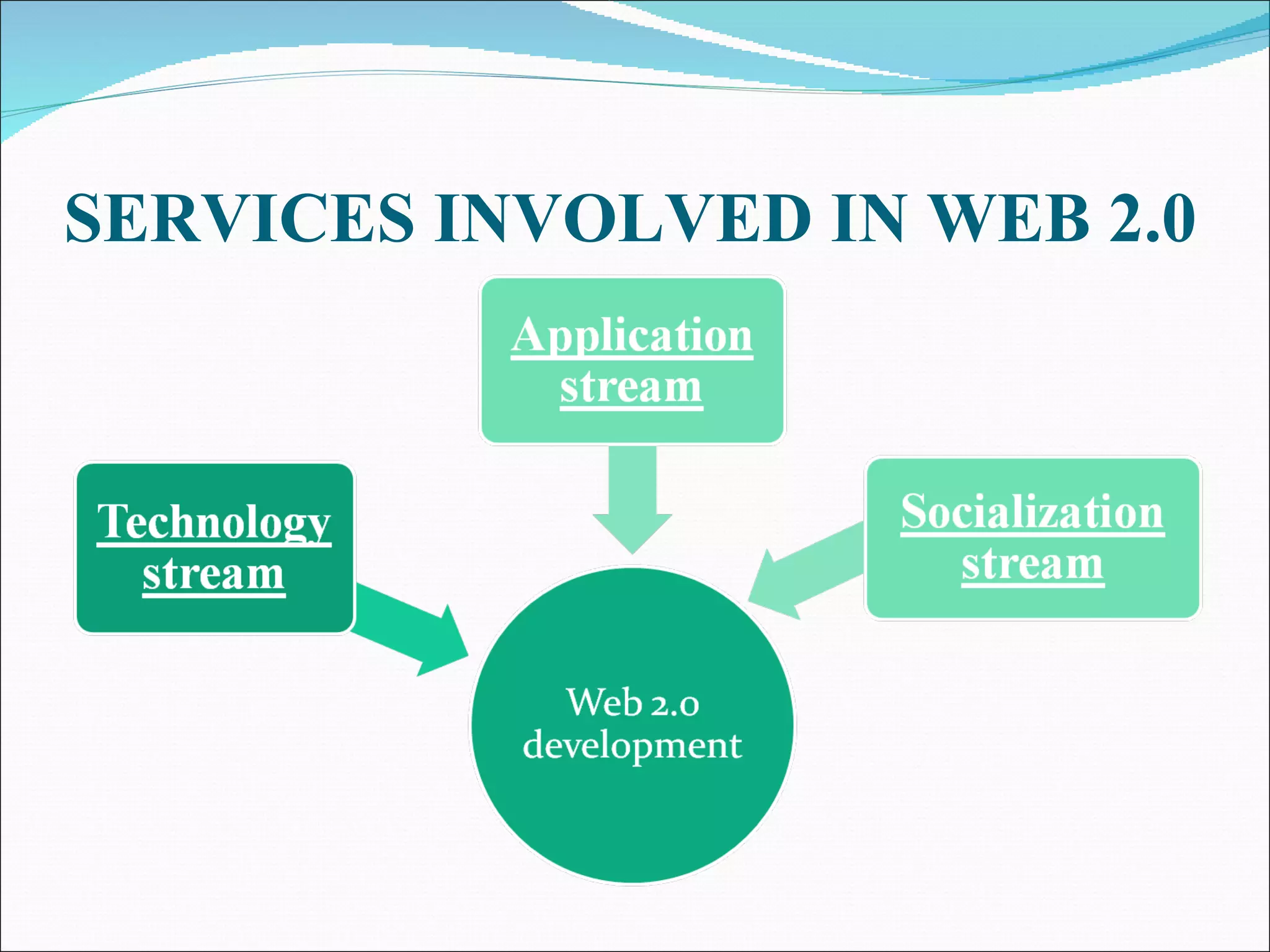
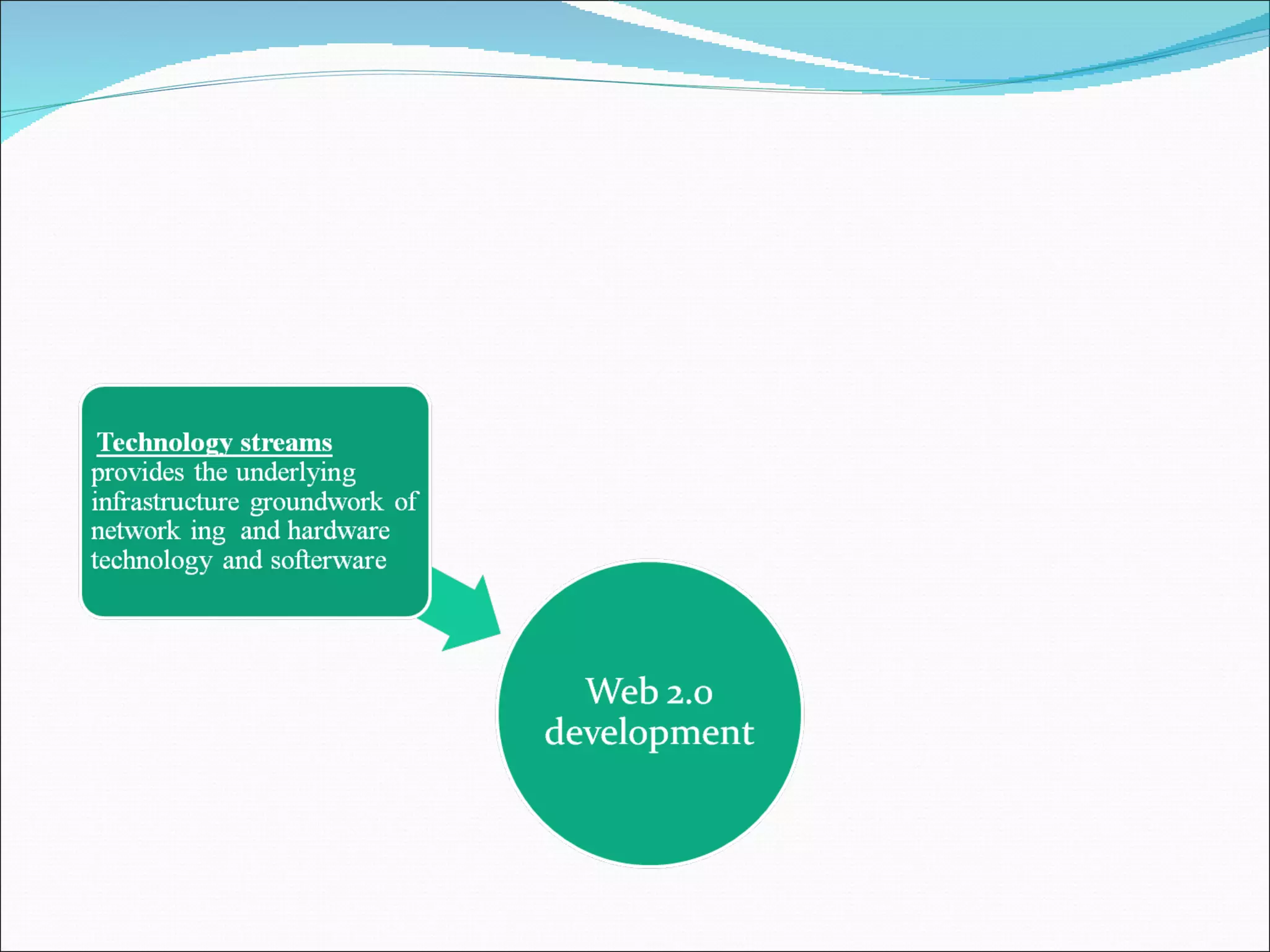
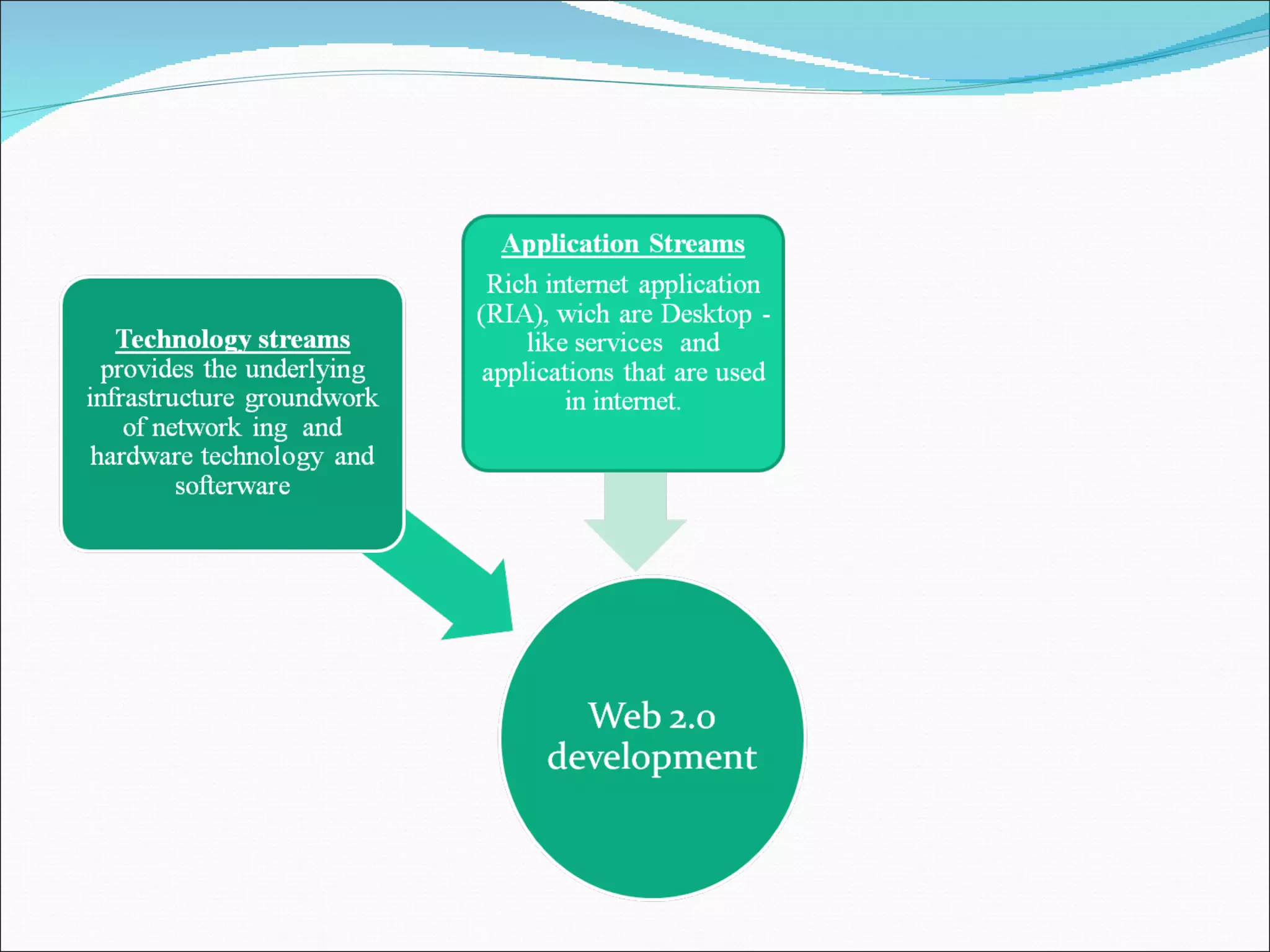
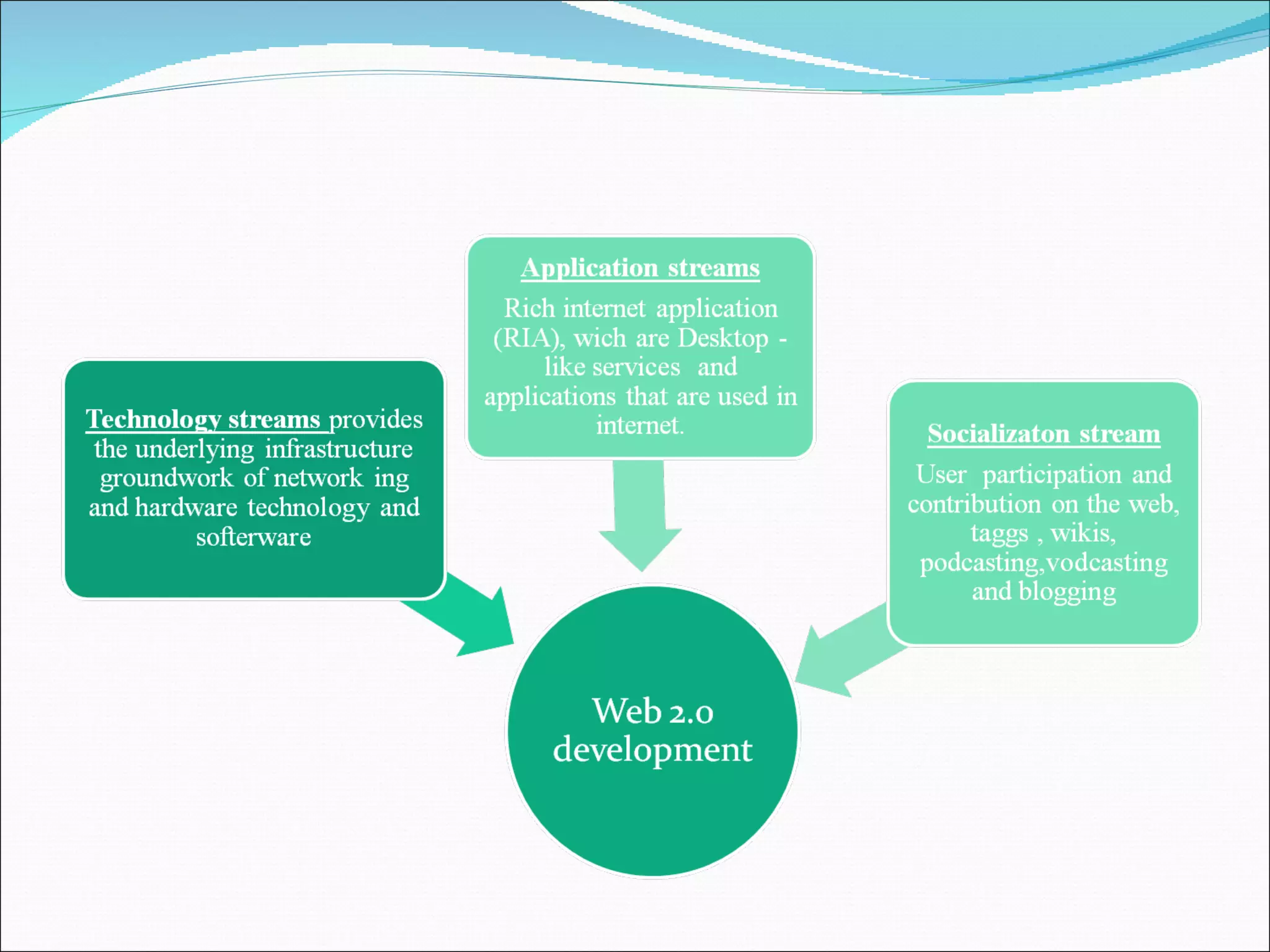
SERVICES INVOLVED IN WEB 2.0


Speed of reading increasing Scamming information, might be a good practice for cursory knowledge acquisition It´s important to learn distinguish between skimming for information and in - deep reading. RSS news feeds allow users to determine what is worth reading in deep and what is not.
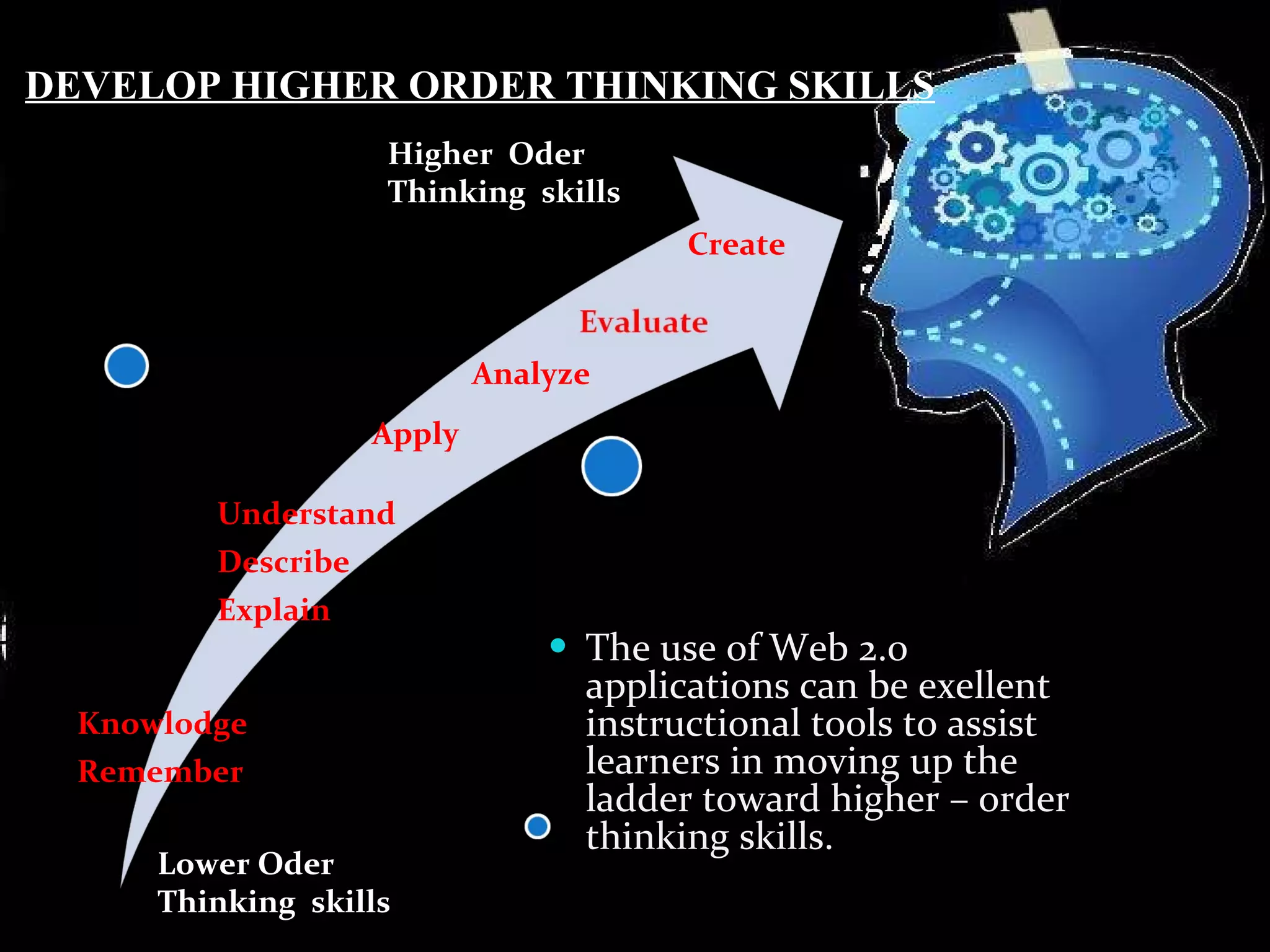
DEVELOP HIGHER ORDER THINKING SKILLS The use of Web 2.0 applications can be exellent instructional tools to assist learners in moving up the ladder toward higher – order thinking skills. Lower Oder  Thinking  skills  Create Higher  Oder  Thinking  skills  Analyze Apply Understand Describe Explain Knowlodge Remember
 
How Wikis work
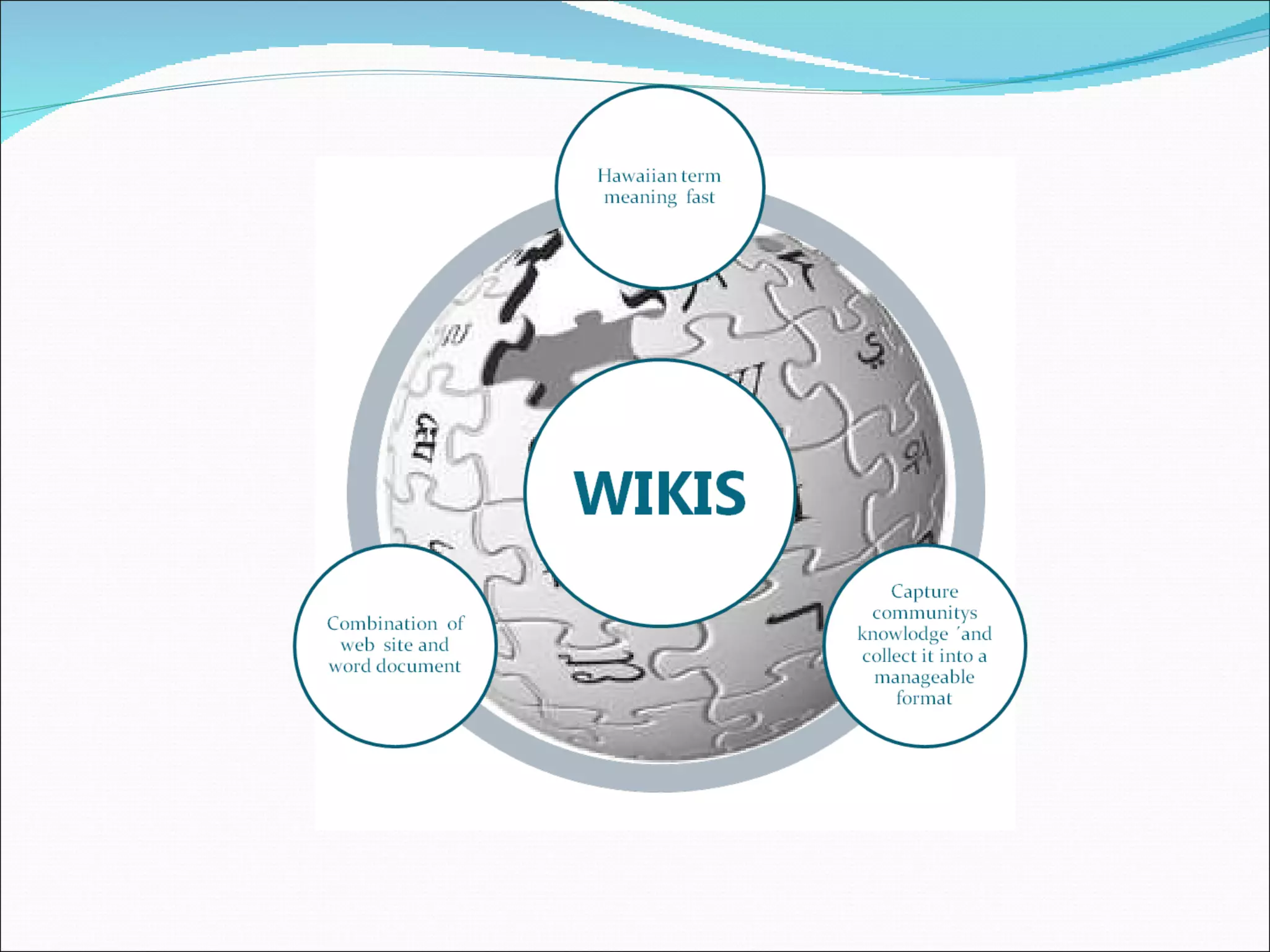
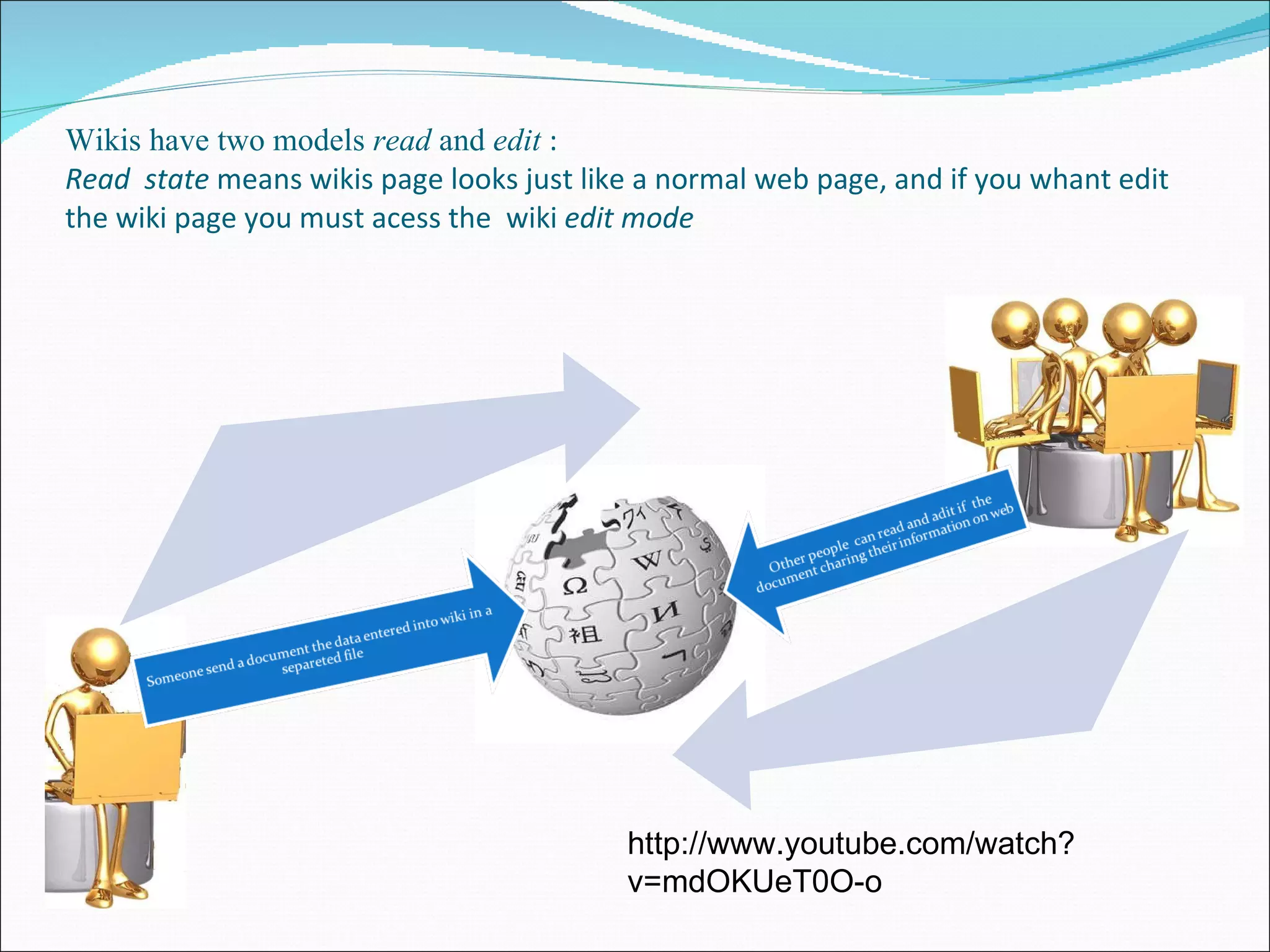
Wikis have two models  read  and  edit   :  Read  state  means wikis page looks just like a normal web page, and if you whant edit the wiki page you must acess the  wiki  edit mode http://www.youtube.com/watch?v=mdOKUeT0O-o
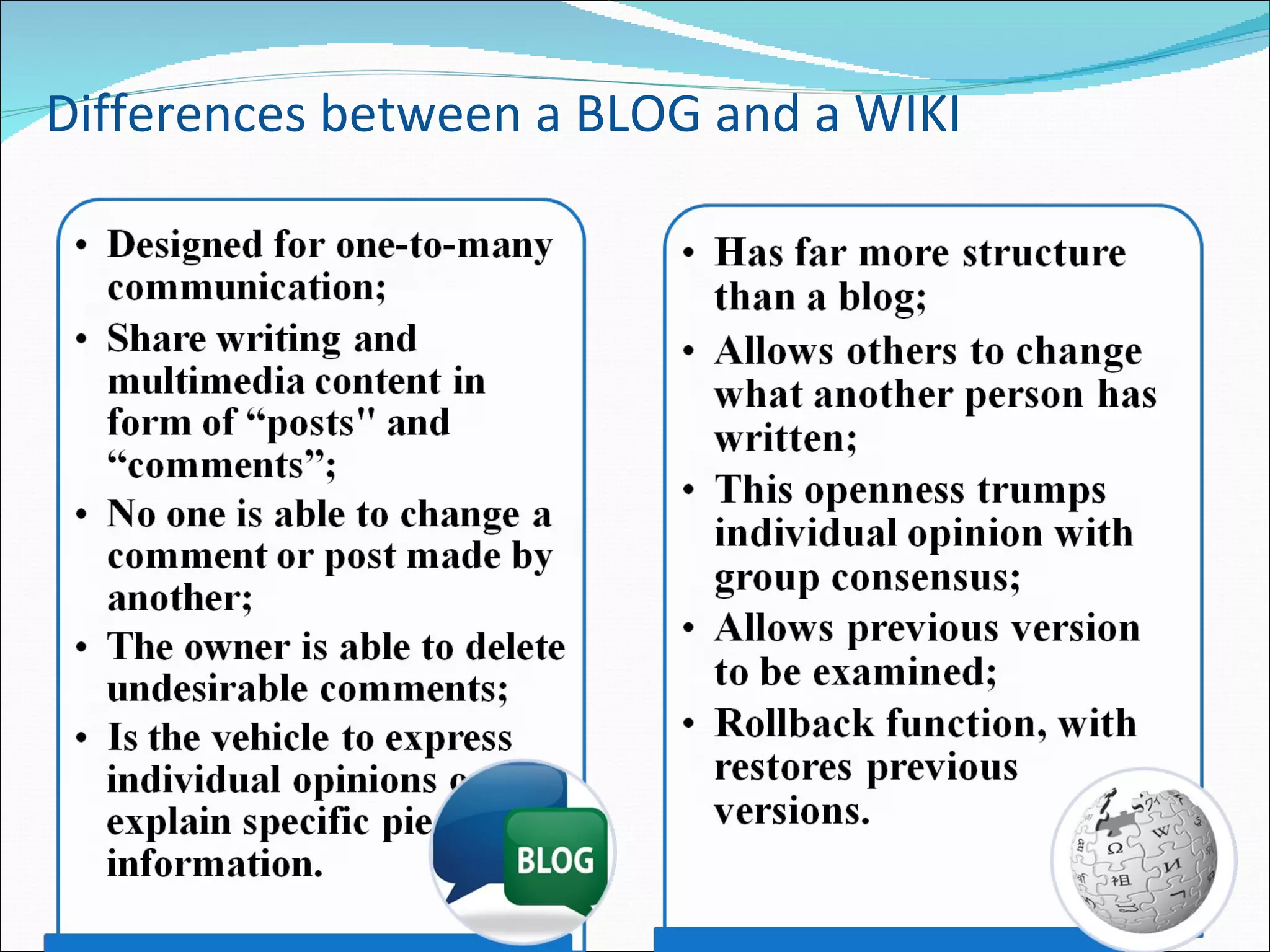
Differences between a BLOG and a WIKI
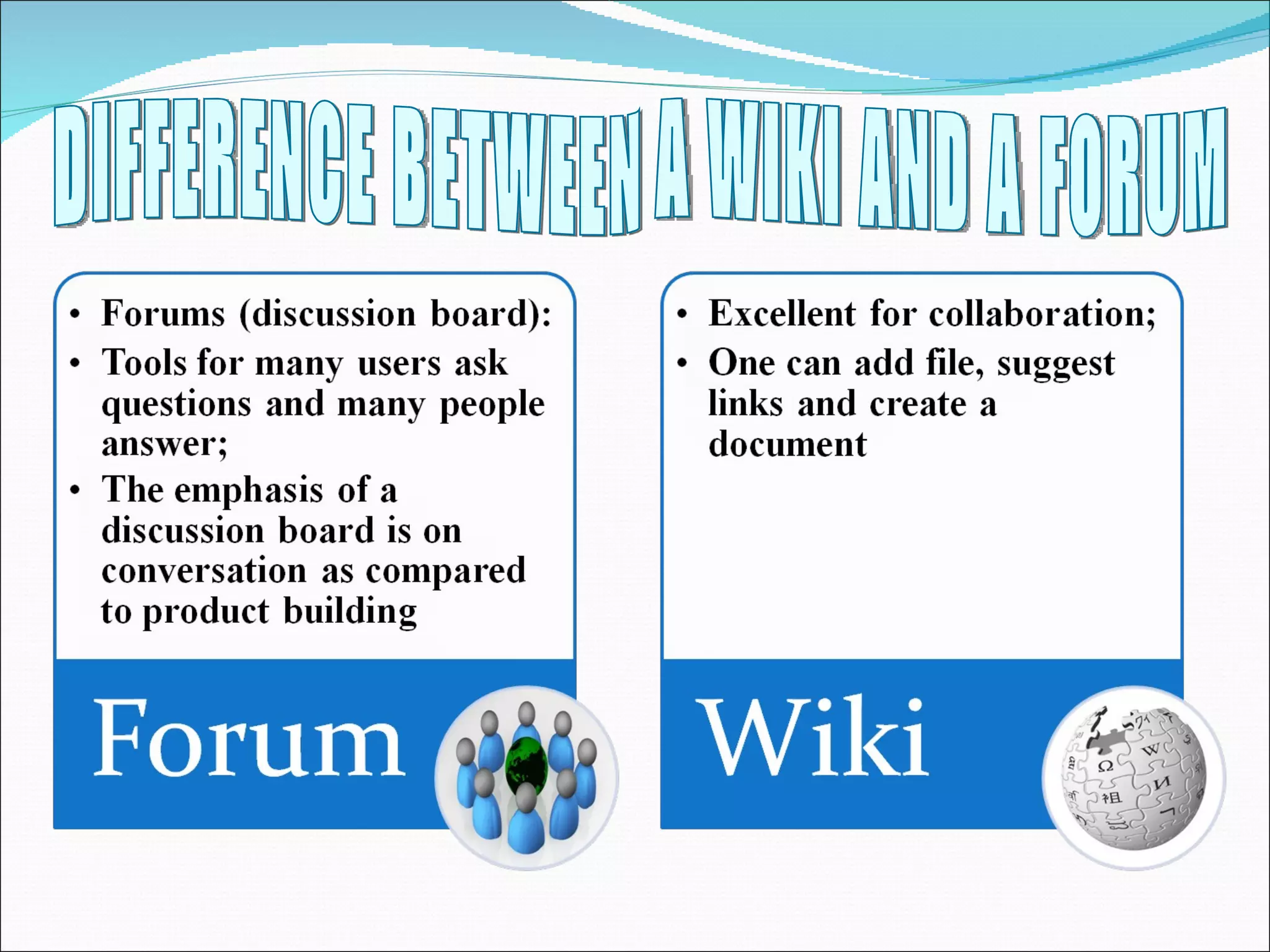
DIFFERENCE BETWEEN A WIKI AND A FORUM
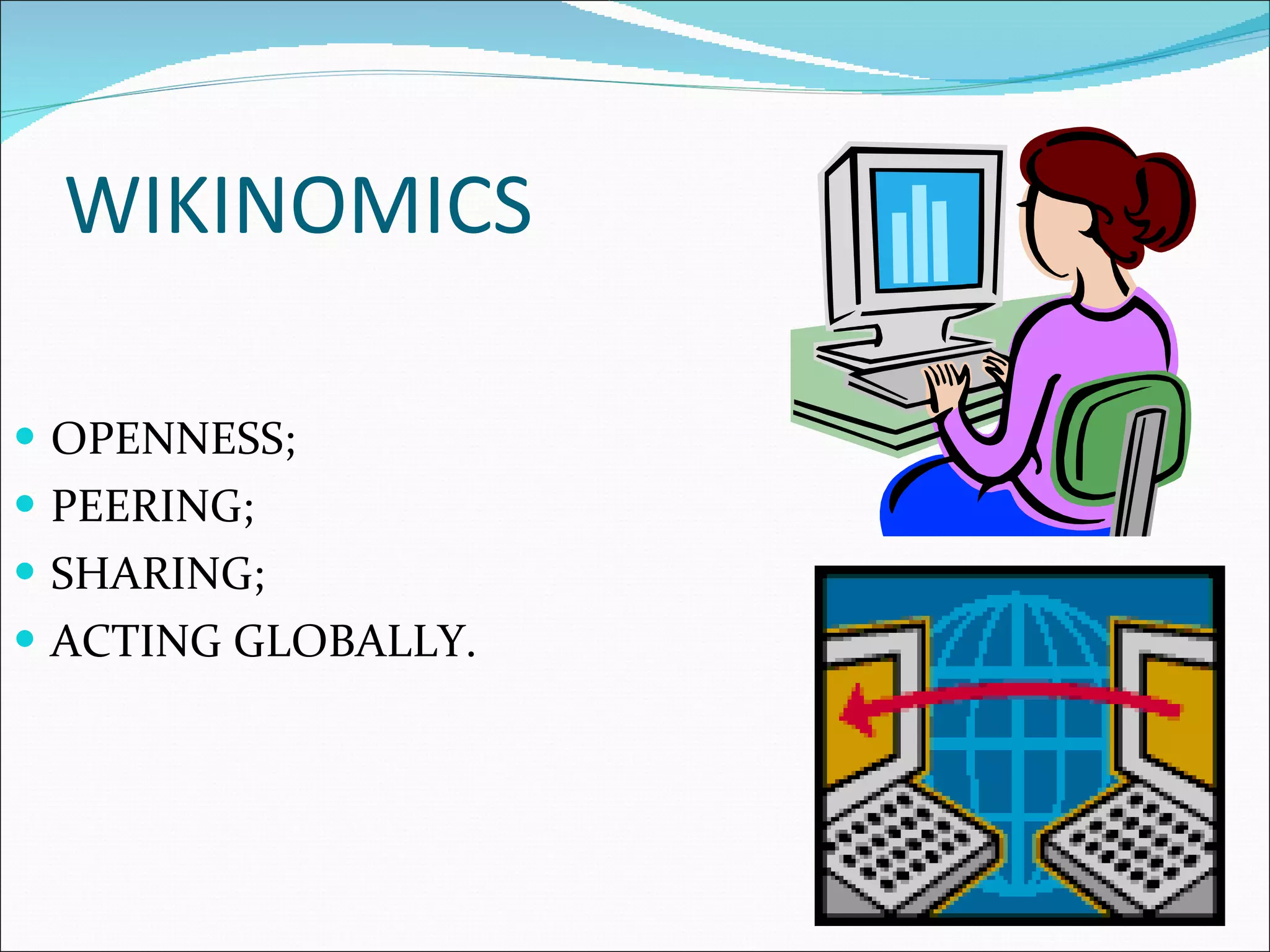
WIKINOMICS OPENNESS; PEERING; SHARING; ACTING GLOBALLY.
 
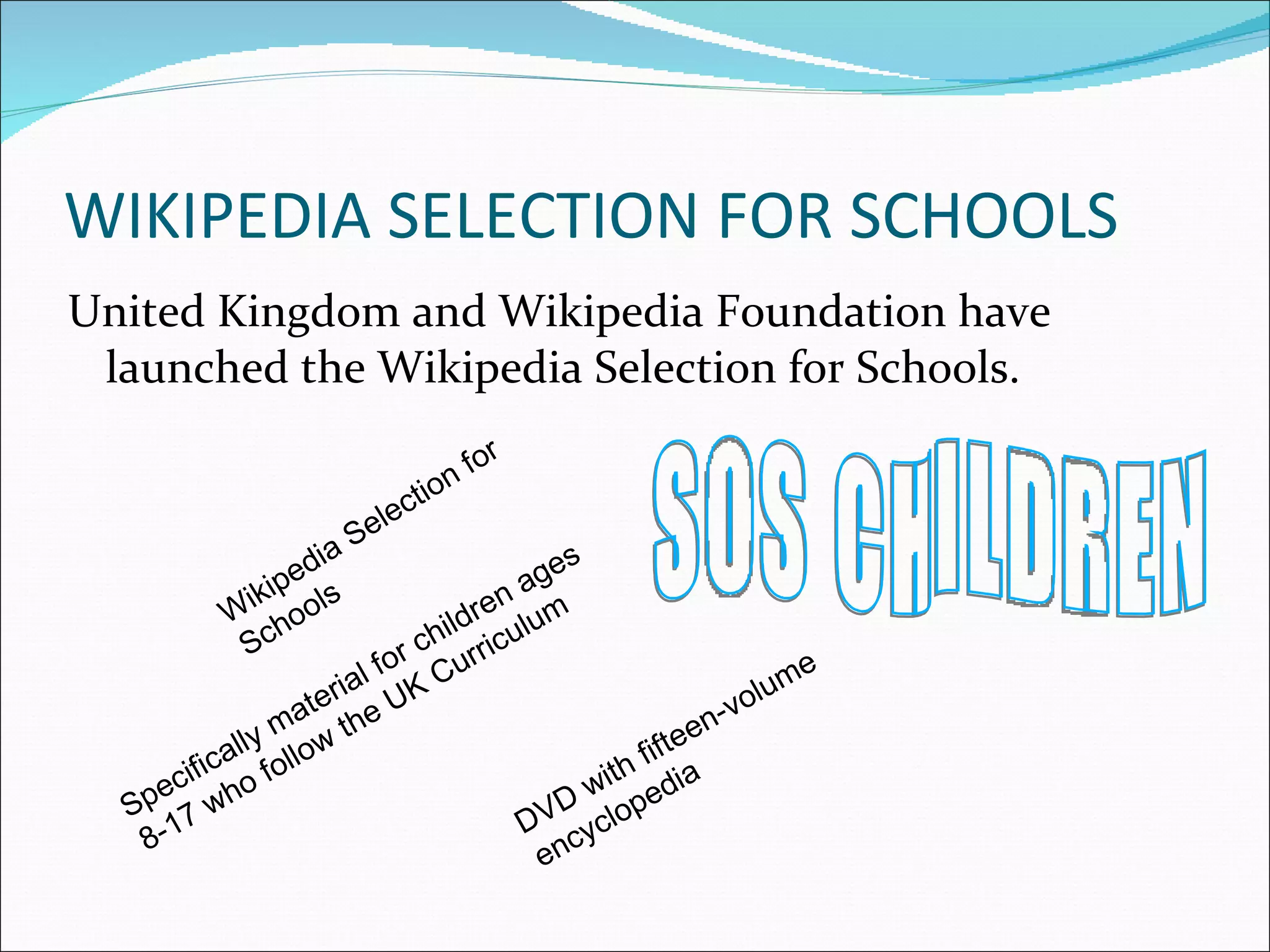
WIKIPEDIA SELECTION FOR SCHOOLS United Kingdom and Wikipedia Foundation have launched the Wikipedia Selection for Schools. Wikipedia Selection for Schools DVD with fifteen-volume encyclopedia Specifically material for children ages 8-17 who follow the UK Curriculum SOS CHILDREN
 
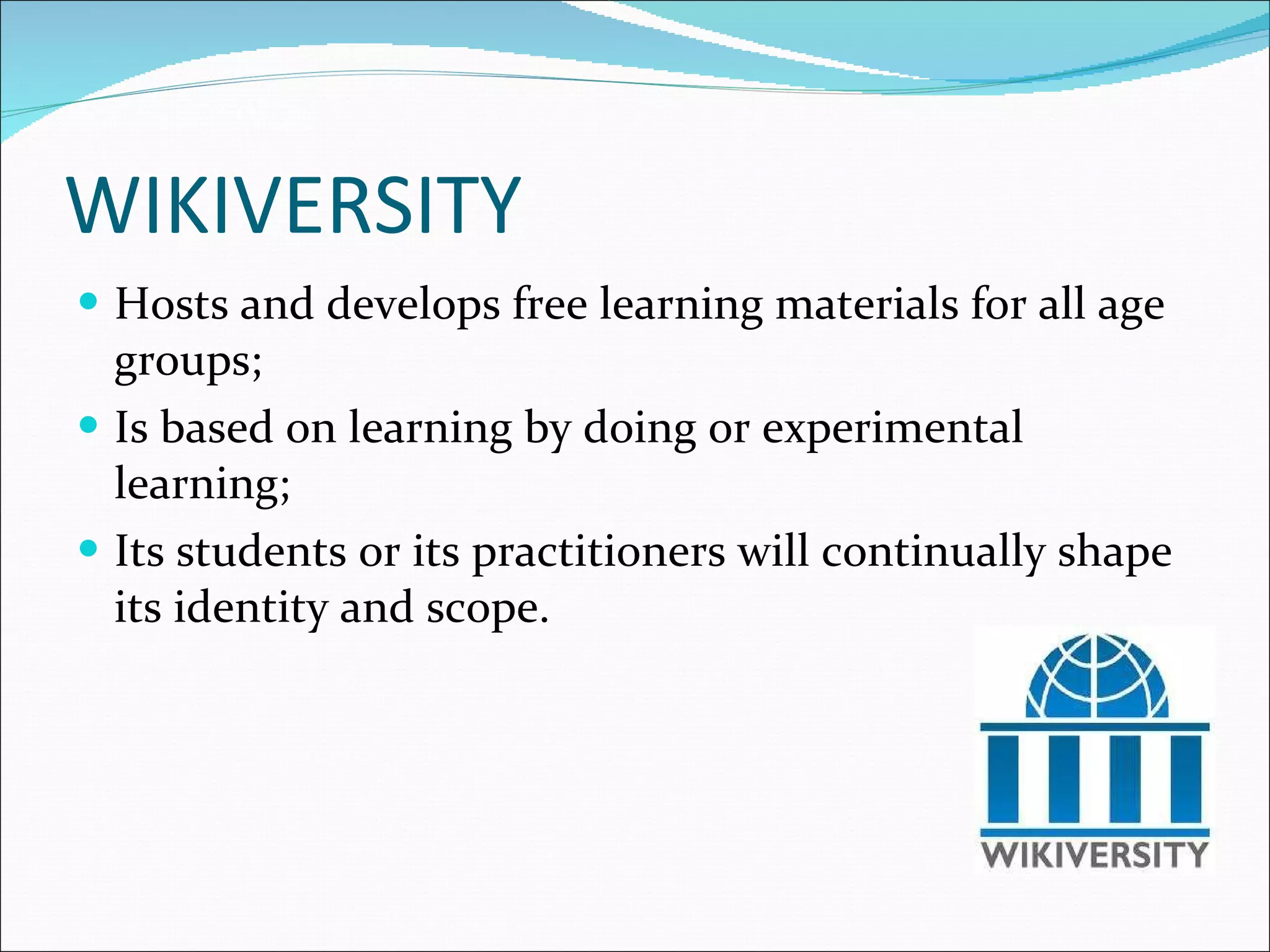
WIKIVERSITY  Hosts and develops free learning materials for all age groups; Is based on learning by doing or experimental learning; Its students or its practitioners will continually shape its identity and scope.
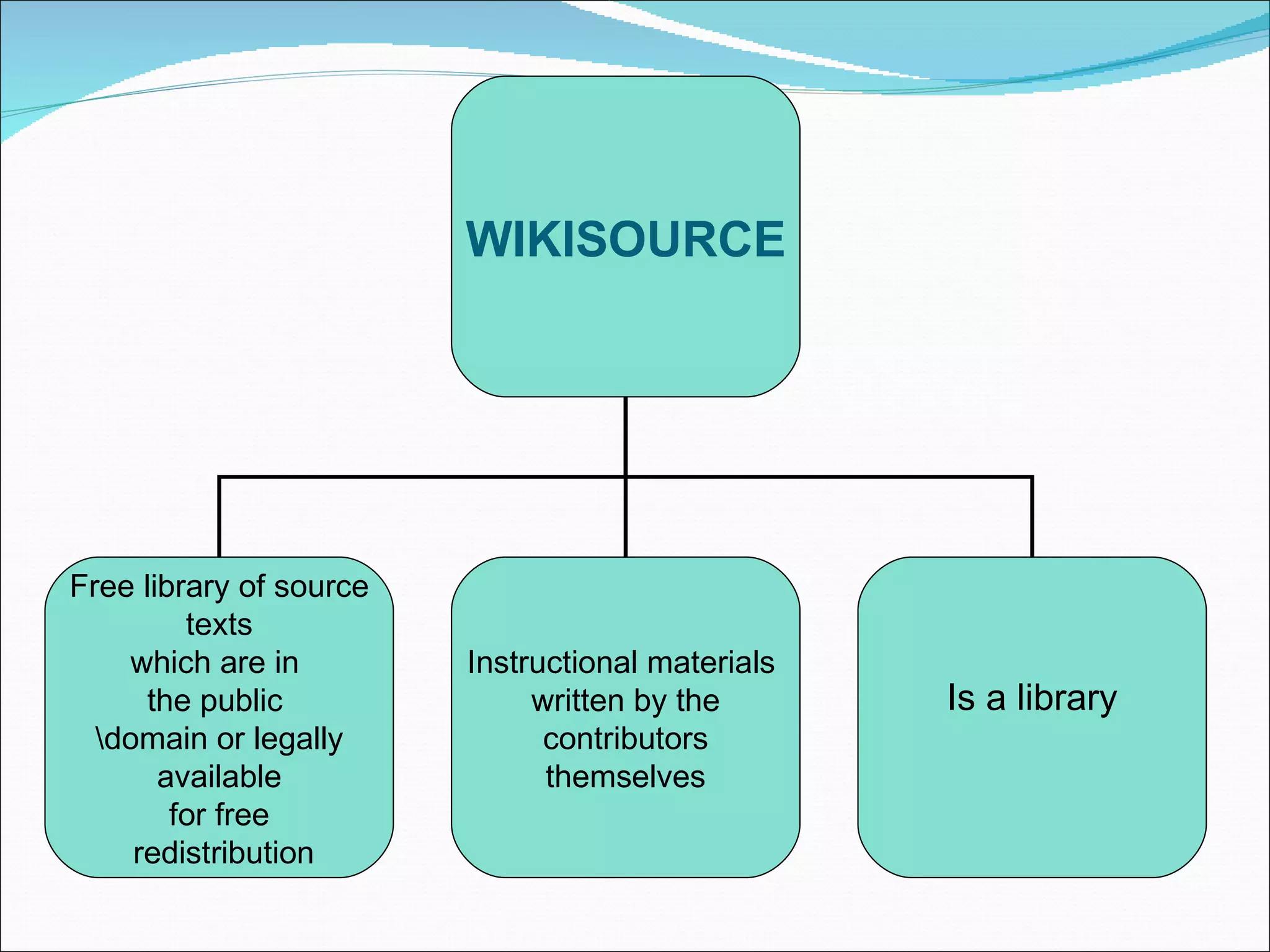
WIKISOURCE Free library of source texts  which are in  the public  \domain or legally available  for free redistribution Instructional materials  written by the contributors  themselves Is a library
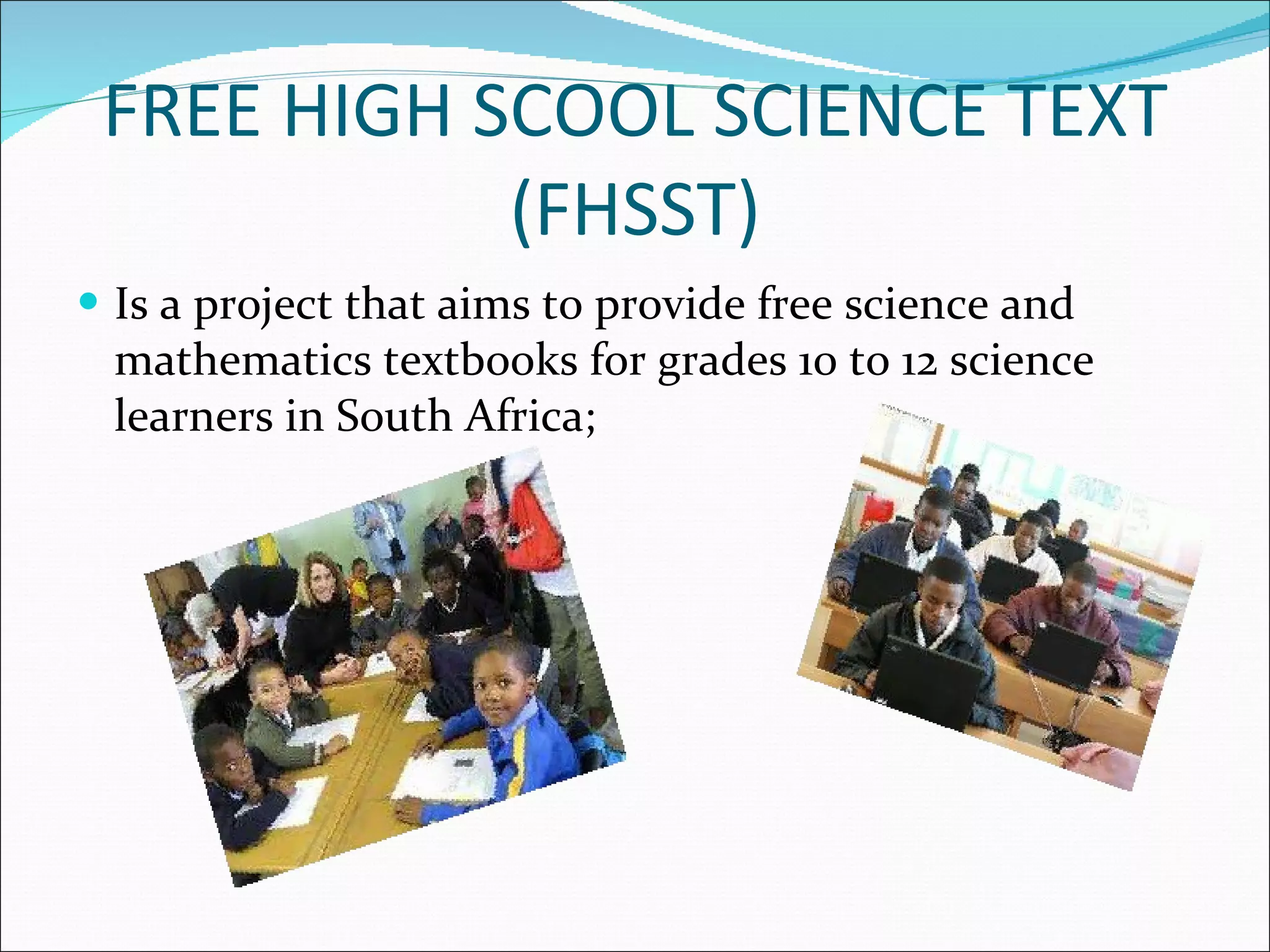
FREE HIGH SCOOL SCIENCE TEXT (FHSST) Is a project that aims to provide free science and mathematics textbooks for grades 10 to 12 science learners in South Africa;
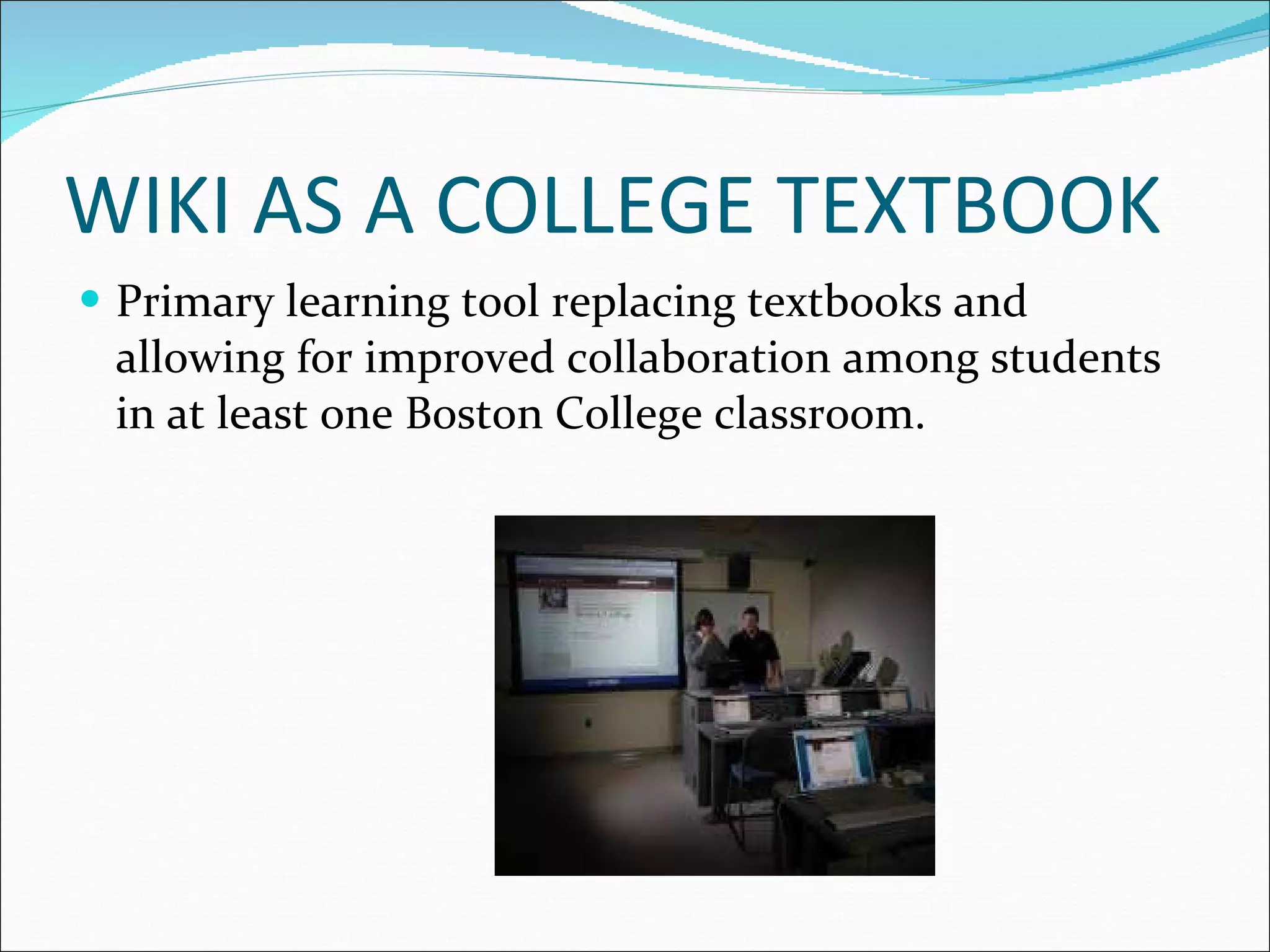
WIKI AS A COLLEGE TEXTBOOK Primary learning tool replacing textbooks and allowing for improved collaboration among students in at least one Boston College classroom.
SELECTING WIKI TOLLS Easy to use; Appearance; Cost; Security.
HOSTED WIKIS SERVER-SIDE WIKIS DESKTOP WIKIS TYPES OF WIKI
BENEFITS AND USE OF WIKIS IN SCHOOL COMMUNICATION Educators can create a glossary of terms for specific subject areas; It can contains pictures and text; Teachers can produce pathfinders and lead researchers through information jungles; Wiki pathfinder can link researchers to critical readings, Web sites, blogs, wikis, portals and databases.
BENEFITS AND USES OF WIKIS IN THE CLASSROOM Help teachers capture the students’ combined knowledge and present it in a manageable way, making it accessible to everyone; Students can share research and data while working on a group project as writing a ‘choose your own path ‘story; When the work is done, students invite others to read their work and comment.
Filtering prevents access to the wiki tools from school; District wiki policy should cover issues related to student identity on the World Wide Web; Develop the rules and guidelines for your wiki with your students and ensure that they have a positive tone. Safety guidelines in using a wiki
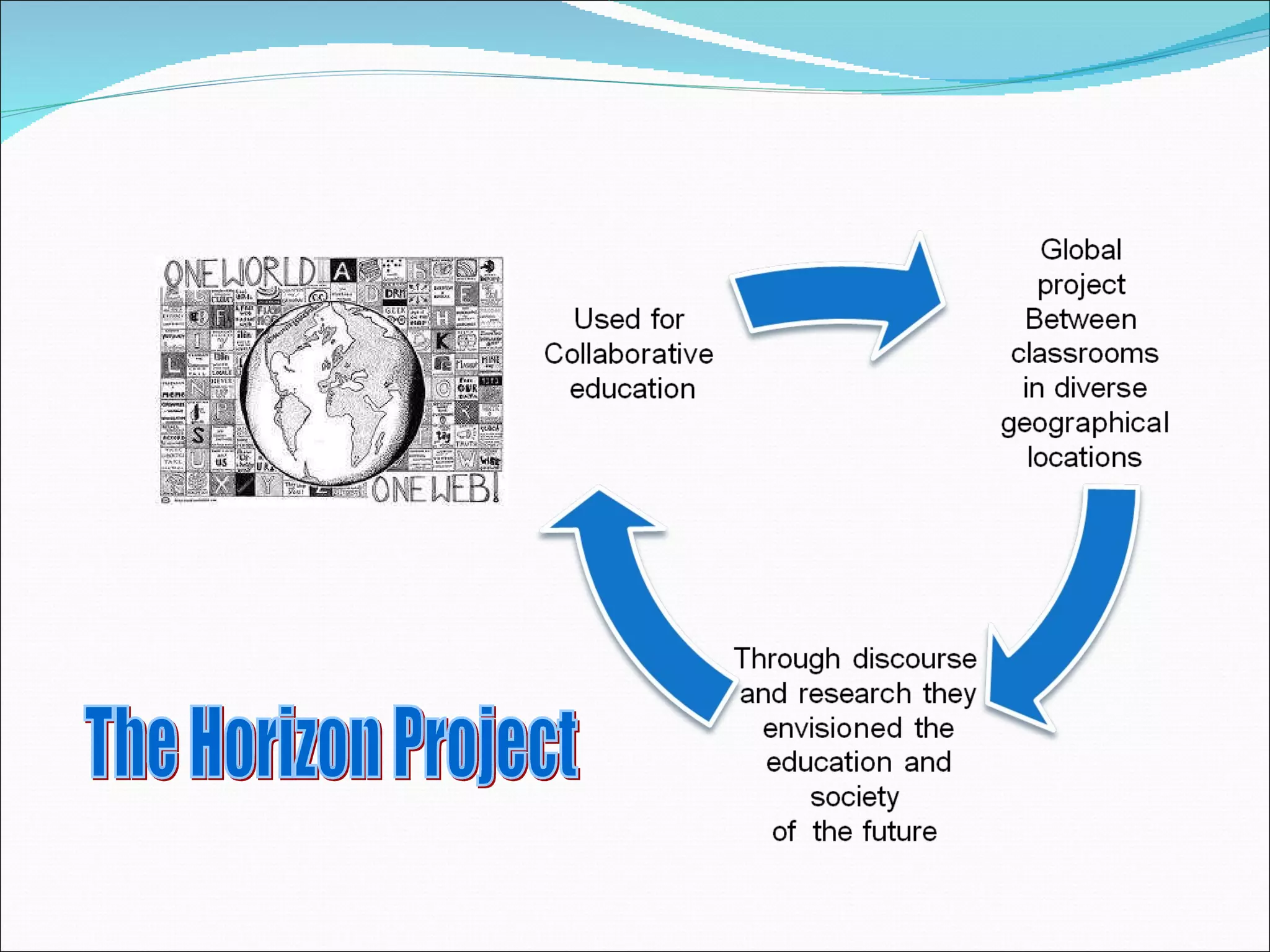
The Horizon Project
Universidade federal de Minas Gerais Curso de especialização em Inglês – CEI  Apredizagem de lingua Inglesa mediada por computador  Task 8 Prof. Reinildes Dias Group 4: Isabel C. Albuquerque Guerrieri Marília Salgado Vilas Boas Safar

Web 2.0 2011

  • 1.
    THE NEW DAYHAS COME
  • 2.
    The concept ofWeb 2.0 began with a conference brainstorming session with Tim O´Reilly and Medialive international.
  • 3.
    SHARE CREATE MIX INCREASE CONCEPTS
  • 4.
    What is web2.0? The term Web 2.0 is associated with web applications that facilitate participatory information sharing, interoperability, user-centered design, and collaboration on the World Wide Web. A Web 2.0 site allows users to interact and collaborate with each other in a social media dialogue as creators (prosumers) of user-generated content in a virtual community, in contrast to websites where users (consumers) are limited to the passive viewing of content that was created for them. Examples of Web 2.0 include social networking sites, blogs, wikis, video sharing sites, hosted services, web applications, mashups and folksonomies. ( Wikipedia)
  • 5.
  • 6.
  • 7.
  • 8.
  • 9.
    Speed of readingincreasing Scamming information, might be a good practice for cursory knowledge acquisition It´s important to learn distinguish between skimming for information and in - deep reading. RSS news feeds allow users to determine what is worth reading in deep and what is not.
  • 10.
    DEVELOP HIGHER ORDERTHINKING SKILLS The use of Web 2.0 applications can be exellent instructional tools to assist learners in moving up the ladder toward higher – order thinking skills. Lower Oder Thinking skills Create Higher Oder Thinking skills Analyze Apply Understand Describe Explain Knowlodge Remember
  • 11.
  • 12.
  • 13.
    Wikis have twomodels read and edit : Read state means wikis page looks just like a normal web page, and if you whant edit the wiki page you must acess the wiki edit mode http://www.youtube.com/watch?v=mdOKUeT0O-o
  • 14.
    Differences between aBLOG and a WIKI
  • 15.
    DIFFERENCE BETWEEN AWIKI AND A FORUM
  • 16.
    WIKINOMICS OPENNESS; PEERING;SHARING; ACTING GLOBALLY.
  • 17.
  • 18.
    WIKIPEDIA SELECTION FORSCHOOLS United Kingdom and Wikipedia Foundation have launched the Wikipedia Selection for Schools. Wikipedia Selection for Schools DVD with fifteen-volume encyclopedia Specifically material for children ages 8-17 who follow the UK Curriculum SOS CHILDREN
  • 19.
  • 20.
    WIKIVERSITY Hostsand develops free learning materials for all age groups; Is based on learning by doing or experimental learning; Its students or its practitioners will continually shape its identity and scope.
  • 21.
    WIKISOURCE Free libraryof source texts which are in the public \domain or legally available for free redistribution Instructional materials written by the contributors themselves Is a library
  • 22.
    FREE HIGH SCOOLSCIENCE TEXT (FHSST) Is a project that aims to provide free science and mathematics textbooks for grades 10 to 12 science learners in South Africa;
  • 23.
    WIKI AS ACOLLEGE TEXTBOOK Primary learning tool replacing textbooks and allowing for improved collaboration among students in at least one Boston College classroom.
  • 24.
    SELECTING WIKI TOLLSEasy to use; Appearance; Cost; Security.
  • 25.
    HOSTED WIKIS SERVER-SIDEWIKIS DESKTOP WIKIS TYPES OF WIKI
  • 26.
    BENEFITS AND USEOF WIKIS IN SCHOOL COMMUNICATION Educators can create a glossary of terms for specific subject areas; It can contains pictures and text; Teachers can produce pathfinders and lead researchers through information jungles; Wiki pathfinder can link researchers to critical readings, Web sites, blogs, wikis, portals and databases.
  • 27.
    BENEFITS AND USESOF WIKIS IN THE CLASSROOM Help teachers capture the students’ combined knowledge and present it in a manageable way, making it accessible to everyone; Students can share research and data while working on a group project as writing a ‘choose your own path ‘story; When the work is done, students invite others to read their work and comment.
  • 28.
    Filtering prevents accessto the wiki tools from school; District wiki policy should cover issues related to student identity on the World Wide Web; Develop the rules and guidelines for your wiki with your students and ensure that they have a positive tone. Safety guidelines in using a wiki
  • 29.
  • 30.
    Universidade federal deMinas Gerais Curso de especialização em Inglês – CEI Apredizagem de lingua Inglesa mediada por computador Task 8 Prof. Reinildes Dias Group 4: Isabel C. Albuquerque Guerrieri Marília Salgado Vilas Boas Safar