About Wikis in education, business, social uses, fun, community, non-profit For the IT department @ UoC as we decide “Do we need a wiki on campus?” Derek Chirnside
First a little quiz Score with your fingers, one point per question
You can pronounce  wiki Wiki : <wee-kee>) or <wick-ey>
You have heard of wikis
You know what  wiki  means Wiki  wiki  (in Hawaiian)    . . . . means  quick
You have used a wiki
You know what a wiki is “ A type of Web site that allows  users  to  easily add and edit  content and is especially suited for  collaborative  writing.” Source: Wikipedia http://en.wikipedia.org/wiki/Wiki
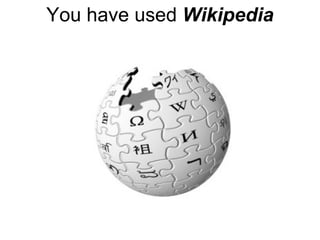
You have used  Wikipedia
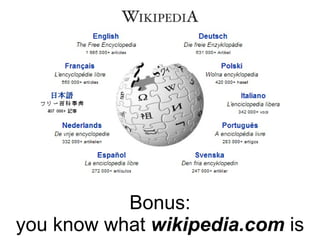
Bonus: you know what  wikipedia.com  is
Bonus: used  wikipedia.com  this week
Double Bonus: You have actually edited  wikipedia.com
Bonus: you have used  other wikis [There are a lot of wikis]
You have thought about using wikis in the classroom, office, business,  or social club  . . .
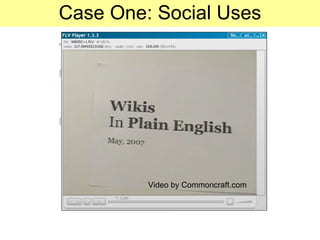
Case One: Social Uses Video by Commoncraft.com
Summary?
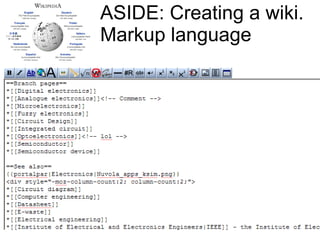
ASIDE: Creating a wiki.  Markup language
ASIDE: Avoiding wiki markup problems Set up a structure for users to enter text into. Find another wiki that does not use wiki markup.
ASIDE: Where is your wiki hosted?? On your server   eg  http://akowiki.canterbury.ac.nz On the web   eg  http://wikispaces.com Free service or fee paying??
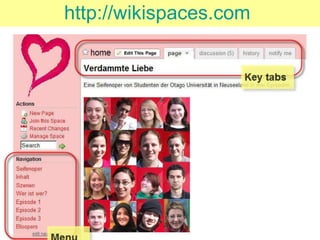
Case Two: German 311 [email_address]   Part One . .  Students develop script for a soap opera in German using wikispaces  http://seifenoper.wikispaces.com/   USE: Collaborative writing
http://wikispaces.com
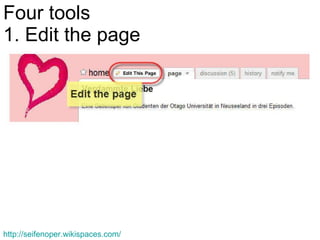
Four tools 1. Edit the page http://seifenoper.wikispaces.com/
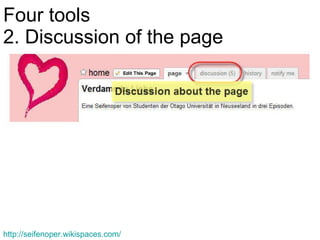
Four tools 2. Discussion of the page http://seifenoper.wikispaces.com/
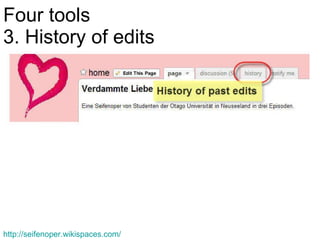
Four tools 3. History of edits http://seifenoper.wikispaces.com/
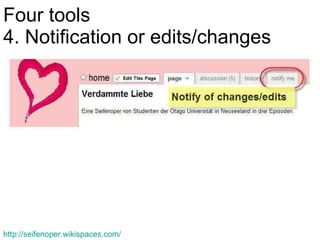
Four tools 4. Notification or edits/changes http://seifenoper.wikispaces.com/
(Another feature: Permissions)
German 311 (Just by the way . .) Part Two . .  Blogging in character Part Three . .  Video the drama, and put it on YouTube.com Wikis  are Not  blogs  which are Not  Forums But there are  blikis !!  http://en.wikipedia.org/wiki/Bliki
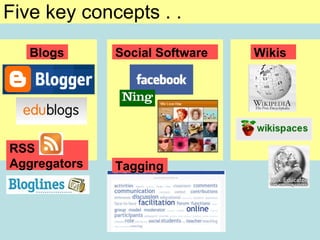
Five key concepts . . Wikis RSS Aggregators Blogs Social Software Tagging
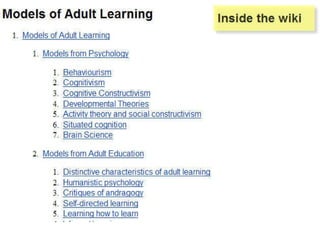
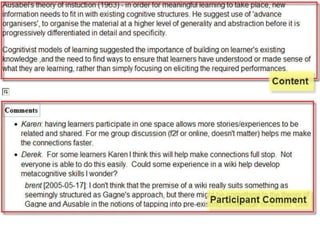
Case Three: TT701 2006 Part One . .  Context:  needed a quick overview of Adult learning theory. An entire document (20 pages) was loaded into a wiki and opened for comment USE: Sharing ideas and commentary
 
 
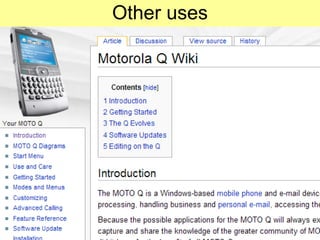
Other uses
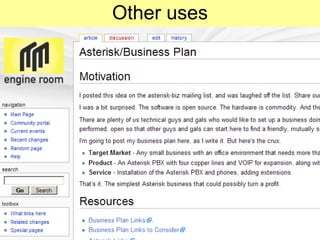
Other uses
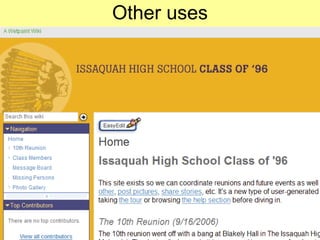
Other uses
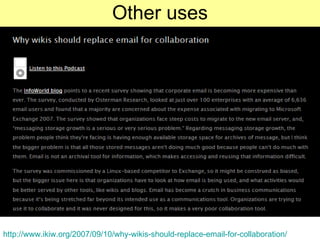
Other uses http://www.ikiw.org/2007/09/10/why-wikis-should-replace-email-for-collaboration/
WIKI Implementation: a conservative view
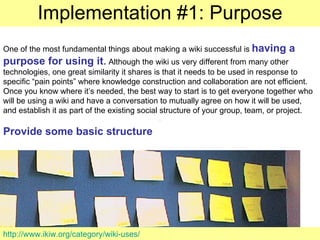
Implementation #1: Purpose One of the most fundamental things about making a wiki successful is  having a purpose for using it .  Although the wiki us very different from many other technologies, one great similarity it shares is that it needs to be used in response to specific “pain points” where knowledge construction and collaboration are not efficient. Once you know where it’s needed, the best way to start is to get everyone together who will be using a wiki and have a conversation to mutually agree on how it will be used, and establish it as part of the existing social structure of your group, team, or project. Provide some basic structure http://www.ikiw.org/category/wiki-uses/
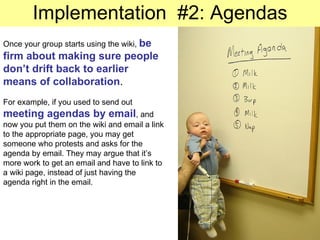
Implementation  #2: Agendas Once your group starts using the wiki,  be firm about making sure people don’t drift back to earlier means of collaboration .   For example, if you used to send out  meeting agendas by email , and now you put them on the wiki and email a link to the appropriate page, you may get someone who protests and asks for the agenda by email. They may argue that it’s more work to get an email and have to link to a wiki page, instead of just having the agenda right in the email.
Implementation  #3: Persist If this happens, I’d suggest responding that although it seems like an inconvenience now, it’s really only a  temporary inconvenience that paves the way for several improvements .  First is a  reduction in email  when people are using to going to the wiki and an email with a link to the meeting agenda wiki page is no longer necessary. The second is a further reduction in email when people need to edit the agenda and can do so directly on the wiki instead of emailing the person who sent the agenda. The third improvement is that now information is  stored in a more archival, accessible, and secure format than email:  if you were to lose your laptop or it’s stolen, email is lost along with it and this can compromise the security of sensitive information. However, if you’re using a wiki, that information is stored on a secure server and won’t be lost or compromised as easily. The fourth improvement is that once you start using the wiki for meeting agendas, it lays the foundation for further wiki use, like managing the tasks and projects that arise from the agenda. It’s this organic use that makes the wiki quickly become an indispensable tool for information and collaboration.
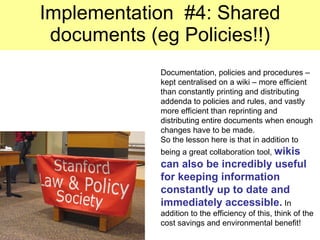
Implementation  #4: Shared documents (eg Policies!!) Documentation, policies and procedures – kept centralised on a wiki – more efficient than constantly printing and distributing addenda to policies and rules, and vastly more efficient than reprinting and distributing entire documents when enough changes have to be made. So the lesson here is that in addition to being a great collaboration tool,  wikis can also be incredibly useful for keeping information constantly up to date and immediately accessible.  In addition to the efficiency of this, think of the cost savings and environmental benefit!
They want to contribute! They don’t want to be passive receivers of information. Why some people like wikis
Wiki technology enables collaborative knowledge gathering and “peer review.” Allows community-moderated, content, updated in real time.
The questions Identity? Audience?
Q. How many Wiki people does it take to change a lightbulb? A. One, but anyone can change it back. - langreiter.com
Thank-you
 

Wikis & Implementation issues

  • 1.
    About Wikis ineducation, business, social uses, fun, community, non-profit For the IT department @ UoC as we decide “Do we need a wiki on campus?” Derek Chirnside
  • 2.
    First a littlequiz Score with your fingers, one point per question
  • 3.
    You can pronounce wiki Wiki : <wee-kee>) or <wick-ey>
  • 4.
  • 5.
    You know what wiki means Wiki wiki (in Hawaiian) . . . . means quick
  • 6.
  • 7.
    You know whata wiki is “ A type of Web site that allows users to easily add and edit content and is especially suited for collaborative writing.” Source: Wikipedia http://en.wikipedia.org/wiki/Wiki
  • 8.
    You have used Wikipedia
  • 9.
    Bonus: you knowwhat wikipedia.com is
  • 10.
    Bonus: used wikipedia.com this week
  • 11.
    Double Bonus: Youhave actually edited wikipedia.com
  • 12.
    Bonus: you haveused other wikis [There are a lot of wikis]
  • 13.
    You have thoughtabout using wikis in the classroom, office, business, or social club . . .
  • 14.
    Case One: SocialUses Video by Commoncraft.com
  • 15.
  • 16.
    ASIDE: Creating awiki. Markup language
  • 17.
    ASIDE: Avoiding wikimarkup problems Set up a structure for users to enter text into. Find another wiki that does not use wiki markup.
  • 18.
    ASIDE: Where isyour wiki hosted?? On your server eg http://akowiki.canterbury.ac.nz On the web eg http://wikispaces.com Free service or fee paying??
  • 19.
    Case Two: German311 [email_address] Part One . . Students develop script for a soap opera in German using wikispaces http://seifenoper.wikispaces.com/ USE: Collaborative writing
  • 20.
  • 21.
    Four tools 1.Edit the page http://seifenoper.wikispaces.com/
  • 22.
    Four tools 2.Discussion of the page http://seifenoper.wikispaces.com/
  • 23.
    Four tools 3.History of edits http://seifenoper.wikispaces.com/
  • 24.
    Four tools 4.Notification or edits/changes http://seifenoper.wikispaces.com/
  • 25.
  • 26.
    German 311 (Justby the way . .) Part Two . . Blogging in character Part Three . . Video the drama, and put it on YouTube.com Wikis are Not blogs which are Not Forums But there are blikis !! http://en.wikipedia.org/wiki/Bliki
  • 27.
    Five key concepts. . Wikis RSS Aggregators Blogs Social Software Tagging
  • 28.
    Case Three: TT7012006 Part One . . Context: needed a quick overview of Adult learning theory. An entire document (20 pages) was loaded into a wiki and opened for comment USE: Sharing ideas and commentary
  • 29.
  • 30.
  • 31.
  • 32.
  • 33.
  • 34.
  • 35.
    WIKI Implementation: aconservative view
  • 36.
    Implementation #1: PurposeOne of the most fundamental things about making a wiki successful is having a purpose for using it . Although the wiki us very different from many other technologies, one great similarity it shares is that it needs to be used in response to specific “pain points” where knowledge construction and collaboration are not efficient. Once you know where it’s needed, the best way to start is to get everyone together who will be using a wiki and have a conversation to mutually agree on how it will be used, and establish it as part of the existing social structure of your group, team, or project. Provide some basic structure http://www.ikiw.org/category/wiki-uses/
  • 37.
    Implementation #2:Agendas Once your group starts using the wiki, be firm about making sure people don’t drift back to earlier means of collaboration . For example, if you used to send out meeting agendas by email , and now you put them on the wiki and email a link to the appropriate page, you may get someone who protests and asks for the agenda by email. They may argue that it’s more work to get an email and have to link to a wiki page, instead of just having the agenda right in the email.
  • 38.
    Implementation #3:Persist If this happens, I’d suggest responding that although it seems like an inconvenience now, it’s really only a temporary inconvenience that paves the way for several improvements . First is a reduction in email when people are using to going to the wiki and an email with a link to the meeting agenda wiki page is no longer necessary. The second is a further reduction in email when people need to edit the agenda and can do so directly on the wiki instead of emailing the person who sent the agenda. The third improvement is that now information is stored in a more archival, accessible, and secure format than email: if you were to lose your laptop or it’s stolen, email is lost along with it and this can compromise the security of sensitive information. However, if you’re using a wiki, that information is stored on a secure server and won’t be lost or compromised as easily. The fourth improvement is that once you start using the wiki for meeting agendas, it lays the foundation for further wiki use, like managing the tasks and projects that arise from the agenda. It’s this organic use that makes the wiki quickly become an indispensable tool for information and collaboration.
  • 39.
    Implementation #4:Shared documents (eg Policies!!) Documentation, policies and procedures – kept centralised on a wiki – more efficient than constantly printing and distributing addenda to policies and rules, and vastly more efficient than reprinting and distributing entire documents when enough changes have to be made. So the lesson here is that in addition to being a great collaboration tool, wikis can also be incredibly useful for keeping information constantly up to date and immediately accessible. In addition to the efficiency of this, think of the cost savings and environmental benefit!
  • 40.
    They want tocontribute! They don’t want to be passive receivers of information. Why some people like wikis
  • 41.
    Wiki technology enablescollaborative knowledge gathering and “peer review.” Allows community-moderated, content, updated in real time.
  • 42.
  • 43.
    Q. How manyWiki people does it take to change a lightbulb? A. One, but anyone can change it back. - langreiter.com
  • 44.
  • 45.