Web 2.0 and Social Media
Business in a Connected World
© McHaney and Sachs 2016
Facebook and LinkedIn
Two high impact social media Web sites for business are
Facebook and LinkedIn. Coupled with Twitter, these
three represent a high impact minimum that all
organizations need to incorporate into their planning.
Facebook and LinkedIn
Big Social Media
Social networking is the ‘what’ and social media is the ‘how’. In other
words, social media are tools that facilitate social networking
For instance, LinkedIn is social
media. Social networking takes
place in LinkedIn each time
people form connections,
exchange information, share, or
discuss. Twitter is social media
and each Tweet represents the
act of social networking. Social
media makes social networking
easier.
Social Networking Versus Social Media
Goddard (2012) states that
“[s]ocial networks are made up of
peers seeking and giving advice to
make better decisions. Advanced
social networking science can
even tell us which people give out
the most advice in the network
and have the most influence.
These people are called opinion
leaders.”
Social Media Impact
Opinion Leaders
Social media, a recent
arrival on the scene,
has provided a new set
of tools to make social
networks easier to
create, join, manage
and use. Social media
includes blogs, online
videos, social news,
social bookmarking and
much more.
Social Media
June, 2016, Facebook had more than
1.65 billion active monthly users.
Over 100 billion social networking
connections exist within Facebook.
Businesses cannot overlook this global
communication channel.
Facebook is the Social Media giant
Facebook Overview
Be Careful Because it is a Social Site
Business on Facebook
Businesses on Facebook
Developing a business presence on Facebook is a must.
Family and Friends
Many people view Facebook as a primary method for communicating
with family and close friends. Business connections, advertisements, and
intrusive messages may not be welcome.
Work Within Facebook Norms
Businesses need to carefully plan their interactions in ways that respect
typical Facebook use.
Support Tools
Not all people prefer to avoid commercial contact on Facebook. On any
given day, millions of Likes are given to business pages and business
content is viewed, downloaded, and commented upon.
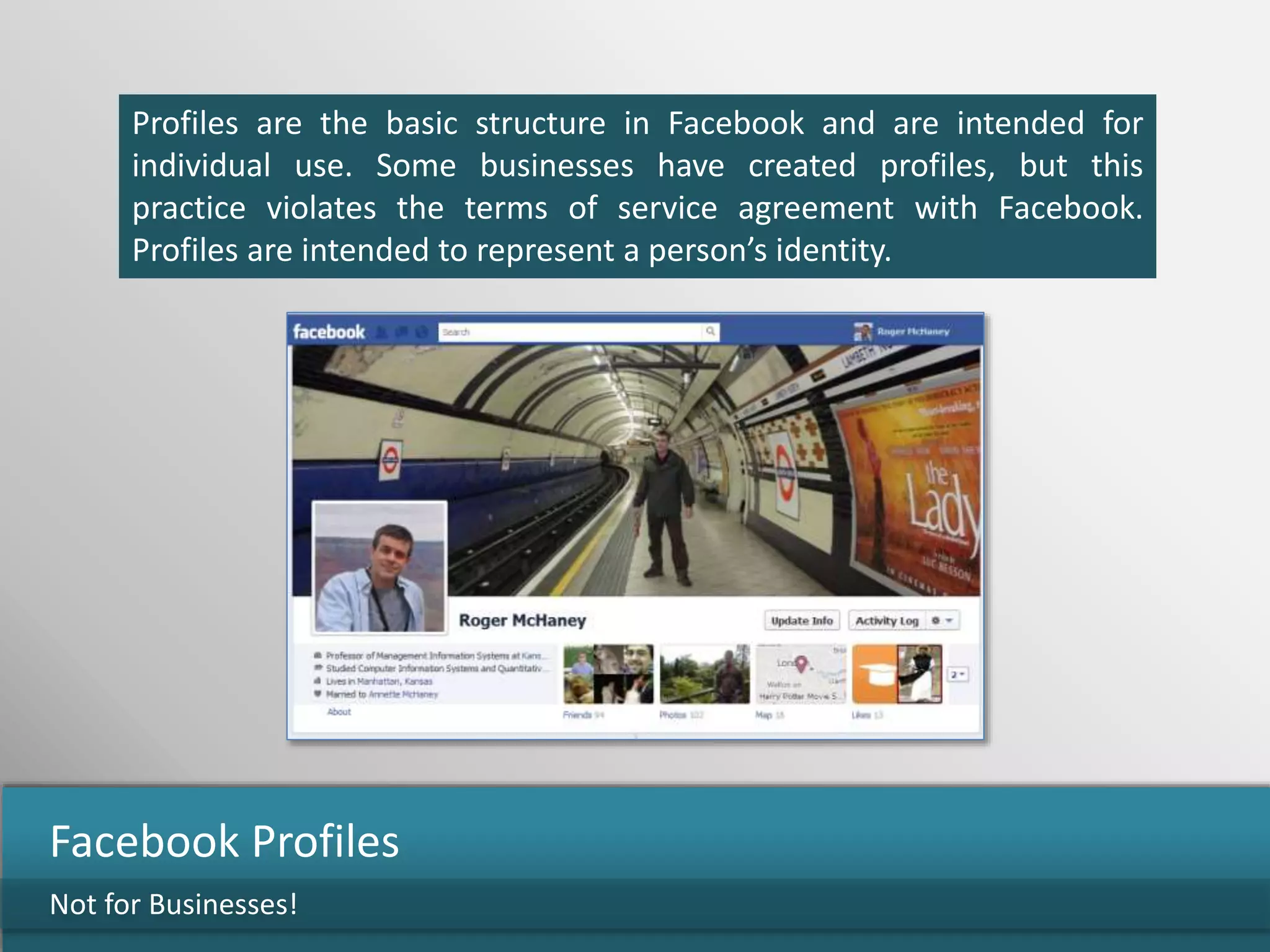
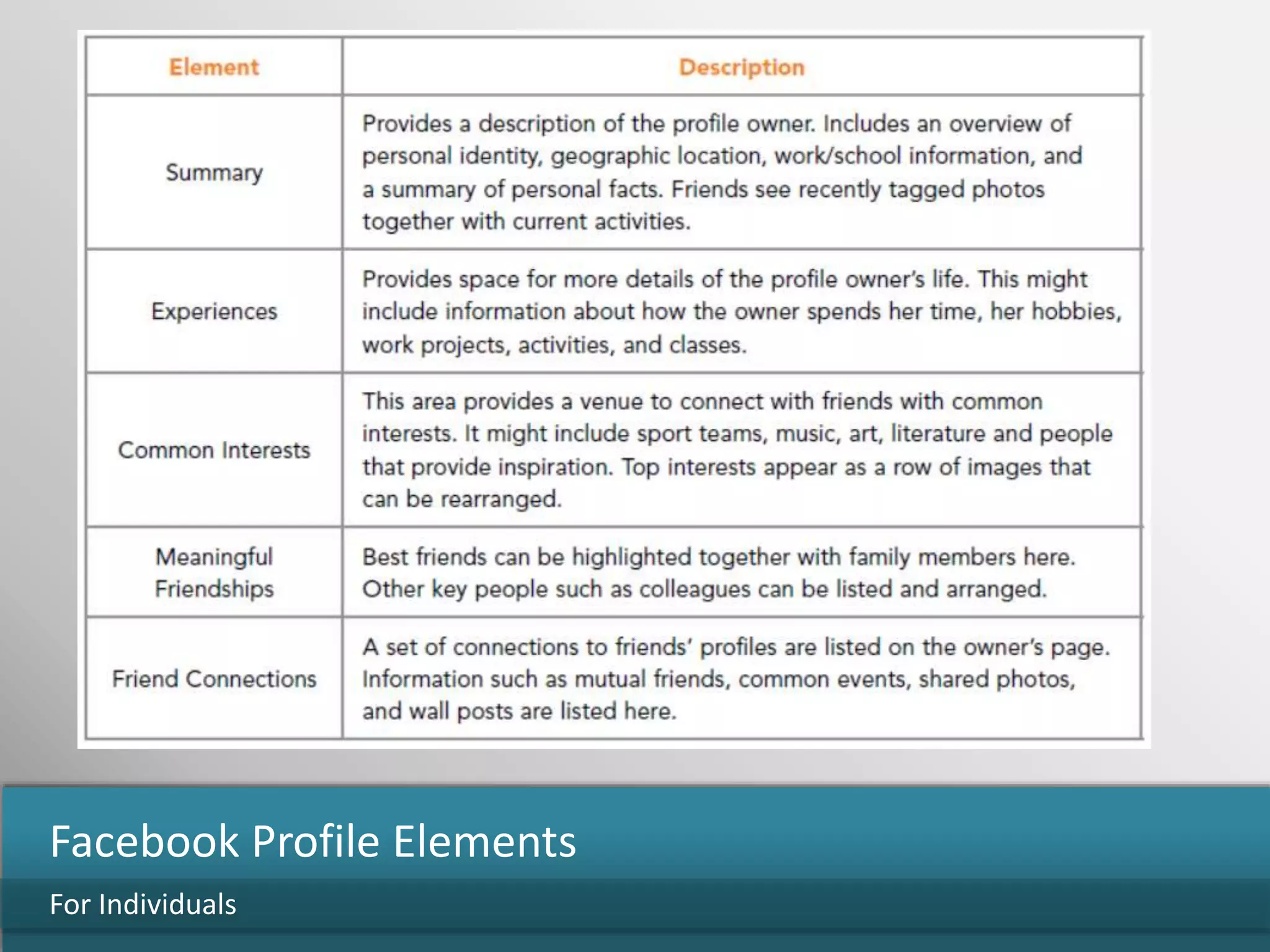
Profiles are the basic structure in Facebook and are intended for
individual use. Some businesses have created profiles, but this
practice violates the terms of service agreement with Facebook.
Profiles are intended to represent a person’s identity.
Not for Businesses!
Facebook Profiles
For Individuals
Facebook Profile Elements
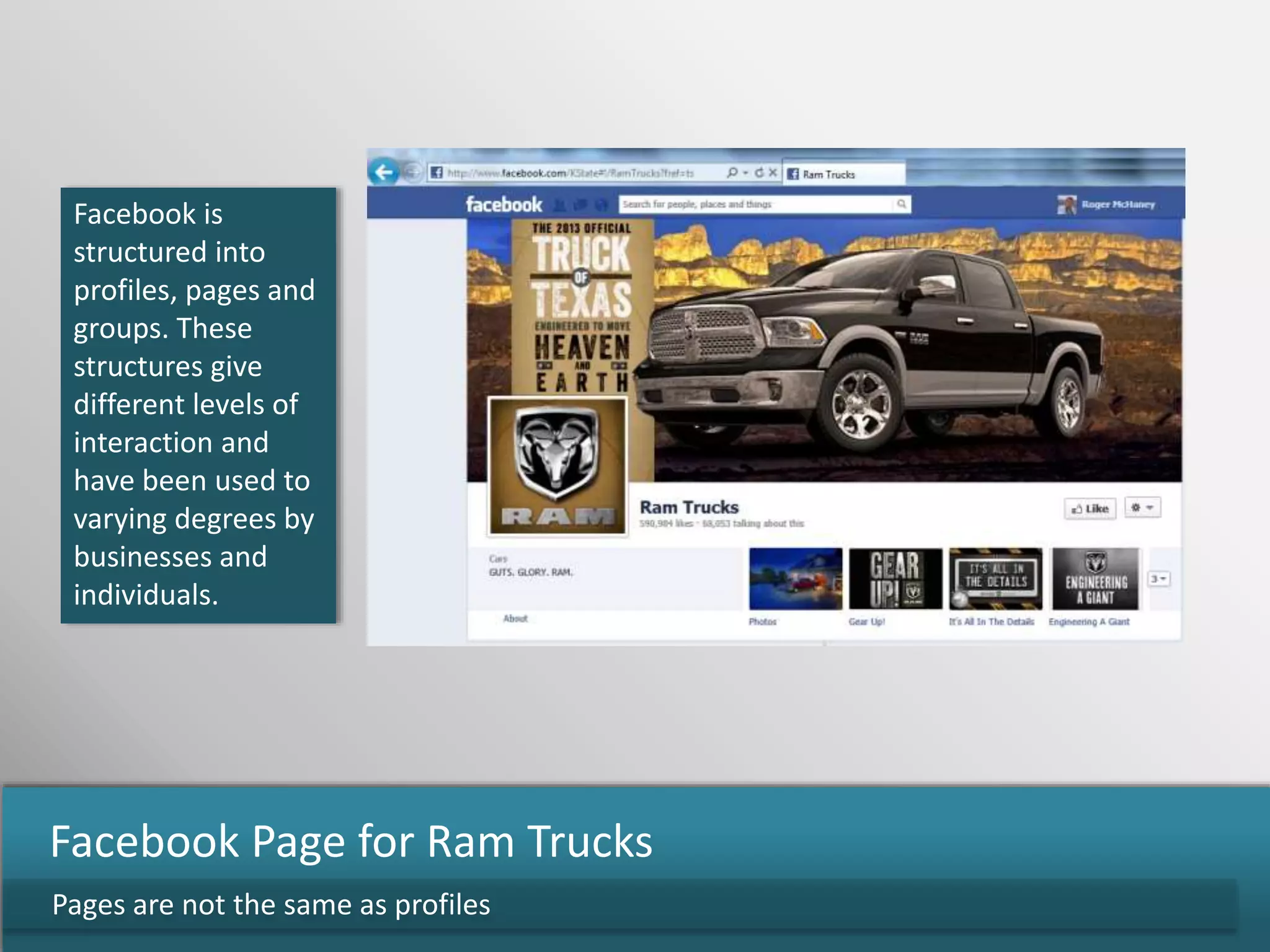
Facebook is
structured into
profiles, pages and
groups. These
structures give
different levels of
interaction and
have been used to
varying degrees by
businesses and
individuals.
Pages are not the same as profiles
Facebook Page for Ram Trucks
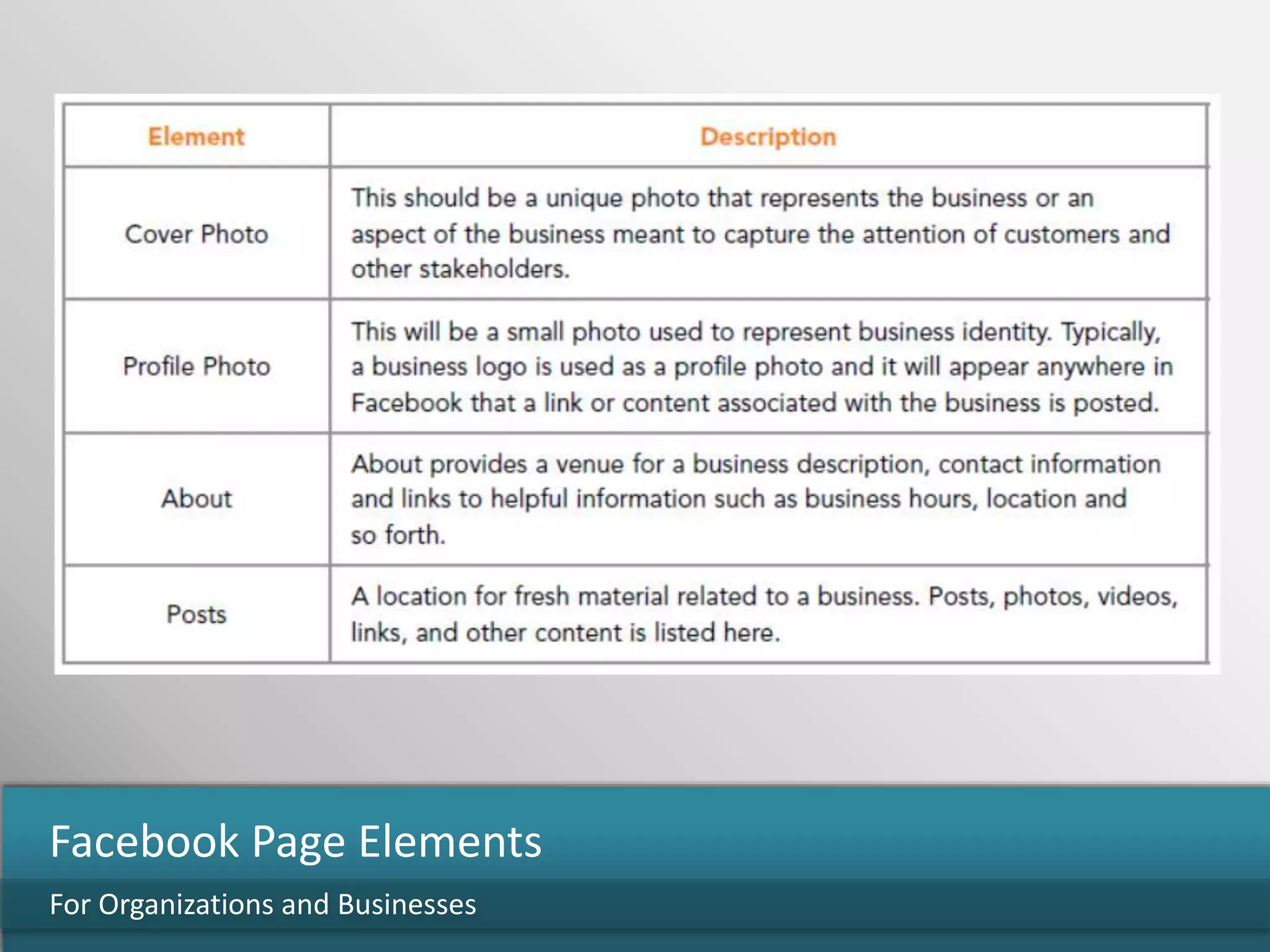
For Organizations and Businesses
Facebook Page Elements
Facebook recommends that businesses use pages to develop rapport
with customers. Regular posts help foster relationships and stimulate an
active online community. A consistent voice and authentic, original
information can encourage people to interact with the business.
Page Recommendations
Page Items Needed to Build a Facebook Community
New Content Stream
Photos, videos, menus, sneak peeks, new product information and event
announcements.
Stimulating Questions
Stimulate customers to provide feedback and opinions about products
and services.
Events
Information about new product launches, anniversaries, promotions, in-
store events and sales.
Stories
Posts that provide
stories about
products, successes,
or other customers
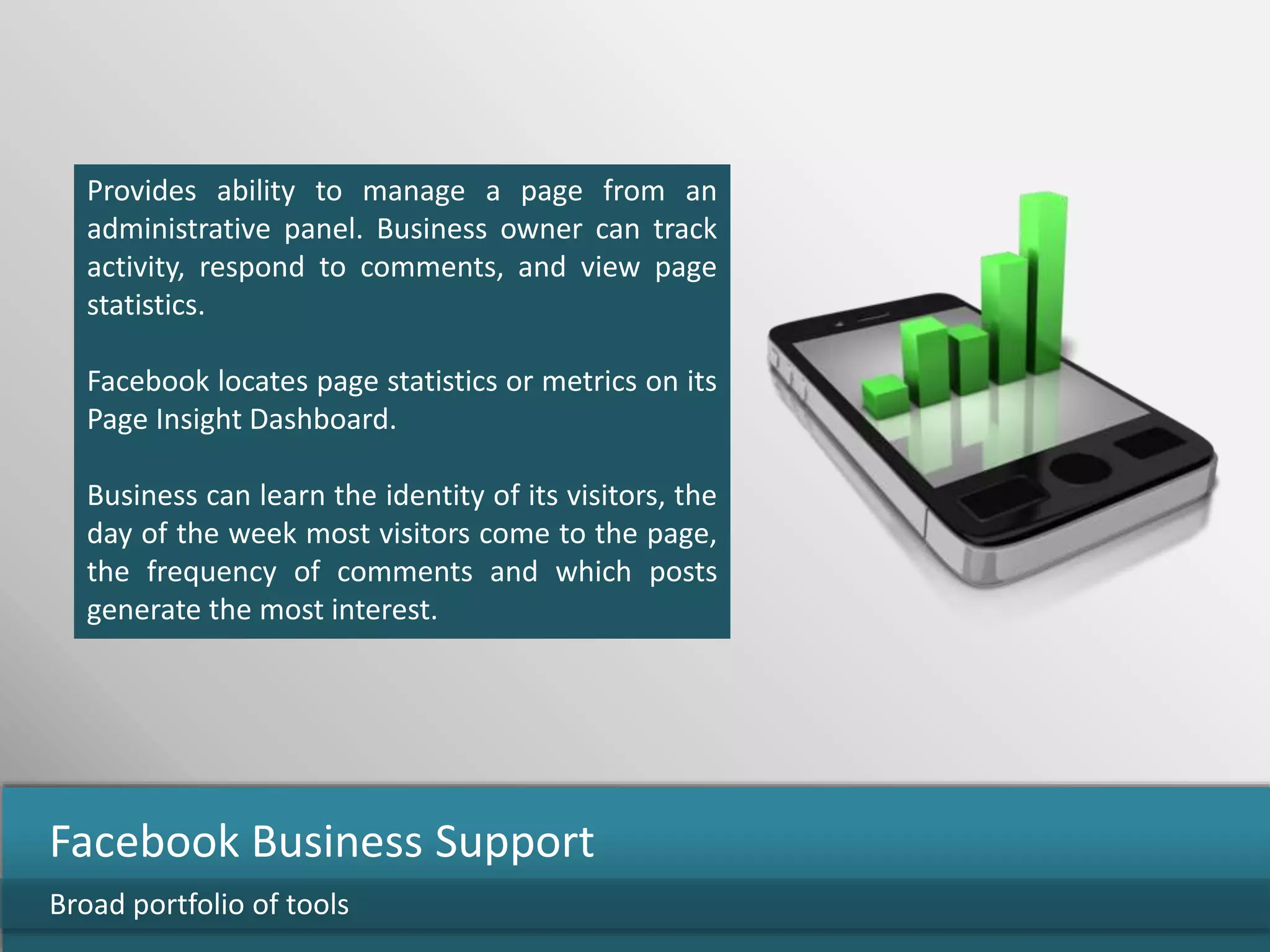
Provides ability to manage a page from an
administrative panel. Business owner can track
activity, respond to comments, and view page
statistics.
Facebook locates page statistics or metrics on its
Page Insight Dashboard.
Business can learn the identity of its visitors, the
day of the week most visitors come to the page,
the frequency of comments and which posts
generate the most interest.
Broad portfolio of tools
Facebook Business Support
More Features of Pages
No Friends
Pages do not accumulate friends. Instead, people become fans.
Pages are Searchable Outside of Facebook
People don’t have to be logged into Facebook to view a business page.
Each page is indexed by Google and other search engines and will be
listed when searches are conducted.
Pages: No Limits
Profiles are limited to 5,000 friends but business pages can have an
unlimited number of fans (for instance, the late pop star David
Bowie’s Facebook page has almost 7 million likes).
Promotions
Pages can be promoted with sidebar ads on Facebook,
customized tabs with coupons and other items (e.g. maps,
videos, et cetera), or discussions with fans.
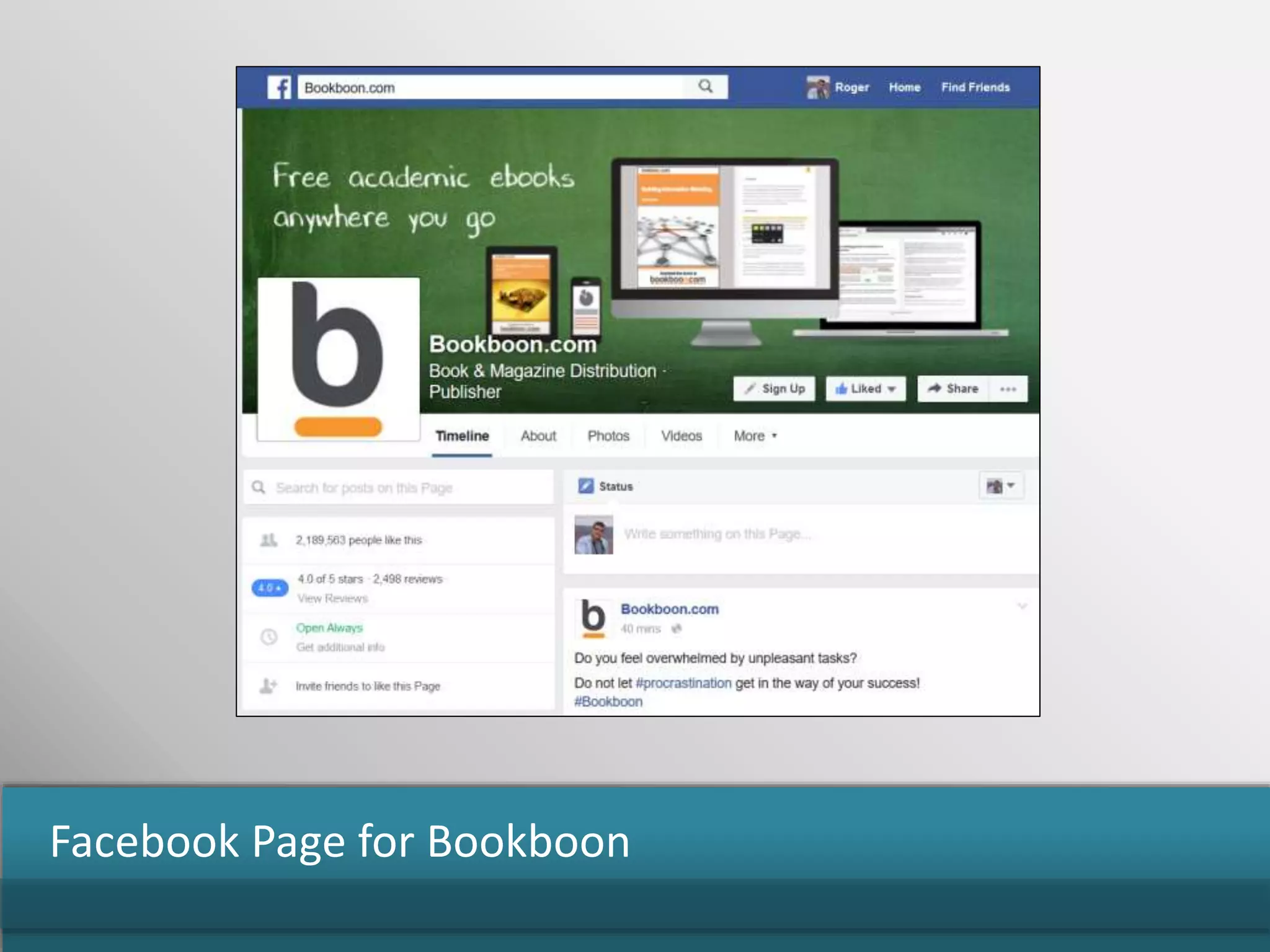
Facebook Page for Bookboon
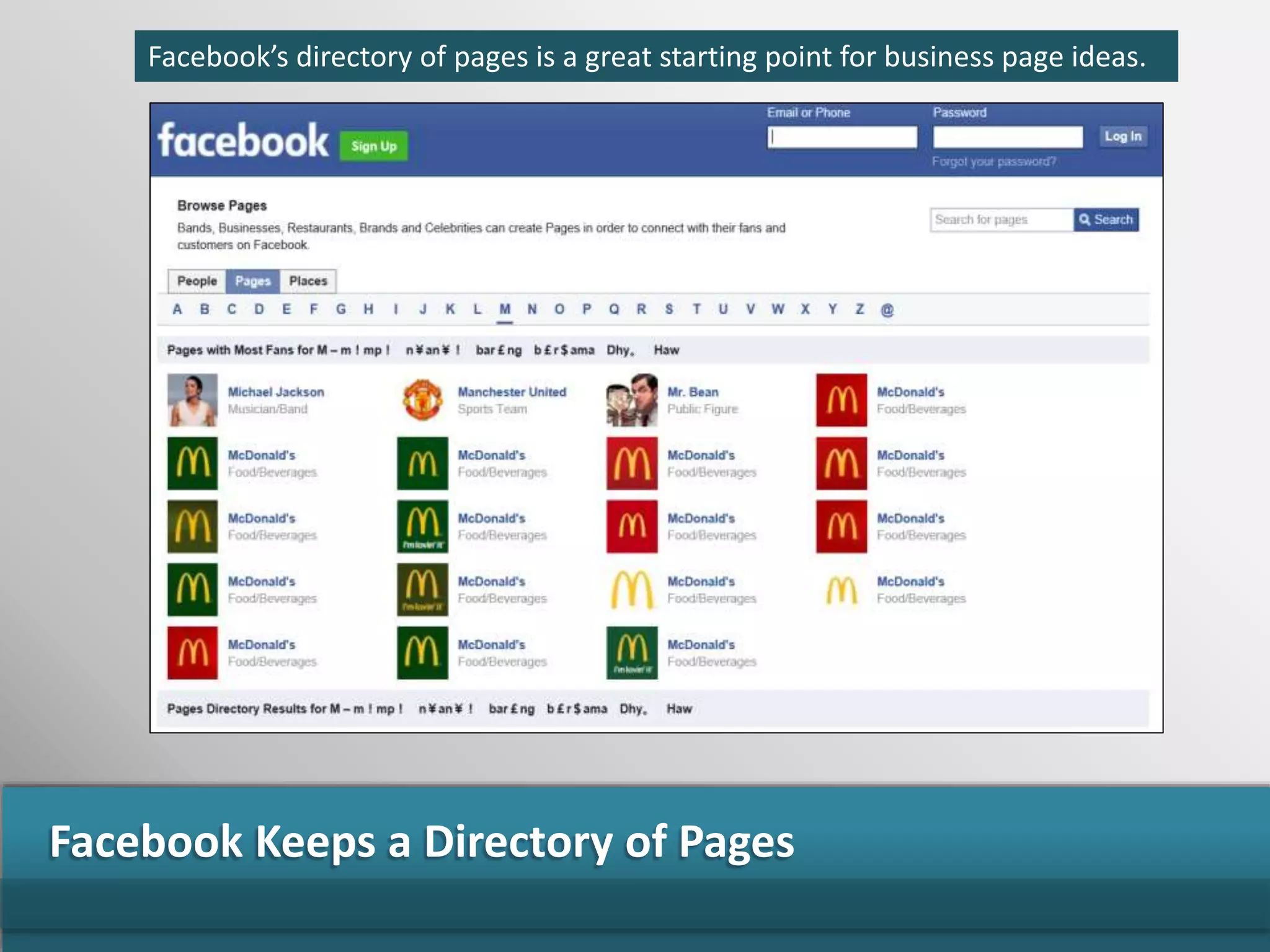
Facebook Keeps a Directory of Pages
Facebook’s directory of pages is a great starting point for business page ideas.
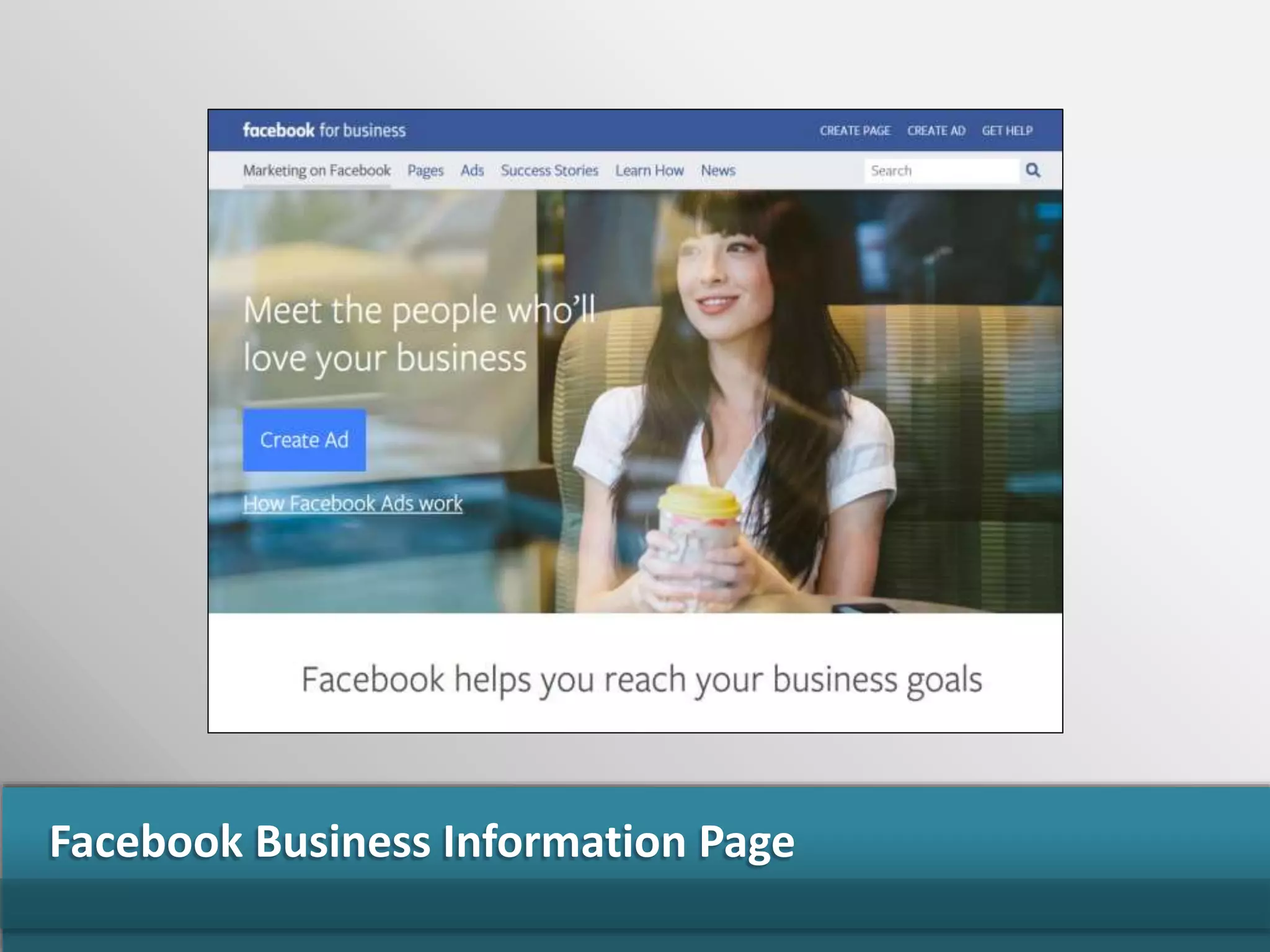
Facebook Business Information Page
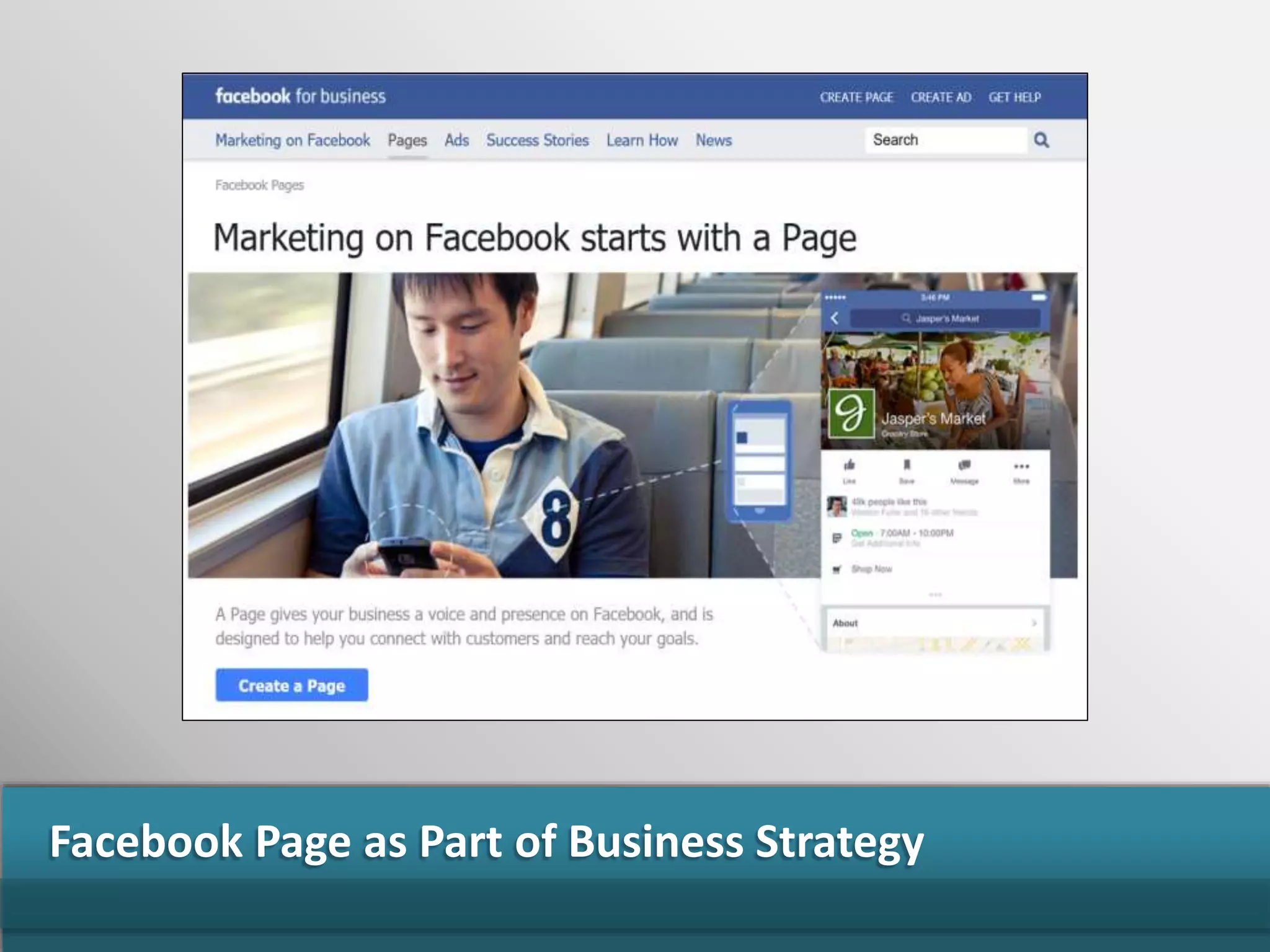
Facebook Page as Part of Business Strategy
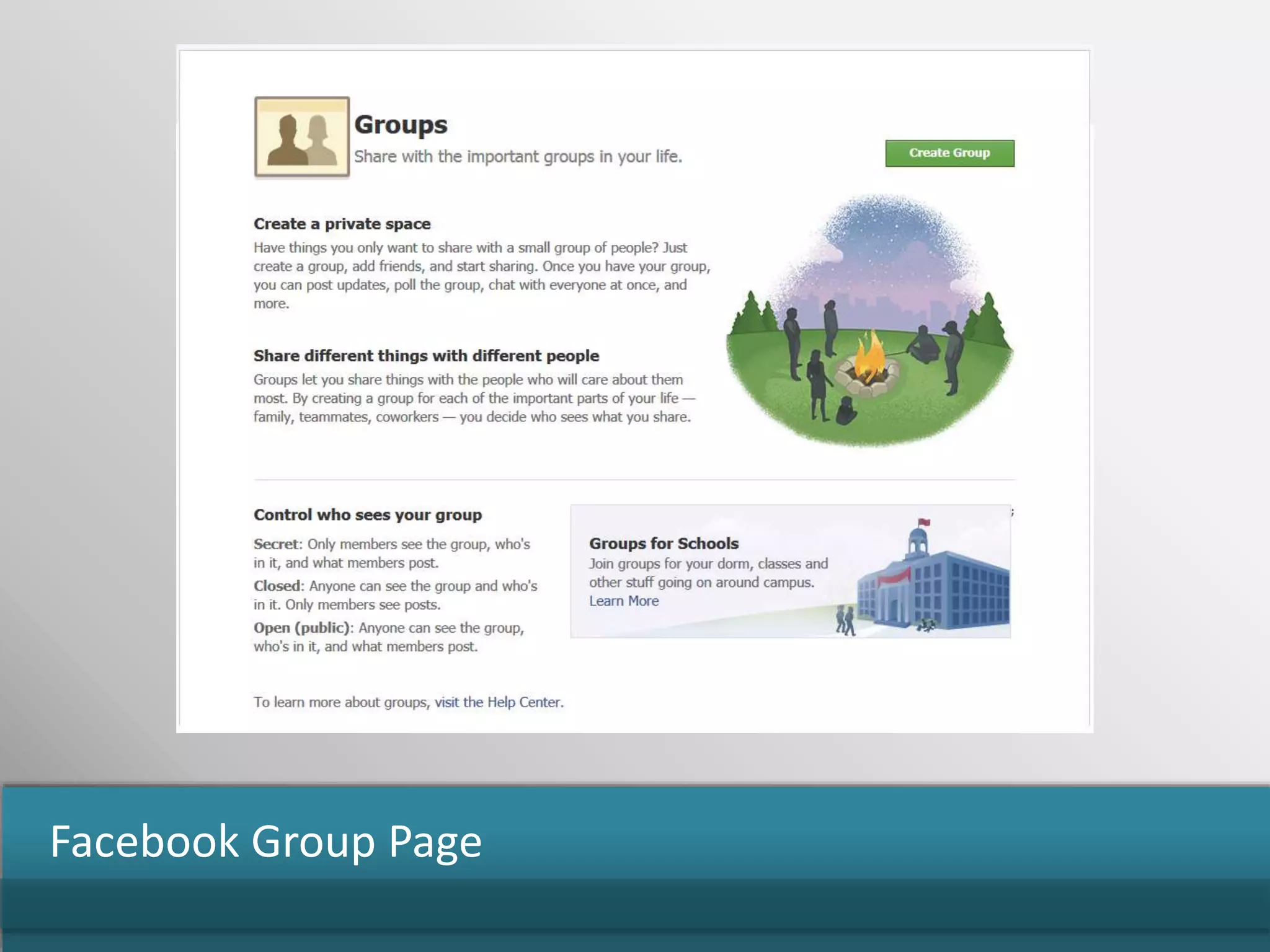
Facebook Group Page
 Groups are intended to allow a subset of people
to interact and share information.
 Groups are a private space that can be
configured in various ways.
 Groups can be secret and visible only to
members.
 A secret group could be used for company
employees or a set of business associates.
 Closed groups can be seen by everyone and
everyone will be able to see the membership list.
However, the content is only open to members.
 Open groups can be seen by anyone;
membership is open and all content can be seen
by the public.
 Groups are intended for use with profiles but can
be used in some business settings
Used by Businesses to Create Communities
Facebook Groups
 Allows businesses to securely access, share, and control
Facebook pages, ad accounts, and other items.
 Eliminates prior limitations on how pages had to be
administered---page owners had to be linked by their
personal profile pages. This created a conflict.
 Anyone can be given permission to see all of a
business’s pages and ad accounts without sharing login
information or needing to be connected to coworkers
on Facebook.
 Business Manager provides the ability to assign
permissions to employees, partners, ad agencies, or
others.
 Prior to Business Manager, business page
administrators had to be cautious to avoid mixing posts
from their personal identities on Facebook with
business interests.
 Fake pages were a previous workaround that were
often deleted and this cut off access to the business’s
page.
Business Manager makes more sense for companies larger than sole proprietorships
Facebook’s Business Manager System
 Eliminates mix-ups between personal accounts and page administrators
 Allows businesses to manage page roles and ad account access from one
convenient place
 Allows a business to see which pages and ad accounts have been assigned to a
particular individual
 Allows a business to see a list of people working on a particular page or ad
account
 Allows partners and affiliated ad agencies to request access to pages and ad
accounts
Advantages of Using This System
Facebook’s Business Manager System
1) Determine the page objective (e.g. brand awareness,
developing a contact list, driving traffic to a corporate
Web site, developing a sense of community, or
gathering ideas for new products).
2) Devise design strategy (decisions regarding the type
of media, posts, and other material).
3) Content strategy determined (deciding whether
photos, videos, posts, updates, events, and links
should be used and in what mix).
4) Promote page both inside of Facebook, across the
Web and in the real world (variety of methods can be
used including widgets, Facebook ads, linked blog
entries, Twitter, and printer media).
5) Engagement and retention actions. Resources
required to enable monitoring and moderation.
6) Convert fans into long-term, loyal customers. Wait
until fan base is approximately 500-1,000 strong.
Generally involves coupons, discounts, special events,
or other incentives to give fans a call to action.
Mara Smith’s Steps to Building a Business Facebook Page
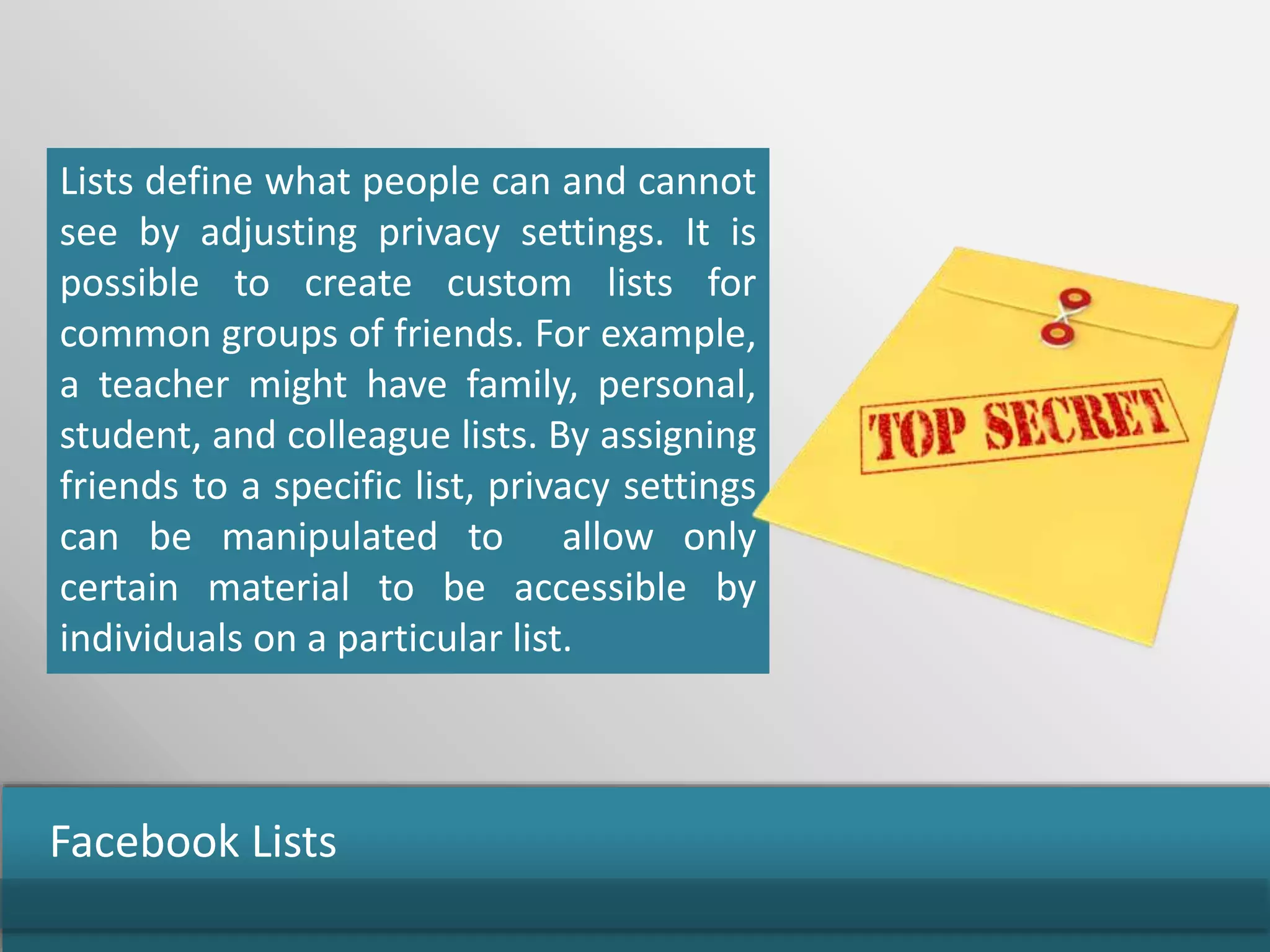
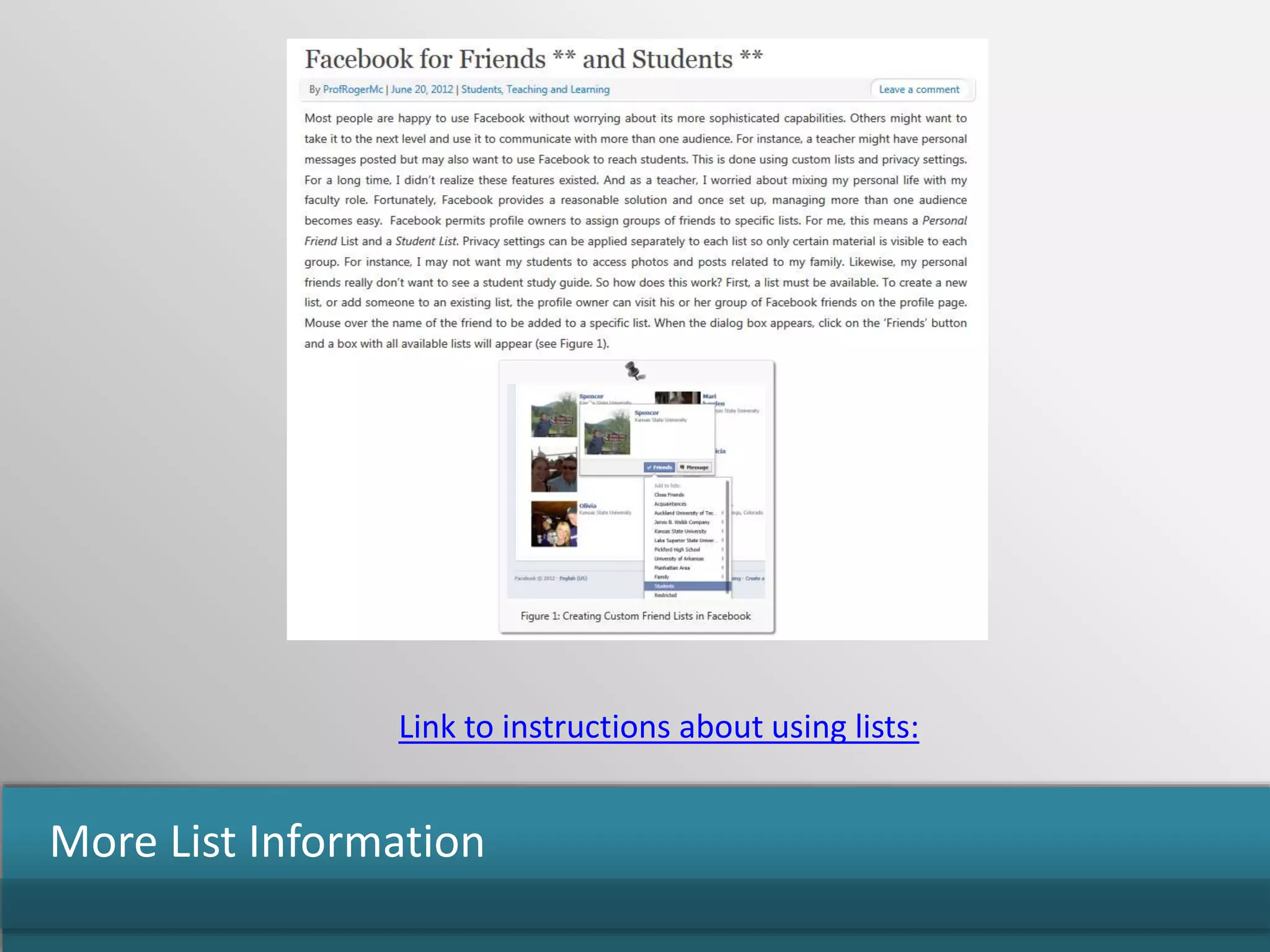
Lists define what people can and cannot
see by adjusting privacy settings. It is
possible to create custom lists for
common groups of friends. For example,
a teacher might have family, personal,
student, and colleague lists. By assigning
friends to a specific list, privacy settings
can be manipulated to allow only
certain material to be accessible by
individuals on a particular list.
Facebook Lists
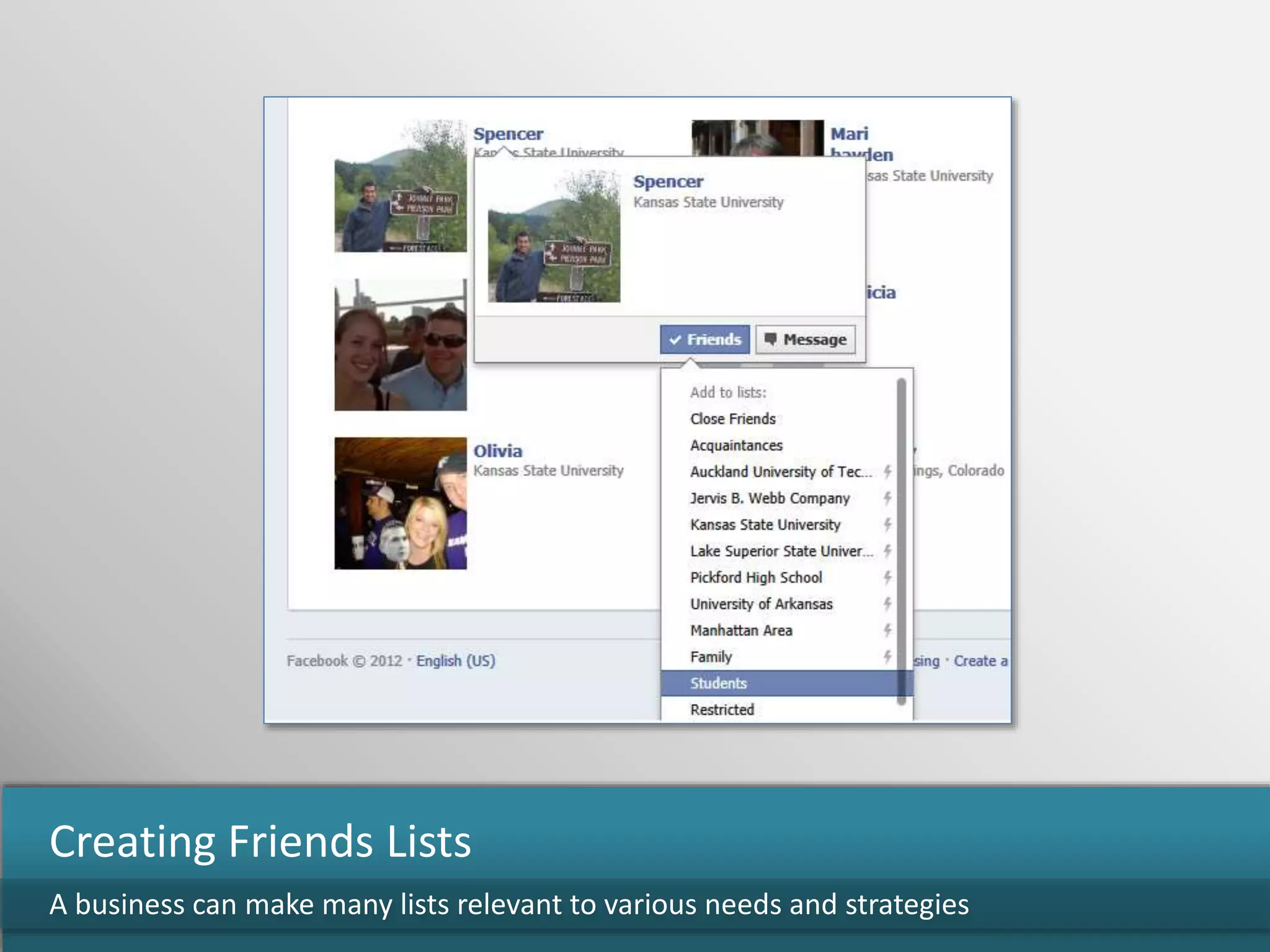
A business can make many lists relevant to various needs and strategies
Creating Friends Lists
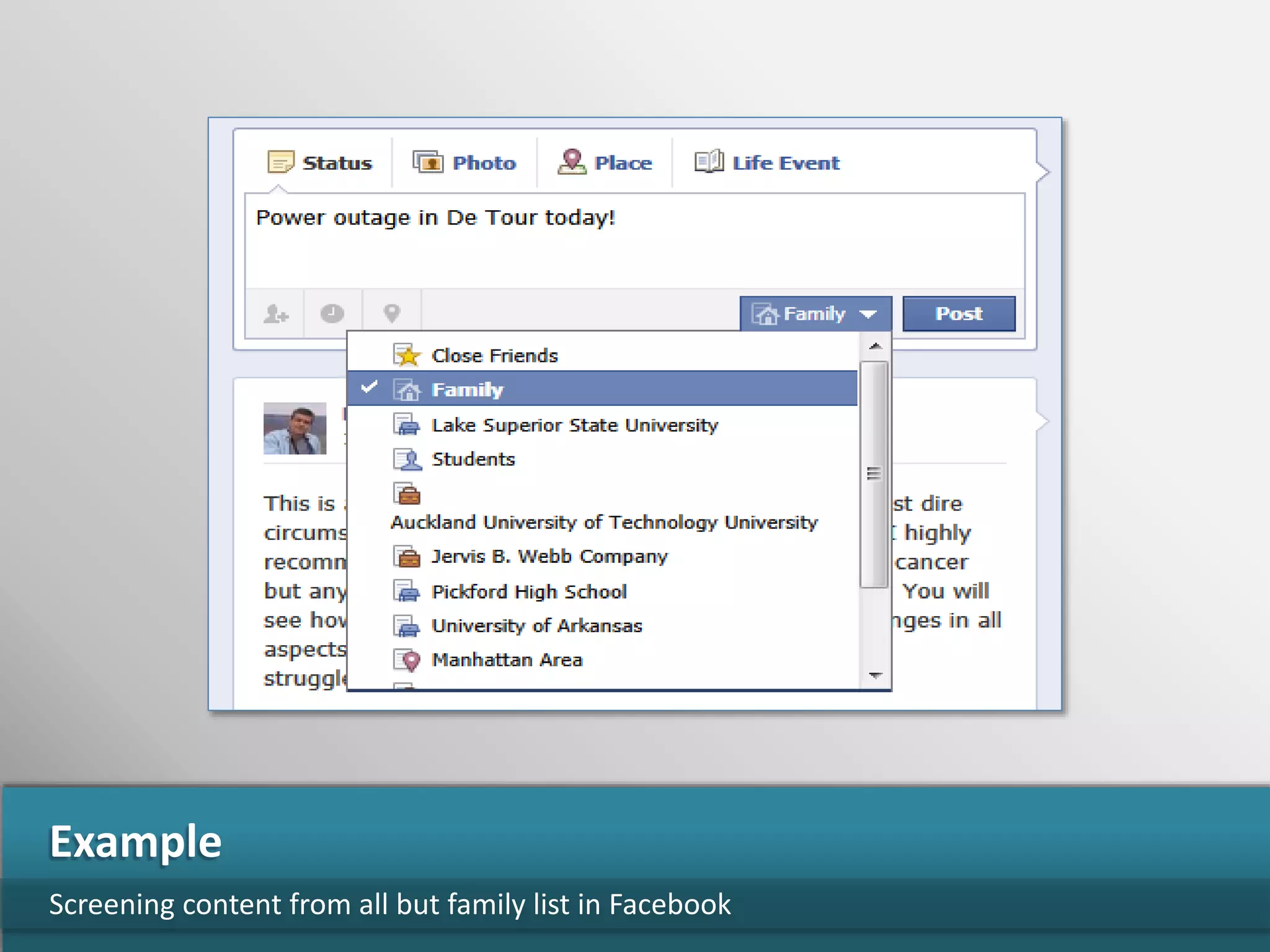
Screening content from all but family list in Facebook
Example
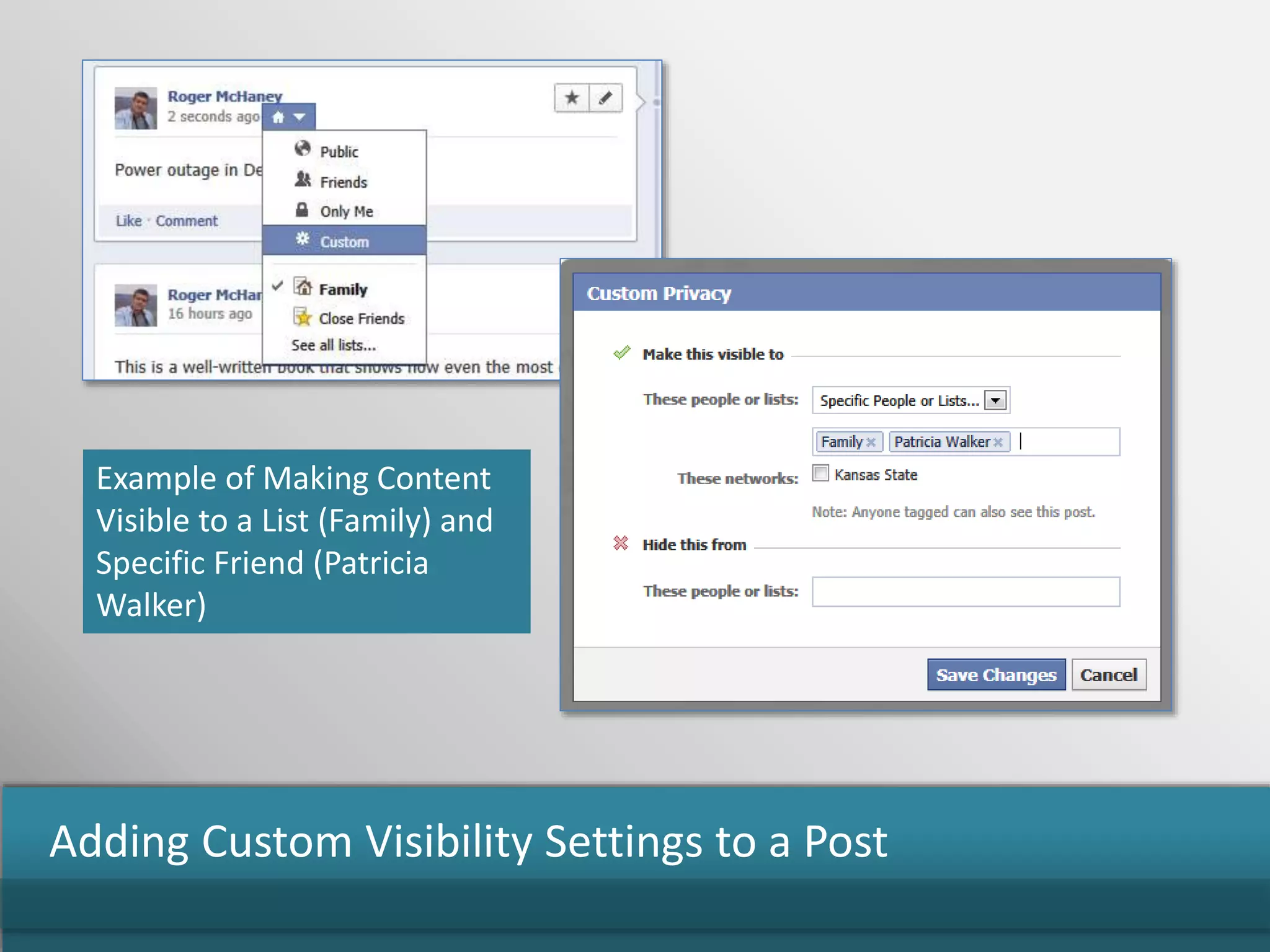
Example of Making Content
Visible to a List (Family) and
Specific Friend (Patricia
Walker)
Adding Custom Visibility Settings to a Post
Link to instructions about using lists:
More List Information
Using Facebook for business requires
functional organization and a consistent
approach. It is important to assign the
responsibility for Facebook or any social
media updates to the correct entity
within a company. This means social
media used to communicate with those
outside an organization is best served by
a media specialist or someone from a
marketing or customer service
background. Internal use of social media
may come from human resources or
various departmental managers.
Part of an Overall Business Strategy for Social Media
Developing a Facebook Policy
Contact: Roger McHaney, Kansas State University, mchaney@ksu.edu

Chapter 7, Part A, Web 2.0 and Social Media for Business, 3rd Edition

  • 1.
    Web 2.0 andSocial Media Business in a Connected World © McHaney and Sachs 2016 Facebook and LinkedIn
  • 2.
    Two high impactsocial media Web sites for business are Facebook and LinkedIn. Coupled with Twitter, these three represent a high impact minimum that all organizations need to incorporate into their planning. Facebook and LinkedIn Big Social Media
  • 3.
    Social networking isthe ‘what’ and social media is the ‘how’. In other words, social media are tools that facilitate social networking For instance, LinkedIn is social media. Social networking takes place in LinkedIn each time people form connections, exchange information, share, or discuss. Twitter is social media and each Tweet represents the act of social networking. Social media makes social networking easier. Social Networking Versus Social Media
  • 4.
    Goddard (2012) statesthat “[s]ocial networks are made up of peers seeking and giving advice to make better decisions. Advanced social networking science can even tell us which people give out the most advice in the network and have the most influence. These people are called opinion leaders.” Social Media Impact Opinion Leaders
  • 5.
    Social media, arecent arrival on the scene, has provided a new set of tools to make social networks easier to create, join, manage and use. Social media includes blogs, online videos, social news, social bookmarking and much more. Social Media
  • 6.
    June, 2016, Facebookhad more than 1.65 billion active monthly users. Over 100 billion social networking connections exist within Facebook. Businesses cannot overlook this global communication channel. Facebook is the Social Media giant Facebook Overview
  • 7.
    Be Careful Becauseit is a Social Site Business on Facebook Businesses on Facebook Developing a business presence on Facebook is a must. Family and Friends Many people view Facebook as a primary method for communicating with family and close friends. Business connections, advertisements, and intrusive messages may not be welcome. Work Within Facebook Norms Businesses need to carefully plan their interactions in ways that respect typical Facebook use. Support Tools Not all people prefer to avoid commercial contact on Facebook. On any given day, millions of Likes are given to business pages and business content is viewed, downloaded, and commented upon.
  • 8.
    Profiles are thebasic structure in Facebook and are intended for individual use. Some businesses have created profiles, but this practice violates the terms of service agreement with Facebook. Profiles are intended to represent a person’s identity. Not for Businesses! Facebook Profiles
  • 9.
  • 10.
    Facebook is structured into profiles,pages and groups. These structures give different levels of interaction and have been used to varying degrees by businesses and individuals. Pages are not the same as profiles Facebook Page for Ram Trucks
  • 11.
    For Organizations andBusinesses Facebook Page Elements
  • 12.
    Facebook recommends thatbusinesses use pages to develop rapport with customers. Regular posts help foster relationships and stimulate an active online community. A consistent voice and authentic, original information can encourage people to interact with the business. Page Recommendations
  • 13.
    Page Items Neededto Build a Facebook Community New Content Stream Photos, videos, menus, sneak peeks, new product information and event announcements. Stimulating Questions Stimulate customers to provide feedback and opinions about products and services. Events Information about new product launches, anniversaries, promotions, in- store events and sales. Stories Posts that provide stories about products, successes, or other customers
  • 14.
    Provides ability tomanage a page from an administrative panel. Business owner can track activity, respond to comments, and view page statistics. Facebook locates page statistics or metrics on its Page Insight Dashboard. Business can learn the identity of its visitors, the day of the week most visitors come to the page, the frequency of comments and which posts generate the most interest. Broad portfolio of tools Facebook Business Support
  • 15.
    More Features ofPages No Friends Pages do not accumulate friends. Instead, people become fans. Pages are Searchable Outside of Facebook People don’t have to be logged into Facebook to view a business page. Each page is indexed by Google and other search engines and will be listed when searches are conducted. Pages: No Limits Profiles are limited to 5,000 friends but business pages can have an unlimited number of fans (for instance, the late pop star David Bowie’s Facebook page has almost 7 million likes). Promotions Pages can be promoted with sidebar ads on Facebook, customized tabs with coupons and other items (e.g. maps, videos, et cetera), or discussions with fans.
  • 16.
  • 17.
    Facebook Keeps aDirectory of Pages Facebook’s directory of pages is a great starting point for business page ideas.
  • 18.
  • 19.
    Facebook Page asPart of Business Strategy
  • 20.
  • 21.
     Groups areintended to allow a subset of people to interact and share information.  Groups are a private space that can be configured in various ways.  Groups can be secret and visible only to members.  A secret group could be used for company employees or a set of business associates.  Closed groups can be seen by everyone and everyone will be able to see the membership list. However, the content is only open to members.  Open groups can be seen by anyone; membership is open and all content can be seen by the public.  Groups are intended for use with profiles but can be used in some business settings Used by Businesses to Create Communities Facebook Groups
  • 22.
     Allows businessesto securely access, share, and control Facebook pages, ad accounts, and other items.  Eliminates prior limitations on how pages had to be administered---page owners had to be linked by their personal profile pages. This created a conflict.  Anyone can be given permission to see all of a business’s pages and ad accounts without sharing login information or needing to be connected to coworkers on Facebook.  Business Manager provides the ability to assign permissions to employees, partners, ad agencies, or others.  Prior to Business Manager, business page administrators had to be cautious to avoid mixing posts from their personal identities on Facebook with business interests.  Fake pages were a previous workaround that were often deleted and this cut off access to the business’s page. Business Manager makes more sense for companies larger than sole proprietorships Facebook’s Business Manager System
  • 23.
     Eliminates mix-upsbetween personal accounts and page administrators  Allows businesses to manage page roles and ad account access from one convenient place  Allows a business to see which pages and ad accounts have been assigned to a particular individual  Allows a business to see a list of people working on a particular page or ad account  Allows partners and affiliated ad agencies to request access to pages and ad accounts Advantages of Using This System Facebook’s Business Manager System
  • 24.
    1) Determine thepage objective (e.g. brand awareness, developing a contact list, driving traffic to a corporate Web site, developing a sense of community, or gathering ideas for new products). 2) Devise design strategy (decisions regarding the type of media, posts, and other material). 3) Content strategy determined (deciding whether photos, videos, posts, updates, events, and links should be used and in what mix). 4) Promote page both inside of Facebook, across the Web and in the real world (variety of methods can be used including widgets, Facebook ads, linked blog entries, Twitter, and printer media). 5) Engagement and retention actions. Resources required to enable monitoring and moderation. 6) Convert fans into long-term, loyal customers. Wait until fan base is approximately 500-1,000 strong. Generally involves coupons, discounts, special events, or other incentives to give fans a call to action. Mara Smith’s Steps to Building a Business Facebook Page
  • 25.
    Lists define whatpeople can and cannot see by adjusting privacy settings. It is possible to create custom lists for common groups of friends. For example, a teacher might have family, personal, student, and colleague lists. By assigning friends to a specific list, privacy settings can be manipulated to allow only certain material to be accessible by individuals on a particular list. Facebook Lists
  • 26.
    A business canmake many lists relevant to various needs and strategies Creating Friends Lists
  • 27.
    Screening content fromall but family list in Facebook Example
  • 28.
    Example of MakingContent Visible to a List (Family) and Specific Friend (Patricia Walker) Adding Custom Visibility Settings to a Post
  • 29.
    Link to instructionsabout using lists: More List Information
  • 30.
    Using Facebook forbusiness requires functional organization and a consistent approach. It is important to assign the responsibility for Facebook or any social media updates to the correct entity within a company. This means social media used to communicate with those outside an organization is best served by a media specialist or someone from a marketing or customer service background. Internal use of social media may come from human resources or various departmental managers. Part of an Overall Business Strategy for Social Media Developing a Facebook Policy
  • 31.
    Contact: Roger McHaney,Kansas State University, mchaney@ksu.edu