Chapter No-03
CAST IRONS
1Prof.Ghadage M.M.
Introduction
 Alloys of iron and carbon in which % C varies between 2-6.67%
 Poor ductility and malleability; hence cannot be forged, rolled, drawn or
pressed into desired shape
 Named “CAST IRONS”, because the components are formed by melting and
casting with or without machining to the required final shape and size
 Properties:
 Cheap
 Lower melting temperatures (1150-1250ᵒ C) as compared to steels (1350-
1500ᵒC)
 Excellent castability
 Corrosion resistant
 Brittle
 Properties can be adjusted by suitable alloying elements and heat treatment
2Prof.Ghadage M.M.
Classification of cast irons
Furnace
Cupola CI
Air
furnace
CI
Electric
furnace
CI
Duplex CI
Composition and purity
Low
carbon, low
silicon CI
High
carbon, low
sulphur CI
Nickel
alloy CI
Microstructure and appearance of fracture
White CI Malleable
CI
Gray CI
Nodular
CI
Mottled
CI
Chilled CI Alloy CI
3Prof.Ghadage M.M.
White cast iron
 Carbon present in combined form (cementite)
and there is no free carbon (graphite)
 Composition: C: 2.3-3%, Si: 0.5-1.3%, S: 0.06-
0.1%, P: 0.1-0.2%, Mn: 0.5-1%
 Named after its white fractured surface
 No graphitisation and hence its solidification can
be represented on I-C diagram
 Properties: Strong in compression (1750MPa),
hard (350-500 BHN), resistant to abrasive wear,
brittle, difficult to machine hence finishing to
final size is done by grinding only
 Used to malleable CI
 Applications: Pump liners, Road roller surfaces,
mill liners, grinding balls, dies and extrusion
nozzles
Microstructures of white CI:
the light cementite regions
are surrounded by pearlite,
which has the ferrite
cementite layered structure.
200x [Source: William
Callister, 2007]
4Prof.Ghadage M.M.
Malleable cast iron
 Heating white cast iron around 900ᵒ C and holding
for long time (24hrs to several days), followed by
very slow cooling to room temperature produces
malleable cast iron
 Contains 2.5% C and 1% Si
 Cementite decomposes during the heat treatment to
more stable form (graphite)
 The free carbon precipitates in the form of
spheroidal particles (temper carbon)
 Properties:
 Show ductility, toughness and are bendable
 Good capacity to absorb shock and vibrations
 NOT MALLEABLE; cannot be rolled, forged or
extruded
 T. S. = 700MPa, % elongation = 10-15%, Hardness
= 80-275 BHN
 More expensive than grey cast iron because of heat
treatment involved
 Applications: Automobile crankshaft, chain links
and brackets, brake pedals, tractor springs, universal
joint yoke
Microstructure of
malleable CI: dark
graphite rosettes (temper
carbon) in an α-ferrite
matrix. 150x [Source:
William Callister, 2007]
5Prof.Ghadage M.M.
Malleable cast iron
 Types of malleable cast iron:
 Ferritic malleable
 Pearlitic malleable
 Pearlitic-ferritic malleable
 Black heart malleable
 White heart malleable
6Prof.Ghadage M.M.
Pearlitic-ferritic malleable cast iron
 Produced due to intermediate cooling rate between
those to produce ferritic malleable and pearlitic
malleable cast irons
 Cooling rate is slow enough to graphitise all the
proeutectoid cementite and a part of eutectoid
cementite
 Since carbon itself is a graphitiser, the cementite
from pearlite adjacent to the existing rosettes of
temper carbon graphite decomposes rapidly without
graphitising cementite away from the rosettes
 Thus, microstructure at room temperature shows
rosettes of temper carbon graphite surrounded by an
envelope of ferrite
 Matrix is coarse pearlite or slightly spherodised due
to slow cooling
 Properties: Intermediate to ferritic and pearlitic
cast iron
 Applications: Machinery parts such as rolls,
pumps, nozzles, cams and rocker arms; axle and
differential housing, cam shaft and crankshaft
Microstructure of pearlitic
ferritic malleable cast iron
showing bull’s eye
structure. 100x [Source: V.
D. Kodgire, 2009]
7Prof.Ghadage M.M.
Grey cast iron
 Show gray fracture and contain graphite flakes
 Flakes are curved plates, interconnected in three
dimensions
 Graphite formed during freezing
 Graphite flakes are sharp at their tips and act like internal
cracks or stresses
 Composition: 2.5-3.8% C, 1.1-2.8% Si, 0.4-1% Mn,
0.15%P and 0.1% S
 Properties: Depend upon morphology and size of
graphite flakes
 Brittle, weak in tension, strong in compression (as cracks
do not propagate under compressive load)
 High fluidity and hence it can be cast into complex shapes
and thin sections easily
 Low shrinkage during solidification
 Good wear resistance because graphite acts as lubricant
 Better damping capacity than steel
 Low notch sensitivity due to the presence of large number
of internal sharp notches (edges of graphite flakes) which
make the influence of external notch ineffective
 Easy to machine, as chip formation is promoted by
graphite flakes. Also flakes serve as lubricant for cutting
tool
 Good bearing properties
 Fairly good corrosion resistance
Microstructures of Gray iron:
the dark graphite flakes are
embedded in an –ferrite
matrix. 500x [Source: William
Callister, 2007]
8Prof.Ghadage M.M.
Grey cast iron
 Low ductility and impact strength
 T. S. = 150-400MPa, Hardness = 150-300BHN, % elongation = < 1%
 Cheaper than steel (low temperatures involved in casting and low control on
impurities as compared to steel)
 Defects:
 Growth
 Firecracks or heat checks
 These defects can be reduced by adding Cr, Mo and Ni
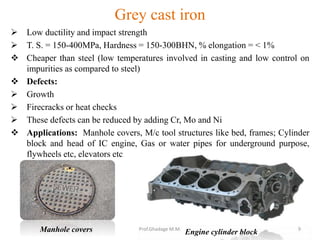
 Applications: Manhole covers, M/c tool structures like bed, frames; Cylinder
block and head of IC engine, Gas or water pipes for underground purpose,
flywheels etc, elevators etc
Engine cylinder blockManhole covers 9Prof.Ghadage M.M.
Nodular (Ductile or Spheroidal) cast iron
 Contains graphite in the form of spheroids
 Produced from grey cast iron by adding nodulising
elements like Mg, Ca, Ba, Li, Zr or Ce
 Composition: 3.2-4.2% C, 1.1-3.5% Si, 0.3-0.8% Mn,
0.08% P, 0.2% S
 Since nodulising elements have strong affinity for
sulphur and they scavenge sulphur from the molten bath
as an initial step in producing nodular graphite. These
elements are expensive and hence for effective
utilization of these elements, the original grey melt must
contain less amount of sulphur (< 0.03%). Sulphur
content is reduced by treating the melt with soda ash
 Properties:
 More tensile strength, ductility and toughness as
compared to grey cast iron
 Excellent machinability, castability and wear resistance
 Do not suffer from defects like growth and firecracks
 T. S. = 400-800MPa, % elongation = 10-18, Hardness =
100-300 BHN
 Defects:
 Blow holes
 Shrinkage
 Applications: Agricultural implements, industrial fan
hub, Crankshafts, gears, punch dies, sheet metal dies,
steel mill rolls and milling equipment, valves, pistons etc
Microstructure of nodular
CI: the dark graphite nodules
are surrounded by an -ferrite
matrix. 200x [Source:
William Callister, 2007]
10Prof.Ghadage M.M.
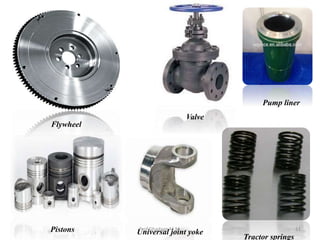
Pistons Universal joint yoke
Tractor springs
Flywheel
Valve
Pump liner
11Prof.Ghadage M.M.
Mottled cast iron
 Shows free cementite and graphite flakes
in its microstructure
 Composition: 93.5% iron, 1.75%
graphite, remaining impurities
 For a given composition, faster cooling
rates gives white structure and slow
cooling rates results in grey structure.
Intermediate cooling rates produces
mottled cast iron
 Mottled structures to be avoided because
of bad properties
 Can be avoided by increasing or
decreasing carbon and silicon content
 Increasing carbon and silicon content
yields grey cast iron
 Decreasing carbon and silicon content
yields white cast iron
Microstructure of mottled cast
iron. 500x [Source: V. D.
Kodgore, 2009]
12Prof.Ghadage M.M.
Chilled cast iron
 Shows white structure at surface and grey
structure in centre
 Composition is adjusted in such a way that
rapid cooling gives white structure and usual
cooling gives grey structure
 Composition: % C: 3.3-3.5, %Si: 2-2.5
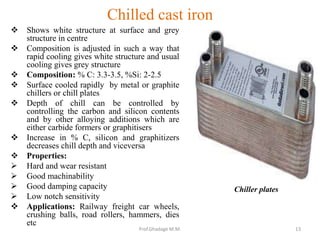
 Surface cooled rapidly by metal or graphite
chillers or chill plates
 Depth of chill can be controlled by
controlling the carbon and silicon contents
and by other alloying additions which are
either carbide formers or graphitisers
 Increase in % C, silicon and graphitizers
decreases chill depth and viceversa
 Properties:
 Hard and wear resistant
 Good machinability
 Good damping capacity
 Low notch sensitivity
 Applications: Railway freight car wheels,
crushing balls, road rollers, hammers, dies
etc
Chiller plates
13Prof.Ghadage M.M.

Chapter no 03 cast iron pptx

  • 1.
  • 2.
    Introduction  Alloys ofiron and carbon in which % C varies between 2-6.67%  Poor ductility and malleability; hence cannot be forged, rolled, drawn or pressed into desired shape  Named “CAST IRONS”, because the components are formed by melting and casting with or without machining to the required final shape and size  Properties:  Cheap  Lower melting temperatures (1150-1250ᵒ C) as compared to steels (1350- 1500ᵒC)  Excellent castability  Corrosion resistant  Brittle  Properties can be adjusted by suitable alloying elements and heat treatment 2Prof.Ghadage M.M.
  • 3.
    Classification of castirons Furnace Cupola CI Air furnace CI Electric furnace CI Duplex CI Composition and purity Low carbon, low silicon CI High carbon, low sulphur CI Nickel alloy CI Microstructure and appearance of fracture White CI Malleable CI Gray CI Nodular CI Mottled CI Chilled CI Alloy CI 3Prof.Ghadage M.M.
  • 4.
    White cast iron Carbon present in combined form (cementite) and there is no free carbon (graphite)  Composition: C: 2.3-3%, Si: 0.5-1.3%, S: 0.06- 0.1%, P: 0.1-0.2%, Mn: 0.5-1%  Named after its white fractured surface  No graphitisation and hence its solidification can be represented on I-C diagram  Properties: Strong in compression (1750MPa), hard (350-500 BHN), resistant to abrasive wear, brittle, difficult to machine hence finishing to final size is done by grinding only  Used to malleable CI  Applications: Pump liners, Road roller surfaces, mill liners, grinding balls, dies and extrusion nozzles Microstructures of white CI: the light cementite regions are surrounded by pearlite, which has the ferrite cementite layered structure. 200x [Source: William Callister, 2007] 4Prof.Ghadage M.M.
  • 5.
    Malleable cast iron Heating white cast iron around 900ᵒ C and holding for long time (24hrs to several days), followed by very slow cooling to room temperature produces malleable cast iron  Contains 2.5% C and 1% Si  Cementite decomposes during the heat treatment to more stable form (graphite)  The free carbon precipitates in the form of spheroidal particles (temper carbon)  Properties:  Show ductility, toughness and are bendable  Good capacity to absorb shock and vibrations  NOT MALLEABLE; cannot be rolled, forged or extruded  T. S. = 700MPa, % elongation = 10-15%, Hardness = 80-275 BHN  More expensive than grey cast iron because of heat treatment involved  Applications: Automobile crankshaft, chain links and brackets, brake pedals, tractor springs, universal joint yoke Microstructure of malleable CI: dark graphite rosettes (temper carbon) in an α-ferrite matrix. 150x [Source: William Callister, 2007] 5Prof.Ghadage M.M.
  • 6.
    Malleable cast iron Types of malleable cast iron:  Ferritic malleable  Pearlitic malleable  Pearlitic-ferritic malleable  Black heart malleable  White heart malleable 6Prof.Ghadage M.M.
  • 7.
    Pearlitic-ferritic malleable castiron  Produced due to intermediate cooling rate between those to produce ferritic malleable and pearlitic malleable cast irons  Cooling rate is slow enough to graphitise all the proeutectoid cementite and a part of eutectoid cementite  Since carbon itself is a graphitiser, the cementite from pearlite adjacent to the existing rosettes of temper carbon graphite decomposes rapidly without graphitising cementite away from the rosettes  Thus, microstructure at room temperature shows rosettes of temper carbon graphite surrounded by an envelope of ferrite  Matrix is coarse pearlite or slightly spherodised due to slow cooling  Properties: Intermediate to ferritic and pearlitic cast iron  Applications: Machinery parts such as rolls, pumps, nozzles, cams and rocker arms; axle and differential housing, cam shaft and crankshaft Microstructure of pearlitic ferritic malleable cast iron showing bull’s eye structure. 100x [Source: V. D. Kodgire, 2009] 7Prof.Ghadage M.M.
  • 8.
    Grey cast iron Show gray fracture and contain graphite flakes  Flakes are curved plates, interconnected in three dimensions  Graphite formed during freezing  Graphite flakes are sharp at their tips and act like internal cracks or stresses  Composition: 2.5-3.8% C, 1.1-2.8% Si, 0.4-1% Mn, 0.15%P and 0.1% S  Properties: Depend upon morphology and size of graphite flakes  Brittle, weak in tension, strong in compression (as cracks do not propagate under compressive load)  High fluidity and hence it can be cast into complex shapes and thin sections easily  Low shrinkage during solidification  Good wear resistance because graphite acts as lubricant  Better damping capacity than steel  Low notch sensitivity due to the presence of large number of internal sharp notches (edges of graphite flakes) which make the influence of external notch ineffective  Easy to machine, as chip formation is promoted by graphite flakes. Also flakes serve as lubricant for cutting tool  Good bearing properties  Fairly good corrosion resistance Microstructures of Gray iron: the dark graphite flakes are embedded in an –ferrite matrix. 500x [Source: William Callister, 2007] 8Prof.Ghadage M.M.
  • 9.
    Grey cast iron Low ductility and impact strength  T. S. = 150-400MPa, Hardness = 150-300BHN, % elongation = < 1%  Cheaper than steel (low temperatures involved in casting and low control on impurities as compared to steel)  Defects:  Growth  Firecracks or heat checks  These defects can be reduced by adding Cr, Mo and Ni  Applications: Manhole covers, M/c tool structures like bed, frames; Cylinder block and head of IC engine, Gas or water pipes for underground purpose, flywheels etc, elevators etc Engine cylinder blockManhole covers 9Prof.Ghadage M.M.
  • 10.
    Nodular (Ductile orSpheroidal) cast iron  Contains graphite in the form of spheroids  Produced from grey cast iron by adding nodulising elements like Mg, Ca, Ba, Li, Zr or Ce  Composition: 3.2-4.2% C, 1.1-3.5% Si, 0.3-0.8% Mn, 0.08% P, 0.2% S  Since nodulising elements have strong affinity for sulphur and they scavenge sulphur from the molten bath as an initial step in producing nodular graphite. These elements are expensive and hence for effective utilization of these elements, the original grey melt must contain less amount of sulphur (< 0.03%). Sulphur content is reduced by treating the melt with soda ash  Properties:  More tensile strength, ductility and toughness as compared to grey cast iron  Excellent machinability, castability and wear resistance  Do not suffer from defects like growth and firecracks  T. S. = 400-800MPa, % elongation = 10-18, Hardness = 100-300 BHN  Defects:  Blow holes  Shrinkage  Applications: Agricultural implements, industrial fan hub, Crankshafts, gears, punch dies, sheet metal dies, steel mill rolls and milling equipment, valves, pistons etc Microstructure of nodular CI: the dark graphite nodules are surrounded by an -ferrite matrix. 200x [Source: William Callister, 2007] 10Prof.Ghadage M.M.
  • 11.
    Pistons Universal jointyoke Tractor springs Flywheel Valve Pump liner 11Prof.Ghadage M.M.
  • 12.
    Mottled cast iron Shows free cementite and graphite flakes in its microstructure  Composition: 93.5% iron, 1.75% graphite, remaining impurities  For a given composition, faster cooling rates gives white structure and slow cooling rates results in grey structure. Intermediate cooling rates produces mottled cast iron  Mottled structures to be avoided because of bad properties  Can be avoided by increasing or decreasing carbon and silicon content  Increasing carbon and silicon content yields grey cast iron  Decreasing carbon and silicon content yields white cast iron Microstructure of mottled cast iron. 500x [Source: V. D. Kodgore, 2009] 12Prof.Ghadage M.M.
  • 13.
    Chilled cast iron Shows white structure at surface and grey structure in centre  Composition is adjusted in such a way that rapid cooling gives white structure and usual cooling gives grey structure  Composition: % C: 3.3-3.5, %Si: 2-2.5  Surface cooled rapidly by metal or graphite chillers or chill plates  Depth of chill can be controlled by controlling the carbon and silicon contents and by other alloying additions which are either carbide formers or graphitisers  Increase in % C, silicon and graphitizers decreases chill depth and viceversa  Properties:  Hard and wear resistant  Good machinability  Good damping capacity  Low notch sensitivity  Applications: Railway freight car wheels, crushing balls, road rollers, hammers, dies etc Chiller plates 13Prof.Ghadage M.M.