Emerging Trends in Computer Engineering
(ETI)
Chapter 2
Internet of Things
Miss. Chordia A. S.
 Embedded System :-
An embedded system is microcontroller or microprocessor based system
which is designed to perform a specific task.
or
An embedded system is a combination of computer hardware and software,
either fixed in capability or programmable, designed for a specific function or functions
within a larger system.
 Purpose of embedded System :-
The embedded system is used in many domains areas such as consumer
electronics, home automation, telecommunication automotive industries,helathcare,
control and instrumentation, banking application, military application etc. According to
application usage the embedded system may have the different functionalities. Every
embedded system designed to accomplished the purpose of any one or a combination of
following task.
 Data Collection/Storage/Representation
 Data Communication in embedded system
 Data Processing
 Monitoring the performance/operation of embedded system
 Control the embedded system
 Application specific user’s interface
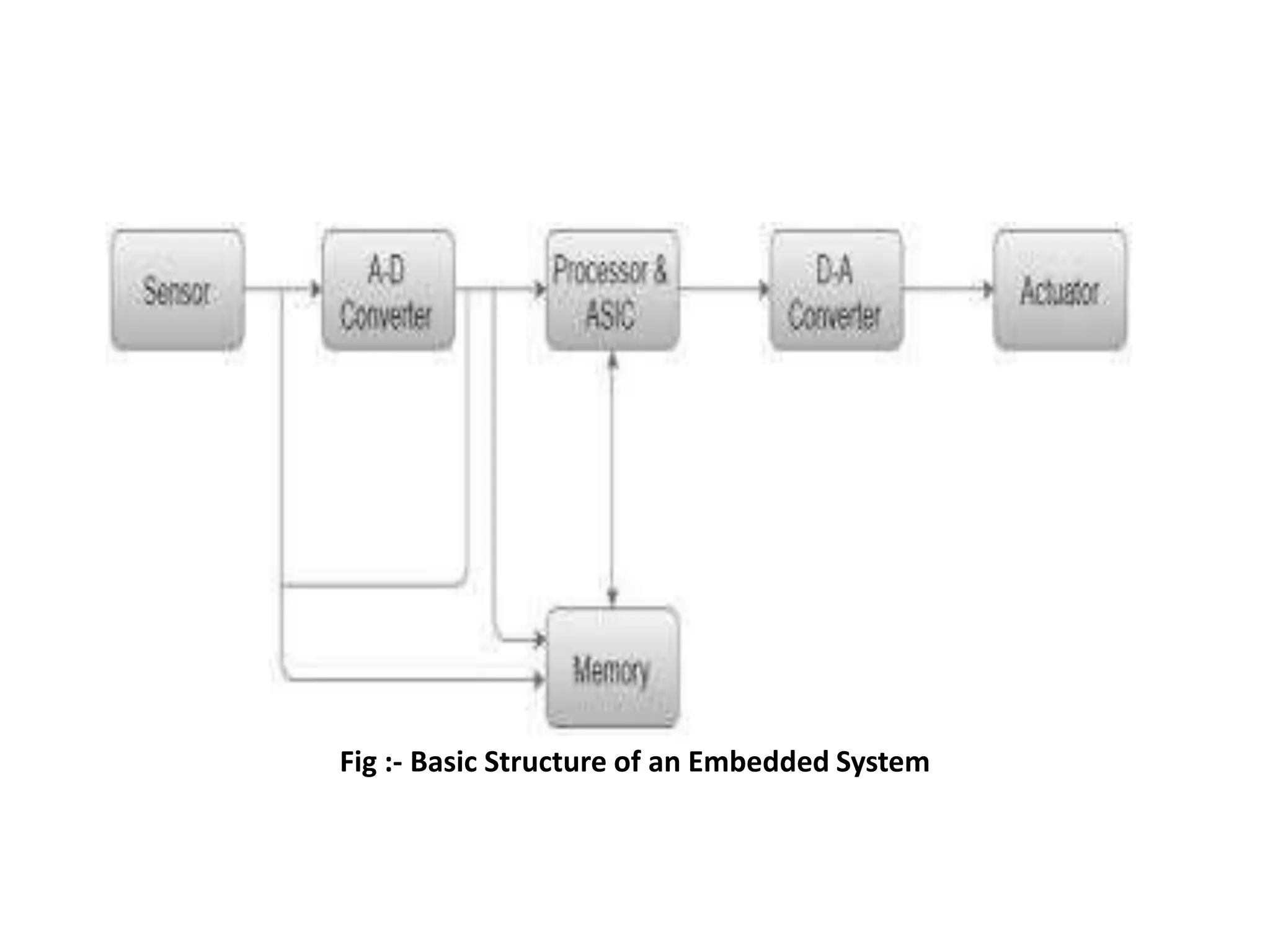
Fig :- Basic Structure of an Embedded System
 Sensor :- Sensor is used to measure the physical quantity and converts it to an electrical
signal which can be read by any electronic device like A-D converter.
 A-D Converter :- An analog-to-digital converter converts the analog signal given by the
sensor into a digital signal.
 Processor & ASICs:- Processors process the data to measure the output and store it to the
memory.
 D-A Converter :- A digital-to analog converter converts the digital data given by the
processor to analog data.
 Actuator :- An actuator compares the output given by the D-A Converter to generates the
actual or expected output.
Three Main Components of Embedded System
1. Embedded system hardware
2. Embedded system software
3. Embedded operating system
1. Embedded system hardware :-
An embedded system uses a hardware platform to execute the operation.
Hardware of the embedded system consist of power supply,Reset,Oscillator circuit, Memory
i.e. program and data, processor (Microcontroller,ARM,PIC,ASIC),Timers, Input/output
circuits,serial communication ports, SASC(System application specific circuits),Interupt
Controller,Parellel ports.
2. Embedded system software:-
The software of an embedded system is written to execute a particular
function. The software used in the embedded system is set of instructions i.e. program.
The microprocessors or microcontrollers used in the hardware circuits of embedded
systems are programmed to perform specific tasks by following the set of instructions.
These programs are mainly written using any programming software like Proteus or
Lab-view using any programming languages such as C or C++ or embedded C. Then,
the program is stored into the microprocessors or microcontrollers memory that are used
in the embedded system circuits.
3. Embedded operating system:-
An embedded operating system (OS) is a dedicated operating system designed
to perform a specific task for a device. The main job of an embedded operating system
is to run the code that allows the device to perform its job. The embedded OS also allow
the device’s hardware accessible to the software that is running on top of the OS.
Embedded operating systems are also known as real-time operating systems (RTOS).
The most common examples of embedded operating system around us include Windows
Mobile/CE (handheld Personal Data Assistants), Symbian (cell phones) and Linux, Palm
OS, iOS - Subset of Mac OS X, used in Apple’s mobile devices
Types of Embedded processors:-
 PIC (Programmable / Peripheral Interface Controllers)
 ARM (Advanced RISC machine)
 AVR(Alf-Egil Bogen Vegard Wollan RISC microcontroller OR Advanced Virtual RISC)
 ASIC(Application specific integrated circuits)
1. Applications of PIC :-
a. Motor Control, Digital Power & Lighting
b. Human Interface
c. Connectivity
2. Applications of ARM :-
 Smartphones
 Multimedia players
 3d handheld game consoles
 Digital cameras
 Tablet computers
 Industrial instrument control systems
 Wireless networking and sensors
 Automotive body system
 Robotics
 Consumer electronics
 Set-top boxes
 Digital television
 Smart watches
 Wireless lan, 802.11, Bluetooth
3. Applications AVR :-
 Signal sensing and Data acquisition
 Motion control and Interface motors
 Displays on LCD
 Interface any type of sensors and transducers
 Interface GSM and GPS
4. Applications of ASIC :-
An ASIC (application-specific integrated circuit) is a microchip designed for a
special application, such as a particular kind of transmission protocol or a hand-
held computer. You might contrast it with general integrated circuits, such as the
microprocessor and the random access memory chips in your PC. ASICs are
used in a wide-range of applications, including auto emission control,
environmental monitoring, and personal digital assistants (PDAs). An ASIC can
be pre-manufactured for a special application or it can be custom manufactured
(typically using components from a "building block" library of components) for
a particular customer application.
 IoT (Internet of Things) :-
 The internet of things (IoT) is a computing concept that describes the idea of everyday
physical objects being connected to the internet and being able to identify themselves to
other devices.
 Internet of Things (IoT) refers to physical and virtual objects that have unique identities
and are connected to the internet to facilitate intelligent applications that make energy,
logistics, industrial control, retail, agriculture and many other domains "smarter".
 Internet of things (IoT) is a new revolution in which endpoints connected to the internet
and driven by the advancements in sensor networks, mobile devices, wireless
communications, networking and cloud technologies.
 Characteristics of IoT:
 Dynamic & Self-Adapting
 Self-Configuring:
 Interoperable Communication Protocols
 Unique Identity
 Integrated into Information Network
 Enormous scale
 Features of IoT
 Connectivity
 Analyzing
 Integrating
 Artificial Intelligence
 Sensing
 Active Engagement
 Endpoint Management
Advantages of IoT:-
 Efficient resource utilization
 Minimize human effort
 Save time
 Improve security
 Reduced Waste
 Enhanced Data Collection
 Disadvantages of IoT:-
 Security
 Privacy
 Complexity
 Flexibility
 Compliance
 IoT Enabling Technologies :-
 Environment
 Cities
 Retail
 Health and Life Style
 Home Automation
 Logistics
 Agriculture
 Industries
 IoT Communication Models :-
 Request- Response
 Publish Subscribe
 Push-Pull
 Exclusive Pair
 IoT Communication APIs :-
 REST-based Communication APIs
 Web-Socket based Communication APIs
 IoT Protocols :-
 802.3 :- It is collection of wired Ethernet standards for the link layer.
 802.11 (Wi-Fi):- It is collection of wireless area network (WLAN) communication
standard.
 802.16 (Wi-Max):- It is collection of wireless broadband standard.
 802.15.4 (LR-WPAN):- It is collection of standard for low-rate wireless personal
area network.
 2G/3G/4G:- Different generations of mobile communication standard.
 IPv4:- Internet Protocol version 4 most deployment internet protocol.
 IPv6:- Internet Protocol version 6 newest version of internet protocol.
 6LOWPAN:- IPv6 Over Low Power Wireless Personal Area Network.
 COAP:- Constrained Application Protocol is application layer protocol for Machine
to Machine applications
 MQTT:- Message Queue Telemetry Transport is a light weight messaging
protocol. based on public subscribe model.
 XMPP:- Extensible Messaging and Presence Protocol (XMPP) is a protocol
for real-time communication and streaming XML data between network
entities.
 DDS:- Data Distribution Service (DDS) is a data-centric middleware standard
for device-to device or machine-to-machine communication.
 AMQP:- Advanced Message Queuing Protocol (AMQP) is an open application
layer protocol for business messaging. AMQP supports both point-to-point and
publisher/subscriber models, routing and queuing.
 Websocket:- It Allows Full Duplex Communication
 HTTP:-
 UDP:-
 TCP:-
 Most of Issues and Challenges relevant to IoT are:
 Data Privacy: Some manufacturers of smart TVs collect data about their customers to
analyze their viewing habits so the data collected by the smart TVs may have a
challenge for data privacy during transmission.
 Data Security: Data security is also a great challenge. While transmitting data
seamlessly, it is important to hide from observing devices on the internet.
 Insurance Concerns: The insurance companies installing IoT devices on vehicles
collect data about health and driving status in order to take decisions about insurance.
 Lack of Common Standard: Since there are many standards for IoT devices and IoT
manufacturing industries. Therefore, it is a big challenge to distinguish between
permitted and non-permitted devices connected to the internet.
 Technical Concerns: Due to the increased usage of IoT devices, the traffic generated
by these devices is also increasing. Hence there is a need to increase network capacity,
therefore, it is also a challenge to store the huge amount of data for analysis and further
final storage.
 Security Attacks and System Vulnerabilities: There has been a lot of work done in
the scenario of IoT security up till now. The related work can be divided into system
security, application security, and network security.
 Applications-Domain Specific IoTs :-
 Home Automation:
Smart Lighting
Smart Appliances
Intrusion Detection
Smoke/Gas Detectors
 Cities:
Smart Parking
Smart Lighting:
Smart Roads
Structural Health Monitoring
Surveillance
Emergency Response
 Environment:
Weather Monitoring
Air Pollution Monitoring
Noise Pollution Monitoring
Forest Fire Detection
River Flood Detection
 Retail:
Inventory
Smart Payments
Smart Vending Machines
 Logistics:
Route generation & scheduling
Fleet Tracking
Shipment Monitoring:
Remote Vehicle Diagnostics
 Agriculture:
Smart Irrigation
Green House Control
Machine diagnosis and prognosis
Indoor Air Quality Monitoring
 Industry:
Machine diagnosis and prognosis
Indoor Air Quality Monitoring
 Health and Life Style:
Health & Fitness Monitoring
Wearable Electronics
 Types of IoT Sensor :-
 Temperature Sensor
 Humidity Sensor
 Motion Sensor
 Gas Sensor
 Smoke Sensor
 Pressure Sensor
 Image Sensor
 Accelerometer Sensor
 IR Sensor
 Proximity Sensor
 Basic Actuator used in IoT Projects:-
 Servo Motors
 Stepper Motor
 DC Motor
 Linear Actuator
 Relay
 Solenoid
 Cloud Computing :-
Cloud computing is a transformative computing paradigm that
involves delivering application and services over the internet.
 Benefits of cloud computing services
 Faster implementation and time to value
 Anywhere access to applications and content
 Rapid scalability to meet demand
 Higher utilization of infrastructure investments
 Lower infrastructure, energy, and facility costs
 Greater IT staff productivity and across organization
 Enhanced security and protection of information assets
 Big Data Analytics:
Big Data analytics is the process of collecting, organizing and analyzing
large sets of data (called Big Data) to discover patterns and other useful
information. Big Data analytics can help organizations to better understand the
information contained within the data and will also help identify the data that is
most important to the business and future business decisions. Analysts working with
Big Data typically want the knowledge that comes from analyzing the data. Big
Data Analytics involved several steps starting from data cleansing, data munging (or
wrangling), data processing and visualization.

Chapter-2 Internet of Things.pptx

  • 1.
    Emerging Trends inComputer Engineering (ETI) Chapter 2 Internet of Things Miss. Chordia A. S.
  • 2.
     Embedded System:- An embedded system is microcontroller or microprocessor based system which is designed to perform a specific task. or An embedded system is a combination of computer hardware and software, either fixed in capability or programmable, designed for a specific function or functions within a larger system.  Purpose of embedded System :- The embedded system is used in many domains areas such as consumer electronics, home automation, telecommunication automotive industries,helathcare, control and instrumentation, banking application, military application etc. According to application usage the embedded system may have the different functionalities. Every embedded system designed to accomplished the purpose of any one or a combination of following task.  Data Collection/Storage/Representation  Data Communication in embedded system  Data Processing  Monitoring the performance/operation of embedded system  Control the embedded system  Application specific user’s interface
  • 3.
    Fig :- BasicStructure of an Embedded System
  • 4.
     Sensor :-Sensor is used to measure the physical quantity and converts it to an electrical signal which can be read by any electronic device like A-D converter.  A-D Converter :- An analog-to-digital converter converts the analog signal given by the sensor into a digital signal.  Processor & ASICs:- Processors process the data to measure the output and store it to the memory.  D-A Converter :- A digital-to analog converter converts the digital data given by the processor to analog data.  Actuator :- An actuator compares the output given by the D-A Converter to generates the actual or expected output. Three Main Components of Embedded System 1. Embedded system hardware 2. Embedded system software 3. Embedded operating system 1. Embedded system hardware :- An embedded system uses a hardware platform to execute the operation. Hardware of the embedded system consist of power supply,Reset,Oscillator circuit, Memory i.e. program and data, processor (Microcontroller,ARM,PIC,ASIC),Timers, Input/output circuits,serial communication ports, SASC(System application specific circuits),Interupt Controller,Parellel ports.
  • 5.
    2. Embedded systemsoftware:- The software of an embedded system is written to execute a particular function. The software used in the embedded system is set of instructions i.e. program. The microprocessors or microcontrollers used in the hardware circuits of embedded systems are programmed to perform specific tasks by following the set of instructions. These programs are mainly written using any programming software like Proteus or Lab-view using any programming languages such as C or C++ or embedded C. Then, the program is stored into the microprocessors or microcontrollers memory that are used in the embedded system circuits. 3. Embedded operating system:- An embedded operating system (OS) is a dedicated operating system designed to perform a specific task for a device. The main job of an embedded operating system is to run the code that allows the device to perform its job. The embedded OS also allow the device’s hardware accessible to the software that is running on top of the OS. Embedded operating systems are also known as real-time operating systems (RTOS). The most common examples of embedded operating system around us include Windows Mobile/CE (handheld Personal Data Assistants), Symbian (cell phones) and Linux, Palm OS, iOS - Subset of Mac OS X, used in Apple’s mobile devices
  • 6.
    Types of Embeddedprocessors:-  PIC (Programmable / Peripheral Interface Controllers)  ARM (Advanced RISC machine)  AVR(Alf-Egil Bogen Vegard Wollan RISC microcontroller OR Advanced Virtual RISC)  ASIC(Application specific integrated circuits) 1. Applications of PIC :- a. Motor Control, Digital Power & Lighting b. Human Interface c. Connectivity
  • 7.
    2. Applications ofARM :-  Smartphones  Multimedia players  3d handheld game consoles  Digital cameras  Tablet computers  Industrial instrument control systems  Wireless networking and sensors  Automotive body system  Robotics  Consumer electronics  Set-top boxes  Digital television  Smart watches  Wireless lan, 802.11, Bluetooth
  • 8.
    3. Applications AVR:-  Signal sensing and Data acquisition  Motion control and Interface motors  Displays on LCD  Interface any type of sensors and transducers  Interface GSM and GPS 4. Applications of ASIC :- An ASIC (application-specific integrated circuit) is a microchip designed for a special application, such as a particular kind of transmission protocol or a hand- held computer. You might contrast it with general integrated circuits, such as the microprocessor and the random access memory chips in your PC. ASICs are used in a wide-range of applications, including auto emission control, environmental monitoring, and personal digital assistants (PDAs). An ASIC can be pre-manufactured for a special application or it can be custom manufactured (typically using components from a "building block" library of components) for a particular customer application.
  • 9.
     IoT (Internetof Things) :-  The internet of things (IoT) is a computing concept that describes the idea of everyday physical objects being connected to the internet and being able to identify themselves to other devices.  Internet of Things (IoT) refers to physical and virtual objects that have unique identities and are connected to the internet to facilitate intelligent applications that make energy, logistics, industrial control, retail, agriculture and many other domains "smarter".  Internet of things (IoT) is a new revolution in which endpoints connected to the internet and driven by the advancements in sensor networks, mobile devices, wireless communications, networking and cloud technologies.  Characteristics of IoT:  Dynamic & Self-Adapting  Self-Configuring:  Interoperable Communication Protocols  Unique Identity  Integrated into Information Network  Enormous scale
  • 10.
     Features ofIoT  Connectivity  Analyzing  Integrating  Artificial Intelligence  Sensing  Active Engagement  Endpoint Management Advantages of IoT:-  Efficient resource utilization  Minimize human effort  Save time  Improve security  Reduced Waste  Enhanced Data Collection
  • 11.
     Disadvantages ofIoT:-  Security  Privacy  Complexity  Flexibility  Compliance  IoT Enabling Technologies :-  Environment  Cities  Retail  Health and Life Style  Home Automation  Logistics  Agriculture  Industries
  • 12.
     IoT CommunicationModels :-  Request- Response  Publish Subscribe  Push-Pull  Exclusive Pair  IoT Communication APIs :-  REST-based Communication APIs  Web-Socket based Communication APIs  IoT Protocols :-  802.3 :- It is collection of wired Ethernet standards for the link layer.  802.11 (Wi-Fi):- It is collection of wireless area network (WLAN) communication standard.  802.16 (Wi-Max):- It is collection of wireless broadband standard.  802.15.4 (LR-WPAN):- It is collection of standard for low-rate wireless personal area network.  2G/3G/4G:- Different generations of mobile communication standard.  IPv4:- Internet Protocol version 4 most deployment internet protocol.  IPv6:- Internet Protocol version 6 newest version of internet protocol.  6LOWPAN:- IPv6 Over Low Power Wireless Personal Area Network.  COAP:- Constrained Application Protocol is application layer protocol for Machine to Machine applications
  • 13.
     MQTT:- MessageQueue Telemetry Transport is a light weight messaging protocol. based on public subscribe model.  XMPP:- Extensible Messaging and Presence Protocol (XMPP) is a protocol for real-time communication and streaming XML data between network entities.  DDS:- Data Distribution Service (DDS) is a data-centric middleware standard for device-to device or machine-to-machine communication.  AMQP:- Advanced Message Queuing Protocol (AMQP) is an open application layer protocol for business messaging. AMQP supports both point-to-point and publisher/subscriber models, routing and queuing.  Websocket:- It Allows Full Duplex Communication  HTTP:-  UDP:-  TCP:-
  • 14.
     Most ofIssues and Challenges relevant to IoT are:  Data Privacy: Some manufacturers of smart TVs collect data about their customers to analyze their viewing habits so the data collected by the smart TVs may have a challenge for data privacy during transmission.  Data Security: Data security is also a great challenge. While transmitting data seamlessly, it is important to hide from observing devices on the internet.  Insurance Concerns: The insurance companies installing IoT devices on vehicles collect data about health and driving status in order to take decisions about insurance.  Lack of Common Standard: Since there are many standards for IoT devices and IoT manufacturing industries. Therefore, it is a big challenge to distinguish between permitted and non-permitted devices connected to the internet.  Technical Concerns: Due to the increased usage of IoT devices, the traffic generated by these devices is also increasing. Hence there is a need to increase network capacity, therefore, it is also a challenge to store the huge amount of data for analysis and further final storage.  Security Attacks and System Vulnerabilities: There has been a lot of work done in the scenario of IoT security up till now. The related work can be divided into system security, application security, and network security.
  • 15.
     Applications-Domain SpecificIoTs :-  Home Automation: Smart Lighting Smart Appliances Intrusion Detection Smoke/Gas Detectors  Cities: Smart Parking Smart Lighting: Smart Roads Structural Health Monitoring Surveillance Emergency Response  Environment: Weather Monitoring Air Pollution Monitoring Noise Pollution Monitoring Forest Fire Detection River Flood Detection
  • 16.
     Retail: Inventory Smart Payments SmartVending Machines  Logistics: Route generation & scheduling Fleet Tracking Shipment Monitoring: Remote Vehicle Diagnostics  Agriculture: Smart Irrigation Green House Control Machine diagnosis and prognosis Indoor Air Quality Monitoring  Industry: Machine diagnosis and prognosis Indoor Air Quality Monitoring  Health and Life Style: Health & Fitness Monitoring Wearable Electronics
  • 17.
     Types ofIoT Sensor :-  Temperature Sensor  Humidity Sensor  Motion Sensor  Gas Sensor  Smoke Sensor  Pressure Sensor  Image Sensor  Accelerometer Sensor  IR Sensor  Proximity Sensor
  • 18.
     Basic Actuatorused in IoT Projects:-  Servo Motors  Stepper Motor  DC Motor  Linear Actuator  Relay  Solenoid
  • 19.
     Cloud Computing:- Cloud computing is a transformative computing paradigm that involves delivering application and services over the internet.  Benefits of cloud computing services  Faster implementation and time to value  Anywhere access to applications and content  Rapid scalability to meet demand  Higher utilization of infrastructure investments  Lower infrastructure, energy, and facility costs  Greater IT staff productivity and across organization  Enhanced security and protection of information assets
  • 20.
     Big DataAnalytics: Big Data analytics is the process of collecting, organizing and analyzing large sets of data (called Big Data) to discover patterns and other useful information. Big Data analytics can help organizations to better understand the information contained within the data and will also help identify the data that is most important to the business and future business decisions. Analysts working with Big Data typically want the knowledge that comes from analyzing the data. Big Data Analytics involved several steps starting from data cleansing, data munging (or wrangling), data processing and visualization.