Emerging Trends in Computer Engineering
(ETI)
Chapter 1
Artificial Intelligence
Miss. Chordia A.S.
Artificial Intelligence
Introduction
Intelligence : - “The Capacity to learn and solve problem”.
Artificial Intelligence :-
Artificial Intelligence (AI) is simulation of human
intelligence by machine.
1. The ability to solve problem.
2. The ability to act rationally.
3. The ability to act like human.
Three Basic Concepts:- 1. Machine Learning
2. Deep Learning
3.Neural Networks
Scope Of AI
• Automation
• Robotics
• The Use of Sophisticated Computer Programs
Components Of AI
1. Logic
2. Cognition
3. Functional
The Central Principles of AI Includes:-
1. Reasoning, Knowledge, Planning, Learning and
Communication.
2. Perception and the ability to move and manipulate objects.
3. It is the science and engineering of making intelligent
machine, especially intelligent computer programs.
Definition :-
 Computers with the ability to mimic or duplicate the functions of
the human brain.
 Artificial Intelligence is the Intelligence of machines and the
branch of computer science with aims to create it.
 “The branch of computer science that is concerned with the
automation of intelligent behavior”.(Luger and
Subblefield.1993).
History of Artificial Intelligence
1950 – The time when it all started.
1955 – John McCarthy coined term “Artificial
Intelligence”.
1974 - Computer became faster and
affordable.
1980 – The year of Artificial Intelligence.
2000 – Landmark of AI establishment
achieved.
Applications of AI in Medicine
• A medical clinic can use AI systems to organize bed
schedules, make a staff rotation and provide medical
information.
• AI has also application in field of
cardiology(CGR),neurology(MRI),embryology
(sonography), complex operations of internal organs
etc.
• It also has an application in image guided surgery and
image analysis and enhancement.
Applications of AI in Music
• Scientist are trying to make the computer emulate the
activities of the skillful musicians.
• Composition, performance music theory, sound
processing are some of the major areas on which
research in music and AI are focusing on. Eg- chunks,
smartmusic etc.
Some Other Applications
• Credit Granting
• Information management and retrieval.
• AI and expert systems embedded in products
• Plant Layout
• Help desk assistance
• Employee performance evaluation
• Shipping
• Marketing
• Warehouse optimization
• Satellite Controls
• Network Development
• Artificial Intelligence is one of the most popular
trends of recent times. Machine learning and
deep learning constitute artificial intelligence.
The Venn diagram shown below explains the
relationship of machine learning and deep
learning −
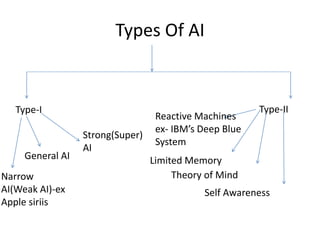
Types Of AI
Type-I Type-II
Narrow
AI(Weak AI)-ex
Apple siriis
General AI
Strong(Super)
AI
Reactive Machines
ex- IBM’s Deep Blue
System
Limited Memory
Theory of Mind
Self Awareness
Machine Learning
• Machine learning is the art of science of getting computers to act as per the
algorithms designed and programmed. Many researchers think machine learning is
the best way to make progress towards human-level AI. Machine learning includes
the following types of patterns
• Supervised learning pattern
• Unsupervised learning pattern
Deep Learning
• Deep learning is a subfield of machine learning where concerned algorithms are
inspired by the structure and function of the brain called artificial neural networks.
• All the value today of deep learning is through supervised learning or learning from
labeled data and algorithms.
• Each algorithm in deep learning goes through the same process. It includes a
hierarchy of nonlinear transformation of input that can be used to generate a
statistical model as output.
• Consider the following steps that define the Machine Learning process
• Identifies relevant data sets and prepares them for analysis.
• Chooses the type of algorithm to use
• Builds an analytical model based on the algorithm used.
• Trains the model on test data sets, revising it as needed.
• Runs the model to generate test scores.
Applications of Machine Learning and Deep Learning
• In this section, we will learn about the different applications
of Machine Learning and Deep Learning.
• Computer vision which is used for facial recognition and
attendance mark through fingerprints or vehicle
identification through number plate.
• Information Retrieval from search engines like text search
for image search.
• Automated email marketing with specified target
identification.
• Medical diagnosis of cancer tumors or anomaly
identification of any chronic disease.
• Natural language processing for applications like photo
tagging. The best example to explain this scenario is used in
Facebook.
• Online Advertising.

Chapter 1- Artficial Intelligence.pptx

  • 1.
    Emerging Trends inComputer Engineering (ETI) Chapter 1 Artificial Intelligence Miss. Chordia A.S.
  • 2.
  • 3.
    Introduction Intelligence : -“The Capacity to learn and solve problem”. Artificial Intelligence :- Artificial Intelligence (AI) is simulation of human intelligence by machine. 1. The ability to solve problem. 2. The ability to act rationally. 3. The ability to act like human. Three Basic Concepts:- 1. Machine Learning 2. Deep Learning 3.Neural Networks
  • 4.
    Scope Of AI •Automation • Robotics • The Use of Sophisticated Computer Programs Components Of AI 1. Logic 2. Cognition 3. Functional
  • 5.
    The Central Principlesof AI Includes:- 1. Reasoning, Knowledge, Planning, Learning and Communication. 2. Perception and the ability to move and manipulate objects. 3. It is the science and engineering of making intelligent machine, especially intelligent computer programs. Definition :-  Computers with the ability to mimic or duplicate the functions of the human brain.  Artificial Intelligence is the Intelligence of machines and the branch of computer science with aims to create it.  “The branch of computer science that is concerned with the automation of intelligent behavior”.(Luger and Subblefield.1993).
  • 6.
    History of ArtificialIntelligence 1950 – The time when it all started. 1955 – John McCarthy coined term “Artificial Intelligence”. 1974 - Computer became faster and affordable. 1980 – The year of Artificial Intelligence. 2000 – Landmark of AI establishment achieved.
  • 7.
    Applications of AIin Medicine • A medical clinic can use AI systems to organize bed schedules, make a staff rotation and provide medical information. • AI has also application in field of cardiology(CGR),neurology(MRI),embryology (sonography), complex operations of internal organs etc. • It also has an application in image guided surgery and image analysis and enhancement.
  • 8.
    Applications of AIin Music • Scientist are trying to make the computer emulate the activities of the skillful musicians. • Composition, performance music theory, sound processing are some of the major areas on which research in music and AI are focusing on. Eg- chunks, smartmusic etc.
  • 9.
    Some Other Applications •Credit Granting • Information management and retrieval. • AI and expert systems embedded in products • Plant Layout • Help desk assistance • Employee performance evaluation • Shipping • Marketing • Warehouse optimization • Satellite Controls • Network Development
  • 10.
    • Artificial Intelligenceis one of the most popular trends of recent times. Machine learning and deep learning constitute artificial intelligence. The Venn diagram shown below explains the relationship of machine learning and deep learning −
  • 11.
    Types Of AI Type-IType-II Narrow AI(Weak AI)-ex Apple siriis General AI Strong(Super) AI Reactive Machines ex- IBM’s Deep Blue System Limited Memory Theory of Mind Self Awareness
  • 12.
    Machine Learning • Machinelearning is the art of science of getting computers to act as per the algorithms designed and programmed. Many researchers think machine learning is the best way to make progress towards human-level AI. Machine learning includes the following types of patterns • Supervised learning pattern • Unsupervised learning pattern Deep Learning • Deep learning is a subfield of machine learning where concerned algorithms are inspired by the structure and function of the brain called artificial neural networks. • All the value today of deep learning is through supervised learning or learning from labeled data and algorithms. • Each algorithm in deep learning goes through the same process. It includes a hierarchy of nonlinear transformation of input that can be used to generate a statistical model as output. • Consider the following steps that define the Machine Learning process • Identifies relevant data sets and prepares them for analysis. • Chooses the type of algorithm to use • Builds an analytical model based on the algorithm used. • Trains the model on test data sets, revising it as needed. • Runs the model to generate test scores.
  • 13.
    Applications of MachineLearning and Deep Learning • In this section, we will learn about the different applications of Machine Learning and Deep Learning. • Computer vision which is used for facial recognition and attendance mark through fingerprints or vehicle identification through number plate. • Information Retrieval from search engines like text search for image search. • Automated email marketing with specified target identification. • Medical diagnosis of cancer tumors or anomaly identification of any chronic disease. • Natural language processing for applications like photo tagging. The best example to explain this scenario is used in Facebook. • Online Advertising.