CONTENT
• What is IoT ?
• History of IoT
• How IoT Works ?
• Internet of Things Lifecycle
• Few Applications of IoT
• Electronic Platforms for IoT
What is IoT ?
The Internet of Things (Iot) is the network of
physical objects or things embedded with
electronics software, sensors , and network
connectivity , which enables these objects to
collect and exchange data.
• A “Thing” in the context of Internet of Things (IoT), is
an entity or physical object that has the ability to
transfer data over a network.
• Smart microwaves
• Self driving cars with built in sensors
• Wearable fitness devices that measure your heart rates
etc.
• These devices collect useful data with the help of
various existing technologies and then autonomously
flow the data between other devices.
History of IoT
In 1999 Kevin Aston, also known as the father of Iot
coin the term “Internet of Things” and establishes
MIT’s Auto-ID Center, a global research network of
academic Laboratories focused on the IoT.
He believed that “Information is a great way to
reduce waste and increase efficiency, and that’s what
the Internet of Things provides”.
How IoT Works ?
The Internet of Things(IoT) , consists of all the web-
enabled devices that collect, send and act on data
they accuire from their surrounding environments
using embedded sensors, processors and
communication hardware.These devices
communicate with each other and act on the
information they get from one another. Humans can
give instructions or access data, but the devices do
most of the work on their own without human
intervention.
The Internet of Things Lifecycle
COLLECT (Devices and Sensors collect data like at your house , in your car etc.)
COMMUNICATE (Sending data and events through networks to a cloud
platform)
ANALYSE (Creating information from the data like building report
filtering data)
ACT (Taking action based on the information and data
like talk to another system or sending
notification)
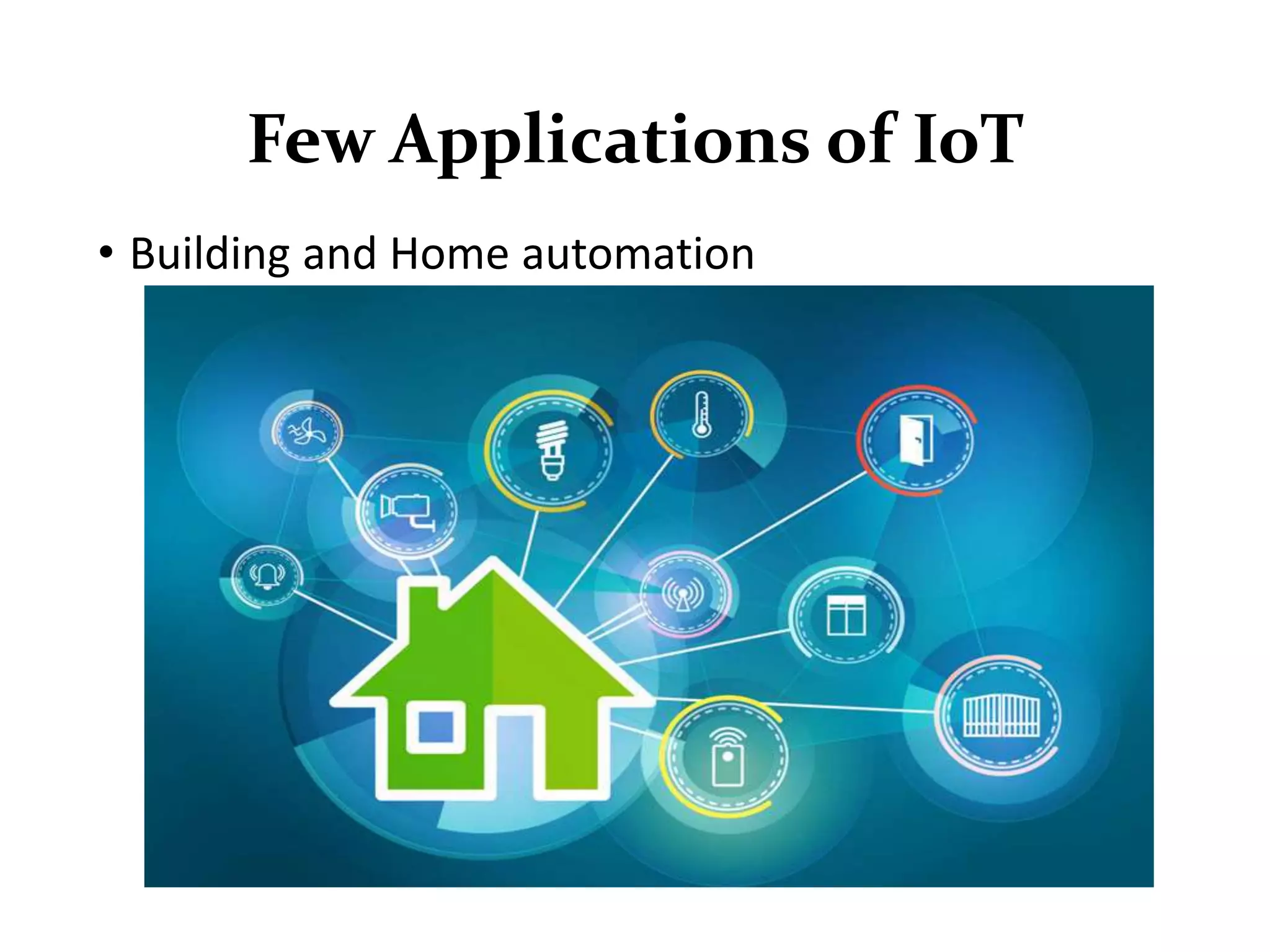
Few Applications of IoT
• Building and Home automation
• Medical and Healthcare systems
• Transportation
• Environment monitoring
• Manufacturing
• Energy management
• Infrastucture management
• Media and so on.
Electronic Platforms for IoT
1. ARDUINO
• Arduino is an open-source prototyping platform
based on easy-to-use hardware and software IDE.
Arduino boards are able to read inputs like light on
a sensor and turn it into an output,activating a
motor, turning on an LED. You can tell your board
what to do by sending a set of instructions to the
microcontroller on the board. It is like the brain of a
project.
• The programming languages that are used with
arduino board are C and C++.
Why Arduino ?
• Inexpensive
• Cross-platform
• Simple programming environment
• Open source and extensible software
• Open source and extensible hardware
Arduino Hardware Description
• Power USB - Arduino can be powered by using the
USB cable from computer.
• Crystal Oscillator - It helps arduino in dealing with
time issues.
• Power LED indicator – This LED should light up
when you plug your Arduino into a power source.
• Pins - Arduino UNO R3 microcontroller based on
Atmega328p has 14 digital pins of which 6 can be
used as PWM outputs, 6 analog inputs, a USB
connection , power jack , ICSP header and a reset
button.
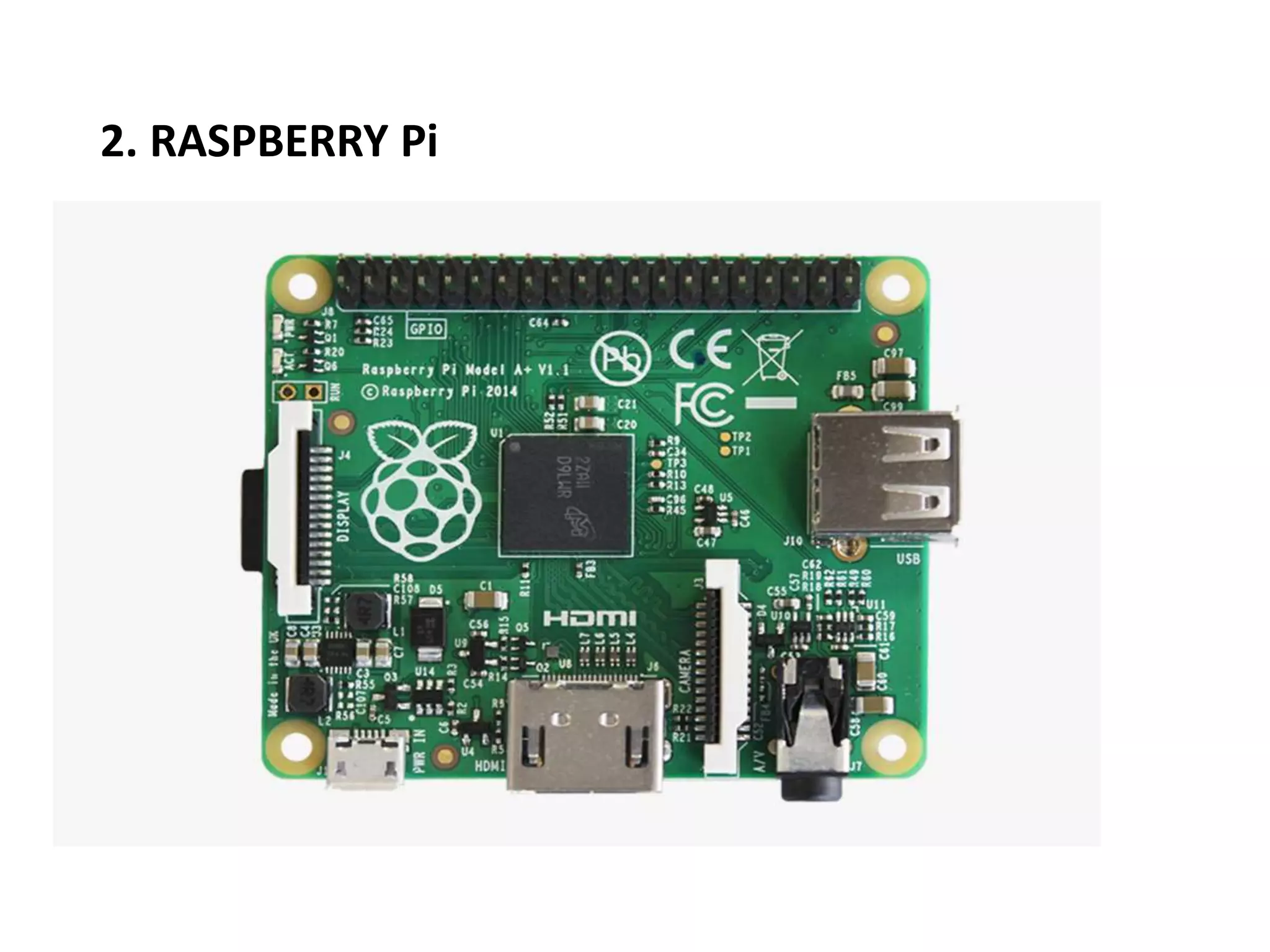
2. RASPBERRY Pi
• The Raspberry Pi is a credit sized fully featured
micro-computer squashed onto a circuit board
measuring approximately 9cm x 5.5cm.
• By default it supports Python as programming
language but any language which will compile for
ARMv6 can be used with the raspberry Pi.
• The SoC used in Raspberry Pi is Broadcom
BCM2835 SoC.
• It does not include a built-in hard disk , but uses an
SD card for booting and long-term storage.
• Supports and runs on free and open source Linux
OS
Why Raspberry Pi ?
• Low cost
• Works on low power
• Small in size and portability
• It works as a Low cost server to handle web traffic
• Can work with open source operating systems like
ArchLinux ARM, Respbian , Fedora etc.
• Easy to program
Raspberry Pi Hardware
Description
• Memory (RAM) - 512 Mb
• Processor – Broadcom BCM2835 SoC
• GPU - Broadcom Videocore IV
• USB 2.0 – 4 ports
• On board storage - micro SD card
• Video input - Camera support via CSI connector
• Video Output – HDMI support via DSI
• Networking - Ethernet support
• Audio Output – 3.5mm jack
• GPIO pins - 40 General Purpose Input Output pins
ENVIRONMENT
PARAMETER
SENSING USING IOT
OBJECTIVE
The main objective of the project is to provide
a platform that monitors the parameters and
help to create better and pollution free future
life.
Hardware Requirements
• Arduino Atmega 328P Microcontroller
• DHT22 Module
• MQ135 Gas Sensor
• Soil Moisture Sensor
• 16*2 Liquid Crystal Display (LCD)
• ESP 8266 WIFI Module
• PCB Board
• Light Detecting Resistors (LDR)
• Resistors
• Jumper Wires
• Soldering Kit
• 12v Supply
• I2c (Inter integrated Circuit) Module for LCD Interfacing in
TWI Mode
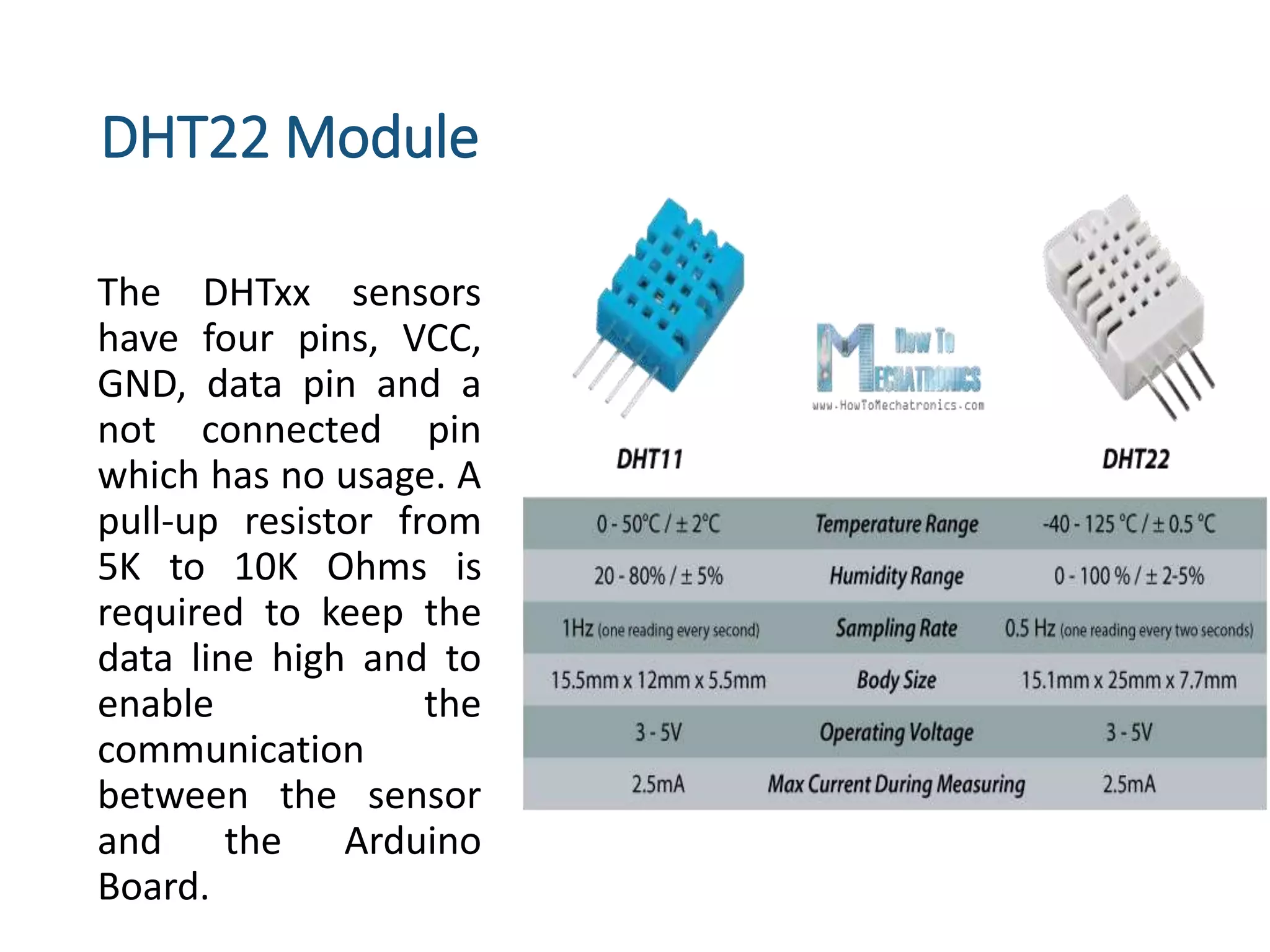
DHT22 Module
The DHTxx sensors
have four pins, VCC,
GND, data pin and a
not connected pin
which has no usage. A
pull-up resistor from
5K to 10K Ohms is
required to keep the
data line high and to
enable the
communication
between the sensor
and the Arduino
Board.
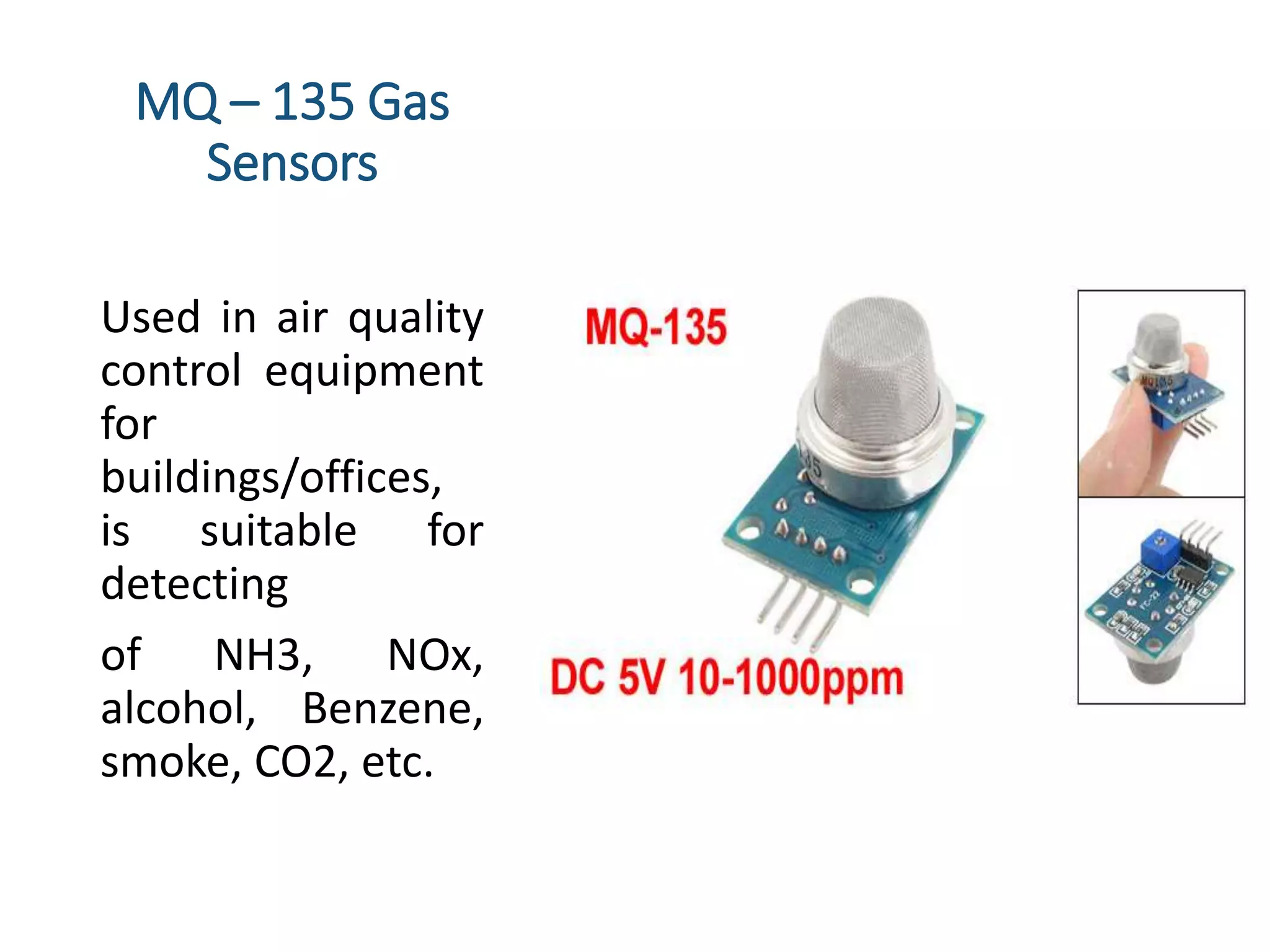
MQ – 135 Gas
Sensors
Used in air quality
control equipment
for
buildings/offices,
is suitable for
detecting
of NH3, NOx,
alcohol, Benzene,
smoke, CO2, etc.
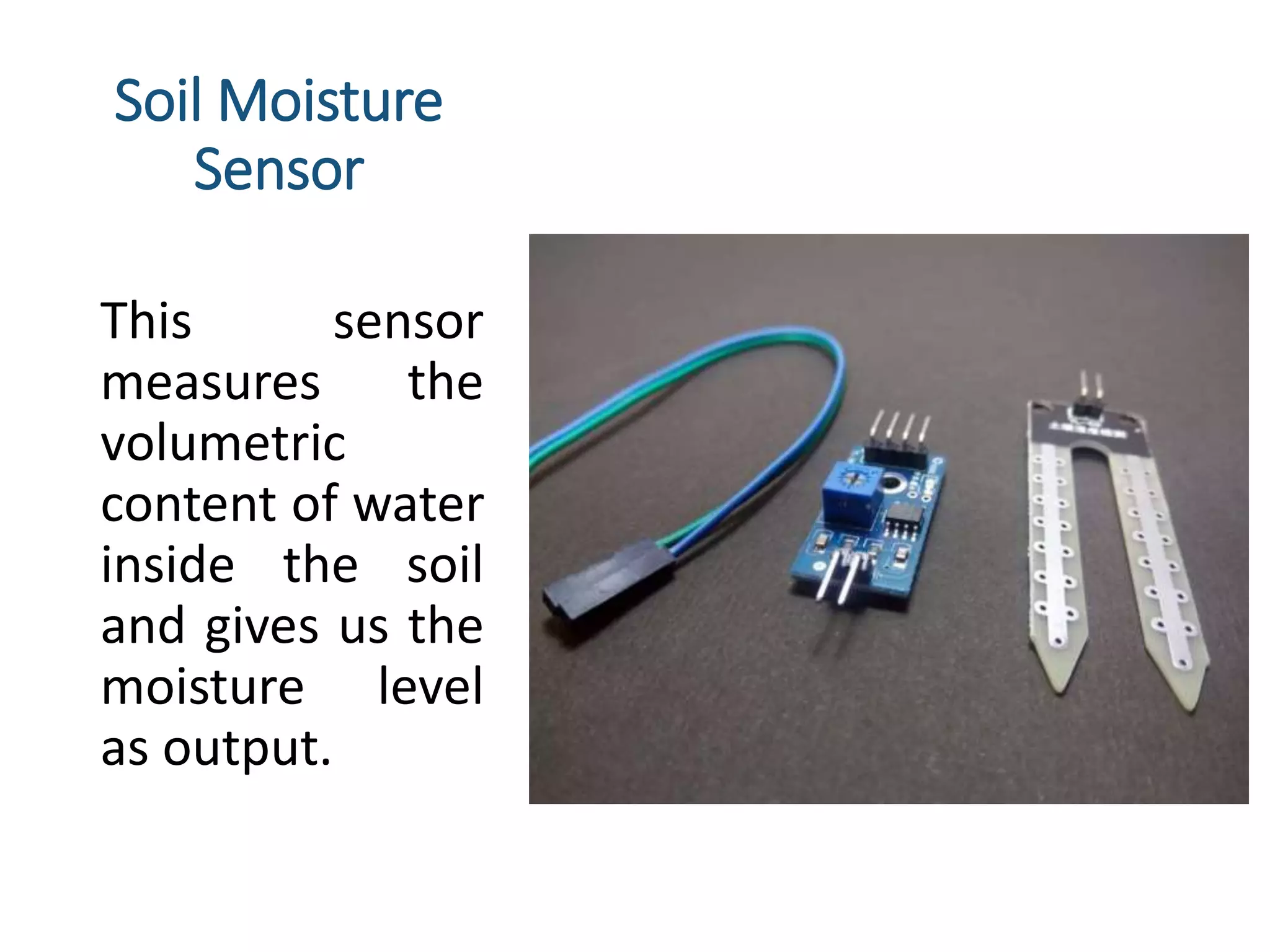
Soil Moisture
Sensor
This sensor
measures the
volumetric
content of water
inside the soil
and gives us the
moisture level
as output.
Light Dependent
Resistors (LDR)
An LDR is a
transducer which
changes its
resistance when
LIGHT falls on its
surface changes.
CONCLUSION
The proposed system which is designed shows the
simulation output of sensing the carbon dioxide gas
in air, humidity, noise pollution and temperature
pollution in Environment. The sensor output is
pushed to cloud and can be viewed through internet.
This is a flourishing system which is very useful in
industries because of the increasing pollution due to
increase in industries. This system is user friendly.
The results of the project are accurate and hence can
be implemented in any industries for the safety of
workers and the environment.
THANK YOU

Internet of things

  • 2.
    CONTENT • What isIoT ? • History of IoT • How IoT Works ? • Internet of Things Lifecycle • Few Applications of IoT • Electronic Platforms for IoT
  • 3.
    What is IoT? The Internet of Things (Iot) is the network of physical objects or things embedded with electronics software, sensors , and network connectivity , which enables these objects to collect and exchange data.
  • 4.
    • A “Thing”in the context of Internet of Things (IoT), is an entity or physical object that has the ability to transfer data over a network. • Smart microwaves • Self driving cars with built in sensors • Wearable fitness devices that measure your heart rates etc. • These devices collect useful data with the help of various existing technologies and then autonomously flow the data between other devices.
  • 5.
    History of IoT In1999 Kevin Aston, also known as the father of Iot coin the term “Internet of Things” and establishes MIT’s Auto-ID Center, a global research network of academic Laboratories focused on the IoT. He believed that “Information is a great way to reduce waste and increase efficiency, and that’s what the Internet of Things provides”.
  • 6.
    How IoT Works? The Internet of Things(IoT) , consists of all the web- enabled devices that collect, send and act on data they accuire from their surrounding environments using embedded sensors, processors and communication hardware.These devices communicate with each other and act on the information they get from one another. Humans can give instructions or access data, but the devices do most of the work on their own without human intervention.
  • 7.
    The Internet ofThings Lifecycle COLLECT (Devices and Sensors collect data like at your house , in your car etc.) COMMUNICATE (Sending data and events through networks to a cloud platform) ANALYSE (Creating information from the data like building report filtering data) ACT (Taking action based on the information and data like talk to another system or sending notification)
  • 8.
    Few Applications ofIoT • Building and Home automation
  • 9.
    • Medical andHealthcare systems
  • 10.
  • 11.
    • Environment monitoring •Manufacturing • Energy management • Infrastucture management • Media and so on.
  • 12.
  • 13.
    • Arduino isan open-source prototyping platform based on easy-to-use hardware and software IDE. Arduino boards are able to read inputs like light on a sensor and turn it into an output,activating a motor, turning on an LED. You can tell your board what to do by sending a set of instructions to the microcontroller on the board. It is like the brain of a project. • The programming languages that are used with arduino board are C and C++.
  • 14.
    Why Arduino ? •Inexpensive • Cross-platform • Simple programming environment • Open source and extensible software • Open source and extensible hardware
  • 15.
  • 16.
    • Power USB- Arduino can be powered by using the USB cable from computer. • Crystal Oscillator - It helps arduino in dealing with time issues. • Power LED indicator – This LED should light up when you plug your Arduino into a power source. • Pins - Arduino UNO R3 microcontroller based on Atmega328p has 14 digital pins of which 6 can be used as PWM outputs, 6 analog inputs, a USB connection , power jack , ICSP header and a reset button.
  • 17.
  • 18.
    • The RaspberryPi is a credit sized fully featured micro-computer squashed onto a circuit board measuring approximately 9cm x 5.5cm. • By default it supports Python as programming language but any language which will compile for ARMv6 can be used with the raspberry Pi. • The SoC used in Raspberry Pi is Broadcom BCM2835 SoC. • It does not include a built-in hard disk , but uses an SD card for booting and long-term storage. • Supports and runs on free and open source Linux OS
  • 19.
    Why Raspberry Pi? • Low cost • Works on low power • Small in size and portability • It works as a Low cost server to handle web traffic • Can work with open source operating systems like ArchLinux ARM, Respbian , Fedora etc. • Easy to program
  • 20.
  • 21.
    • Memory (RAM)- 512 Mb • Processor – Broadcom BCM2835 SoC • GPU - Broadcom Videocore IV • USB 2.0 – 4 ports • On board storage - micro SD card • Video input - Camera support via CSI connector • Video Output – HDMI support via DSI • Networking - Ethernet support • Audio Output – 3.5mm jack • GPIO pins - 40 General Purpose Input Output pins
  • 22.
  • 23.
    OBJECTIVE The main objectiveof the project is to provide a platform that monitors the parameters and help to create better and pollution free future life.
  • 24.
    Hardware Requirements • ArduinoAtmega 328P Microcontroller • DHT22 Module • MQ135 Gas Sensor • Soil Moisture Sensor • 16*2 Liquid Crystal Display (LCD) • ESP 8266 WIFI Module • PCB Board • Light Detecting Resistors (LDR) • Resistors • Jumper Wires • Soldering Kit • 12v Supply • I2c (Inter integrated Circuit) Module for LCD Interfacing in TWI Mode
  • 25.
    DHT22 Module The DHTxxsensors have four pins, VCC, GND, data pin and a not connected pin which has no usage. A pull-up resistor from 5K to 10K Ohms is required to keep the data line high and to enable the communication between the sensor and the Arduino Board.
  • 26.
    MQ – 135Gas Sensors Used in air quality control equipment for buildings/offices, is suitable for detecting of NH3, NOx, alcohol, Benzene, smoke, CO2, etc.
  • 27.
    Soil Moisture Sensor This sensor measuresthe volumetric content of water inside the soil and gives us the moisture level as output.
  • 28.
    Light Dependent Resistors (LDR) AnLDR is a transducer which changes its resistance when LIGHT falls on its surface changes.
  • 29.
    CONCLUSION The proposed systemwhich is designed shows the simulation output of sensing the carbon dioxide gas in air, humidity, noise pollution and temperature pollution in Environment. The sensor output is pushed to cloud and can be viewed through internet. This is a flourishing system which is very useful in industries because of the increasing pollution due to increase in industries. This system is user friendly. The results of the project are accurate and hence can be implemented in any industries for the safety of workers and the environment.
  • 30.