Chemistry 17.2
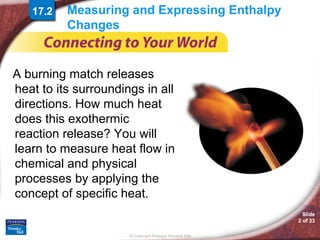
Measuring and Expressing Enthalpy Changes A burning match releases heat to its surroundings in all directions. How much heat does this exothermic reaction release? You will learn to measure heat flow in chemical and physical processes by applying the concept of specific heat. 17.2
Calorimetry Calorimetry What basic concepts apply to calorimetry? 17.2
Calorimetry Calorimetry  is the precise measurement of the heat flow into or out of a system for chemical and physical processes. 17.2
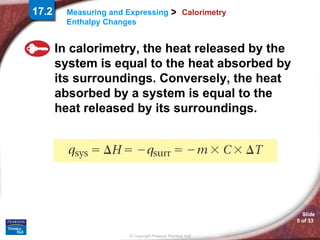
Calorimetry In calorimetry, the heat released by the system is equal to the heat absorbed by its surroundings. Conversely, the heat absorbed by a system is equal to the heat released by its surroundings. 17.2
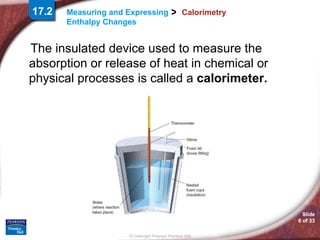
Calorimetry The insulated device used to measure the absorption or release of heat in chemical or physical processes is called a  calorimeter. 17.2
Calorimetry Constant-Pressure Calorimeters The heat content of a system at constant pressure is the same as a property called the  enthalpy  ( H ) of the system.  17.2
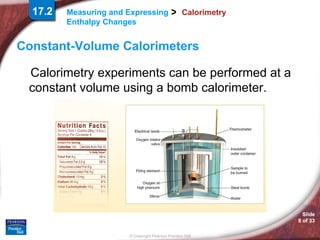
Calorimetry Constant-Volume Calorimeters Calorimetry experiments can be performed at a constant volume using a bomb calorimeter. 17.2
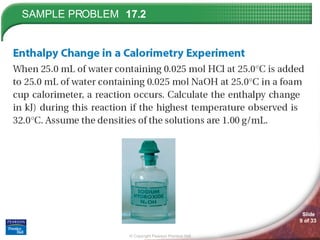
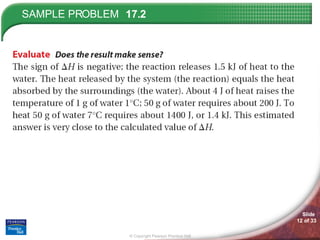
17.2
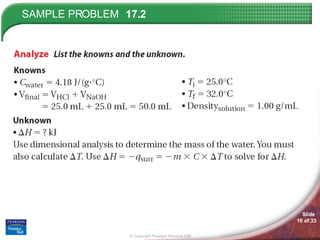
17.2
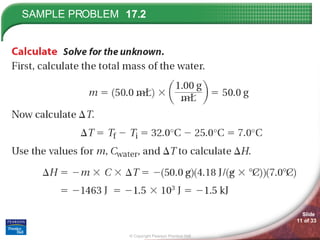
17.2
17.2
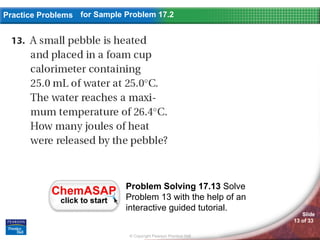
for Sample Problem 17.2 Problem Solving 17.13  Solve Problem 13 with the help of an interactive guided tutorial.
Thermochemical Equations Thermochemical Equations How can you express the enthalpy change for a reaction in a chemical equation? 17.2
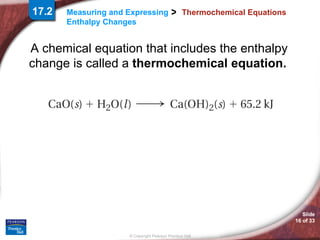
Thermochemical Equations In a chemical equation, the enthalpy change for the reaction can be written as either a reactant or a product.  17.2
Thermochemical Equations A chemical equation that includes the enthalpy change is called a  thermochemical equation.   17.2

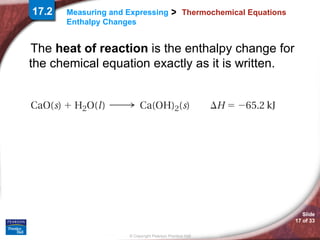
Thermochemical Equations The  heat of reaction  is the enthalpy change for the chemical equation exactly as it is written. 17.2
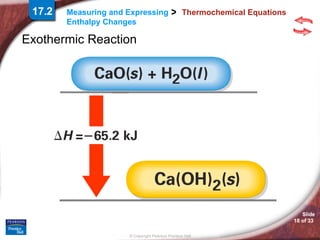
Thermochemical Equations 17.2 Exothermic Reaction
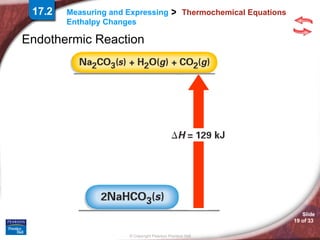
Thermochemical Equations 17.2 Endothermic Reaction
Thermochemical Equations Simulation 22  Simulate a combustion reaction and compare the ∆ H  results for several compounds.
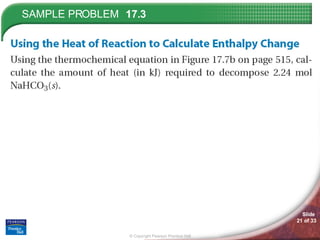
17.3
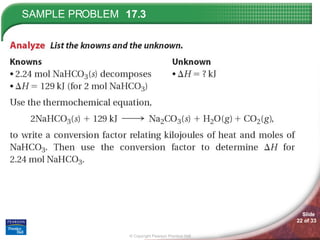
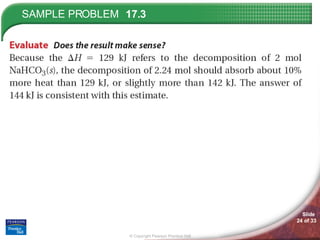
17.3
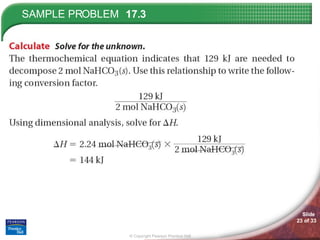
17.3
17.3
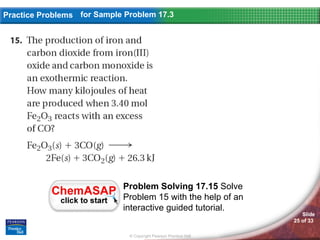
for Sample Problem 17.3 Problem Solving 17.15  Solve Problem 15 with the help of an interactive guided tutorial.
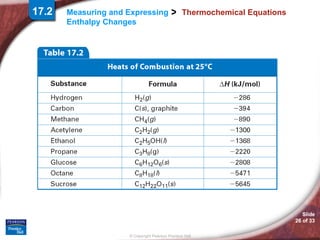
Thermochemical Equations 17.2
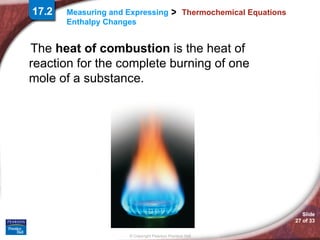
Thermochemical Equations The  heat of combustion  is the heat of reaction for the complete burning of one mole of a substance. 17.2
17.2 Section Quiz. 17.2.
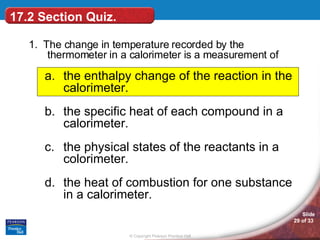
1.  The change in temperature recorded by the thermometer in a calorimeter is a measurement of the enthalpy change of the reaction in the calorimeter. the specific heat of each compound in a calorimeter. the physical states of the reactants in a colorimeter. the heat of combustion for one substance in a calorimeter. 17.2 Section Quiz.
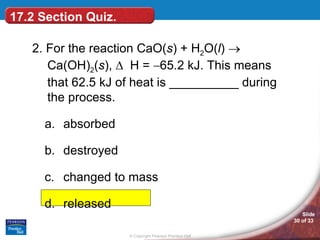
17.2 Section Quiz. 2. For the reaction CaO( s ) + H 2 O( l )   Ca(OH) 2 ( s ),     H =   65.2 kJ. This means that 62.5 kJ of heat is __________ during the process. absorbed destroyed changed to mass released
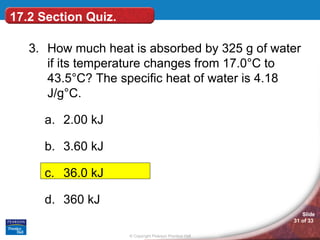
17.2 Section Quiz. 3. How much heat is absorbed by 325 g of water if its temperature changes from 17.0°C to 43.5°C? The specific heat of water is 4.18 J/g°C. 2.00 kJ 3.60 kJ 36.0 kJ 360 kJ
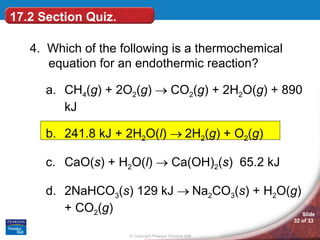
4.  Which of the following is a thermochemical equation for an endothermic reaction? CH 4 ( g ) + 2O 2 ( g )    CO 2 ( g ) + 2H 2 O( g ) + 890 kJ 241.8 kJ + 2H 2 O( l )   2H 2 ( g ) + O 2 ( g ) CaO( s ) + H 2 O( l )    Ca(OH) 2 ( s )  65.2 kJ 2NaHCO 3 ( s ) 129 kJ   Na 2 CO 3 ( s ) + H 2 O( g ) + CO 2 ( g ) 17.2 Section Quiz.
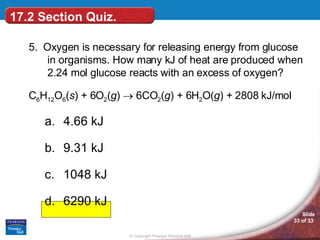
5.  Oxygen is necessary for releasing energy from glucose in organisms. How many kJ of heat are produced when 2.24 mol glucose reacts with an excess of oxygen? C 6 H 12 O 6 ( s ) + 6O 2 ( g )    6CO 2 ( g ) + 6H 2 O( g ) + 2808 kJ/mol 4.66 kJ 9.31 kJ 1048 kJ 6290 kJ 17.2 Section Quiz.
END OF SHOW

Chapter17 Section02 Edit

  • 1.
  • 2.
    Measuring and ExpressingEnthalpy Changes A burning match releases heat to its surroundings in all directions. How much heat does this exothermic reaction release? You will learn to measure heat flow in chemical and physical processes by applying the concept of specific heat. 17.2
  • 3.
    Calorimetry Calorimetry Whatbasic concepts apply to calorimetry? 17.2
  • 4.
    Calorimetry Calorimetry is the precise measurement of the heat flow into or out of a system for chemical and physical processes. 17.2
  • 5.
    Calorimetry In calorimetry,the heat released by the system is equal to the heat absorbed by its surroundings. Conversely, the heat absorbed by a system is equal to the heat released by its surroundings. 17.2
  • 6.
    Calorimetry The insulateddevice used to measure the absorption or release of heat in chemical or physical processes is called a calorimeter. 17.2
  • 7.
    Calorimetry Constant-Pressure CalorimetersThe heat content of a system at constant pressure is the same as a property called the enthalpy ( H ) of the system. 17.2
  • 8.
    Calorimetry Constant-Volume CalorimetersCalorimetry experiments can be performed at a constant volume using a bomb calorimeter. 17.2
  • 9.
  • 10.
  • 11.
  • 12.
  • 13.
    for Sample Problem17.2 Problem Solving 17.13 Solve Problem 13 with the help of an interactive guided tutorial.
  • 14.
    Thermochemical Equations ThermochemicalEquations How can you express the enthalpy change for a reaction in a chemical equation? 17.2
  • 15.
    Thermochemical Equations Ina chemical equation, the enthalpy change for the reaction can be written as either a reactant or a product. 17.2
  • 16.
    Thermochemical Equations Achemical equation that includes the enthalpy change is called a thermochemical equation. 17.2
  • 17.
    Thermochemical Equations The heat of reaction is the enthalpy change for the chemical equation exactly as it is written. 17.2
  • 18.
    Thermochemical Equations 17.2Exothermic Reaction
  • 19.
    Thermochemical Equations 17.2Endothermic Reaction
  • 20.
    Thermochemical Equations Simulation22 Simulate a combustion reaction and compare the ∆ H results for several compounds.
  • 21.
  • 22.
  • 23.
  • 24.
  • 25.
    for Sample Problem17.3 Problem Solving 17.15 Solve Problem 15 with the help of an interactive guided tutorial.
  • 26.
  • 27.
    Thermochemical Equations The heat of combustion is the heat of reaction for the complete burning of one mole of a substance. 17.2
  • 28.
  • 29.
    1. Thechange in temperature recorded by the thermometer in a calorimeter is a measurement of the enthalpy change of the reaction in the calorimeter. the specific heat of each compound in a calorimeter. the physical states of the reactants in a colorimeter. the heat of combustion for one substance in a calorimeter. 17.2 Section Quiz.
  • 30.
    17.2 Section Quiz.2. For the reaction CaO( s ) + H 2 O( l )  Ca(OH) 2 ( s ),  H =  65.2 kJ. This means that 62.5 kJ of heat is __________ during the process. absorbed destroyed changed to mass released
  • 31.
    17.2 Section Quiz.3. How much heat is absorbed by 325 g of water if its temperature changes from 17.0°C to 43.5°C? The specific heat of water is 4.18 J/g°C. 2.00 kJ 3.60 kJ 36.0 kJ 360 kJ
  • 32.
    4. Whichof the following is a thermochemical equation for an endothermic reaction? CH 4 ( g ) + 2O 2 ( g )  CO 2 ( g ) + 2H 2 O( g ) + 890 kJ 241.8 kJ + 2H 2 O( l )  2H 2 ( g ) + O 2 ( g ) CaO( s ) + H 2 O( l )  Ca(OH) 2 ( s ) 65.2 kJ 2NaHCO 3 ( s ) 129 kJ  Na 2 CO 3 ( s ) + H 2 O( g ) + CO 2 ( g ) 17.2 Section Quiz.
  • 33.
    5. Oxygenis necessary for releasing energy from glucose in organisms. How many kJ of heat are produced when 2.24 mol glucose reacts with an excess of oxygen? C 6 H 12 O 6 ( s ) + 6O 2 ( g )  6CO 2 ( g ) + 6H 2 O( g ) + 2808 kJ/mol 4.66 kJ 9.31 kJ 1048 kJ 6290 kJ 17.2 Section Quiz.
  • 34.