Lecture Slides 
Chapter Eleven 
Personality 
By Glenn Meyer 
Trinity University
Introduction: What Is 
Personality? 
Personality is an individual’s 
unique and relatively 
consistent pattern of thinking, 
feeling, and behaving. 
Personality theory attempts to 
describe and explain how people 
are similar, how they are different, 
and why every individual is unique. 
Psychoanalytic perspective 
emphasizes the importance of 
unconscious processes and 
the influence of early childhood 
experience 
Humanistic perspective 
represents an optimistic look at 
human nature, emphasizing 
the self and fulfillment of a 
person’s unique potential 
Social cognitive perspective 
emphasizes learning and 
conscious cognitive processes, 
including the importance of 
beliefs about self, goal setting, 
and self- regulation 
Trait perspective emphasizes 
description and measurement 
of specific personality 
differences among individuals 
Four basic perspectives: 
Psychoanalytic 
Perspective 
Click Here 
Humanistic 
Perspective 
Click Here 
Social Cognitive 
Perspective 
Click Here 
Trait 
Perspective 
Click Here
The Psychoanalytic 
Perspective on 
Personality 
The Life of Sigmund Freud 
• Born in 1856 in what is today Pribor, 
Czech Republic 
• Studied medicine, became a 
physician and outstanding 
physiological researcher 
• Among first investigators of a new 
drug that had anesthetic and mood-altering 
properties—cocaine 
• Prospects for an academic career in 
scientific research were very poor, 
especially for a Jew in Vienna, which 
was intensely anti-Semitic at that 
time 
• Freud gave up physiological research 
for private practice in neurology
Influences in the Development of 
Freud’s Ideas 
• One influence was Joseph 
Breuer: hypnosis; patients 
with psychological symptoms 
• Freud developed his own 
technique of free association 
• 1900, his most important 
work, The Interpretation of 
Dreams 
• 1904, the Psychopathology of 
Everyday Life described how 
unconscious thoughts, 
feelings, and wishes are often 
reflected in acts of forgetting, 
inadvertent slips of tongue, 
accidents, and errors 
• Fled the Nazis to England
Freud’s Dynamic Theory of Personality 
Psychoanalytic Approach 
• Psychoanalysis is both an approach to therapy and a theory 
of personality. 
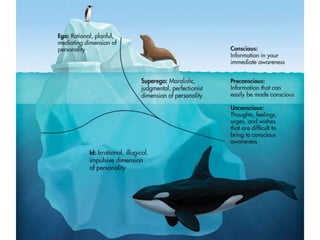
• Emphasizes unconscious motivation – the main causes 
of behavior lie buried in the unconscious mind 
• Freud (1940) saw personality and behavior as the result of 
a constant interplay among conflicting psychological forces. 
• These psychological forces operate at three different levels 
of awareness: 
• Conscious 
• Preconscious 
• Unconscious 
• Unconscious material seeps through to the 
conscious level in distorted, disguised, or symbolic 
forms 
• Can be revealed by free association, dreams, slips of 
the tongue (Freudian slip), accidents, etc.
Dream Analysis 
Click here 
Techniques to Reveal the 
Unconscious 
Free Association 
Click here 
A psychoanalytical 
technique in which the 
patient spontaneously 
reports all thoughts, 
feelings, and mental 
images as they come to 
mind 
Dreams contain 
• Manifest content 
(surface meaning) 
• Latent content (true, 
unconscious meaning)
The Structure of Personality 
Id 
• Instinctual drives present at birth 
• Does not distinguish reality from fantasy 
• Operates according to pleasure principle 
• Motive to obtain pleasure and avoid 
tension or discomfort; this is the 
most fundamental human motive and 
guiding principle of id 
• Immune to logic 
• Energy comes from 
• Eros— self-preservation or life 
instinct 
• Libido—psychological and 
emotional energy associated with 
expressions of sexuality; sex drive 
• Thanatos—death instinct 
• Reflected in aggressive, 
destructive, and self-destructive 
actions 
• Person 
possesses a 
certain amount 
of 
psychological 
energy 
• Psychological 
energy 
develops into 
three basic 
structures of 
personality: id, 
ego, superego
Ego 
• Latin for I 
• The partly conscious rational component of personality 
• Develops out of the id in infancy 
• Understands reality and logic 
• Most in touch with the demands of the external world 
• Reality 
• Mediator between id and superego 
• Reality principle — the ability to postpone gratification 
in accordance with demands of external world 
• Can repress desires that cannot be met in an 
acceptable manner
Superego 
• At age 5 or 6, child 
develops an 
internal, parental 
voice that is partly 
conscious 
• Internalization of 
parental and 
society’s moral 
standards 
• Responsible for 
guilt; praises and 
admonishes
The Ego Defense Mechanisms 
• If demands of the id or superego threaten to overwhelm 
the ego, anxiety results. 
• If a realistic solution or compromise is not possible, the 
ego may temporarily reduce anxiety by distorting 
thoughts or perceptions of reality through ego defense 
mechanisms. 
• By resorting to these largely unconscious self-deceptions, 
the ego can maintain an integrated sense of 
self while searching for a more acceptable and realistic 
solution to a conflict between the id and the superego. 
• Repression is the most fundamental ego defense 
mechanism. Others are used if repression fails. 
• The short-term use of defense mechanisms can be 
helpful; long-term use is problematic.
Personality Development 
Fixation 
• At each psychosexual stage, the child 
is faced with a developmental conflict 
that must be successfully resolved 
• Child may be frustrated or 
overindulged in stage’s expression of 
pleasurable feelings 
• If frustrated, child will be left with 
feelings of unmet needs characteristic 
of that stage 
• If overindulged, child may be reluctant 
to move on to the next 
• In either case, result of an unresolved 
developmental conflict is fixation 
Freud’s 
Psychosexual 
Stages 
People progress 
through five 
psychosexual 
stages of 
development. The 
foundations of adult 
personality are 
established during 
the first five years of 
life, as the child 
progresses through 
the oral, anal, and 
phallic 
psychosexual 
stages.
The Oedipus Complex 
Child’s unconscious sexual 
desire for the opposite-sex 
parent, usually accompanied 
by hostile feelings toward the 
same-sex parent 
Boys: 
• Confrontation with father 
for the affections of mother 
• Boy feels hostility and 
jealousy toward his father 
• Realizes that father is 
more physically powerful 
• Boy experiences 
castration anxiety, or fear 
that father will castrate him 
• To resolve, boy uses 
identification — imitates 
and internalizes father’s 
values, attitudes, 
mannerisms 
Girls: 
• Little girl discovers that 
little boys have a penis 
and that she does not 
• Feels a sense of 
deprivation and loss — 
penis envy 
• Attempts to take her 
mother’s place with her 
father, she also identifies 
with her mother 
• One of the most critiqued 
of Freud’s ideas 
Identification: Ego 
defense mechanism that 
reduces anxiety by 
imitating behavior and 
characteristics of 
another person 
• He later admitted “the 
sexual life of adult women 
is a ‘dark continent’ for 
psychology.”
The Latency and Genital Stages 
Genital Stage (puberty and 
older) 
Click here 
Latency (5 years – puberty) 
Click here 
• Because the Oedipus 
complex causes anxiety, 
sexual urges of boys 
and girls become 
repressed 
• Children desire to 
associate with same-sex 
peers, a preference 
that strengthens the 
child’s sexual identity 
• Final resolution of the 
Oedipus complex in 
adolescence 
• Incestuous urges start 
to resurface; they are 
prohibited by superego 
and societal restriction 
• Person directs sexual 
urges toward socially 
acceptable substitutes, 
who often resemble the 
person’s opposite-sex 
parent 
Song lyrics from 1911: 
I want a girl just like the 
girl that married dear old 
dad.
The Neo-Freudians 
• Carl Jung’s collective unconscious 
• Karen Horney’s focus on security 
• Alfred Adler’s individual psychology 
• Neo-Freudians followed Freud in stressing the 
importance of the unconscious and early childhood, 
but they developed their own personality theories 
• Disagreed with Freud on three key points 
• Disagreed that behavior was primarily motivated by 
sexual urges 
• Disagreed that personality is fundamentally 
determined by early childhood experiences 
• Disagreed with Freud’s generally pessimistic view of 
human nature and society
Carl Jung — Archetypes and the 
Collective Unconscious 
• People motivated by more general psychic 
energy to achieve growth 
• Believed in collective unconscious 
• Based on human collective evolutionary 
history (archetypes) 
• “The whole spiritual heritage of 
mankind’s evolution, born anew in 
the brain structure of every 
individual.” 
• Mental images of universal human instincts, 
themes, and preoccupations 
• Common archetypal themes that are 
expressed in virtually every culture are hero, 
powerful father, nurturing mother, witch, wise 
old man, innocent child, and death and 
rebirth. 
• Two important archetypes that Jung (1951) 
described are anima and animus— 
representations of feminine and masculine 
qualities 
• First to describe introverts and extraverts 
Carl Jung 
Ceremonial 
buffalo robe 
of the Plains 
Indians 
Archetypes in popular 
culture
Karen Horney — Basic 
Anxiety and “Womb Envy” 
• Stressed importance of cultural and social factors in 
personality development 
• Looked at anxiety related to security and social 
relationships 
• Basic anxiety — the feeling of being isolated and 
helpless in a hostile world 
• Described three patterns of behavior that the 
individual uses to defend against basic anxiety: 
moving toward, against, or away from other people 
• Disagreed with Freud’s interpretation of female 
development, and notion that women suffer from 
penis envy 
• What women envy in men, is not their penis, but 
their superior status in society 
• Contended that men often suffer womb envy, 
envying women’s capacity to bear children 
• Men compensate for minor role in reproduction by 
striving to make creative achievements in their work 
• Believed that the drive to grow psychologically and 
achieve one’s potential is basic human motive
Alfred Adler — Feelings of 
Inferiority 
• Most fundamental human motive is striving for 
superiority 
• Arises from universal feelings of inferiority that are 
experienced during childhood 
• These feelings motivate people to compensate for 
real or imagined weaknesses by emphasizing 
talents and abilities and by working hard to improve 
themselves 
• Overcompensation may cause superiority complex, 
in which a person exaggerates their own 
achievements and importance 
• When people are unable to compensate for specific 
weaknesses or when feelings of inferiority are 
excessive, can develop an inferiority complex—a 
general sense of inadequacy, weakness, and 
helplessness 
• Adler believed that humans were motivated to grow 
and achieve their personal goals 
• Emphasized importance of cultural influences and 
social relationships
Evaluating Freud and the 
Psychoanalytic Perspective 
on Personality 
• Inadequacy of evidence 
• Small and skewed 
samples 
• Problems with testability 
• Psychoanalytic concepts 
are vague and 
ambiguous 
• Impossible to disprove 
because even seemingly 
contradictory information 
can be used to support 
Freud’s theory 
• Better at explaining past 
behavior than at 
predicting future 
behavior 
Ideas that have been 
substantiated by empirical 
research 
• Much of mental life is 
unconscious 
• Early childhood 
experiences have a critical 
influence on interpersonal 
relationships and 
psychological adjustment 
• People differ significantly 
in ability to regulate 
impulses, emotions, and 
thoughts toward adaptive 
and socially acceptable 
ends
Sexism and Freud 
• Because penis envy produces feelings of shame and 
inferiority, Freud claimed, women are more vain, 
masochistic, and jealous than men 
• Women are more influenced by emotions and have a 
lesser ethical and moral sense than men 
• Used male psychology as a prototype 
• Women are essentially viewed as a deviation from the 
norm of masculinity
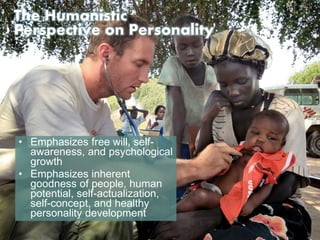
The Humanistic 
Perspective on Personality 
• Emphasizes free will, self-awareness, 
and psychological 
growth 
• Emphasizes inherent 
goodness of people, human 
potential, self-actualization, 
self-concept, and healthy 
personality development
The Emergence of 
the “Third Force” 
• Another group of 
psychologists opposed to 
both psychoanalysis and 
behaviorism championed a 
“third force” in psychology 
• Saw people as being 
innately good 
• Focused on the healthy 
personality 
• Doubted that laboratory 
research with rats and 
pigeons accurately reflected 
human nature 
• Most important factor in 
personality is the individual’s 
conscious, subjective 
perception of self 
• Major figures – Carl Rogers, 
Abraham Maslow
Carl Rogers—The Self-Concept 
• Most basic human motive is actualizing tendency — the innate 
drive to maintain and enhance the human organism 
• Other drives are secondary 
• Self-concept — set of perceptions and beliefs you hold about 
yourself 
• People are motivated in accordance with self-concept 
• Self-concept begins early in life 
• Positive regard = sense of being loved and valued by others 
• Children’s increasing self-awareness produces need for positive 
regard 
• Regard can be conditional and unconditional 
• Unconditional positive regard: child’s sense of being 
unconditionally loved and valued, even if he or she doesn’t 
conform to standards and expectations of others 
• Conditional positive regard: child’s sense of being valued and 
loved only if he or she behaves in a way that is acceptable to 
others 
• Feelings become denied or distorted not because they are 
threatening but because they contradict the self-concept. In this 
case, people are in a state of incongruence. 
• Fully functioning person has a flexible, constantly evolving self-concept 
and experiences congruence
Evaluating the Humanistic 
Perspective on Personality 
• Difficult to test or validate scientifically 
• Based on philosophical assumptions or clinical 
observations rather than on empirical research 
• Tends to be too optimistic, minimizing some of the 
more destructive aspects of human nature 
• Influence of humanistic psychology has waned 
• Made contributions to psychotherapy, counseling, 
education, and parenting 
• Subjective experience and the self-concept has 
become widely accepted
The Social Cognitive 
Perspective on Personality 
• Stresses conscious thought processes, self-regulation, 
and the importance of situational influences 
• Social cognitive personality theorists rely on 
experimental findings 
• Social cognitive perspective emphasizes conscious, self-regulated 
behavior rather than unconscious mental 
influences and instinctual drives 
• Social cognitive approach emphasizes that our sense of 
self can vary, depending on our thoughts, feelings, and 
behaviors in a given situation
Albert Bandura and Social 
Cognitive Theory 
• Human behavior and 
personality are caused by 
the interaction of 
behavioral, cognitive, and 
environmental factors 
• Process called reciprocal 
determinism 
• Person’s cognitive skills, 
abilities, and attitudes 
represent the person’s self-system 
• Most critical elements 
influencing the self-system 
are our beliefs of self-efficacy 
• Self-efficacy — the belief 
that people have about 
their ability to meet the 
demands of a specific 
situation
Evaluating the Social Cognitive 
Perspective on Personality 
• Well-grounded in empirical, laboratory research 
• Major impact on the study of personality 
• However, laboratory experiences are rather simple and 
may not reflect the complexity of human interactions in 
real world 
• Downplays the influences of the unconscious, emotions, 
and conflicts 
• Emphasizes the self-regulation of behavior 
• Places most of the responsibility for behavior on the 
person
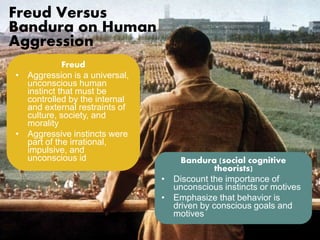
Freud Versus 
Bandura on Human 
Aggression 
Freud 
• Aggression is a universal, 
unconscious human 
instinct that must be 
controlled by the internal 
and external restraints of 
culture, society, and 
morality 
• Aggressive instincts were 
part of the irrational, 
impulsive, and 
unconscious id Bandura (social cognitive 
theorists) 
• Discount the importance of 
unconscious instincts or motives 
• Emphasize that behavior is 
driven by conscious goals and 
motives
The Trait Perspective on Personality 
• Focuses on 
identifying, 
describing, and 
measuring individual 
differences 
• Trait theorists view 
the person as being 
a unique combination 
of personality 
characteristics or 
attributes, called 
traits 
• Trait: formally 
defined as a 
relatively stable, 
enduring 
predisposition to 
behave in a certain 
way
Surface Traits and Source Traits 
Source Trait 
Click here 
Surface Trait 
Click here 
• Characteristic that can 
be inferred from 
observable behavior 
Examples: “happy,” 
exuberant,” “spacey,” 
and “gloomy” 
• 4,000 English words 
describe specific 
personality traits 
Most fundamental 
dimensions of personality; 
broad, basic traits that are 
hypothesized to be 
universal and relatively 
few in number
Two Representative 
Trait Theories – 
Cattell and Eysenck 
Raymond Cattell 
• Proposed 16 personality 
factors 
• Used a statistical 
technique called factor 
analysis to identify them 
• Developed the Sixteen 
Personality Factor 
Questionnaire 
(abbreviated 16PF) 
• Sixteen is generally 
considered by others as 
too many traits
Two Representative 
Trait Theories – 
Cattell and Eysenck 
Hans Eysenck 
• Had three different source 
traits 
• Introversion-extraversion 
• Neuroticism-stability 
• Psychoticism 
• Believed that individual 
differences in personality 
are due to biological 
differences among people 
• Three is generally 
considered by others as 
too few traits
The Five-Factor Model 
• The consensus among many trait 
researchers is that essential building 
blocks of personality can be 
described in terms of five basic 
personality dimensions, which are 
sometimes called “the Big Five.” 
• Factors — usually rated from low to 
high 
• Has been tested in more than 50 
cultures 
• Probably biologically based as 
evolution found these factors adaptive 
• Traits seem stable over lifespan 
• Seem consistent over different 
situations and related to specific brain 
activities and structures
Personality Traits and Behavioral 
Genetics 
• Interdisciplinary field that studies the effects of genes 
and heredity on behavior 
• Basic research strategy is to compare the degree of 
difference among subjects with their degree of genetic 
relatedness 
• Evidence for genetic influence is particularly strong for 
extraversion and neuroticism, two of the Big Five 
personality traits 
• Twin studies have found that openness to experience, 
conscientiousness, and agreeableness are influenced 
by genetics to a lesser extent 
• As twins grow up and leave home, personalities can 
diverge somewhat, showing the influence of 
environment and experience
The Neuroscience of Personality 
Brain Structure and the Big Five 
Brain imaging 
(MRIs) has found: 
• People who were 
high in 
extraversion 
(Factor 2) 
showed higher 
levels of brain 
activation in 
response to 
positive images. 
• People who 
score high in 
neuroticism 
(Factor 1) show 
more activation 
in response to 
negative images.
The Neuroscience of Personality 
Brain Structure and the Big Five 
Extraversion 
Click here 
• medial orbitofrontal cortex 
sensitivity to rewarding stimuli 
Agreeableness 
Click here 
• posterior cingulate cortex 
understanding beliefs of others 
• fusiform gyrus 
perceiving faces 
Conscientiousness 
Click here 
• middle frontal gyrus 
planning, working memory, 
and self-regulation 
Neuroticism 
Click here 
• mixed pattern of brain structure 
Openness to 
experience 
Click here 
• no significant pattern of brain differences 
Associations 
with brain 
structures
Evaluating the Trait Perspective on 
Personality 
• Don’t really explain personality, simply describe general 
predispositions 
• Doesn’t describe the development of the behaviors; 
simply saying they are due to environment and heredity 
is not that useful 
• Trait approaches generally fail to address how issues 
such as motives, unconscious mental processes, or 
beliefs about self affect personality development 
• Doesn’t discuss grand conclusions about the essence of 
human nature that characterize the psychoanalytic and 
humanistic theories
Assessing Personality 
Tests to 
measure 
and 
evaluate 
personality 
fall into two 
categories 
Projective tests 
type of personality 
test that involves a 
person’s 
interpreting an 
ambiguous image 
Self-report 
inventories 
type of 
psychological test 
in which a person’s 
responses to 
standardized 
questions are 
compared with 
established norms
Projective Tests 
Projective tests developed out of 
psychoanalytic approaches 
• Interpretation of an ambiguous image 
• Used to determine unconscious motives, 
conflicts, and psychological traits 
• Related to projection (defense 
mechanism) 
• First projective test was the famous 
Rorschach Inkblot Test 
• Presentation and interpretation of a 
series of black-and-white and colored 
inkblots 
• Numerous scoring systems exist 
based on such criteria as whether 
person reports seeing animate or 
inanimate objects, human or animal 
figures, and movement, and whether 
person deals with whole blot or 
fragments 
• More structured projective test is 
Thematic Apperception Test 
• Involves creating stories about each 
of a series of ambiguous scenes
Strengths and Limitations of Projective 
Tests 
Clinicians say the strength of projective tests is that they 
provide qualitative information about individual’s 
psychological functioning. 
Critiques 
• Testing situation or examiner’s behavior can 
influence a person’s responses 
• Scoring of projective tests is highly subjective 
• Projective tests often fail to produce consistent 
results 
• Many studies question their validity and their 
reliability
Self-Report Inventories 
• Psychological test in which an individual 
answers standardized questions about 
their behavior and feelings 
• Answers are then compared with 
established norms 
• Often called objective personality tests 
• Most widely used self-report inventory is 
the Minnesota Multiphasic Personality 
Inventory (MMPI) 
• Current version is MMPI -2 
• Originally designed to assess mental 
health and detect psychological 
symptoms 
• Includes more than 500 questions to 
which person must reply “True” or 
“False” 
• Topics include social, political, 
religious, and sexual attitudes; 
physical and psychological health; 
interpersonal relationships; and 
abnormal thoughts and behaviors 
• Includes “lying scales”
Other Self-Report Inventories 
Sixteen Personality Factor Questionnaire (16PF) 
• Based on Cattell’s trait theory 
Myers-Briggs Type Indicator (MBTI) 
• Designed to assess personality types rather than 
measure personality traits 
• Has reliability and validity problems
Strengths and Limitations of 
Self-Report Inventories 
Strengths 
• Standardized — each 
person receives the 
same instructions and 
responds to the same 
questions 
• Use of established 
norms: results are 
compared with 
previously established 
norms and are not 
subjectively evaluated 
• Reliability and validity of 
self-report inventories 
are far greater than 
those of projective tests 
Limitations 
• Evidence that people 
can “fake” responses 
to look better (or 
worse) 
• Tests contain 
hundreds of items 
and become tedious 
• People may not be 
good judges of their 
own behavior 
• No personality test, 
by itself, is likely to 
provide a definitive 
description of any 
given individual

Chapter11

  • 1.
    Lecture Slides ChapterEleven Personality By Glenn Meyer Trinity University
  • 2.
    Introduction: What Is Personality? Personality is an individual’s unique and relatively consistent pattern of thinking, feeling, and behaving. Personality theory attempts to describe and explain how people are similar, how they are different, and why every individual is unique. Psychoanalytic perspective emphasizes the importance of unconscious processes and the influence of early childhood experience Humanistic perspective represents an optimistic look at human nature, emphasizing the self and fulfillment of a person’s unique potential Social cognitive perspective emphasizes learning and conscious cognitive processes, including the importance of beliefs about self, goal setting, and self- regulation Trait perspective emphasizes description and measurement of specific personality differences among individuals Four basic perspectives: Psychoanalytic Perspective Click Here Humanistic Perspective Click Here Social Cognitive Perspective Click Here Trait Perspective Click Here
  • 3.
    The Psychoanalytic Perspectiveon Personality The Life of Sigmund Freud • Born in 1856 in what is today Pribor, Czech Republic • Studied medicine, became a physician and outstanding physiological researcher • Among first investigators of a new drug that had anesthetic and mood-altering properties—cocaine • Prospects for an academic career in scientific research were very poor, especially for a Jew in Vienna, which was intensely anti-Semitic at that time • Freud gave up physiological research for private practice in neurology
  • 4.
    Influences in theDevelopment of Freud’s Ideas • One influence was Joseph Breuer: hypnosis; patients with psychological symptoms • Freud developed his own technique of free association • 1900, his most important work, The Interpretation of Dreams • 1904, the Psychopathology of Everyday Life described how unconscious thoughts, feelings, and wishes are often reflected in acts of forgetting, inadvertent slips of tongue, accidents, and errors • Fled the Nazis to England
  • 5.
    Freud’s Dynamic Theoryof Personality Psychoanalytic Approach • Psychoanalysis is both an approach to therapy and a theory of personality. • Emphasizes unconscious motivation – the main causes of behavior lie buried in the unconscious mind • Freud (1940) saw personality and behavior as the result of a constant interplay among conflicting psychological forces. • These psychological forces operate at three different levels of awareness: • Conscious • Preconscious • Unconscious • Unconscious material seeps through to the conscious level in distorted, disguised, or symbolic forms • Can be revealed by free association, dreams, slips of the tongue (Freudian slip), accidents, etc.
  • 8.
    Dream Analysis Clickhere Techniques to Reveal the Unconscious Free Association Click here A psychoanalytical technique in which the patient spontaneously reports all thoughts, feelings, and mental images as they come to mind Dreams contain • Manifest content (surface meaning) • Latent content (true, unconscious meaning)
  • 9.
    The Structure ofPersonality Id • Instinctual drives present at birth • Does not distinguish reality from fantasy • Operates according to pleasure principle • Motive to obtain pleasure and avoid tension or discomfort; this is the most fundamental human motive and guiding principle of id • Immune to logic • Energy comes from • Eros— self-preservation or life instinct • Libido—psychological and emotional energy associated with expressions of sexuality; sex drive • Thanatos—death instinct • Reflected in aggressive, destructive, and self-destructive actions • Person possesses a certain amount of psychological energy • Psychological energy develops into three basic structures of personality: id, ego, superego
  • 10.
    Ego • Latinfor I • The partly conscious rational component of personality • Develops out of the id in infancy • Understands reality and logic • Most in touch with the demands of the external world • Reality • Mediator between id and superego • Reality principle — the ability to postpone gratification in accordance with demands of external world • Can repress desires that cannot be met in an acceptable manner
  • 11.
    Superego • Atage 5 or 6, child develops an internal, parental voice that is partly conscious • Internalization of parental and society’s moral standards • Responsible for guilt; praises and admonishes
  • 12.
    The Ego DefenseMechanisms • If demands of the id or superego threaten to overwhelm the ego, anxiety results. • If a realistic solution or compromise is not possible, the ego may temporarily reduce anxiety by distorting thoughts or perceptions of reality through ego defense mechanisms. • By resorting to these largely unconscious self-deceptions, the ego can maintain an integrated sense of self while searching for a more acceptable and realistic solution to a conflict between the id and the superego. • Repression is the most fundamental ego defense mechanism. Others are used if repression fails. • The short-term use of defense mechanisms can be helpful; long-term use is problematic.
  • 14.
    Personality Development Fixation • At each psychosexual stage, the child is faced with a developmental conflict that must be successfully resolved • Child may be frustrated or overindulged in stage’s expression of pleasurable feelings • If frustrated, child will be left with feelings of unmet needs characteristic of that stage • If overindulged, child may be reluctant to move on to the next • In either case, result of an unresolved developmental conflict is fixation Freud’s Psychosexual Stages People progress through five psychosexual stages of development. The foundations of adult personality are established during the first five years of life, as the child progresses through the oral, anal, and phallic psychosexual stages.
  • 16.
    The Oedipus Complex Child’s unconscious sexual desire for the opposite-sex parent, usually accompanied by hostile feelings toward the same-sex parent Boys: • Confrontation with father for the affections of mother • Boy feels hostility and jealousy toward his father • Realizes that father is more physically powerful • Boy experiences castration anxiety, or fear that father will castrate him • To resolve, boy uses identification — imitates and internalizes father’s values, attitudes, mannerisms Girls: • Little girl discovers that little boys have a penis and that she does not • Feels a sense of deprivation and loss — penis envy • Attempts to take her mother’s place with her father, she also identifies with her mother • One of the most critiqued of Freud’s ideas Identification: Ego defense mechanism that reduces anxiety by imitating behavior and characteristics of another person • He later admitted “the sexual life of adult women is a ‘dark continent’ for psychology.”
  • 17.
    The Latency andGenital Stages Genital Stage (puberty and older) Click here Latency (5 years – puberty) Click here • Because the Oedipus complex causes anxiety, sexual urges of boys and girls become repressed • Children desire to associate with same-sex peers, a preference that strengthens the child’s sexual identity • Final resolution of the Oedipus complex in adolescence • Incestuous urges start to resurface; they are prohibited by superego and societal restriction • Person directs sexual urges toward socially acceptable substitutes, who often resemble the person’s opposite-sex parent Song lyrics from 1911: I want a girl just like the girl that married dear old dad.
  • 18.
    The Neo-Freudians •Carl Jung’s collective unconscious • Karen Horney’s focus on security • Alfred Adler’s individual psychology • Neo-Freudians followed Freud in stressing the importance of the unconscious and early childhood, but they developed their own personality theories • Disagreed with Freud on three key points • Disagreed that behavior was primarily motivated by sexual urges • Disagreed that personality is fundamentally determined by early childhood experiences • Disagreed with Freud’s generally pessimistic view of human nature and society
  • 19.
    Carl Jung —Archetypes and the Collective Unconscious • People motivated by more general psychic energy to achieve growth • Believed in collective unconscious • Based on human collective evolutionary history (archetypes) • “The whole spiritual heritage of mankind’s evolution, born anew in the brain structure of every individual.” • Mental images of universal human instincts, themes, and preoccupations • Common archetypal themes that are expressed in virtually every culture are hero, powerful father, nurturing mother, witch, wise old man, innocent child, and death and rebirth. • Two important archetypes that Jung (1951) described are anima and animus— representations of feminine and masculine qualities • First to describe introverts and extraverts Carl Jung Ceremonial buffalo robe of the Plains Indians Archetypes in popular culture
  • 20.
    Karen Horney —Basic Anxiety and “Womb Envy” • Stressed importance of cultural and social factors in personality development • Looked at anxiety related to security and social relationships • Basic anxiety — the feeling of being isolated and helpless in a hostile world • Described three patterns of behavior that the individual uses to defend against basic anxiety: moving toward, against, or away from other people • Disagreed with Freud’s interpretation of female development, and notion that women suffer from penis envy • What women envy in men, is not their penis, but their superior status in society • Contended that men often suffer womb envy, envying women’s capacity to bear children • Men compensate for minor role in reproduction by striving to make creative achievements in their work • Believed that the drive to grow psychologically and achieve one’s potential is basic human motive
  • 21.
    Alfred Adler —Feelings of Inferiority • Most fundamental human motive is striving for superiority • Arises from universal feelings of inferiority that are experienced during childhood • These feelings motivate people to compensate for real or imagined weaknesses by emphasizing talents and abilities and by working hard to improve themselves • Overcompensation may cause superiority complex, in which a person exaggerates their own achievements and importance • When people are unable to compensate for specific weaknesses or when feelings of inferiority are excessive, can develop an inferiority complex—a general sense of inadequacy, weakness, and helplessness • Adler believed that humans were motivated to grow and achieve their personal goals • Emphasized importance of cultural influences and social relationships
  • 22.
    Evaluating Freud andthe Psychoanalytic Perspective on Personality • Inadequacy of evidence • Small and skewed samples • Problems with testability • Psychoanalytic concepts are vague and ambiguous • Impossible to disprove because even seemingly contradictory information can be used to support Freud’s theory • Better at explaining past behavior than at predicting future behavior Ideas that have been substantiated by empirical research • Much of mental life is unconscious • Early childhood experiences have a critical influence on interpersonal relationships and psychological adjustment • People differ significantly in ability to regulate impulses, emotions, and thoughts toward adaptive and socially acceptable ends
  • 23.
    Sexism and Freud • Because penis envy produces feelings of shame and inferiority, Freud claimed, women are more vain, masochistic, and jealous than men • Women are more influenced by emotions and have a lesser ethical and moral sense than men • Used male psychology as a prototype • Women are essentially viewed as a deviation from the norm of masculinity
  • 24.
    The Humanistic Perspectiveon Personality • Emphasizes free will, self-awareness, and psychological growth • Emphasizes inherent goodness of people, human potential, self-actualization, self-concept, and healthy personality development
  • 25.
    The Emergence of the “Third Force” • Another group of psychologists opposed to both psychoanalysis and behaviorism championed a “third force” in psychology • Saw people as being innately good • Focused on the healthy personality • Doubted that laboratory research with rats and pigeons accurately reflected human nature • Most important factor in personality is the individual’s conscious, subjective perception of self • Major figures – Carl Rogers, Abraham Maslow
  • 26.
    Carl Rogers—The Self-Concept • Most basic human motive is actualizing tendency — the innate drive to maintain and enhance the human organism • Other drives are secondary • Self-concept — set of perceptions and beliefs you hold about yourself • People are motivated in accordance with self-concept • Self-concept begins early in life • Positive regard = sense of being loved and valued by others • Children’s increasing self-awareness produces need for positive regard • Regard can be conditional and unconditional • Unconditional positive regard: child’s sense of being unconditionally loved and valued, even if he or she doesn’t conform to standards and expectations of others • Conditional positive regard: child’s sense of being valued and loved only if he or she behaves in a way that is acceptable to others • Feelings become denied or distorted not because they are threatening but because they contradict the self-concept. In this case, people are in a state of incongruence. • Fully functioning person has a flexible, constantly evolving self-concept and experiences congruence
  • 27.
    Evaluating the Humanistic Perspective on Personality • Difficult to test or validate scientifically • Based on philosophical assumptions or clinical observations rather than on empirical research • Tends to be too optimistic, minimizing some of the more destructive aspects of human nature • Influence of humanistic psychology has waned • Made contributions to psychotherapy, counseling, education, and parenting • Subjective experience and the self-concept has become widely accepted
  • 28.
    The Social Cognitive Perspective on Personality • Stresses conscious thought processes, self-regulation, and the importance of situational influences • Social cognitive personality theorists rely on experimental findings • Social cognitive perspective emphasizes conscious, self-regulated behavior rather than unconscious mental influences and instinctual drives • Social cognitive approach emphasizes that our sense of self can vary, depending on our thoughts, feelings, and behaviors in a given situation
  • 29.
    Albert Bandura andSocial Cognitive Theory • Human behavior and personality are caused by the interaction of behavioral, cognitive, and environmental factors • Process called reciprocal determinism • Person’s cognitive skills, abilities, and attitudes represent the person’s self-system • Most critical elements influencing the self-system are our beliefs of self-efficacy • Self-efficacy — the belief that people have about their ability to meet the demands of a specific situation
  • 30.
    Evaluating the SocialCognitive Perspective on Personality • Well-grounded in empirical, laboratory research • Major impact on the study of personality • However, laboratory experiences are rather simple and may not reflect the complexity of human interactions in real world • Downplays the influences of the unconscious, emotions, and conflicts • Emphasizes the self-regulation of behavior • Places most of the responsibility for behavior on the person
  • 31.
    Freud Versus Banduraon Human Aggression Freud • Aggression is a universal, unconscious human instinct that must be controlled by the internal and external restraints of culture, society, and morality • Aggressive instincts were part of the irrational, impulsive, and unconscious id Bandura (social cognitive theorists) • Discount the importance of unconscious instincts or motives • Emphasize that behavior is driven by conscious goals and motives
  • 32.
    The Trait Perspectiveon Personality • Focuses on identifying, describing, and measuring individual differences • Trait theorists view the person as being a unique combination of personality characteristics or attributes, called traits • Trait: formally defined as a relatively stable, enduring predisposition to behave in a certain way
  • 34.
    Surface Traits andSource Traits Source Trait Click here Surface Trait Click here • Characteristic that can be inferred from observable behavior Examples: “happy,” exuberant,” “spacey,” and “gloomy” • 4,000 English words describe specific personality traits Most fundamental dimensions of personality; broad, basic traits that are hypothesized to be universal and relatively few in number
  • 35.
    Two Representative TraitTheories – Cattell and Eysenck Raymond Cattell • Proposed 16 personality factors • Used a statistical technique called factor analysis to identify them • Developed the Sixteen Personality Factor Questionnaire (abbreviated 16PF) • Sixteen is generally considered by others as too many traits
  • 36.
    Two Representative TraitTheories – Cattell and Eysenck Hans Eysenck • Had three different source traits • Introversion-extraversion • Neuroticism-stability • Psychoticism • Believed that individual differences in personality are due to biological differences among people • Three is generally considered by others as too few traits
  • 37.
    The Five-Factor Model • The consensus among many trait researchers is that essential building blocks of personality can be described in terms of five basic personality dimensions, which are sometimes called “the Big Five.” • Factors — usually rated from low to high • Has been tested in more than 50 cultures • Probably biologically based as evolution found these factors adaptive • Traits seem stable over lifespan • Seem consistent over different situations and related to specific brain activities and structures
  • 38.
    Personality Traits andBehavioral Genetics • Interdisciplinary field that studies the effects of genes and heredity on behavior • Basic research strategy is to compare the degree of difference among subjects with their degree of genetic relatedness • Evidence for genetic influence is particularly strong for extraversion and neuroticism, two of the Big Five personality traits • Twin studies have found that openness to experience, conscientiousness, and agreeableness are influenced by genetics to a lesser extent • As twins grow up and leave home, personalities can diverge somewhat, showing the influence of environment and experience
  • 39.
    The Neuroscience ofPersonality Brain Structure and the Big Five Brain imaging (MRIs) has found: • People who were high in extraversion (Factor 2) showed higher levels of brain activation in response to positive images. • People who score high in neuroticism (Factor 1) show more activation in response to negative images.
  • 40.
    The Neuroscience ofPersonality Brain Structure and the Big Five Extraversion Click here • medial orbitofrontal cortex sensitivity to rewarding stimuli Agreeableness Click here • posterior cingulate cortex understanding beliefs of others • fusiform gyrus perceiving faces Conscientiousness Click here • middle frontal gyrus planning, working memory, and self-regulation Neuroticism Click here • mixed pattern of brain structure Openness to experience Click here • no significant pattern of brain differences Associations with brain structures
  • 41.
    Evaluating the TraitPerspective on Personality • Don’t really explain personality, simply describe general predispositions • Doesn’t describe the development of the behaviors; simply saying they are due to environment and heredity is not that useful • Trait approaches generally fail to address how issues such as motives, unconscious mental processes, or beliefs about self affect personality development • Doesn’t discuss grand conclusions about the essence of human nature that characterize the psychoanalytic and humanistic theories
  • 42.
    Assessing Personality Teststo measure and evaluate personality fall into two categories Projective tests type of personality test that involves a person’s interpreting an ambiguous image Self-report inventories type of psychological test in which a person’s responses to standardized questions are compared with established norms
  • 43.
    Projective Tests Projectivetests developed out of psychoanalytic approaches • Interpretation of an ambiguous image • Used to determine unconscious motives, conflicts, and psychological traits • Related to projection (defense mechanism) • First projective test was the famous Rorschach Inkblot Test • Presentation and interpretation of a series of black-and-white and colored inkblots • Numerous scoring systems exist based on such criteria as whether person reports seeing animate or inanimate objects, human or animal figures, and movement, and whether person deals with whole blot or fragments • More structured projective test is Thematic Apperception Test • Involves creating stories about each of a series of ambiguous scenes
  • 44.
    Strengths and Limitationsof Projective Tests Clinicians say the strength of projective tests is that they provide qualitative information about individual’s psychological functioning. Critiques • Testing situation or examiner’s behavior can influence a person’s responses • Scoring of projective tests is highly subjective • Projective tests often fail to produce consistent results • Many studies question their validity and their reliability
  • 45.
    Self-Report Inventories •Psychological test in which an individual answers standardized questions about their behavior and feelings • Answers are then compared with established norms • Often called objective personality tests • Most widely used self-report inventory is the Minnesota Multiphasic Personality Inventory (MMPI) • Current version is MMPI -2 • Originally designed to assess mental health and detect psychological symptoms • Includes more than 500 questions to which person must reply “True” or “False” • Topics include social, political, religious, and sexual attitudes; physical and psychological health; interpersonal relationships; and abnormal thoughts and behaviors • Includes “lying scales”
  • 46.
    Other Self-Report Inventories Sixteen Personality Factor Questionnaire (16PF) • Based on Cattell’s trait theory Myers-Briggs Type Indicator (MBTI) • Designed to assess personality types rather than measure personality traits • Has reliability and validity problems
  • 47.
    Strengths and Limitationsof Self-Report Inventories Strengths • Standardized — each person receives the same instructions and responds to the same questions • Use of established norms: results are compared with previously established norms and are not subjectively evaluated • Reliability and validity of self-report inventories are far greater than those of projective tests Limitations • Evidence that people can “fake” responses to look better (or worse) • Tests contain hundreds of items and become tedious • People may not be good judges of their own behavior • No personality test, by itself, is likely to provide a definitive description of any given individual

Editor's Notes

  • #3 Click as directed to reveal information about each of the four perspectives
  • #4 Click to reveal bullets.
  • #5 Click to reveal bullets.
  • #6 Click to reveal bullets. Graphic is on the next slide.
  • #8 Video starts automatically.
  • #9 Click to reveal information in each box.
  • #10 Click to reveal bullets.
  • #11 Click to reveal bullets.
  • #12 Click to reveal bullets.
  • #13 Click to reveal bullets. Example is on the next slide.
  • #15 Click to reveal bullets. Example is on the next slide.
  • #17 Click to reveal bullets.
  • #18 Click to reveal information in each box.
  • #19 Click to reveal bullets.
  • #20 Click to reveal bullets and caption photos.
  • #21 Click to reveal bullets.
  • #22 Click to reveal bullets.
  • #23 Click for bullets.
  • #24 Click for bullets.
  • #25 Click for bullets.
  • #26 Click for bullets.
  • #27 Click to reveal bullets and example.
  • #28 Click to reveal bullets.
  • #29 Click to reveal bullets.
  • #30 Click to reveal bullets.
  • #31 Click to reveal bullets.
  • #32 Click to reveal box about Freud and box about Bandura.
  • #33 Click to reveal bullets.
  • #35 Click to reveal information in each box.
  • #36 Click to reveal bullets and example.
  • #37 Click to reveal bullets and example.
  • #38 Click to reveal bullets.
  • #39 Click to reveal bullets.
  • #40 Click to reveal bullets.
  • #41 Click as directed to reveal more information.
  • #42 Click to reveal bullets and example.
  • #43 No animation.
  • #44 Click to reveal bullets.
  • #45 Click to reveal critiques.
  • #46 Click to reveal bullets and example.
  • #47 Click to reveal bullets and example.
  • #48 Click to reveal strengths and limitations.