Intro
Chapter 11:
Personality
Personality
An individual’s unique and
relatively consistent pattern of
thinking, feeling, and behaving.
Personality theory attempts to
describe and explain how people
are similar, how they are different,
and why every individual is unique.
Personality Theory
Personality Perspectives
• Psychoanalytic — importance of
unconscious processes and childhood
experiences
• Humanistic — importance of self and
fulfillment of potential
• Social cognitive — importance of beliefs
about self
• Trait — description and measurement of
personality differences
Psychoanalytic Approach
• Developed by Sigmund Freud
• Psychoanalysis is both an approach to
therapy and a theory of personality
» Emphasizes unconscious motivation – the
main causes of behavior lie buried in the
unconscious mind
» Personality and Behavior resulting from a
constant interplay between conflicting
psychological forces that operate at 3
different levels of awareness.
Psychoanalytic Approach
• Conscious –
all things we
are aware of
at any given
moment
• Thoughts,
feelings and
sensations.
Psychoanalytic Approach
• Preconscious –
everything that
can, with a little
effort, be brought
into
consciousness
• (childhood
memories, SSN)
Psychoanalytic Approach
• Unconscious –
inaccessible
warehouse of
anxiety-producing
thoughts and
drives
• Submerged
thoughts, feelings,
wishes and
drives-enormous
influence on
conscious.
Psychoanalytic Divisions of the Mind-
3 basic structures of personality
• Id — instinctual drives present at birth
– does not distinguish between reality and fantasy-primitive,
immediate satisfaction
– operates according to the pleasure principle-immune to logic,
values, danger, morality & demands of external world
• Ego — develops out of the id in infancy
– understands reality and logic-organized, rational planning
– mediator between id and superego-operates on reality principle
• Superego
– internalization of society’s moral standards
– responsible for guilt-internal rules & values, internal parental
voice
Id: The Pleasure Principle
• Pleasure principle — drive toward
immediate gratification, most
fundamental human motive
• Sources of energy
– Eros — life instinct, perpetuates life
– Thanatos — death instinct, aggression,
self-destructive actions
• Libido — sexual energy or motivation
Ego: The Reality Principle
• Reality principle — the ability to
postpone gratification in accordance
with demands of reality
• Ego — rational, organized, logical,
mediator to demands of reality
• Can repress desires that cannot be
met in an acceptable manner
Superego: Conscience
• Internalization of societal and
parental values
• Partially unconscious
• Can be harshly punitive, using
feelings of guilt
Defense Mechanisms
Unconscious mental processes
employed by the ego to reduce
anxiety
When demands of id or superego threaten
to overwhelm the ego anxiety results-ego
tries to reduce anxiety by distorting thoughts
or perceptions of reality with defense
mechanisms.
Defense Mechanisms
• Repression — keeping anxiety-
producing thoughts out of the
conscious mind
• Reaction formation — replacing
an unacceptable wish with its
opposite
Defense Mechanisms
• Displacement — when a drive directed to
one activity by the id is redirected to a
more acceptable activity by the ego-
unconscious forgetting
• Sublimation — displacement to activities
that are valued by society-sexual urges
put to productive, socially acceptable,
non-sexual activities.
Defense Mechanisms
• Projection — reducing anxiety by
attributing unacceptable impulses to
someone else
• Rationalization — reasoning away
anxiety-producing thoughts
• Regression — retreating to a mode of
behavior characteristic of an earlier
stage of development
Psychosexual Stages
• Freud’s five stages of personality
development, each associated with
a particular erogenous zone
• Fixation — an attempt to achieve
pleasure as an adult in ways that
are equivalent to how pleasure was
achieved in these stages
Oral Stage (birth – 1 year)
• Mouth is associated with sexual
pleasure-sucking, chewing, biting
• Weaning a child can lead to
fixation if not handled correctly
• Fixation can lead to oral activities
in adulthood
Anal Stage (1 – 3 years)
• Anus is associated with pleasure
• Toilet training can lead to fixation if
not handled correctly
• Fixation can lead to anal retentive
or expulsive behaviors in
adulthood
Phallic Stage (3 – 5 years)
• Focus of pleasure shifts to the genitals
• Oedipus or Electra complex can occur
• Fixation can lead to excessive
masculinity in males and the need for
attention or domination in females
• Oedipus Complex
• A child’s unconscious sexual desire
for the opposite-sex parent, usually
accompanied by hostile feelings
towards same-sex parent.
• Freud believed most critical occurs
during phallic stage
Latency Stage (5 years – puberty)
• Sexuality is repressed
• Children participate in hobbies,
school, and same-sex friendships
Genital Stage (puberty and older)
• Sexual feelings re-emerge and
are oriented toward others
• Healthy adults find pleasure in
love and work, fixated adults
have their energy tied up in
earlier stages
Post-Freudian
Psychodynamic Theories
• Carl Jung’s collective unconscious
• Karen Horney’s focus on security
• Alfred Adler’s individual psychology
Carl Jung
• More general psychic energy
• Universality of themes —
archetypes
• Collective unconscious — human
collective evolutionary history
(archetypes)
• First to describe introverts and
extraverts
• Personality continues to develop
in significant ways throughout
lifespan.
Karen Horney
• Looked at anxiety related
to security and social
relationships
• Basic anxiety — the feeling
of being isolated and
helpless in a hostile world
• Moving toward, against, or
away from other people
Alfred Adler
• Most fundamental human
motive is striving for
superiority
• Arises from universal feelings
of inferiority that are
experienced during childhood
• Overcompensation may cause
superiority complex, in which a
person exaggerates their own
achievements and importance
Evaluation of Psychoanalysis
• Evidence is inadequate — data are
not available or able to be reviewed
• Theory is not testable — lack of
operational definitions; good at
explaining past, but not at prediction
• Sexism — believed that women were
weak and inferior; used male
psychology as basis for all people
Humanistic Perspective
• Free will
• Self-awareness
• Psychological growth
• Abraham Maslow
• Carl Rogers
Carl Rogers
• Actualizing tendency — innate drive
to maintain and enhance the human
organism
• Self-concept — set of perceptions
you hold about yourself
• Positive regard — conditional and
unconditional
Evaluating Humanism
• Difficult to test or validate scientifically
• Tends to be too optimistic, minimizing
some of the more destructive aspects of
human nature
Social Cognitive Perspective
• Social cognitive theory — the importance of
observational learning, conscious cognitive
processes, social experience, self-efficacy
and reciprocal determinism in personality
• Reciprocal determinism — model that
explains personality as the result of
behavioral, cognitive, and environmental
interactions
• Self-efficacy — belief that people have about
their ability to meet the demands of a specific
situation
Reciprocal Determinism —
Albert Bandura
Evaluation of Social Cognitive
Perspective
• Well grounded in empirical, laboratory
research
• However, laboratory experiences are
rather simple and may not reflect the
complexity of human interactions
• Ignores the influences of the
unconscious, emotions, and conflicts
Trait and Type Theories
• Trait — relatively stable predisposition
to behave in a certain way
• Surface trait — characteristic that can
be inferred from observable behavior
• Source trait — most fundamental
dimensions of personality; relatively few
Theorists
• Raymond Cattell — 16PF
• Hans Eysenck — Three-factor model
• McCrae and Costa — Five-factor
model
Raymond Cattell
• Used factor analysis to come up with
16 basic personality traits, also called
source traits
• 16PF test that was developed to
measure these traits
• Generally considered too many traits
Hans Eysenck
• Similar method to Cattell
• Had 3 different source traits
– Introversion-extraversion
– Neuroticism-stability
– Psychoticism
• Generally considered too few traits
Five-Factor Model (Most widely
accepted model)
• Described somewhat differently among
researchers
• Factors — usually rated from low to
high
– Extraversion
– Neuroticism
– Openness to Experience
– Agreeableness
– Conscientiousness
Behavioral Genetics
• Interdisciplinary field that studies the
effects of genes and heredity on
behavior
• Heredity seems to play a role in four
of the ―big five‖ personality traits —
extraversion, neuroticism, openness
to experience, and conscientiousness
Evaluation of Trait Perspective
• Don’t really explain personality, simply
describe the behaviors
• Doesn’t describe the development of the
behaviors
• Trait approaches generally fail to address
how issues such as motives, unconscious,
or beliefs about self affect personality
development
Personality Assessment
Projective Techniques
• Interpretation of an ambiguous image
• Used to determine unconscious
motives, conflicts, and psychological
traits
Rorschach Inkblot Test
• Presentation and interpretation of a
series of black-and-white and colored
inkblots
• Numerous scoring systems exist
Thematic Apperception Test
• Series of pictures depicting ambiguous
scenes
• Person is asked to create a story about
the scene
• Answers are scored according to themes,
motives, and anxieties of main character
Drawbacks to Projective Tests
• Examiner or test situation may
influence individual’s response
• Scoring is highly subjective
• Tests fail to produce consistent
results (reliability problem)
• Tests are poor predictors of future
behavior (validity problem)
Self-Report Inventory
• Psychological test in which an individual
answers standardized questions about
their behavior and feelings
• The answers are then compared with
established norms
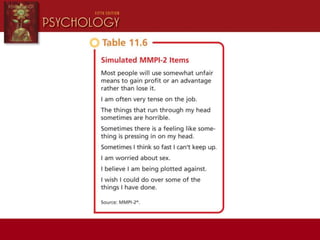
MMPI
• Most widely used self-report inventory
• Originally designed to assess mental
health and detect psychological symptoms
• Includes more than 500 questions to which
person must reply ―True‖ or ―False‖
• Includes ―lying scales‖
Strengths of Self-Reports
• Standardized — each person
receives same instructions and
responds to the same questions
• Use of established norms: results are
compared with previously established
norms and are not subjectively
evaluated
Weaknesses of Self-Reports
• Evidence that people can ―fake‖
responses to look better (or worse)
• Tests contain hundreds of items and
become tedious
• People may not be good judges of
their own behavior
Possible Selves
• The aspect of the self-concept that
includes images of the selves that
you hope, fear, or expect to become
in the future.

PSYC 1113 Chapter 11

  • 1.
  • 2.
    Personality An individual’s uniqueand relatively consistent pattern of thinking, feeling, and behaving.
  • 3.
    Personality theory attemptsto describe and explain how people are similar, how they are different, and why every individual is unique. Personality Theory
  • 4.
    Personality Perspectives • Psychoanalytic— importance of unconscious processes and childhood experiences • Humanistic — importance of self and fulfillment of potential • Social cognitive — importance of beliefs about self • Trait — description and measurement of personality differences
  • 5.
    Psychoanalytic Approach • Developedby Sigmund Freud • Psychoanalysis is both an approach to therapy and a theory of personality » Emphasizes unconscious motivation – the main causes of behavior lie buried in the unconscious mind » Personality and Behavior resulting from a constant interplay between conflicting psychological forces that operate at 3 different levels of awareness.
  • 6.
    Psychoanalytic Approach • Conscious– all things we are aware of at any given moment • Thoughts, feelings and sensations.
  • 7.
    Psychoanalytic Approach • Preconscious– everything that can, with a little effort, be brought into consciousness • (childhood memories, SSN)
  • 8.
    Psychoanalytic Approach • Unconscious– inaccessible warehouse of anxiety-producing thoughts and drives • Submerged thoughts, feelings, wishes and drives-enormous influence on conscious.
  • 9.
    Psychoanalytic Divisions ofthe Mind- 3 basic structures of personality • Id — instinctual drives present at birth – does not distinguish between reality and fantasy-primitive, immediate satisfaction – operates according to the pleasure principle-immune to logic, values, danger, morality & demands of external world • Ego — develops out of the id in infancy – understands reality and logic-organized, rational planning – mediator between id and superego-operates on reality principle • Superego – internalization of society’s moral standards – responsible for guilt-internal rules & values, internal parental voice
  • 10.
    Id: The PleasurePrinciple • Pleasure principle — drive toward immediate gratification, most fundamental human motive • Sources of energy – Eros — life instinct, perpetuates life – Thanatos — death instinct, aggression, self-destructive actions • Libido — sexual energy or motivation
  • 11.
    Ego: The RealityPrinciple • Reality principle — the ability to postpone gratification in accordance with demands of reality • Ego — rational, organized, logical, mediator to demands of reality • Can repress desires that cannot be met in an acceptable manner
  • 12.
    Superego: Conscience • Internalizationof societal and parental values • Partially unconscious • Can be harshly punitive, using feelings of guilt
  • 13.
    Defense Mechanisms Unconscious mentalprocesses employed by the ego to reduce anxiety When demands of id or superego threaten to overwhelm the ego anxiety results-ego tries to reduce anxiety by distorting thoughts or perceptions of reality with defense mechanisms.
  • 15.
    Defense Mechanisms • Repression— keeping anxiety- producing thoughts out of the conscious mind • Reaction formation — replacing an unacceptable wish with its opposite
  • 16.
    Defense Mechanisms • Displacement— when a drive directed to one activity by the id is redirected to a more acceptable activity by the ego- unconscious forgetting • Sublimation — displacement to activities that are valued by society-sexual urges put to productive, socially acceptable, non-sexual activities.
  • 17.
    Defense Mechanisms • Projection— reducing anxiety by attributing unacceptable impulses to someone else • Rationalization — reasoning away anxiety-producing thoughts • Regression — retreating to a mode of behavior characteristic of an earlier stage of development
  • 18.
    Psychosexual Stages • Freud’sfive stages of personality development, each associated with a particular erogenous zone • Fixation — an attempt to achieve pleasure as an adult in ways that are equivalent to how pleasure was achieved in these stages
  • 19.
    Oral Stage (birth– 1 year) • Mouth is associated with sexual pleasure-sucking, chewing, biting • Weaning a child can lead to fixation if not handled correctly • Fixation can lead to oral activities in adulthood
  • 20.
    Anal Stage (1– 3 years) • Anus is associated with pleasure • Toilet training can lead to fixation if not handled correctly • Fixation can lead to anal retentive or expulsive behaviors in adulthood
  • 21.
    Phallic Stage (3– 5 years) • Focus of pleasure shifts to the genitals • Oedipus or Electra complex can occur • Fixation can lead to excessive masculinity in males and the need for attention or domination in females
  • 22.
    • Oedipus Complex •A child’s unconscious sexual desire for the opposite-sex parent, usually accompanied by hostile feelings towards same-sex parent. • Freud believed most critical occurs during phallic stage
  • 23.
    Latency Stage (5years – puberty) • Sexuality is repressed • Children participate in hobbies, school, and same-sex friendships
  • 24.
    Genital Stage (pubertyand older) • Sexual feelings re-emerge and are oriented toward others • Healthy adults find pleasure in love and work, fixated adults have their energy tied up in earlier stages
  • 25.
    Post-Freudian Psychodynamic Theories • CarlJung’s collective unconscious • Karen Horney’s focus on security • Alfred Adler’s individual psychology
  • 26.
    Carl Jung • Moregeneral psychic energy • Universality of themes — archetypes • Collective unconscious — human collective evolutionary history (archetypes) • First to describe introverts and extraverts • Personality continues to develop in significant ways throughout lifespan.
  • 27.
    Karen Horney • Lookedat anxiety related to security and social relationships • Basic anxiety — the feeling of being isolated and helpless in a hostile world • Moving toward, against, or away from other people
  • 28.
    Alfred Adler • Mostfundamental human motive is striving for superiority • Arises from universal feelings of inferiority that are experienced during childhood • Overcompensation may cause superiority complex, in which a person exaggerates their own achievements and importance
  • 29.
    Evaluation of Psychoanalysis •Evidence is inadequate — data are not available or able to be reviewed • Theory is not testable — lack of operational definitions; good at explaining past, but not at prediction • Sexism — believed that women were weak and inferior; used male psychology as basis for all people
  • 30.
    Humanistic Perspective • Freewill • Self-awareness • Psychological growth • Abraham Maslow • Carl Rogers
  • 31.
    Carl Rogers • Actualizingtendency — innate drive to maintain and enhance the human organism • Self-concept — set of perceptions you hold about yourself • Positive regard — conditional and unconditional
  • 32.
    Evaluating Humanism • Difficultto test or validate scientifically • Tends to be too optimistic, minimizing some of the more destructive aspects of human nature
  • 33.
    Social Cognitive Perspective •Social cognitive theory — the importance of observational learning, conscious cognitive processes, social experience, self-efficacy and reciprocal determinism in personality • Reciprocal determinism — model that explains personality as the result of behavioral, cognitive, and environmental interactions • Self-efficacy — belief that people have about their ability to meet the demands of a specific situation
  • 34.
  • 35.
    Evaluation of SocialCognitive Perspective • Well grounded in empirical, laboratory research • However, laboratory experiences are rather simple and may not reflect the complexity of human interactions • Ignores the influences of the unconscious, emotions, and conflicts
  • 36.
    Trait and TypeTheories • Trait — relatively stable predisposition to behave in a certain way • Surface trait — characteristic that can be inferred from observable behavior • Source trait — most fundamental dimensions of personality; relatively few
  • 37.
    Theorists • Raymond Cattell— 16PF • Hans Eysenck — Three-factor model • McCrae and Costa — Five-factor model
  • 38.
    Raymond Cattell • Usedfactor analysis to come up with 16 basic personality traits, also called source traits • 16PF test that was developed to measure these traits • Generally considered too many traits
  • 40.
    Hans Eysenck • Similarmethod to Cattell • Had 3 different source traits – Introversion-extraversion – Neuroticism-stability – Psychoticism • Generally considered too few traits
  • 41.
    Five-Factor Model (Mostwidely accepted model) • Described somewhat differently among researchers • Factors — usually rated from low to high – Extraversion – Neuroticism – Openness to Experience – Agreeableness – Conscientiousness
  • 43.
    Behavioral Genetics • Interdisciplinaryfield that studies the effects of genes and heredity on behavior • Heredity seems to play a role in four of the ―big five‖ personality traits — extraversion, neuroticism, openness to experience, and conscientiousness
  • 44.
    Evaluation of TraitPerspective • Don’t really explain personality, simply describe the behaviors • Doesn’t describe the development of the behaviors • Trait approaches generally fail to address how issues such as motives, unconscious, or beliefs about self affect personality development
  • 45.
    Personality Assessment Projective Techniques •Interpretation of an ambiguous image • Used to determine unconscious motives, conflicts, and psychological traits
  • 46.
    Rorschach Inkblot Test •Presentation and interpretation of a series of black-and-white and colored inkblots • Numerous scoring systems exist
  • 48.
    Thematic Apperception Test •Series of pictures depicting ambiguous scenes • Person is asked to create a story about the scene • Answers are scored according to themes, motives, and anxieties of main character
  • 50.
    Drawbacks to ProjectiveTests • Examiner or test situation may influence individual’s response • Scoring is highly subjective • Tests fail to produce consistent results (reliability problem) • Tests are poor predictors of future behavior (validity problem)
  • 51.
    Self-Report Inventory • Psychologicaltest in which an individual answers standardized questions about their behavior and feelings • The answers are then compared with established norms
  • 52.
    MMPI • Most widelyused self-report inventory • Originally designed to assess mental health and detect psychological symptoms • Includes more than 500 questions to which person must reply ―True‖ or ―False‖ • Includes ―lying scales‖
  • 54.
    Strengths of Self-Reports •Standardized — each person receives same instructions and responds to the same questions • Use of established norms: results are compared with previously established norms and are not subjectively evaluated
  • 55.
    Weaknesses of Self-Reports •Evidence that people can ―fake‖ responses to look better (or worse) • Tests contain hundreds of items and become tedious • People may not be good judges of their own behavior
  • 56.
    Possible Selves • Theaspect of the self-concept that includes images of the selves that you hope, fear, or expect to become in the future.