PSYCHOANALYTIC
THEORY
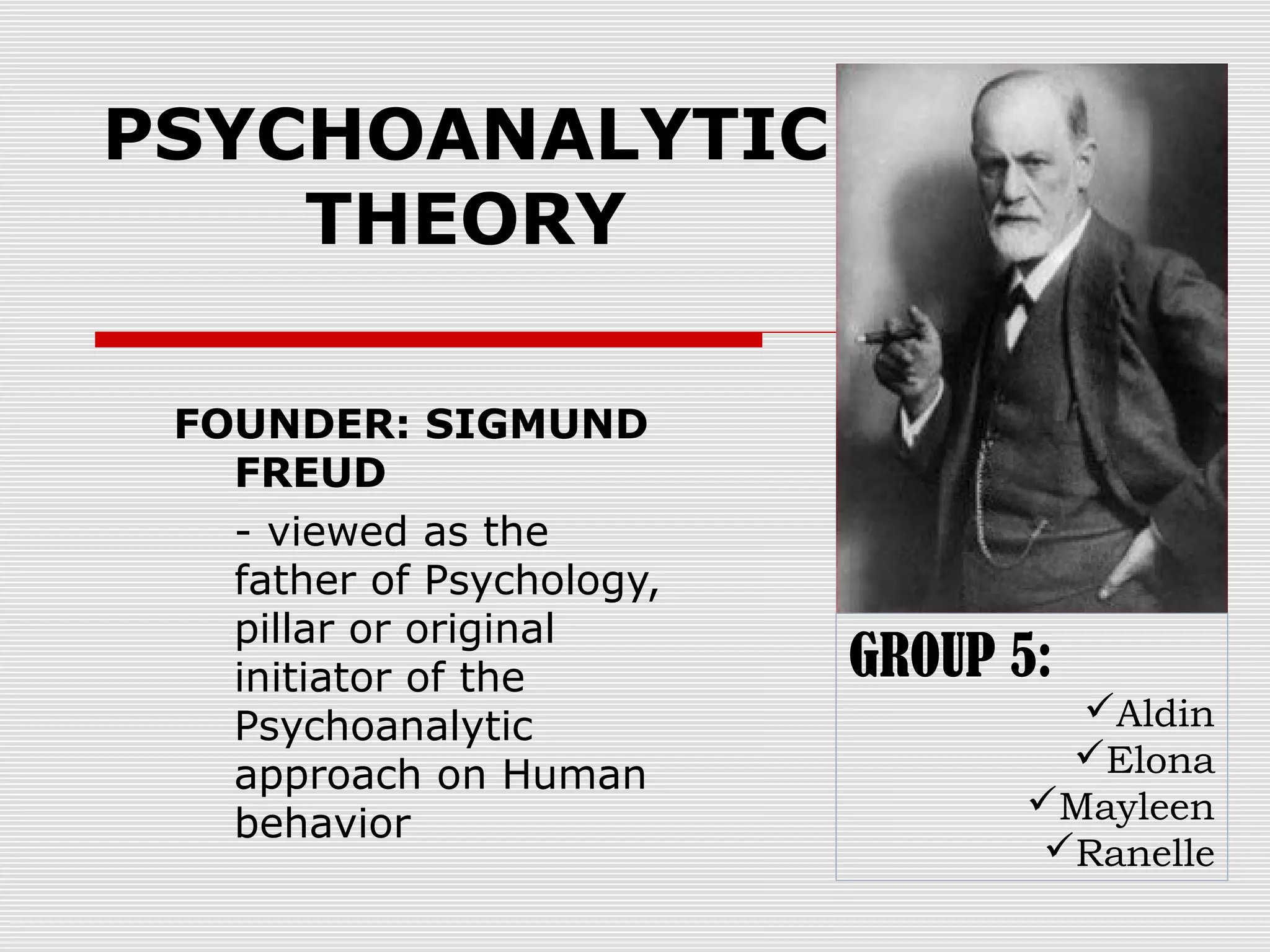
FOUNDER: SIGMUND
FREUD
- viewed as the
father of Psychology,
pillar or original
initiator of the
Psychoanalytic
approach on Human
behavior
GROUP 5:
Aldin
Elona
Mayleen
Ranelle
KEY CONCEPTS
I.HUMAN NATURE
II.INSTINCTS
III.THEORY OF PERSONALITY
a. Structural/Topographical –ID, Ego,
Superego
b. Functional or Dynamic – Consciousness
and The Unconscious
IV. ANXIETY
V. EGO DEFENSE MECHANISM
VI.PSYCHOSEXUAL DEVT.
KEY CONCEPTS
I. HUMAN NATURE
“DETERMINISTIC” – Simply put, Human
Nature, Happens because it happens, our
behavior is determined by Irrational forces,
unconscious motivations and biological &
instinctual drives that are stemmed from
repressed childhood memories or experiences
that hold a certain degree of impact to our
lives
PSYCHOANALYSIS
-emphasizes that behavior is motivated by the
subconscious thoughts and feelings
-Experiences of the first 6 yrs of life are determinants of
later development of personality
-this is dsicovering the unconscious mind and repressed
thoughts, feelings and conflicts that cause the anxiety
(Theory of Anxiety) and helping the person gain the
insight into and resolve the conflicts (Therapy)
II. INSTINCTS
LIFE INSTINCTS(EROS)
- Deals with basic survival, pleasure &
reproduction
DEATH INSTINCTS (THANATOS)
- Unconscious desire to die or to hurt
oneself or others
1.Structural or Topographical
ID- focus on wants and needs (Biological Component )
-not rational, present at birth, first portion of personality to
develop
- aims at achieving pleasure and avoiding pain ( Pleasure
principle )
EGO- opposite of Id
-focuses on justice or morality (Psychological Component)
- judgment portion of the personality
- Reality principle -purpose: to set EQUILIBRIUM
SUPEREGO – decides if things is good/bad- social conscience
(Social Component) ideals
*basis of Psychoanalytic explanation of mental illness
III. THEORY OF PERSONALITY
2. Functional or Dynamic - Mind has two main parts:
CONSCIOUS - awareness of our mental (small portion) ,
includes thoughts and feelings
UNCONSCIOUS – contains all impulses , desires and
feelings that are beyong awareness , is the core of the
person ( largest portion)
Eg. Dreams, hypnosis
3 LEVEL OF AWARENESS: CONSCIOUS,
PRECONCIOUS, UNCONCIOUS
IV. ANXIETY
- A.k.a. as the feeling of “dread” that results from
repressed feelings
- Arises from the conflict among id, ego and
superego
- state of tension that compels the person to do
something
- 3 kinds:
1. Reality Anxiety – fear of danger of the external
world
2. Neurotic – fear of punishment
3. Moral Anxiety – fear of ones conscience
V. DEFENSE MECHANISM
-strategy develop by the ego to protect
against anxiety
VI. PSYCHOSEXUAL DEVELOPMENT
- One of the significant contribution of psychoanalytic
model is providing framework for psychosexual and
psychosocial devt from birth to adulthood
- -personality develops through a series of childhood
stages
PsychosexualPsychosexual
DevelopmentDevelopment
Theory of Sigmund Freud
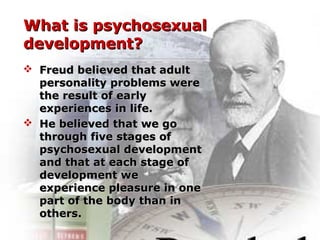
What is psychosexualWhat is psychosexual
development?development?
 Freud believed that adultFreud believed that adult
personality problems werepersonality problems were
the result of earlythe result of early
experiences in life.experiences in life.
 He believed that we goHe believed that we go
through five stages ofthrough five stages of
psychosexual developmentpsychosexual development
and that at each stage ofand that at each stage of
development wedevelopment we
experience pleasure in oneexperience pleasure in one
part of the body than inpart of the body than in
others.others.
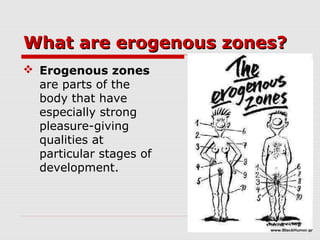
What are erogenous zones?What are erogenous zones?
 Erogenous zones
are parts of the
body that have
especially strong
pleasure-giving
qualities at
particular stages of
development.
What is psychosexualWhat is psychosexual
development?development?
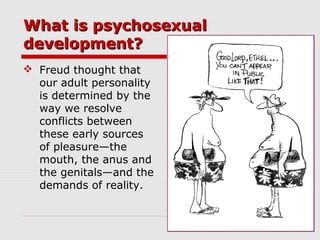
 Freud thought that
our adult personality
is determined by the
way we resolve
conflicts between
these early sources
of pleasure—the
mouth, the anus and
the genitals—and the
demands of reality.
What is fixation?What is fixation?
 Fixation is the
psychoanalytic
defense
mechanism that
occurs when the
individual remains
locked in an
earlier
developmental
stage because
needs are under-
or over-gratified
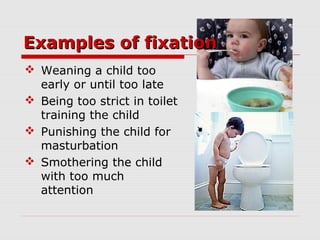
Examples of fixationExamples of fixation
 Weaning a child too
early or until too late
 Being too strict in toilet
training the child
 Punishing the child for
masturbation
 Smothering the child
with too much
attention
STAGES OFSTAGES OF
PSYCHOSEXUALPSYCHOSEXUAL
DEVELOPMENTDEVELOPMENT
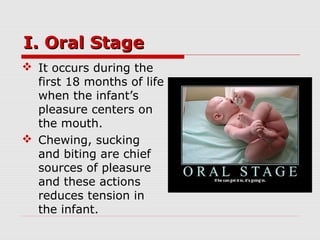
I. Oral StageI. Oral Stage
 It occurs during the
first 18 months of life
when the infant’s
pleasure centers on
the mouth.
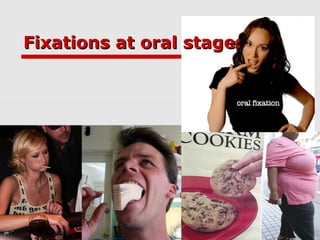
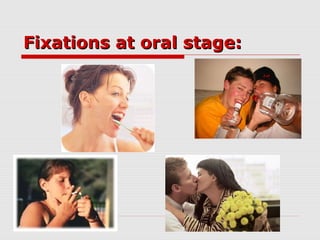
 Chewing, sucking
and biting are chief
sources of pleasure
and these actions
reduces tension in
the infant.
Fixations at oral stage:Fixations at oral stage:
II. Anal StageII. Anal Stage
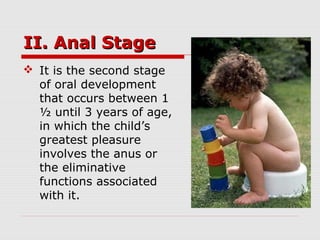
 It is the second stage
of oral development
that occurs between 1
½ until 3 years of age,
in which the child’s
greatest pleasure
involves the anus or
the eliminative
functions associated
with it.
II. Anal StageII. Anal Stage
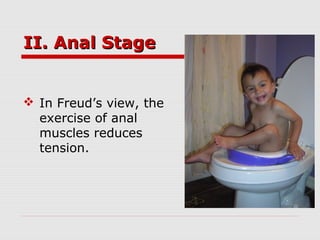
 In Freud’s view, the
exercise of anal
muscles reduces
tension.
II. Anal StageII. Anal Stage
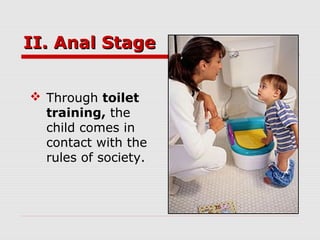
 Through toilet
training, the
child comes in
contact with the
rules of society.
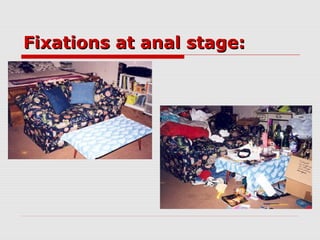
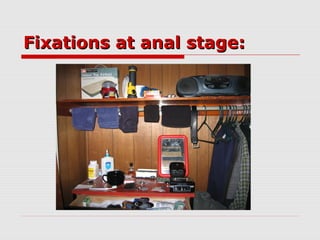
Fixations at anal stage:Fixations at anal stage:
III. Phallic StageIII. Phallic Stage
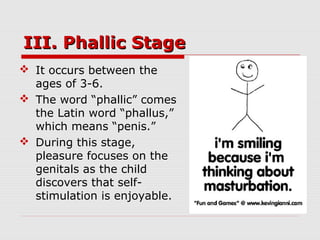
 It occurs between the
ages of 3-6.
 The word “phallic” comes
the Latin word “phallus,”
which means “penis.”
 During this stage,
pleasure focuses on the
genitals as the child
discovers that self-
stimulation is enjoyable.
Importance of Phallic StageImportance of Phallic Stage
 In Freud’s view, the
phallic stage has a
special importance in
personality
development because
this period triggers
the Oedipus
Complex.
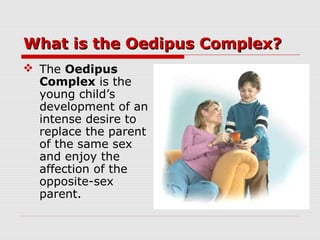
What is the Oedipus Complex?What is the Oedipus Complex?
 The Oedipus
Complex is the
young child’s
development of an
intense desire to
replace the parent
of the same sex
and enjoy the
affection of the
opposite-sex
parent.
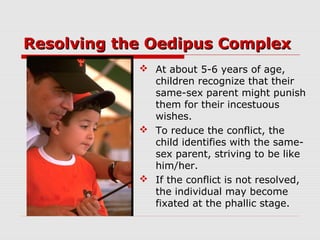
Resolving the Oedipus ComplexResolving the Oedipus Complex
 At about 5-6 years of age,
children recognize that their
same-sex parent might punish
them for their incestuous
wishes.
 To reduce the conflict, the
child identifies with the same-
sex parent, striving to be like
him/her.
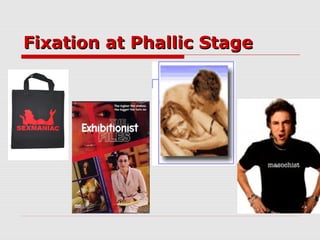
 If the conflict is not resolved,
the individual may become
fixated at the phallic stage.
Fixation at Phallic StageFixation at Phallic Stage
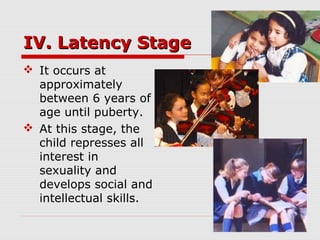
IV. Latency StageIV. Latency Stage
 It occurs at
approximately
between 6 years of
age until puberty.
 At this stage, the
child represses all
interest in
sexuality and
develops social and
intellectual skills.
IV. Latency StageIV. Latency Stage
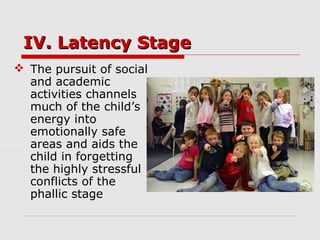
 The pursuit of social
and academic
activities channels
much of the child’s
energy into
emotionally safe
areas and aids the
child in forgetting
the highly stressful
conflicts of the
phallic stage
V. Genital StageV. Genital Stage
 The final stage of
psychosexual
development occurs
from puberty onwards.
 It is the time of sexual
reawakening, but the
source of sexual
pleasure now becomes
someone outside the
family.
V. Genital StageV. Genital Stage
 Freud believed that
unresolved conflicts
with parents re-
emerged during
adolescence.
 Once resolved, Freud
believed that the
individual capable of
developing a mature
love relationship and
functioning
independently as an
adult.
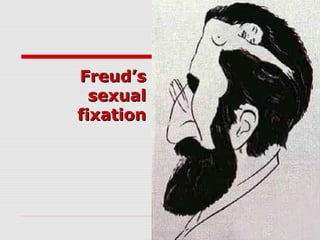
Freud’sFreud’s
sexualsexual
fixationfixation

Freud final

  • 1.
    PSYCHOANALYTIC THEORY FOUNDER: SIGMUND FREUD - viewedas the father of Psychology, pillar or original initiator of the Psychoanalytic approach on Human behavior GROUP 5: Aldin Elona Mayleen Ranelle
  • 2.
    KEY CONCEPTS I.HUMAN NATURE II.INSTINCTS III.THEORYOF PERSONALITY a. Structural/Topographical –ID, Ego, Superego b. Functional or Dynamic – Consciousness and The Unconscious IV. ANXIETY V. EGO DEFENSE MECHANISM VI.PSYCHOSEXUAL DEVT.
  • 3.
    KEY CONCEPTS I. HUMANNATURE “DETERMINISTIC” – Simply put, Human Nature, Happens because it happens, our behavior is determined by Irrational forces, unconscious motivations and biological & instinctual drives that are stemmed from repressed childhood memories or experiences that hold a certain degree of impact to our lives
  • 4.
    PSYCHOANALYSIS -emphasizes that behavioris motivated by the subconscious thoughts and feelings -Experiences of the first 6 yrs of life are determinants of later development of personality -this is dsicovering the unconscious mind and repressed thoughts, feelings and conflicts that cause the anxiety (Theory of Anxiety) and helping the person gain the insight into and resolve the conflicts (Therapy)
  • 5.
    II. INSTINCTS LIFE INSTINCTS(EROS) -Deals with basic survival, pleasure & reproduction DEATH INSTINCTS (THANATOS) - Unconscious desire to die or to hurt oneself or others
  • 6.
    1.Structural or Topographical ID-focus on wants and needs (Biological Component ) -not rational, present at birth, first portion of personality to develop - aims at achieving pleasure and avoiding pain ( Pleasure principle ) EGO- opposite of Id -focuses on justice or morality (Psychological Component) - judgment portion of the personality - Reality principle -purpose: to set EQUILIBRIUM SUPEREGO – decides if things is good/bad- social conscience (Social Component) ideals *basis of Psychoanalytic explanation of mental illness III. THEORY OF PERSONALITY
  • 7.
    III. THEORY OFPERSONALITY 2. Functional or Dynamic - Mind has two main parts: CONSCIOUS - awareness of our mental (small portion) , includes thoughts and feelings UNCONSCIOUS – contains all impulses , desires and feelings that are beyong awareness , is the core of the person ( largest portion) Eg. Dreams, hypnosis 3 LEVEL OF AWARENESS: CONSCIOUS, PRECONCIOUS, UNCONCIOUS
  • 8.
    IV. ANXIETY - A.k.a.as the feeling of “dread” that results from repressed feelings - Arises from the conflict among id, ego and superego - state of tension that compels the person to do something - 3 kinds: 1. Reality Anxiety – fear of danger of the external world 2. Neurotic – fear of punishment 3. Moral Anxiety – fear of ones conscience
  • 9.
    V. DEFENSE MECHANISM -strategydevelop by the ego to protect against anxiety VI. PSYCHOSEXUAL DEVELOPMENT - One of the significant contribution of psychoanalytic model is providing framework for psychosexual and psychosocial devt from birth to adulthood - -personality develops through a series of childhood stages
  • 10.
  • 11.
    What is psychosexualWhatis psychosexual development?development?  Freud believed that adultFreud believed that adult personality problems werepersonality problems were the result of earlythe result of early experiences in life.experiences in life.  He believed that we goHe believed that we go through five stages ofthrough five stages of psychosexual developmentpsychosexual development and that at each stage ofand that at each stage of development wedevelopment we experience pleasure in oneexperience pleasure in one part of the body than inpart of the body than in others.others.
  • 12.
    What are erogenouszones?What are erogenous zones?  Erogenous zones are parts of the body that have especially strong pleasure-giving qualities at particular stages of development.
  • 13.
    What is psychosexualWhatis psychosexual development?development?  Freud thought that our adult personality is determined by the way we resolve conflicts between these early sources of pleasure—the mouth, the anus and the genitals—and the demands of reality.
  • 14.
    What is fixation?Whatis fixation?  Fixation is the psychoanalytic defense mechanism that occurs when the individual remains locked in an earlier developmental stage because needs are under- or over-gratified
  • 15.
    Examples of fixationExamplesof fixation  Weaning a child too early or until too late  Being too strict in toilet training the child  Punishing the child for masturbation  Smothering the child with too much attention
  • 16.
  • 17.
    I. Oral StageI.Oral Stage  It occurs during the first 18 months of life when the infant’s pleasure centers on the mouth.  Chewing, sucking and biting are chief sources of pleasure and these actions reduces tension in the infant.
  • 18.
    Fixations at oralstage:Fixations at oral stage:
  • 19.
    Fixations at oralstage:Fixations at oral stage:
  • 20.
    II. Anal StageII.Anal Stage  It is the second stage of oral development that occurs between 1 ½ until 3 years of age, in which the child’s greatest pleasure involves the anus or the eliminative functions associated with it.
  • 21.
    II. Anal StageII.Anal Stage  In Freud’s view, the exercise of anal muscles reduces tension.
  • 22.
    II. Anal StageII.Anal Stage  Through toilet training, the child comes in contact with the rules of society.
  • 23.
    Fixations at analstage:Fixations at anal stage:
  • 24.
    Fixations at analstage:Fixations at anal stage:
  • 25.
    III. Phallic StageIII.Phallic Stage  It occurs between the ages of 3-6.  The word “phallic” comes the Latin word “phallus,” which means “penis.”  During this stage, pleasure focuses on the genitals as the child discovers that self- stimulation is enjoyable.
  • 26.
    Importance of PhallicStageImportance of Phallic Stage  In Freud’s view, the phallic stage has a special importance in personality development because this period triggers the Oedipus Complex.
  • 27.
    What is theOedipus Complex?What is the Oedipus Complex?  The Oedipus Complex is the young child’s development of an intense desire to replace the parent of the same sex and enjoy the affection of the opposite-sex parent.
  • 28.
    Resolving the OedipusComplexResolving the Oedipus Complex  At about 5-6 years of age, children recognize that their same-sex parent might punish them for their incestuous wishes.  To reduce the conflict, the child identifies with the same- sex parent, striving to be like him/her.  If the conflict is not resolved, the individual may become fixated at the phallic stage.
  • 29.
    Fixation at PhallicStageFixation at Phallic Stage
  • 30.
    Fixation at PhallicStageFixation at Phallic Stage
  • 31.
    IV. Latency StageIV.Latency Stage  It occurs at approximately between 6 years of age until puberty.  At this stage, the child represses all interest in sexuality and develops social and intellectual skills.
  • 32.
    IV. Latency StageIV.Latency Stage  The pursuit of social and academic activities channels much of the child’s energy into emotionally safe areas and aids the child in forgetting the highly stressful conflicts of the phallic stage
  • 33.
    V. Genital StageV.Genital Stage  The final stage of psychosexual development occurs from puberty onwards.  It is the time of sexual reawakening, but the source of sexual pleasure now becomes someone outside the family.
  • 34.
    V. Genital StageV.Genital Stage  Freud believed that unresolved conflicts with parents re- emerged during adolescence.  Once resolved, Freud believed that the individual capable of developing a mature love relationship and functioning independently as an adult.
  • 35.