
Personality
Muhammad Hasan Raza
occupational therapist
IPM&R KMU

 Personality is individuals’ unique and relatively
stable patterns of behavior, thoughts, and feelings.
 Personality research, in turn, focuses on
understanding the origins or causes of the
similarities and differences among people in their
patterns of cognition, emotion, and behavior.
Definition

 Sigmund Freud
 Id, ego, superego
 Anxiety and defense mechanism
 Stages of personality development
The Psychodynamic Approach [focused on unconscious thought process]

 Sigmund Freud is, by far, the most famous figure in
the history of psychology – even though he was a
medical doctor.
 He was born in what is now part of the Czech
Republic, but when he was four years old, his family
moved to Vienna, and he spent almost his entire life
in that city.
 During his private practice after completion of his
degree he formulated his theories of human
personality and psychological disorders.
Sigmund Freud

Model of Mind (Level of consciousness)

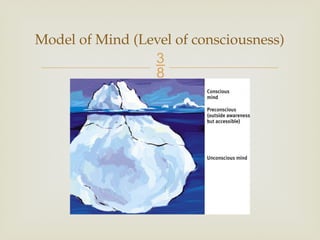
 The mind is like an iceberg. It is mostly hidden, and
below the surface lies the unconscious mind.
 Consciousness is best understood as having an
awareness of something. This includes our current
thoughts: what ever we are thinking about or
experiencing at a given moment.
 Its ability to direct your focus.
 Its ability to imagine that which is not real
Model of mind

 Subconscious (preconscious) is the storage point for
any recent memories needed for quick recall.
 This contains memories that are not part of current
thought but can readily be brought to mind if the
need arises.
 Such as what your telephone number is or the
name of a person you just met.
 It also holds current information that you use
every day, such as your current recurring
thoughts, behavior patterns, habits, and feelings.

 The unconscious mind is thoughts, desires, and
impulses of which we remain largely unaware.
 Where all of our memories and past experiences reside.
 These are those memories that have been
repressed through trauma and those that have
simply been consciously forgotten and no longer
important to us (automatic thoughts).
 It’s from these memories and experiences that our
beliefs, habits, and behaviors are formed.

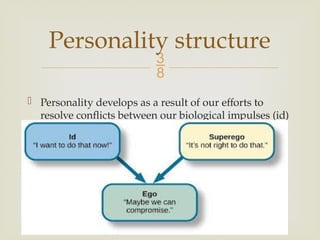
 Personality develops as a result of our efforts to
resolve conflicts between our biological impulses (id)
and social restraints (superego).
Personality structure

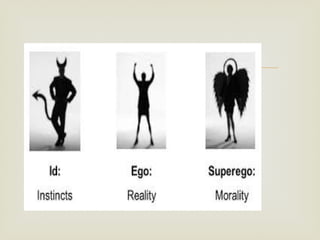
 The Id consists of all our primitive, innate urges.
These include various bodily needs, sexual desire,
and aggressive impulses.
 According to Freud, the id is totally unconscious
and operates in accordance with what he termed
the “pleasure principle”:
 It demands immediate, total gratification and is not
capable of considering the potential costs of seeking
this goal.

 The world offers few opportunities for instant
pleasure.
 The ego’s task is to hold the id in check until
conditions allow for satisfaction of its impulses.
 Thus the ego operates in accordance with the reality
principle:
 It takes into account external conditions and the
consequences of various actions and directs behavior
so as to maximize pleasure and minimize pain.
The ego

 The ego is partly conscious but not entirely so; thus
some of its actions – for example, its external
struggle with the id – are outside our conscious
knowledge or understanding.
 The ego functions as the “executive” and mediates
the demands of the id and superego.

 The superego provides standards for judgment (the
conscience) and for future aspirations.
 It too seeks to control satisfaction of id impulses, but,
in contrast to the ego, it is concerned with morality –
with whether various ways that could potentially
satisfy id impulses are right or wrong.
 The superego permits us to gratify such impulses only
when it is morally correct to do so – not simply when
it is safe or feasible, as required by ego.
The superego


 Freud believed that personality is formed during the
first few years of life.
 He divided them into psychosexual stages.
 During these stages the id’s pleasure-seeking
energies focus on pleasure sensitive body areas called
erogenous zones.
Personality
development

 Libido refers to the instinctual life force that
energizes the id.(psychic energy that powers all
mental activity).
 In each stage of development, we obtain different
kinds of pleasure and leave behind a small amount
of libido – this is the normal course of events.
 If an excessive amount of libido energy is tied to a
particular stage, however, fixation results.
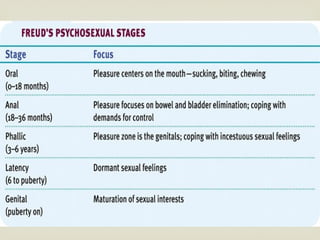
 Freud divided the development of personality into
five psychosexual stages.

 Seek pleasure mainly through the mouth.
 If too much or too little gratification occurs during
this stage, an individual may become fixated at it.
 Too little gratification results in a personality that is
overly dependent on others;
 Too much, especially after the child has developed
some teeth, results in a personality that is excessively
hostile, especially through verbal sarcasm.
1. Oral stage

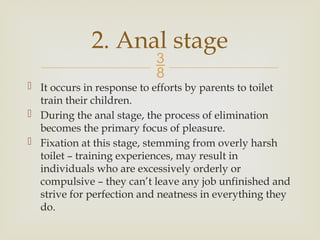
 It occurs in response to efforts by parents to toilet
train their children.
 During the anal stage, the process of elimination
becomes the primary focus of pleasure.
 Fixation at this stage, stemming from overly harsh
toilet – training experiences, may result in
individuals who are excessively orderly or
compulsive – they can’t leave any job unfinished and
strive for perfection and neatness in everything they
do.
2. Anal stage

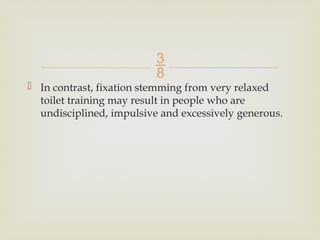
 In contrast, fixation stemming from very relaxed
toilet training may result in people who are
undisciplined, impulsive and excessively generous.

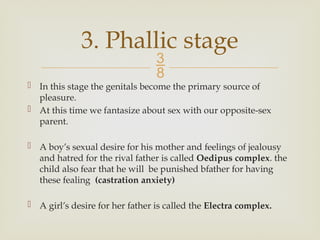
 In this stage the genitals become the primary source of
pleasure.
 At this time we fantasize about sex with our opposite-sex
parent.
 A boy’s sexual desire for his mother and feelings of jealousy
and hatred for the rival father is called Oedipus complex. the
child also fear that he will be punished bfather for having
these fealing (castration anxiety)
 A girl’s desire for her father is called the Electra complex.
3. Phallic stage

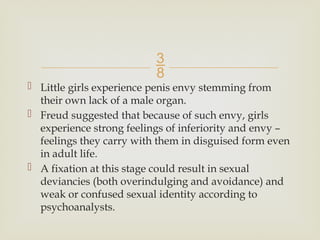
 Little girls experience penis envy stemming from
their own lack of a male organ.
 Freud suggested that because of such envy, girls
experience strong feelings of inferiority and envy –
feelings they carry with them in disguised form even
in adult life.
 A fixation at this stage could result in sexual
deviancies (both overindulging and avoidance) and
weak or confused sexual identity according to
psychoanalysts.

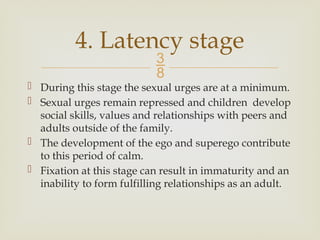
 During this stage the sexual urges are at a minimum.
 Sexual urges remain repressed and children develop
social skills, values and relationships with peers and
adults outside of the family.
 The development of the ego and superego contribute
to this period of calm.
 Fixation at this stage can result in immaturity and an
inability to form fulfilling relationships as an adult.
4. Latency stage

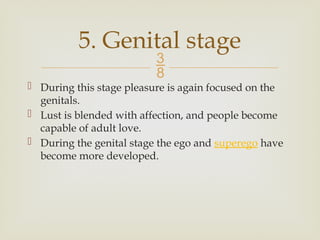
 During this stage pleasure is again focused on the
genitals.
 Lust is blended with affection, and people become
capable of adult love.
 During the genital stage the ego and superego have
become more developed.
5. Genital stage

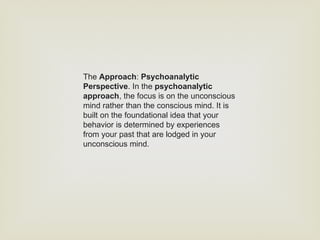
The Approach: Psychoanalytic
Perspective. In the psychoanalytic
approach, the focus is on the unconscious
mind rather than the conscious mind. It is
built on the foundational idea that your
behavior is determined by experiences
from your past that are lodged in your
unconscious mind.

 Carl Jung(1916) argued that libido was not just
sexual instinct but a more general life force that
includes an innate drive for creativity, for growth-
oriented resolution of conflicts, and for the
productive blending of basic impulses with real-
world demands.
Jung’s Analytic
Psychology
He believed the libido was not just sexual energy, but instead
generalized psychic energy. For Jung, the purpose of psychic
energy was to motivate the individual in a number of important ways,
including spiritually, intellectually, and creatively.

 Jung did not identify specific stages in personality
development.
 He suggested instead that people develop, over
time, differing degrees of introversion (a tendency
to reflect on one’s own experiences) or extraversion
(a tendency to focus on the social world), along
with differing tendencies to rely on specific
psychological functions such as thinking versus
feelings.

 The combination of these tendencies, said Jung,
creates personalities that display distinctive and
predictable patterns of behavior.
 Jung also argued for the existence of a collective
unconscious, which he defined as the memories that
all of us inherit from our human and nonhuman
ancestors.

 According to Jung we are not consciously aware of
these memories, yet they are responsible for our
innate tendencies to react in particular ways to
certain objects in our environment.
 For example, Jung believed that our collective
memory of mothers influences how each of us
perceives our own mother.

 Archetypes are universal symbols or patterns that are
present in the collective unconscious of all humans.
unlearned and function to organize how we experience
certain things.
 Jung identified four major archetypes, but also believed
that there was no limit to the number that may exist.
1. The Persona
2. The Shadow
3. The Anima/Animus
4. The Self

 The persona is how we present ourselves to the
world.
 The word "persona" is derived from a Latin word
that literally means "mask."
 The persona represents all of the different social
masks that we wear among various groups and
situations.
The Persona

 The shadow is an archetype that consists of the sex
and life instincts.
 The shadow exists as part of the unconscious mind
and is composed of repressed ideas, weaknesses,
desires, instincts, and shortcomings.
 The shadow forms out of our attempts to adapt to
cultural norms and expectations.
The Shadow

 The anima is a feminine image in the male psyche,
and the animus is a male image in the female psyche.
 The anima/animus represents the "true self" rather
than the image we present to others and serves as the
primary source of communication with the collective
unconscious.
The Anima or Animus

 The self is an archetype that represents the unified
unconsciousness and consciousness of an individual.
 Creating the self occurs through a process known as
individuation, in which the various aspects of
personality are integrated.
 Jung often represented the self as a circle, square, or
mandala.
The Self

 The self archetype represents the unified psyche as a
whole.
 Jung suggested that there were two different centers
of personality.
 The ego makes up the center of consciousness, but it
is the self that lies at the center of personality.

 Personality encompasses not only consciousness, but
also the ego and the unconscious mind.
 You can think of this by imagining a circle with a dot
right at the center.
 The entire circle makes up the self, where the small
dot in the middle represents the ego.

 The following are just a few of the various
archetypes that Jung described:
 The father: Authority figure; stern; powerful.
 The mother: Nurturing; comforting.
 The child: Longing for innocence; rebirth;
salvation.
 The wise old man: Guidance; knowledge; wisdom.
 The hero: Champion; defender; rescuer.
 The maiden: Innocence; desire; purity.
 The trickster: Deceiver; liar; trouble-maker.

 Psychologist Erik Erikson (1902–1994) created a
theory of personality development based, in part, on
the work of Freud.
 However, Erikson believed the personality continued
to change over time and was never truly finished.
 His theory includes eight stages of development,
beginning with birth and ending with death.
Erik Erikson

 Trust vs. mistrust is the first stage in Erik Erikson's
theory of psychosocial development.
 This stage begins at birth continues to approximately
18 months of age.
 During this stage, the infant is uncertain about the
world in which they live, and looks towards their
primary caregiver for stability and consistency of
care.
1. Trust vs. Mistrust

 If the care the infant receives is consistent,
predictable and reliable, they will develop a sense of
trust which will carry with them to other
relationships, and they will be able to feel secure
even when threatened.
 If these needs are not consistently met, mistrust,
suspicion, and anxiety may develop.

 Success in this stage will lead to the virtue of hope.
 By developing a sense of trust, the infant can have
hope that as new crises arise, there is a real
possibility that other people will be there as a source
of support.
 Failing to acquire the virtue of hope will lead to the
development of fear.

 Autonomy versus shame and doubt is the second
stage of Erik Erikson's stages of psychosocial
development.
 This stage occurs between the ages of 18 months to
approximately 3 years.
 According to Erikson, children at this stage are
focused on developing a sense of personal control
over physical skills and a sense of independence.
2. Autonomy vs. Shame
and Doubt

 Success in this stage will lead to the virtue of will.
 If children in this stage are encouraged and
supported in their increased independence, they
become more confident and secure in their own
ability to survive in the world.

 If children are criticized, overly controlled, or not
given the opportunity to assert themselves, they
begin to feel inadequate in their ability to survive,
and may then become overly dependent upon
others, lack self-esteem, and feel a sense of shame or
doubt in their abilities.

3. Initiative vs. Guilt
 Initiative versus guilt is the third stage of Erik
Erikson's theory of psychosocial development.
During the initiative versus guilt stage, children
assert themselves more frequently.
 These are particularly lively, rapid-developing
years in a child’s life. According to Bee (1992), it is
a “time of vigor of action and of behaviors that the
parents may see as aggressive."

 During this period the primary feature involves the
child regularly interacting with other children at
school.
 Central to this stage is play, as it provides children
with the opportunity to explore their interpersonal
skills through initiating activities.

 Children begin to plan activities, make up games,
and initiate activities with others.
 If given this opportunity, children develop a sense of
initiative and feel secure in their ability to lead others
and make decisions.

 If this tendency is crushed, either through criticism
or control, children develop a sense of guilt.
 The child will often overstep the mark in his
forcefulness, and the danger is that the parents will
tend to punish the child and restrict his initiatives
too much.
 Too much guilt can make the child slow to interact
with others and may inhibit their creativity.

4. Industry vs.
Inferiority
 Erikson's fourth psychosocial crisis, involving
industry (competence) vs. inferiority occurs during
childhood between the ages of five and twelve.
 Children are at the stage where they will be learning
to read and write, to do sums, to do things on their
own. Teachers begin to take an important role in the
child’s life as they teach the child specific skills.

 It is at this stage that the child’s peer group will gain
greater significance and will become a major source
of the child’s self-esteem.
 The child now feels the need to win approval by
demonstrating specific competencies that are valued
by society and begin to develop a sense of pride in
their accomplishments.

 If children are encouraged and reinforced for their
initiative, they begin to feel industrious
(competent) and feel confident in their ability to
achieve goals.
 If this initiative is not encouraged, if it is restricted
by parents or teacher, then the child begins to feel
inferior, doubting his own abilities and therefore
may not reach his or her potential.

5. Identity vs. Role Confusion
 The fifth stage of Erik Erikson's theory of
psychosocial development is identity vs. role
confusion, and it occurs during adolescence, from
about 12-18 years.
 During this stage, adolescents search for a sense of
self and personal identity, through an intense
exploration of personal values, beliefs, and goals.

 This is a major stage of development where the child
has to learn the roles he will occupy as an adult.
 It is during this stage that the adolescent will re-
examine his identity and try to find out exactly who
he or she is.
 Erikson suggests that two identities are involved:
the sexual and the occupational.

 During this period, they explore possibilities and
begin to form their own identity based upon the
outcome of their explorations.
 Failure to establish a sense of identity within
society ("I don’t know what I want to be when I
grow up") can lead to role confusion.
 Role confusion involves the individual not being
sure about themselves or their place in society.

6. Intimacy vs. Isolation
 Intimacy versus isolation is the sixth stage of Erik
Erikson's theory of psychosocial development. This
stage takes place during young adulthood between
the ages of approximately 18 to 40 yrs.
 During this period, the major conflict centers on
forming intimate, loving relationships with other
people.

 During this period, we begin to share ourselves more
intimately with others. We explore relationships
leading toward longer-term commitments with
someone other than a family member.

 Successful completion of this stage can result in
happy relationships and a sense of commitment,
safety, and care within a relationship.
 Avoiding intimacy, fearing commitment and
relationships can lead to isolation, loneliness, and
sometimes depression. Success in this stage will
lead to the virtue of love.

7. Generativity vs. Stagnation
 Generativity versus stagnation is the seventh of eight
stages of Erik Erikson's theory of psychosocial
development. This stage takes place during during
middle adulthood (ages 40 to 65 yrs).
 Generativity refers to "making your mark" on the
world through creating or nurturing things that will
outlast an individual.

 People experience a need to create or nurture
things that will outlast them, often having mentees
or creating positive changes that will benefit other
people.
 We give back to society through raising our
children, being productive at work, and becoming
involved in community activities and
organizations. Through generativity we develop a
sense of being a part of the bigger picture.

 Success leads to feelings of usefulness and
accomplishment, while failure results in shallow
involvement in the world.

8. Ego Integrity vs.
Despair
 Ego integrity versus despair is the eighth and final
stage of Erik Erikson’s stage theory of psychosocial
development. This stage begins at approximately age
65 and ends at death.
 It is during this time that we contemplate our
accomplishments and can develop integrity if we see
ourselves as leading a successful life.

 Erik Erikson believed if we see our lives as
unproductive, feel guilt about our past, or feel that
we did not accomplish our life goals, we become
dissatisfied with life and develop despair, often
leading to depression and hopelessness.

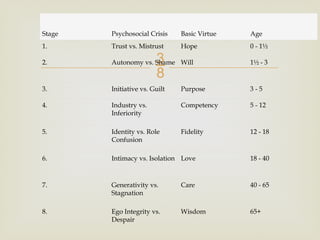
Stage Psychosocial Crisis Basic Virtue Age
1. Trust vs. Mistrust Hope 0 - 1½
2. Autonomy vs. Shame Will 1½ - 3
3. Initiative vs. Guilt Purpose 3 - 5
4. Industry vs.
Inferiority
Competency 5 - 12
5. Identity vs. Role
Confusion
Fidelity 12 - 18
6. Intimacy vs. Isolation Love 18 - 40
7. Generativity vs.
Stagnation
Care 40 - 65
8. Ego Integrity vs.
Despair
Wisdom 65+

Personality.pptx pschlogy 2nd semster ot

  • 1.
  • 2.
      Personality isindividuals’ unique and relatively stable patterns of behavior, thoughts, and feelings.  Personality research, in turn, focuses on understanding the origins or causes of the similarities and differences among people in their patterns of cognition, emotion, and behavior. Definition
  • 3.
      Sigmund Freud Id, ego, superego  Anxiety and defense mechanism  Stages of personality development The Psychodynamic Approach [focused on unconscious thought process]
  • 4.
      Sigmund Freudis, by far, the most famous figure in the history of psychology – even though he was a medical doctor.  He was born in what is now part of the Czech Republic, but when he was four years old, his family moved to Vienna, and he spent almost his entire life in that city.  During his private practice after completion of his degree he formulated his theories of human personality and psychological disorders. Sigmund Freud
  • 5.
     Model of Mind(Level of consciousness)
  • 6.
      The mindis like an iceberg. It is mostly hidden, and below the surface lies the unconscious mind.  Consciousness is best understood as having an awareness of something. This includes our current thoughts: what ever we are thinking about or experiencing at a given moment.  Its ability to direct your focus.  Its ability to imagine that which is not real Model of mind
  • 7.
      Subconscious (preconscious)is the storage point for any recent memories needed for quick recall.  This contains memories that are not part of current thought but can readily be brought to mind if the need arises.  Such as what your telephone number is or the name of a person you just met.  It also holds current information that you use every day, such as your current recurring thoughts, behavior patterns, habits, and feelings.
  • 8.
      The unconsciousmind is thoughts, desires, and impulses of which we remain largely unaware.  Where all of our memories and past experiences reside.  These are those memories that have been repressed through trauma and those that have simply been consciously forgotten and no longer important to us (automatic thoughts).  It’s from these memories and experiences that our beliefs, habits, and behaviors are formed.
  • 9.
      Personality developsas a result of our efforts to resolve conflicts between our biological impulses (id) and social restraints (superego). Personality structure
  • 10.
      The Idconsists of all our primitive, innate urges. These include various bodily needs, sexual desire, and aggressive impulses.  According to Freud, the id is totally unconscious and operates in accordance with what he termed the “pleasure principle”:  It demands immediate, total gratification and is not capable of considering the potential costs of seeking this goal.
  • 11.
      The worldoffers few opportunities for instant pleasure.  The ego’s task is to hold the id in check until conditions allow for satisfaction of its impulses.  Thus the ego operates in accordance with the reality principle:  It takes into account external conditions and the consequences of various actions and directs behavior so as to maximize pleasure and minimize pain. The ego
  • 12.
      The egois partly conscious but not entirely so; thus some of its actions – for example, its external struggle with the id – are outside our conscious knowledge or understanding.  The ego functions as the “executive” and mediates the demands of the id and superego.
  • 13.
      The superegoprovides standards for judgment (the conscience) and for future aspirations.  It too seeks to control satisfaction of id impulses, but, in contrast to the ego, it is concerned with morality – with whether various ways that could potentially satisfy id impulses are right or wrong.  The superego permits us to gratify such impulses only when it is morally correct to do so – not simply when it is safe or feasible, as required by ego. The superego
  • 14.
  • 15.
      Freud believedthat personality is formed during the first few years of life.  He divided them into psychosexual stages.  During these stages the id’s pleasure-seeking energies focus on pleasure sensitive body areas called erogenous zones. Personality development
  • 16.
      Libido refersto the instinctual life force that energizes the id.(psychic energy that powers all mental activity).  In each stage of development, we obtain different kinds of pleasure and leave behind a small amount of libido – this is the normal course of events.  If an excessive amount of libido energy is tied to a particular stage, however, fixation results.  Freud divided the development of personality into five psychosexual stages.
  • 17.
      Seek pleasuremainly through the mouth.  If too much or too little gratification occurs during this stage, an individual may become fixated at it.  Too little gratification results in a personality that is overly dependent on others;  Too much, especially after the child has developed some teeth, results in a personality that is excessively hostile, especially through verbal sarcasm. 1. Oral stage
  • 18.
      It occursin response to efforts by parents to toilet train their children.  During the anal stage, the process of elimination becomes the primary focus of pleasure.  Fixation at this stage, stemming from overly harsh toilet – training experiences, may result in individuals who are excessively orderly or compulsive – they can’t leave any job unfinished and strive for perfection and neatness in everything they do. 2. Anal stage
  • 19.
      In contrast,fixation stemming from very relaxed toilet training may result in people who are undisciplined, impulsive and excessively generous.
  • 20.
      In thisstage the genitals become the primary source of pleasure.  At this time we fantasize about sex with our opposite-sex parent.  A boy’s sexual desire for his mother and feelings of jealousy and hatred for the rival father is called Oedipus complex. the child also fear that he will be punished bfather for having these fealing (castration anxiety)  A girl’s desire for her father is called the Electra complex. 3. Phallic stage
  • 21.
      Little girlsexperience penis envy stemming from their own lack of a male organ.  Freud suggested that because of such envy, girls experience strong feelings of inferiority and envy – feelings they carry with them in disguised form even in adult life.  A fixation at this stage could result in sexual deviancies (both overindulging and avoidance) and weak or confused sexual identity according to psychoanalysts.
  • 22.
      During thisstage the sexual urges are at a minimum.  Sexual urges remain repressed and children develop social skills, values and relationships with peers and adults outside of the family.  The development of the ego and superego contribute to this period of calm.  Fixation at this stage can result in immaturity and an inability to form fulfilling relationships as an adult. 4. Latency stage
  • 23.
      During thisstage pleasure is again focused on the genitals.  Lust is blended with affection, and people become capable of adult love.  During the genital stage the ego and superego have become more developed. 5. Genital stage
  • 24.
  • 25.
    The Approach: Psychoanalytic Perspective.In the psychoanalytic approach, the focus is on the unconscious mind rather than the conscious mind. It is built on the foundational idea that your behavior is determined by experiences from your past that are lodged in your unconscious mind.
  • 26.
      Carl Jung(1916)argued that libido was not just sexual instinct but a more general life force that includes an innate drive for creativity, for growth- oriented resolution of conflicts, and for the productive blending of basic impulses with real- world demands. Jung’s Analytic Psychology
  • 27.
    He believed thelibido was not just sexual energy, but instead generalized psychic energy. For Jung, the purpose of psychic energy was to motivate the individual in a number of important ways, including spiritually, intellectually, and creatively.
  • 28.
      Jung didnot identify specific stages in personality development.  He suggested instead that people develop, over time, differing degrees of introversion (a tendency to reflect on one’s own experiences) or extraversion (a tendency to focus on the social world), along with differing tendencies to rely on specific psychological functions such as thinking versus feelings.
  • 29.
      The combinationof these tendencies, said Jung, creates personalities that display distinctive and predictable patterns of behavior.  Jung also argued for the existence of a collective unconscious, which he defined as the memories that all of us inherit from our human and nonhuman ancestors.
  • 30.
      According toJung we are not consciously aware of these memories, yet they are responsible for our innate tendencies to react in particular ways to certain objects in our environment.  For example, Jung believed that our collective memory of mothers influences how each of us perceives our own mother.
  • 31.
      Archetypes areuniversal symbols or patterns that are present in the collective unconscious of all humans. unlearned and function to organize how we experience certain things.  Jung identified four major archetypes, but also believed that there was no limit to the number that may exist. 1. The Persona 2. The Shadow 3. The Anima/Animus 4. The Self
  • 32.
      The personais how we present ourselves to the world.  The word "persona" is derived from a Latin word that literally means "mask."  The persona represents all of the different social masks that we wear among various groups and situations. The Persona
  • 33.
      The shadowis an archetype that consists of the sex and life instincts.  The shadow exists as part of the unconscious mind and is composed of repressed ideas, weaknesses, desires, instincts, and shortcomings.  The shadow forms out of our attempts to adapt to cultural norms and expectations. The Shadow
  • 34.
      The animais a feminine image in the male psyche, and the animus is a male image in the female psyche.  The anima/animus represents the "true self" rather than the image we present to others and serves as the primary source of communication with the collective unconscious. The Anima or Animus
  • 35.
      The selfis an archetype that represents the unified unconsciousness and consciousness of an individual.  Creating the self occurs through a process known as individuation, in which the various aspects of personality are integrated.  Jung often represented the self as a circle, square, or mandala. The Self
  • 36.
      The selfarchetype represents the unified psyche as a whole.  Jung suggested that there were two different centers of personality.  The ego makes up the center of consciousness, but it is the self that lies at the center of personality.
  • 37.
      Personality encompassesnot only consciousness, but also the ego and the unconscious mind.  You can think of this by imagining a circle with a dot right at the center.  The entire circle makes up the self, where the small dot in the middle represents the ego.
  • 38.
      The followingare just a few of the various archetypes that Jung described:  The father: Authority figure; stern; powerful.  The mother: Nurturing; comforting.  The child: Longing for innocence; rebirth; salvation.  The wise old man: Guidance; knowledge; wisdom.  The hero: Champion; defender; rescuer.  The maiden: Innocence; desire; purity.  The trickster: Deceiver; liar; trouble-maker.
  • 39.
      Psychologist ErikErikson (1902–1994) created a theory of personality development based, in part, on the work of Freud.  However, Erikson believed the personality continued to change over time and was never truly finished.  His theory includes eight stages of development, beginning with birth and ending with death. Erik Erikson
  • 40.
      Trust vs.mistrust is the first stage in Erik Erikson's theory of psychosocial development.  This stage begins at birth continues to approximately 18 months of age.  During this stage, the infant is uncertain about the world in which they live, and looks towards their primary caregiver for stability and consistency of care. 1. Trust vs. Mistrust
  • 41.
      If thecare the infant receives is consistent, predictable and reliable, they will develop a sense of trust which will carry with them to other relationships, and they will be able to feel secure even when threatened.  If these needs are not consistently met, mistrust, suspicion, and anxiety may develop.
  • 42.
      Success inthis stage will lead to the virtue of hope.  By developing a sense of trust, the infant can have hope that as new crises arise, there is a real possibility that other people will be there as a source of support.  Failing to acquire the virtue of hope will lead to the development of fear.
  • 43.
      Autonomy versusshame and doubt is the second stage of Erik Erikson's stages of psychosocial development.  This stage occurs between the ages of 18 months to approximately 3 years.  According to Erikson, children at this stage are focused on developing a sense of personal control over physical skills and a sense of independence. 2. Autonomy vs. Shame and Doubt
  • 44.
      Success inthis stage will lead to the virtue of will.  If children in this stage are encouraged and supported in their increased independence, they become more confident and secure in their own ability to survive in the world.
  • 45.
      If childrenare criticized, overly controlled, or not given the opportunity to assert themselves, they begin to feel inadequate in their ability to survive, and may then become overly dependent upon others, lack self-esteem, and feel a sense of shame or doubt in their abilities.
  • 46.
     3. Initiative vs.Guilt  Initiative versus guilt is the third stage of Erik Erikson's theory of psychosocial development. During the initiative versus guilt stage, children assert themselves more frequently.  These are particularly lively, rapid-developing years in a child’s life. According to Bee (1992), it is a “time of vigor of action and of behaviors that the parents may see as aggressive."
  • 47.
      During thisperiod the primary feature involves the child regularly interacting with other children at school.  Central to this stage is play, as it provides children with the opportunity to explore their interpersonal skills through initiating activities.
  • 48.
      Children beginto plan activities, make up games, and initiate activities with others.  If given this opportunity, children develop a sense of initiative and feel secure in their ability to lead others and make decisions.
  • 49.
      If thistendency is crushed, either through criticism or control, children develop a sense of guilt.  The child will often overstep the mark in his forcefulness, and the danger is that the parents will tend to punish the child and restrict his initiatives too much.  Too much guilt can make the child slow to interact with others and may inhibit their creativity.
  • 50.
     4. Industry vs. Inferiority Erikson's fourth psychosocial crisis, involving industry (competence) vs. inferiority occurs during childhood between the ages of five and twelve.  Children are at the stage where they will be learning to read and write, to do sums, to do things on their own. Teachers begin to take an important role in the child’s life as they teach the child specific skills.
  • 51.
      It isat this stage that the child’s peer group will gain greater significance and will become a major source of the child’s self-esteem.  The child now feels the need to win approval by demonstrating specific competencies that are valued by society and begin to develop a sense of pride in their accomplishments.
  • 52.
      If childrenare encouraged and reinforced for their initiative, they begin to feel industrious (competent) and feel confident in their ability to achieve goals.  If this initiative is not encouraged, if it is restricted by parents or teacher, then the child begins to feel inferior, doubting his own abilities and therefore may not reach his or her potential.
  • 53.
     5. Identity vs.Role Confusion  The fifth stage of Erik Erikson's theory of psychosocial development is identity vs. role confusion, and it occurs during adolescence, from about 12-18 years.  During this stage, adolescents search for a sense of self and personal identity, through an intense exploration of personal values, beliefs, and goals.
  • 54.
      This isa major stage of development where the child has to learn the roles he will occupy as an adult.  It is during this stage that the adolescent will re- examine his identity and try to find out exactly who he or she is.  Erikson suggests that two identities are involved: the sexual and the occupational.
  • 55.
      During thisperiod, they explore possibilities and begin to form their own identity based upon the outcome of their explorations.  Failure to establish a sense of identity within society ("I don’t know what I want to be when I grow up") can lead to role confusion.  Role confusion involves the individual not being sure about themselves or their place in society.
  • 56.
     6. Intimacy vs.Isolation  Intimacy versus isolation is the sixth stage of Erik Erikson's theory of psychosocial development. This stage takes place during young adulthood between the ages of approximately 18 to 40 yrs.  During this period, the major conflict centers on forming intimate, loving relationships with other people.
  • 57.
      During thisperiod, we begin to share ourselves more intimately with others. We explore relationships leading toward longer-term commitments with someone other than a family member.
  • 58.
      Successful completionof this stage can result in happy relationships and a sense of commitment, safety, and care within a relationship.  Avoiding intimacy, fearing commitment and relationships can lead to isolation, loneliness, and sometimes depression. Success in this stage will lead to the virtue of love.
  • 59.
     7. Generativity vs.Stagnation  Generativity versus stagnation is the seventh of eight stages of Erik Erikson's theory of psychosocial development. This stage takes place during during middle adulthood (ages 40 to 65 yrs).  Generativity refers to "making your mark" on the world through creating or nurturing things that will outlast an individual.
  • 60.
      People experiencea need to create or nurture things that will outlast them, often having mentees or creating positive changes that will benefit other people.  We give back to society through raising our children, being productive at work, and becoming involved in community activities and organizations. Through generativity we develop a sense of being a part of the bigger picture.
  • 61.
      Success leadsto feelings of usefulness and accomplishment, while failure results in shallow involvement in the world.
  • 62.
     8. Ego Integrityvs. Despair  Ego integrity versus despair is the eighth and final stage of Erik Erikson’s stage theory of psychosocial development. This stage begins at approximately age 65 and ends at death.  It is during this time that we contemplate our accomplishments and can develop integrity if we see ourselves as leading a successful life.
  • 63.
      Erik Eriksonbelieved if we see our lives as unproductive, feel guilt about our past, or feel that we did not accomplish our life goals, we become dissatisfied with life and develop despair, often leading to depression and hopelessness.
  • 64.
     Stage Psychosocial CrisisBasic Virtue Age 1. Trust vs. Mistrust Hope 0 - 1½ 2. Autonomy vs. Shame Will 1½ - 3 3. Initiative vs. Guilt Purpose 3 - 5 4. Industry vs. Inferiority Competency 5 - 12 5. Identity vs. Role Confusion Fidelity 12 - 18 6. Intimacy vs. Isolation Love 18 - 40 7. Generativity vs. Stagnation Care 40 - 65 8. Ego Integrity vs. Despair Wisdom 65+