Chapter Two: Review
of the Literature
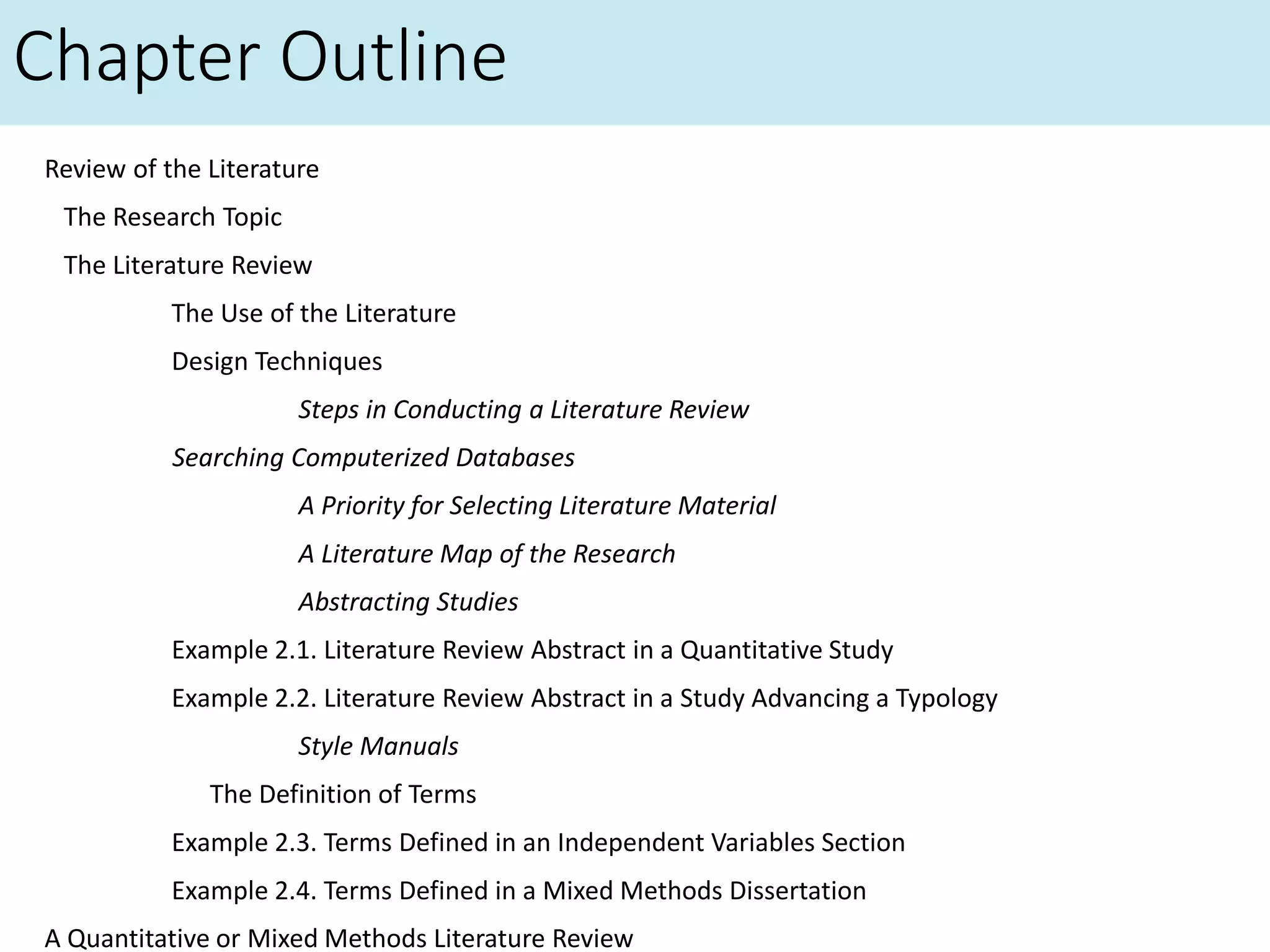
Chapter Outline
Review of the Literature
The Research Topic
The Literature Review
The Use of the Literature
Design Techniques
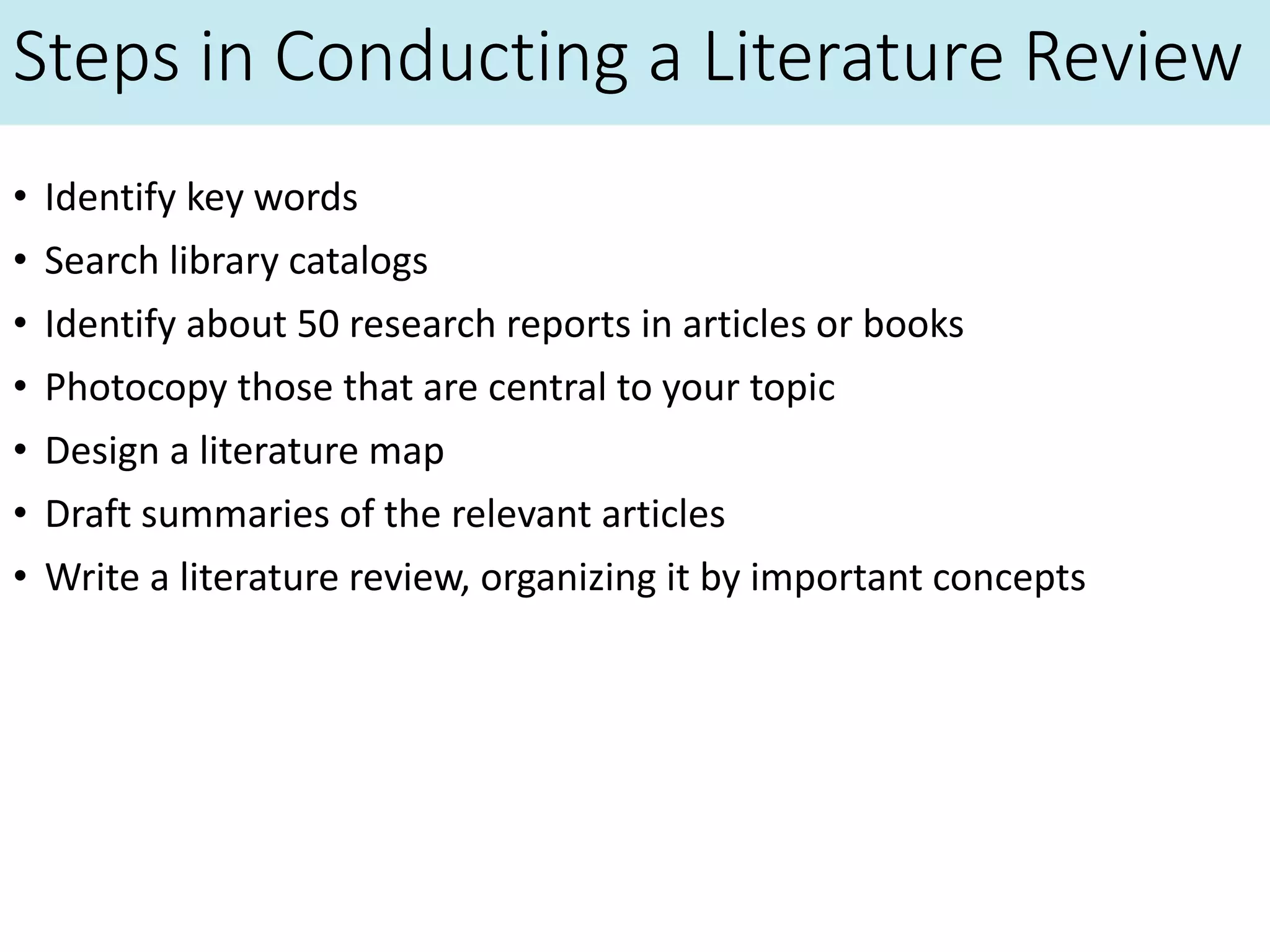
Steps in Conducting a Literature Review
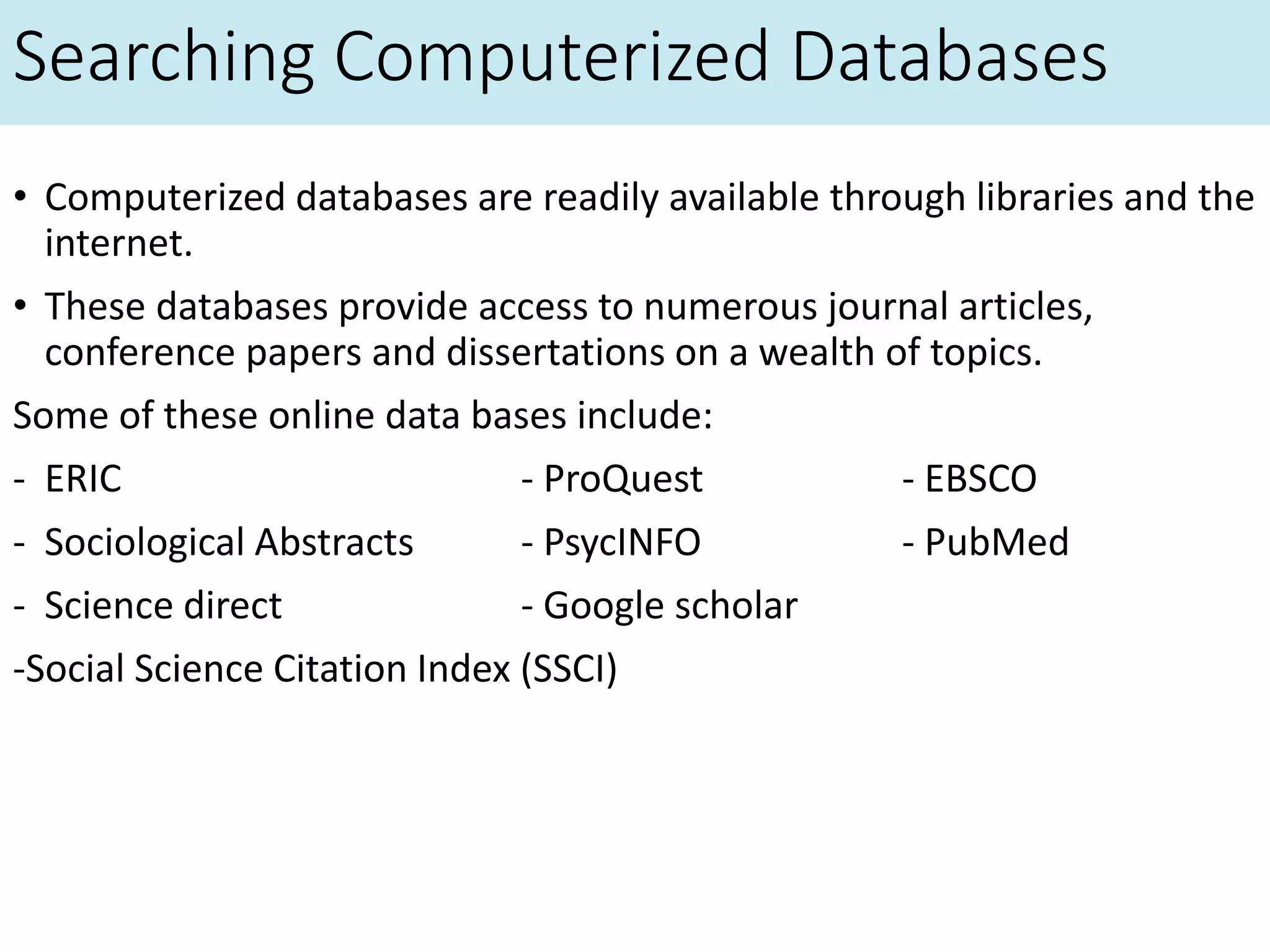
Searching Computerized Databases
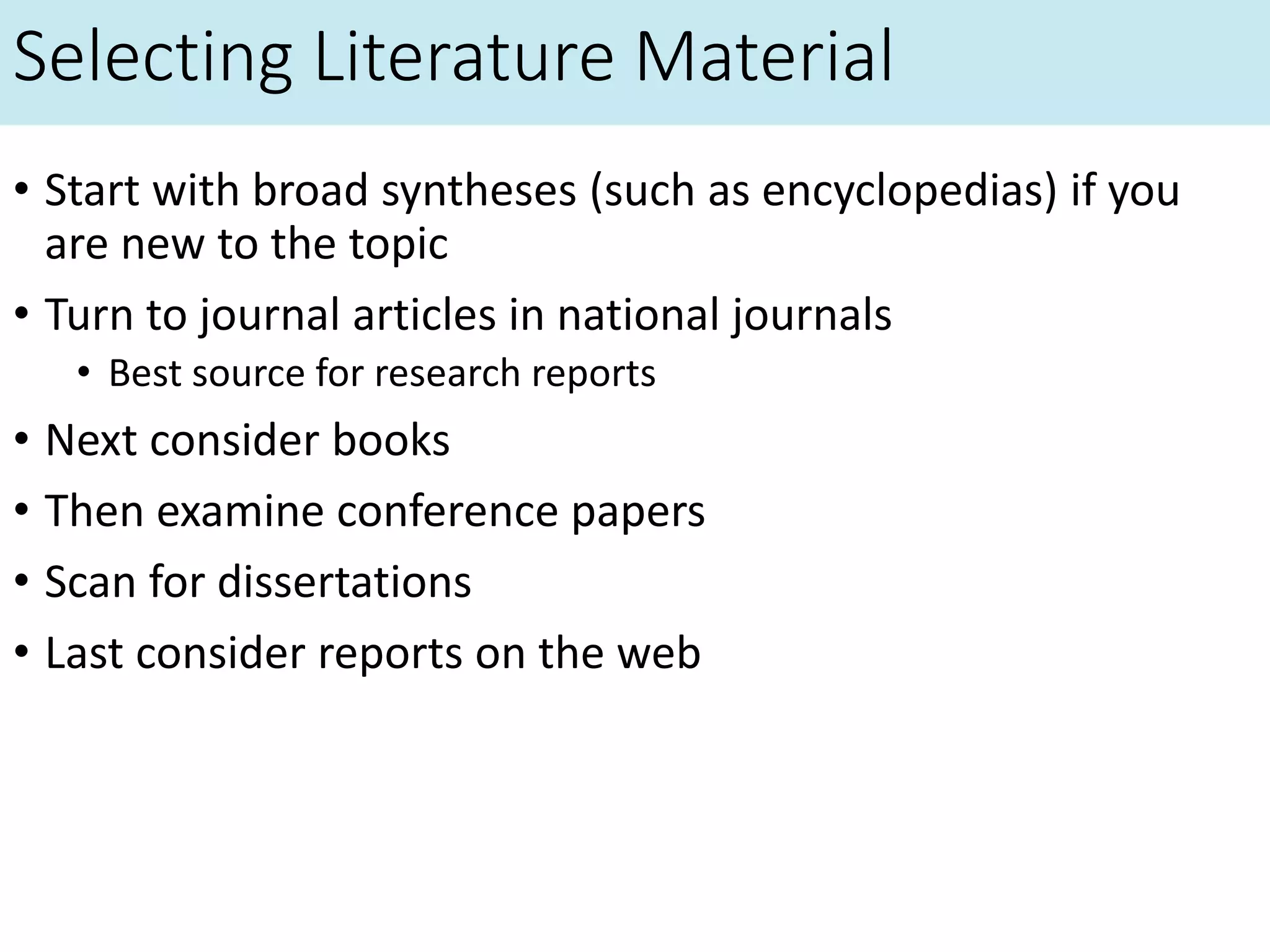
A Priority for Selecting Literature Material
A Literature Map of the Research
Abstracting Studies
Example 2.1. Literature Review Abstract in a Quantitative Study
Example 2.2. Literature Review Abstract in a Study Advancing a Typology
Style Manuals
The Definition of Terms
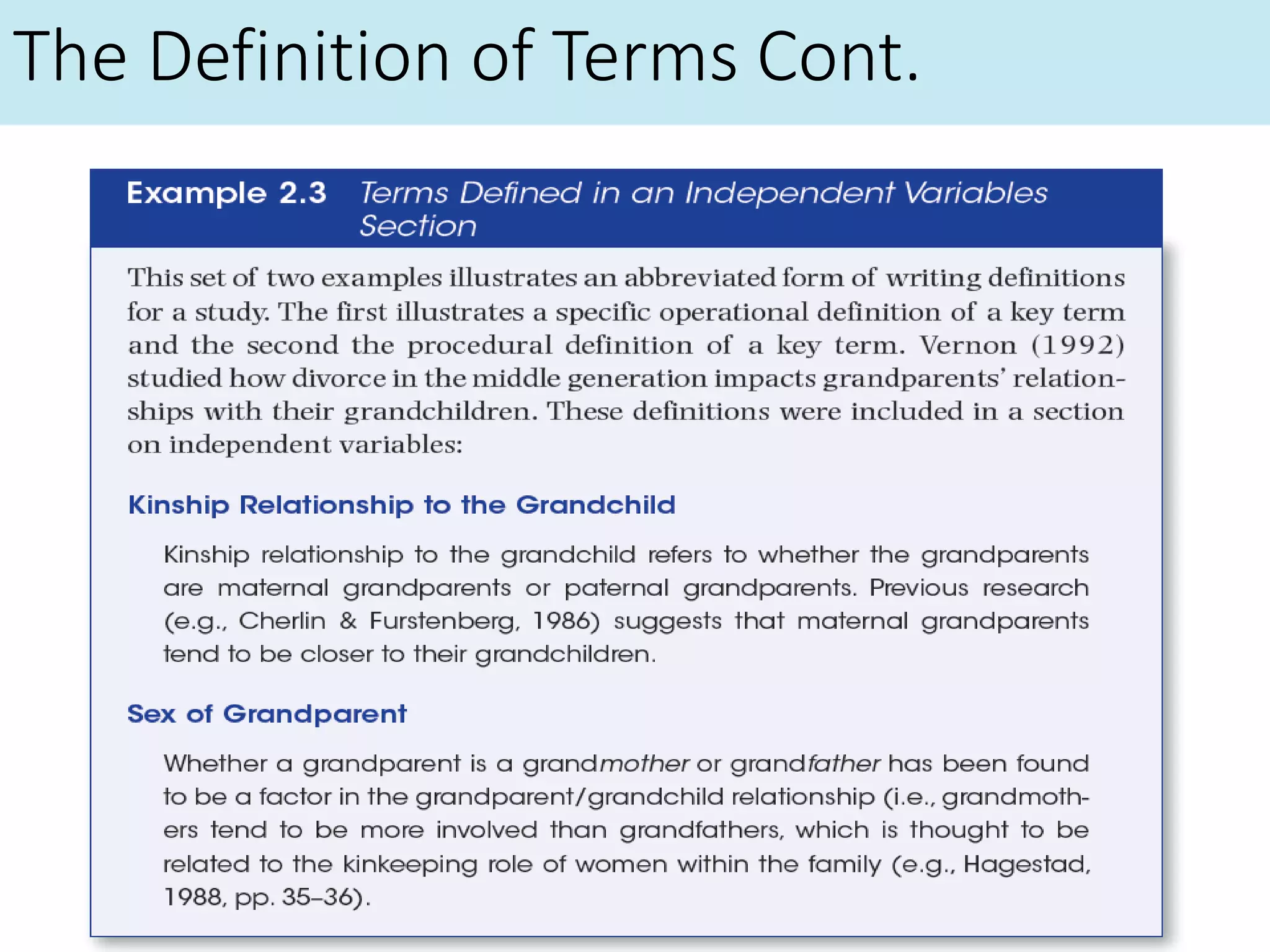
Example 2.3. Terms Defined in an Independent Variables Section
Example 2.4. Terms Defined in a Mixed Methods Dissertation
A Quantitative or Mixed Methods Literature Review
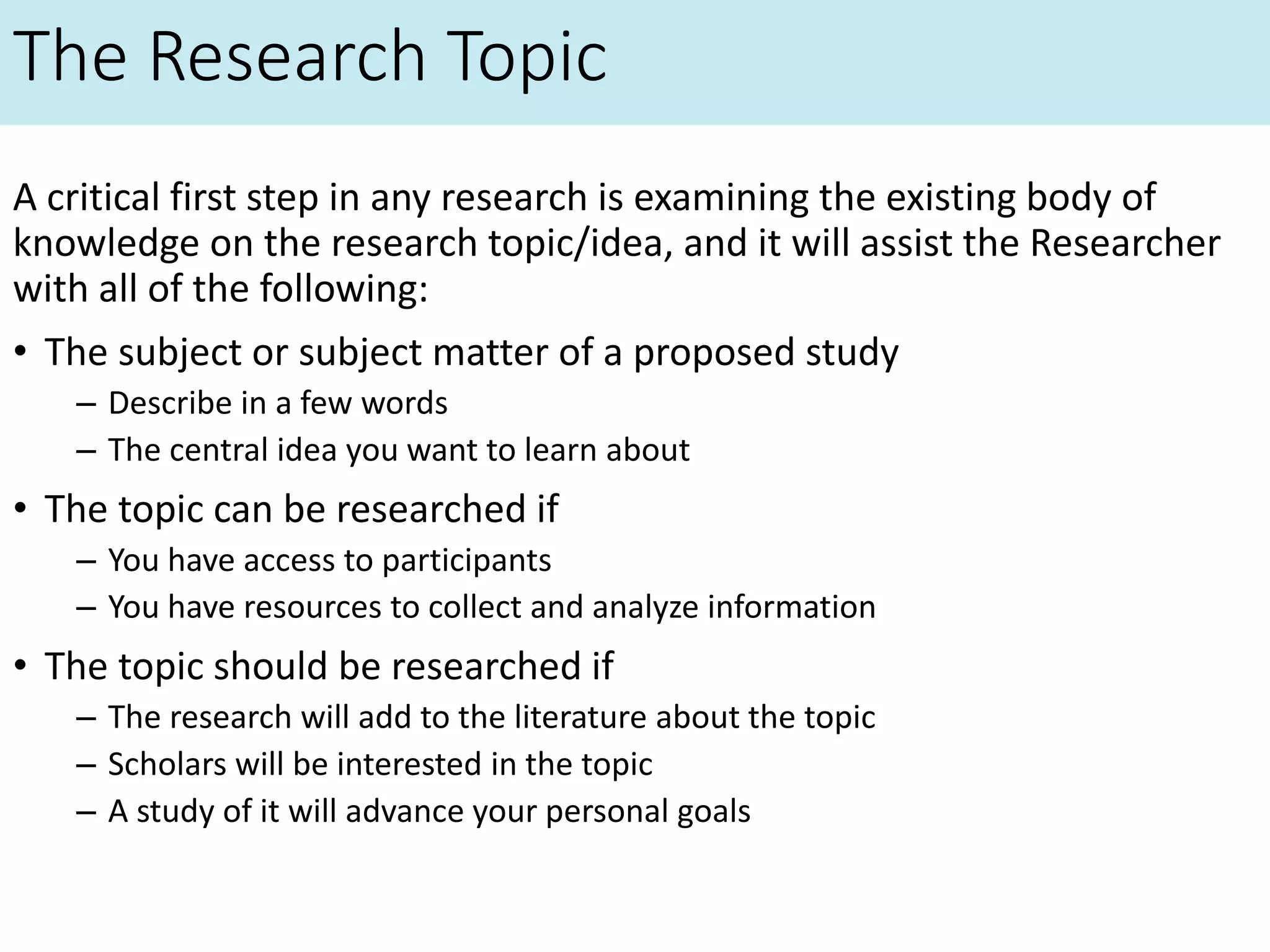
The Research Topic
A critical first step in any research is examining the existing body of
knowledge on the research topic/idea, and it will assist the Researcher
with all of the following:
• The subject or subject matter of a proposed study
– Describe in a few words
– The central idea you want to learn about
• The topic can be researched if
– You have access to participants
– You have resources to collect and analyze information
• The topic should be researched if
– The research will add to the literature about the topic
– Scholars will be interested in the topic
– A study of it will advance your personal goals
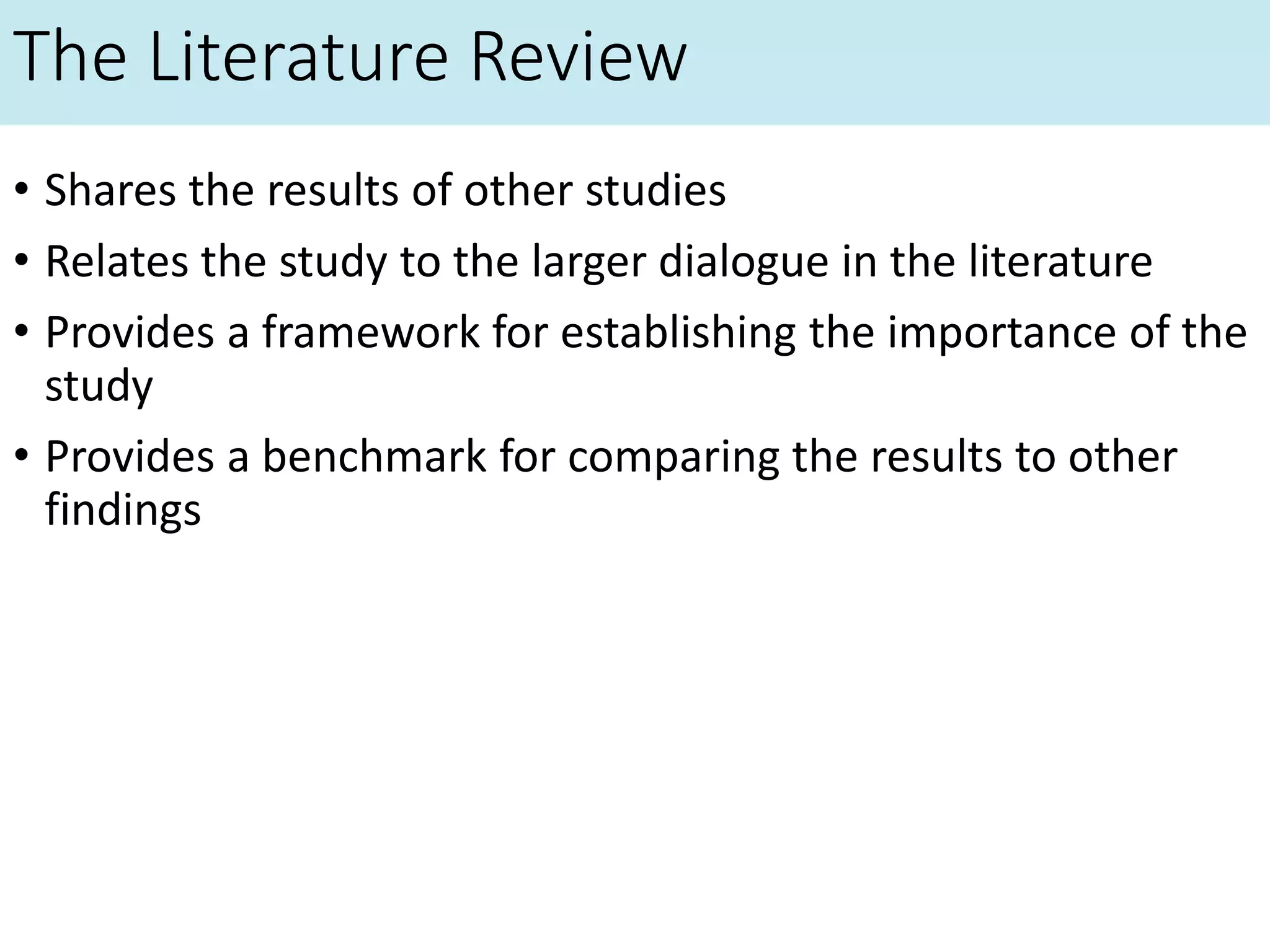
The Literature Review
• Shares the results of other studies
• Relates the study to the larger dialogue in the literature
• Provides a framework for establishing the importance of the
study
• Provides a benchmark for comparing the results to other
findings
The Use of Literature
The use and length of the literature varies based on the forum: research
proposal, dissertation or journal article. Despite this, the literature may:
• provide a summary of major studies on the research problem
• demonstrate the writers knowledge of the topic/problem/issue
• integrate what others have done and said about the topic/problem/issue
• may criticize previous scholarly works on the topic/problem/issue
• may allow for connections between related topics
• may elucidate the central issues in the field
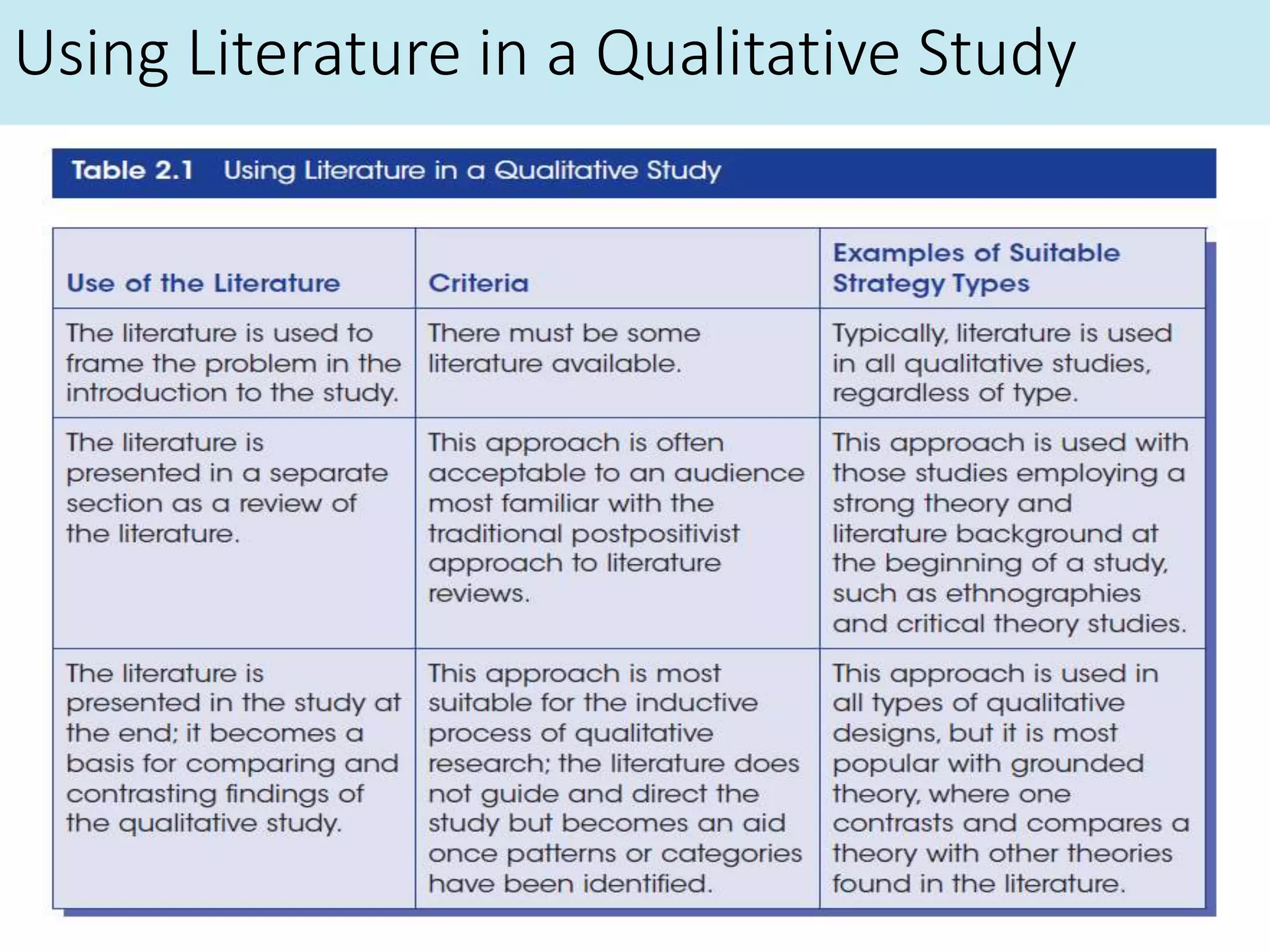
Using Literature in a Qualitative Study
The Use of Literature in a Quantitative Study
In quantitative studies the literature is used deductively as it provides a
framework for the research questions and hypothesis
• Provide direction to the research questions and hypotheses
• Introduce a problem
• Introduce and describe the theory that will be used
• Examine the usefulness of the theory
• Compare results with existing literature or predictions
The Use of Literature in a Mixed Methods Study
In mixed methods studies Researchers use the literature:
• in either a quantitative or qualitative approach
• in a manner consistent with either quantitative or qualitative approach
• relative to the intended audience
Irrespective of the type of study, choose one of the following types of literature
reviews:
1. Integrative
2. Critical
3. Building bridges among topics
4. Identification of central issues
Steps in Conducting a Literature Review
• Identify key words
• Search library catalogs
• Identify about 50 research reports in articles or books
• Photocopy those that are central to your topic
• Design a literature map
• Draft summaries of the relevant articles
• Write a literature review, organizing it by important concepts
Searching Computerized Databases
• Computerized databases are readily available through libraries and the
internet.
• These databases provide access to numerous journal articles,
conference papers and dissertations on a wealth of topics.
Some of these online data bases include:
- ERIC - ProQuest - EBSCO
- Sociological Abstracts - PsycINFO - PubMed
- Science direct - Google scholar
-Social Science Citation Index (SSCI)
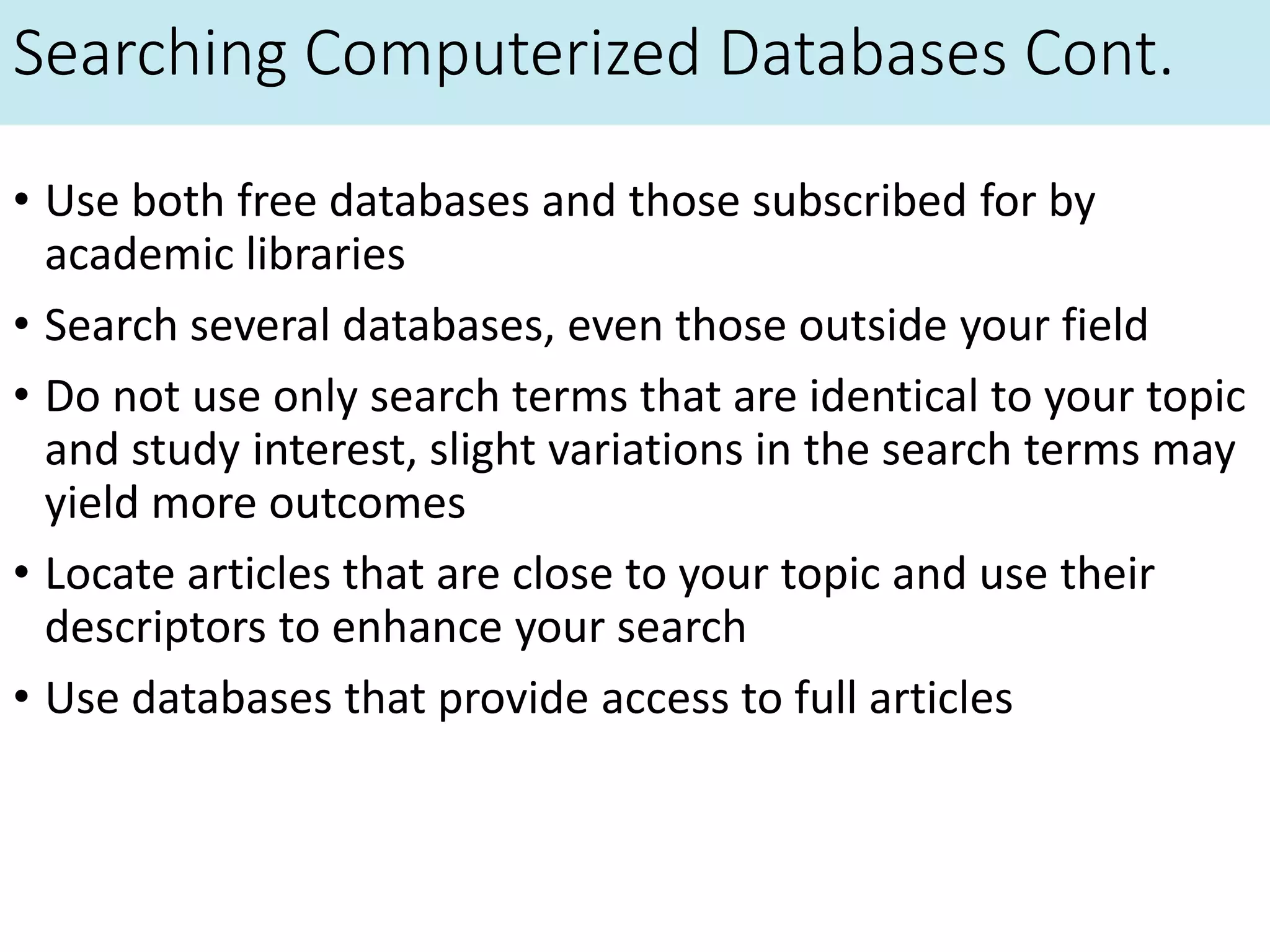
Searching Computerized Databases Cont.
• Use both free databases and those subscribed for by
academic libraries
• Search several databases, even those outside your field
• Do not use only search terms that are identical to your topic
and study interest, slight variations in the search terms may
yield more outcomes
• Locate articles that are close to your topic and use their
descriptors to enhance your search
• Use databases that provide access to full articles
Selecting Literature Material
• Start with broad syntheses (such as encyclopedias) if you
are new to the topic
• Turn to journal articles in national journals
• Best source for research reports
• Next consider books
• Then examine conference papers
• Scan for dissertations
• Last consider reports on the web
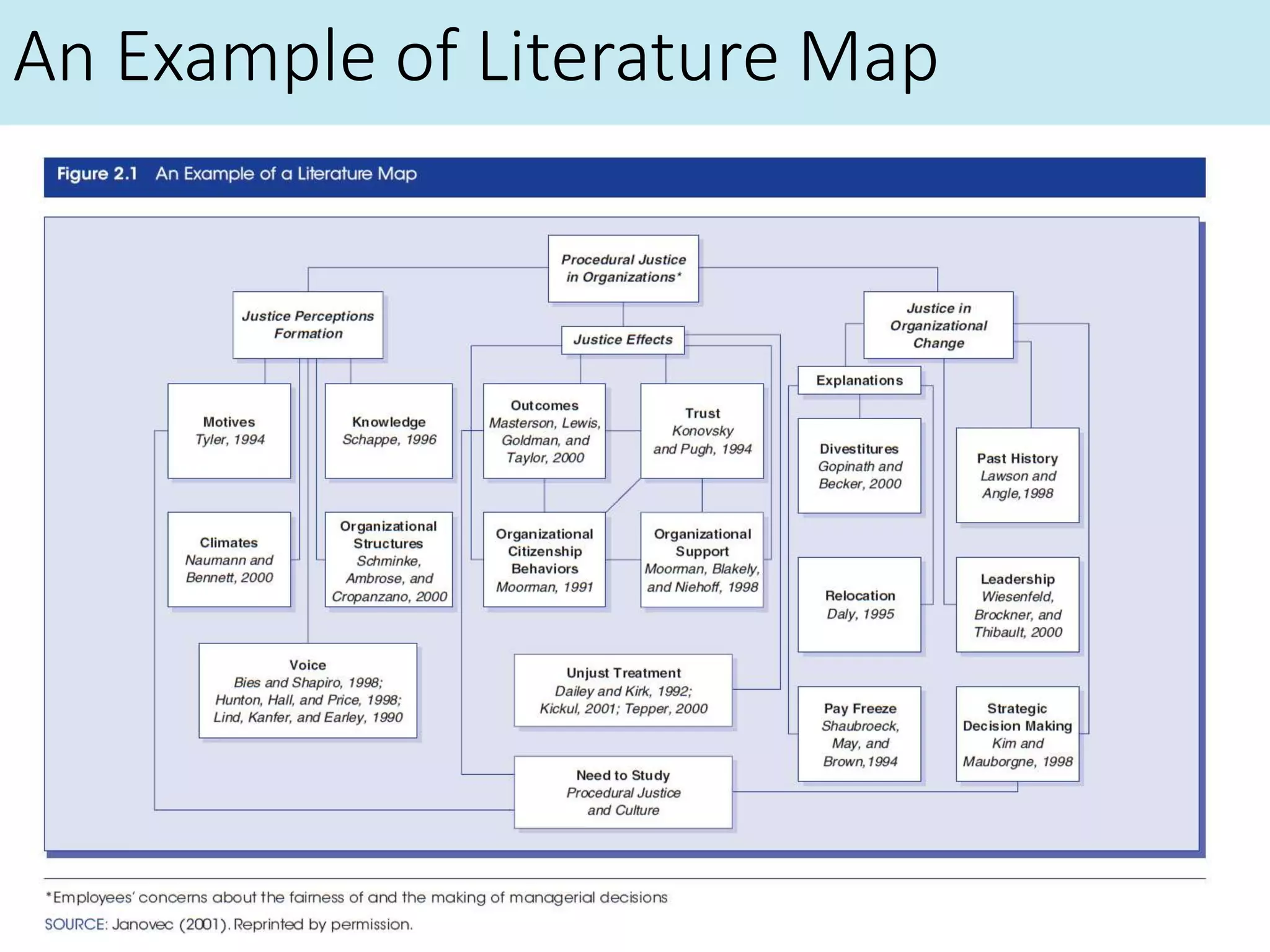
Literature Map of Research
• A literature map is a visual summary of existing research on
a topic
• The structure of the literature map may be:
• a hierarchical pattern
• a flowchart layout
• a series of circles
An Example of Literature Map
Abstracting Studies
• Draft abstracts that summarize selected articles
• For research studies:
• Mention the problem
• State the central purpose
• State information about the population and sample
• Review key results
• Point out methodological flaws (if a methodological review)
• For nonempirical studies (essays, opinions, etc.)
• Mention the problem
• State the central theme
• State the major conclusions
• Mention flaws in reasoning or logic (if a methodological review)
Style Manuals
Style manuals provide guidelines for producing scholarly work
and include directions on the following:
– Citing references
– Creating headings
– Presenting tables and figures
– In-text citation/references
– End-of-text references
– Footnotes (not used in all style manuals)
Reminder: Consistently use the chosen style manual
The Definition of Terms
• Identify and define terms that readers need to understand a proposal
• Define terms introduced in all sections of the research plan
• The title of the study
• The problem statement
• The purpose statement
• The research questions, hypotheses, or objectives
• The literature review
• The theory base of the study
• The methods section
The Definition of Terms Cont.
• Qualitative studies are inductive and evolutionary in nature
hence the definition of terms may appear later in the
written report, perhaps in the data analysis.
• Quantitative studies are deductive with a fixed set of
objectives, hence all relevant terms are comprehensively
defined earlier in the study.
• In Mixed methods studies the definition of relevant terms
follows the use of (earlier or later in the study) and
emphasis placed on quantitative and qualitative
approaches.
The Definition of Terms Cont.
• Define terms when they first appear in the manuscript
• Use specific operational definitions
• Do not define terms using everyday language, be guided by
the literature
• Define terms so that they accomplish different goals
• One may use a definition of terms section in the manuscript
The Definition of Terms Cont.
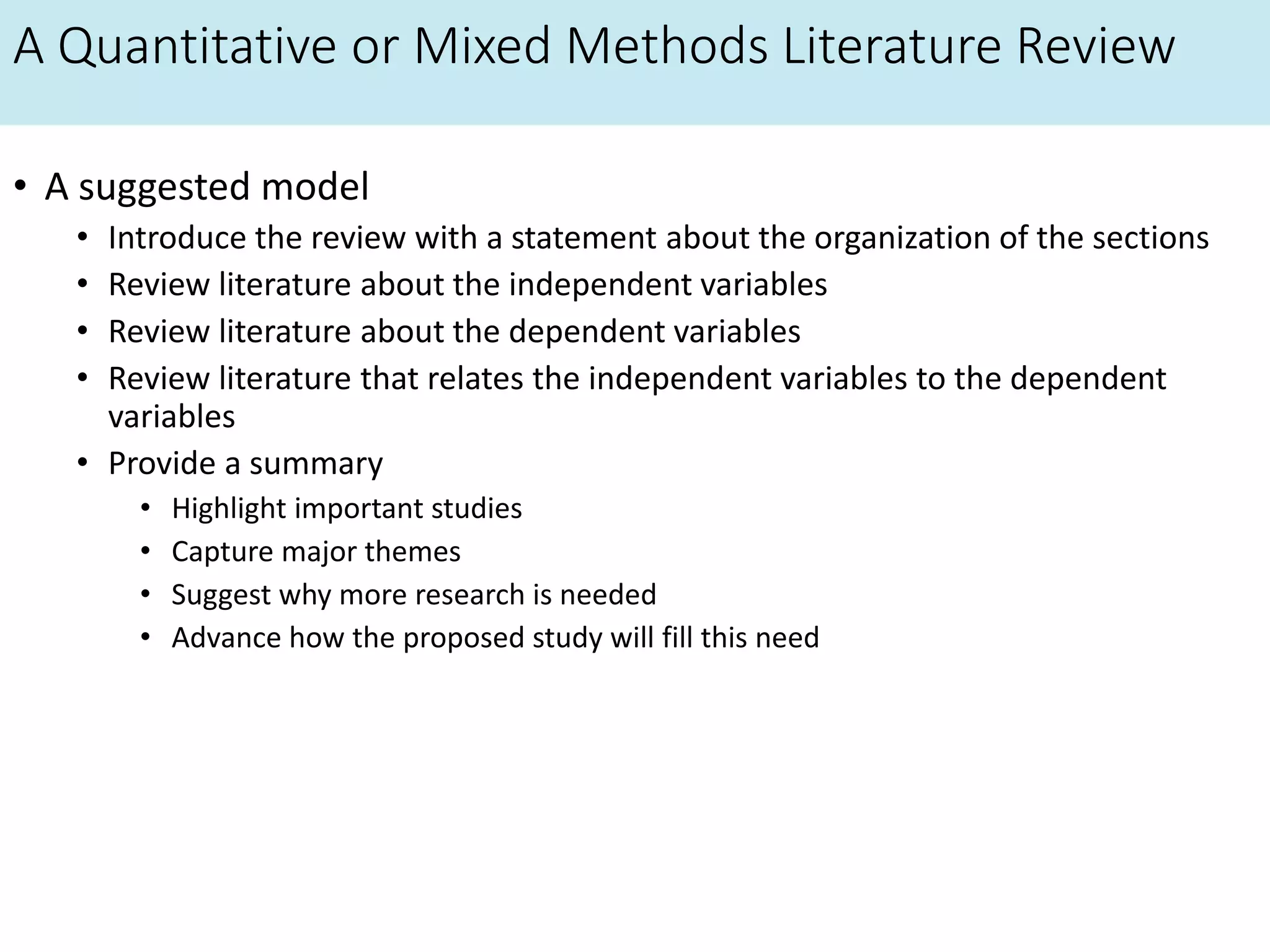
A Quantitative or Mixed Methods Literature Review
• A suggested model
• Introduce the review with a statement about the organization of the sections
• Review literature about the independent variables
• Review literature about the dependent variables
• Review literature that relates the independent variables to the dependent
variables
• Provide a summary
• Highlight important studies
• Capture major themes
• Suggest why more research is needed
• Advance how the proposed study will fill this need

Chapter Two Review of the Literature

  • 1.
    Chapter Two: Review ofthe Literature
  • 2.
    Chapter Outline Review ofthe Literature The Research Topic The Literature Review The Use of the Literature Design Techniques Steps in Conducting a Literature Review Searching Computerized Databases A Priority for Selecting Literature Material A Literature Map of the Research Abstracting Studies Example 2.1. Literature Review Abstract in a Quantitative Study Example 2.2. Literature Review Abstract in a Study Advancing a Typology Style Manuals The Definition of Terms Example 2.3. Terms Defined in an Independent Variables Section Example 2.4. Terms Defined in a Mixed Methods Dissertation A Quantitative or Mixed Methods Literature Review
  • 3.
    The Research Topic Acritical first step in any research is examining the existing body of knowledge on the research topic/idea, and it will assist the Researcher with all of the following: • The subject or subject matter of a proposed study – Describe in a few words – The central idea you want to learn about • The topic can be researched if – You have access to participants – You have resources to collect and analyze information • The topic should be researched if – The research will add to the literature about the topic – Scholars will be interested in the topic – A study of it will advance your personal goals
  • 4.
    The Literature Review •Shares the results of other studies • Relates the study to the larger dialogue in the literature • Provides a framework for establishing the importance of the study • Provides a benchmark for comparing the results to other findings
  • 5.
    The Use ofLiterature The use and length of the literature varies based on the forum: research proposal, dissertation or journal article. Despite this, the literature may: • provide a summary of major studies on the research problem • demonstrate the writers knowledge of the topic/problem/issue • integrate what others have done and said about the topic/problem/issue • may criticize previous scholarly works on the topic/problem/issue • may allow for connections between related topics • may elucidate the central issues in the field
  • 6.
    Using Literature ina Qualitative Study
  • 7.
    The Use ofLiterature in a Quantitative Study In quantitative studies the literature is used deductively as it provides a framework for the research questions and hypothesis • Provide direction to the research questions and hypotheses • Introduce a problem • Introduce and describe the theory that will be used • Examine the usefulness of the theory • Compare results with existing literature or predictions
  • 8.
    The Use ofLiterature in a Mixed Methods Study In mixed methods studies Researchers use the literature: • in either a quantitative or qualitative approach • in a manner consistent with either quantitative or qualitative approach • relative to the intended audience Irrespective of the type of study, choose one of the following types of literature reviews: 1. Integrative 2. Critical 3. Building bridges among topics 4. Identification of central issues
  • 9.
    Steps in Conductinga Literature Review • Identify key words • Search library catalogs • Identify about 50 research reports in articles or books • Photocopy those that are central to your topic • Design a literature map • Draft summaries of the relevant articles • Write a literature review, organizing it by important concepts
  • 10.
    Searching Computerized Databases •Computerized databases are readily available through libraries and the internet. • These databases provide access to numerous journal articles, conference papers and dissertations on a wealth of topics. Some of these online data bases include: - ERIC - ProQuest - EBSCO - Sociological Abstracts - PsycINFO - PubMed - Science direct - Google scholar -Social Science Citation Index (SSCI)
  • 11.
    Searching Computerized DatabasesCont. • Use both free databases and those subscribed for by academic libraries • Search several databases, even those outside your field • Do not use only search terms that are identical to your topic and study interest, slight variations in the search terms may yield more outcomes • Locate articles that are close to your topic and use their descriptors to enhance your search • Use databases that provide access to full articles
  • 12.
    Selecting Literature Material •Start with broad syntheses (such as encyclopedias) if you are new to the topic • Turn to journal articles in national journals • Best source for research reports • Next consider books • Then examine conference papers • Scan for dissertations • Last consider reports on the web
  • 13.
    Literature Map ofResearch • A literature map is a visual summary of existing research on a topic • The structure of the literature map may be: • a hierarchical pattern • a flowchart layout • a series of circles
  • 14.
    An Example ofLiterature Map
  • 15.
    Abstracting Studies • Draftabstracts that summarize selected articles • For research studies: • Mention the problem • State the central purpose • State information about the population and sample • Review key results • Point out methodological flaws (if a methodological review) • For nonempirical studies (essays, opinions, etc.) • Mention the problem • State the central theme • State the major conclusions • Mention flaws in reasoning or logic (if a methodological review)
  • 16.
    Style Manuals Style manualsprovide guidelines for producing scholarly work and include directions on the following: – Citing references – Creating headings – Presenting tables and figures – In-text citation/references – End-of-text references – Footnotes (not used in all style manuals) Reminder: Consistently use the chosen style manual
  • 17.
    The Definition ofTerms • Identify and define terms that readers need to understand a proposal • Define terms introduced in all sections of the research plan • The title of the study • The problem statement • The purpose statement • The research questions, hypotheses, or objectives • The literature review • The theory base of the study • The methods section
  • 18.
    The Definition ofTerms Cont. • Qualitative studies are inductive and evolutionary in nature hence the definition of terms may appear later in the written report, perhaps in the data analysis. • Quantitative studies are deductive with a fixed set of objectives, hence all relevant terms are comprehensively defined earlier in the study. • In Mixed methods studies the definition of relevant terms follows the use of (earlier or later in the study) and emphasis placed on quantitative and qualitative approaches.
  • 19.
    The Definition ofTerms Cont. • Define terms when they first appear in the manuscript • Use specific operational definitions • Do not define terms using everyday language, be guided by the literature • Define terms so that they accomplish different goals • One may use a definition of terms section in the manuscript
  • 20.
    The Definition ofTerms Cont.
  • 21.
    A Quantitative orMixed Methods Literature Review • A suggested model • Introduce the review with a statement about the organization of the sections • Review literature about the independent variables • Review literature about the dependent variables • Review literature that relates the independent variables to the dependent variables • Provide a summary • Highlight important studies • Capture major themes • Suggest why more research is needed • Advance how the proposed study will fill this need