Chapter 3: Locating and Reviewing Related Literature Kristen Fuller and Pan Zhang
The Purpose of Reviewing Related Literature To relate previous research and theory to the problem under investigation. http://www.youtube.com/watch?v=2IUZWZX4OGI Refining the research problem Establishing the conceptual or  theoretical orientation Developing significance Identifying methodological limitations Identifying contradictory findings Developing research hypotheses Learning about new information
Step 1: Select a Topic & Key Terms  Select a topic & key terms - Have idea of topic - Identify most important terms *use related terms to topic - Use terms in computer database Jump in or refine terms - ERIC (Education Resources Information Center)  Thesaurus or PsycINFO Thesaurus - Controlled Vocabulary – descriptors vs. key words - Search thesaurus for term matches - Alternative – search library catalog
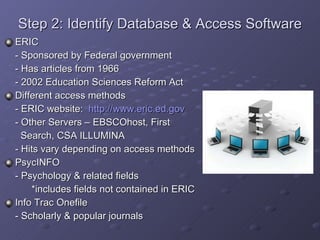
Step 2: Identify Database & Access Software ERIC - Sponsored by Federal government - Has articles from 1966 - 2002 Education Sciences Reform Act Different access methods - ERIC website:  http://www.eric.ed.gov - Other Servers – EBSCOhost, First    Search, CSA ILLUMINA - Hits vary depending on access methods PsycINFO - Psychology & related fields   *includes fields not contained in ERIC Info Trac Onefile - Scholarly & popular journals
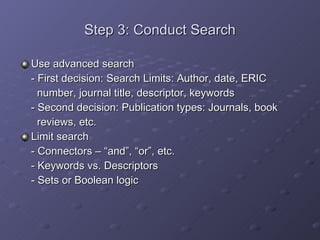
Step 3: Conduct Search Use advanced search - First decision: Search Limits: Author, date, ERIC    number, journal title, descriptor, keywords - Second decision: Publication types: Journals, book    reviews, etc. Limit search - Connectors – “and”, “or”, etc. - Keywords vs. Descriptors - Sets or Boolean logic
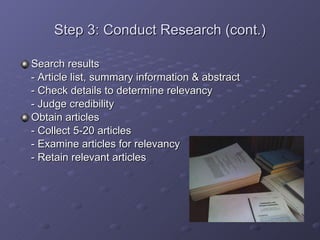
Step 3: Conduct Research (cont.) Search results - Article list, summary information & abstract - Check details to determine relevancy - Judge credibility Obtain articles - Collect 5-20 articles - Examine articles for relevancy - Retain relevant articles
Discussion Question: What is the difference between a primary and secondary source? Give examples of each. Why is it important to be careful with secondary sources?
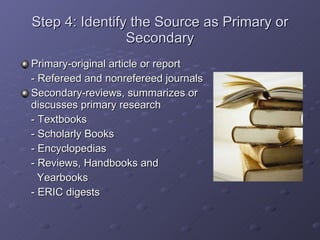
Step 4: Identify the Source as Primary or Secondary Primary-original article or report - Refereed and nonrefereed journals Secondary-reviews, summarizes or discusses primary research - Textbooks - Scholarly Books - Encyclopedias - Reviews, Handbooks and    Yearbooks - ERIC digests
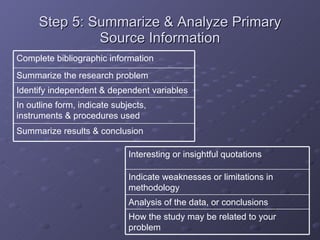
Step 5: Summarize & Analyze Primary Source Information Summarize results & conclusion In outline form, indicate subjects, instruments & procedures used Identify independent & dependent variables Summarize the research problem Complete bibliographic information How the study may be related to your problem Analysis of the data, or conclusions Indicate weaknesses or limitations in methodology Interesting or insightful quotations
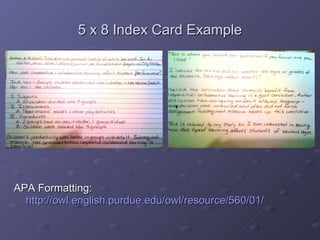
5 x 8 Index Card Example APA Formatting:   http://owl.english.purdue.edu/owl/resource/560/01/
Discussion Question: What would be the differences and similarities among the literature reviews for qualitative, quantitative and mixed method research?
Step 6: Organize & Write the Review Quantitative Reviews - often detailed and found in the beginning sections of an article. Step 1 – Provide brief summary of articles Step 2 – Analyze the studies Step 3 – State explicitly how reviewed studies relate to present research Qualitative Reviews - tend to be brief in the beginning but more integrated throughout. Thematic – topic is identified and discussed, without a detailed analysis of individual studies. Most qualitative reviews are thematic.
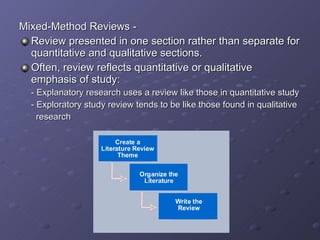
Mixed-Method Reviews - Review presented in one section rather than separate for quantitative and qualitative sections. Often, review reflects quantitative or qualitative emphasis of study: - Explanatory research uses a review like those in quantitative study - Exploratory study review tends to be like those found in qualitative    research
Review of Literature Identify which part of the article is the review of literature Scan the review to get an idea of the general structure & organization When reading, highlight points of references, places where findings from other studies are summarized & analyses of the studies Determine how well the review corresponds to the following criteria:
Criteria for Evaluating the Review of Literature The review of literature should: Adequately cover previous research on your topic Cite actual findings from other studies Be up-to-date Analyze as well as summarize previous studies Be organized logically by topic, not by author Briefly summarize minor studies & discuss major studies in detail Relate previous studies explicitly to the research problem or methods Provide a logical basis for the hypothesis Establish a theoretical or conceptual framework for the problem Help establish the significance of the research

Chapter 3

  • 1.
    Chapter 3: Locatingand Reviewing Related Literature Kristen Fuller and Pan Zhang
  • 2.
    The Purpose ofReviewing Related Literature To relate previous research and theory to the problem under investigation. http://www.youtube.com/watch?v=2IUZWZX4OGI Refining the research problem Establishing the conceptual or theoretical orientation Developing significance Identifying methodological limitations Identifying contradictory findings Developing research hypotheses Learning about new information
  • 3.
    Step 1: Selecta Topic & Key Terms Select a topic & key terms - Have idea of topic - Identify most important terms *use related terms to topic - Use terms in computer database Jump in or refine terms - ERIC (Education Resources Information Center) Thesaurus or PsycINFO Thesaurus - Controlled Vocabulary – descriptors vs. key words - Search thesaurus for term matches - Alternative – search library catalog
  • 4.
    Step 2: IdentifyDatabase & Access Software ERIC - Sponsored by Federal government - Has articles from 1966 - 2002 Education Sciences Reform Act Different access methods - ERIC website: http://www.eric.ed.gov - Other Servers – EBSCOhost, First Search, CSA ILLUMINA - Hits vary depending on access methods PsycINFO - Psychology & related fields *includes fields not contained in ERIC Info Trac Onefile - Scholarly & popular journals
  • 5.
    Step 3: ConductSearch Use advanced search - First decision: Search Limits: Author, date, ERIC number, journal title, descriptor, keywords - Second decision: Publication types: Journals, book reviews, etc. Limit search - Connectors – “and”, “or”, etc. - Keywords vs. Descriptors - Sets or Boolean logic
  • 6.
    Step 3: ConductResearch (cont.) Search results - Article list, summary information & abstract - Check details to determine relevancy - Judge credibility Obtain articles - Collect 5-20 articles - Examine articles for relevancy - Retain relevant articles
  • 7.
    Discussion Question: Whatis the difference between a primary and secondary source? Give examples of each. Why is it important to be careful with secondary sources?
  • 8.
    Step 4: Identifythe Source as Primary or Secondary Primary-original article or report - Refereed and nonrefereed journals Secondary-reviews, summarizes or discusses primary research - Textbooks - Scholarly Books - Encyclopedias - Reviews, Handbooks and Yearbooks - ERIC digests
  • 9.
    Step 5: Summarize& Analyze Primary Source Information Summarize results & conclusion In outline form, indicate subjects, instruments & procedures used Identify independent & dependent variables Summarize the research problem Complete bibliographic information How the study may be related to your problem Analysis of the data, or conclusions Indicate weaknesses or limitations in methodology Interesting or insightful quotations
  • 10.
    5 x 8Index Card Example APA Formatting: http://owl.english.purdue.edu/owl/resource/560/01/
  • 11.
    Discussion Question: Whatwould be the differences and similarities among the literature reviews for qualitative, quantitative and mixed method research?
  • 12.
    Step 6: Organize& Write the Review Quantitative Reviews - often detailed and found in the beginning sections of an article. Step 1 – Provide brief summary of articles Step 2 – Analyze the studies Step 3 – State explicitly how reviewed studies relate to present research Qualitative Reviews - tend to be brief in the beginning but more integrated throughout. Thematic – topic is identified and discussed, without a detailed analysis of individual studies. Most qualitative reviews are thematic.
  • 13.
    Mixed-Method Reviews -Review presented in one section rather than separate for quantitative and qualitative sections. Often, review reflects quantitative or qualitative emphasis of study: - Explanatory research uses a review like those in quantitative study - Exploratory study review tends to be like those found in qualitative research
  • 14.
    Review of LiteratureIdentify which part of the article is the review of literature Scan the review to get an idea of the general structure & organization When reading, highlight points of references, places where findings from other studies are summarized & analyses of the studies Determine how well the review corresponds to the following criteria:
  • 15.
    Criteria for Evaluatingthe Review of Literature The review of literature should: Adequately cover previous research on your topic Cite actual findings from other studies Be up-to-date Analyze as well as summarize previous studies Be organized logically by topic, not by author Briefly summarize minor studies & discuss major studies in detail Relate previous studies explicitly to the research problem or methods Provide a logical basis for the hypothesis Establish a theoretical or conceptual framework for the problem Help establish the significance of the research