
Academic writing and publishing
Presented By:
GhulamFarid
PhD Scholar- Information Management
About the Author- James Hartley
• James Hartley is Research Professor at the School of Psychology, The University of
Keela, UK
• Best Psychologist in UK
• President of British Psychology Society
• Expertise & Skills
• Writing, Academic Writing
• Creative Thinking, Design Thinking
• Information Graphic, Visual Information
• Behavioral Sciences, Cognitive Psychology
• Publications- 283
• Citations- 4,339
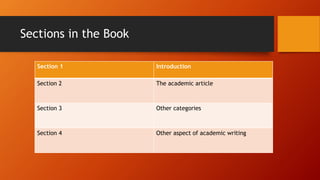
Sections in the Book
Section 1 Introduction
Section 2 The academic article
Section 3 Other categories
Section 4 Other aspect of academic writing
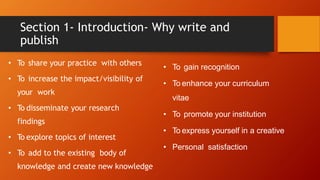
Section 1- Introduction- Why write and
publish
• To share your practice with others
• To increase the impact/visibility of
your work
• To disseminate your research
findings
• To explore topics of interest
• To add to the existing body of
knowledge and create new knowledge
• To gain recognition
• To enhance your curriculum
vitae
• To promote your institution
• To express yourself in a creative
• Personal satisfaction
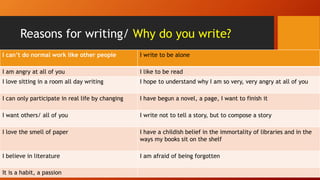
Reasons for writing/ Why do you write?
I can’t do normal work like other people I write to be alone
I am angry at all of you I like to be read
I love sitting in a room all day writing I hope to understand why I am so very, very angry at all of you
I can only participate in real life by changing I have begun a novel, a page, I want to finish it
I want others/ all of you I write not to tell a story, but to compose a story
I love the smell of paper I have a childish belief in the immortality of libraries and in the
ways my books sit on the shelf
I believe in literature I am afraid of being forgotten
It is a habit, a passion
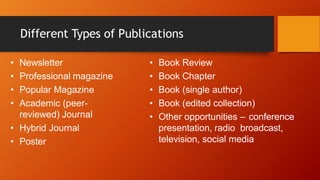
Different Types of Publications
• Newsletter
• Professional magazine
• Popular Magazine
• Academic (peer-
reviewed) Journal
• Hybrid Journal
• Poster
• Book Review
• Book Chapter
• Book (single author)
• Book (edited collection)
• Other opportunities – conference
presentation, radio broadcast,
television, social media
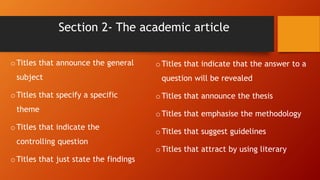
Section 2- The academic article
oTitles that announce the general
subject
oTitles that specify a specific
theme
oTitles that indicate the
controlling question
oTitles that just state the findings
oTitles that indicate that the answer to a
question will be revealed
oTitles that announce the thesis
oTitles that emphasise the methodology
oTitles that suggest guidelines
oTitles that attract by using literary
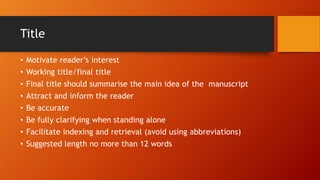
Title
• Motivate reader’s interest
• Working title/final title
• Final title should summarise the main idea of the manuscript
• Attract and inform the reader
• Be accurate
• Be fully clarifying when standing alone
• Facilitate indexing and retrieval (avoid using abbreviations)
• Suggested length no more than 12 words
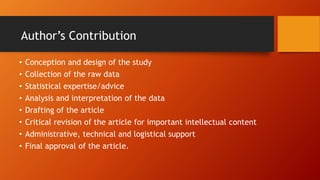
Author’s Contribution
• Conception and design of the study
• Collection of the raw data
• Statistical expertise/advice
• Analysis and interpretation of the data
• Drafting of the article
• Critical revision of the article for important intellectual content
• Administrative, technical and logistical support
• Final approval of the article.
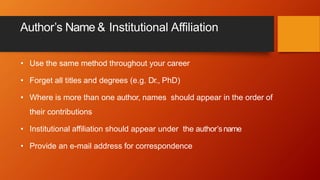
Author’s Name & Institutional Affiliation
• Use the same method throughout your career
• Forget all titles and degrees (e.g. Dr., PhD)
• Where is more than one author, names should appear in the order of
their contributions
• Institutional affiliation should appear under the author’sname
• Provide an e-mail address for correspondence
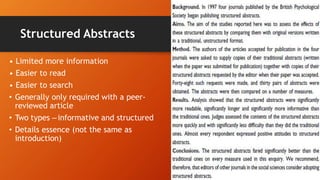
Structured Abstracts
• Limited more information
• Easier to read
• Easier to search
• Generally only required with a peer-
reviewed article
• Two types –informative and structured
• Details essence (not the same as
introduction)
Cont.….
• Compare the abstract with an outline of the manuscript’s headings to verify
its accuracy
• Use clear and concise language
• Use verbs rather than their noun equivalent (investigates rather than
investigation)
• Use active rather than passive verbs
• Begin the abstract with the most important points
• Length determined by journal–typically range from 150 to 250 words
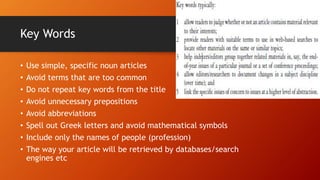
Key Words
• Use simple, specific noun articles
• Avoid terms that are too common
• Do not repeat key words from the title
• Avoid unnecessary prepositions
• Avoid abbreviations
• Spell out Greek letters and avoid mathematical symbols
• Include only the names of people (profession)
• The way your article will be retrieved by databases/search
engines etc
Introductions
• Introduces the practical content of the paper/the research question/the
problem
• Tells why this issue/problem is important
• Sets the scene
• States the purpose
• States the scope
• States how issue is addressed/Describes the research strategy
• Explains how this work relates to previous work in this area
• Usually starts from the general and progresses to the specific
Literature review
• Tells what others have found on the topic
• Provides a context
• Understanding about knowledge
• Author is familiar with thinking on a topic
• Understands where their work fits
• Highly selective and specific
• Link your findings and conclusions back to the literature review
Methods
• Describes how the study will be
• Different types of studies have different methodologies
• Subsections where relevant e.g.
• Participant characteristics,
• sampling procedures,
• research design
Results
• Summary of collected data
• Analysis of data
• Findings
• Interpreted
• Relating them about hypotheses and methods
• Where required e.g. statistics, tables, charts, maps, or quotes
Discussions
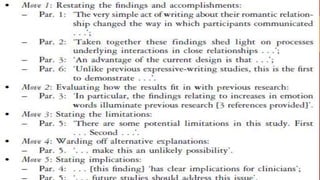
• Move 1: Examine, interpret and qualify results
• Move 2: Evaluate how the results fit in with the previous findings – do
they deny, qualify, agree or go beyond them?
• Move 3: List potential limitations to the study
• Move 4: Offer an interpretation/explanation
• Move 5: State the implications and recommend further research
References & Footnotes
References
• Follow journal guidelines
• Complete
• Accurate
Footnotes
Provide additional content
Drafting and Redrafting
• All writing is rewriting
• Draft and redraft
• Number, date and save drafts
• Refer back to your abstract
• Ask a critical colleague to read
• Revise title, abstract & article
• Check references against journal guidelines
• Spell check
• Date and File preprint (pre-refereeing)
• Let go
Submission
• Professional Journal – editor
• Academic Journal – peer-review
• Usually double blind peer review
– Accept as is
– Accept with revisions
– Revise and resubmit
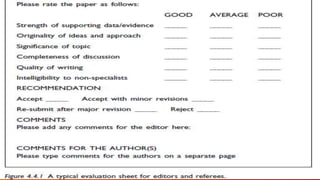
– Reject
Responding to referees
• Referee 1: Accept
• Referee 2: Accept with revision. This paper addresses an interesting and
important topic . . . Despite this . . the results are somewhat of a mixed
bag overall. Accordingly I would recommend the following revisions
before it is considered for publication.
• Referee 3: Reject. [. . .] This paper conflates (this technical task) with
some non-technical terms, some common-sense beliefs about reading
and writing that there is no strong evidence for, normative expectations
of what texts should be and moralistic stances towards textual patterns.
Why editors reject manuscripts
• Author guidelines not followed
• Not in-depth (little substance)
• Bad writing (lack of clarity)
• Subject of little/no interest to readers
• Poor statistics, tables, figures
• Subject or data out of date
• Unprofessional appearance
• Title
• Too simple – reporting
• Written at the wrong level
Section 3- Other Categories- Books
• Different Types of the books
• The popular science book
• The edited collection of previously published papers by the same author
• The edited collection of previously published papers written by different authors
• The edited collection of original chapters written by several different authors
• The conference collection
• The handbook
• The individually authored textbook
Theses
• A thesis is much like a graduate student: It has a limited purpose and a small
audience; it is often insecure and defensive, justifying itself with extreme
documentation; it is too narrowly focussed; and it has not yet developed a style of
its own. (Luey, 2002, p. 34)
Different kinds of thesis
• Traditional (simple)
• Introduction
• literature review
• materials and methods
• Results
• discussion and conclusions
• the IMRAD
Traditional (complex)
• introduction;
• background to the study
• literature review;
• Background theory and methods (optional);
• study 1 – IMRAD;
• study 2 – IMRAD,
• study 3 etc.;
• general discussion and conclusions.
Strategies for the beginning thesis writer
• Try to be well organised
• Examine two or three theses in your discipline/area
• Write from the beginning
• Make and keep clearly categorized (back up data)
• Discuss what you are doing it/ with fellow students all the time
• Think of how you might publish each chapter
• Appropriate procedures for presenting text- Reference
• Read the requirements of your institution
• Submit regular drafts of subsections of your thesis to your supervisor
• Make sure your supervisor eventually sees the thesis as a whole
Conference papers
• “The essential launching pad for nearly all scholarly careers” (Gould, 1995, p. 37)
• Power Point
• computer-based slides are most common
• appreciate the clarity
• seven words per line, and seven lines per slide (7*7 rule) some (5*5)
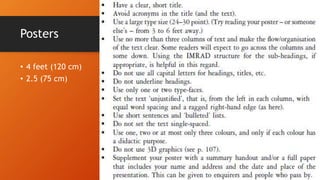
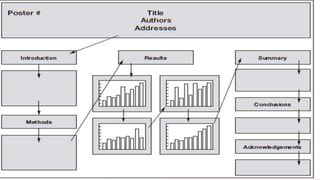
Posters
• 4 feet (120 cm)
• 2.5 (75 cm)
Section 4- Other aspects of academic writing
• Finding, keeping and disseminating information
• It is accessible twenty-four hours a day
• You do not have to visit a library
• To find information relatively quickly and conveniently
• You can choose between saving, printing or reading the information from the
computer screen
• Sources on the Internet are often more up to date than sources in paper format
Choosing where to publish
• Author decide where to published their article
• 20,000–25,000 peer-reviewed academic journals
• In UK and USA- Mostly online journals
• Most authors preferred they published their work in peer reviewed
Some typical criticisms of impact factors
• Does not necessarily reflect the quality of all of the articles
• No correction is made for self-citations
• Review articles are heavily referenced
• Books are not included in calculating impact factors
• Impact factors vary in different disciplines
• Small research areas tend to lack journals with high impact factors
• High-quality research in non-English journals is rarely cited.
Open-access journal
• Author puts findings/paper online for free
• Author pays to publish online in an open-access journal
• Author’s institution pays for the author to publish online in an open access journal
• Research funding agencies pay for publication of the research findings
• Online in an open-access journal
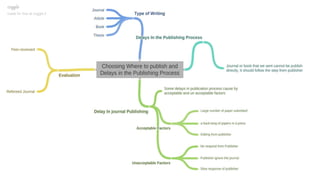
Delays in the publishing process
WRITER’S BLOCK- Factors in
writer’s block
• Delay
• Fear of failure
• Criticism
• Neatness
• Time pressure
• Personality factors and mood disorders
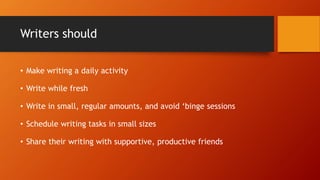
Writers should
• Make writing a daily activity
• Write while fresh
• Write in small, regular amounts, and avoid ‘binge sessions
• Schedule writing tasks in small sizes
• Share their writing with supportive, productive friends
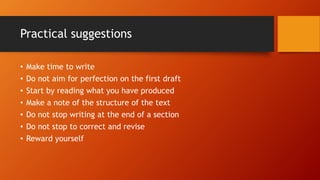
Practical suggestions
• Make time to write
• Do not aim for perfection on the first draft
• Start by reading what you have produced
• Make a note of the structure of the text
• Do not stop writing at the end of a section
• Do not stop to correct and revise
• Reward yourself
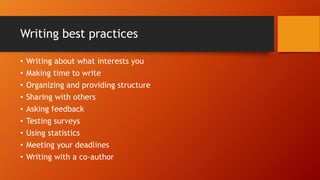
Writing best practices
• Writing about what interests you
• Making time to write
• Organizing and providing structure
• Sharing with others
• Asking feedback
• Testing surveys
• Using statistics
• Meeting your deadlines
• Writing with a co-author
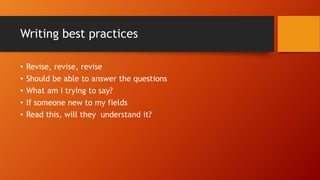
Writing best practices
• Revise, revise, revise
• Should be able to answer the questions
• What am I trying to say?
• If someone new to my fields
• Read this, will they understand it?
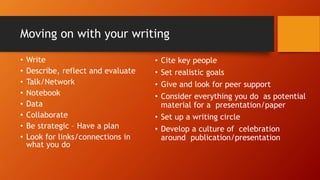
Moving on with your writing
• Write
• Describe, reflect and evaluate
• Talk/Network
• Notebook
• Data
• Collaborate
• Be strategic – Have a plan
• Look for links/connections in
what you do
• Cite key people
• Set realistic goals
• Give and look for peer support
• Consider everything you do as potential
material for a presentation/paper
• Set up a writing circle
• Develop a culture of celebration
around publication/presentation
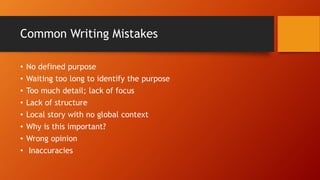
Common Writing Mistakes
• No defined purpose
• Waiting too long to identify the purpose
• Too much detail; lack of focus
• Lack of structure
• Local story with no global context
• Why is this important?
• Wrong opinion
• Inaccuracies
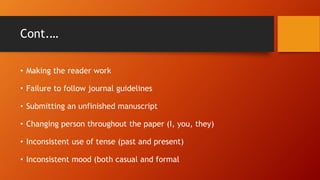
Cont.…
• Making the reader work
• Failure to follow journal guidelines
• Submitting an unfinished manuscript
• Changing person throughout the paper (I, you, they)
• Inconsistent use of tense (past and present)
• Inconsistent mood (both casual and formal
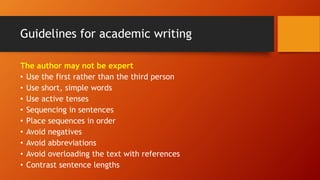
Guidelines for academic writing
The author may not be expert
• Use the first rather than the third person
• Use short, simple words
• Use active tenses
• Sequencing in sentences
• Place sequences in order
• Avoid negatives
• Avoid abbreviations
• Avoid overloading the text with references
• Contrast sentence lengths
Guidelines for academic writing
• Use short paragraphs
• Use numbers or bullets
• Settings for lists
• Use subheadings
• Print out and revise
• Read the text clearly
• Ask other people to read your drafts
• Read and listen to other authors
• Revise continuously . . .
Writing Activity- Plan
• Writing goal
Topic and purpose
List of ideas to cover
• Writing approach
Mood – formal or informal
Research method
Publications to target
• Resources required
People to consult or interview
Tools
Time
Research and investigation
• List of tasks to do
• Tentative time line and schedule for
project milestones
So, do you want to write an article, thesis or
book?
Academic writing and and publishing

Academic writing and and publishing

  • 1.
    Academic writing andpublishing Presented By: GhulamFarid PhD Scholar- Information Management
  • 2.
    About the Author-James Hartley • James Hartley is Research Professor at the School of Psychology, The University of Keela, UK • Best Psychologist in UK • President of British Psychology Society • Expertise & Skills • Writing, Academic Writing • Creative Thinking, Design Thinking • Information Graphic, Visual Information • Behavioral Sciences, Cognitive Psychology • Publications- 283 • Citations- 4,339
  • 3.
    Sections in theBook Section 1 Introduction Section 2 The academic article Section 3 Other categories Section 4 Other aspect of academic writing
  • 4.
    Section 1- Introduction-Why write and publish • To share your practice with others • To increase the impact/visibility of your work • To disseminate your research findings • To explore topics of interest • To add to the existing body of knowledge and create new knowledge • To gain recognition • To enhance your curriculum vitae • To promote your institution • To express yourself in a creative • Personal satisfaction
  • 5.
    Reasons for writing/Why do you write? I can’t do normal work like other people I write to be alone I am angry at all of you I like to be read I love sitting in a room all day writing I hope to understand why I am so very, very angry at all of you I can only participate in real life by changing I have begun a novel, a page, I want to finish it I want others/ all of you I write not to tell a story, but to compose a story I love the smell of paper I have a childish belief in the immortality of libraries and in the ways my books sit on the shelf I believe in literature I am afraid of being forgotten It is a habit, a passion
  • 6.
    Different Types ofPublications • Newsletter • Professional magazine • Popular Magazine • Academic (peer- reviewed) Journal • Hybrid Journal • Poster • Book Review • Book Chapter • Book (single author) • Book (edited collection) • Other opportunities – conference presentation, radio broadcast, television, social media
  • 7.
    Section 2- Theacademic article oTitles that announce the general subject oTitles that specify a specific theme oTitles that indicate the controlling question oTitles that just state the findings oTitles that indicate that the answer to a question will be revealed oTitles that announce the thesis oTitles that emphasise the methodology oTitles that suggest guidelines oTitles that attract by using literary
  • 8.
    Title • Motivate reader’sinterest • Working title/final title • Final title should summarise the main idea of the manuscript • Attract and inform the reader • Be accurate • Be fully clarifying when standing alone • Facilitate indexing and retrieval (avoid using abbreviations) • Suggested length no more than 12 words
  • 9.
    Author’s Contribution • Conceptionand design of the study • Collection of the raw data • Statistical expertise/advice • Analysis and interpretation of the data • Drafting of the article • Critical revision of the article for important intellectual content • Administrative, technical and logistical support • Final approval of the article.
  • 10.
    Author’s Name &Institutional Affiliation • Use the same method throughout your career • Forget all titles and degrees (e.g. Dr., PhD) • Where is more than one author, names should appear in the order of their contributions • Institutional affiliation should appear under the author’sname • Provide an e-mail address for correspondence
  • 11.
    Structured Abstracts • Limitedmore information • Easier to read • Easier to search • Generally only required with a peer- reviewed article • Two types –informative and structured • Details essence (not the same as introduction)
  • 12.
    Cont.…. • Compare theabstract with an outline of the manuscript’s headings to verify its accuracy • Use clear and concise language • Use verbs rather than their noun equivalent (investigates rather than investigation) • Use active rather than passive verbs • Begin the abstract with the most important points • Length determined by journal–typically range from 150 to 250 words
  • 13.
    Key Words • Usesimple, specific noun articles • Avoid terms that are too common • Do not repeat key words from the title • Avoid unnecessary prepositions • Avoid abbreviations • Spell out Greek letters and avoid mathematical symbols • Include only the names of people (profession) • The way your article will be retrieved by databases/search engines etc
  • 14.
    Introductions • Introduces thepractical content of the paper/the research question/the problem • Tells why this issue/problem is important • Sets the scene • States the purpose • States the scope • States how issue is addressed/Describes the research strategy • Explains how this work relates to previous work in this area • Usually starts from the general and progresses to the specific
  • 15.
    Literature review • Tellswhat others have found on the topic • Provides a context • Understanding about knowledge • Author is familiar with thinking on a topic • Understands where their work fits • Highly selective and specific • Link your findings and conclusions back to the literature review
  • 16.
    Methods • Describes howthe study will be • Different types of studies have different methodologies • Subsections where relevant e.g. • Participant characteristics, • sampling procedures, • research design
  • 17.
    Results • Summary ofcollected data • Analysis of data • Findings • Interpreted • Relating them about hypotheses and methods • Where required e.g. statistics, tables, charts, maps, or quotes
  • 18.
    Discussions • Move 1:Examine, interpret and qualify results • Move 2: Evaluate how the results fit in with the previous findings – do they deny, qualify, agree or go beyond them? • Move 3: List potential limitations to the study • Move 4: Offer an interpretation/explanation • Move 5: State the implications and recommend further research
  • 20.
    References & Footnotes References •Follow journal guidelines • Complete • Accurate Footnotes Provide additional content
  • 21.
    Drafting and Redrafting •All writing is rewriting • Draft and redraft • Number, date and save drafts • Refer back to your abstract • Ask a critical colleague to read • Revise title, abstract & article • Check references against journal guidelines • Spell check • Date and File preprint (pre-refereeing) • Let go
  • 22.
    Submission • Professional Journal– editor • Academic Journal – peer-review • Usually double blind peer review – Accept as is – Accept with revisions – Revise and resubmit – Reject
  • 23.
    Responding to referees •Referee 1: Accept • Referee 2: Accept with revision. This paper addresses an interesting and important topic . . . Despite this . . the results are somewhat of a mixed bag overall. Accordingly I would recommend the following revisions before it is considered for publication. • Referee 3: Reject. [. . .] This paper conflates (this technical task) with some non-technical terms, some common-sense beliefs about reading and writing that there is no strong evidence for, normative expectations of what texts should be and moralistic stances towards textual patterns.
  • 24.
    Why editors rejectmanuscripts • Author guidelines not followed • Not in-depth (little substance) • Bad writing (lack of clarity) • Subject of little/no interest to readers • Poor statistics, tables, figures • Subject or data out of date • Unprofessional appearance • Title • Too simple – reporting • Written at the wrong level
  • 25.
    Section 3- OtherCategories- Books • Different Types of the books • The popular science book • The edited collection of previously published papers by the same author • The edited collection of previously published papers written by different authors • The edited collection of original chapters written by several different authors • The conference collection • The handbook • The individually authored textbook
  • 26.
    Theses • A thesisis much like a graduate student: It has a limited purpose and a small audience; it is often insecure and defensive, justifying itself with extreme documentation; it is too narrowly focussed; and it has not yet developed a style of its own. (Luey, 2002, p. 34)
  • 27.
    Different kinds ofthesis • Traditional (simple) • Introduction • literature review • materials and methods • Results • discussion and conclusions • the IMRAD
  • 28.
    Traditional (complex) • introduction; •background to the study • literature review; • Background theory and methods (optional); • study 1 – IMRAD; • study 2 – IMRAD, • study 3 etc.; • general discussion and conclusions.
  • 29.
    Strategies for thebeginning thesis writer • Try to be well organised • Examine two or three theses in your discipline/area • Write from the beginning • Make and keep clearly categorized (back up data) • Discuss what you are doing it/ with fellow students all the time • Think of how you might publish each chapter • Appropriate procedures for presenting text- Reference • Read the requirements of your institution • Submit regular drafts of subsections of your thesis to your supervisor • Make sure your supervisor eventually sees the thesis as a whole
  • 30.
    Conference papers • “Theessential launching pad for nearly all scholarly careers” (Gould, 1995, p. 37) • Power Point • computer-based slides are most common • appreciate the clarity • seven words per line, and seven lines per slide (7*7 rule) some (5*5)
  • 31.
    Posters • 4 feet(120 cm) • 2.5 (75 cm)
  • 33.
    Section 4- Otheraspects of academic writing • Finding, keeping and disseminating information • It is accessible twenty-four hours a day • You do not have to visit a library • To find information relatively quickly and conveniently • You can choose between saving, printing or reading the information from the computer screen • Sources on the Internet are often more up to date than sources in paper format
  • 34.
    Choosing where topublish • Author decide where to published their article • 20,000–25,000 peer-reviewed academic journals • In UK and USA- Mostly online journals • Most authors preferred they published their work in peer reviewed
  • 35.
    Some typical criticismsof impact factors • Does not necessarily reflect the quality of all of the articles • No correction is made for self-citations • Review articles are heavily referenced • Books are not included in calculating impact factors • Impact factors vary in different disciplines • Small research areas tend to lack journals with high impact factors • High-quality research in non-English journals is rarely cited.
  • 36.
    Open-access journal • Authorputs findings/paper online for free • Author pays to publish online in an open-access journal • Author’s institution pays for the author to publish online in an open access journal • Research funding agencies pay for publication of the research findings • Online in an open-access journal
  • 37.
    Delays in thepublishing process
  • 39.
    WRITER’S BLOCK- Factorsin writer’s block • Delay • Fear of failure • Criticism • Neatness • Time pressure • Personality factors and mood disorders
  • 40.
    Writers should • Makewriting a daily activity • Write while fresh • Write in small, regular amounts, and avoid ‘binge sessions • Schedule writing tasks in small sizes • Share their writing with supportive, productive friends
  • 41.
    Practical suggestions • Maketime to write • Do not aim for perfection on the first draft • Start by reading what you have produced • Make a note of the structure of the text • Do not stop writing at the end of a section • Do not stop to correct and revise • Reward yourself
  • 42.
    Writing best practices •Writing about what interests you • Making time to write • Organizing and providing structure • Sharing with others • Asking feedback • Testing surveys • Using statistics • Meeting your deadlines • Writing with a co-author
  • 43.
    Writing best practices •Revise, revise, revise • Should be able to answer the questions • What am I trying to say? • If someone new to my fields • Read this, will they understand it?
  • 44.
    Moving on withyour writing • Write • Describe, reflect and evaluate • Talk/Network • Notebook • Data • Collaborate • Be strategic – Have a plan • Look for links/connections in what you do • Cite key people • Set realistic goals • Give and look for peer support • Consider everything you do as potential material for a presentation/paper • Set up a writing circle • Develop a culture of celebration around publication/presentation
  • 45.
    Common Writing Mistakes •No defined purpose • Waiting too long to identify the purpose • Too much detail; lack of focus • Lack of structure • Local story with no global context • Why is this important? • Wrong opinion • Inaccuracies
  • 46.
    Cont.… • Making thereader work • Failure to follow journal guidelines • Submitting an unfinished manuscript • Changing person throughout the paper (I, you, they) • Inconsistent use of tense (past and present) • Inconsistent mood (both casual and formal
  • 47.
    Guidelines for academicwriting The author may not be expert • Use the first rather than the third person • Use short, simple words • Use active tenses • Sequencing in sentences • Place sequences in order • Avoid negatives • Avoid abbreviations • Avoid overloading the text with references • Contrast sentence lengths
  • 48.
    Guidelines for academicwriting • Use short paragraphs • Use numbers or bullets • Settings for lists • Use subheadings • Print out and revise • Read the text clearly • Ask other people to read your drafts • Read and listen to other authors • Revise continuously . . .
  • 49.
    Writing Activity- Plan •Writing goal Topic and purpose List of ideas to cover • Writing approach Mood – formal or informal Research method Publications to target • Resources required People to consult or interview Tools Time Research and investigation • List of tasks to do • Tentative time line and schedule for project milestones
  • 50.
    So, do youwant to write an article, thesis or book?