Republic of the Philippines
       Mindanao State University
          General Santos City

Module 9: Grading and Reporting
Lesson 4: Common Grading Problems

        Presented to: Dr. Ava Clare Marie Robles


          Presented by: Norjie Flores Bacsan
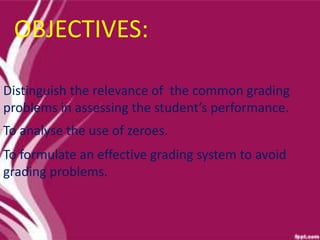
OBJECTIVES:

Distinguish the relevance of the common grading
problems in assessing the student’s performance.
To analyse the use of zeroes.
To formulate an effective grading system to avoid
grading problems.
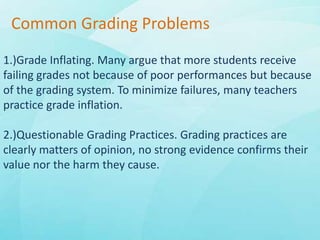
Common Grading Problems
1.)Grade Inflating. Many argue that more students receive
failing grades not because of poor performances but because
of the grading system. To minimize failures, many teachers
practice grade inflation.

2.)Questionable Grading Practices. Grading practices are
clearly matters of opinion, no strong evidence confirms their
value nor the harm they cause.
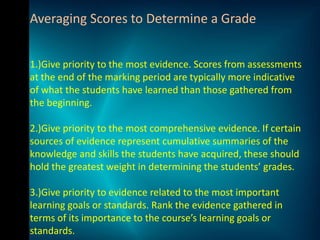
Averaging Scores to Determine a Grade


1.)Give priority to the most evidence. Scores from assessments
at the end of the marking period are typically more indicative
of what the students have learned than those gathered from
the beginning.

2.)Give priority to the most comprehensive evidence. If certain
sources of evidence represent cumulative summaries of the
knowledge and skills the students have acquired, these should
hold the greatest weight in determining the students’ grades.

3.)Give priority to evidence related to the most important
learning goals or standards. Rank the evidence gathered in
terms of its importance to the course’s learning goals or
standards.
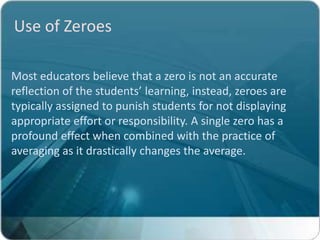
Use of Zeroes

Most educators believe that a zero is not an accurate
reflection of the students’ learning, instead, zeroes are
typically assigned to punish students for not displaying
appropriate effort or responsibility. A single zero has a
profound effect when combined with the practice of
averaging as it drastically changes the average.
Lowering Grades Because of Behavioral
Infractions


 Behavioral infractions cannot be considered indicators of
 achievement or performance since they do not reflect
 product criteria.
Thank you for listening .. Hope we learn something


          Have a great afternoon

Ed103_powerpoint

  • 1.
    Republic of thePhilippines Mindanao State University General Santos City Module 9: Grading and Reporting Lesson 4: Common Grading Problems Presented to: Dr. Ava Clare Marie Robles Presented by: Norjie Flores Bacsan
  • 2.
    OBJECTIVES: Distinguish the relevanceof the common grading problems in assessing the student’s performance. To analyse the use of zeroes. To formulate an effective grading system to avoid grading problems.
  • 3.
    Common Grading Problems 1.)GradeInflating. Many argue that more students receive failing grades not because of poor performances but because of the grading system. To minimize failures, many teachers practice grade inflation. 2.)Questionable Grading Practices. Grading practices are clearly matters of opinion, no strong evidence confirms their value nor the harm they cause.
  • 4.
    Averaging Scores toDetermine a Grade 1.)Give priority to the most evidence. Scores from assessments at the end of the marking period are typically more indicative of what the students have learned than those gathered from the beginning. 2.)Give priority to the most comprehensive evidence. If certain sources of evidence represent cumulative summaries of the knowledge and skills the students have acquired, these should hold the greatest weight in determining the students’ grades. 3.)Give priority to evidence related to the most important learning goals or standards. Rank the evidence gathered in terms of its importance to the course’s learning goals or standards.
  • 5.
    Use of Zeroes Mosteducators believe that a zero is not an accurate reflection of the students’ learning, instead, zeroes are typically assigned to punish students for not displaying appropriate effort or responsibility. A single zero has a profound effect when combined with the practice of averaging as it drastically changes the average.
  • 6.
    Lowering Grades Becauseof Behavioral Infractions Behavioral infractions cannot be considered indicators of achievement or performance since they do not reflect product criteria.
  • 7.
    Thank you forlistening .. Hope we learn something Have a great afternoon