Assessment  for Learning: why, what and how? Why raising achievement is important Why formative assessment is the answer How we can put this into practice
Raising Achievement matters For Most – Higher level of education = Higher salary 1 year extra education adds 1 and 1/2 years to life Long term goal: Confident individuals, Responsible Citizens, Successful Learners, Effective Contributors
Formative Assessment  (Black et al.,2002) Assessment for learning is any assessment for which the first priority in its design and practice is to serve the purpose of  promoting pupils’ learning . It thus differs from assessment designed primarily to serve the purposes of accountability, or of ranking, or of certifying competence.  An assessment activity can help learning if it provides information to be used as feedback, by teachers, and by their pupils, in assessing themselves and each other, to modify the teaching and learning activities in which they are engaged. Such assessment becomes ‘formative assessment’ when the evidence is actually used to adapt the teaching work to meet learning needs.
Formative Assessment http://www. ltscotland .org. uk / learningaboutlearning /movies/ formativeassessmentdylanwiliam .asp
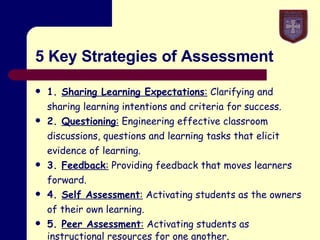
5 Key Strategies of Assessment 1.  Sharing Learning Expectations :  Clarifying and sharing learning intentions and criteria for success. 2.  Questioning :  Engineering effective classroom discussions, questions and learning tasks that elicit evidence of learning. 3.  Feedback :  Providing feedback that moves learners forward. 4.  Self Assessment :  Activating students as the owners of their own learning. 5.  Peer Assessment :  Activating students as instructional  resources for one another.
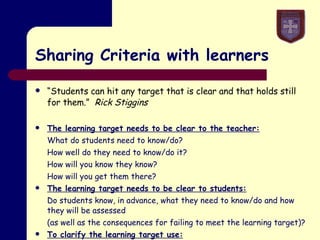
Sharing Criteria with learners “ Students can hit any target that is clear and that holds still for them.”  Rick Stiggins   The learning target needs to be clear to the teacher: What do students need to know/do? How well do they need to know/do it?  How will you know they know? How will you get them there?   The learning target needs to be clear to students: Do students know, in advance, what they need to know/do and how they will be assessed  (as well as the consequences for failing to meet the learning target)?   To clarify the learning target use: Examples and non-examples Models Rubrics Scoring guides Test specification guides
A few techniques
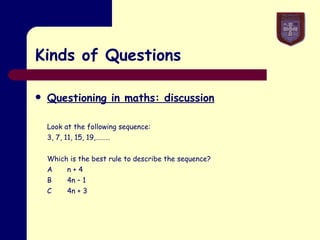
Kinds of Questions Questioning in maths: discussion Look at the following sequence: 3, 7, 11, 15, 19,……… Which is the best rule to describe the sequence? A n + 4 B 4n – 1 C 4n + 3
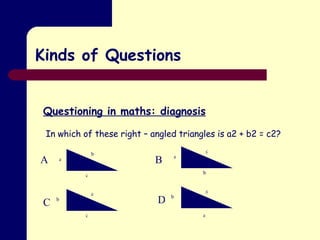
Kinds of Questions Questioning in maths: diagnosis In which of these right – angled triangles is a2 + b2 = c2? a b c c b a a c b c b a A B C D
Feedback Kinds of Feedback: Scores Comments Scores & Comments What impact do you think these 3 types of feedback have? [Butler (1998) Br. J. Educ. Psychol, 58 1-14]
Feedback Feedback is formative only if the information fed back is actually used in closing the gap. Feedback that is ego based / grade based is proved to have no impact on high achievers and bad impact on low achievers. Feedback must be – Where are you going.
Peer & Self Assessment
Conclusion Only learners create learning, and so, when we look at the role that assessment plays in promoting learning, the crucial feature is not the validity of the assessment, or its reliability, but its impact on the student.
Practical Techniques Carol McCabe
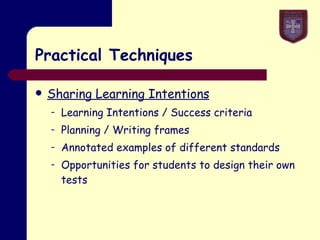
Practical Techniques Sharing Learning Intentions Learning Intentions / Success criteria Planning / Writing frames Annotated examples of different standards Opportunities for students to design their own tests
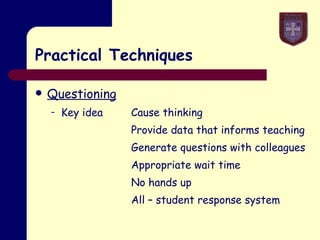
Practical Techniques Questioning Key idea Cause thinking Provide data that informs teaching Generate questions with colleagues Appropriate wait time No hands up All – student response system
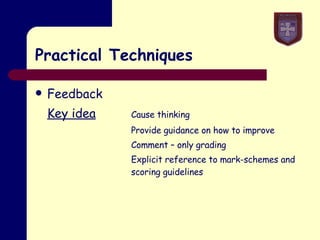
Practical Techniques Feedback Key idea Cause thinking Provide guidance on how to improve Comment – only grading Explicit reference to mark-schemes and  scoring guidelines
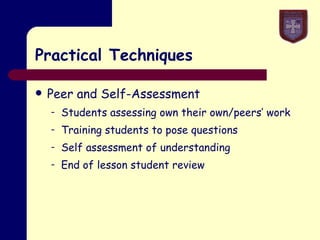
Practical Techniques Peer and Self-Assessment Students assessing own their own/peers’ work Training students to pose questions Self assessment of understanding End of lesson student review
Putting it into practice Don’t try it all Flexibility to make a difference

Ai Fl Presentation

  • 1.
    Assessment forLearning: why, what and how? Why raising achievement is important Why formative assessment is the answer How we can put this into practice
  • 2.
    Raising Achievement mattersFor Most – Higher level of education = Higher salary 1 year extra education adds 1 and 1/2 years to life Long term goal: Confident individuals, Responsible Citizens, Successful Learners, Effective Contributors
  • 3.
    Formative Assessment (Black et al.,2002) Assessment for learning is any assessment for which the first priority in its design and practice is to serve the purpose of promoting pupils’ learning . It thus differs from assessment designed primarily to serve the purposes of accountability, or of ranking, or of certifying competence. An assessment activity can help learning if it provides information to be used as feedback, by teachers, and by their pupils, in assessing themselves and each other, to modify the teaching and learning activities in which they are engaged. Such assessment becomes ‘formative assessment’ when the evidence is actually used to adapt the teaching work to meet learning needs.
  • 4.
    Formative Assessment http://www.ltscotland .org. uk / learningaboutlearning /movies/ formativeassessmentdylanwiliam .asp
  • 5.
    5 Key Strategiesof Assessment 1. Sharing Learning Expectations : Clarifying and sharing learning intentions and criteria for success. 2. Questioning : Engineering effective classroom discussions, questions and learning tasks that elicit evidence of learning. 3. Feedback : Providing feedback that moves learners forward. 4. Self Assessment : Activating students as the owners of their own learning. 5. Peer Assessment : Activating students as instructional resources for one another.
  • 6.
    Sharing Criteria withlearners “ Students can hit any target that is clear and that holds still for them.” Rick Stiggins The learning target needs to be clear to the teacher: What do students need to know/do? How well do they need to know/do it? How will you know they know? How will you get them there? The learning target needs to be clear to students: Do students know, in advance, what they need to know/do and how they will be assessed (as well as the consequences for failing to meet the learning target)? To clarify the learning target use: Examples and non-examples Models Rubrics Scoring guides Test specification guides
  • 7.
  • 8.
    Kinds of QuestionsQuestioning in maths: discussion Look at the following sequence: 3, 7, 11, 15, 19,……… Which is the best rule to describe the sequence? A n + 4 B 4n – 1 C 4n + 3
  • 9.
    Kinds of QuestionsQuestioning in maths: diagnosis In which of these right – angled triangles is a2 + b2 = c2? a b c c b a a c b c b a A B C D
  • 10.
    Feedback Kinds ofFeedback: Scores Comments Scores & Comments What impact do you think these 3 types of feedback have? [Butler (1998) Br. J. Educ. Psychol, 58 1-14]
  • 11.
    Feedback Feedback isformative only if the information fed back is actually used in closing the gap. Feedback that is ego based / grade based is proved to have no impact on high achievers and bad impact on low achievers. Feedback must be – Where are you going.
  • 12.
    Peer & SelfAssessment
  • 13.
    Conclusion Only learnerscreate learning, and so, when we look at the role that assessment plays in promoting learning, the crucial feature is not the validity of the assessment, or its reliability, but its impact on the student.
  • 14.
  • 15.
    Practical Techniques SharingLearning Intentions Learning Intentions / Success criteria Planning / Writing frames Annotated examples of different standards Opportunities for students to design their own tests
  • 16.
    Practical Techniques QuestioningKey idea Cause thinking Provide data that informs teaching Generate questions with colleagues Appropriate wait time No hands up All – student response system
  • 17.
    Practical Techniques FeedbackKey idea Cause thinking Provide guidance on how to improve Comment – only grading Explicit reference to mark-schemes and scoring guidelines
  • 18.
    Practical Techniques Peerand Self-Assessment Students assessing own their own/peers’ work Training students to pose questions Self assessment of understanding End of lesson student review
  • 19.
    Putting it intopractice Don’t try it all Flexibility to make a difference

Editor's Notes

  • #2 This presentation will make you think.