Dr Hironmoy Roy
Assessment- Introduction, FA, IA
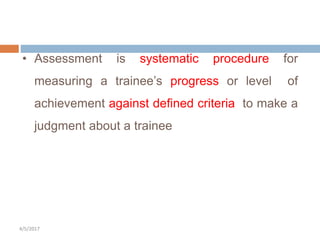
• Assessment is systematic procedure for
measuring a trainee’s progress or level of
achievement against defined criteria to make a
judgment about a trainee
4/5/2017
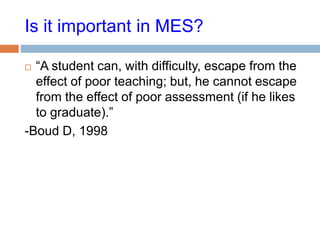
Is it important in MES?
 “A student can, with difficulty, escape from the
effect of poor teaching; but, he cannot escape
from the effect of poor assessment (if he likes
to graduate).”
-Boud D, 1998
6
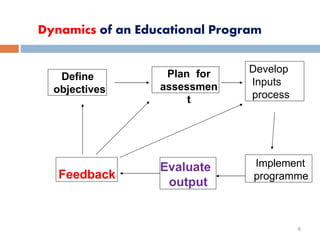
Dynamics of an Educational Program
Define
objectives
Plan for
assessmen
t
Develop
Inputs
process
Implement
programme
Evaluate
output
Feedback
Session’s objectives
right• To sensitize regarding need for
assessment methods
• To help in choosing right
assessment methods for given:
Learning Objectives & Competencies
• Assessment
•
refers to any formal or purported action/task to
obtain information about the competence and
performance of a student.
Term: used in context of students
•Evaluation
• on the otherhand , it means passing a value
judgment on the quality or worth
Term:Used in context of educational
Assessment Vs Evaluation
Why do we need to
assess
medical students?
We are certifying students fit
for dealingwith human
lives
• How Assessment helps us?
 It gives “Feedback” to students (where are
they?), to teachers (where are we?), to the
entire medical education system (How far to
go?)
 It is a guideline for Quality Assurance in ME
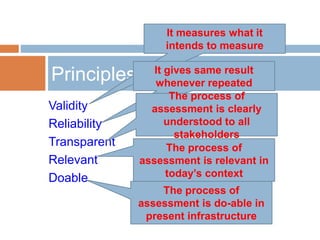
Validity
Reliability
Transparent
Relevant
Doable
Principles of Assessment
It measures what it
intends to measure
It gives same result
whenever repeated
The process of
assessment is clearly
understood to all
stakeholders
The process of
assessment is relevant in
today’s context
The process of
assessment is do-able in
present infrastructure
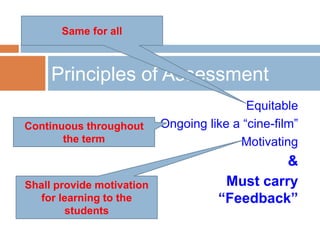
Principles of Assessment
Equitable
Ongoing like a “cine-film”
Motivating
&
Must carry
“Feedback”
Same for all
Continuous throughout
the term
Shall provide motivation
for learning to the
students
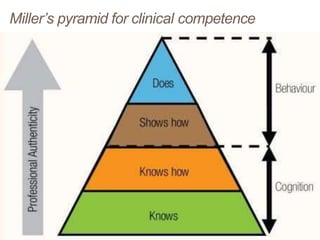
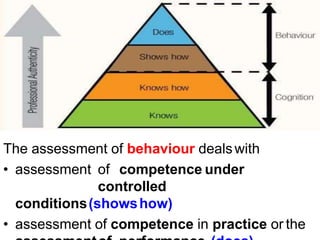
Miller’s pyramid for clinical competence
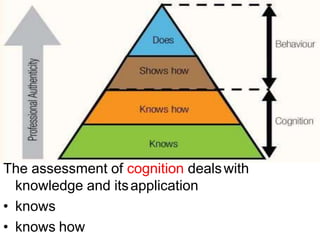
The assessment of cognition dealswith
knowledge and itsapplication
• knows
• knows how
The assessment of behaviour dealswith
• assessment of competence under
controlled
conditions(showshow)
• assessment of competence in practice or the
Types
 Summative Assessment
 Formative Assessment
 Continuous Internal Assessment (CIA)
Summative Assessment
 End-term examination, that takes into
consideration of skills & knowledge
acquired during entire course. Like.
University Prof Exams
OF
Formative Assessment
 Monitor students’ learning and provides
ongoing feedback
 Feedback applicable to the
Teacher/Student as well as the teaching-
learning process
 No pass/fail system
 No marking/gradation- IDEAL
FOR
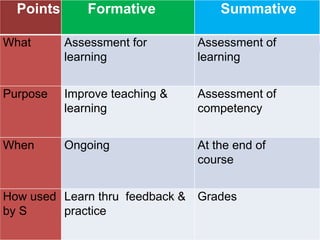
Points Formative Summative
What Assessment for
learning
Assessment of
learning
Purpose Improve teaching &
learning
Assessment of
competency
When Ongoing At the end of
course
How used
by S
Learn thru feedback &
practice
Grades
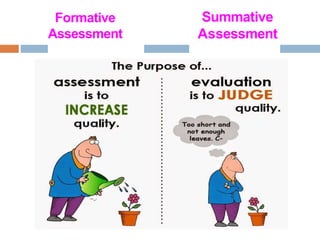
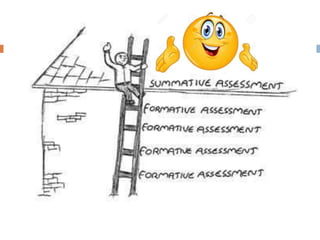
Formative
Assessment
Summative
Assessment
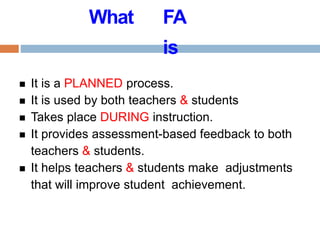
What FA
is
 It is a PLANNED process.
 It is used by both teachers & students
 Takes place DURING instruction.
 It provides assessment-based feedback to both
teachers & students.
 It helps teachers & students make adjustments
that will improve student achievement.
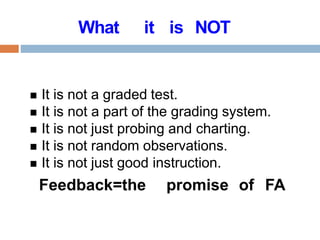
What it is NOT
 It is not a graded test.
 It is not a part of the grading system.
 It is not just probing and charting.
 It is not random observations.
 It is not just good instruction.
Feedback=the promise of FA
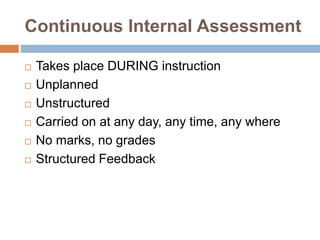
Continuous Internal Assessment
 Takes place DURING instruction
 Unplanned
 Unstructured
 Carried on at any day, any time, any where
 No marks, no grades
 Structured Feedback
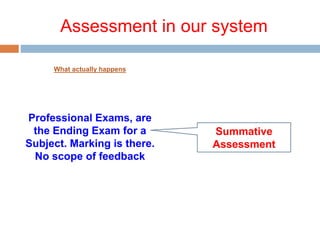
Assessment in our system
What actually happens
Professional Exams, are
the Ending Exam for a
Subject. Marking is there.
No scope of feedback
Summative
Assessment
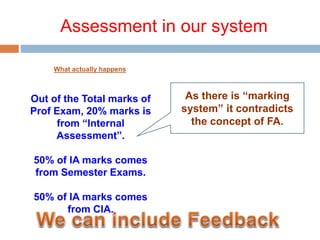
Assessment in our system
What actually happens
Out of the Total marks of
Prof Exam, 20% marks is
from “Internal
Assessment”.
50% of IA marks comes
from Semester Exams.
50% of IA marks comes
from CIA.
As there is “marking
system” it contradicts
the concept of FA.
INTRODUCTION TO ASSESSMENT

INTRODUCTION TO ASSESSMENT

  • 1.
    Dr Hironmoy Roy Assessment-Introduction, FA, IA
  • 2.
    • Assessment issystematic procedure for measuring a trainee’s progress or level of achievement against defined criteria to make a judgment about a trainee 4/5/2017
  • 3.
    Is it importantin MES?  “A student can, with difficulty, escape from the effect of poor teaching; but, he cannot escape from the effect of poor assessment (if he likes to graduate).” -Boud D, 1998
  • 4.
    6 Dynamics of anEducational Program Define objectives Plan for assessmen t Develop Inputs process Implement programme Evaluate output Feedback
  • 5.
    Session’s objectives right• Tosensitize regarding need for assessment methods • To help in choosing right assessment methods for given: Learning Objectives & Competencies
  • 6.
    • Assessment • refers toany formal or purported action/task to obtain information about the competence and performance of a student. Term: used in context of students •Evaluation • on the otherhand , it means passing a value judgment on the quality or worth Term:Used in context of educational Assessment Vs Evaluation
  • 7.
    Why do weneed to assess medical students? We are certifying students fit for dealingwith human lives
  • 8.
    • How Assessmenthelps us?  It gives “Feedback” to students (where are they?), to teachers (where are we?), to the entire medical education system (How far to go?)  It is a guideline for Quality Assurance in ME
  • 9.
    Validity Reliability Transparent Relevant Doable Principles of Assessment Itmeasures what it intends to measure It gives same result whenever repeated The process of assessment is clearly understood to all stakeholders The process of assessment is relevant in today’s context The process of assessment is do-able in present infrastructure
  • 10.
    Principles of Assessment Equitable Ongoinglike a “cine-film” Motivating & Must carry “Feedback” Same for all Continuous throughout the term Shall provide motivation for learning to the students
  • 11.
    Miller’s pyramid forclinical competence
  • 12.
    The assessment ofcognition dealswith knowledge and itsapplication • knows • knows how
  • 13.
    The assessment ofbehaviour dealswith • assessment of competence under controlled conditions(showshow) • assessment of competence in practice or the
  • 14.
    Types  Summative Assessment Formative Assessment  Continuous Internal Assessment (CIA)
  • 15.
    Summative Assessment  End-termexamination, that takes into consideration of skills & knowledge acquired during entire course. Like. University Prof Exams OF
  • 16.
    Formative Assessment  Monitorstudents’ learning and provides ongoing feedback  Feedback applicable to the Teacher/Student as well as the teaching- learning process  No pass/fail system  No marking/gradation- IDEAL FOR
  • 17.
    Points Formative Summative WhatAssessment for learning Assessment of learning Purpose Improve teaching & learning Assessment of competency When Ongoing At the end of course How used by S Learn thru feedback & practice Grades
  • 18.
  • 19.
    What FA is  Itis a PLANNED process.  It is used by both teachers & students  Takes place DURING instruction.  It provides assessment-based feedback to both teachers & students.  It helps teachers & students make adjustments that will improve student achievement.
  • 20.
    What it isNOT  It is not a graded test.  It is not a part of the grading system.  It is not just probing and charting.  It is not random observations.  It is not just good instruction. Feedback=the promise of FA
  • 21.
    Continuous Internal Assessment Takes place DURING instruction  Unplanned  Unstructured  Carried on at any day, any time, any where  No marks, no grades  Structured Feedback
  • 22.
    Assessment in oursystem What actually happens Professional Exams, are the Ending Exam for a Subject. Marking is there. No scope of feedback Summative Assessment
  • 23.
    Assessment in oursystem What actually happens Out of the Total marks of Prof Exam, 20% marks is from “Internal Assessment”. 50% of IA marks comes from Semester Exams. 50% of IA marks comes from CIA. As there is “marking system” it contradicts the concept of FA.