MANUFACTURED SUBTANCES IN
        INDUSTRY

   BY : NURFARAHAIN BINTI AHMAD
                4ST
           SMK SG ABONG
Introduction


Many industrial products are manufactured for our comfort.


They are either made from sulphuric acid, ammonia, alloys, synthetic
polymers, glass, ceramics or composite materials.
MAIN MENU


     ALLOY

SYNTHETIC POLYMERS

 GLASS & CERAMICS

COMPOSITE MATERIALS
ALLOYS


∗ An alloy is a homogenous mixture of two or more
  elements (especially metals) mixed in a certain fixed
  percentage.
∗ Alloys are made to improve the hardness, malleability
  and resistance to corrosion of pure metals.
∗ General properties of pure metals :
 * ductile- can be drawn into wires
* malleable- can be hammered into sheets
 * high melting and boiling points
 * high density
 * high electrical and heat conductivity
∗Most metals in their pure form are soft.
∗Metals like iron and copper tend to undergo corrosion readily
to form oxides.
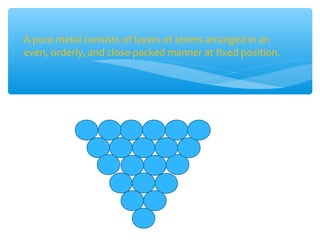
∗ A pure metal consists of layers of atoms arranged in an
  even, orderly, and close-packed manner at fixed position.
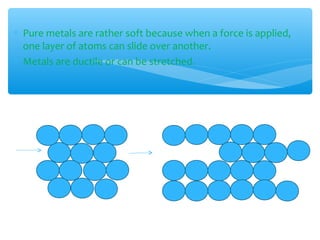
∗ Pure metals are rather soft because when a force is applied,
  one layer of atoms can slide over another.
∗ Metals are ductile or can be stretched.
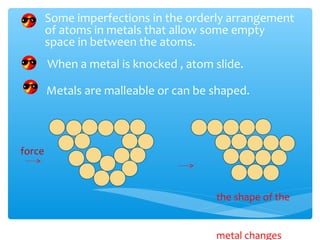
Some imperfections in the orderly arrangement
        of atoms in metals that allow some empty
        space in between the atoms.
        When a metal is knocked , atom slide.

        Metals are malleable or can be shaped.


force


                                       the shape of the


                                       metal changes
∗ Alloys such as bronze, brass, steel, stainless, duralumin and
  pewter are commonly used in our daily lives.
∗ The uses of each different type of alloys depend on the
  properties of the alloy.
∗ For example, cutlery is made of stainless steel because
  stainless steel is shiny and does not rust.
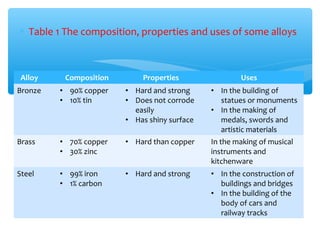
∗ Table 1 The composition, properties and uses of some alloys


 Alloy    Composition       Properties                Uses
Bronze   • 90% copper   • Hard and strong     • In the building of
         • 10% tin      • Does not corrode      statues or monuments
                          easily              • In the making of
                        • Has shiny surface     medals, swords and
                                                artistic materials
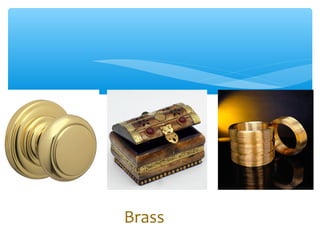
Brass    • 70% copper   • Hard than copper    In the making of musical
         • 30% zinc                           instruments and
                                              kitchenware
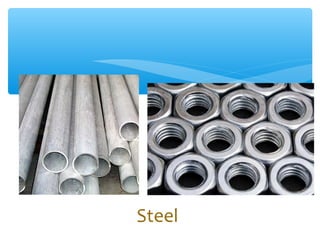
Steel    • 99% iron     • Hard and strong     • In the construction of
         • 1% carbon                            buildings and bridges
                                              • In the building of the
                                                body of cars and
                                                railway tracks
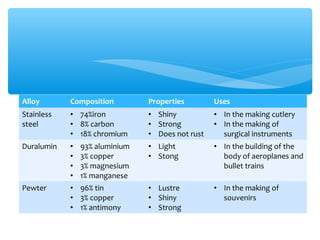
Alloy       Composition         Properties        Uses
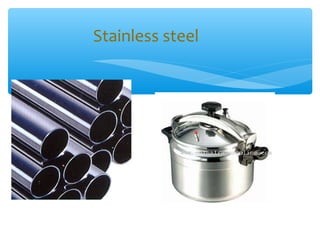
Stainless   • 74%iron           • Shiny           • In the making cutlery
steel       • 8% carbon         • Strong          • In the making of
            • 18% chromium      • Does not rust     surgical instruments
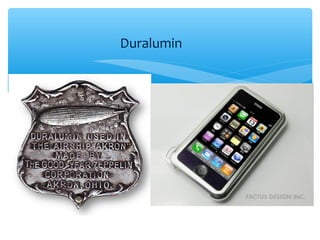
Duralumin   •   93% aluminium   • Light           • In the building of the
            •   3% copper       • Stong             body of aeroplanes and
            •   3% magnesium                        bullet trains
            •   1% manganese
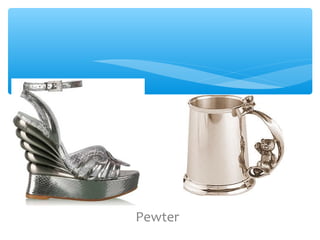
Pewter      • 96% tin           • Lustre          • In the making of
            • 3% copper         • Shiny             souvenirs
            • 1% antimony       • Strong
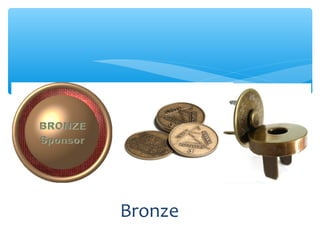
Bronze
Brass
Steel
Stainless steel
Duralumin
Pewter
THE ARRANGEMENT OF ATOMS IN ALLOYS


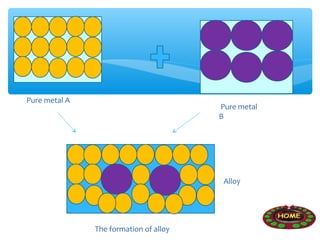
∗ The presence of atoms of other metals that are of
  different size disturb the orderly arrangement of atoms
   in the metal.
∗ This reduces the layer of atoms from sliding.
∗ Thus, an alloy is stronger and harder than its pure
  metal.
Pure metal A
                                        Pure metal
                                        B


                                         Alloy


               The formation of alloy
Synthetic Polymers


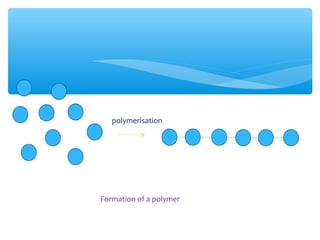
∗ Polymers are large molecules made up of many
  identical repeating sub-units called monomers which
  are joined together by covalent bonds.
∗ Monomers are joined into chains by a process of
  repeated linking known as polymerisation.
polymerisation


Formation of a polymer
A polymer may consist of thousands of monomers. Some polymers
occur naturally.

Starch, cellulose, wool, protein, silk and natural rubber are some
example of naturally occuring polymers.


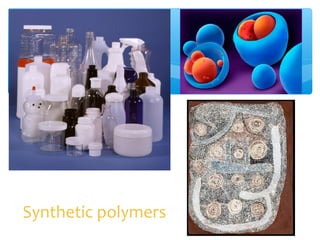
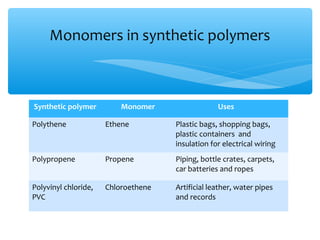
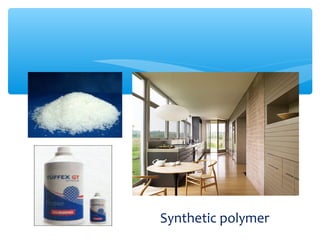
Synthetic polymerare man-made polymers.


The monomers used are usually obtained from petroleum after
going through the refining and cracking processes.


The monomers used are usually obtained from petroleum after
going through the refining and cracking processes.
Synthetic polymers
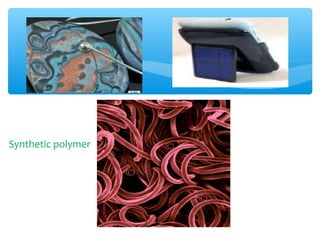
Synthetic polymer
Synthetic polymers
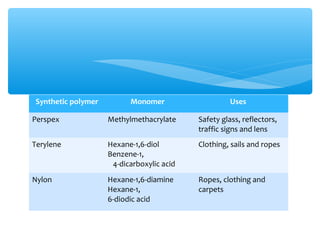
Monomers in synthetic polymers


Synthetic polymer         Monomer                 Uses

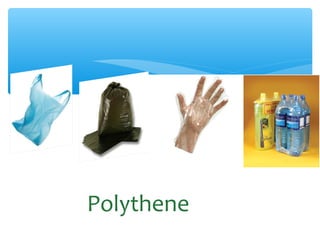
Polythene             Ethene         Plastic bags, shopping bags,
                                     plastic containers and
                                     insulation for electrical wiring
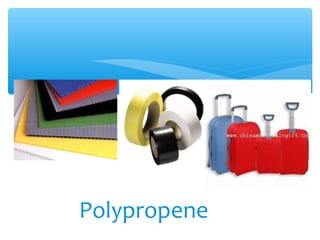
Polypropene           Propene        Piping, bottle crates, carpets,
                                     car batteries and ropes

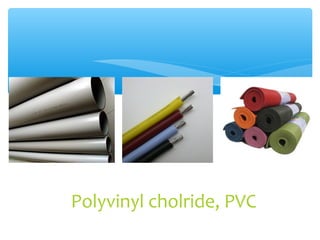
Polyvinyl chloride,   Chloroethene   Artificial leather, water pipes
PVC                                  and records
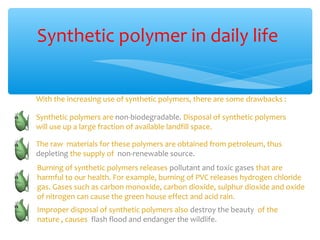
Synthetic polymer         Monomer                    Uses

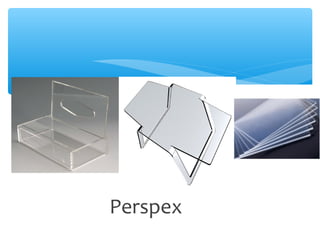
Perspex             Methylmethacrylate     Safety glass, reflectors,
                                           traffic signs and lens
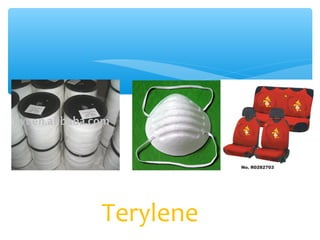
Terylene            Hexane-1,6-diol        Clothing, sails and ropes
                    Benzene-1,
                     4-dicarboxylic acid
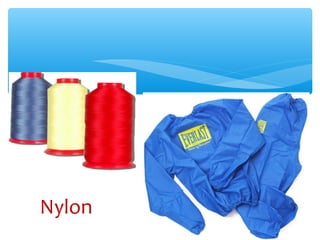
Nylon               Hexane-1,6-diamine     Ropes, clothing and
                    Hexane-1,              carpets
                    6-diodic acid
Synthetic polymer in daily life


With the increasing use of synthetic polymers, there are some drawbacks :

Synthetic polymers are non-biodegradable. Disposal of synthetic polymers
will use up a large fraction of available landfill space.

The raw materials for these polymers are obtained from petroleum, thus
depleting the supply of non-renewable source.
Burning of synthetic polymers releases pollutant and toxic gases that are
harmful to our health. For example, burning of PVC releases hydrogen chloride
gas. Gases such as carbon monoxide, carbon dioxide, sulphur dioxide and oxide
of nitrogen can cause the green house effect and acid rain.
Improper disposal of synthetic polymers also destroy the beauty of the
nature , causes flash flood and endanger the wildlife.
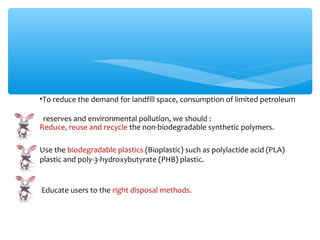
•To reduce the demand for landfill space, consumption of limited petroleum

 reserves and environmental pollution, we should :
Reduce, reuse and recycle the non-biodegradable synthetic polymers.

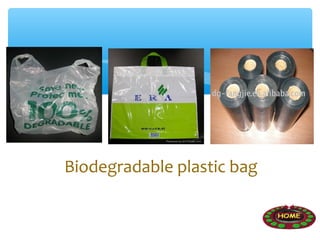
Use the biodegradable plastics (Bioplastic) such as polylactide acid (PLA)
plastic and poly-3-hydroxybutyrate (PHB) plastic.


Educate users to the right disposal methods.
Synthetic polymer
Polythene
Nylon
Polypropene
Terylene
Perspex
Polyvinyl cholride, PVC
Biodegradable plastic bag
Glass

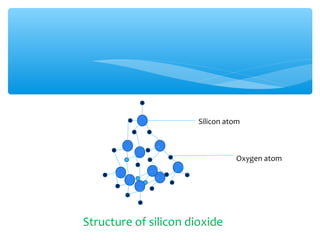
The major component of glass is silica or silicon dioxide, SiO2.

Silicon dioxide is the second most abundant elements in the Earth’s
crust. It is commonly found in sand.

The most way common of preparing glass is to heat the sand to the
temperature of 1700 degree celcius. The molten liquid obtained is the
cooled quickly so that it solidifies to produce glass.
Silicon atom


                                 Oxygen atom


Structure of silicon dioxide
During rapid cooling, the particles in the liquid do not have time to return to
its original crystalline arrangement. They occupy randomly arranged lattice
sites and result s in an amorphus solid. This amorphus structure makes the
glass brittle.


The main characteristics of glass are :
  a. hard but brittle
  b. chemically inert
  c. transparent and impermeable (non-porous)
  d. withstand compression
  e. good heat and electrical insulators
Types, composition, properties
       and uses of glass

1. There are four types of glasses :
    (a) Soda-lime glass (soft glass)
        * The most common and least expensive glass
    (b) Lead crystal glass (soft glass)
    (c) Borosilicate glass (hard glass)
    (d) Fused glass (hardest glass)
        * The simplest and most expensive glass
Type of     Production             Composition      Properties             Uses
 glass       method
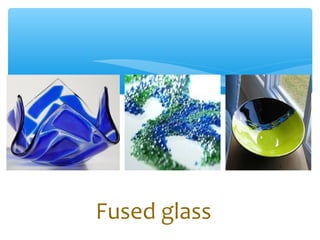
Fused     Silica is heated until   • Silicon     • Very high melting    • Laboratory
glass     it melts at 1 700          dioxide       point                  glass rods
          degree celcius and                     • High transparency    • Telescope
          cooled rapidly                         • Highest resistance     mirrors
                                                   to thermal shock     • Optical
                                                   (can be heated to      fibres
                                                   an extremely high    • Lenses
                                                   temperature and
                                                   then plunged into
                                                   icy, cold water
                                                   without cracking)
Type of       Production       Composition      Properties               Uses
 glass         method
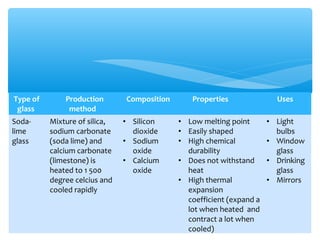
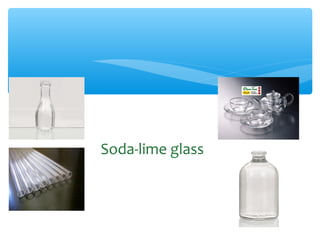
Soda-     Mixture of silica,   • Silicon     • Low melting point       • Light
lime      sodium carbonate       dioxide     • Easily shaped             bulbs
glass     (soda lime) and      • Sodium      • High chemical           • Window
          calcium carbonate      oxide         durability                glass
          (limestone) is       • Calcium     • Does not withstand      • Drinking
          heated to 1 500        oxide         heat                      glass
          degree celcius and                 • High thermal            • Mirrors
          cooled rapidly                       expansion
                                               coefficient (expand a
                                               lot when heated and
                                               contract a lot when
                                               cooled)
Type of         Production        Composition          Properties              Uses
 glass            method
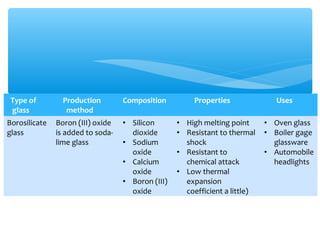
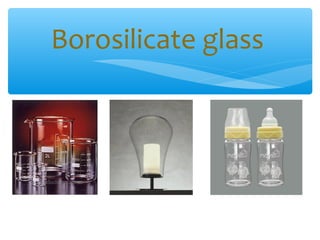
Borosilicate   Boron (III) oxide   • Silicon       • High melting point      • Oven glass
glass          is added to soda-     dioxide       • Resistant to thermal    • Boiler gage
               lime glass          • Sodium          shock                     glassware
                                     oxide         • Resistant to            • Automobile
                                   • Calcium         chemical attack           headlights
                                     oxide         • Low thermal
                                   • Boron (III)     expansion
                                     oxide           coefficient a little)
Type of     Production        Composition       Properties         Uses
  glass       method
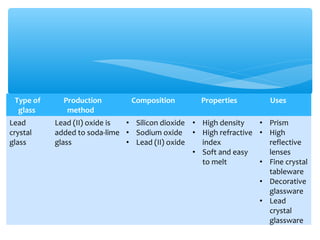
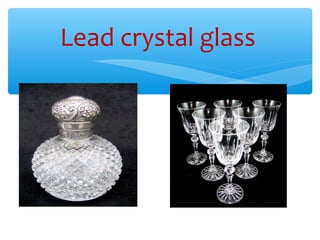
Lead       Lead (II) oxide is • Silicon dioxide • High density  • Prism
crystal    added to soda-lime • Sodium oxide • High refractive • High
glass      glass              • Lead (II) oxide   index           reflective
                                                • Soft and easy   lenses
                                                  to melt       • Fine crystal
                                                                  tableware
                                                                • Decorative
                                                                  glassware
                                                                • Lead
                                                                  crystal
                                                                  glassware
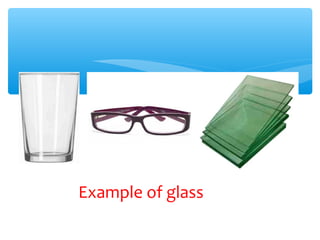
Example of glass
Fused glass
Soda-lime glass
Borosilicate glass
Lead crystal glass
Special glasses
Some special glasses have been made for specific purposes such as
photochromic glass, conducting glass and bullet-resistant glass.


Silver chloride in photochromic glass darkens the glass when exposed to
sunlight and protects the eyes from ultraviolet radiation.


Indium tin oxide (ITO) in conducting glass is able to conduct electricity. It
is mainly used to make transparent conductive coatings for liquid crystal
display (LCD), flat panel display and plasma display.
Bullet-resisitant glass is usually constructed using a strong but transparent
materials such as polycarbonate thermoplastic sandwiched between layers
of regular glass. The plastic provides impact resistance while the glass
flattens the bullet, thereby preventing penetration.
Ceramics

Ceramics are made from clay. Kaolin, a hydrated aluminosilicate,
Al2O.2SiO2.2H2O is an example of clay.

The major component of ceramic is silicate. Silicate is a chemical
compound containing silicon, oxygen, and one or more metals.

The common way of preparing ceramic is to heat the mouldedclay at a
very high temperature.
Ceramic that has been hardened after heating cannot be melted again due
to its extremely high heat resistance.

The main characteristics of ceramic are
  (a) extremely hard but brittle
  (b) chemically inert
  (c) opaque and porous
  (d) withstand compression
  (e) good heat and electrical insulators
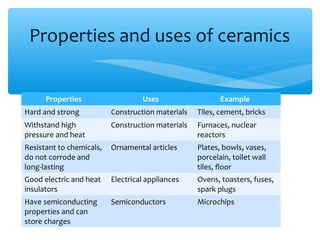
Properties and uses of ceramics


      Properties                   Uses                   Example
Hard and strong           Construction materials   Tiles, cement, bricks
Withstand high            Construction materials   Furnaces, nuclear
pressure and heat                                  reactors
Resistant to chemicals,   Ornamental articles      Plates, bowls, vases,
do not corrode and                                 porcelain, toilet wall
long-lasting                                       tiles, floor
Good electric and heat    Electrical appliances    Ovens, toasters, fuses,
insulators                                         spark plugs
Have semiconducting       Semiconductors           Microchips
properties and can
store charges
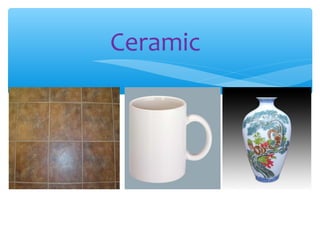
Ceramic
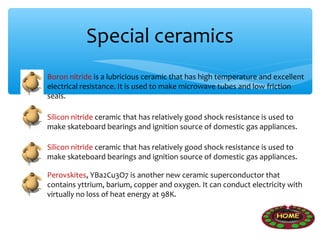
Special ceramics
Boron nitride is a lubricious ceramic that has high temperature and excellent
electrical resistance. It is used to make microwave tubes and low friction
seals.

Silicon nitride ceramic that has relatively good shock resistance is used to
make skateboard bearings and ignition source of domestic gas appliances.

Silicon nitride ceramic that has relatively good shock resistance is used to
make skateboard bearings and ignition source of domestic gas appliances.

Perovskites, YBa2Cu3O7 is another new ceramic superconductor that
contains yttrium, barium, copper and oxygen. It can conduct electricity with
virtually no loss of heat energy at 98K.
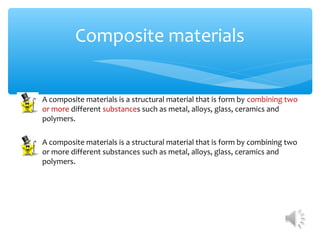
Composite materials


A composite materials is a structural material that is form by combining two
or more different substances such as metal, alloys, glass, ceramics and
polymers.

A composite materials is a structural material that is form by combining two
or more different substances such as metal, alloys, glass, ceramics and
polymers.
Examples of composite materials
1) Reinforced concrete

Concrete is a composite material which consists of mixture of stones, chips
and sand bound together by cement.


Concrete is strong but brittle and weak in tension. Steel has good tensile
strength.

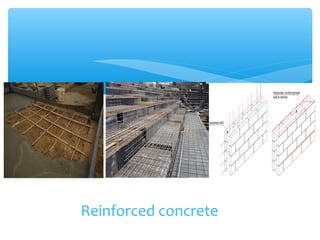
When concrete is reinforced with steel bars, steel wires of rods, it produces a
very tough materials with more tensile strength called reinforced concrete.
Reinforced concrete
Reinforced concrete is relatively cheap and can be moulded into any shape.
It is also stronger and better able to withstand tensile forces than concrete
alone.

It is used in high-rise buildings, bridges, oil platforms and highway.
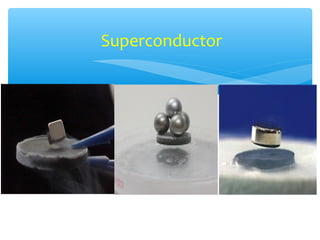
2) Superconductor

A superconductor is capable to conduct electricity without any electrical
resistance when it is cooled to an extremely low temperature.
Metal such as mercury can be a superconductor in 4.2K but it is very
expensive to maintain such extremely low temperature.

Using a combination of metals and metal oxide, a ceramic composite is
found to be superconducting at temperatures higher than 30K.
Perovskites is the latest ceramic superconductor that has zero resistance
at 95K.
Superconductors have low power dissipation, high-speed operation and
high sensitivity.
Superconductors are used in bullet trains (maglev train), magnetic
resonance imaging (MRI), computer chips, generators and transformers.
Superconductor
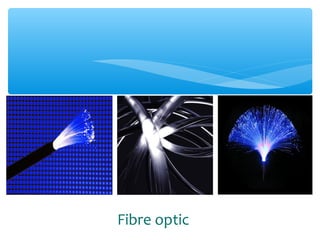
3) Fibre optic

A fibre optic capable consists of a bundle of glass or plastic threads that
are surrounded by a glass cladding.

It has high transmission capacity and chemical stability, but low
susceptibility to interference and material costs.

It is used in video cameras and local area networks for computers.
Besides that, it is used in instruments for examining internal parts of the
body or manufactured structural products and to transmit data, voice
and image in a digital format.
Fibre optic
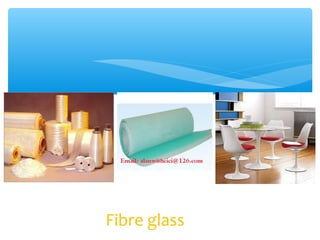
4) Fibre glass

Glass is hard, strong, has high density but it is relatively brittle. Plastic is
elastic, flexible, has low density but it is not strong.

When glass fibres are reinforced in plastic, a strong composite material
called fibre glass is produced.

It has high tensile strength, low density, can be easily coloured,
moulded and shaped. It can even be made into thin layers, yet very
strong.

It is used in water storage tanks, badminton rackets, small boats and
helmets.
Fibre glass
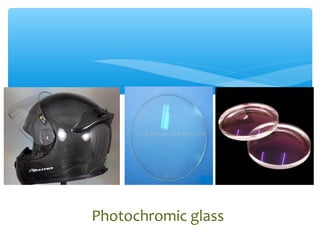
5) Photochromic glass

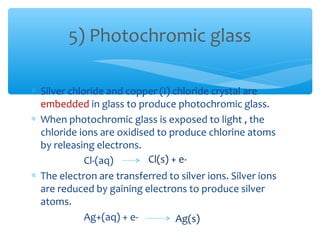
∗ Silver chloride and copper (I) chloride crystal are
  embedded in glass to produce photochromic glass.
∗ When photochromic glass is exposed to light , the
  chloride ions are oxidised to produce chlorine atoms
  by releasing electrons.
             Cl-(aq)       Cl(s) + e-
∗ The electron are transferred to silver ions. Silver ions
  are reduced by gaining electrons to produce silver
  atoms.
             Ag+(aq) + e-         Ag(s)
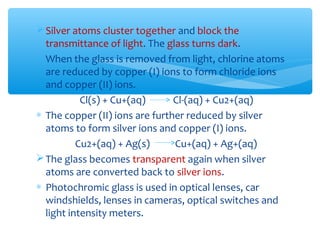
 Silver atoms cluster together and block the
  transmittance of light. The glass turns dark.
∗ When the glass is removed from light, chlorine atoms
  are reduced by copper (I) ions to form chloride ions
  and copper (II) ions.
           Cl(s) + Cu+(aq)      Cl-(aq) + Cu2+(aq)
∗ The copper (II) ions are further reduced by silver
  atoms to form silver ions and copper (I) ions.
          Cu2+(aq) + Ag(s)      Cu+(aq) + Ag+(aq)
 The glass becomes transparent again when silver
  atoms are converted back to silver ions.
∗ Photochromic glass is used in optical lenses, car
  windshields, lenses in cameras, optical switches and
  light intensity meters.
Photochromic glass
The uses of composite materials
   The needs for new materials for specific purposes
With the high demand of items with specific
properties, scientists have invented many new
substances to replace many traditional ones.
For example, plastics replace wood, optical fibres
replace copper wires and synthetic fibres replace cotton
and wool.
However, alloys, ceramics, glass, polymers produced
still have their disadvantages and do not meet certain
requirements in industry, communication, construction
and transportation.
Therefore, composite materials are created for
specific application.
THE END

manufactured substance in industry

  • 1.
    MANUFACTURED SUBTANCES IN INDUSTRY BY : NURFARAHAIN BINTI AHMAD 4ST SMK SG ABONG
  • 2.
    Introduction Many industrial productsare manufactured for our comfort. They are either made from sulphuric acid, ammonia, alloys, synthetic polymers, glass, ceramics or composite materials.
  • 3.
    MAIN MENU ALLOY SYNTHETIC POLYMERS GLASS & CERAMICS COMPOSITE MATERIALS
  • 4.
    ALLOYS ∗ An alloyis a homogenous mixture of two or more elements (especially metals) mixed in a certain fixed percentage. ∗ Alloys are made to improve the hardness, malleability and resistance to corrosion of pure metals. ∗ General properties of pure metals : * ductile- can be drawn into wires
  • 5.
    * malleable- canbe hammered into sheets * high melting and boiling points * high density * high electrical and heat conductivity ∗Most metals in their pure form are soft. ∗Metals like iron and copper tend to undergo corrosion readily to form oxides.
  • 6.
    ∗ A puremetal consists of layers of atoms arranged in an even, orderly, and close-packed manner at fixed position.
  • 7.
    ∗ Pure metalsare rather soft because when a force is applied, one layer of atoms can slide over another. ∗ Metals are ductile or can be stretched.
  • 8.
    Some imperfections inthe orderly arrangement of atoms in metals that allow some empty space in between the atoms. When a metal is knocked , atom slide. Metals are malleable or can be shaped. force the shape of the metal changes
  • 9.
    ∗ Alloys suchas bronze, brass, steel, stainless, duralumin and pewter are commonly used in our daily lives. ∗ The uses of each different type of alloys depend on the properties of the alloy. ∗ For example, cutlery is made of stainless steel because stainless steel is shiny and does not rust.
  • 10.
    ∗ Table 1The composition, properties and uses of some alloys Alloy Composition Properties Uses Bronze • 90% copper • Hard and strong • In the building of • 10% tin • Does not corrode statues or monuments easily • In the making of • Has shiny surface medals, swords and artistic materials Brass • 70% copper • Hard than copper In the making of musical • 30% zinc instruments and kitchenware Steel • 99% iron • Hard and strong • In the construction of • 1% carbon buildings and bridges • In the building of the body of cars and railway tracks
  • 11.
    Alloy Composition Properties Uses Stainless • 74%iron • Shiny • In the making cutlery steel • 8% carbon • Strong • In the making of • 18% chromium • Does not rust surgical instruments Duralumin • 93% aluminium • Light • In the building of the • 3% copper • Stong body of aeroplanes and • 3% magnesium bullet trains • 1% manganese Pewter • 96% tin • Lustre • In the making of • 3% copper • Shiny souvenirs • 1% antimony • Strong
  • 12.
  • 13.
  • 14.
  • 15.
  • 16.
  • 17.
  • 18.
    THE ARRANGEMENT OFATOMS IN ALLOYS ∗ The presence of atoms of other metals that are of different size disturb the orderly arrangement of atoms in the metal. ∗ This reduces the layer of atoms from sliding. ∗ Thus, an alloy is stronger and harder than its pure metal.
  • 19.
    Pure metal A Pure metal B Alloy The formation of alloy
  • 20.
    Synthetic Polymers ∗ Polymersare large molecules made up of many identical repeating sub-units called monomers which are joined together by covalent bonds. ∗ Monomers are joined into chains by a process of repeated linking known as polymerisation.
  • 21.
  • 22.
    A polymer mayconsist of thousands of monomers. Some polymers occur naturally. Starch, cellulose, wool, protein, silk and natural rubber are some example of naturally occuring polymers. Synthetic polymerare man-made polymers. The monomers used are usually obtained from petroleum after going through the refining and cracking processes. The monomers used are usually obtained from petroleum after going through the refining and cracking processes.
  • 23.
  • 24.
  • 25.
  • 26.
    Monomers in syntheticpolymers Synthetic polymer Monomer Uses Polythene Ethene Plastic bags, shopping bags, plastic containers and insulation for electrical wiring Polypropene Propene Piping, bottle crates, carpets, car batteries and ropes Polyvinyl chloride, Chloroethene Artificial leather, water pipes PVC and records
  • 27.
    Synthetic polymer Monomer Uses Perspex Methylmethacrylate Safety glass, reflectors, traffic signs and lens Terylene Hexane-1,6-diol Clothing, sails and ropes Benzene-1, 4-dicarboxylic acid Nylon Hexane-1,6-diamine Ropes, clothing and Hexane-1, carpets 6-diodic acid
  • 28.
    Synthetic polymer indaily life With the increasing use of synthetic polymers, there are some drawbacks : Synthetic polymers are non-biodegradable. Disposal of synthetic polymers will use up a large fraction of available landfill space. The raw materials for these polymers are obtained from petroleum, thus depleting the supply of non-renewable source. Burning of synthetic polymers releases pollutant and toxic gases that are harmful to our health. For example, burning of PVC releases hydrogen chloride gas. Gases such as carbon monoxide, carbon dioxide, sulphur dioxide and oxide of nitrogen can cause the green house effect and acid rain. Improper disposal of synthetic polymers also destroy the beauty of the nature , causes flash flood and endanger the wildlife.
  • 29.
    •To reduce thedemand for landfill space, consumption of limited petroleum reserves and environmental pollution, we should : Reduce, reuse and recycle the non-biodegradable synthetic polymers. Use the biodegradable plastics (Bioplastic) such as polylactide acid (PLA) plastic and poly-3-hydroxybutyrate (PHB) plastic. Educate users to the right disposal methods.
  • 30.
  • 31.
  • 32.
  • 33.
  • 34.
  • 35.
  • 36.
  • 37.
  • 38.
    Glass The major componentof glass is silica or silicon dioxide, SiO2. Silicon dioxide is the second most abundant elements in the Earth’s crust. It is commonly found in sand. The most way common of preparing glass is to heat the sand to the temperature of 1700 degree celcius. The molten liquid obtained is the cooled quickly so that it solidifies to produce glass.
  • 39.
    Silicon atom Oxygen atom Structure of silicon dioxide
  • 40.
    During rapid cooling,the particles in the liquid do not have time to return to its original crystalline arrangement. They occupy randomly arranged lattice sites and result s in an amorphus solid. This amorphus structure makes the glass brittle. The main characteristics of glass are : a. hard but brittle b. chemically inert c. transparent and impermeable (non-porous) d. withstand compression e. good heat and electrical insulators
  • 41.
    Types, composition, properties and uses of glass 1. There are four types of glasses : (a) Soda-lime glass (soft glass) * The most common and least expensive glass (b) Lead crystal glass (soft glass) (c) Borosilicate glass (hard glass) (d) Fused glass (hardest glass) * The simplest and most expensive glass
  • 42.
    Type of Production Composition Properties Uses glass method Fused Silica is heated until • Silicon • Very high melting • Laboratory glass it melts at 1 700 dioxide point glass rods degree celcius and • High transparency • Telescope cooled rapidly • Highest resistance mirrors to thermal shock • Optical (can be heated to fibres an extremely high • Lenses temperature and then plunged into icy, cold water without cracking)
  • 43.
    Type of Production Composition Properties Uses glass method Soda- Mixture of silica, • Silicon • Low melting point • Light lime sodium carbonate dioxide • Easily shaped bulbs glass (soda lime) and • Sodium • High chemical • Window calcium carbonate oxide durability glass (limestone) is • Calcium • Does not withstand • Drinking heated to 1 500 oxide heat glass degree celcius and • High thermal • Mirrors cooled rapidly expansion coefficient (expand a lot when heated and contract a lot when cooled)
  • 44.
    Type of Production Composition Properties Uses glass method Borosilicate Boron (III) oxide • Silicon • High melting point • Oven glass glass is added to soda- dioxide • Resistant to thermal • Boiler gage lime glass • Sodium shock glassware oxide • Resistant to • Automobile • Calcium chemical attack headlights oxide • Low thermal • Boron (III) expansion oxide coefficient a little)
  • 45.
    Type of Production Composition Properties Uses glass method Lead Lead (II) oxide is • Silicon dioxide • High density • Prism crystal added to soda-lime • Sodium oxide • High refractive • High glass glass • Lead (II) oxide index reflective • Soft and easy lenses to melt • Fine crystal tableware • Decorative glassware • Lead crystal glassware
  • 46.
  • 47.
  • 48.
  • 49.
  • 50.
  • 51.
    Special glasses Some specialglasses have been made for specific purposes such as photochromic glass, conducting glass and bullet-resistant glass. Silver chloride in photochromic glass darkens the glass when exposed to sunlight and protects the eyes from ultraviolet radiation. Indium tin oxide (ITO) in conducting glass is able to conduct electricity. It is mainly used to make transparent conductive coatings for liquid crystal display (LCD), flat panel display and plasma display.
  • 52.
    Bullet-resisitant glass isusually constructed using a strong but transparent materials such as polycarbonate thermoplastic sandwiched between layers of regular glass. The plastic provides impact resistance while the glass flattens the bullet, thereby preventing penetration.
  • 53.
    Ceramics Ceramics are madefrom clay. Kaolin, a hydrated aluminosilicate, Al2O.2SiO2.2H2O is an example of clay. The major component of ceramic is silicate. Silicate is a chemical compound containing silicon, oxygen, and one or more metals. The common way of preparing ceramic is to heat the mouldedclay at a very high temperature.
  • 54.
    Ceramic that hasbeen hardened after heating cannot be melted again due to its extremely high heat resistance. The main characteristics of ceramic are (a) extremely hard but brittle (b) chemically inert (c) opaque and porous (d) withstand compression (e) good heat and electrical insulators
  • 55.
    Properties and usesof ceramics Properties Uses Example Hard and strong Construction materials Tiles, cement, bricks Withstand high Construction materials Furnaces, nuclear pressure and heat reactors Resistant to chemicals, Ornamental articles Plates, bowls, vases, do not corrode and porcelain, toilet wall long-lasting tiles, floor Good electric and heat Electrical appliances Ovens, toasters, fuses, insulators spark plugs Have semiconducting Semiconductors Microchips properties and can store charges
  • 56.
  • 57.
    Special ceramics Boron nitrideis a lubricious ceramic that has high temperature and excellent electrical resistance. It is used to make microwave tubes and low friction seals. Silicon nitride ceramic that has relatively good shock resistance is used to make skateboard bearings and ignition source of domestic gas appliances. Silicon nitride ceramic that has relatively good shock resistance is used to make skateboard bearings and ignition source of domestic gas appliances. Perovskites, YBa2Cu3O7 is another new ceramic superconductor that contains yttrium, barium, copper and oxygen. It can conduct electricity with virtually no loss of heat energy at 98K.
  • 58.
    Composite materials A compositematerials is a structural material that is form by combining two or more different substances such as metal, alloys, glass, ceramics and polymers. A composite materials is a structural material that is form by combining two or more different substances such as metal, alloys, glass, ceramics and polymers.
  • 59.
  • 60.
    1) Reinforced concrete Concreteis a composite material which consists of mixture of stones, chips and sand bound together by cement. Concrete is strong but brittle and weak in tension. Steel has good tensile strength. When concrete is reinforced with steel bars, steel wires of rods, it produces a very tough materials with more tensile strength called reinforced concrete.
  • 61.
  • 62.
    Reinforced concrete isrelatively cheap and can be moulded into any shape. It is also stronger and better able to withstand tensile forces than concrete alone. It is used in high-rise buildings, bridges, oil platforms and highway.
  • 63.
    2) Superconductor A superconductoris capable to conduct electricity without any electrical resistance when it is cooled to an extremely low temperature. Metal such as mercury can be a superconductor in 4.2K but it is very expensive to maintain such extremely low temperature. Using a combination of metals and metal oxide, a ceramic composite is found to be superconducting at temperatures higher than 30K. Perovskites is the latest ceramic superconductor that has zero resistance at 95K. Superconductors have low power dissipation, high-speed operation and high sensitivity. Superconductors are used in bullet trains (maglev train), magnetic resonance imaging (MRI), computer chips, generators and transformers.
  • 64.
  • 65.
    3) Fibre optic Afibre optic capable consists of a bundle of glass or plastic threads that are surrounded by a glass cladding. It has high transmission capacity and chemical stability, but low susceptibility to interference and material costs. It is used in video cameras and local area networks for computers. Besides that, it is used in instruments for examining internal parts of the body or manufactured structural products and to transmit data, voice and image in a digital format.
  • 66.
  • 67.
    4) Fibre glass Glassis hard, strong, has high density but it is relatively brittle. Plastic is elastic, flexible, has low density but it is not strong. When glass fibres are reinforced in plastic, a strong composite material called fibre glass is produced. It has high tensile strength, low density, can be easily coloured, moulded and shaped. It can even be made into thin layers, yet very strong. It is used in water storage tanks, badminton rackets, small boats and helmets.
  • 68.
  • 69.
    5) Photochromic glass ∗Silver chloride and copper (I) chloride crystal are embedded in glass to produce photochromic glass. ∗ When photochromic glass is exposed to light , the chloride ions are oxidised to produce chlorine atoms by releasing electrons. Cl-(aq) Cl(s) + e- ∗ The electron are transferred to silver ions. Silver ions are reduced by gaining electrons to produce silver atoms. Ag+(aq) + e- Ag(s)
  • 70.
     Silver atomscluster together and block the transmittance of light. The glass turns dark. ∗ When the glass is removed from light, chlorine atoms are reduced by copper (I) ions to form chloride ions and copper (II) ions. Cl(s) + Cu+(aq) Cl-(aq) + Cu2+(aq) ∗ The copper (II) ions are further reduced by silver atoms to form silver ions and copper (I) ions. Cu2+(aq) + Ag(s) Cu+(aq) + Ag+(aq)  The glass becomes transparent again when silver atoms are converted back to silver ions. ∗ Photochromic glass is used in optical lenses, car windshields, lenses in cameras, optical switches and light intensity meters.
  • 71.
  • 72.
    The uses ofcomposite materials The needs for new materials for specific purposes With the high demand of items with specific properties, scientists have invented many new substances to replace many traditional ones. For example, plastics replace wood, optical fibres replace copper wires and synthetic fibres replace cotton and wool. However, alloys, ceramics, glass, polymers produced still have their disadvantages and do not meet certain requirements in industry, communication, construction and transportation. Therefore, composite materials are created for specific application.
  • 73.