Identify gases – H 2 , O 2 , CO 2 , NH 3 , SO 2 , C l 2  and H 2 O Identify cations – Pb 2+ , A l 3+ , Ca 2+ , Zn 2+ , Fe 3+ , Fe 2+ ,    NH 4 +, Cu 2+ Identify anions – CO 3 2- , SO 4 2- , SO 3 2- , NO 3 - , Br - , I - , C l - Qualitative Analysis Chapter 21 L EARNING   O UTCOMES
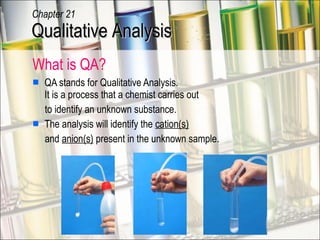
What is QA? QA stands for Qualitative Analysis.  It is a process that a chemist carries out  to identify an unknown substance. The analysis will identify the  cation(s)   and  anion(s)  present in the unknown sample.   Qualitative Analysis Chapter 21
The QA Process Make preliminary observations about the  unknown substance. Carry out tests in the order given. Make observations and record them in a suitable format. Draw conclusions from the observations Identify the unknown substance. Five important steps Qualitative Analysis Chapter 21
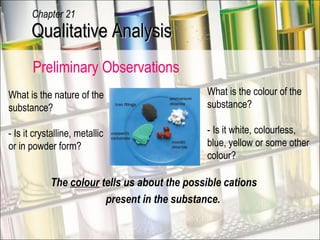
Preliminary Observations  The  colour  tells us about the possible cations  present in the substance. What is the colour of the substance? - Is it white, colourless, blue, yellow or some other colour? What is the nature of the substance? - Is it crystalline, metallic or in powder form? Qualitative Analysis Chapter 21
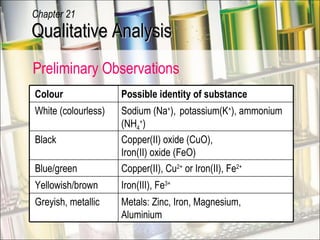
Qualitative Analysis Chapter 21 Preliminary Observations  Colour Possible identity of substance White (colourless) Sodium (Na + ),   potassium(K + ), ammonium (NH 4 + ) Black Copper(II) oxide (CuO), Iron(II) oxide (FeO) Blue/green Copper(II), Cu 2+  or Iron(II), Fe 2+   Yellowish/brown Iron(III), Fe 3+ Greyish, metallic Metals: Zinc, Iron, Magnesium, Aluminium
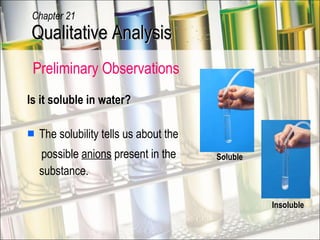
Is it soluble in water? The solubility tells us about the  possible  anions  present in the substance. Insoluble Soluble Qualitative Analysis Chapter 21 Preliminary Observations
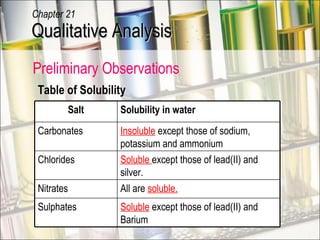
Table of Solubility Qualitative Analysis Chapter 21 Preliminary Observations  Salt Solubility in water Carbonates Insoluble  except those of sodium, potassium and ammonium Chlorides Soluble  except those of lead(II) and silver. Nitrates All are  soluble. Sulphates Soluble  except those of lead(II) and Barium
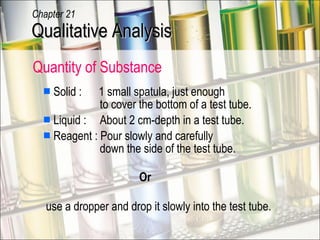
Solid :  1 small spatula, just enough   to cover the bottom of a test tube. Liquid :  About 2 cm-depth in a test tube. Reagent : Pour slowly and carefully    down the side of the test tube.   Or  Quantity of Substance use a dropper and drop it slowly into the test tube. Qualitative Analysis Chapter 21
Using a Bunsen burner Heating Liquids Use a gentle non-luminous flame (air-hole half open) for heating a liquid in a test tube. Move the test tube up and down the flame and stop the heating as soon as the liquid starts to boil. Heating Solids When heating a solid, place it in a dry, clean test tube. Heat gently at first, then strongly. For your own safety, wear protective goggles and point the test tube away from yourself and others when heating. Qualitative Analysis Chapter 21
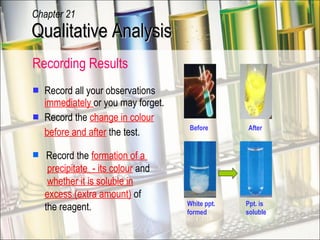
Recording Results Record all your observations  immediately  or you may forget. Record the  change in colour   before and after  the test. Record the  formation of a    precipitate  - its colour  and    whether it is soluble in   excess (extra amount)  of   the reagent. Before After Ppt. is soluble White ppt. formed Qualitative Analysis Chapter 21
Recording Results formulae  for names of chemicals  ppt.  for precipitate  aq.  for aqueous solution You may use phrases and short forms: Record the  liberation of a gas  by noting if any  bubbles  (effervescence) are seen. State the test you carried out to identify the gas, and the result you obtained. Qualitative Analysis Chapter 21
Quick Check 1 State the colour of the following substances: (a) Sodium carbonate: __________ (b) Potassium sulphate: _________ (c) Calcium chloride: ___________ (d)  Iron(II) sulphate: ___________ (e)  Iron(III) sulphate: ___________ (f)  Copper(II) sulphate: _________ (g) Copper(II) carbonate: ________ (h)  Copper(II) oxide: ___________ Solution Qualitative Analysis Chapter 21
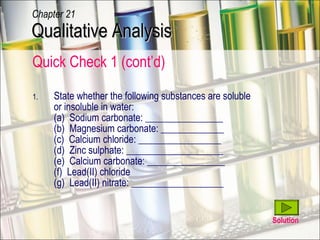
Quick Check 1 (cont’d) State whether the following substances are soluble  or insoluble in water: (a)  Sodium carbonate: ________________ (b)  Magnesium carbonate: _____________ (c)  Calcium chloride: _________________ (d)  Zinc sulphate: ____________________ (e)  Calcium carbonate: ________________ (f)  Lead(II) chloride (g)  Lead(II) nitrate: ___________________ Solution Qualitative Analysis Chapter 21
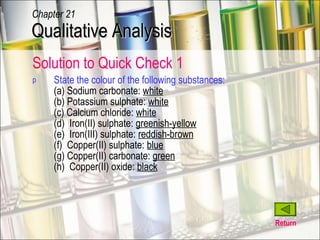
State the colour of the following substances: (a) Sodium carbonate:  white (b) Potassium sulphate:  white (c) Calcium chloride:  white (d)  Iron(II) sulphate:  greenish-yellow (e)  Iron(III) sulphate:  reddish-brown (f)  Copper(II) sulphate:  blue (g) Copper(II) carbonate:  green (h)  Copper(II) oxide:  black Return Qualitative Analysis Chapter 21 Solution to Quick Check 1
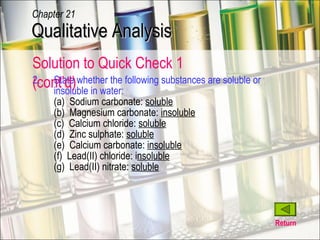
2. State whether the following substances are soluble or insoluble in water: (a)  Sodium carbonate:  soluble (b)  Magnesium carbonate:  insoluble (c)  Calcium chloride:  soluble (d)  Zinc sulphate:  soluble (e)  Calcium carbonate:  insoluble (f)  Lead(II) chloride: i nsoluble (g)  Lead(II) nitrate:  soluble Return Qualitative Analysis Chapter 21 Solution to Quick Check 1 (cont’d)
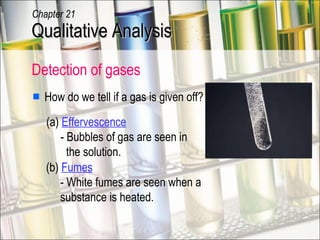
Detection of gases  How do we tell if a gas is given off? (a)  Effervescence   - Bubbles of gas are seen in   the solution.  (b)  Fumes   - White fumes are seen when a   substance is heated. Qualitative Analysis Chapter 21
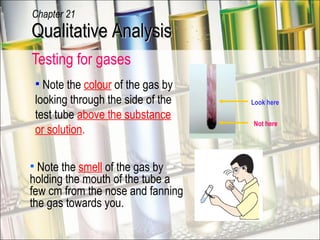
Testing for gases  Look here Not here Note the  smell  of the gas by holding the mouth of the tube a few cm from the nose and fanning the gas towards you. Note the  colour  of the gas by looking through the side of the test tube  above the substance or solution . Qualitative Analysis Chapter 21
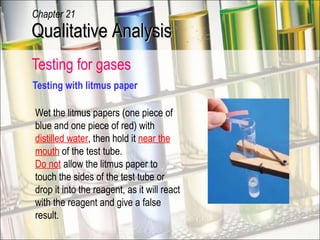
Testing for gases  Testing with litmus paper Wet the litmus papers (one piece of blue and one piece of red) with  distilled water , then hold it  near the mouth  of the test tube. Do not  allow the litmus paper to touch the sides of the test tube or drop it into the reagent, as it will react with the reagent and give a false result. Qualitative Analysis Chapter 21
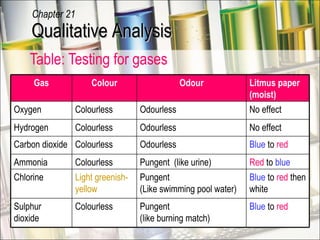
Table: Testing for gases  Qualitative Analysis Chapter 21 Gas Colour Odour Litmus paper (moist) Oxygen Colourless Odourless No effect Hydrogen Colourless Odourless No effect Carbon dioxide Colourless Odourless Blue  to  red   Ammonia Colourless Pungent  (like urine) Red  to  blue Chlorine Light greenish-yellow Pungent (Like swimming pool water) Blue  to  red  then white Sulphur dioxide Colourless Pungent  (like burning match) Blue  to  red
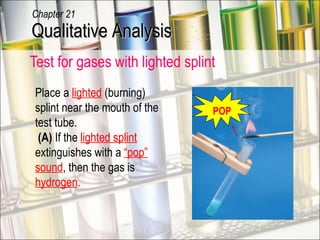
Test for gases with lighted splint POP Place a   lighted  (burning) splint near the mouth of the test tube. (A)  If the  lighted splint extinguishes with a  “pop” sound , then the gas is  hydrogen . Qualitative Analysis Chapter 21
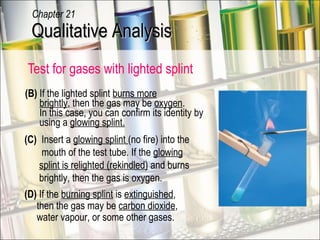
Test for gases with lighted splint  (B)  If the lighted splint  burns more   brightly , then the gas may be  oxygen .   In this case, you can confirm its identity by   using a  glowing splint. (D)  If the  burning splint  is  extinguished ,   then the gas may be  carbon dioxide ,    water vapour, or some other gases. (C)  Insert a  glowing splint  (no fire) into the   mouth of the test tube. If the  glowing   splint is relighted (rekindled)  and burns   brightly, then the gas is oxygen. flame extinguished Qualitative Analysis Chapter 21
Testing for carbon dioxide Note The carbon dioxide should not be passed for too long, as the limewater will turn clear again (due to the formation of soluble calcium hydrogen carbonate), giving a false impression of a negative test. Pour limewater (calcium hydroxide solution) into a test tube until it reaches a depth of 2 cm from the bottom of the test tube. Stopper the reacting test tube with a delivery tube and pass the gas into the limewater. If a white ppt. is formed, the gas is carbon dioxide. Qualitative Analysis Chapter 21
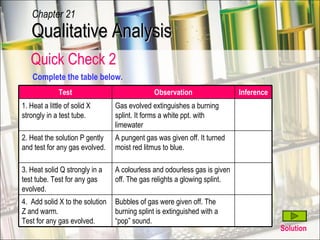
Quick Check 2 Solution Complete the table below. Qualitative Analysis Chapter 21 Test Observation Inference 1. Heat a little of solid X strongly in a test tube. Gas evolved extinguishes a burning splint. It forms a white ppt. with limewater 2. Heat the solution P gently and test for any gas evolved.  A pungent gas was given off. It turned moist red litmus to blue. 3. Heat solid Q strongly in a test tube. Test for any gas evolved. A colourless and odourless gas is given off. The gas relights a glowing splint. 4.  Add solid X to the solution Z and warm. Test for any gas evolved. Bubbles of gas were given off. The burning splint is extinguished with a “pop” sound.
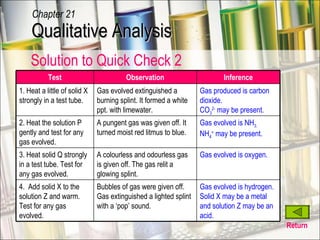
Return Qualitative Analysis Chapter 21 Solution to  Quick Check 2 Test Observation Inference 1. Heat a little of solid X strongly in a test tube. Gas evolved extinguished a burning splint. It formed a white ppt. with limewater. Gas produced is carbon dioxide.  CO 3 2-  may be present. 2. Heat the solution P gently and test for any gas evolved.  A pungent gas was given off. It turned moist red litmus to blue. Gas evolved is NH 3. NH 4 +  may be present. 3. Heat solid Q strongly in a test tube. Test for any gas evolved. A colourless and odourless gas is given off. The gas relit a glowing splint. Gas evolved is oxygen. 4.  Add solid X to the solution Z and warm. Test for any gas evolved. Bubbles of gas were given off. Gas extinguished a lighted splint with a ‘pop’ sound. Gas evolved is hydrogen. Solid X may be a metal and solution Z may be an acid.
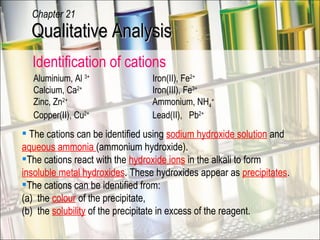
Identification of cations Aluminium, Al  3+ Iron(II), Fe 2+ Calcium, Ca 2+ Iron(III), Fe 3+ Zinc, Zn 2+ Ammonium, NH 4 + Copper(II), Cu 2+ Lead(II),  Pb 2+ Qualitative Analysis Chapter 21 The cations can be identified using  sodium hydroxide solution  and  aqueous ammonia  (ammonium hydroxide). The cations react with the  hydroxide ions  in the alkali to form  insoluble metal hydroxides . These hydroxides appear as  precipitates . The cations can be identified from:  (a)  the  colour  of the precipitate, (b)  the  solubility  of the precipitate in excess of the reagent.
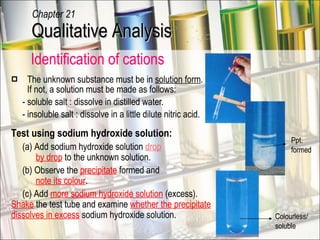
Identification of cations The unknown substance must be in  solution form .  If not, a solution must be made as follows: - soluble salt : dissolve in distilled water. - insoluble salt : dissolve in a little dilute nitric acid. Test using sodium hydroxide solution: (a) Add sodium hydroxide solution  drop   by drop  to the unknown solution. (b) Observe the  precipitate  formed and   note its colour . (c) Add  more sodium hydroxide solution  (excess).  Shake  the test tube and examine  whether the precipitate dissolves in excess  sodium hydroxide solution.  Ppt. formed Colourless/ soluble Qualitative Analysis Chapter 21
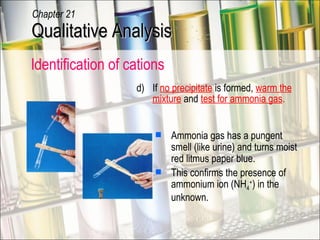
Identification of cations d) If  no precipitate  is formed,  warm the mixture  and  test for ammonia gas .  Ammonia gas has a pungent smell (like urine) and turns moist red litmus paper blue. This confirms the presence of ammonium ion (NH 4 + ) in the unknown. Qualitative Analysis Chapter 21
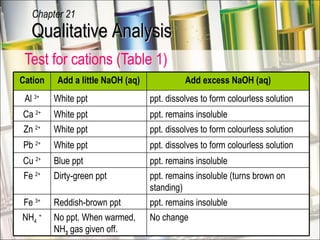
Test for cations (Table 1) Qualitative Analysis Chapter 21 C ation Add a little NaOH (aq) Add excess NaOH (aq) Al  3+ White ppt ppt. dissolves to form colourless solution Ca  2+ White ppt ppt. remains insoluble Zn  2+ White ppt ppt. dissolves to form colourless solution Pb  2+ White ppt ppt. dissolves to form colourless solution Cu  2+ Blue ppt ppt. remains insoluble Fe  2+ Dirty-green ppt ppt. remains insoluble (turns brown on standing) Fe  3+ Reddish-brown ppt ppt. remains insoluble NH 4   + No ppt. When warmed, NH 3  gas given off. No change
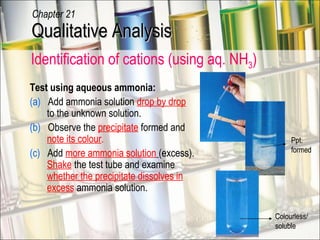
Identification of cations (using aq. NH 3 ) Test using aqueous ammonia: (a)   Add ammonia solution  drop by drop   to the unknown solution. (b)   Observe the  precipitate  formed and   note its colour . (c)   Add  more ammonia solution   (excess).    Shake  the test tube and examine   whether the precipitate dissolves in   excess  ammonia solution.  Qualitative Analysis Chapter 21 Ppt. formed Colourless/ soluble
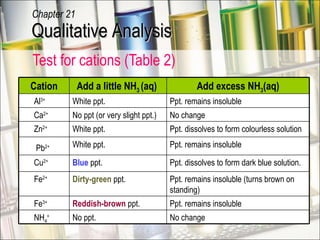
Test for cations (Table 2) Qualitative Analysis Chapter 21 Cation Add a little NH 3  (aq)  Add excess NH 3 (aq) Al 3+  White ppt. Ppt. remains insoluble Ca 2+ No ppt (or very slight ppt.) No change Zn 2+ White ppt. Ppt. dissolves to form colourless solution Pb 2+ White ppt. Ppt. remains insoluble Cu 2+ Blue  ppt. Ppt. dissolves to form dark blue solution. Fe 2+ Dirty-green  ppt. Ppt. remains insoluble (turns brown on standing) Fe 3+ Reddish-brown  ppt. Ppt. remains insoluble NH 4 + No ppt.  No change
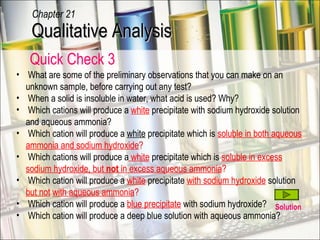
Quick Check 3 What are some of the preliminary observations that you can make on an unknown sample, before carrying out any test? When a solid is insoluble in water, what acid is used? Why? Which cations will produce a  white  precipitate with sodium hydroxide solution and aqueous ammonia? Which cation will produce a  white  precipitate which is  soluble in both aqueous ammonia and sodium hydroxide ? Which cations will produce a  white  precipitate which is  soluble in excess sodium hydroxide, but  not  in excess aqueous ammonia ? Which cation will produce a  white  precipitate  with sodium hydroxide  solution  but not   with aqueous ammonia ? Which cation will produce a  blue precipitate  with sodium hydroxide? Which cation will produce a deep blue solution with aqueous ammonia? Qualitative Analysis Chapter 21 Solution
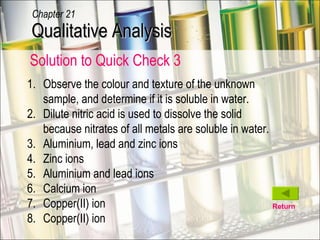
Return Observe the colour and texture of the unknown sample, and determine if it is soluble in water. Dilute nitric acid is used to dissolve the solid because nitrates of all metals are soluble in water. Aluminium, lead and zinc ions Zinc ions Aluminium and lead ions Calcium ion Copper(II) ion Copper(II) ion Qualitative Analysis Chapter 21 Solution to Quick Check 3
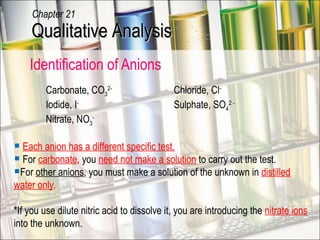
Identification of Anions Carbonate, CO 3 2-   Chloride, Cl - Iodide, I -   Sulphate, SO 4 2 - Nitrate, NO 3 - Each anion has a different specific test. For  carbonate ,  you  need not make a solution  to carry out the test. For  other anions , you must make a solution of the unknown in  distilled water only .   *If you use dilute nitric acid to dissolve it, you are introducing the  nitrate ions  into the unknown. Qualitative Analysis Chapter 21
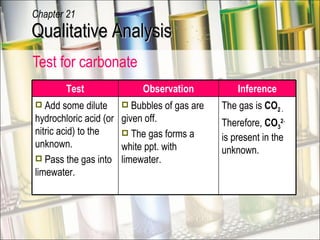
Test for carbonate Qualitative Analysis Chapter 21 Test Observation Inference Add some dilute hydrochloric acid (or nitric acid) to the unknown. Pass the gas into limewater. Bubbles of gas are given off. The gas forms a white ppt. with limewater. The gas is  CO 2 . Therefore,  CO 3 2 -  is present in the unknown.
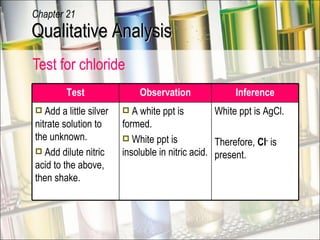
Test for chloride  Qualitative Analysis Chapter 21 Test Observation Inference Add a little silver nitrate solution to the unknown. Add dilute nitric acid to the above, then shake. A white ppt is formed. White ppt is insoluble in nitric acid. White ppt is AgCl. Therefore,  Cl -  is present.
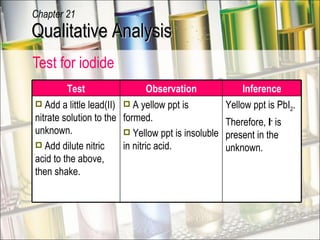
Test for iodide Qualitative Analysis Chapter 21 Test Observation Inference Add a little lead(II) nitrate solution to the unknown. Add dilute nitric acid to the above, then shake. A yellow ppt is formed. Yellow ppt is insoluble in nitric acid. Yellow ppt is PbI 2 . Therefore,  I -  is present in the unknown.
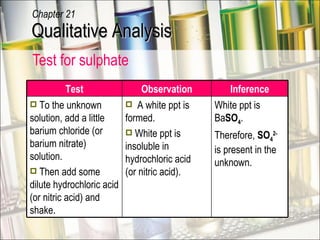
Test for sulphate Qualitative Analysis Chapter 21 Test Observation Inference To the unknown solution, add a little barium chloride (or barium nitrate)  solution. Then add some dilute hydrochloric acid (or nitric acid) and shake. A white ppt is formed. White ppt is insoluble in hydrochloric acid (or nitric acid). White ppt is Ba SO 4 . Therefore,  SO 4 2-  is present in the unknown.
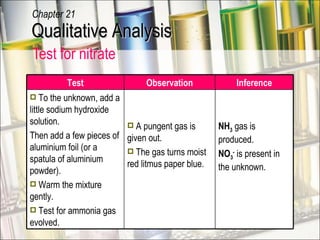
Test for nitrate Qualitative Analysis Chapter 21 Test Observation Inference To the unknown, add a little sodium hydroxide solution. Then add a few pieces of aluminium foil (or a spatula of aluminium powder). Warm the mixture gently. Test for ammonia gas evolved. A pungent gas is given out. The gas turns moist red litmus paper blue. NH 3  gas is produced. NO 3 -  is present in the unknown.
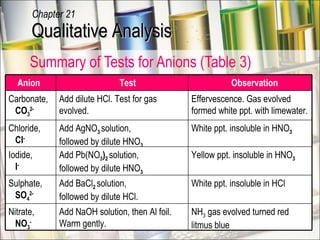
Summary of Tests for Anions (Table 3) Qualitative Analysis Chapter 21 Anion Test Observation Carbonate,    CO 3 2- Add dilute HCl. Test for gas evolved. Effervescence. Gas evolved formed white ppt. with limewater. Chloride,    Cl - Add AgNO 3   solution, followed by dilute HNO 3 White ppt. insoluble in HNO 3 Iodide,    I - Add Pb(NO 3 ) 2   solution, followed by dilute HNO 3 Yellow ppt. insoluble in HNO 3 Sulphate,    SO 4 2- Add BaCl 2   solution, followed by dilute HCl. White ppt. insoluble in HCl Nitrate,    NO 3 - Add NaOH solution, then Al foil.  Warm gently. NH 3  gas evolved turned red litmus blue
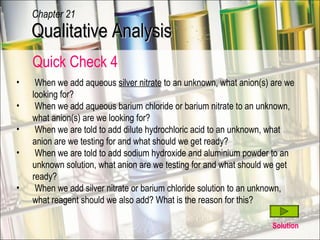
Quick Check 4 Solution When we add aqueous  silver nitrate  to an unknown, what anion(s) are we looking for? When we add aqueous barium chloride or barium nitrate to an unknown, what anion(s) are we looking for? When we are told to add dilute hydrochloric acid to an unknown, what anion are we testing for and what should we get ready? When we are told to add sodium hydroxide and aluminium powder to an unknown solution, what anion are we testing for and what should we get ready? When we add silver nitrate or barium chloride solution to an unknown, what reagent should we also add? What is the reason for this? Qualitative Analysis Chapter 21
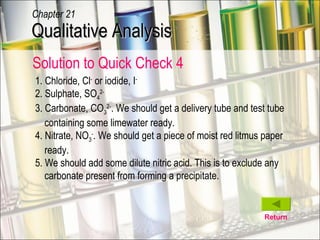
Return 1. Chloride, Cl -  or iodide, I - 2. Sulphate, SO 4 2- 3. Carbonate, CO 3 2- . We should get a delivery tube and test tube containing some limewater ready.  4. Nitrate, NO 3 - . We should get a piece of moist red litmus paper ready. 5. We should add some dilute nitric acid. This is to exclude any carbonate present from forming a precipitate. Qualitative Analysis Chapter 21 Solution to Quick Check 4
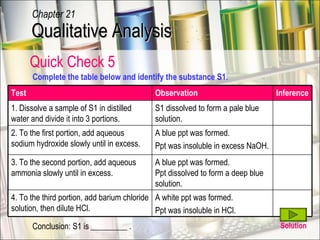
Quick Check 5 Conclusion: S1 is _________ . Complete the table below and identify the substance S1. Solution Qualitative Analysis Chapter 21 Test Observation  Inference 1. Dissolve a sample of S1 in distilled water and divide it into 3 portions. S1 dissolved to form a pale blue solution. 2. To the first portion, add aqueous sodium hydroxide slowly until in excess. A blue ppt was formed. Ppt was insoluble in excess NaOH. 3. To the second portion, add aqueous ammonia slowly until in excess. A blue ppt was formed. Ppt dissolved to form a deep blue solution. 4. To the third portion, add barium chloride solution, then dilute HCl. A white ppt was formed. Ppt was insoluble in HCl.
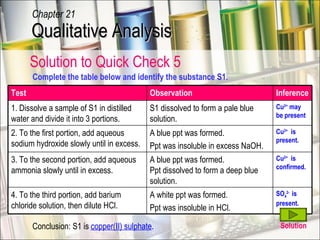
Solution to Quick Check 5 Conclusion: S1 is  copper(II) sulphate . Complete the table below and identify the substance S1. Solution Qualitative Analysis Chapter 21 Test Observation  Inference 1. Dissolve a sample of S1 in distilled water and divide it into 3 portions. S1 dissolved to form a pale blue solution. Cu 2+  may be present 2. To the first portion, add aqueous sodium hydroxide slowly until in excess. A blue ppt was formed. Ppt was insoluble in excess NaOH. Cu 2+   is present. 3. To the second portion, add aqueous ammonia slowly until in excess. A blue ppt was formed. Ppt dissolved to form a deep blue solution. Cu 2+   is confirmed. 4. To the third portion, add barium chloride solution, then dilute HCl. A white ppt was formed. Ppt was insoluble in HCl. SO 4 2-  is present.

C21 qualitative-analysis-edited

  • 1.
    Identify gases –H 2 , O 2 , CO 2 , NH 3 , SO 2 , C l 2 and H 2 O Identify cations – Pb 2+ , A l 3+ , Ca 2+ , Zn 2+ , Fe 3+ , Fe 2+ , NH 4 +, Cu 2+ Identify anions – CO 3 2- , SO 4 2- , SO 3 2- , NO 3 - , Br - , I - , C l - Qualitative Analysis Chapter 21 L EARNING O UTCOMES
  • 2.
    What is QA?QA stands for Qualitative Analysis. It is a process that a chemist carries out to identify an unknown substance. The analysis will identify the cation(s) and anion(s) present in the unknown sample. Qualitative Analysis Chapter 21
  • 3.
    The QA ProcessMake preliminary observations about the unknown substance. Carry out tests in the order given. Make observations and record them in a suitable format. Draw conclusions from the observations Identify the unknown substance. Five important steps Qualitative Analysis Chapter 21
  • 4.
    Preliminary Observations The colour tells us about the possible cations present in the substance. What is the colour of the substance? - Is it white, colourless, blue, yellow or some other colour? What is the nature of the substance? - Is it crystalline, metallic or in powder form? Qualitative Analysis Chapter 21
  • 5.
    Qualitative Analysis Chapter21 Preliminary Observations Colour Possible identity of substance White (colourless) Sodium (Na + ), potassium(K + ), ammonium (NH 4 + ) Black Copper(II) oxide (CuO), Iron(II) oxide (FeO) Blue/green Copper(II), Cu 2+ or Iron(II), Fe 2+ Yellowish/brown Iron(III), Fe 3+ Greyish, metallic Metals: Zinc, Iron, Magnesium, Aluminium
  • 6.
    Is it solublein water? The solubility tells us about the possible anions present in the substance. Insoluble Soluble Qualitative Analysis Chapter 21 Preliminary Observations
  • 7.
    Table of SolubilityQualitative Analysis Chapter 21 Preliminary Observations Salt Solubility in water Carbonates Insoluble except those of sodium, potassium and ammonium Chlorides Soluble except those of lead(II) and silver. Nitrates All are soluble. Sulphates Soluble except those of lead(II) and Barium
  • 8.
    Solid : 1 small spatula, just enough to cover the bottom of a test tube. Liquid : About 2 cm-depth in a test tube. Reagent : Pour slowly and carefully down the side of the test tube. Or Quantity of Substance use a dropper and drop it slowly into the test tube. Qualitative Analysis Chapter 21
  • 9.
    Using a Bunsenburner Heating Liquids Use a gentle non-luminous flame (air-hole half open) for heating a liquid in a test tube. Move the test tube up and down the flame and stop the heating as soon as the liquid starts to boil. Heating Solids When heating a solid, place it in a dry, clean test tube. Heat gently at first, then strongly. For your own safety, wear protective goggles and point the test tube away from yourself and others when heating. Qualitative Analysis Chapter 21
  • 10.
    Recording Results Recordall your observations immediately or you may forget. Record the change in colour before and after the test. Record the formation of a precipitate - its colour and whether it is soluble in excess (extra amount) of the reagent. Before After Ppt. is soluble White ppt. formed Qualitative Analysis Chapter 21
  • 11.
    Recording Results formulae for names of chemicals ppt. for precipitate aq. for aqueous solution You may use phrases and short forms: Record the liberation of a gas by noting if any bubbles (effervescence) are seen. State the test you carried out to identify the gas, and the result you obtained. Qualitative Analysis Chapter 21
  • 12.
    Quick Check 1State the colour of the following substances: (a) Sodium carbonate: __________ (b) Potassium sulphate: _________ (c) Calcium chloride: ___________ (d) Iron(II) sulphate: ___________ (e) Iron(III) sulphate: ___________ (f) Copper(II) sulphate: _________ (g) Copper(II) carbonate: ________ (h) Copper(II) oxide: ___________ Solution Qualitative Analysis Chapter 21
  • 13.
    Quick Check 1(cont’d) State whether the following substances are soluble or insoluble in water: (a) Sodium carbonate: ________________ (b) Magnesium carbonate: _____________ (c) Calcium chloride: _________________ (d) Zinc sulphate: ____________________ (e) Calcium carbonate: ________________ (f) Lead(II) chloride (g) Lead(II) nitrate: ___________________ Solution Qualitative Analysis Chapter 21
  • 14.
    State the colourof the following substances: (a) Sodium carbonate: white (b) Potassium sulphate: white (c) Calcium chloride: white (d) Iron(II) sulphate: greenish-yellow (e) Iron(III) sulphate: reddish-brown (f) Copper(II) sulphate: blue (g) Copper(II) carbonate: green (h) Copper(II) oxide: black Return Qualitative Analysis Chapter 21 Solution to Quick Check 1
  • 15.
    2. State whetherthe following substances are soluble or insoluble in water: (a) Sodium carbonate: soluble (b) Magnesium carbonate: insoluble (c) Calcium chloride: soluble (d) Zinc sulphate: soluble (e) Calcium carbonate: insoluble (f) Lead(II) chloride: i nsoluble (g) Lead(II) nitrate: soluble Return Qualitative Analysis Chapter 21 Solution to Quick Check 1 (cont’d)
  • 16.
    Detection of gases How do we tell if a gas is given off? (a) Effervescence - Bubbles of gas are seen in the solution. (b) Fumes - White fumes are seen when a substance is heated. Qualitative Analysis Chapter 21
  • 17.
    Testing for gases Look here Not here Note the smell of the gas by holding the mouth of the tube a few cm from the nose and fanning the gas towards you. Note the colour of the gas by looking through the side of the test tube above the substance or solution . Qualitative Analysis Chapter 21
  • 18.
    Testing for gases Testing with litmus paper Wet the litmus papers (one piece of blue and one piece of red) with distilled water , then hold it near the mouth of the test tube. Do not allow the litmus paper to touch the sides of the test tube or drop it into the reagent, as it will react with the reagent and give a false result. Qualitative Analysis Chapter 21
  • 19.
    Table: Testing forgases Qualitative Analysis Chapter 21 Gas Colour Odour Litmus paper (moist) Oxygen Colourless Odourless No effect Hydrogen Colourless Odourless No effect Carbon dioxide Colourless Odourless Blue to red Ammonia Colourless Pungent (like urine) Red to blue Chlorine Light greenish-yellow Pungent (Like swimming pool water) Blue to red then white Sulphur dioxide Colourless Pungent (like burning match) Blue to red
  • 20.
    Test for gaseswith lighted splint POP Place a lighted (burning) splint near the mouth of the test tube. (A) If the lighted splint extinguishes with a “pop” sound , then the gas is hydrogen . Qualitative Analysis Chapter 21
  • 21.
    Test for gaseswith lighted splint (B) If the lighted splint burns more brightly , then the gas may be oxygen . In this case, you can confirm its identity by using a glowing splint. (D) If the burning splint is extinguished , then the gas may be carbon dioxide , water vapour, or some other gases. (C) Insert a glowing splint (no fire) into the mouth of the test tube. If the glowing splint is relighted (rekindled) and burns brightly, then the gas is oxygen. flame extinguished Qualitative Analysis Chapter 21
  • 22.
    Testing for carbondioxide Note The carbon dioxide should not be passed for too long, as the limewater will turn clear again (due to the formation of soluble calcium hydrogen carbonate), giving a false impression of a negative test. Pour limewater (calcium hydroxide solution) into a test tube until it reaches a depth of 2 cm from the bottom of the test tube. Stopper the reacting test tube with a delivery tube and pass the gas into the limewater. If a white ppt. is formed, the gas is carbon dioxide. Qualitative Analysis Chapter 21
  • 23.
    Quick Check 2Solution Complete the table below. Qualitative Analysis Chapter 21 Test Observation Inference 1. Heat a little of solid X strongly in a test tube. Gas evolved extinguishes a burning splint. It forms a white ppt. with limewater 2. Heat the solution P gently and test for any gas evolved. A pungent gas was given off. It turned moist red litmus to blue. 3. Heat solid Q strongly in a test tube. Test for any gas evolved. A colourless and odourless gas is given off. The gas relights a glowing splint. 4. Add solid X to the solution Z and warm. Test for any gas evolved. Bubbles of gas were given off. The burning splint is extinguished with a “pop” sound.
  • 24.
    Return Qualitative AnalysisChapter 21 Solution to Quick Check 2 Test Observation Inference 1. Heat a little of solid X strongly in a test tube. Gas evolved extinguished a burning splint. It formed a white ppt. with limewater. Gas produced is carbon dioxide. CO 3 2- may be present. 2. Heat the solution P gently and test for any gas evolved. A pungent gas was given off. It turned moist red litmus to blue. Gas evolved is NH 3. NH 4 + may be present. 3. Heat solid Q strongly in a test tube. Test for any gas evolved. A colourless and odourless gas is given off. The gas relit a glowing splint. Gas evolved is oxygen. 4. Add solid X to the solution Z and warm. Test for any gas evolved. Bubbles of gas were given off. Gas extinguished a lighted splint with a ‘pop’ sound. Gas evolved is hydrogen. Solid X may be a metal and solution Z may be an acid.
  • 25.
    Identification of cationsAluminium, Al 3+ Iron(II), Fe 2+ Calcium, Ca 2+ Iron(III), Fe 3+ Zinc, Zn 2+ Ammonium, NH 4 + Copper(II), Cu 2+ Lead(II), Pb 2+ Qualitative Analysis Chapter 21 The cations can be identified using sodium hydroxide solution and aqueous ammonia (ammonium hydroxide). The cations react with the hydroxide ions in the alkali to form insoluble metal hydroxides . These hydroxides appear as precipitates . The cations can be identified from: (a) the colour of the precipitate, (b) the solubility of the precipitate in excess of the reagent.
  • 26.
    Identification of cationsThe unknown substance must be in solution form . If not, a solution must be made as follows: - soluble salt : dissolve in distilled water. - insoluble salt : dissolve in a little dilute nitric acid. Test using sodium hydroxide solution: (a) Add sodium hydroxide solution drop by drop to the unknown solution. (b) Observe the precipitate formed and note its colour . (c) Add more sodium hydroxide solution (excess). Shake the test tube and examine whether the precipitate dissolves in excess sodium hydroxide solution. Ppt. formed Colourless/ soluble Qualitative Analysis Chapter 21
  • 27.
    Identification of cationsd) If no precipitate is formed, warm the mixture and test for ammonia gas . Ammonia gas has a pungent smell (like urine) and turns moist red litmus paper blue. This confirms the presence of ammonium ion (NH 4 + ) in the unknown. Qualitative Analysis Chapter 21
  • 28.
    Test for cations(Table 1) Qualitative Analysis Chapter 21 C ation Add a little NaOH (aq) Add excess NaOH (aq) Al 3+ White ppt ppt. dissolves to form colourless solution Ca 2+ White ppt ppt. remains insoluble Zn 2+ White ppt ppt. dissolves to form colourless solution Pb 2+ White ppt ppt. dissolves to form colourless solution Cu 2+ Blue ppt ppt. remains insoluble Fe 2+ Dirty-green ppt ppt. remains insoluble (turns brown on standing) Fe 3+ Reddish-brown ppt ppt. remains insoluble NH 4 + No ppt. When warmed, NH 3 gas given off. No change
  • 29.
    Identification of cations(using aq. NH 3 ) Test using aqueous ammonia: (a) Add ammonia solution drop by drop to the unknown solution. (b) Observe the precipitate formed and note its colour . (c) Add more ammonia solution (excess). Shake the test tube and examine whether the precipitate dissolves in excess ammonia solution. Qualitative Analysis Chapter 21 Ppt. formed Colourless/ soluble
  • 30.
    Test for cations(Table 2) Qualitative Analysis Chapter 21 Cation Add a little NH 3 (aq) Add excess NH 3 (aq) Al 3+ White ppt. Ppt. remains insoluble Ca 2+ No ppt (or very slight ppt.) No change Zn 2+ White ppt. Ppt. dissolves to form colourless solution Pb 2+ White ppt. Ppt. remains insoluble Cu 2+ Blue ppt. Ppt. dissolves to form dark blue solution. Fe 2+ Dirty-green ppt. Ppt. remains insoluble (turns brown on standing) Fe 3+ Reddish-brown ppt. Ppt. remains insoluble NH 4 + No ppt. No change
  • 31.
    Quick Check 3What are some of the preliminary observations that you can make on an unknown sample, before carrying out any test? When a solid is insoluble in water, what acid is used? Why? Which cations will produce a white precipitate with sodium hydroxide solution and aqueous ammonia? Which cation will produce a white precipitate which is soluble in both aqueous ammonia and sodium hydroxide ? Which cations will produce a white precipitate which is soluble in excess sodium hydroxide, but not in excess aqueous ammonia ? Which cation will produce a white precipitate with sodium hydroxide solution but not with aqueous ammonia ? Which cation will produce a blue precipitate with sodium hydroxide? Which cation will produce a deep blue solution with aqueous ammonia? Qualitative Analysis Chapter 21 Solution
  • 32.
    Return Observe thecolour and texture of the unknown sample, and determine if it is soluble in water. Dilute nitric acid is used to dissolve the solid because nitrates of all metals are soluble in water. Aluminium, lead and zinc ions Zinc ions Aluminium and lead ions Calcium ion Copper(II) ion Copper(II) ion Qualitative Analysis Chapter 21 Solution to Quick Check 3
  • 33.
    Identification of AnionsCarbonate, CO 3 2- Chloride, Cl - Iodide, I - Sulphate, SO 4 2 - Nitrate, NO 3 - Each anion has a different specific test. For carbonate , you need not make a solution to carry out the test. For other anions , you must make a solution of the unknown in distilled water only . *If you use dilute nitric acid to dissolve it, you are introducing the nitrate ions into the unknown. Qualitative Analysis Chapter 21
  • 34.
    Test for carbonateQualitative Analysis Chapter 21 Test Observation Inference Add some dilute hydrochloric acid (or nitric acid) to the unknown. Pass the gas into limewater. Bubbles of gas are given off. The gas forms a white ppt. with limewater. The gas is CO 2 . Therefore, CO 3 2 - is present in the unknown.
  • 35.
    Test for chloride Qualitative Analysis Chapter 21 Test Observation Inference Add a little silver nitrate solution to the unknown. Add dilute nitric acid to the above, then shake. A white ppt is formed. White ppt is insoluble in nitric acid. White ppt is AgCl. Therefore, Cl - is present.
  • 36.
    Test for iodideQualitative Analysis Chapter 21 Test Observation Inference Add a little lead(II) nitrate solution to the unknown. Add dilute nitric acid to the above, then shake. A yellow ppt is formed. Yellow ppt is insoluble in nitric acid. Yellow ppt is PbI 2 . Therefore, I - is present in the unknown.
  • 37.
    Test for sulphateQualitative Analysis Chapter 21 Test Observation Inference To the unknown solution, add a little barium chloride (or barium nitrate) solution. Then add some dilute hydrochloric acid (or nitric acid) and shake. A white ppt is formed. White ppt is insoluble in hydrochloric acid (or nitric acid). White ppt is Ba SO 4 . Therefore, SO 4 2- is present in the unknown.
  • 38.
    Test for nitrateQualitative Analysis Chapter 21 Test Observation Inference To the unknown, add a little sodium hydroxide solution. Then add a few pieces of aluminium foil (or a spatula of aluminium powder). Warm the mixture gently. Test for ammonia gas evolved. A pungent gas is given out. The gas turns moist red litmus paper blue. NH 3 gas is produced. NO 3 - is present in the unknown.
  • 39.
    Summary of Testsfor Anions (Table 3) Qualitative Analysis Chapter 21 Anion Test Observation Carbonate, CO 3 2- Add dilute HCl. Test for gas evolved. Effervescence. Gas evolved formed white ppt. with limewater. Chloride, Cl - Add AgNO 3 solution, followed by dilute HNO 3 White ppt. insoluble in HNO 3 Iodide, I - Add Pb(NO 3 ) 2 solution, followed by dilute HNO 3 Yellow ppt. insoluble in HNO 3 Sulphate, SO 4 2- Add BaCl 2 solution, followed by dilute HCl. White ppt. insoluble in HCl Nitrate, NO 3 - Add NaOH solution, then Al foil. Warm gently. NH 3 gas evolved turned red litmus blue
  • 40.
    Quick Check 4Solution When we add aqueous silver nitrate to an unknown, what anion(s) are we looking for? When we add aqueous barium chloride or barium nitrate to an unknown, what anion(s) are we looking for? When we are told to add dilute hydrochloric acid to an unknown, what anion are we testing for and what should we get ready? When we are told to add sodium hydroxide and aluminium powder to an unknown solution, what anion are we testing for and what should we get ready? When we add silver nitrate or barium chloride solution to an unknown, what reagent should we also add? What is the reason for this? Qualitative Analysis Chapter 21
  • 41.
    Return 1. Chloride,Cl - or iodide, I - 2. Sulphate, SO 4 2- 3. Carbonate, CO 3 2- . We should get a delivery tube and test tube containing some limewater ready. 4. Nitrate, NO 3 - . We should get a piece of moist red litmus paper ready. 5. We should add some dilute nitric acid. This is to exclude any carbonate present from forming a precipitate. Qualitative Analysis Chapter 21 Solution to Quick Check 4
  • 42.
    Quick Check 5Conclusion: S1 is _________ . Complete the table below and identify the substance S1. Solution Qualitative Analysis Chapter 21 Test Observation Inference 1. Dissolve a sample of S1 in distilled water and divide it into 3 portions. S1 dissolved to form a pale blue solution. 2. To the first portion, add aqueous sodium hydroxide slowly until in excess. A blue ppt was formed. Ppt was insoluble in excess NaOH. 3. To the second portion, add aqueous ammonia slowly until in excess. A blue ppt was formed. Ppt dissolved to form a deep blue solution. 4. To the third portion, add barium chloride solution, then dilute HCl. A white ppt was formed. Ppt was insoluble in HCl.
  • 43.
    Solution to QuickCheck 5 Conclusion: S1 is copper(II) sulphate . Complete the table below and identify the substance S1. Solution Qualitative Analysis Chapter 21 Test Observation Inference 1. Dissolve a sample of S1 in distilled water and divide it into 3 portions. S1 dissolved to form a pale blue solution. Cu 2+ may be present 2. To the first portion, add aqueous sodium hydroxide slowly until in excess. A blue ppt was formed. Ppt was insoluble in excess NaOH. Cu 2+ is present. 3. To the second portion, add aqueous ammonia slowly until in excess. A blue ppt was formed. Ppt dissolved to form a deep blue solution. Cu 2+ is confirmed. 4. To the third portion, add barium chloride solution, then dilute HCl. A white ppt was formed. Ppt was insoluble in HCl. SO 4 2- is present.

Editor's Notes

  • #2 Chemistry Expression 02/09/11 SNP Panpac Pte Ltd.
  • #3 Chemistry Expression 02/09/11 SNP Panpac Pte Ltd.
  • #4 Chemistry Expression 02/09/11 SNP Panpac Pte Ltd.
  • #5 Chemistry Expression 02/09/11 SNP Panpac Pte Ltd.
  • #6 Chemistry Expression 02/09/11 SNP Panpac Pte Ltd.
  • #7 Chemistry Expression 02/09/11 SNP Panpac Pte Ltd.
  • #8 Chemistry Expression 02/09/11 SNP Panpac Pte Ltd.
  • #9 Chemistry Expression 02/09/11 SNP Panpac Pte Ltd.
  • #10 Chemistry Expression 02/09/11 SNP Panpac Pte Ltd.
  • #11 Chemistry Expression 02/09/11 SNP Panpac Pte Ltd.
  • #12 Chemistry Expression 02/09/11 SNP Panpac Pte Ltd.
  • #13 Chemistry Expression 02/09/11 SNP Panpac Pte Ltd.
  • #14 Chemistry Expression 02/09/11 SNP Panpac Pte Ltd.
  • #15 Chemistry Expression 02/09/11 SNP Panpac Pte Ltd.
  • #16 Chemistry Expression 02/09/11 SNP Panpac Pte Ltd.
  • #17 Chemistry Expression 02/09/11 SNP Panpac Pte Ltd.
  • #18 Chemistry Expression 02/09/11 SNP Panpac Pte Ltd.
  • #19 Chemistry Expression 02/09/11 SNP Panpac Pte Ltd.
  • #20 Chemistry Expression 02/09/11 SNP Panpac Pte Ltd.
  • #21 Chemistry Expression 02/09/11 SNP Panpac Pte Ltd.
  • #22 Chemistry Expression 02/09/11 SNP Panpac Pte Ltd.
  • #23 Chemistry Expression 02/09/11 SNP Panpac Pte Ltd.
  • #24 Chemistry Expression 02/09/11 SNP Panpac Pte Ltd.
  • #25 Chemistry Expression 02/09/11 SNP Panpac Pte Ltd.
  • #26 Chemistry Expression 02/09/11 SNP Panpac Pte Ltd.
  • #27 Chemistry Expression 02/09/11 SNP Panpac Pte Ltd.
  • #28 Chemistry Expression 02/09/11 SNP Panpac Pte Ltd.
  • #29 Chemistry Expression 02/09/11 SNP Panpac Pte Ltd.
  • #30 Chemistry Expression 02/09/11 SNP Panpac Pte Ltd.
  • #31 Chemistry Expression 02/09/11 SNP Panpac Pte Ltd.
  • #32 Chemistry Expression 02/09/11 SNP Panpac Pte Ltd.
  • #33 Chemistry Expression 02/09/11 SNP Panpac Pte Ltd.
  • #34 Chemistry Expression 02/09/11 SNP Panpac Pte Ltd.
  • #35 Chemistry Expression 02/09/11 SNP Panpac Pte Ltd.
  • #36 Chemistry Expression 02/09/11 SNP Panpac Pte Ltd.
  • #37 Chemistry Expression 02/09/11 SNP Panpac Pte Ltd.
  • #38 Chemistry Expression 02/09/11 SNP Panpac Pte Ltd.
  • #39 Chemistry Expression 02/09/11 SNP Panpac Pte Ltd.
  • #40 Chemistry Expression 02/09/11 SNP Panpac Pte Ltd.
  • #41 Chemistry Expression 02/09/11 SNP Panpac Pte Ltd.
  • #42 Chemistry Expression 02/09/11 SNP Panpac Pte Ltd.
  • #43 Chemistry Expression 02/09/11 SNP Panpac Pte Ltd.
  • #44 Chemistry Expression 02/09/11 SNP Panpac Pte Ltd.