
Chapter 6Chapter 6
E-MarketingE-Marketing
By: Marya Sholevar
Fall 2014
Department of Banking and Finance
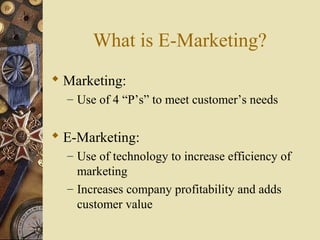
What is E-Marketing?
 Marketing:
– Use of 4 “P’s” to meet customer’s needs
 E-Marketing:
– Use of technology to increase efficiency of
marketing
– Increases company profitability and adds
customer value
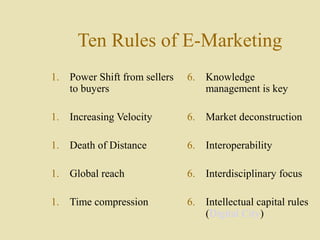
Ten Rules of E-Marketing
1. Power Shift from sellers
to buyers
1. Increasing Velocity
1. Death of Distance
1. Global reach
1. Time compression
6. Knowledge
management is key
6. Market deconstruction
6. Interoperability
6. Interdisciplinary focus
6. Intellectual capital rules
(Digital City)
E-Marketing Challenges and
Opportunities
 Markets
 Revenge of the Consumer
 Businesses
 Technology
Five Markets
 Business-to-Consumer (B2C)
– Example: www.iGo.com
 Business-to-Business (B2B)
– Example: www.amazon.com
 Consumer-to-Consumer (C2C)
– Example: www.eBay.com
 Business-to-Government (B2G)
 Government-to-Consumer (G2C)
Methods for online marketing:
 E-mail marketing
 Blogging
 Pay per click marketing(ppc)
 Social media marketing
 Digital marketing
 Viral marketing
E-mail marketing
 Email marketing is promoting products through
the use of email
 There are 2 main ingredients to an effective email
marketing campaign
 They are to build a large list of people you can
email and to write great emails
 The emails should be packed with free value and
they should move people to buy what you’re
trying to sell
Blogging
 Yet another but important and crucial marketing
trend that has brought a huge aberration in our
society
 Blogger was launched in 1999 by three friends.
Blogging as an ardent marketing tool has really
blossomed in the last some years
 Businesses, companies and even superstar now
use blogging system for huge promotion
Pay per click marketing
You have to pay for PPC ads.
You target certain words and then when
those words are searched for on a search
engine such as Google your ad will appear.
But you do have to pay every time your ad is
clicked on.
You need to make sure you do your homework and
find out how to effectively use PPC.
Otherwise you can easily lose a lot of money in a
short amount of time.
But if you do learn how to use PPC effectively then
Social media marketing
Social media is very popular right now and
it’s only getting more popular
You can tap into that popularity by using
social media to sell your products
Just make sure you don’t SPAM people. In
fact, you shouldn’t use any social media to
directly sell anything
Just use social media to direct people to
other sites where you can then hit them with
a sales pitch
Digital marketing
 With regards to the Internet, this is the promoting of
brands using all forms of online digital advertising
channels to reach consumers
 This includes video channels, Internet Radio, mobile
phones, display or banner ads, digital outdoors, and any
other form of digital media.
Viral marketing
 Marketing techniques that use social networks to
produce an increase in brand awareness or
achieve other marketing objectives (such as
product sales) through self-replicating viral
processes.
 It can be word-of-mouth delivered or enhanced
by the network effects of the Internet.
 Viral promotions may take the form of video
clips, interactive Flash games, ebooks, images, or
even text messages.
Revenge of the Consumer
 1930s:
– Caveat emptor (“let the buyer beware”)
 2000s:
– Consumers have control
 What consumers want:
– Privacy
– To safeguard their children
– Permission before being sent commercial email
Businesses
 Challenges:
– Quality customer service
– Information overload
 Opportunities:
– Ways of generating revenue
– Greater interdependence in their value chain
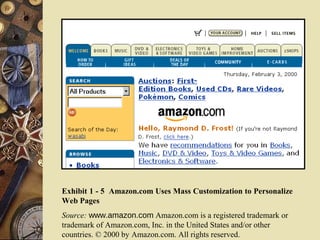
Exhibit 1 - 5 Amazon.com Uses Mass Customization to Personalize
Web Pages
Source: www.amazon.com Amazon.com is a registered trademark or
trademark of Amazon.com, Inc. in the United States and/or other
countries. © 2000 by Amazon.com. All rights reserved.
Technology
 Can lower costs on staff and paperwork
 Can be a costly investment
 Security issues
 New payment instruments
 Low bandwidth
E-Marketing Delivers
Value = Benefits – Costs
 Value - customer perceptions of the product’s
benefits
 Benefits - attributes, brand name, etc…
– Add benefits through mass customization and
personalization
 Costs - time, money, energy, and psychic
– Lower costs through 24/7 convenience and one-stop
shopping
Marketing Mix Components
 Product
 Price
 Distribution
 Marketing Communication
 Relationship Marketing
Product
 Through E-Marketing numerous new
products emerged
 Breakthrough software, hardware, and
services that created digital value
Price
 Efficiencies have been manifested through
E-Marketing
 No need for a sales force with all order
processing, billing and payments are
transacted between customer and Website
– Cost savings return a larger profit margin and
lower prices
Distribution
 A primary E-Marketing application that creates
customer value
 New ways for selling and distributing products
 Affects all manufacturers, service providers and
intermediaries
 Models:
– Content Sponsorship Model
– Direct Selling Model
– Infomediary Model
– Intermediaries Model
Content Sponsorship Model
 Companies create valuable content or
services on their Websites
 Self-advertising
– Examples:
• Yahoo!
• gURL.com
Direct-Selling Model
 Manufacturers eliminating channel
intermediaries and sell directly to
consumers
 Known as “Disintermediation”
 Dell Computers
Infomediary Model
 An organization that collects and sells
information about consumers or businesses
 Similar to a Market Research firm
 Hoover’s
Intermediary Model
 Brokers and agents bring buyers and sellers
together but neither purchase nor take possession
of the actual products
– Brokerage firms
• E-Trade, E-Bay, Metalsite
– Agent firms
• Travelocity
 E-tailers are firms that buy products and resell
them online
– “Click and mortar” stores
– Example: E-Toys
E-Marketing Communication
 Accomplished through promotion mix elements:
– Advertising
– Sales Promotion
– Direct Marketing
– Public Relations
 Models:
– Online Advertising Model
– Online Sales Promotion Model
– Content Publishing Model
– Email Model
Online Advertising Model
 Firms purchase advertising space on
Websites owned by other firms
 Does not include a firm’s own Website
 Dogpile
Online Sales and
Promotion Model
 Sampling digital products
 Allows consumer to view products before
purchasing
 E-Music
Content Publishing Model
 A company’s Website
 The displaying of a firm’s information about their
product offerings on the Website to Internet users
 Brochureware
 Does not involve transactions
 Directed towards stakeholders
 Pure Fishing
E-Mail Model
 Three types:
– Target Promotions
• Companies target users through research and data mining to
send e-mail
• Bulk Email Software Marketing
– Reverse Channel
• User to firm
• Customer service
• Bass Pro Shops
– Consumer-to-Consumer
• Word of mouth
Relationship Marketing
 Customer Relationship Marketing (CRM)
 E-Marketing is able to build long-term
relationships due to:
– Online FAQs
– Automatic e-mail responders
– Customized Websites
– Fax-on-demand
– Supply chains integrated with the firm’s functions
 Model:
– Community Building Model
Community Building Model
 Website developed to create a special interest
community
 Users may provide information for products or
services
 Bring consumer to concise location, making them
more available for communication by a firm
 Creates social bonds and enhances customer
relationships
 Ivillage
Marketing Plan Tasks
 Situation Analysis
– Environmental Factors – Marketers collect and
analyze external elements that include economic
analysis, social and demographic trends, and more
– Market opportunity analysis – This entails a supply
and demand analysis along with a SWOT analysis.
The SWOT analysis determines the strengths,
weaknesses, opportunities, and threats.
 Selecting Target Market – marketers select the
type of customer they are looking to attract.
Marketing Plan Tasks continued
 Setting objectives – marketers set the objectives
according to the firm’s mission and resources.
 Designing marketing mix strategies – Develop
product, pricing, distribution, and promotion
strategies
 Action Plan – Plan the actual marketing plan
implementation
 Budget – Set a budget for the marketing plan
 Evaluation Plan – Continuously evaluate the plan to
make sure objectives are met.
The End.The End.

Chapter 6:e marketing

  • 1.
    Chapter 6Chapter 6 E-MarketingE-Marketing By:Marya Sholevar Fall 2014 Department of Banking and Finance
  • 2.
    What is E-Marketing? Marketing: – Use of 4 “P’s” to meet customer’s needs  E-Marketing: – Use of technology to increase efficiency of marketing – Increases company profitability and adds customer value
  • 3.
    Ten Rules ofE-Marketing 1. Power Shift from sellers to buyers 1. Increasing Velocity 1. Death of Distance 1. Global reach 1. Time compression 6. Knowledge management is key 6. Market deconstruction 6. Interoperability 6. Interdisciplinary focus 6. Intellectual capital rules (Digital City)
  • 4.
    E-Marketing Challenges and Opportunities Markets  Revenge of the Consumer  Businesses  Technology
  • 5.
    Five Markets  Business-to-Consumer(B2C) – Example: www.iGo.com  Business-to-Business (B2B) – Example: www.amazon.com  Consumer-to-Consumer (C2C) – Example: www.eBay.com  Business-to-Government (B2G)  Government-to-Consumer (G2C)
  • 6.
    Methods for onlinemarketing:  E-mail marketing  Blogging  Pay per click marketing(ppc)  Social media marketing  Digital marketing  Viral marketing
  • 7.
    E-mail marketing  Emailmarketing is promoting products through the use of email  There are 2 main ingredients to an effective email marketing campaign  They are to build a large list of people you can email and to write great emails  The emails should be packed with free value and they should move people to buy what you’re trying to sell
  • 8.
    Blogging  Yet anotherbut important and crucial marketing trend that has brought a huge aberration in our society  Blogger was launched in 1999 by three friends. Blogging as an ardent marketing tool has really blossomed in the last some years  Businesses, companies and even superstar now use blogging system for huge promotion
  • 9.
    Pay per clickmarketing You have to pay for PPC ads. You target certain words and then when those words are searched for on a search engine such as Google your ad will appear. But you do have to pay every time your ad is clicked on. You need to make sure you do your homework and find out how to effectively use PPC. Otherwise you can easily lose a lot of money in a short amount of time. But if you do learn how to use PPC effectively then
  • 10.
    Social media marketing Socialmedia is very popular right now and it’s only getting more popular You can tap into that popularity by using social media to sell your products Just make sure you don’t SPAM people. In fact, you shouldn’t use any social media to directly sell anything Just use social media to direct people to other sites where you can then hit them with a sales pitch
  • 11.
    Digital marketing  Withregards to the Internet, this is the promoting of brands using all forms of online digital advertising channels to reach consumers  This includes video channels, Internet Radio, mobile phones, display or banner ads, digital outdoors, and any other form of digital media.
  • 12.
    Viral marketing  Marketingtechniques that use social networks to produce an increase in brand awareness or achieve other marketing objectives (such as product sales) through self-replicating viral processes.  It can be word-of-mouth delivered or enhanced by the network effects of the Internet.  Viral promotions may take the form of video clips, interactive Flash games, ebooks, images, or even text messages.
  • 13.
    Revenge of theConsumer  1930s: – Caveat emptor (“let the buyer beware”)  2000s: – Consumers have control  What consumers want: – Privacy – To safeguard their children – Permission before being sent commercial email
  • 14.
    Businesses  Challenges: – Qualitycustomer service – Information overload  Opportunities: – Ways of generating revenue – Greater interdependence in their value chain
  • 15.
    Exhibit 1 -5 Amazon.com Uses Mass Customization to Personalize Web Pages Source: www.amazon.com Amazon.com is a registered trademark or trademark of Amazon.com, Inc. in the United States and/or other countries. © 2000 by Amazon.com. All rights reserved.
  • 16.
    Technology  Can lowercosts on staff and paperwork  Can be a costly investment  Security issues  New payment instruments  Low bandwidth
  • 17.
    E-Marketing Delivers Value =Benefits – Costs  Value - customer perceptions of the product’s benefits  Benefits - attributes, brand name, etc… – Add benefits through mass customization and personalization  Costs - time, money, energy, and psychic – Lower costs through 24/7 convenience and one-stop shopping
  • 18.
    Marketing Mix Components Product  Price  Distribution  Marketing Communication  Relationship Marketing
  • 19.
    Product  Through E-Marketingnumerous new products emerged  Breakthrough software, hardware, and services that created digital value
  • 20.
    Price  Efficiencies havebeen manifested through E-Marketing  No need for a sales force with all order processing, billing and payments are transacted between customer and Website – Cost savings return a larger profit margin and lower prices
  • 21.
    Distribution  A primaryE-Marketing application that creates customer value  New ways for selling and distributing products  Affects all manufacturers, service providers and intermediaries  Models: – Content Sponsorship Model – Direct Selling Model – Infomediary Model – Intermediaries Model
  • 22.
    Content Sponsorship Model Companies create valuable content or services on their Websites  Self-advertising – Examples: • Yahoo! • gURL.com
  • 23.
    Direct-Selling Model  Manufacturerseliminating channel intermediaries and sell directly to consumers  Known as “Disintermediation”  Dell Computers
  • 24.
    Infomediary Model  Anorganization that collects and sells information about consumers or businesses  Similar to a Market Research firm  Hoover’s
  • 25.
    Intermediary Model  Brokersand agents bring buyers and sellers together but neither purchase nor take possession of the actual products – Brokerage firms • E-Trade, E-Bay, Metalsite – Agent firms • Travelocity  E-tailers are firms that buy products and resell them online – “Click and mortar” stores – Example: E-Toys
  • 26.
    E-Marketing Communication  Accomplishedthrough promotion mix elements: – Advertising – Sales Promotion – Direct Marketing – Public Relations  Models: – Online Advertising Model – Online Sales Promotion Model – Content Publishing Model – Email Model
  • 27.
    Online Advertising Model Firms purchase advertising space on Websites owned by other firms  Does not include a firm’s own Website  Dogpile
  • 28.
    Online Sales and PromotionModel  Sampling digital products  Allows consumer to view products before purchasing  E-Music
  • 29.
    Content Publishing Model A company’s Website  The displaying of a firm’s information about their product offerings on the Website to Internet users  Brochureware  Does not involve transactions  Directed towards stakeholders  Pure Fishing
  • 30.
    E-Mail Model  Threetypes: – Target Promotions • Companies target users through research and data mining to send e-mail • Bulk Email Software Marketing – Reverse Channel • User to firm • Customer service • Bass Pro Shops – Consumer-to-Consumer • Word of mouth
  • 31.
    Relationship Marketing  CustomerRelationship Marketing (CRM)  E-Marketing is able to build long-term relationships due to: – Online FAQs – Automatic e-mail responders – Customized Websites – Fax-on-demand – Supply chains integrated with the firm’s functions  Model: – Community Building Model
  • 32.
    Community Building Model Website developed to create a special interest community  Users may provide information for products or services  Bring consumer to concise location, making them more available for communication by a firm  Creates social bonds and enhances customer relationships  Ivillage
  • 33.
    Marketing Plan Tasks Situation Analysis – Environmental Factors – Marketers collect and analyze external elements that include economic analysis, social and demographic trends, and more – Market opportunity analysis – This entails a supply and demand analysis along with a SWOT analysis. The SWOT analysis determines the strengths, weaknesses, opportunities, and threats.  Selecting Target Market – marketers select the type of customer they are looking to attract.
  • 34.
    Marketing Plan Taskscontinued  Setting objectives – marketers set the objectives according to the firm’s mission and resources.  Designing marketing mix strategies – Develop product, pricing, distribution, and promotion strategies  Action Plan – Plan the actual marketing plan implementation  Budget – Set a budget for the marketing plan  Evaluation Plan – Continuously evaluate the plan to make sure objectives are met.
  • 35.