Insurance Practice and Procedure 
by Maryam Sholevar 
Presenting at 
Department of Banking and Finance 
Maryam Sholevar Jimma University
Chapter One 
Introduction 
Insurance is a social device for spreading the chance of financial loss among 
a large number of people. Insurance protects against pure risk. 
Risk is the possibility of losing economic security. 
Risk can be of two kinds: speculative or pure And Maryam Sholevar Jimma University
Pure Risk 
Pure risk involves only two possible outcomes: 
loss or no loss, with no possibility of gain or profit 
Maryam Sholevar Jimma University
The Law of Large Numbers: 
The average of the results obtained from a large number of trials should 
be close to the expected value. 
Underwriting: 
The process of selecting certain types of risks that have historically 
produced a profit. 
Peril: 
A potential cause of loss. Accident, fire, and theft are common perils. 
Hazard: 
Anything that increases the seriousness of a loss or increases 
the likelihood that a loss will occur. 
Maryam Sholevar Jimma University
Adverse Selection: 
Is the tendency of person with a higher than average chance 
of loss to seek insurance at the average state, which if not 
Controlled by underwriting, result in higher than expected 
Loss levels. 
Insurance is not same as gambling. Gambling is creat a new 
speculative risk and socially is unproductive but insurance 
Deals with pure risk and socially is productive. 
Insurance is not same as hedging. Insurance involves the 
Transfer of pure risk and reduce objective risk but hedging 
Involves just the transfer of speculative risk not risk 
Reduduction. 
Maryam Sholevar Jimma University
Types of Insurance: 
Private insurance, consist of health insurance, property and 
liabilty insurance. 
Government Insurance, cnosist of social insurance and other 
Government insurance programs. 
Maryam Sholevar Jimma University
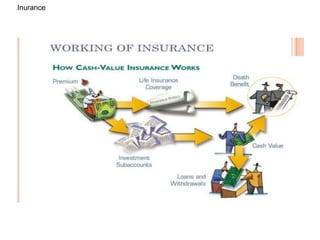
How does insurance work? 
You pay a fee called a premium, and in exchange, 
the insurance company agrees to pay you a certain 
amount of money 
Maryam Sholevar Jimma University
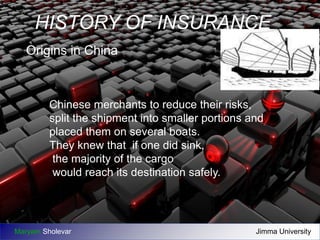
HISTORY OF INSURANCE 
Origins in China 
Chinese merchants to reduce their risks, 
split the shipment into smaller portions and 
placed them on several boats. 
They knew that if one did sink, 
the majority of the cargo 
would reach its destination safely. 
Maryam Sholevar Jimma University
Basic Characteristics Of Insurance 
Pooling of losses 
Payment of fortuitous losses 
Risk transfer 
Indemnification 
Maryam Sholevar Jimma University
Pooling of losses 
Spreading of losses incurred by the few over the entire group. 
• Key mechanism is “law of large number”. 
• Future losses are predicted based on law of large number. 
Note 
• Pooling of loss is the spreading of losses incurred by the few over the 
entire group so that in the process average loss is substituted for actual loss. 
• The primary purpose of pooling is to reduce the variation in possible 
Outcomes , which reduces risk. 
Maryam Sholevar Jimma University
Payment of fortuitous losses 
A fortuitous loss is one that is unforeseen and 
unexpected and occurs as a result of chance. 
Insurance policies do not cover intentional losses 
Maryam Sholevar Jimma University
Risk Transfer 
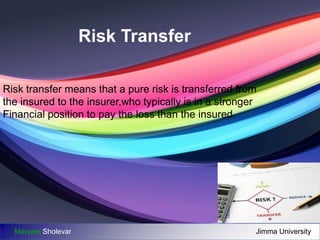
Risk transfer means that a pure risk is transferred from 
the insured to the insurer,who typically is in a stronger 
Financial position to pay the loss than the insured. 
Maryam Sholevar Jimma University
Indemnification 
Means that the insured is restored to his or her approximate 
financial position prior to the occurrence of the loss. 
Maryam Sholevar Jimma University
Insurable Risk 
Insurer normally insure only pure risk. 
Not all pure risks are insurable 
1. There must be a large number of exposure units. 
2. The loss must be accidental and unintentional. 
3. The loss must be determinable and measurable. 
4. The loss should not be catastrophic. 
5. The chance of loss must be calculable. 
6. The premium must be economically feasible. 
Maryam Sholevar Jimma University
Insurable Risk 
1. There must be a large number of exposure units. 
an insurance organization prefers to have a large 
number of similar units when insuring 
a possible loss exposure. 
The concepts of mass and similarity are thus 
considered before an insurer accepts a loss exposure. 
Maryam Sholevar Jimma University
Insurable Risk 
2. The loss must be accidental and unintentional. 
Loss should be fortuitous and outside the insured’control. 
Two purposes of this requirement are : 
1. If intentional losses were paid, moral hazard 
would be substantially increased. 
2. Law of large number requires random occurrence 
of events. 
Maryam Sholevar Jimma University
Insurable Risk 
3. The loss must be determinable and measurable. 
Purpose of this requirement is to enable an insurer 
to determine if the loss is covered under the policy, 
and if it is covered, how much should be paid. 
Maryam Sholevar Jimma University
Insurable Risk 
4. The loss should not be catastrophic. 
This is to ensure that a large proportion of 
exposure units should not incur losses at the 
same time. 
Maryam Sholevar Jimma University
Insurable Risk 
5. The chance of loss must be calculable. 
Both average frequency and the average severity 
of future losses with some accuracy. 
Purpose of this requirement is to assess 
the appropriate premium. 
Maryam Sholevar Jimma University
Insurable Risk 
6. The premium must be economically feasible. 
For the insurance to be attractive purchase, 
the premiums paid must be substantially less 
than the face value 
Maryam Sholevar Jimma University
unique characteristics of insurance contracts 
• Insurance contracts are contracts of adhesion, which is a 
take it or leave it contract. 
• Insurance contracts are unilateral in that there is only one promise 
made and it’s made by the insurer to pay in the event of a loss. 
• Insurance contracts are conditional. Two types of conditions: 
1) conditions precedent; and 2) conditions subsequent. 
A condition precedent is a condition that must be fulfilled to activate 
the contract. 
Conditions subsequent 
are acts or duties that must be adhered to in order to receive the benefits of 
the policy. 
Maryam Sholevar Jimma University
unique characteristics of insurance contracts 
• The insured must have an insurable interest. 
• It is a contract based on the principal of indemnity 
(insured cannot make a profit from a claim on insurance). 
• Insurance contracts are aleatory in nature, which means The performance 
of one or both parties is contingent on the occurrence of an event that may 
never materialize. 
• Utmost Good Faith – Both parties to the insurance contract almost totally 
rely on the honesty of the other party. The insurer relies on the honesty 
of the insured in providing underwriting information; the insured relies on 
the honesty of the insurer that they will pay when a covered loss occurs. 
Maryam Sholevar Jimma University
COST AND BENEFITS OF INSURANCE 
BENEFITS 
*Indemnification for losses 
*Reduction of worry and fear 
*Source of investment fund 
*Loss prevention 
*Enhancement of credit 
COST 
*Cost of doing business 
*Fraudulent claims 
*Infalted Claims 
Maryam Sholevar Jimma University
Function Of Insurance 
(i) Primary Functions 
* Insurance provides certainty 
*Insurance provides protection 
*Risk-Sharing 
(ii) Secondary Functions 
*Prevention of loss 
*It Provides Capital 
*It Improves Efficiency 
*It helps Economic Progress 
Maryam Sholevar Jimma University
Inurance

Chapter 1: Introduction to Insurance

  • 1.
    Insurance Practice andProcedure by Maryam Sholevar Presenting at Department of Banking and Finance Maryam Sholevar Jimma University
  • 2.
    Chapter One Introduction Insurance is a social device for spreading the chance of financial loss among a large number of people. Insurance protects against pure risk. Risk is the possibility of losing economic security. Risk can be of two kinds: speculative or pure And Maryam Sholevar Jimma University
  • 3.
    Pure Risk Purerisk involves only two possible outcomes: loss or no loss, with no possibility of gain or profit Maryam Sholevar Jimma University
  • 4.
    The Law ofLarge Numbers: The average of the results obtained from a large number of trials should be close to the expected value. Underwriting: The process of selecting certain types of risks that have historically produced a profit. Peril: A potential cause of loss. Accident, fire, and theft are common perils. Hazard: Anything that increases the seriousness of a loss or increases the likelihood that a loss will occur. Maryam Sholevar Jimma University
  • 5.
    Adverse Selection: Isthe tendency of person with a higher than average chance of loss to seek insurance at the average state, which if not Controlled by underwriting, result in higher than expected Loss levels. Insurance is not same as gambling. Gambling is creat a new speculative risk and socially is unproductive but insurance Deals with pure risk and socially is productive. Insurance is not same as hedging. Insurance involves the Transfer of pure risk and reduce objective risk but hedging Involves just the transfer of speculative risk not risk Reduduction. Maryam Sholevar Jimma University
  • 6.
    Types of Insurance: Private insurance, consist of health insurance, property and liabilty insurance. Government Insurance, cnosist of social insurance and other Government insurance programs. Maryam Sholevar Jimma University
  • 7.
    How does insurancework? You pay a fee called a premium, and in exchange, the insurance company agrees to pay you a certain amount of money Maryam Sholevar Jimma University
  • 8.
    HISTORY OF INSURANCE Origins in China Chinese merchants to reduce their risks, split the shipment into smaller portions and placed them on several boats. They knew that if one did sink, the majority of the cargo would reach its destination safely. Maryam Sholevar Jimma University
  • 9.
    Basic Characteristics OfInsurance Pooling of losses Payment of fortuitous losses Risk transfer Indemnification Maryam Sholevar Jimma University
  • 10.
    Pooling of losses Spreading of losses incurred by the few over the entire group. • Key mechanism is “law of large number”. • Future losses are predicted based on law of large number. Note • Pooling of loss is the spreading of losses incurred by the few over the entire group so that in the process average loss is substituted for actual loss. • The primary purpose of pooling is to reduce the variation in possible Outcomes , which reduces risk. Maryam Sholevar Jimma University
  • 11.
    Payment of fortuitouslosses A fortuitous loss is one that is unforeseen and unexpected and occurs as a result of chance. Insurance policies do not cover intentional losses Maryam Sholevar Jimma University
  • 12.
    Risk Transfer Risktransfer means that a pure risk is transferred from the insured to the insurer,who typically is in a stronger Financial position to pay the loss than the insured. Maryam Sholevar Jimma University
  • 13.
    Indemnification Means thatthe insured is restored to his or her approximate financial position prior to the occurrence of the loss. Maryam Sholevar Jimma University
  • 14.
    Insurable Risk Insurernormally insure only pure risk. Not all pure risks are insurable 1. There must be a large number of exposure units. 2. The loss must be accidental and unintentional. 3. The loss must be determinable and measurable. 4. The loss should not be catastrophic. 5. The chance of loss must be calculable. 6. The premium must be economically feasible. Maryam Sholevar Jimma University
  • 15.
    Insurable Risk 1.There must be a large number of exposure units. an insurance organization prefers to have a large number of similar units when insuring a possible loss exposure. The concepts of mass and similarity are thus considered before an insurer accepts a loss exposure. Maryam Sholevar Jimma University
  • 16.
    Insurable Risk 2.The loss must be accidental and unintentional. Loss should be fortuitous and outside the insured’control. Two purposes of this requirement are : 1. If intentional losses were paid, moral hazard would be substantially increased. 2. Law of large number requires random occurrence of events. Maryam Sholevar Jimma University
  • 17.
    Insurable Risk 3.The loss must be determinable and measurable. Purpose of this requirement is to enable an insurer to determine if the loss is covered under the policy, and if it is covered, how much should be paid. Maryam Sholevar Jimma University
  • 18.
    Insurable Risk 4.The loss should not be catastrophic. This is to ensure that a large proportion of exposure units should not incur losses at the same time. Maryam Sholevar Jimma University
  • 19.
    Insurable Risk 5.The chance of loss must be calculable. Both average frequency and the average severity of future losses with some accuracy. Purpose of this requirement is to assess the appropriate premium. Maryam Sholevar Jimma University
  • 20.
    Insurable Risk 6.The premium must be economically feasible. For the insurance to be attractive purchase, the premiums paid must be substantially less than the face value Maryam Sholevar Jimma University
  • 21.
    unique characteristics ofinsurance contracts • Insurance contracts are contracts of adhesion, which is a take it or leave it contract. • Insurance contracts are unilateral in that there is only one promise made and it’s made by the insurer to pay in the event of a loss. • Insurance contracts are conditional. Two types of conditions: 1) conditions precedent; and 2) conditions subsequent. A condition precedent is a condition that must be fulfilled to activate the contract. Conditions subsequent are acts or duties that must be adhered to in order to receive the benefits of the policy. Maryam Sholevar Jimma University
  • 22.
    unique characteristics ofinsurance contracts • The insured must have an insurable interest. • It is a contract based on the principal of indemnity (insured cannot make a profit from a claim on insurance). • Insurance contracts are aleatory in nature, which means The performance of one or both parties is contingent on the occurrence of an event that may never materialize. • Utmost Good Faith – Both parties to the insurance contract almost totally rely on the honesty of the other party. The insurer relies on the honesty of the insured in providing underwriting information; the insured relies on the honesty of the insurer that they will pay when a covered loss occurs. Maryam Sholevar Jimma University
  • 23.
    COST AND BENEFITSOF INSURANCE BENEFITS *Indemnification for losses *Reduction of worry and fear *Source of investment fund *Loss prevention *Enhancement of credit COST *Cost of doing business *Fraudulent claims *Infalted Claims Maryam Sholevar Jimma University
  • 24.
    Function Of Insurance (i) Primary Functions * Insurance provides certainty *Insurance provides protection *Risk-Sharing (ii) Secondary Functions *Prevention of loss *It Provides Capital *It Improves Efficiency *It helps Economic Progress Maryam Sholevar Jimma University
  • 25.