Marketing is about communicating the value of a product,
service or brand to customers or consumers for the
purpose of promoting or selling that product, service, or
brand.
The oldest – and perhaps simplest and most natural form
of marketing – is 'word of mouth' (WOM) marketing.
These communications can of course be either positive and
negative.
In recent times, the internet has provided a platform for
mass, electronic WOM marketing (e-WOM), with
consumers actively engaged in rating and commenting on
goods and services.
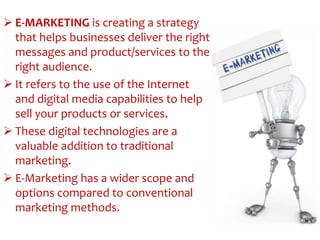
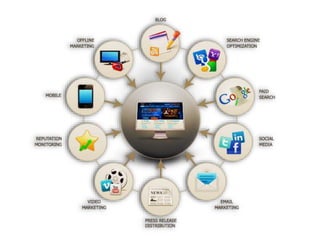
 E-MARKETING is creating a strategy
that helps businesses deliver the right
messages and product/services to the
right audience.
 It refers to the use of the Internet
and digital media capabilities to help
sell your products or services.
 These digital technologies are a
valuable addition to traditional
marketing.
 E-Marketing has a wider scope and
options compared to conventional
marketing methods.
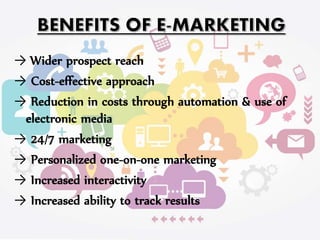
→ Wider prospect reach
→ Cost-effective approach
→ Reduction in costs through automation & use of
electronic media
→ 24/7 marketing
→ Personalized one-on-one marketing
→ Increased interactivity
→ Increased ability to track results
INTERNET MARKETING
 INTERNET MARKETING is a form of marketing and
advertising which uses the Internet to
deliver promotional marketing messages to
consumers.
 It includes email marketing, search engine
marketing (SEM), social media marketing, many types
of display advertising ,banner advertising and mobile
advertising.
 DELIVERY METHODS
Display advertising
Web banner advertising
Floating ad
Expanding ad
Trick banners
Social media is an example of Web 2.0
technologies with a rich user experience, dynamic
content, scalability, openness and collective
intelligence.
Different types of social media include
 Social networks
 Weblogs
 Microblogging
 Content communities
 Podcasts and wikis
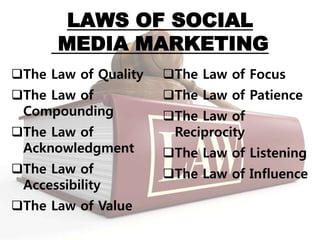
LAWS OF SOCIAL
MEDIA MARKETING
The Law of Quality
The Law of
Compounding
The Law of
Acknowledgment
The Law of
Accessibility
The Law of Value
The Law of Focus
The Law of Patience
The Law of
Reciprocity
The Law of Listening
The Law of Influence
MEANING
The Wikipedia explains viral marketing as “marketing
techniques that seek to exploit pre-existing social networks to
produce exponential increases in brand awareness, through viral
processes similar to the spread of an epidemic. It is word-of-
mouth delivered and enhanced online; it harnesses the network
effect of the Internet and can be very useful in reaching a large
number of people rapidly.”
CONCEPT
• Word-of-mouth
• Enter the internet
ELEMENTS
Gives away products or services.
Provides for effortless transfer to others.
Scales easily from small to very large.
Exploits common motivations and
behaviors.
Utilizes existing communication
networks.
Takes advantage of others' resources.
MOBILE
MARKETING
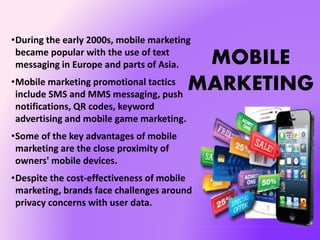
•During the early 2000s, mobile marketing
became popular with the use of text
messaging in Europe and parts of Asia.
•Mobile marketing promotional tactics
include SMS and MMS messaging, push
notifications, QR codes, keyword
advertising and mobile game marketing.
•Some of the key advantages of mobile
marketing are the close proximity of
owners' mobile devices.
•Despite the cost-effectiveness of mobile
marketing, brands face challenges around
privacy concerns with user data.
10 TRENDS OF MOBILE MARKETING
 Mobile the center of marketing
 Transparency dictates brand-customer relationships
 The need for good content
 User-generated content the new hit
 Publicity becomes the next Internet
 Brands control own their audience
 Brands solely-focused on Millennials go out of relevance
 Good brands to behave like product companies and not like
service companies
 Personalized, data-driven marketing becomes more refined
 More accurate metrics surfaces
MOBILE MARKETING
PROS
• Instant results
• Easy to work with
• Convenient to use
• Direct marketing
• Tracking user response
• Huge viral potential
• Mass communication made easy
• Mobile payment
CONS
• Platforms too diverse
• Privacy issues
• Navigation on a mobile phone
CONCLUSION
The role of E-Marketing is to make certain how Business
communicates with their existing and potential customers
and the way they do this is by advertising their product on
their online website. Hence, the companies marketing their
products via the internet not only improves their Financial
Management but also increase the customers at a
substantial level.
E MARKETING

E MARKETING

  • 3.
    Marketing is aboutcommunicating the value of a product, service or brand to customers or consumers for the purpose of promoting or selling that product, service, or brand. The oldest – and perhaps simplest and most natural form of marketing – is 'word of mouth' (WOM) marketing. These communications can of course be either positive and negative. In recent times, the internet has provided a platform for mass, electronic WOM marketing (e-WOM), with consumers actively engaged in rating and commenting on goods and services.
  • 4.
     E-MARKETING iscreating a strategy that helps businesses deliver the right messages and product/services to the right audience.  It refers to the use of the Internet and digital media capabilities to help sell your products or services.  These digital technologies are a valuable addition to traditional marketing.  E-Marketing has a wider scope and options compared to conventional marketing methods.
  • 5.
    → Wider prospectreach → Cost-effective approach → Reduction in costs through automation & use of electronic media → 24/7 marketing → Personalized one-on-one marketing → Increased interactivity → Increased ability to track results
  • 7.
    INTERNET MARKETING  INTERNETMARKETING is a form of marketing and advertising which uses the Internet to deliver promotional marketing messages to consumers.  It includes email marketing, search engine marketing (SEM), social media marketing, many types of display advertising ,banner advertising and mobile advertising.  DELIVERY METHODS Display advertising Web banner advertising Floating ad Expanding ad Trick banners
  • 9.
    Social media isan example of Web 2.0 technologies with a rich user experience, dynamic content, scalability, openness and collective intelligence. Different types of social media include  Social networks  Weblogs  Microblogging  Content communities  Podcasts and wikis
  • 10.
    LAWS OF SOCIAL MEDIAMARKETING The Law of Quality The Law of Compounding The Law of Acknowledgment The Law of Accessibility The Law of Value The Law of Focus The Law of Patience The Law of Reciprocity The Law of Listening The Law of Influence
  • 12.
    MEANING The Wikipedia explainsviral marketing as “marketing techniques that seek to exploit pre-existing social networks to produce exponential increases in brand awareness, through viral processes similar to the spread of an epidemic. It is word-of- mouth delivered and enhanced online; it harnesses the network effect of the Internet and can be very useful in reaching a large number of people rapidly.” CONCEPT • Word-of-mouth • Enter the internet
  • 13.
    ELEMENTS Gives away productsor services. Provides for effortless transfer to others. Scales easily from small to very large. Exploits common motivations and behaviors. Utilizes existing communication networks. Takes advantage of others' resources.
  • 14.
    MOBILE MARKETING •During the early2000s, mobile marketing became popular with the use of text messaging in Europe and parts of Asia. •Mobile marketing promotional tactics include SMS and MMS messaging, push notifications, QR codes, keyword advertising and mobile game marketing. •Some of the key advantages of mobile marketing are the close proximity of owners' mobile devices. •Despite the cost-effectiveness of mobile marketing, brands face challenges around privacy concerns with user data.
  • 15.
    10 TRENDS OFMOBILE MARKETING  Mobile the center of marketing  Transparency dictates brand-customer relationships  The need for good content  User-generated content the new hit  Publicity becomes the next Internet  Brands control own their audience  Brands solely-focused on Millennials go out of relevance  Good brands to behave like product companies and not like service companies  Personalized, data-driven marketing becomes more refined  More accurate metrics surfaces
  • 16.
    MOBILE MARKETING PROS • Instantresults • Easy to work with • Convenient to use • Direct marketing • Tracking user response • Huge viral potential • Mass communication made easy • Mobile payment CONS • Platforms too diverse • Privacy issues • Navigation on a mobile phone
  • 17.
    CONCLUSION The role ofE-Marketing is to make certain how Business communicates with their existing and potential customers and the way they do this is by advertising their product on their online website. Hence, the companies marketing their products via the internet not only improves their Financial Management but also increase the customers at a substantial level.