1
E-marketing
2
Contents
3
 E-marketing
 Concept of E-marketing
 What is E-marketing and E-commerce?
 Internet marketing vs. E-marketing vs. E-commerce
 Why E-Commerce and E-marketing?
 Scope of E-marketing
 Objectives of E-marketing
 Global and Indian scenario of
E-marketing
 Methods of E-marketing
 Traditional methods
 Modern methods
 Marketing through mobile phone
Contents
4
 Advantages of E-marketing
 E-marketing mix
 SWOT analysis
 E-CRM
 Case study: E-CRM
 Case study: Viral Marketing
 Conclusion
E-marketing
 Uses internet and
digital media
capabilities.
 Addition to traditional
marketing approaches.
5
Source: Anonymous (2015)
Concept of E-marketing
 Relatively new concept that crept into the
business vocabulary in 1970s.
 Flawless application of information technology
from the point of origin to the ultimate
destination of the products.
 Process of using modern technology for
providing information to the consumers
regarding products and services by
companies.6 Source: Anonymous (2015)
What is E-Marketing and E-
Commerce?
 E-marketing (Electronic Marketing) is the
moving of marketing strategies and activities to a
computerized, networked environment such as
the internet.
 Strategic process of creating, distributing,
promoting, and pricing goods and services over
the internet or through wireless digital tools.
 E-commerce (Electronic Commerce or EC) is
the buying and selling of these goods and
7
Source: Anonymous (2015)
Internet-marketing vs. E-
Marketing vs. E-commerce
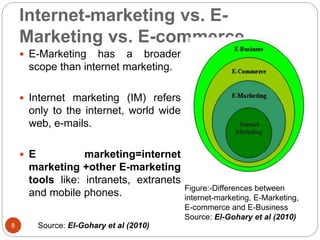
 E-Marketing has a broader
scope than internet marketing.
 Internet marketing (IM) refers
only to the internet, world wide
web, e-mails.
 E marketing=internet
marketing +other E-marketing
tools like: intranets, extranets
and mobile phones. Figure:-Differences between
internet-marketing, E-Marketing,
E-commerce and E-Business
Source: El-Gohary et al (2010)
8 Source: El-Gohary et al (2010)
Why E-Commerce and E-
Marketing?
 Consumers research products and services
on the internet.
 Businesses don’t need a shop everywhere
with a website.
 Expensive and repetitive methods need not
be used.
 Staff can spend valuable time in the
workplace.9
Source: Anonymous (2015)
Why E-Commerce and E-
Marketing?
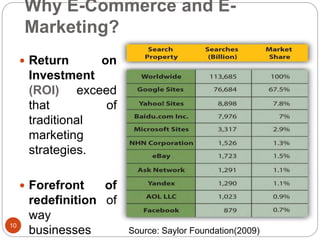
 Return on
Investment
(ROI) exceed
that of
traditional
marketing
strategies.
 Forefront of
redefinition of
way
businesses
10
Source: Saylor Foundation(2009)
Scope of E-marketing
 The digital technologies used as delivery and
communication mediums within the scope of E-
marketing include:-
 Internet media such as websites and e-mail
 Digital media such as wireless, mobile, cable and
satellite.
11
Source: Anonymous (2015)
Objectives of E-marketing
 E-marketing objectives differ with companies
and their circumstances
 5 S framework includes:-
 Sell
 Serve
 Speak
 Save
 Sizzle
12
Source: Anonymous (2015)
Objectives of E-marketing
 E-marketing objectives should be:-
 Specific
 Measurable
 Action-oriented
 Realistic
 Time-specific
13
Source: Anonymous (2015)
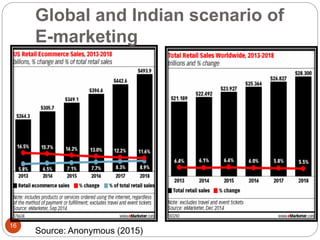
Global and Indian scenario of
E-marketing
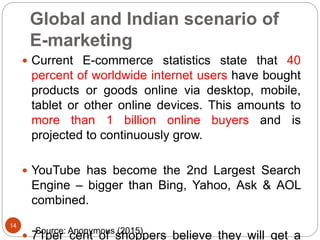
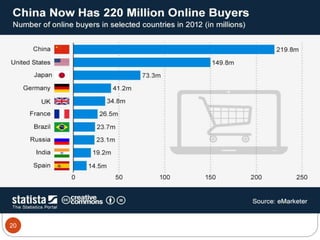
 Current E-commerce statistics state that 40
percent of worldwide internet users have bought
products or goods online via desktop, mobile,
tablet or other online devices. This amounts to
more than 1 billion online buyers and is
projected to continuously grow.
 YouTube has become the 2nd Largest Search
Engine – bigger than Bing, Yahoo, Ask & AOL
combined.
 71per cent of shoppers believe they will get a
14
Source: Anonymous (2015)
15
Global and Indian scenario of
E-marketing
Source: Anonymous (2015)
16
Global and Indian scenario of
E-marketing
Source: Anonymous (2015)
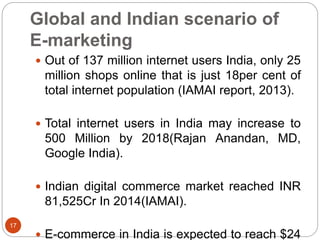
 Out of 137 million internet users India, only 25
million shops online that is just 18per cent of
total internet population (IAMAI report, 2013).
 Total internet users in India may increase to
500 Million by 2018(Rajan Anandan, MD,
Google India).
 Indian digital commerce market reached INR
81,525Cr In 2014(IAMAI).
 E-commerce in India is expected to reach $24
17
Global and Indian scenario of
E-marketing
18
19
20
Methods of E-marketing
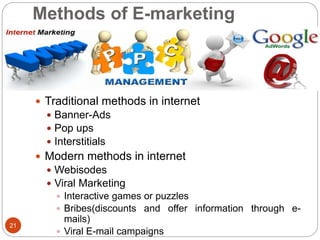
 Traditional methods in internet
 Banner-Ads
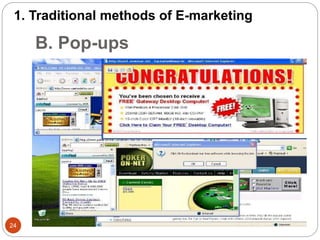
 Pop ups
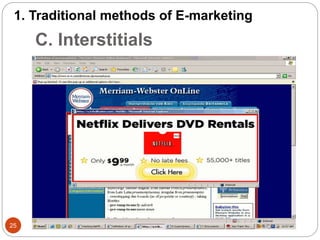
 Interstitials
 Modern methods in internet
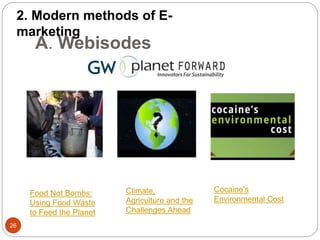
 Webisodes
 Viral Marketing
 Interactive games or puzzles
 Bribes(discounts and offer information through e-
mails)
 Viral E-mail campaigns
21
Methods of E-marketing
22
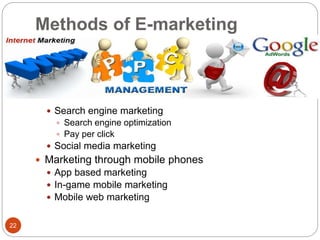
 Search engine marketing
 Search engine optimization
 Pay per click
 Social media marketing
 Marketing through mobile phones
 App based marketing
 In-game mobile marketing
 Mobile web marketing
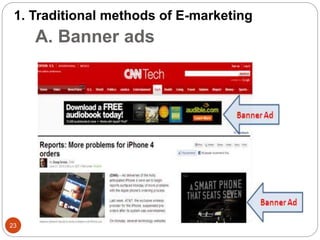
A. Banner ads
1. Traditional methods of E-marketing
23
B. Pop-ups
1. Traditional methods of E-marketing
24
C. Interstitials
1. Traditional methods of E-marketing
25
A. Webisodes
2. Modern methods of E-
marketing
26
Cocaine's
Environmental Cost
Food Not Bombs:
Using Food Waste
to Feed the Planet
Climate,
Agriculture and the
Challenges Ahead
B. Viral marketing
•Electronic equivalent of
‘word of mouth’.
•Facilitates consumer to
consumer (C to C) promotion at a rapid pace in
internet.
•Types of Viral Marketing
•Interactive games or puzzles
•Bribes (discounts and offer information)
•Viral e mail marketing campaigns
2. Modern methods of E-
marketing
27
Source: Senthil (2009)
28
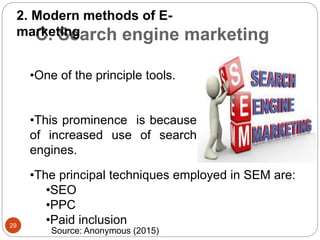
C. Search engine marketing
2. Modern methods of E-
marketing
29
•One of the principle tools.
•This prominence is because
of increased use of search
engines.
•The principal techniques employed in SEM are:
•SEO
•PPC
•Paid inclusion
Source: Anonymous (2015)
30
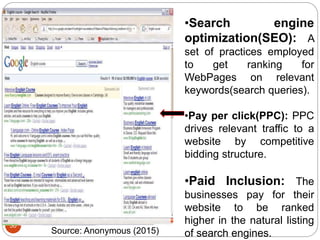
•Search engine
optimization(SEO): A
set of practices employed
to get ranking for
WebPages on relevant
keywords(search queries).
•Pay per click(PPC): PPC
drives relevant traffic to a
website by competitive
bidding structure.
•Paid Inclusion: The
businesses pay for their
website to be ranked
higher in the natural listing
of search engines.Source: Anonymous (2015)
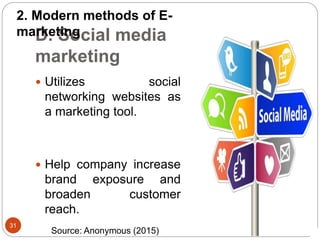
D. Social media
marketing
31
 Utilizes social
networking websites as
a marketing tool.
 Help company increase
brand exposure and
broaden customer
reach.
2. Modern methods of E-
marketing
Source: Anonymous (2015)
D. Social media marketing
32
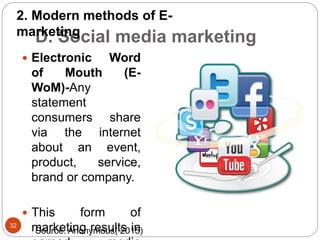
 Electronic Word
of Mouth (E-
WoM)-Any
statement
consumers share
via the internet
about an event,
product, service,
brand or company.
 This form of
marketing results in
2. Modern methods of E-
marketing
Source: Anonymous( 2015)
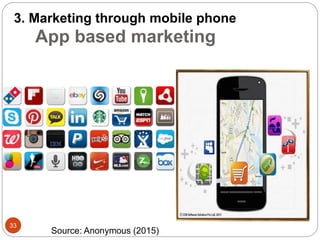
App based marketing
33
3. Marketing through mobile phone
Source: Anonymous (2015)
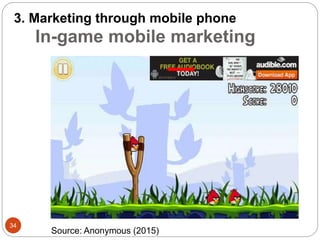
In-game mobile marketing
34
3. Marketing through mobile phone
Source: Anonymous (2015)
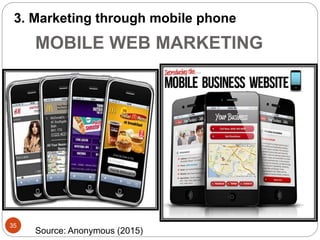
MOBILE WEB MARKETING
35
3. Marketing through mobile phone
Source: Anonymous (2015)
36
37
38
Source: IMRB international
39
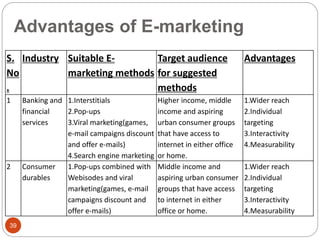
S.
No
.
Industry Suitable E-
marketing methods
Target audience
for suggested
methods
Advantages
1 Banking and
financial
services
1.Interstitials
2.Pop-ups
3.Viral marketing(games,
e-mail campaigns discount
and offer e-mails)
4.Search engine marketing
Higher income, middle
income and aspiring
urban consumer groups
that have access to
internet in either office
or home.
1.Wider reach
2.Individual
targeting
3.Interactivity
4.Measurability
2 Consumer
durables
1.Pop-ups combined with
Webisodes and viral
marketing(games, e-mail
campaigns discount and
offer e-mails)
Middle income and
aspiring urban consumer
groups that have access
to internet in either
office or home.
1.Wider reach
2.Individual
targeting
3.Interactivity
4.Measurability
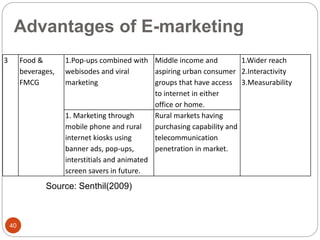
Advantages of E-marketing
40
3 Food &
beverages,
FMCG
1.Pop-ups combined with
webisodes and viral
marketing
Middle income and
aspiring urban consumer
groups that have access
to internet in either
office or home.
1.Wider reach
2.Interactivity
3.Measurability
1. Marketing through
mobile phone and rural
internet kiosks using
banner ads, pop-ups,
interstitials and animated
screen savers in future.
Rural markets having
purchasing capability and
telecommunication
penetration in market.
Advantages of E-marketing
Source: Senthil(2009)
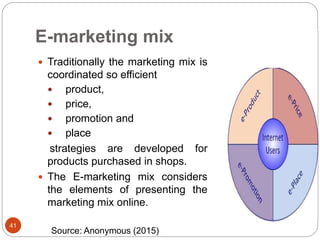
E-marketing mix
41
 Traditionally the marketing mix is
coordinated so efficient
 product,
 price,
 promotion and
 place
strategies are developed for
products purchased in shops.
 The E-marketing mix considers
the elements of presenting the
marketing mix online.
Source: Anonymous (2015)
E-Product
Strategies
42
 Online, there are facts mentioned about the
products.
 Buying process customized for returning
visitors.
 Ancillary products can be offered immediately
along with the main purchase.
Source: Anonymous (2015)
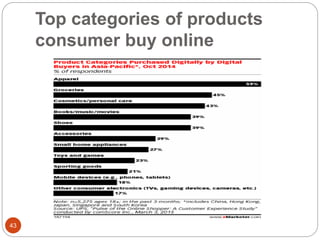
Top categories of products
consumer buy online
43
44
E-Price
strategies
 The internet gives consumers the power to
shop around for the best deal at a click of a
button.
 Growth of online auction.
 Loyalty incentives to repeat visitors.
 Easy payment.
Source: Anonymous (2015)
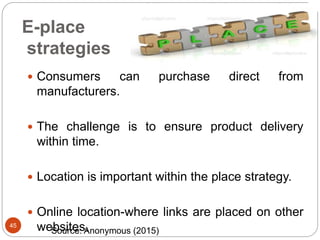
E-place
strategies
45
 Consumers can purchase direct from
manufacturers.
 The challenge is to ensure product delivery
within time.
 Location is important within the place strategy.
 Online location-where links are placed on other
websites.Source: Anonymous (2015)
E-promotion strategies
46
 Approaches to E-promotion:-
 Recognizable domain name.
 Banner advertisements on other web pages.
Source: Anonymous (2015)
E-promotion strategies
47
 Web public relations (WPR).
 Direct email. Direct emailing also known as
SPAM (Sending persistent annoying email).
 Social media.(anonymous)
Source: Anonymous (2015)
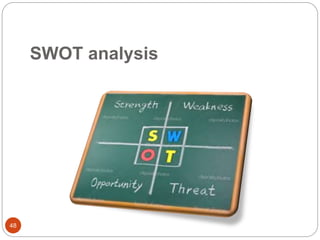
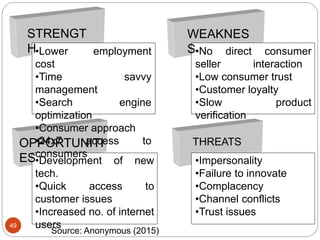
SWOT analysis
48
49
STRENGT
H
WEAKNES
S
OPPORTUNITI
ES
THREATS
•Lower employment
cost
•Time savvy
management
•Search engine
optimization
•Consumer approach
•24x7 access to
consumers
•No direct consumer
seller interaction
•Low consumer trust
•Customer loyalty
•Slow product
verification
•Development of new
tech.
•Quick access to
customer issues
•Increased no. of internet
users
•Impersonality
•Failure to innovate
•Complacency
•Channel conflicts
•Trust issues
Source: Anonymous (2015)
50
Electronic Customer
Relationship Management (E-
CRM)
51
 The phenomenon of building a relationship
with customers via the internet is known as E-
CRM.
 Main difference between CRM and E-CRM is
the medium used for providing services to the
customer.
 E-CRM focuses on electronic channels mainly
internet and technologies.
 E-CRM helps companies understand,
E-CRM
Source: Sudhakar (2009)
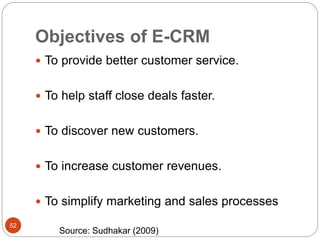
Objectives of E-CRM
52
 To provide better customer service.
 To help staff close deals faster.
 To discover new customers.
 To increase customer revenues.
 To simplify marketing and sales processes
Source: Sudhakar (2009)
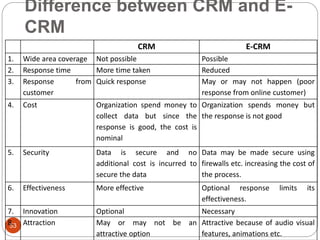
Difference between CRM and E-
CRM
53
CRM E-CRM
1. Wide area coverage Not possible Possible
2. Response time More time taken Reduced
3. Response from
customer
Quick response May or may not happen (poor
response from online customer)
4. Cost Organization spend money to
collect data but since the
response is good, the cost is
nominal
Organization spends money but
the response is not good
5. Security Data is secure and no
additional cost is incurred to
secure the data
Data may be made secure using
firewalls etc. increasing the cost of
the process.
6. Effectiveness More effective Optional response limits its
effectiveness.
7. Innovation Optional Necessary
8. Attraction May or may not be an
attractive option
Attractive because of audio visual
features, animations etc.
Why companies need E-CRM
54
 To get customer loyalty companies.
 To get a 360 degree view of the customer.
 To identify new market trends
 To meet the needs of the customer more fully.
 To increase interaction with the customer.
Source: Sudhakar (2009)
Major trends in E-CRM
55
 Three major trends that will create an
explosion in E-CRM services are:-
 Explosion of broadband and
telecommunication networks and services.
 Penetration of mobile data services.
 Customer care using offshore and web
based technology.
Source: Sudhakar (2009)
Major trends in E-CRM
56
 Three major trends that will create an
explosion in E-CRM services are:-
 Explosion of broadband and
telecommunication networks and services.
 Penetration of mobile data services.
 Customer care using offshore and web
based technology.
Source: Sudhakar (2009)
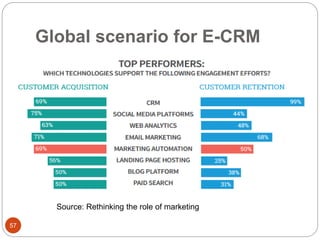
Global scenario for E-CRM
57
Source: Rethinking the role of marketing
Case Study:
Customer Service
as Public Relations
58
 Zappos (http://www.zappos.com), a U.S. online shoe
retailer, bases much of its success on its customer
service.
 It offers free shipping on all its purchases, as well as
free returns.
 In fact, goods are shipped with a preprinted return
label, making the process straightforward for
customers.
Source: Saylor
Case Study: Customer Service
as Public Relations
59
 For example, Zaz LaMarr blogged about her
experience with Zappos. She had meant to return
some shoes to Zappos, but her mother passed away,
and naturally she just didn’t have time. Zappos
arranged to have UPS come pick up the shoes and
then sent her flowers.
 Yahoo! shows nearly two thousand links to her blog
post, which has generated some good comments
increasing the goodwill of the company.
 The return to Zappos in terms of goodwill is almost
immeasurable (although its online reputation is
excellent) but no doubt leads to increased referralsSource: Saylor
Case Study 2 : Viral Marketing
60
Firebox.com and Speedy Santa
61
 In December 2004, firebox.com, a leading UK
gifts and gadgets E-tailer, hired Inbox.co.uk to
create a Christmas viral to drive online traffic
to them and increase sales.
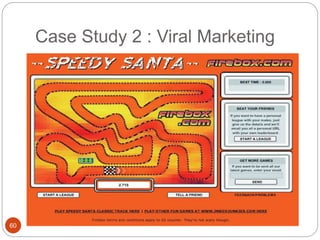
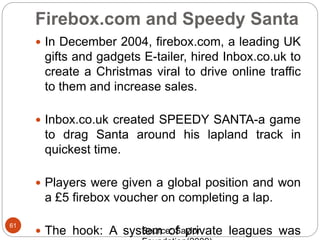
 Inbox.co.uk created SPEEDY SANTA-a game
to drag Santa around his lapland track in
quickest time.
 Players were given a global position and won
a £5 firebox voucher on completing a lap.
 The hook: A system of private leagues wasSource: Saylor
Firebox.com and Speedy Santa
62
 Everyone in that league was e-mailed a
personal Web site link and scores were
updated in real time.
 These leagues proved to be a big hit and
created a lot of office buzz.
 The Speedy Santa game was played over
twenty-two million times in the run-up to
Christmas.
 On average, people played the game overSource: Saylor
Firebox.com and Speedy Santa
63
 Of people who played the Firebox Speedy
Santa game, 87 percent clicked through to the
Firebox.com site, at a cost to Firebox of under
$0.02 per click-through
 And they each had a Firebox voucher to
spend right before Christmas.
 Christian Robinson, marketing director of
Firebox.com, said, “It has definitely been one
of the most successful promotions we have
ever run, generated hundreds of thousands of
pounds in revenue and bringing the FireboxSource: Saylor
Conclusion
64
 It can be concluded that the scope of E-marketing is
vast and innumerable opportunities will be presented
in the near future.
 Marketers need to learn to harness these
opportunities through different marketing methods.
 The increased number of internet users presents vast
opportunities for E-commerce and E-marketing.
 The number of online buyers have increased and are
continuously growing.
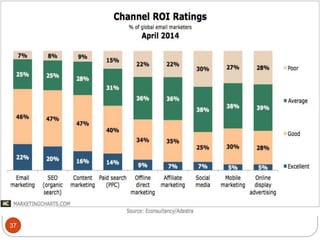
 Email marketing and search engine marketing give
Conclusion
65
 Viral and social media marketing help marketers
spread the word quickly.
 One of the plus points of E-marketing is quick access
to customer issues.
 Loyalty and trust are some of the issues an E-
marketer needs to deal with.
 Apparels and groceries are most demanded products
digitally.
 Importance of E-CRM has been realized and
marketers are adopting it in due course of time.
66

E marketing-global scenario

  • 1.
  • 2.
  • 3.
    Contents 3  E-marketing  Conceptof E-marketing  What is E-marketing and E-commerce?  Internet marketing vs. E-marketing vs. E-commerce  Why E-Commerce and E-marketing?  Scope of E-marketing  Objectives of E-marketing  Global and Indian scenario of E-marketing  Methods of E-marketing  Traditional methods  Modern methods  Marketing through mobile phone
  • 4.
    Contents 4  Advantages ofE-marketing  E-marketing mix  SWOT analysis  E-CRM  Case study: E-CRM  Case study: Viral Marketing  Conclusion
  • 5.
    E-marketing  Uses internetand digital media capabilities.  Addition to traditional marketing approaches. 5 Source: Anonymous (2015)
  • 6.
    Concept of E-marketing Relatively new concept that crept into the business vocabulary in 1970s.  Flawless application of information technology from the point of origin to the ultimate destination of the products.  Process of using modern technology for providing information to the consumers regarding products and services by companies.6 Source: Anonymous (2015)
  • 7.
    What is E-Marketingand E- Commerce?  E-marketing (Electronic Marketing) is the moving of marketing strategies and activities to a computerized, networked environment such as the internet.  Strategic process of creating, distributing, promoting, and pricing goods and services over the internet or through wireless digital tools.  E-commerce (Electronic Commerce or EC) is the buying and selling of these goods and 7 Source: Anonymous (2015)
  • 8.
    Internet-marketing vs. E- Marketingvs. E-commerce  E-Marketing has a broader scope than internet marketing.  Internet marketing (IM) refers only to the internet, world wide web, e-mails.  E marketing=internet marketing +other E-marketing tools like: intranets, extranets and mobile phones. Figure:-Differences between internet-marketing, E-Marketing, E-commerce and E-Business Source: El-Gohary et al (2010) 8 Source: El-Gohary et al (2010)
  • 9.
    Why E-Commerce andE- Marketing?  Consumers research products and services on the internet.  Businesses don’t need a shop everywhere with a website.  Expensive and repetitive methods need not be used.  Staff can spend valuable time in the workplace.9 Source: Anonymous (2015)
  • 10.
    Why E-Commerce andE- Marketing?  Return on Investment (ROI) exceed that of traditional marketing strategies.  Forefront of redefinition of way businesses 10 Source: Saylor Foundation(2009)
  • 11.
    Scope of E-marketing The digital technologies used as delivery and communication mediums within the scope of E- marketing include:-  Internet media such as websites and e-mail  Digital media such as wireless, mobile, cable and satellite. 11 Source: Anonymous (2015)
  • 12.
    Objectives of E-marketing E-marketing objectives differ with companies and their circumstances  5 S framework includes:-  Sell  Serve  Speak  Save  Sizzle 12 Source: Anonymous (2015)
  • 13.
    Objectives of E-marketing E-marketing objectives should be:-  Specific  Measurable  Action-oriented  Realistic  Time-specific 13 Source: Anonymous (2015)
  • 14.
    Global and Indianscenario of E-marketing  Current E-commerce statistics state that 40 percent of worldwide internet users have bought products or goods online via desktop, mobile, tablet or other online devices. This amounts to more than 1 billion online buyers and is projected to continuously grow.  YouTube has become the 2nd Largest Search Engine – bigger than Bing, Yahoo, Ask & AOL combined.  71per cent of shoppers believe they will get a 14 Source: Anonymous (2015)
  • 15.
    15 Global and Indianscenario of E-marketing Source: Anonymous (2015)
  • 16.
    16 Global and Indianscenario of E-marketing Source: Anonymous (2015)
  • 17.
     Out of137 million internet users India, only 25 million shops online that is just 18per cent of total internet population (IAMAI report, 2013).  Total internet users in India may increase to 500 Million by 2018(Rajan Anandan, MD, Google India).  Indian digital commerce market reached INR 81,525Cr In 2014(IAMAI).  E-commerce in India is expected to reach $24 17 Global and Indian scenario of E-marketing
  • 18.
  • 19.
  • 20.
  • 21.
    Methods of E-marketing Traditional methods in internet  Banner-Ads  Pop ups  Interstitials  Modern methods in internet  Webisodes  Viral Marketing  Interactive games or puzzles  Bribes(discounts and offer information through e- mails)  Viral E-mail campaigns 21
  • 22.
    Methods of E-marketing 22 Search engine marketing  Search engine optimization  Pay per click  Social media marketing  Marketing through mobile phones  App based marketing  In-game mobile marketing  Mobile web marketing
  • 23.
    A. Banner ads 1.Traditional methods of E-marketing 23
  • 24.
    B. Pop-ups 1. Traditionalmethods of E-marketing 24
  • 25.
    C. Interstitials 1. Traditionalmethods of E-marketing 25
  • 26.
    A. Webisodes 2. Modernmethods of E- marketing 26 Cocaine's Environmental Cost Food Not Bombs: Using Food Waste to Feed the Planet Climate, Agriculture and the Challenges Ahead
  • 27.
    B. Viral marketing •Electronicequivalent of ‘word of mouth’. •Facilitates consumer to consumer (C to C) promotion at a rapid pace in internet. •Types of Viral Marketing •Interactive games or puzzles •Bribes (discounts and offer information) •Viral e mail marketing campaigns 2. Modern methods of E- marketing 27 Source: Senthil (2009)
  • 28.
  • 29.
    C. Search enginemarketing 2. Modern methods of E- marketing 29 •One of the principle tools. •This prominence is because of increased use of search engines. •The principal techniques employed in SEM are: •SEO •PPC •Paid inclusion Source: Anonymous (2015)
  • 30.
    30 •Search engine optimization(SEO): A setof practices employed to get ranking for WebPages on relevant keywords(search queries). •Pay per click(PPC): PPC drives relevant traffic to a website by competitive bidding structure. •Paid Inclusion: The businesses pay for their website to be ranked higher in the natural listing of search engines.Source: Anonymous (2015)
  • 31.
    D. Social media marketing 31 Utilizes social networking websites as a marketing tool.  Help company increase brand exposure and broaden customer reach. 2. Modern methods of E- marketing Source: Anonymous (2015)
  • 32.
    D. Social mediamarketing 32  Electronic Word of Mouth (E- WoM)-Any statement consumers share via the internet about an event, product, service, brand or company.  This form of marketing results in 2. Modern methods of E- marketing Source: Anonymous( 2015)
  • 33.
    App based marketing 33 3.Marketing through mobile phone Source: Anonymous (2015)
  • 34.
    In-game mobile marketing 34 3.Marketing through mobile phone Source: Anonymous (2015)
  • 35.
    MOBILE WEB MARKETING 35 3.Marketing through mobile phone Source: Anonymous (2015)
  • 36.
  • 37.
  • 38.
  • 39.
    39 S. No . Industry Suitable E- marketingmethods Target audience for suggested methods Advantages 1 Banking and financial services 1.Interstitials 2.Pop-ups 3.Viral marketing(games, e-mail campaigns discount and offer e-mails) 4.Search engine marketing Higher income, middle income and aspiring urban consumer groups that have access to internet in either office or home. 1.Wider reach 2.Individual targeting 3.Interactivity 4.Measurability 2 Consumer durables 1.Pop-ups combined with Webisodes and viral marketing(games, e-mail campaigns discount and offer e-mails) Middle income and aspiring urban consumer groups that have access to internet in either office or home. 1.Wider reach 2.Individual targeting 3.Interactivity 4.Measurability Advantages of E-marketing
  • 40.
    40 3 Food & beverages, FMCG 1.Pop-upscombined with webisodes and viral marketing Middle income and aspiring urban consumer groups that have access to internet in either office or home. 1.Wider reach 2.Interactivity 3.Measurability 1. Marketing through mobile phone and rural internet kiosks using banner ads, pop-ups, interstitials and animated screen savers in future. Rural markets having purchasing capability and telecommunication penetration in market. Advantages of E-marketing Source: Senthil(2009)
  • 41.
    E-marketing mix 41  Traditionallythe marketing mix is coordinated so efficient  product,  price,  promotion and  place strategies are developed for products purchased in shops.  The E-marketing mix considers the elements of presenting the marketing mix online. Source: Anonymous (2015)
  • 42.
    E-Product Strategies 42  Online, thereare facts mentioned about the products.  Buying process customized for returning visitors.  Ancillary products can be offered immediately along with the main purchase. Source: Anonymous (2015)
  • 43.
    Top categories ofproducts consumer buy online 43
  • 44.
    44 E-Price strategies  The internetgives consumers the power to shop around for the best deal at a click of a button.  Growth of online auction.  Loyalty incentives to repeat visitors.  Easy payment. Source: Anonymous (2015)
  • 45.
    E-place strategies 45  Consumers canpurchase direct from manufacturers.  The challenge is to ensure product delivery within time.  Location is important within the place strategy.  Online location-where links are placed on other websites.Source: Anonymous (2015)
  • 46.
    E-promotion strategies 46  Approachesto E-promotion:-  Recognizable domain name.  Banner advertisements on other web pages. Source: Anonymous (2015)
  • 47.
    E-promotion strategies 47  Webpublic relations (WPR).  Direct email. Direct emailing also known as SPAM (Sending persistent annoying email).  Social media.(anonymous) Source: Anonymous (2015)
  • 48.
  • 49.
    49 STRENGT H WEAKNES S OPPORTUNITI ES THREATS •Lower employment cost •Time savvy management •Searchengine optimization •Consumer approach •24x7 access to consumers •No direct consumer seller interaction •Low consumer trust •Customer loyalty •Slow product verification •Development of new tech. •Quick access to customer issues •Increased no. of internet users •Impersonality •Failure to innovate •Complacency •Channel conflicts •Trust issues Source: Anonymous (2015)
  • 50.
  • 51.
    51  The phenomenonof building a relationship with customers via the internet is known as E- CRM.  Main difference between CRM and E-CRM is the medium used for providing services to the customer.  E-CRM focuses on electronic channels mainly internet and technologies.  E-CRM helps companies understand, E-CRM Source: Sudhakar (2009)
  • 52.
    Objectives of E-CRM 52 To provide better customer service.  To help staff close deals faster.  To discover new customers.  To increase customer revenues.  To simplify marketing and sales processes Source: Sudhakar (2009)
  • 53.
    Difference between CRMand E- CRM 53 CRM E-CRM 1. Wide area coverage Not possible Possible 2. Response time More time taken Reduced 3. Response from customer Quick response May or may not happen (poor response from online customer) 4. Cost Organization spend money to collect data but since the response is good, the cost is nominal Organization spends money but the response is not good 5. Security Data is secure and no additional cost is incurred to secure the data Data may be made secure using firewalls etc. increasing the cost of the process. 6. Effectiveness More effective Optional response limits its effectiveness. 7. Innovation Optional Necessary 8. Attraction May or may not be an attractive option Attractive because of audio visual features, animations etc.
  • 54.
    Why companies needE-CRM 54  To get customer loyalty companies.  To get a 360 degree view of the customer.  To identify new market trends  To meet the needs of the customer more fully.  To increase interaction with the customer. Source: Sudhakar (2009)
  • 55.
    Major trends inE-CRM 55  Three major trends that will create an explosion in E-CRM services are:-  Explosion of broadband and telecommunication networks and services.  Penetration of mobile data services.  Customer care using offshore and web based technology. Source: Sudhakar (2009)
  • 56.
    Major trends inE-CRM 56  Three major trends that will create an explosion in E-CRM services are:-  Explosion of broadband and telecommunication networks and services.  Penetration of mobile data services.  Customer care using offshore and web based technology. Source: Sudhakar (2009)
  • 57.
    Global scenario forE-CRM 57 Source: Rethinking the role of marketing
  • 58.
    Case Study: Customer Service asPublic Relations 58  Zappos (http://www.zappos.com), a U.S. online shoe retailer, bases much of its success on its customer service.  It offers free shipping on all its purchases, as well as free returns.  In fact, goods are shipped with a preprinted return label, making the process straightforward for customers. Source: Saylor
  • 59.
    Case Study: CustomerService as Public Relations 59  For example, Zaz LaMarr blogged about her experience with Zappos. She had meant to return some shoes to Zappos, but her mother passed away, and naturally she just didn’t have time. Zappos arranged to have UPS come pick up the shoes and then sent her flowers.  Yahoo! shows nearly two thousand links to her blog post, which has generated some good comments increasing the goodwill of the company.  The return to Zappos in terms of goodwill is almost immeasurable (although its online reputation is excellent) but no doubt leads to increased referralsSource: Saylor
  • 60.
    Case Study 2: Viral Marketing 60
  • 61.
    Firebox.com and SpeedySanta 61  In December 2004, firebox.com, a leading UK gifts and gadgets E-tailer, hired Inbox.co.uk to create a Christmas viral to drive online traffic to them and increase sales.  Inbox.co.uk created SPEEDY SANTA-a game to drag Santa around his lapland track in quickest time.  Players were given a global position and won a £5 firebox voucher on completing a lap.  The hook: A system of private leagues wasSource: Saylor
  • 62.
    Firebox.com and SpeedySanta 62  Everyone in that league was e-mailed a personal Web site link and scores were updated in real time.  These leagues proved to be a big hit and created a lot of office buzz.  The Speedy Santa game was played over twenty-two million times in the run-up to Christmas.  On average, people played the game overSource: Saylor
  • 63.
    Firebox.com and SpeedySanta 63  Of people who played the Firebox Speedy Santa game, 87 percent clicked through to the Firebox.com site, at a cost to Firebox of under $0.02 per click-through  And they each had a Firebox voucher to spend right before Christmas.  Christian Robinson, marketing director of Firebox.com, said, “It has definitely been one of the most successful promotions we have ever run, generated hundreds of thousands of pounds in revenue and bringing the FireboxSource: Saylor
  • 64.
    Conclusion 64  It canbe concluded that the scope of E-marketing is vast and innumerable opportunities will be presented in the near future.  Marketers need to learn to harness these opportunities through different marketing methods.  The increased number of internet users presents vast opportunities for E-commerce and E-marketing.  The number of online buyers have increased and are continuously growing.  Email marketing and search engine marketing give
  • 65.
    Conclusion 65  Viral andsocial media marketing help marketers spread the word quickly.  One of the plus points of E-marketing is quick access to customer issues.  Loyalty and trust are some of the issues an E- marketer needs to deal with.  Apparels and groceries are most demanded products digitally.  Importance of E-CRM has been realized and marketers are adopting it in due course of time.
  • 66.