E-COMMERCE
          BUS2513
(Diploma in International Business)

Chapter 1: Core Marketing Concepts
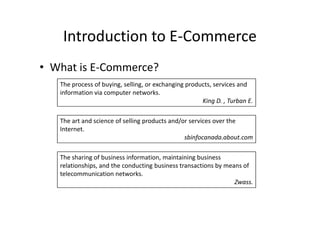
Introduction to E-Commerce
• What is E-Commerce?
   The process of buying, selling, or exchanging products, services and
   information via computer networks.
                                                      King D. , Turban E.

   The art and science of selling products and/or services over the
   Internet.
                                                sbinfocanada.about.com

   The sharing of business information, maintaining business
   relationships, and the conducting business transactions by means of
   telecommunication networks.
                                                                 Zwass.
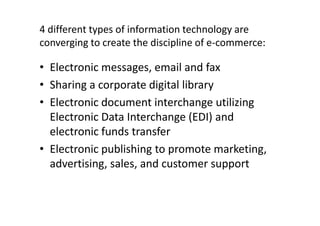
4 different types of information technology are
converging to create the discipline of e-commerce:

• Electronic messages, email and fax
• Sharing a corporate digital library
• Electronic document interchange utilizing
  Electronic Data Interchange (EDI) and
  electronic funds transfer
• Electronic publishing to promote marketing,
  advertising, sales, and customer support
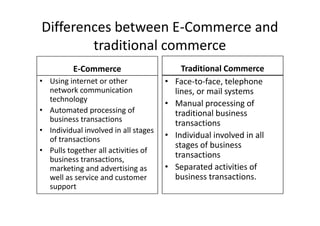
Differences between E-Commerce and
        traditional commerce
          E-Commerce                        Traditional Commerce
• Using internet or other             •   Face-to-face, telephone
  network communication                   lines, or mail systems
  technology
                                      •   Manual processing of
• Automated processing of                 traditional business
  business transactions                   transactions
• Individual involved in all stages
  of transactions                     •   Individual involved in all
                                          stages of business
• Pulls together all activities of
  business transactions,
                                          transactions
  marketing and advertising as        •   Separated activities of
  well as service and customer            business transactions.
  support
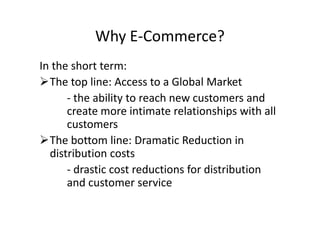
Why E-Commerce?
In the short term:
The top line: Access to a Global Market
      - the ability to reach new customers and
      create more intimate relationships with all
      customers
The bottom line: Dramatic Reduction in
  distribution costs
      - drastic cost reductions for distribution
      and customer service
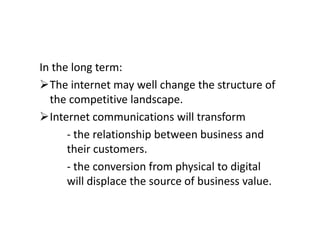
In the long term:
The internet may well change the structure of
  the competitive landscape.
Internet communications will transform
      - the relationship between business and
      their customers.
      - the conversion from physical to digital
      will displace the source of business value.
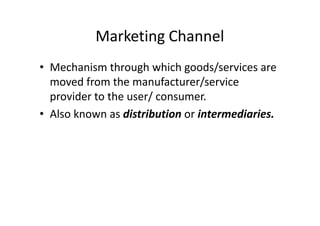
Marketing Channel
• Mechanism through which goods/services are
  moved from the manufacturer/service
  provider to the user/ consumer.
• Also known as distribution or intermediaries.
Types of intermediaries
• Wholesaler : buy from producers in a large
  quantity and resell to retailer.
• Agent : secure an order for producer and will
  take commission for success transaction
• Retailer : directly sell goods to customer. They
  might have strong personal relationship with
  the customer
• Internet : e-commerce technology
Marketing Defined
• Kotler’s social definition:
   “Marketing is a societal process by
    which individuals and groups obtain
    what they need and want through
    creating, offering, and freely
    exchanging products and services of
    value with others.”
Marketing Defined
• The AMA managerial definition:
   “Marketing is the process of planning
    and executing the conception, pricing,
    promotion, and distribution of ideas,
    goods, and services to create
    exchanges that satisfy individual and
    organizational objectives.”
The Marketing Process A Five-Step
               Process
1. Understand the marketplace and customer needs
   and wants
2. Design a customer-driven marketing strategy
3. Construct a marketing program that delivers
   superior value
4. Build profitable relationships and create customer
   delight
5. Capture value from customers to create profits and
   customer quality
Marketing Concepts

• Target markets and market    • Exchange and transactions,
  segmentation                   & Relationship and
• Marketplace, market-space,     networks
  metamarkets                  • Marketing channels
• Marketers & prospects        • Supply chain
• Needs, wants, demands        • Competition
• Product offering and brand   • Marketing environment
• Value and satisfaction       • Marketing program
Customer Key Concepts
• Customer loyalty
   Customer loyalty is all about attracting the right customer, getting
   them to buy, buy often, buy in higher quantities and bring you
   even more customers.


• Share of customer
   The percentage of customers that buy a company's product of all
   customers purchasing in that product category.
• Customer equity
  Value: a fair return or equivalent in goods, services, or money for
  something exchanged.

  Brand: An identifying symbol, words, or mark that distinguishes a
  product or company from its competitors.

  Customer retention: Keep a company’s customer and to retain
  their revenue contribution. Aim is to prevent customers from
  defecting to alternative brands / going to the competition.
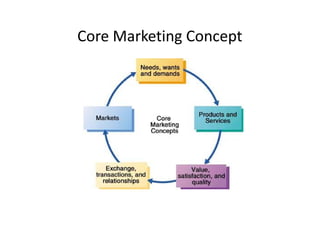
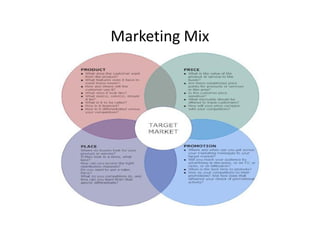
Core Marketing Concept
Marketing Mix
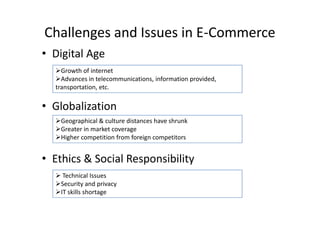
Challenges and Issues in E-Commerce
• Digital Age
  Growth of internet
  Advances in telecommunications, information provided,
  transportation, etc.


• Globalization
  Geographical & culture distances have shrunk
  Greater in market coverage
  Higher competition from foreign competitors


• Ethics & Social Responsibility
   Technical Issues
  Security and privacy
  IT skills shortage
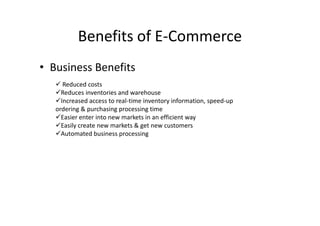
Benefits of E-Commerce
• Business Benefits
    Reduced costs
   Reduces inventories and warehouse
   Increased access to real-time inventory information, speed-up
   ordering & purchasing processing time
   Easier enter into new markets in an efficient way
   Easily create new markets & get new customers
   Automated business processing
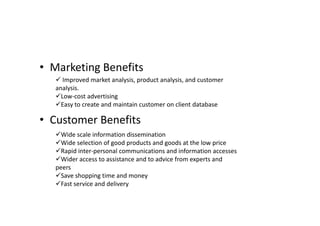
• Marketing Benefits
    Improved market analysis, product analysis, and customer
   analysis.
   Low-cost advertising
   Easy to create and maintain customer on client database

• Customer Benefits
   Wide scale information dissemination
   Wide selection of good products and goods at the low price
   Rapid inter-personal communications and information accesses
   Wider access to assistance and to advice from experts and
   peers
   Save shopping time and money
   Fast service and delivery
Internet Marketing
• E-commerce (EC) : the process of buying, selling or
  exchanging products, services or information via
  computer network.
• E-business :
 A broader definition of EC
 Includes not just the buying and selling of goods and
  services.
 Servicing customers.
 Collaborating with business partners.
 Conducting electronic transaction within an
  organisation.
• Online Marketing : company efforts to market
  products and services, and build customer
  relationship over the internet.
• Internet : a vast public web of computer
  networks that connects users all around the
  world to each other and to an amazingly large
  ‘information repository’.
EC Organisations
• Brick-And-Mortar : old-economy
  organisations that perform most of their
  business off-line, selling physical products by
  means of physical agent
• Virtual/Pure-Play/Click Only : organisations
  that conduct their business activities solely
  online
• Click-And-Mortar : organisations that conduct
  some e-commerce activities, but do their
  primary business in the physical world
Internet Advertising Terminology
• Hit: a request for data from a Web page or file
• Visit: a series of requests during one
  navigation of a web site; a pause of a certain
  length of time ends a visit
• Unique Visit: a count of a number of visitors
  to a site, regardless of how many pages are
  viewed per visit
• Stickiness: characteristic that influences the
  average length of time a visitor stays in a site.
Advertising Strategies & Promotions
                Online
• Affiliate Marketing: a marketing arrangement by
  which an organisation refer consumers to the
  selling company’s Web site
• Viral Marketing: word-of-mouth marketing by
  which customers promote a product or service by
  telling others about it
• Webcasting: a free Internet news service that
  broadcasts personalized news and information,
  including seminars, in category selected by the
  user
Web Advertising
• Interactive Marketing: Online marketing,
  enabled by the Internet, in which advertisers
  can interact directly with customers and
  consumer can interact with
  advertisers/vendors
Major Business Models for
          Advertising Online
• Using the Web as a channel to advertise a
  firm’s own products and services.
• Making a firm’s site a public portal site and
  using captive audiences to advertise products
  offered by other firms.
Internet Advertising Methods
• Banner: on a Web page, graphic advertising
  display linked to the advertiser’s Web page.
• Keyword Banners: banner ads that appear
  when a predetermined word is queried from a
  search engine.
• Random Banners: banner ads that appear at
  random, not as the result of the user’s action.
Benefits of Banner Ads
• By clicking on them, users are transferred to
  an advertiser’s site, and frequently direct to
  the shopping page of that site.
• The ability to customize them for individual
  surfer or a market segment of surfers.
• Viewing of banner is fairly high because “force
  advertising” is use.
• Banners may include attention-grabbing
  multimedia.
Limitations of Banner Ads
• Costly.
• A limited amount of information can be places
  on the banner.
• Viewers have become somewhat immune to
  banners and simply do not notice them as
  they once did.
Types of Banner Ads
• Banner Swapping: an agreement between
  two companies to display the other’s banner
  ad on its Web site.
• Banner Exchanges: markets in which
  companies can trade or exchange placement
  of banner ads on each other’s Web sites.
• Pop-Up Ad: an ad that appears in a separate
  window before, during, or after Internet
  surfing or when reading e-mail.
• Pop-Under Ad: an ad that appears underneath
  the current browser window, so when the
  user close the active window, he or she can
  sees the ads.
• Interstitial: an initial Web page or a portion of
  its that is used to capture the user’s attention
  for a short time while other content is loading.
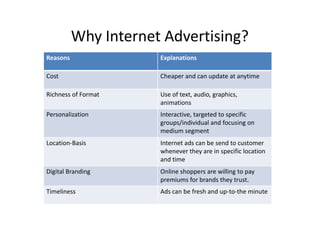
Why Internet Advertising?
Reasons               Explanations

Cost                  Cheaper and can update at anytime

Richness of Format    Use of text, audio, graphics,
                      animations
Personalization       Interactive, targeted to specific
                      groups/individual and focusing on
                      medium segment
Location-Basis        Internet ads can be send to customer
                      whenever they are in specific location
                      and time
Digital Branding      Online shoppers are willing to pay
                      premiums for brands they trust.
Timeliness            Ads can be fresh and up-to-the minute

Chp1 e commerce

  • 1.
    E-COMMERCE BUS2513 (Diploma in International Business) Chapter 1: Core Marketing Concepts
  • 2.
    Introduction to E-Commerce •What is E-Commerce? The process of buying, selling, or exchanging products, services and information via computer networks. King D. , Turban E. The art and science of selling products and/or services over the Internet. sbinfocanada.about.com The sharing of business information, maintaining business relationships, and the conducting business transactions by means of telecommunication networks. Zwass.
  • 3.
    4 different typesof information technology are converging to create the discipline of e-commerce: • Electronic messages, email and fax • Sharing a corporate digital library • Electronic document interchange utilizing Electronic Data Interchange (EDI) and electronic funds transfer • Electronic publishing to promote marketing, advertising, sales, and customer support
  • 4.
    Differences between E-Commerceand traditional commerce E-Commerce Traditional Commerce • Using internet or other • Face-to-face, telephone network communication lines, or mail systems technology • Manual processing of • Automated processing of traditional business business transactions transactions • Individual involved in all stages of transactions • Individual involved in all stages of business • Pulls together all activities of business transactions, transactions marketing and advertising as • Separated activities of well as service and customer business transactions. support
  • 5.
    Why E-Commerce? In theshort term: The top line: Access to a Global Market - the ability to reach new customers and create more intimate relationships with all customers The bottom line: Dramatic Reduction in distribution costs - drastic cost reductions for distribution and customer service
  • 6.
    In the longterm: The internet may well change the structure of the competitive landscape. Internet communications will transform - the relationship between business and their customers. - the conversion from physical to digital will displace the source of business value.
  • 7.
    Marketing Channel • Mechanismthrough which goods/services are moved from the manufacturer/service provider to the user/ consumer. • Also known as distribution or intermediaries.
  • 8.
    Types of intermediaries •Wholesaler : buy from producers in a large quantity and resell to retailer. • Agent : secure an order for producer and will take commission for success transaction • Retailer : directly sell goods to customer. They might have strong personal relationship with the customer • Internet : e-commerce technology
  • 9.
    Marketing Defined • Kotler’ssocial definition: “Marketing is a societal process by which individuals and groups obtain what they need and want through creating, offering, and freely exchanging products and services of value with others.”
  • 10.
    Marketing Defined • TheAMA managerial definition: “Marketing is the process of planning and executing the conception, pricing, promotion, and distribution of ideas, goods, and services to create exchanges that satisfy individual and organizational objectives.”
  • 11.
    The Marketing ProcessA Five-Step Process 1. Understand the marketplace and customer needs and wants 2. Design a customer-driven marketing strategy 3. Construct a marketing program that delivers superior value 4. Build profitable relationships and create customer delight 5. Capture value from customers to create profits and customer quality
  • 12.
    Marketing Concepts • Targetmarkets and market • Exchange and transactions, segmentation & Relationship and • Marketplace, market-space, networks metamarkets • Marketing channels • Marketers & prospects • Supply chain • Needs, wants, demands • Competition • Product offering and brand • Marketing environment • Value and satisfaction • Marketing program
  • 13.
    Customer Key Concepts •Customer loyalty Customer loyalty is all about attracting the right customer, getting them to buy, buy often, buy in higher quantities and bring you even more customers. • Share of customer The percentage of customers that buy a company's product of all customers purchasing in that product category.
  • 14.
    • Customer equity Value: a fair return or equivalent in goods, services, or money for something exchanged. Brand: An identifying symbol, words, or mark that distinguishes a product or company from its competitors. Customer retention: Keep a company’s customer and to retain their revenue contribution. Aim is to prevent customers from defecting to alternative brands / going to the competition.
  • 15.
  • 16.
  • 17.
    Challenges and Issuesin E-Commerce • Digital Age Growth of internet Advances in telecommunications, information provided, transportation, etc. • Globalization Geographical & culture distances have shrunk Greater in market coverage Higher competition from foreign competitors • Ethics & Social Responsibility  Technical Issues Security and privacy IT skills shortage
  • 18.
    Benefits of E-Commerce •Business Benefits  Reduced costs Reduces inventories and warehouse Increased access to real-time inventory information, speed-up ordering & purchasing processing time Easier enter into new markets in an efficient way Easily create new markets & get new customers Automated business processing
  • 19.
    • Marketing Benefits  Improved market analysis, product analysis, and customer analysis. Low-cost advertising Easy to create and maintain customer on client database • Customer Benefits Wide scale information dissemination Wide selection of good products and goods at the low price Rapid inter-personal communications and information accesses Wider access to assistance and to advice from experts and peers Save shopping time and money Fast service and delivery
  • 20.
    Internet Marketing • E-commerce(EC) : the process of buying, selling or exchanging products, services or information via computer network. • E-business :  A broader definition of EC  Includes not just the buying and selling of goods and services.  Servicing customers.  Collaborating with business partners.  Conducting electronic transaction within an organisation.
  • 21.
    • Online Marketing: company efforts to market products and services, and build customer relationship over the internet. • Internet : a vast public web of computer networks that connects users all around the world to each other and to an amazingly large ‘information repository’.
  • 22.
    EC Organisations • Brick-And-Mortar: old-economy organisations that perform most of their business off-line, selling physical products by means of physical agent • Virtual/Pure-Play/Click Only : organisations that conduct their business activities solely online • Click-And-Mortar : organisations that conduct some e-commerce activities, but do their primary business in the physical world
  • 23.
    Internet Advertising Terminology •Hit: a request for data from a Web page or file • Visit: a series of requests during one navigation of a web site; a pause of a certain length of time ends a visit • Unique Visit: a count of a number of visitors to a site, regardless of how many pages are viewed per visit • Stickiness: characteristic that influences the average length of time a visitor stays in a site.
  • 24.
    Advertising Strategies &Promotions Online • Affiliate Marketing: a marketing arrangement by which an organisation refer consumers to the selling company’s Web site • Viral Marketing: word-of-mouth marketing by which customers promote a product or service by telling others about it • Webcasting: a free Internet news service that broadcasts personalized news and information, including seminars, in category selected by the user
  • 25.
    Web Advertising • InteractiveMarketing: Online marketing, enabled by the Internet, in which advertisers can interact directly with customers and consumer can interact with advertisers/vendors
  • 26.
    Major Business Modelsfor Advertising Online • Using the Web as a channel to advertise a firm’s own products and services. • Making a firm’s site a public portal site and using captive audiences to advertise products offered by other firms.
  • 27.
    Internet Advertising Methods •Banner: on a Web page, graphic advertising display linked to the advertiser’s Web page. • Keyword Banners: banner ads that appear when a predetermined word is queried from a search engine. • Random Banners: banner ads that appear at random, not as the result of the user’s action.
  • 28.
    Benefits of BannerAds • By clicking on them, users are transferred to an advertiser’s site, and frequently direct to the shopping page of that site. • The ability to customize them for individual surfer or a market segment of surfers. • Viewing of banner is fairly high because “force advertising” is use. • Banners may include attention-grabbing multimedia.
  • 29.
    Limitations of BannerAds • Costly. • A limited amount of information can be places on the banner. • Viewers have become somewhat immune to banners and simply do not notice them as they once did.
  • 30.
    Types of BannerAds • Banner Swapping: an agreement between two companies to display the other’s banner ad on its Web site. • Banner Exchanges: markets in which companies can trade or exchange placement of banner ads on each other’s Web sites. • Pop-Up Ad: an ad that appears in a separate window before, during, or after Internet surfing or when reading e-mail.
  • 31.
    • Pop-Under Ad:an ad that appears underneath the current browser window, so when the user close the active window, he or she can sees the ads. • Interstitial: an initial Web page or a portion of its that is used to capture the user’s attention for a short time while other content is loading.
  • 32.
    Why Internet Advertising? Reasons Explanations Cost Cheaper and can update at anytime Richness of Format Use of text, audio, graphics, animations Personalization Interactive, targeted to specific groups/individual and focusing on medium segment Location-Basis Internet ads can be send to customer whenever they are in specific location and time Digital Branding Online shoppers are willing to pay premiums for brands they trust. Timeliness Ads can be fresh and up-to-the minute