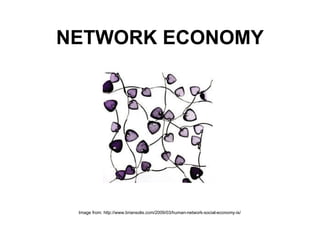
NETWORK ECONOMY Image from: http://www.briansolis.com/2009/03/human-network-social-economy-is/
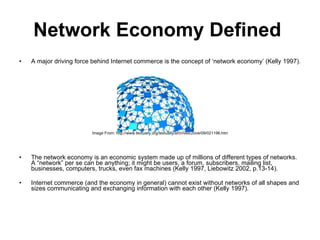
Network Economy Defined   A major driving force behind Internet commerce is the concept of ‘network economy’  (Kelly 1997). Image From: http://www.textually.org/textually/archives/2008/09/021196.htm The network economy is an economic system made up of millions of different types of networks. A “network” per se can be anything; it might be users, a forum, subscribers, mailing list, businesses, computers, trucks, even fax machines (Kelly 1997,  Liebowitz 2002, p.13-14). Internet commerce (and the economy in general) cannot exist without networks of all shapes and sizes communicating and exchanging information with each other (Kelly 1997).
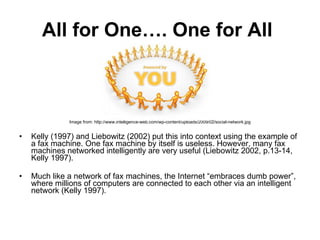
All for One…. One for All   Image from: http://www.intelligence-web.com/wp-content/uploads/2009/02/social-network.jpg Kelly (1997) and Liebowitz (2002) put this into context using the example of a fax machine. One fax machine by itself is useless. However, many fax machines networked intelligently are very useful (Liebowitz 2002, p.13-14, Kelly 1997).  Much like a network of fax machines, the Internet “embraces dumb power”, where millions of computers are connected to each other via an intelligent network (Kelly 1997).
Not New …. More Efficient   Image from: http://hollywoodlandlord.files.wordpress.com/2010/01/wordofmouth.jpg Businesses have always relied on a network of sorts, whether this be word of mouth advertising, or simply through the support of a business, to allow the owner to acquire more stock, which satisfies more consumers.  The concept of Network Economy is not a new event. However, with the Internet came many more opportunities to enhance a businesses network (Kelly 1997).
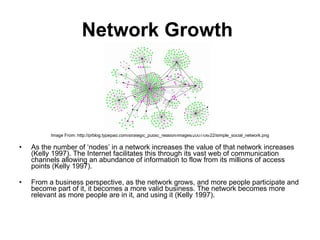
Network Growth   Image From: http://prblog.typepad.com/strategic_public_relation/images/2007/06/22/simple_social_network.png As the number of ‘nodes’ in a network increases the value of that network increases (Kelly 1997). The Internet facilitates this through its vast web of communication channels allowing an abundance of information to flow from its millions of access points (Kelly 1997). From a business perspective, as the network grows, and more people participate and become part of it, it becomes a more valid business. The network becomes more relevant as more people are in it, and using it (Kelly 1997).
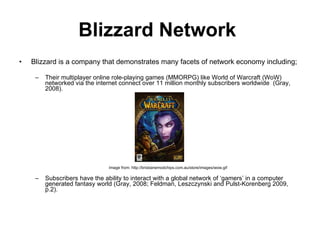
Blizzard Network   Blizzard is a company that demonstrates many facets of network economy including; Their  multiplayer online role-playing games (MMORPG) like World of Warcraft (WoW) networked via the internet connect  over 11 million monthly subscribers worldwide  ( Gray, 2008). Image from: http://brisbanemodchips.com.au/store/images/wow.gif Subscribers  have the ability to  interact with a global network of ‘gamers’ in a computer generated fantasy world ( Gray, 2008; Feldman, Leszczynski and Pulst-Korenberg 2009, p.2).
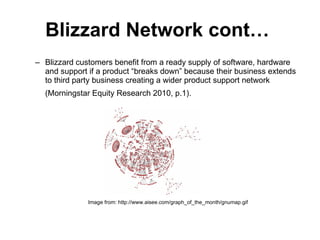
Blizzard Network cont…   Blizzard customers benefit from a ready supply of software, hardware and support if a product “breaks down” because their business extends to third party business creating a wider product support network (Morningstar Equity Research 2010, p.1).   Image from: http://www.aisee.com/graph_of_the_month/gnumap.gif
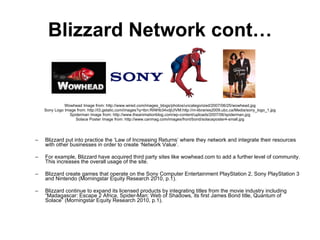
Blizzard Network cont… Wowhead Image from: http://www.wired.com/images_blogs/photos/uncategorized/2007/06/25/wowhead.jpg Sony Logo Image from: http://t3.gstatic.com/images?q=tbn:RiNHb34vdjUIVM:http://m-libraries2009.ubc.ca/Media/sony_logo_1.jpg Spiderman Image from: http://www.theanimationblog.com/wp-content/uploads/2007/06/spiderman.jpg Solace Poster Image from: http://www.canmag.com/images/front/bond/solaceposter4-small.jpg Blizzard put into practice the ‘Law of Increasing Returns’ where they network and integrate their resources with other businesses in order to create ‘Network Value’.  For example,  Blizzard have acquired third party sites like wowhead.com to add a further level of community. This increases the overall usage of the site. Blizzard create games that operate on the Sony Computer Entertainment PlayStation 2, Sony PlayStation 3 and Nintendo ( Morningstar Equity Research 2010, p.1). Blizzard continue to expand its licensed products by integrating titles from the movie industry including “Madagascar: Escape 2 Africa, Spider-Man: Web of Shadows, its first James Bond title, Quantum of Solace” ( Morningstar Equity Research 2010, p.1).
Blizzard Network cont…   Image from: http://www.gosugamers.net/warcraft/images/news/Activision_Blizzard_Logo.jpg In December 2007 Activision and Blizzard merge to form Activision Blizzard.  This meant combining a world leader in interactive publishing with a world leader MMORPG equating to 18.3% market share at that time  ( Cunningham, Langlotz, Rhode and Whaley 2008, p.24).
Sharing   Image from: http://givetoothers.com/image/kids_icecream.jpg Liebowitz (2002) describes ‘Winner-Takes-All’ where businesses ‘share’ with other businesses to increase their network capabilities. They achieve this by; Pooling resources Sharing financial, human resources, knowledge, expertise Linking manufacturing, distribution and marketing Forming technology cooperation networks (Rifkin 2001, p.19).
Non Exclusion   This is a drastic change from Industrial economy where it was all about excluding competition (Rifkin 2001, p.17).  Image from: http://thumbs.dreamstime.com/thumb_409/1245072303vEM5zW.jpg
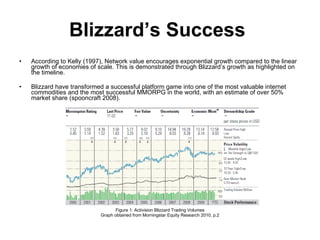
Blizzard’s Success   According to Kelly (1997), Network value encourages exponential growth compared to the linear growth of economies of scale. This is demonstrated through Blizzard’s growth as highlighted on the timeline.  Blizzard have transformed a successful platform game into one of the most valuable internet commodities and the most successful MMORPG in the world, with an estimate of over 50% market share (spooncraft 2008).  Figure 1: Activision Blizzard Trading Volumes Graph obtained from Morningstar Equity Research 2010, p.2
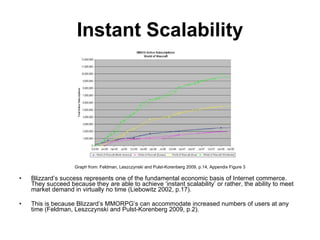
Instant Scalability Graph from:  Feldman, Leszczynski and Pulst-Korenberg 2009, p.14, Appendix Figure 3 Blizzard’s success represents one of the  fundamental economic basis of Internet commerce . They succeed because they are able to achieve ‘instant scalability’ or rather, the ability to meet market demand in virtually no time (Liebowitz 2002, p.17).  This is because Blizzard’s  MMORPG’s  can accommodate increased numbers of users at any time ( Feldman, Leszczynski and Pulst-Korenberg 2009, p.2).
Access   Image from: http://www.hss.state.ak.us/gcdse/history/Images/DSS_AccessImage.jpg Blizzard’s instant scalability is largely due to their products involving ‘access’ rather than ‘ownership’ particularly with  MMORPG  games like WoW that involve monthly subscriber fees (Feldman et al. 2009, p.2).  This is one of the fundamental economic basis of Internet commerce   as demonstrated by Rifkin (2001); “Markets are making way for networks, and ownership is being replaced by access” (Rifkin 2001, p.4).
Knowledge Economy   The concept of ‘access’ over ‘ownership’ relates a fundamental economic shift towards a knowledge economy where ‘ideas, and intangible assets’ creates revenue as apposed the ownership of physical assets  (Rifkin 2001, p.3).  Image from: http://pixelverdict.com/wp-content/uploads/2009/08/wow-cataclysm-logo-5801.jpg Blizzard demonstrates the importance of networked knowledge and creativity through their significant investment in product development, via their development studio, in order  to stay ahead in the market. This is demonstrated with the continued release of WoW ‘expansion packs’ in 2007, 2009 and 2010 (ITG 2010).   This example demonstrates a fundamental  economic basis of Internet commerce where  product life cycles in general are narrowing in order to remain competitive (Rifkin 2001, p.21).
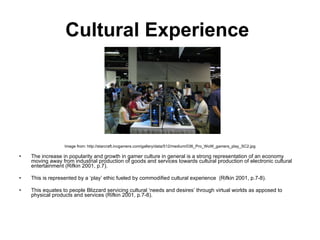
Cultural Experience   Image from: http://starcraft.incgamers.com/gallery/data/512/medium/036_Pro_WoW_gamers_play_SC2.jpg The increase in popularity and growth in gamer culture in general is a strong representation of an economy moving away from industrial production of goods and services towards cultural production of electronic cultural entertainment (Rifkin 2001, p.7).  This is represented by a ‘play’ ethic fueled by commodified cultural experience  (Rifkin 2001, p.7-8).  This equates to people Blizzard servicing cultural ‘needs and desires’ through virtual worlds as apposed to physical products and services (Rifkin 2001, p.7-8).
Globalisation   Image from: http://bulgaria.usembassy.gov/uploads/sO/bX/sObXJ0cSW96V4g6DMGj4hA/earth.gif This culture shift is not contained within geographic location. It is a global culture shift as Internet commerce operates globally (Flew 2008, p.193-195).  From a network economy perspective, this means business like Blizzard act as a global network of technology, businesses, communications, products and customers to name a few (Flew 2008, p.193-195). Global access means transactions and information are exchanged internationally and around the clock (Flew 2008, p.193-195).
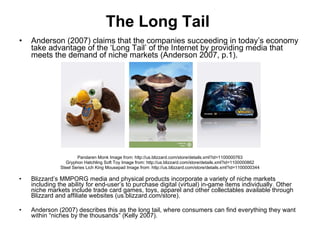
The Long Tail   Anderson (2007) claims that the companies succeeding in today’s economy take advantage of the ‘Long Tail’ of the Internet by providing media that meets the demand of niche markets (Anderson 2007, p.1).  Pandaren Monk Image from: http://us.blizzard.com/store/details.xml?id=1100000763 Gryphon Hatchling Soft Toy Image from: http://us.blizzard.com/store/details.xml?id=1100000862 Steel Series Lich King Mousepad Image from: http://us.blizzard.com/store/details.xml?id=1100000344 Blizzard’s MMPORG media and physical products incorporate a variety of niche markets including the ability for end-user’s to purchase digital (virtual) in-game items individually. Other niche markets include trade card games, toys, apparel and other collectables available through Blizzard and affiliate websites (us.blizzard.com/store). Anderson (2007) describes this as the long tail, where consumers can find everything they want within “niches by the thousands” (Kelly 2007).
Gift economy Image from: http://www.secretsexposedclub.com/images/Newsletter%202/gift-box.jpg Gift giving in World of Warcraft is common practice (Koojiman). Players frequently give other players in-game items including gold and weapons (Koojiman n.d, p.1-3). Blizzard are also in the business of giving away products. For example, WoW allows its users to give away 10 day free passes to their friends (worldofwarcraft.com, 2010).  From a network perspective, gift giving can be viewed as creating a new node in the network. Each new alliance creates a new node in the ever expanding network of business (Kelly 2007).
Economic Success   Image from: http://t2.gstatic.com/images?q=tbn:6NBinft3LYldsM:http://www.ambitnation.com/_/rsrc/1233140401209/Home/consultant-opportunity/Making%2520Money%2520Success.png Knieps (2006) categorises the network as a long term reality that has become stronger with the increase in communication options available today. As there are more users, and these users group together the importance and the relevance of the business has increased (Knieps 2006).  As Blizzard embrace multiple overlapping networks their business increases economic potential. Expanding network economy is a crucial ingredient to success in the network economy (Kelly 2007). The network is the measure of long term success. Attention alone cannot economically build a successful business. Using attention alone to bring new business ultimately undermines the success and economic survival (Knieps 2006).
In Text Reference   Anderson, C. (2009). The Long Tail .   Wired , 12(10). October. Available: http://www.wired.com/wired/archive/12.10/tail.html Cunningham, A.,  Langlotz, H., Rhode, M., Whaley, C. (2008) Video Game Industry Overview: An Analysis of the Current Market and Future Growth Trends, Retrieved July 2nd, 2010 from http://holgerlanglotz.de/downloads/BU4510_VideoGamesIndustry_LanglotzEtAl.pdf. Feldman, M., Leszczynski, P., Pulst-Korenberg J. (2009). Blizzard Entertainment: The Massive Multiplayer Online Gaming Market, Retrieved June 29th, 2010 from http://www.mcafee.cc/Classes/BEM106/Papers/2009/Blizzard.pdf. Flew, T. (2008). Introduction to New Media .  In  New Media: An Introduction  (3rd ed., pp.1-37). New York: Oxford. In e-Reserve. Gray, M. (2008).  ‘ World of Warcraft hits 11 million subscribers worldwide’, Retrieved July 3rd, 2010 from http://www.wow.com/2008/10/28/world-of-warcraft-hits-11-million-subscribers-worldwide/ Guild-bank.com (2010) Retrieved July 20, 2010, from www.guild-bank.com ITG (2010) Success: A Blizzard Entertainment Timeline, Retrieved 3rd July, 2010 from   http://imtalkingames.com/2010/01/23/success-a-blizzard-ent-timeline/ Kelly, K. (1997, September). New Rules for the New Economy: Twelve Dependable Principles for Thriving in a Turbulent World.  Wired . Available: http://www.wired.com/wired/archive/5.09/newrules_pr.html .
Knieps, G. (2006), Competition in the Post-Trade Markets: A network econmic Analysis of the Securities Industry, Journal of Industry, COmpetition and Trade 6;1, doi 10.1007/s10862-005-5649-x Koojiman, R. (n.d), It’s not my birthday, A study on Gift Economy, Retrieved 18th July, 2010 from http://sybil.nl/2007/index2.php?option=com_content&do_pdf=1&id=15 Leibowitz, S.J. (2002). Basic economics of the internet from Re-Thinking the Network Economy: The True Forces that Drive the Digital Marketplace. New York: Amacom. (pp. 9 - 24). Morningstar Equity Research (2010).  Activision Blizzard, Inc. ATVI, Retrieved June 29th, 2010 from  http://www.nasdaq.com/MorningStarProfileReports/ATVI_USA.pdf. Rifkin, J. (2001).   Entering the age of access and When markets give way to networks from The Age of Access: The New Culture of Hypercapitalism, Where all of Life is a Paid-For Experience. Tarcher Penguin Putnam. (pp. pp 3-29, 267-269). Spooncraft (2008), MMO Subscriptions: Wow has 62.3% market share, retrieved 13 July 2010 from http://www.spooncraft.com/whatever/mmo-subscriptions-wow-has-623-market-share/ Success of Internet Commerce, Information Systems Research, 2002 INFORMS Vol. 13, No. 2, June 2002, pp. 187-204. Torkzadeh, G., Dhillon, G. (2002).  Measuring Factors that Influence the Worldofwarcraft.com (2010) Retrieved July 20, 2010, from http://www.worldofwarcraft.com/index.xml
Figure Reference Figure 1:  [Graph] (2010) Activision Blizzard Trading Volume Graph, Morningstar Equity Research 2010, p.2 Figure 2: [Graph] (2009) Feldman, Leszczynski and Pulst-Korenberg 2009, p.14, Appendix Figure 3
Image Reference Activision Blizzard Logo [Image] (n.d). Retrieved July 15, 2010 from: http://www.gosugamers.net/warcraft/images/news/Activision_Blizzard_Logo.jpg Blue Sphere Network  [Image] (n.d.). Retrieved July 15, 2010 from: http://www.textually.org/textually/archives/2008/09/021196.htm DSS Access Image [Image] (n.d). Retrieved July 15, 2010 from: http://www.hss.state.ak.us/gcdse/history/Images/DSS_AccessImage.jpg Earth [Image] (n.d). Retrieved July 15, 2010 from: http://bulgaria.usembassy.gov/uploads/sO/bX/sObXJ0cSW96V4g6DMGj4hA/earth.gif Gift Box [Image] (n.d). Retrieved July 15, 2010 from: http://www.secretsexposedclub.com/images/Newsletter%202/gift-box.jpg Glass Heartrs [Image] (n.d.). Retrieved July 23, 2010 from  http://www.briansolis.com/2009/03/human-network-social-economy-is/   Gnumap [Image] (n.d). Retrieved July 15, 2010 from: http://www.aisee.com/graph_of_the_month/gnumap.gif Gryphon Hatchling Soft Toy [Image] (n.d). Retrieved July 23, 2010 from: http://us.blizzard.com/store/details.xml?id=1100000862 Kids Ice Cream [Image] (n.d). Retrieved July 15, 2010 from: http://givetoothers.com/image/kids_icecream.jpg Kids Not Sharing Ice Cream [Image] (n.d). Retrieved July 15, 2010 from: http://givetoothers.com/image/kids_icecream.jpg
Money Making Success [Image] (n.d). Retrieved July 20, 2010 from: http://t2.gstatic.com/images?q=tbn:6NBinft3LYldsM:http://www.ambitnation.com/_/rsrc/1233140401209/Home/consultant-opportunity/Making%2520Money%2520Success.png Pandarin Monk [Image] (n.d). Retrieved July 23, 2010 from: http://us.blizzard.com/store/details.xml?id=1100000763 Pro WoW Gamers Play SC2 [Image] (n.d). Retrieved July 17, 2010 from: http://starcraft.incgamers.com/gallery/data/512/medium/036_Pro_WoW_gamers_play_SC2.jpg Simple Social Network [Image] (n.d). Retrieved July 15, 2010 from: http://prblog.typepad.com/strategic_public_relation/images/2007/06/22/simple_social_network.png Social-Network [Image] (n.d). Retrieved July 15, 2010 from : http://www.intelligence-web.com/wp-content/uploads/2009/02/social-network.jpg Solace Poster [Image] (n.d). Retrieved July 20, 2010 from: http://www.canmag.com/images/front/bond/solaceposter4-small.jpg Sony Logo Image [Image] (n.d). Retrieved July 20, 2010 from: http://t3.gstatic.com/images?q=tbn:RiNHb34vdjUIVM:http://m-libraries2009.ubc.ca/Media/sony_logo_1.jpg Spiderman [Image] (n.d). Retrieved July 20, 2010 from: http://www.theanimationblog.com/wp-content/uploads/2007/06/spiderman.jpg Steel Series Lich King Mousepad [Image] (n.d). Retrieved July 23, 2010 from: http://us.blizzard.com/store/details.xml?id=1100000344 WoW [Image] (n.d). Retrieved July 15, 2010 from:  http://brisbanemodchips.com.au/store/images/wow.gif WoW CataclysmLogo [Image] (n.d). Retrieved July 15, 2010 from:  http://pixelverdict.com/wp-content/uploads/2009/08/wow-cataclysm-logo-5801.jpg
WoW Head [Image] (n.d). Retrieved July 20, 2010 from: http://www.wired.com/images_blogs/photos/uncategorized/2007/06/25/wowhead.jpg Word of Mouth [Image] (n.d). Retrieved July 15, 2010  from:  http://hollywoodlandlord.files.wordpress.com/2010/01/wordofmouth.jpg

Network economy

  • 1.
    NETWORK ECONOMY Imagefrom: http://www.briansolis.com/2009/03/human-network-social-economy-is/
  • 2.
    Network Economy Defined A major driving force behind Internet commerce is the concept of ‘network economy’ (Kelly 1997). Image From: http://www.textually.org/textually/archives/2008/09/021196.htm The network economy is an economic system made up of millions of different types of networks. A “network” per se can be anything; it might be users, a forum, subscribers, mailing list, businesses, computers, trucks, even fax machines (Kelly 1997, Liebowitz 2002, p.13-14). Internet commerce (and the economy in general) cannot exist without networks of all shapes and sizes communicating and exchanging information with each other (Kelly 1997).
  • 3.
    All for One….One for All Image from: http://www.intelligence-web.com/wp-content/uploads/2009/02/social-network.jpg Kelly (1997) and Liebowitz (2002) put this into context using the example of a fax machine. One fax machine by itself is useless. However, many fax machines networked intelligently are very useful (Liebowitz 2002, p.13-14, Kelly 1997). Much like a network of fax machines, the Internet “embraces dumb power”, where millions of computers are connected to each other via an intelligent network (Kelly 1997).
  • 4.
    Not New ….More Efficient Image from: http://hollywoodlandlord.files.wordpress.com/2010/01/wordofmouth.jpg Businesses have always relied on a network of sorts, whether this be word of mouth advertising, or simply through the support of a business, to allow the owner to acquire more stock, which satisfies more consumers. The concept of Network Economy is not a new event. However, with the Internet came many more opportunities to enhance a businesses network (Kelly 1997).
  • 5.
    Network Growth Image From: http://prblog.typepad.com/strategic_public_relation/images/2007/06/22/simple_social_network.png As the number of ‘nodes’ in a network increases the value of that network increases (Kelly 1997). The Internet facilitates this through its vast web of communication channels allowing an abundance of information to flow from its millions of access points (Kelly 1997). From a business perspective, as the network grows, and more people participate and become part of it, it becomes a more valid business. The network becomes more relevant as more people are in it, and using it (Kelly 1997).
  • 6.
    Blizzard Network Blizzard is a company that demonstrates many facets of network economy including; Their multiplayer online role-playing games (MMORPG) like World of Warcraft (WoW) networked via the internet connect over 11 million monthly subscribers worldwide ( Gray, 2008). Image from: http://brisbanemodchips.com.au/store/images/wow.gif Subscribers have the ability to interact with a global network of ‘gamers’ in a computer generated fantasy world ( Gray, 2008; Feldman, Leszczynski and Pulst-Korenberg 2009, p.2).
  • 7.
    Blizzard Network cont… Blizzard customers benefit from a ready supply of software, hardware and support if a product “breaks down” because their business extends to third party business creating a wider product support network (Morningstar Equity Research 2010, p.1). Image from: http://www.aisee.com/graph_of_the_month/gnumap.gif
  • 8.
    Blizzard Network cont…Wowhead Image from: http://www.wired.com/images_blogs/photos/uncategorized/2007/06/25/wowhead.jpg Sony Logo Image from: http://t3.gstatic.com/images?q=tbn:RiNHb34vdjUIVM:http://m-libraries2009.ubc.ca/Media/sony_logo_1.jpg Spiderman Image from: http://www.theanimationblog.com/wp-content/uploads/2007/06/spiderman.jpg Solace Poster Image from: http://www.canmag.com/images/front/bond/solaceposter4-small.jpg Blizzard put into practice the ‘Law of Increasing Returns’ where they network and integrate their resources with other businesses in order to create ‘Network Value’. For example, Blizzard have acquired third party sites like wowhead.com to add a further level of community. This increases the overall usage of the site. Blizzard create games that operate on the Sony Computer Entertainment PlayStation 2, Sony PlayStation 3 and Nintendo ( Morningstar Equity Research 2010, p.1). Blizzard continue to expand its licensed products by integrating titles from the movie industry including “Madagascar: Escape 2 Africa, Spider-Man: Web of Shadows, its first James Bond title, Quantum of Solace” ( Morningstar Equity Research 2010, p.1).
  • 9.
    Blizzard Network cont… Image from: http://www.gosugamers.net/warcraft/images/news/Activision_Blizzard_Logo.jpg In December 2007 Activision and Blizzard merge to form Activision Blizzard. This meant combining a world leader in interactive publishing with a world leader MMORPG equating to 18.3% market share at that time ( Cunningham, Langlotz, Rhode and Whaley 2008, p.24).
  • 10.
    Sharing Image from: http://givetoothers.com/image/kids_icecream.jpg Liebowitz (2002) describes ‘Winner-Takes-All’ where businesses ‘share’ with other businesses to increase their network capabilities. They achieve this by; Pooling resources Sharing financial, human resources, knowledge, expertise Linking manufacturing, distribution and marketing Forming technology cooperation networks (Rifkin 2001, p.19).
  • 11.
    Non Exclusion This is a drastic change from Industrial economy where it was all about excluding competition (Rifkin 2001, p.17). Image from: http://thumbs.dreamstime.com/thumb_409/1245072303vEM5zW.jpg
  • 12.
    Blizzard’s Success According to Kelly (1997), Network value encourages exponential growth compared to the linear growth of economies of scale. This is demonstrated through Blizzard’s growth as highlighted on the timeline. Blizzard have transformed a successful platform game into one of the most valuable internet commodities and the most successful MMORPG in the world, with an estimate of over 50% market share (spooncraft 2008). Figure 1: Activision Blizzard Trading Volumes Graph obtained from Morningstar Equity Research 2010, p.2
  • 13.
    Instant Scalability Graphfrom: Feldman, Leszczynski and Pulst-Korenberg 2009, p.14, Appendix Figure 3 Blizzard’s success represents one of the fundamental economic basis of Internet commerce . They succeed because they are able to achieve ‘instant scalability’ or rather, the ability to meet market demand in virtually no time (Liebowitz 2002, p.17). This is because Blizzard’s MMORPG’s can accommodate increased numbers of users at any time ( Feldman, Leszczynski and Pulst-Korenberg 2009, p.2).
  • 14.
    Access Image from: http://www.hss.state.ak.us/gcdse/history/Images/DSS_AccessImage.jpg Blizzard’s instant scalability is largely due to their products involving ‘access’ rather than ‘ownership’ particularly with MMORPG games like WoW that involve monthly subscriber fees (Feldman et al. 2009, p.2). This is one of the fundamental economic basis of Internet commerce as demonstrated by Rifkin (2001); “Markets are making way for networks, and ownership is being replaced by access” (Rifkin 2001, p.4).
  • 15.
    Knowledge Economy The concept of ‘access’ over ‘ownership’ relates a fundamental economic shift towards a knowledge economy where ‘ideas, and intangible assets’ creates revenue as apposed the ownership of physical assets (Rifkin 2001, p.3). Image from: http://pixelverdict.com/wp-content/uploads/2009/08/wow-cataclysm-logo-5801.jpg Blizzard demonstrates the importance of networked knowledge and creativity through their significant investment in product development, via their development studio, in order to stay ahead in the market. This is demonstrated with the continued release of WoW ‘expansion packs’ in 2007, 2009 and 2010 (ITG 2010). This example demonstrates a fundamental economic basis of Internet commerce where product life cycles in general are narrowing in order to remain competitive (Rifkin 2001, p.21).
  • 16.
    Cultural Experience Image from: http://starcraft.incgamers.com/gallery/data/512/medium/036_Pro_WoW_gamers_play_SC2.jpg The increase in popularity and growth in gamer culture in general is a strong representation of an economy moving away from industrial production of goods and services towards cultural production of electronic cultural entertainment (Rifkin 2001, p.7). This is represented by a ‘play’ ethic fueled by commodified cultural experience (Rifkin 2001, p.7-8). This equates to people Blizzard servicing cultural ‘needs and desires’ through virtual worlds as apposed to physical products and services (Rifkin 2001, p.7-8).
  • 17.
    Globalisation Image from: http://bulgaria.usembassy.gov/uploads/sO/bX/sObXJ0cSW96V4g6DMGj4hA/earth.gif This culture shift is not contained within geographic location. It is a global culture shift as Internet commerce operates globally (Flew 2008, p.193-195). From a network economy perspective, this means business like Blizzard act as a global network of technology, businesses, communications, products and customers to name a few (Flew 2008, p.193-195). Global access means transactions and information are exchanged internationally and around the clock (Flew 2008, p.193-195).
  • 18.
    The Long Tail Anderson (2007) claims that the companies succeeding in today’s economy take advantage of the ‘Long Tail’ of the Internet by providing media that meets the demand of niche markets (Anderson 2007, p.1). Pandaren Monk Image from: http://us.blizzard.com/store/details.xml?id=1100000763 Gryphon Hatchling Soft Toy Image from: http://us.blizzard.com/store/details.xml?id=1100000862 Steel Series Lich King Mousepad Image from: http://us.blizzard.com/store/details.xml?id=1100000344 Blizzard’s MMPORG media and physical products incorporate a variety of niche markets including the ability for end-user’s to purchase digital (virtual) in-game items individually. Other niche markets include trade card games, toys, apparel and other collectables available through Blizzard and affiliate websites (us.blizzard.com/store). Anderson (2007) describes this as the long tail, where consumers can find everything they want within “niches by the thousands” (Kelly 2007).
  • 19.
    Gift economy Imagefrom: http://www.secretsexposedclub.com/images/Newsletter%202/gift-box.jpg Gift giving in World of Warcraft is common practice (Koojiman). Players frequently give other players in-game items including gold and weapons (Koojiman n.d, p.1-3). Blizzard are also in the business of giving away products. For example, WoW allows its users to give away 10 day free passes to their friends (worldofwarcraft.com, 2010). From a network perspective, gift giving can be viewed as creating a new node in the network. Each new alliance creates a new node in the ever expanding network of business (Kelly 2007).
  • 20.
    Economic Success Image from: http://t2.gstatic.com/images?q=tbn:6NBinft3LYldsM:http://www.ambitnation.com/_/rsrc/1233140401209/Home/consultant-opportunity/Making%2520Money%2520Success.png Knieps (2006) categorises the network as a long term reality that has become stronger with the increase in communication options available today. As there are more users, and these users group together the importance and the relevance of the business has increased (Knieps 2006). As Blizzard embrace multiple overlapping networks their business increases economic potential. Expanding network economy is a crucial ingredient to success in the network economy (Kelly 2007). The network is the measure of long term success. Attention alone cannot economically build a successful business. Using attention alone to bring new business ultimately undermines the success and economic survival (Knieps 2006).
  • 21.
    In Text Reference Anderson, C. (2009). The Long Tail . Wired , 12(10). October. Available: http://www.wired.com/wired/archive/12.10/tail.html Cunningham, A., Langlotz, H., Rhode, M., Whaley, C. (2008) Video Game Industry Overview: An Analysis of the Current Market and Future Growth Trends, Retrieved July 2nd, 2010 from http://holgerlanglotz.de/downloads/BU4510_VideoGamesIndustry_LanglotzEtAl.pdf. Feldman, M., Leszczynski, P., Pulst-Korenberg J. (2009). Blizzard Entertainment: The Massive Multiplayer Online Gaming Market, Retrieved June 29th, 2010 from http://www.mcafee.cc/Classes/BEM106/Papers/2009/Blizzard.pdf. Flew, T. (2008). Introduction to New Media . In New Media: An Introduction (3rd ed., pp.1-37). New York: Oxford. In e-Reserve. Gray, M. (2008). ‘ World of Warcraft hits 11 million subscribers worldwide’, Retrieved July 3rd, 2010 from http://www.wow.com/2008/10/28/world-of-warcraft-hits-11-million-subscribers-worldwide/ Guild-bank.com (2010) Retrieved July 20, 2010, from www.guild-bank.com ITG (2010) Success: A Blizzard Entertainment Timeline, Retrieved 3rd July, 2010 from http://imtalkingames.com/2010/01/23/success-a-blizzard-ent-timeline/ Kelly, K. (1997, September). New Rules for the New Economy: Twelve Dependable Principles for Thriving in a Turbulent World. Wired . Available: http://www.wired.com/wired/archive/5.09/newrules_pr.html .
  • 22.
    Knieps, G. (2006),Competition in the Post-Trade Markets: A network econmic Analysis of the Securities Industry, Journal of Industry, COmpetition and Trade 6;1, doi 10.1007/s10862-005-5649-x Koojiman, R. (n.d), It’s not my birthday, A study on Gift Economy, Retrieved 18th July, 2010 from http://sybil.nl/2007/index2.php?option=com_content&do_pdf=1&id=15 Leibowitz, S.J. (2002). Basic economics of the internet from Re-Thinking the Network Economy: The True Forces that Drive the Digital Marketplace. New York: Amacom. (pp. 9 - 24). Morningstar Equity Research (2010). Activision Blizzard, Inc. ATVI, Retrieved June 29th, 2010 from http://www.nasdaq.com/MorningStarProfileReports/ATVI_USA.pdf. Rifkin, J. (2001). Entering the age of access and When markets give way to networks from The Age of Access: The New Culture of Hypercapitalism, Where all of Life is a Paid-For Experience. Tarcher Penguin Putnam. (pp. pp 3-29, 267-269). Spooncraft (2008), MMO Subscriptions: Wow has 62.3% market share, retrieved 13 July 2010 from http://www.spooncraft.com/whatever/mmo-subscriptions-wow-has-623-market-share/ Success of Internet Commerce, Information Systems Research, 2002 INFORMS Vol. 13, No. 2, June 2002, pp. 187-204. Torkzadeh, G., Dhillon, G. (2002). Measuring Factors that Influence the Worldofwarcraft.com (2010) Retrieved July 20, 2010, from http://www.worldofwarcraft.com/index.xml
  • 23.
    Figure Reference Figure1: [Graph] (2010) Activision Blizzard Trading Volume Graph, Morningstar Equity Research 2010, p.2 Figure 2: [Graph] (2009) Feldman, Leszczynski and Pulst-Korenberg 2009, p.14, Appendix Figure 3
  • 24.
    Image Reference ActivisionBlizzard Logo [Image] (n.d). Retrieved July 15, 2010 from: http://www.gosugamers.net/warcraft/images/news/Activision_Blizzard_Logo.jpg Blue Sphere Network [Image] (n.d.). Retrieved July 15, 2010 from: http://www.textually.org/textually/archives/2008/09/021196.htm DSS Access Image [Image] (n.d). Retrieved July 15, 2010 from: http://www.hss.state.ak.us/gcdse/history/Images/DSS_AccessImage.jpg Earth [Image] (n.d). Retrieved July 15, 2010 from: http://bulgaria.usembassy.gov/uploads/sO/bX/sObXJ0cSW96V4g6DMGj4hA/earth.gif Gift Box [Image] (n.d). Retrieved July 15, 2010 from: http://www.secretsexposedclub.com/images/Newsletter%202/gift-box.jpg Glass Heartrs [Image] (n.d.). Retrieved July 23, 2010 from http://www.briansolis.com/2009/03/human-network-social-economy-is/ Gnumap [Image] (n.d). Retrieved July 15, 2010 from: http://www.aisee.com/graph_of_the_month/gnumap.gif Gryphon Hatchling Soft Toy [Image] (n.d). Retrieved July 23, 2010 from: http://us.blizzard.com/store/details.xml?id=1100000862 Kids Ice Cream [Image] (n.d). Retrieved July 15, 2010 from: http://givetoothers.com/image/kids_icecream.jpg Kids Not Sharing Ice Cream [Image] (n.d). Retrieved July 15, 2010 from: http://givetoothers.com/image/kids_icecream.jpg
  • 25.
    Money Making Success[Image] (n.d). Retrieved July 20, 2010 from: http://t2.gstatic.com/images?q=tbn:6NBinft3LYldsM:http://www.ambitnation.com/_/rsrc/1233140401209/Home/consultant-opportunity/Making%2520Money%2520Success.png Pandarin Monk [Image] (n.d). Retrieved July 23, 2010 from: http://us.blizzard.com/store/details.xml?id=1100000763 Pro WoW Gamers Play SC2 [Image] (n.d). Retrieved July 17, 2010 from: http://starcraft.incgamers.com/gallery/data/512/medium/036_Pro_WoW_gamers_play_SC2.jpg Simple Social Network [Image] (n.d). Retrieved July 15, 2010 from: http://prblog.typepad.com/strategic_public_relation/images/2007/06/22/simple_social_network.png Social-Network [Image] (n.d). Retrieved July 15, 2010 from : http://www.intelligence-web.com/wp-content/uploads/2009/02/social-network.jpg Solace Poster [Image] (n.d). Retrieved July 20, 2010 from: http://www.canmag.com/images/front/bond/solaceposter4-small.jpg Sony Logo Image [Image] (n.d). Retrieved July 20, 2010 from: http://t3.gstatic.com/images?q=tbn:RiNHb34vdjUIVM:http://m-libraries2009.ubc.ca/Media/sony_logo_1.jpg Spiderman [Image] (n.d). Retrieved July 20, 2010 from: http://www.theanimationblog.com/wp-content/uploads/2007/06/spiderman.jpg Steel Series Lich King Mousepad [Image] (n.d). Retrieved July 23, 2010 from: http://us.blizzard.com/store/details.xml?id=1100000344 WoW [Image] (n.d). Retrieved July 15, 2010 from: http://brisbanemodchips.com.au/store/images/wow.gif WoW CataclysmLogo [Image] (n.d). Retrieved July 15, 2010 from: http://pixelverdict.com/wp-content/uploads/2009/08/wow-cataclysm-logo-5801.jpg
  • 26.
    WoW Head [Image](n.d). Retrieved July 20, 2010 from: http://www.wired.com/images_blogs/photos/uncategorized/2007/06/25/wowhead.jpg Word of Mouth [Image] (n.d). Retrieved July 15, 2010 from: http://hollywoodlandlord.files.wordpress.com/2010/01/wordofmouth.jpg