CHAPTER 6
CHAPTER 6
3
Learning Objectives :
6.1 Introduction to Physical Activity
6.2 Concept And Need of Sports Environment
6.3 Essential Elements of Positive Sports
Environment
6.4 Principle of Physical Activity Environment
6.5 Components of Health Related Fitness
6.6 Behaviour Change Technique for Physical
Activity
6.7 Exercise Guidelines at Different Stages of
Growth
PHYSICAL ACTIVITY ENVIRONMENT
4
Intro
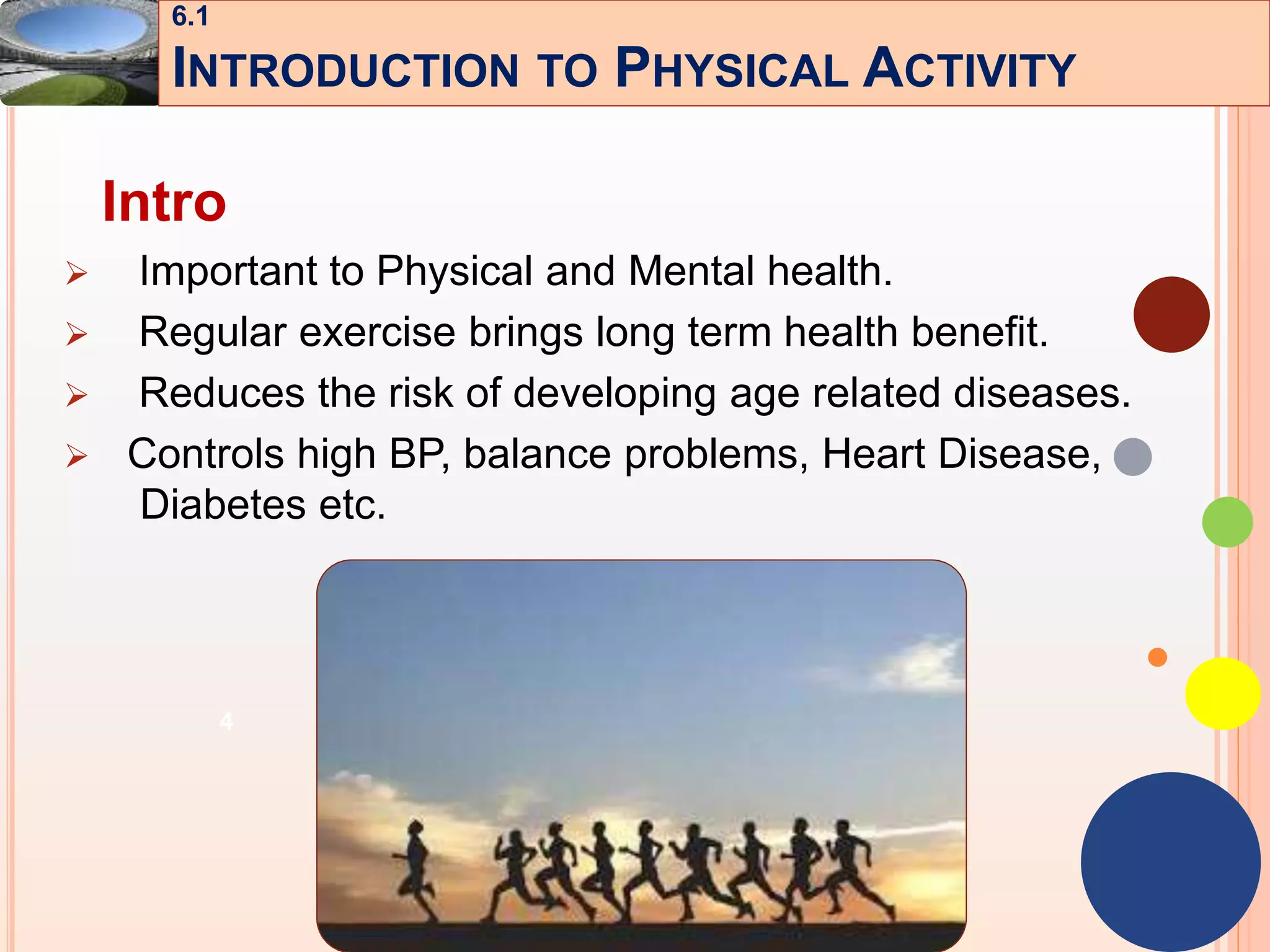
 Important to Physical and Mental health.
 Regular exercise brings long term health benefit.
 Reduces the risk of developing age related diseases.
 Controls high BP, balance problems, Heart Disease,
Diabetes etc.
6.1
INTRODUCTION TO PHYSICAL ACTIVITY
5
Physical Activity :
 Physical activity is any body movement that makes the
muscles work and requires more energy than resting.
 Physical activity is defined as any bodily movement
produced by skeletal muscles that requires energy
expenditure.
 Physical activity is mandatory for physical fitness as it
strengthens muscles and makes body flexible
 Different physical activity requirement for different age
group.
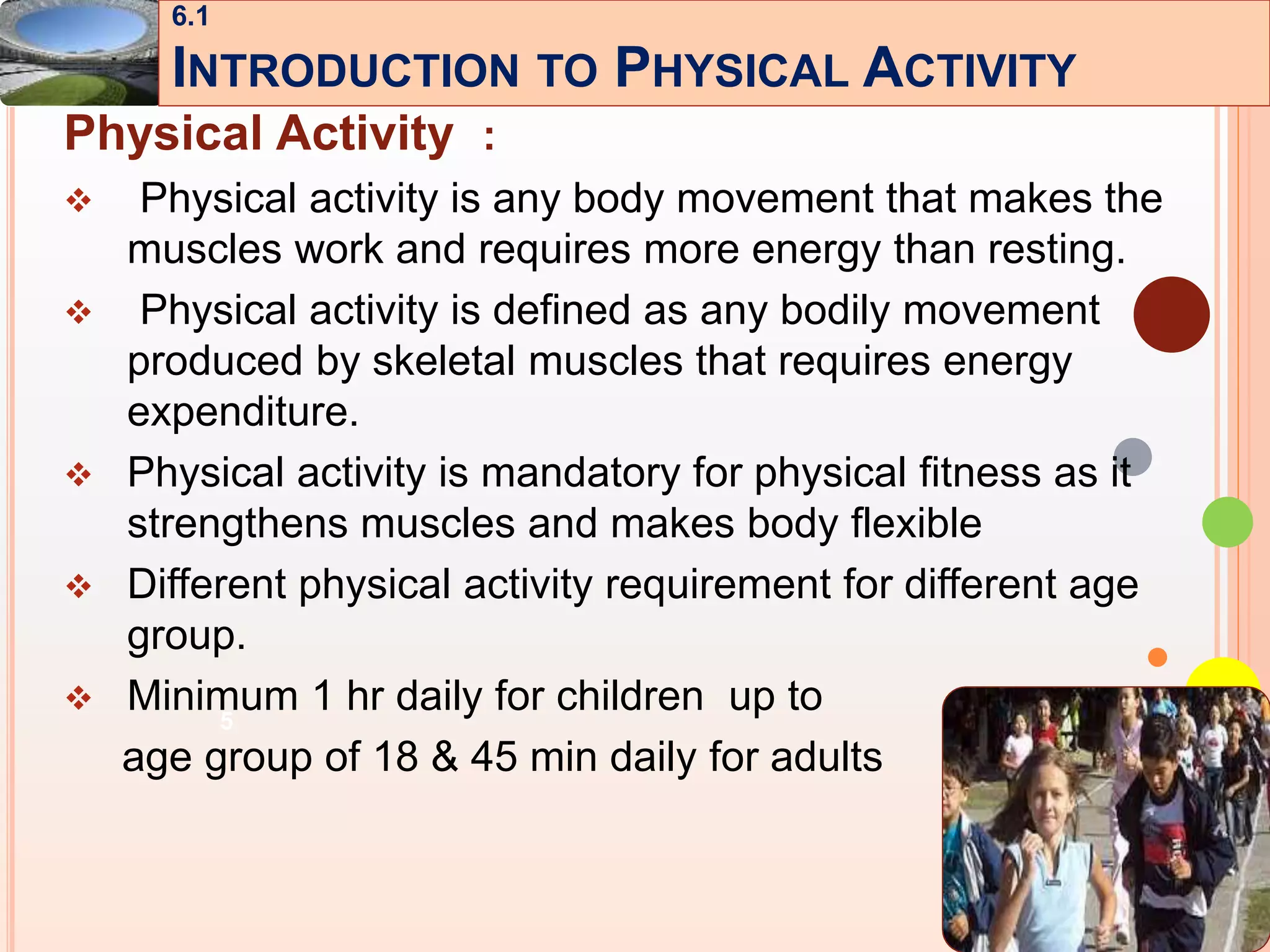
 Minimum 1 hr daily for children up to
age group of 18 & 45 min daily for adults
6.1
INTRODUCTION TO PHYSICAL ACTIVITY
6
Types of Physical Activities
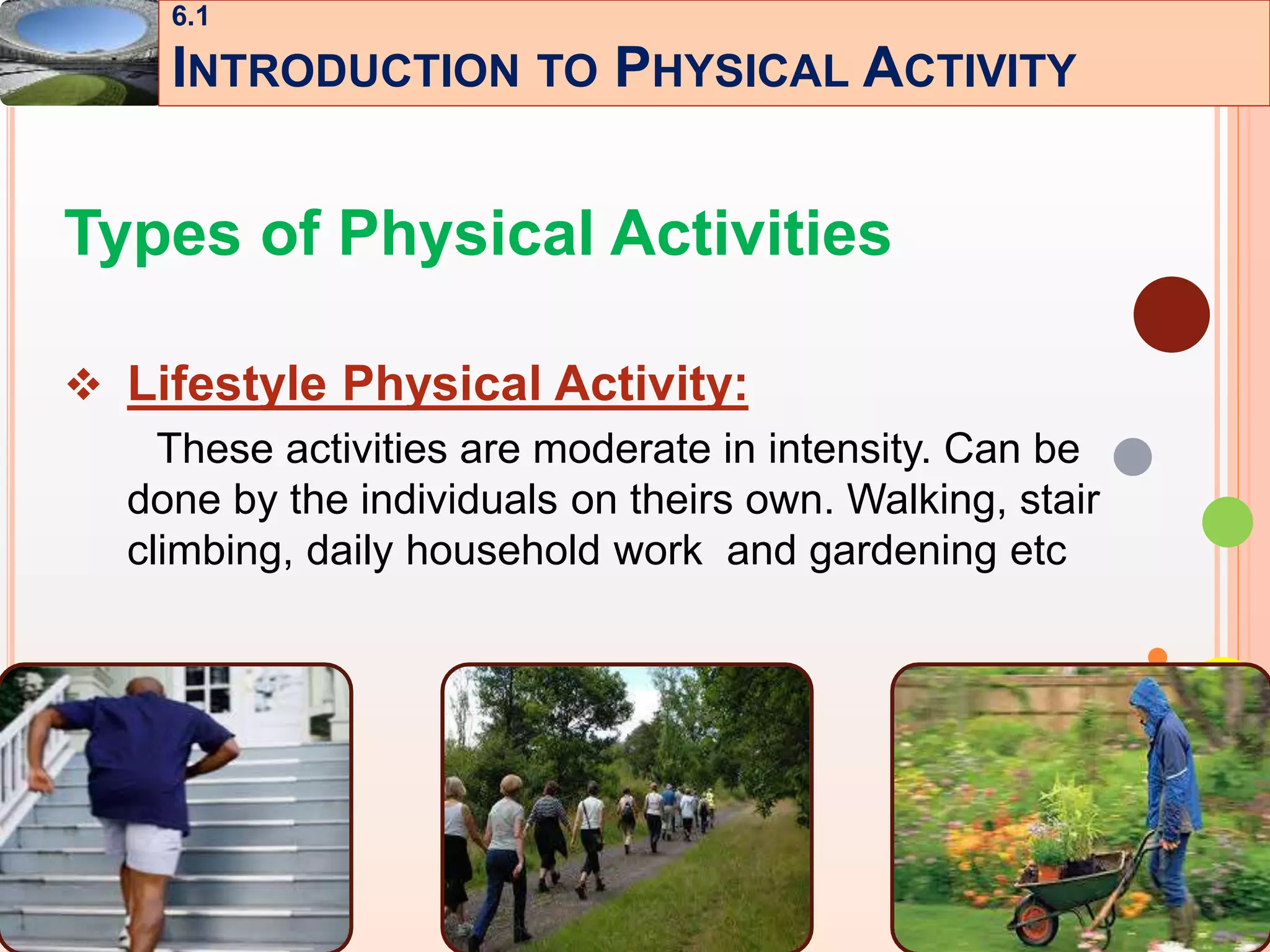
 Lifestyle Physical Activity:
These activities are moderate in intensity. Can be
done by the individuals on theirs own. Walking, stair
climbing, daily household work and gardening etc
6.1
INTRODUCTION TO PHYSICAL ACTIVITY
7
 Difference between Physical Exercise and
Physical Activity :
Exercise
Exercise is a form of physical activity that is planned, structured
and done to improve at least one aspect of physical fitness that is,
strength, flexibility or aerobic endurance.
Physical Activity
Physical activity includes activity that is part of your daily life.
Household, workplace and lifestyle physical activity are three of the
most common types of physical activity:
 Household physical activity, such as sweeping and cleaning.
6.1
INTRODUCTION TO PHYSICAL ACTIVITY
8
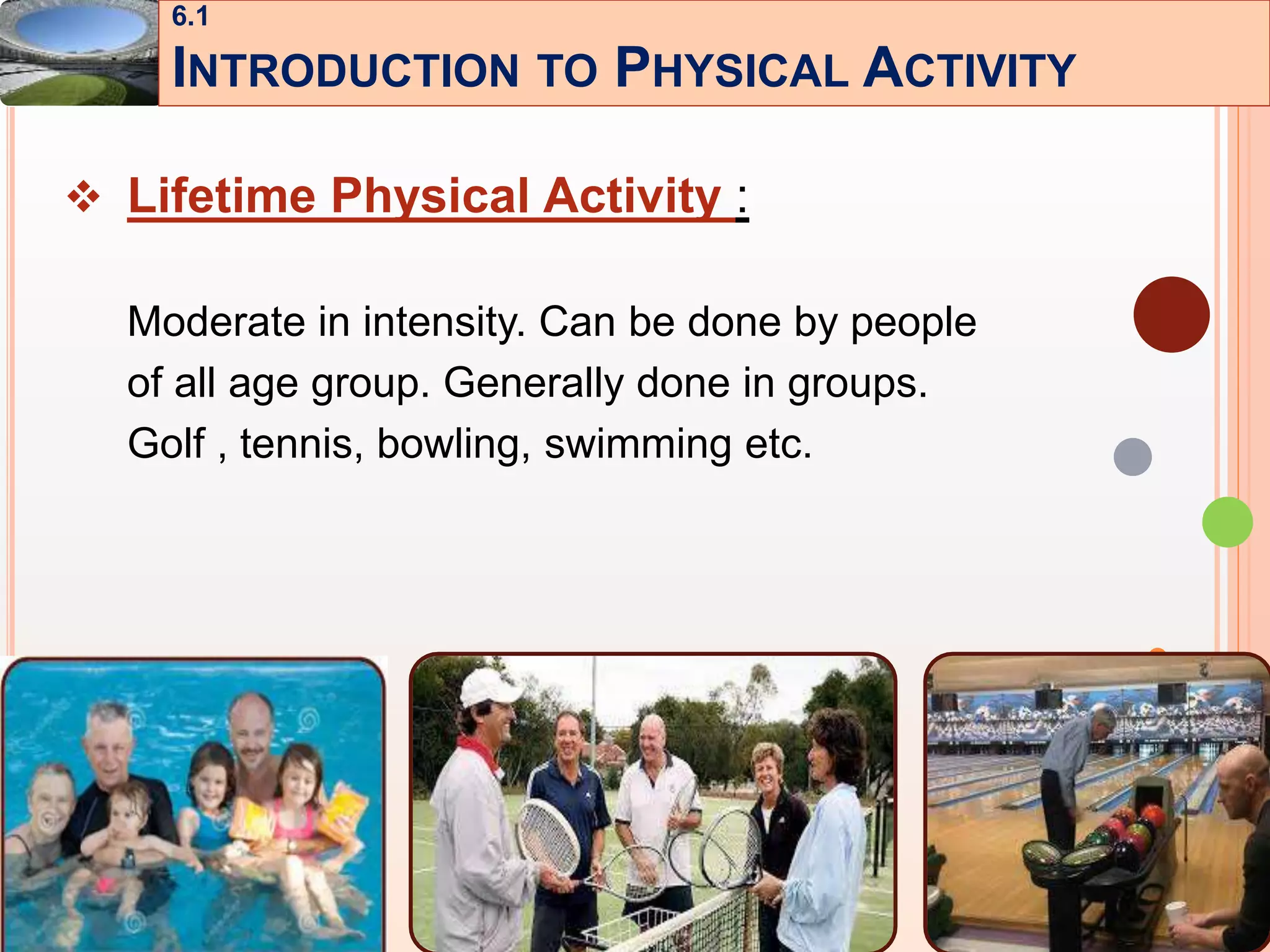
 Lifetime Physical Activity :
Moderate in intensity. Can be done by people
of all age group. Generally done in groups.
Golf , tennis, bowling, swimming etc.
6.1
INTRODUCTION TO PHYSICAL ACTIVITY
9
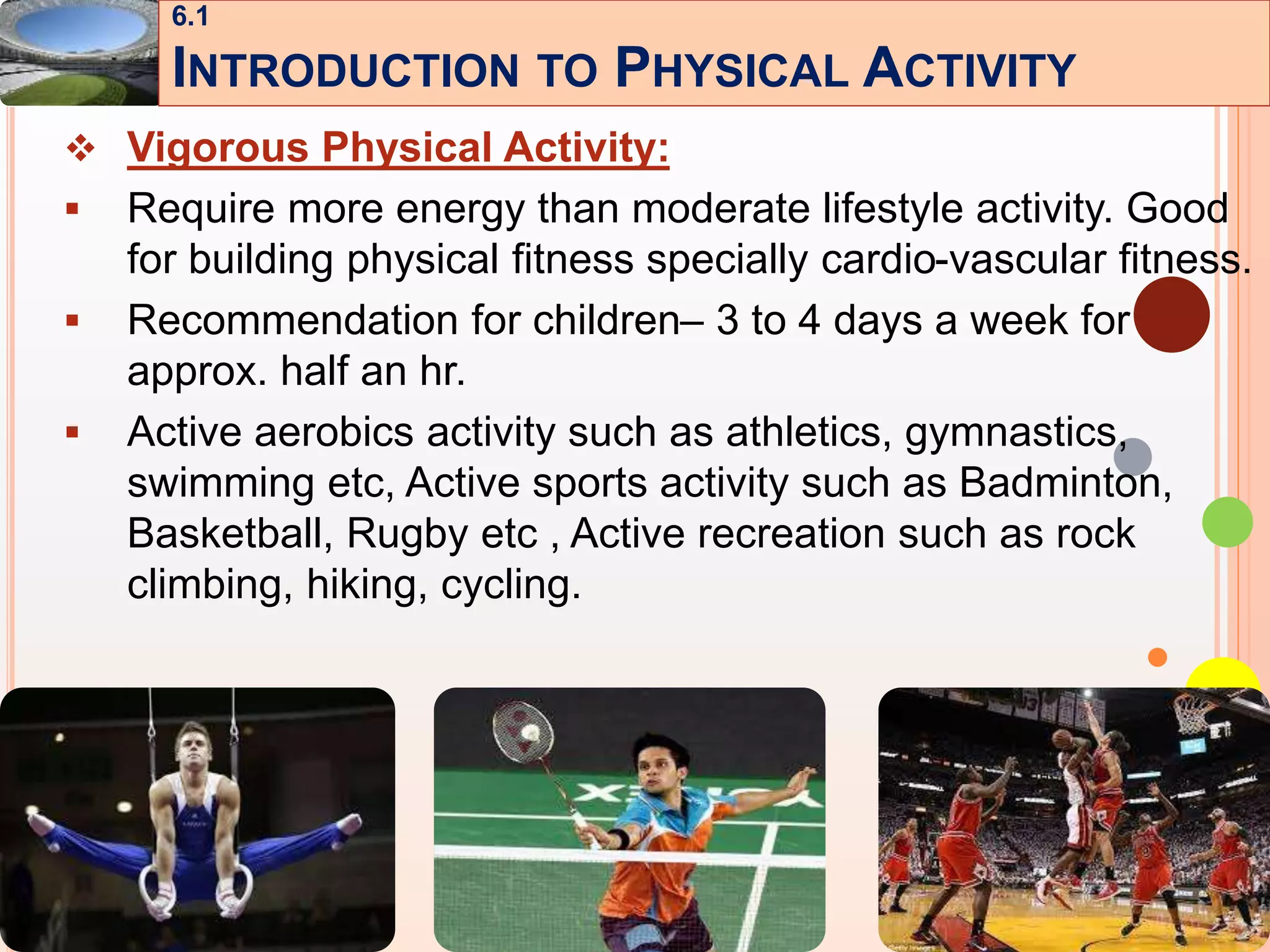
 Vigorous Physical Activity:
 Require more energy than moderate lifestyle activity. Good
for building physical fitness specially cardio-vascular fitness.
 Recommendation for children– 3 to 4 days a week for
approx. half an hr.
 Active aerobics activity such as athletics, gymnastics,
swimming etc, Active sports activity such as Badminton,
Basketball, Rugby etc , Active recreation such as rock
climbing, hiking, cycling.
6.1
INTRODUCTION TO PHYSICAL ACTIVITY
10
Physical Exercise :
 Aerobic Exercise:
 Any activity that uses large muscle groups and
causes the body to use more oxygen than at rest.
 Increases Cardio- Vascular endurance.
 Swimming, brisk walking, running, racket games.
 Anaerobic Exercise
 It is short-lasting, high-intensity activity, where body's
demand for oxygen exceeds the oxygen supply
available.
 Relies on energy sources that are stored in the
muscles.
 Also called strength or resistance training.
 Push-ups, weight training, eccentric training,
functional training, interval training.
6.1
INTRODUCTION TO PHYSICAL ACTIVITY
11
 Muscles strengthening Exercise :
 Activities to build body strength like, lifting weights , push-
ups etc.
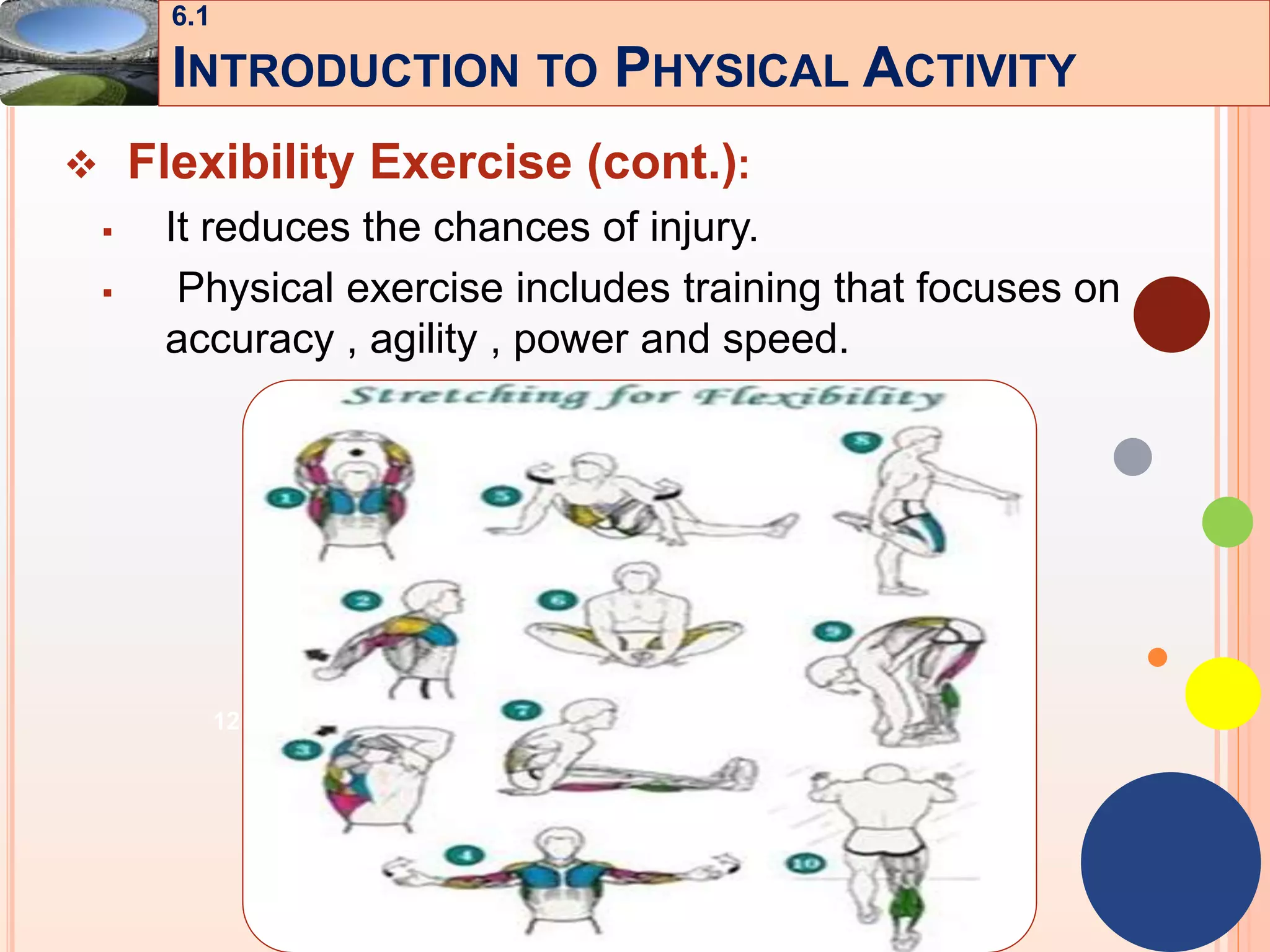
 Flexibility Exercise:
 It is the activity which make joints to move freely
 Increases mobility of the muscles to allow more
movement around the joint.
 Improved flexibility enhances performance in aerobic
training and muscular conditioning.
6.1
INTRODUCTION TO PHYSICAL ACTIVITY
12
 Flexibility Exercise (cont.):
 It reduces the chances of injury.
 Physical exercise includes training that focuses on
accuracy , agility , power and speed.
6.1
INTRODUCTION TO PHYSICAL ACTIVITY
13
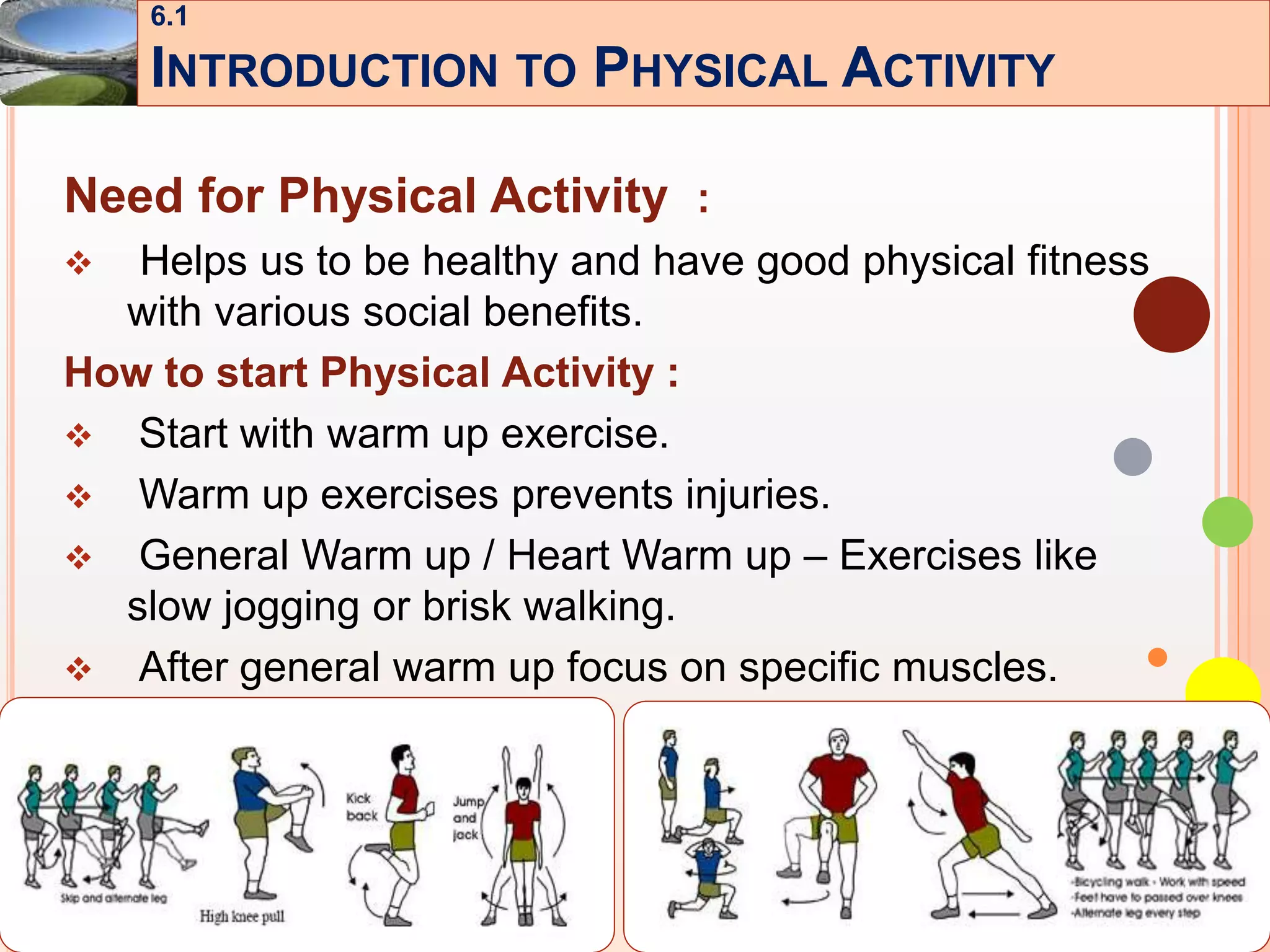
Need for Physical Activity :
 Helps us to be healthy and have good physical fitness
with various social benefits.
How to start Physical Activity :
 Start with warm up exercise.
 Warm up exercises prevents injuries.
 General Warm up / Heart Warm up – Exercises like
slow jogging or brisk walking.
 After general warm up focus on specific muscles.
6.1
INTRODUCTION TO PHYSICAL ACTIVITY
14
Benefits of Physical Activity :
1. Helps to live longer, prevents many chronic diseases
such as heart diseases, High B.P., abnormal blood lipid,
diabetes etc.
2. Improves cardio respiratory and muscular fitness.
3. Increases bone density.
4. Helps in digestion and regular bowl movement.
5. Helps in maintaining body posture and agility in old age.
6. Improves metabolism and helps to loose weight easily
7. Reduces stress , anxiety and depression.
8. Helps to maintain brain function in old age.
9. Improves sleep quality and quality of life.
6.1
INTRODUCTION TO PHYSICAL ACTIVITY
15
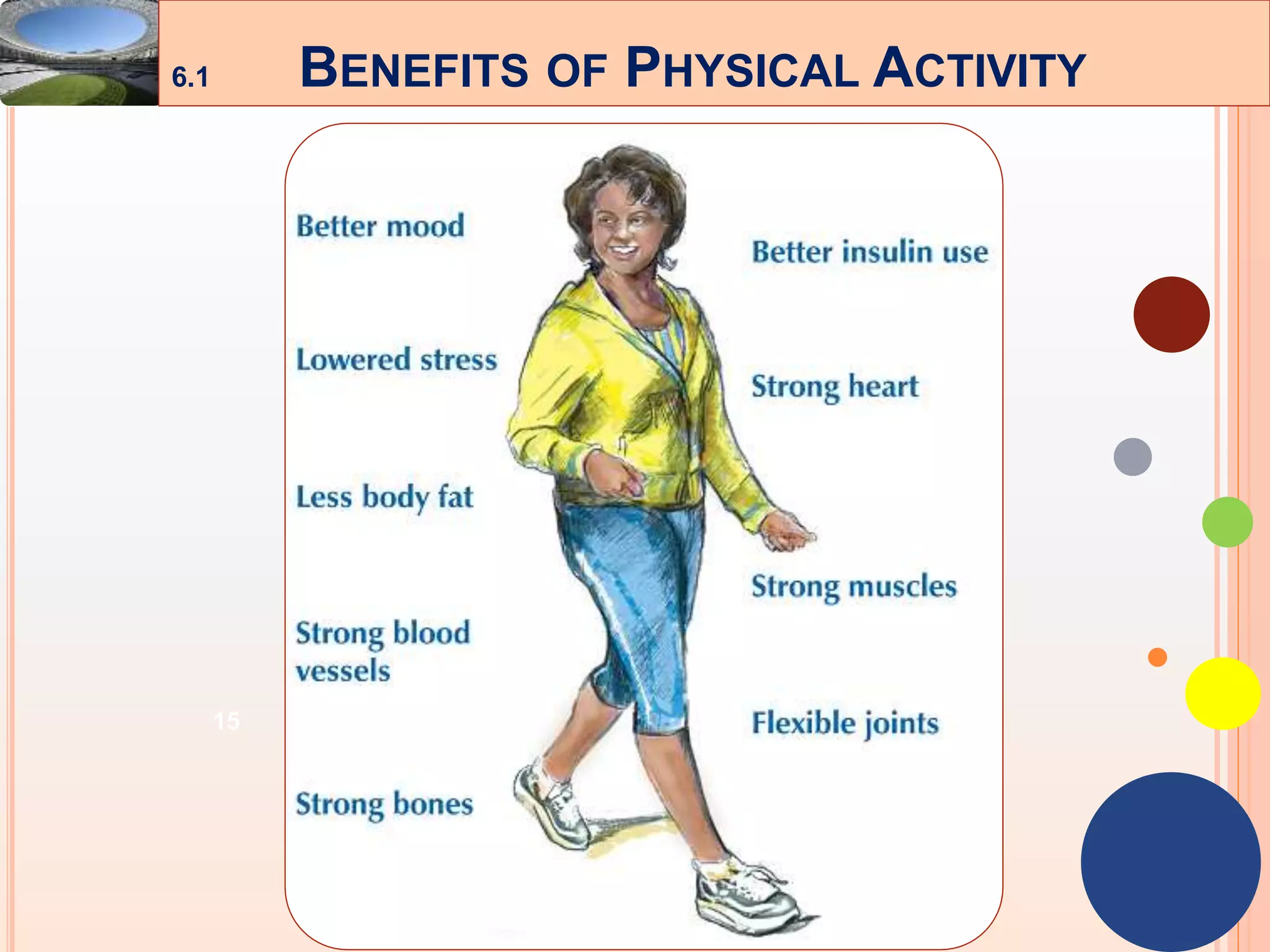
6.1 BENEFITS OF PHYSICAL ACTIVITY
16
6.2
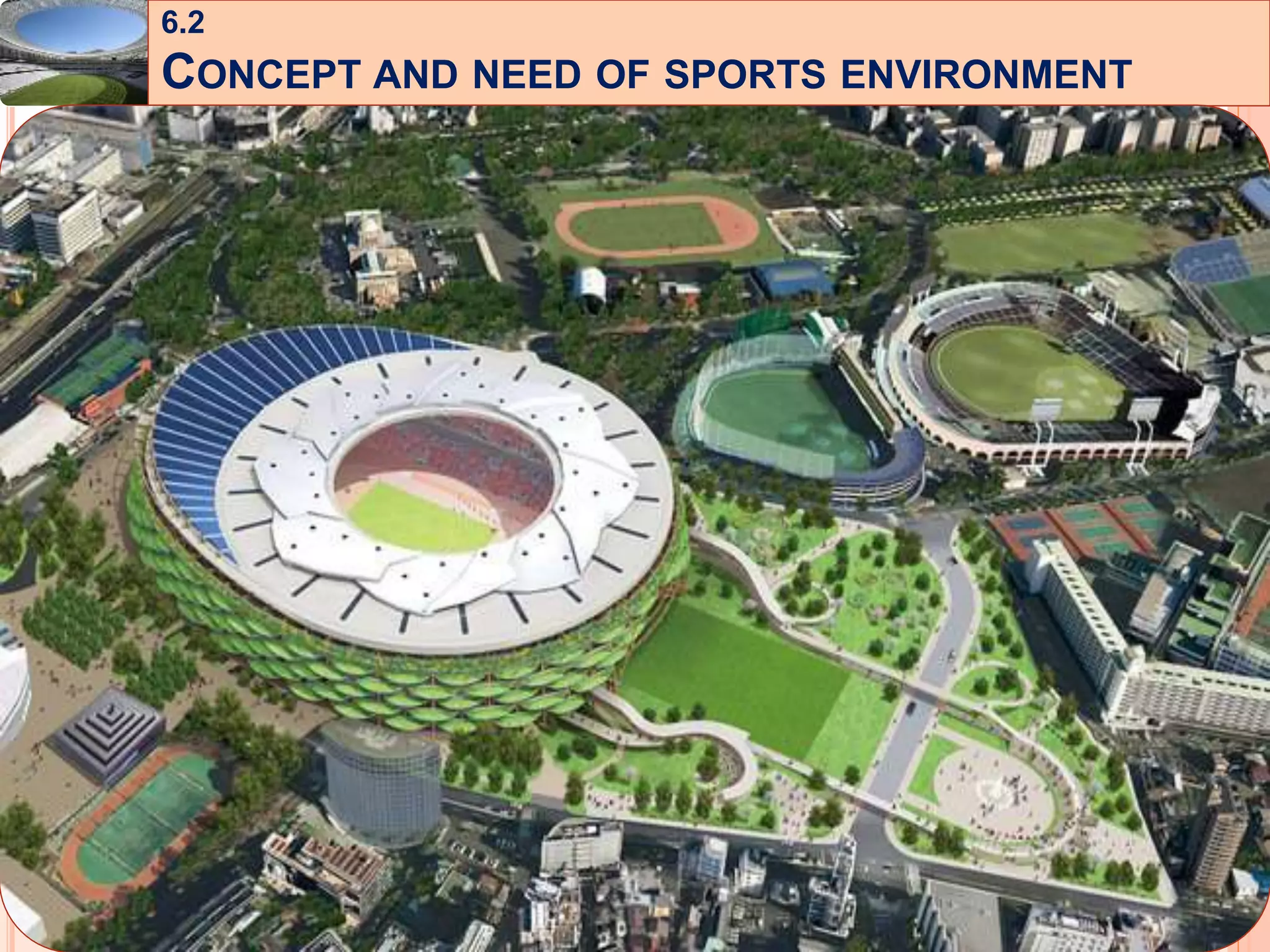
CONCEPT AND NEED OF SPORTS ENVIRONMENT
17
 Physical Environment
 Social Environment
 Factors that encourages participation and
promotion of sports.
 It requires proper infrastructure, modern
equipment ,qualified coach and qualified
physio trainer.
 Motivation from parents, society and the
government improves sports
environment.
 Sports person can perform their best in a
healthy sports environment.
6.2
CONCEPT AND NEED OF SPORTS ENVIRONMENT
18
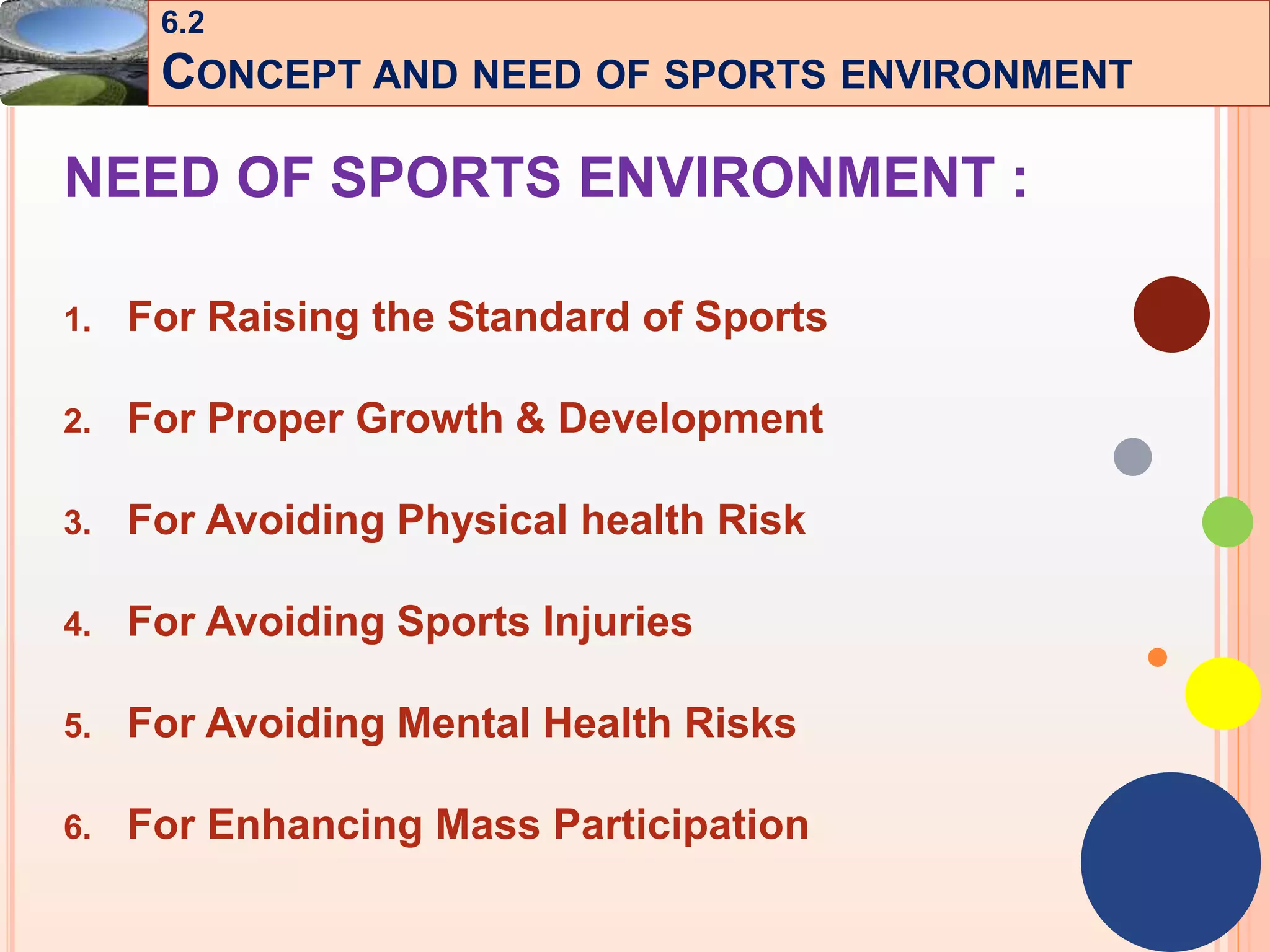
NEED OF SPORTS ENVIRONMENT :
1. For Raising the Standard of Sports
2. For Proper Growth & Development
3. For Avoiding Physical health Risk
4. For Avoiding Sports Injuries
5. For Avoiding Mental Health Risks
6. For Enhancing Mass Participation
6.2
CONCEPT AND NEED OF SPORTS ENVIRONMENT
19
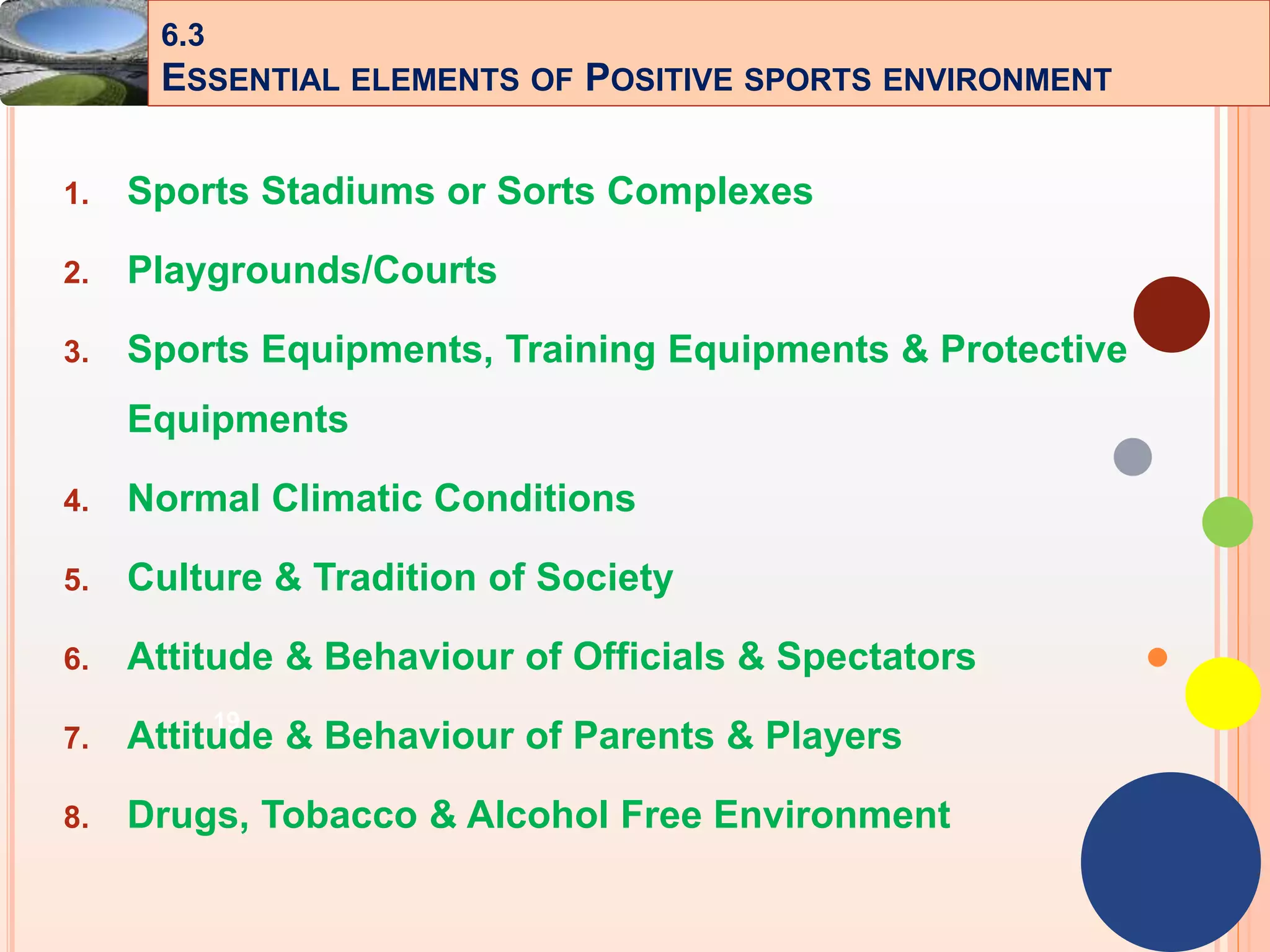
1. Sports Stadiums or Sorts Complexes
2. Playgrounds/Courts
3. Sports Equipments, Training Equipments & Protective
Equipments
4. Normal Climatic Conditions
5. Culture & Tradition of Society
6. Attitude & Behaviour of Officials & Spectators
7. Attitude & Behaviour of Parents & Players
8. Drugs, Tobacco & Alcohol Free Environment
6.3
ESSENTIAL ELEMENTS OF POSITIVE SPORTS ENVIRONMENT
20
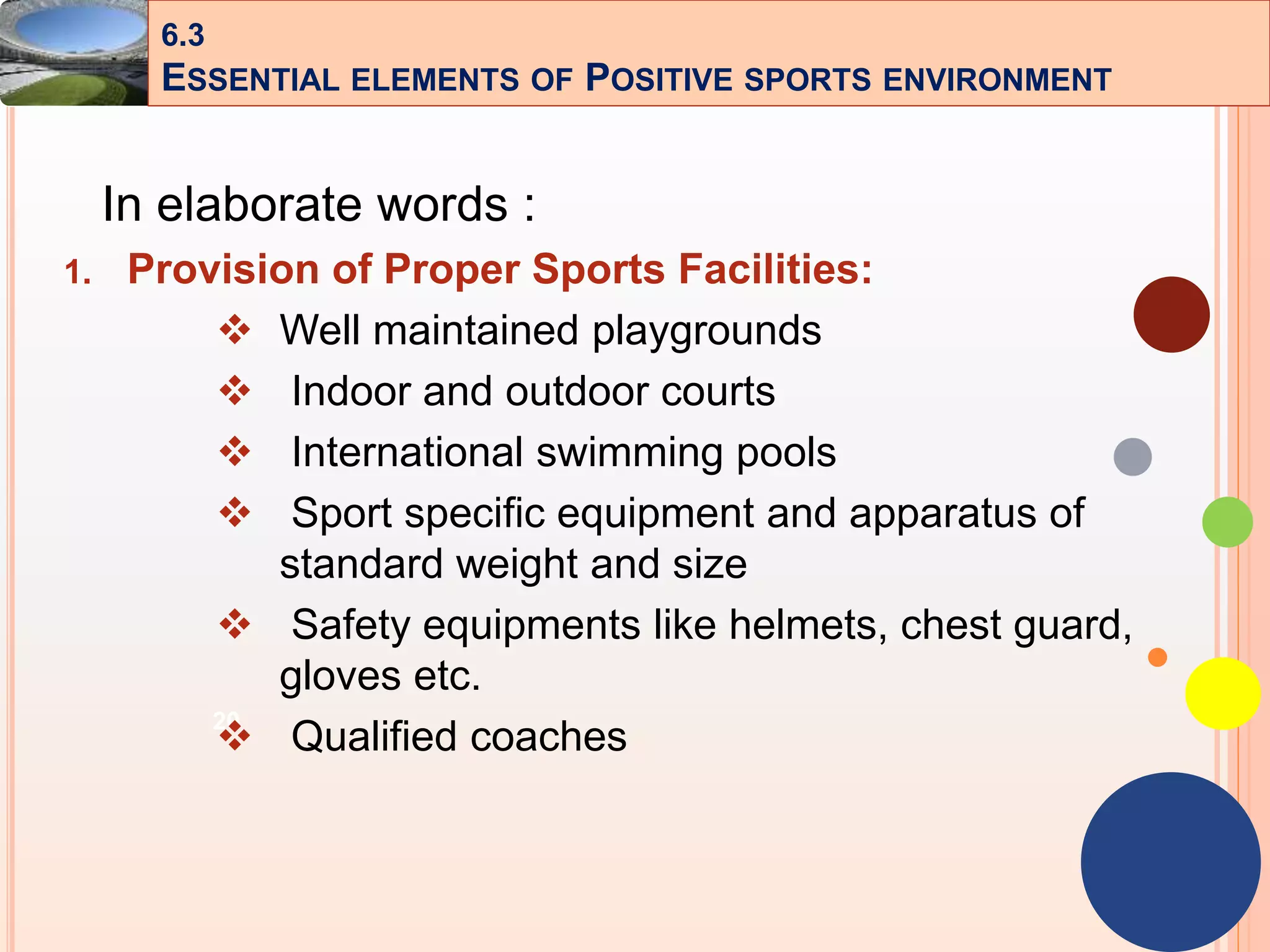
In elaborate words :
1. Provision of Proper Sports Facilities:
 Well maintained playgrounds
 Indoor and outdoor courts
 International swimming pools
 Sport specific equipment and apparatus of
standard weight and size
 Safety equipments like helmets, chest guard,
gloves etc.
 Qualified coaches
6.3
ESSENTIAL ELEMENTS OF POSITIVE SPORTS ENVIRONMENT
21
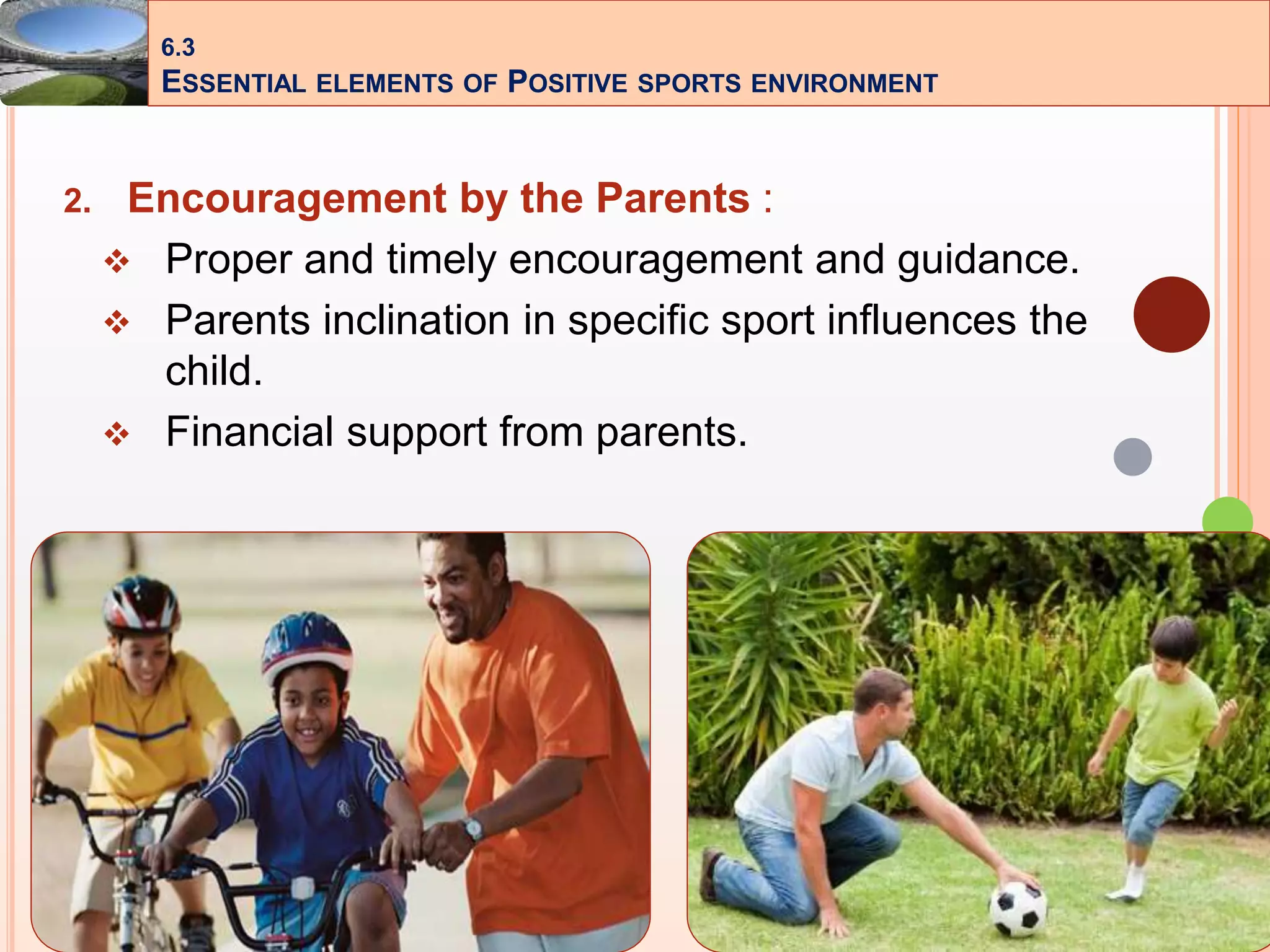
2. Encouragement by the Parents :
 Proper and timely encouragement and guidance.
 Parents inclination in specific sport influences the
child.
 Financial support from parents.
6.3
ESSENTIAL ELEMENTS OF POSITIVE SPORTS ENVIRONMENT
22
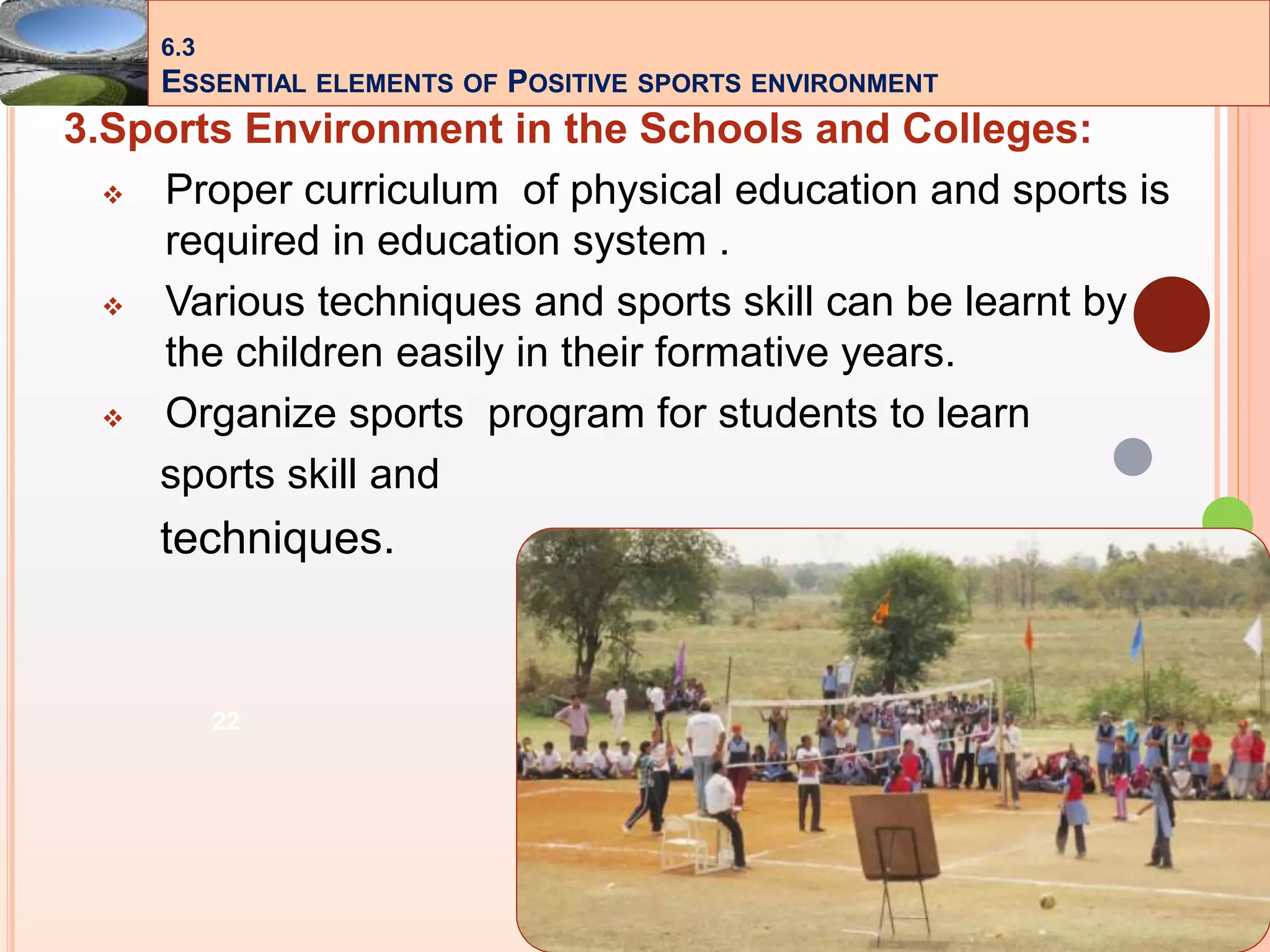
3.Sports Environment in the Schools and Colleges:
 Proper curriculum of physical education and sports is
required in education system .
 Various techniques and sports skill can be learnt by
the children easily in their formative years.
 Organize sports program for students to learn
sports skill and
techniques.
6.3
ESSENTIAL ELEMENTS OF POSITIVE SPORTS ENVIRONMENT
23
4. Influence of Community :
 Popularity of a sport in community promotes it
in all aspects.
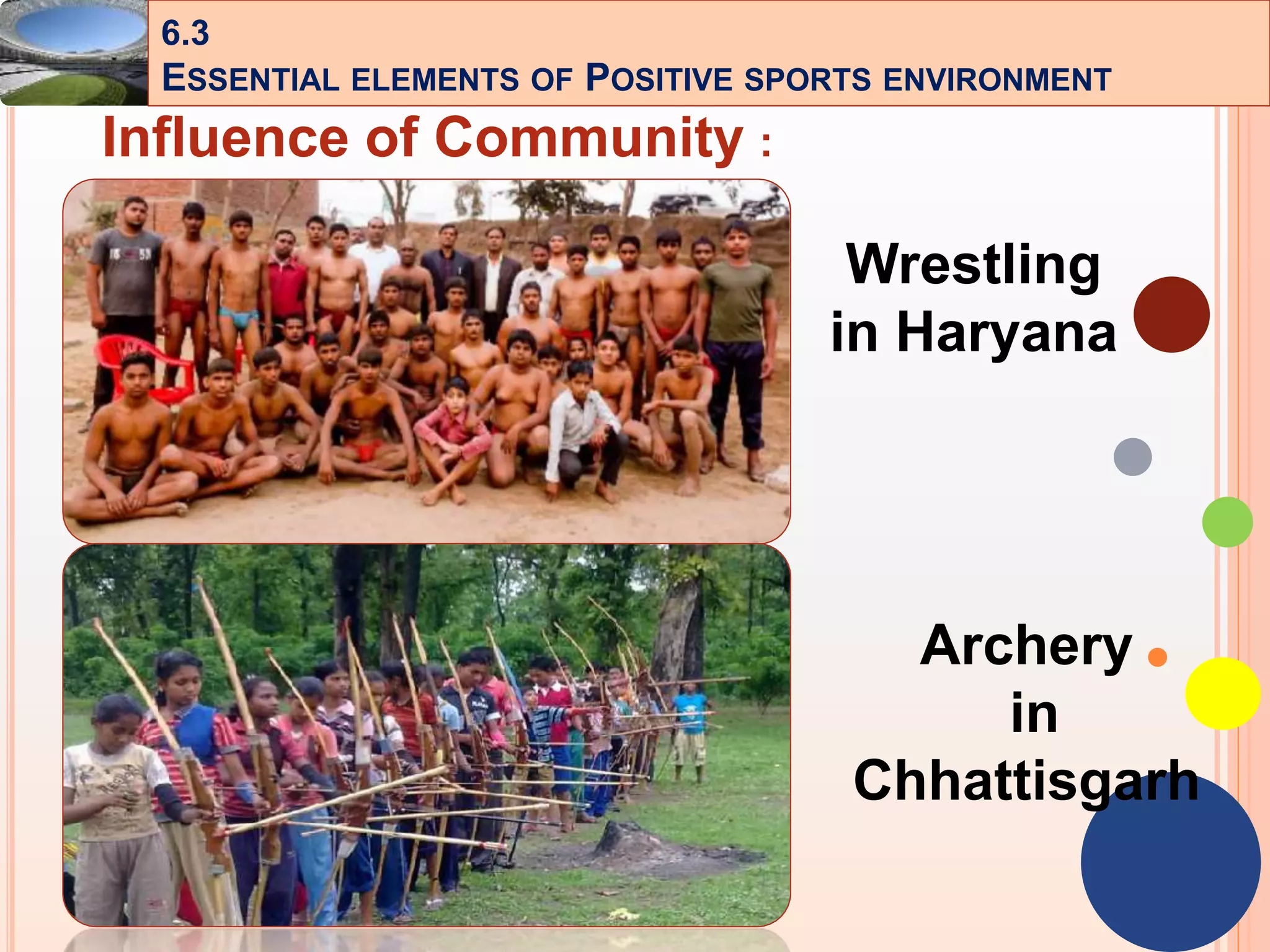
 Traditional sports are promoted in a particular
areas or by particular community. For e.g.
Wrestling promoted in Haryana, Archery
promoted in tribal areas , Hockey in Punjab .
 Efforts should be made for the adoption of
sports by the communities / area.
6.3
ESSENTIAL ELEMENTS OF POSITIVE SPORTS ENVIRONMENT
24
Influence of Community :
6.3
ESSENTIAL ELEMENTS OF POSITIVE SPORTS ENVIRONMENT
Wrestling
in Haryana
Archery
in
Chhattisgarh
25
5. Impact of Spectators :
 Large number of spectators motivates sports
person and promote sports.
E.g. Love for cricket in India.
6. Impact of Regular Tournaments :
 Regular tournaments create a healthy sports
environment
 Federations / Associations should organize
tournament at regular intervals at various
level. E.g. School level, District Level, Zonal
level, State level, National Level etc.
 Training / Coaching Camps at various level
should be organized .
 Awards and incentives for best sports person
.
6.3
ESSENTIAL ELEMENTS OF POSITIVE SPORTS ENVIRONMENT
26
1. Location of the place of physical activity
2. Pollute less environment for physical
activity
3. Proper facilities for physical activities
4. Proper playgrounds & courts
5. Proper climatic conditions
6. Existing infrastructure should be well
maintained
7. Physical activity environment should be
safe & clean
6.4
PRINCIPLES OF PHYSICAL ACTIVITY ENVIRONMENT
27
Sports :
Cover a range of physical activities performed
within a set of rules.
Undertaken as part of leisure or competition
Involves teams or individuals.
Supported by an institutional framework.
6.4
PRINCIPLES OF PHYSICAL ACTIVITY ENVIRONMENT
28
Sports :
Seven principles of physical activity known as PROVRBS
should be followed during activity or exercise program.
PROVRBS
P :Progression
R : Regularity :
O :Overload :
V :Variety
R : Recovery
B :Balance
S : Specificity
6.4
PRINCIPLES OF PHYSICAL ACTIVITY ENVIRONMENT
29
Environment
Wind speed :
It can present an unsettling element to athletes.
Running , cycling and ball sport played in open grounds
are exposed to the winds. Adverse wind condition
affects the performance of sailors.
Rain :
Environment conditions change dramatically in rain
combined with wind. It changes the playing surface of
ground requiring to change the footwear particularly
nails length of spikes. Rain changes the characteristics
of the equipment such as football hence due
importance is given during training.
6.4
PRINCIPLES OF PHYSICAL ACTIVITY ENVIRONMENT
30
Environment
Crowd Noise :
It is a particular issue when visiting team plays at a
large indoor or outdoor stadium where the team can not
hear its own signals. Team requires regular exposure to
such conditions.
Warm Weather :
Most common adverse environment factor encountered
by athletes. Hot weather accompanied with high
humidity affects the health of the athletes. It can be
readily adopted through a gradual introduction of the
body to the unaccustomed heat.
6.4
PRINCIPLES OF PHYSICAL ACTIVITY ENVIRONMENT
31
Environment
Cold Weather :
It requires the provisioning of protective clothing
barriers to keep the environment out. Cold weather
accompanied with snow, makes condition adverse and
need to provide better clothing.
High Altitude :
Oxygen availability is less. Altitudes above 6500 ft
present environmental challenges to peak athletic
performance. At high altitude, body is forced to produce
larger number of RBC to transport oxygen to fulfill the
oxygen deficit in air.
6.4
PRINCIPLES OF PHYSICAL ACTIVITY ENVIRONMENT
32
1. Cardio Respiratory Endurance :
It is the ability of the body’s circulatory and
respiratory system to supply oxygen during
sustained physical activity. To improve CRE
activities that keep heart rate elevated at a
safe level for a sustained period should be
taken up. Intensity of the activity should be
progressively increased. Running , Cycling
, swimming etc..
6.5
COMPONENTS OF HEALTH RELATED FITNESS
33
2. Muscular Strength :
It is the ability of the muscles to exert force
during an activity. To make muscle
stronger ,muscles should be worked
against resistance. Weight lifting , running
on the stairs etc..
6.5
COMPONENTS OF HEALTH RELATED FITNESS
34
3. Muscular Endurance :
Ability of the muscles to continue to perform
without fatigue. Cardio respiratory activities
such as walking , jogging , swimming improve
muscle endurance.
4. Body Composition :
It describes the percentages of fat, bone,
water and muscle in human body. It is
important for health and managing the weight.
6.5
COMPONENTS OF HEALTH RELATED FITNESS
35
5. Flexibility :
It is the range of motion around a joint.
Good flexibility in the joints can
prevent injuries through all stages of
life. To improve flexibility basic
stretching activities should be taken
up.
6.5
COMPONENTS OF HEALTH RELATED FITNESS
36
BENEFITS OF HEALTH RELATED FITNESS
1. Improved Health :
Increase efficiency of heart and lungs.
Reduce cholesterol level.
Balanced blood pressure.
Reduce risk of major illness.
Balanced weight.
2. Improved Sense of Well Being :
More energy ,less stress
Improved ability to cope with stress.
Increased mental sharpness.
3. Improved Appearance :
Balanced weight , toned muscles
Improved posture.
6.5
COMPONENTS OF HEALTH RELATED FITNESS
37
BENEFITS OF HEALTH RELATED FITNESS
4. Enhanced Social Life :
Improved self image.
Increased opportunity to make friends .
Increased opportunity to share
activities with family.
5. Increased Stamina :
Increased productivity .
Increased physical capabilities.
Less frequent injuries.
Improved immunity to minor illness.
6.5
COMPONENTS OF HEALTH RELATED FITNESS
38
Behaviour Change Technique :
 To enhance the psychological component of
physical activity, mental skills training has
been recognised as an effective method.
 A process that can influence psychological
determinants.
 Psychological determinants are theoretical
variables in peoples’ mind, comparable to
risk factors in epidemiology.
.
6.6 BEHAVIOUR CHANGE TECHNIQUE FOR
PHYSICAL ACTIVITY
39
1. SELF –MONITORING
2. GOAL SETTING
3. CORRECTIVE FEEDBACK
4. BOOSTING PERFORMANCE
6.6 BEHAVIOUR CHANGE TECHNIQUE FOR
PHYSICAL ACTIVITY
40
1. Intervention Method:
 Theory based method for changing
psychological determinants of behaviour of the
person’s attitude or self-efficiency
 Includes the concept of parameters of
effectiveness
 Develops a generic, abstract vocabulary to
facilitate discussion of active ingredients of
intervention
 Emphasise the distinction between behaviour
change method and practical application of these
method
6.6 BEHAVIOUR CHANGE TECHNIQUE FOR
PHYSICAL ACTIVITY
41
2. Trial and Error :
 Process of experimenting with various activities
till the most successful is found
 Different techniques for different individuals
 Jumps, Throws, Running actions can be
corrected
3. Cognitive Behavioural Technique:
 Examines the relationship between thoughts,
feelings and behaviour
 Problem focused and goal oriented
 Useful for anxiety disorders, panic attacks
6.6 BEHAVIOUR CHANGE TECHNIQUE FOR
PHYSICAL ACTIVITY
42
4. Observation Technique:
 Changes that take place by observing other
person( called model).
 Also known as imitation, vicarious learning,
social learning
 Children model their parents, student model their
teacher
5. Punishment:
 Administration of aversive stimulus to reduce
unwanted behaviour
 May be physical or non- physical
 Behaviour not the person is punished
 Positive and Negative Punishment
 Used in extreme cases
6.6 BEHAVIOUR CHANGE TECHNIQUE FOR
PHYSICAL ACTIVITY
43
Growth:
It refers to increase in size and weight, becoming
larger and heavier.
Can be viewed as physical changes that occurs from
conception to maturity
It can also be defined as a progressive development
of a living thing, specially the process by which the
body reaches its point of complete physical
development.
Human growth from infancy to maturity involves
major changes in body size and appearance,
including the development of several characteristics.
Individual pattern of growth vary widely due to
difference in hereditary and environment.
6.7
DIFFERENT STAGES OF GROWTH
44
Stages of Growth:
1. Infancy (1 to 3 years )
2. Early Childhood ( 3 to 8 years )
3. Later Childhood ( 8 to 12 years )
4. Adolescence ( 13 to 19 years )
5. Adulthood ( Above 19 years )
EXERCISE GUIDELINE AT DIFFERENT STAGES OF
GROWTH
45
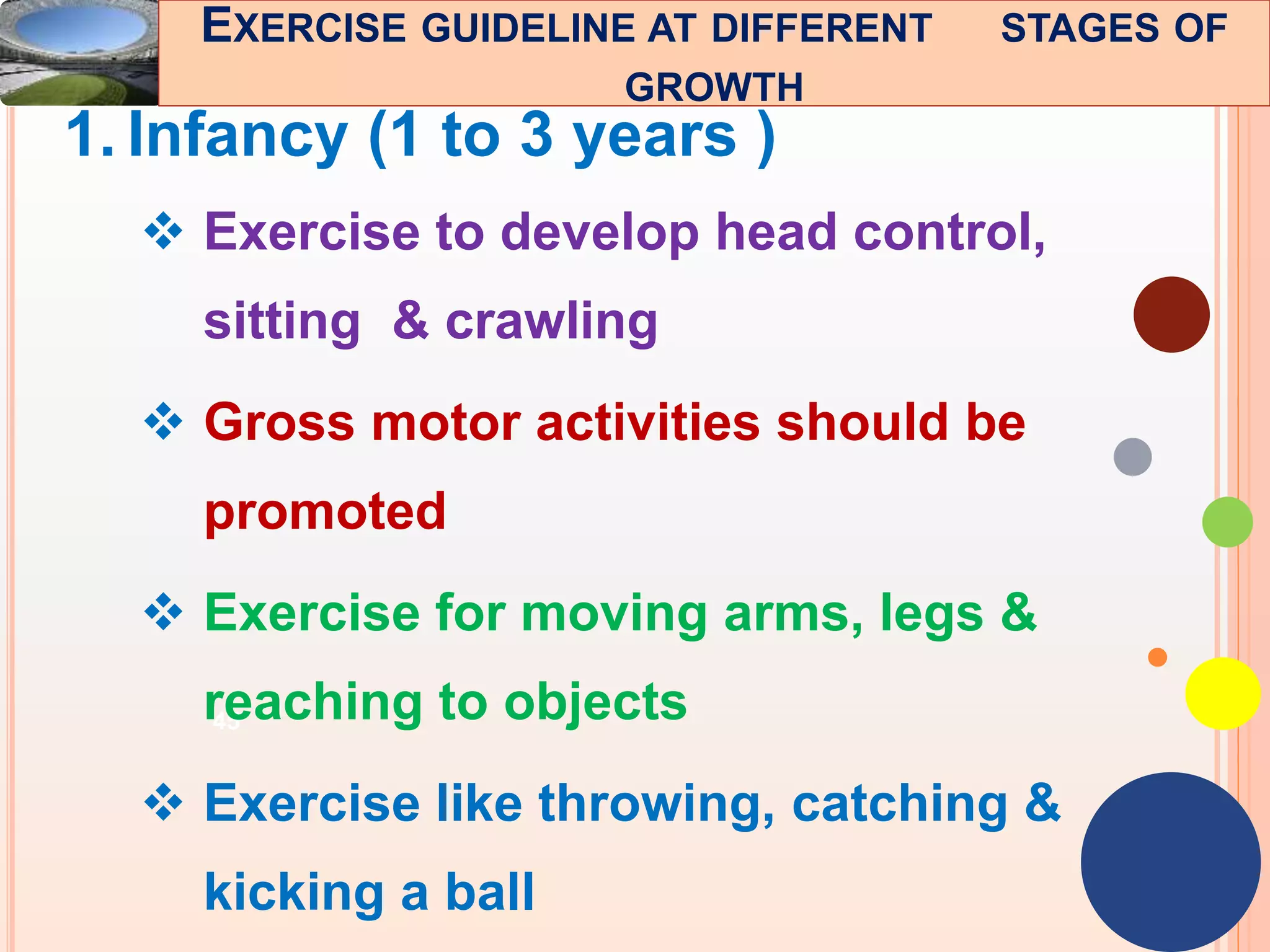
1. Infancy (1 to 3 years )
 Exercise to develop head control,
sitting & crawling
 Gross motor activities should be
promoted
 Exercise for moving arms, legs &
reaching to objects
 Exercise like throwing, catching &
kicking a ball
EXERCISE GUIDELINE AT DIFFERENT STAGES OF
GROWTH
46
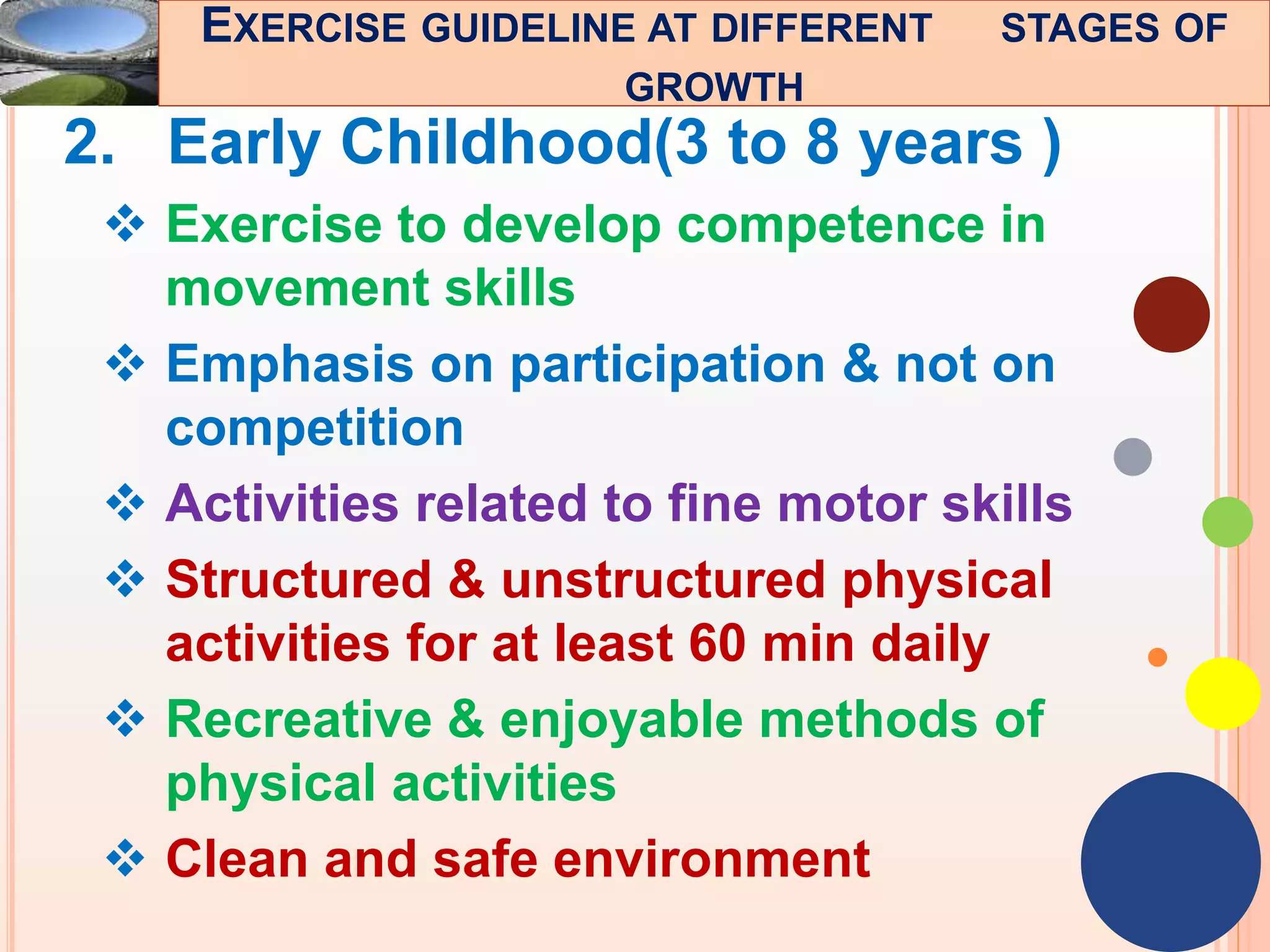
2. Early Childhood(3 to 8 years )
 Exercise to develop competence in
movement skills
 Emphasis on participation & not on
competition
 Activities related to fine motor skills
 Structured & unstructured physical
activities for at least 60 min daily
 Recreative & enjoyable methods of
physical activities
 Clean and safe environment
EXERCISE GUIDELINE AT DIFFERENT STAGES OF
GROWTH
47
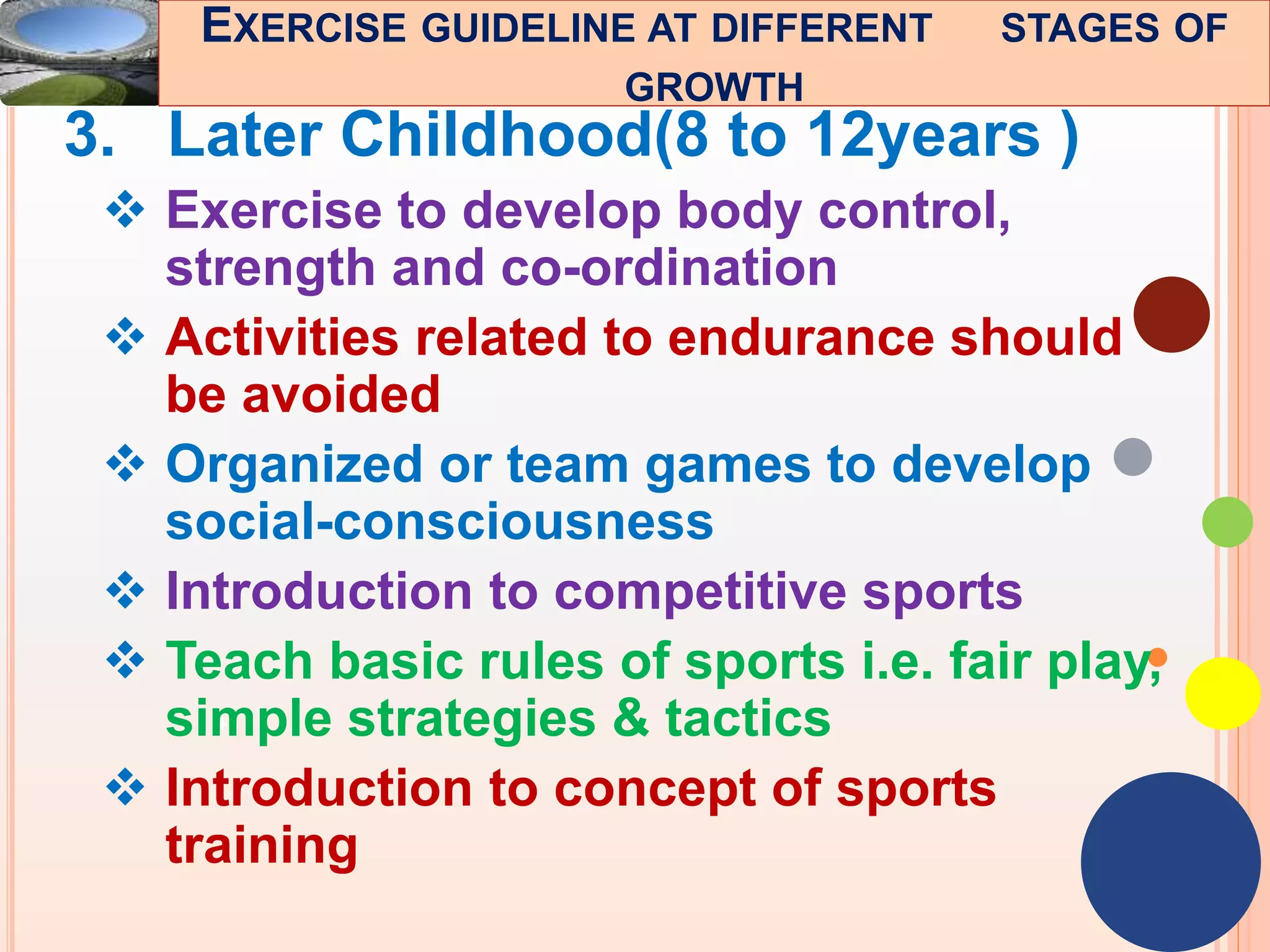
3. Later Childhood(8 to 12years )
 Exercise to develop body control,
strength and co-ordination
 Activities related to endurance should
be avoided
 Organized or team games to develop
social-consciousness
 Introduction to competitive sports
 Teach basic rules of sports i.e. fair play,
simple strategies & tactics
 Introduction to concept of sports
training
EXERCISE GUIDELINE AT DIFFERENT STAGES OF
GROWTH
48
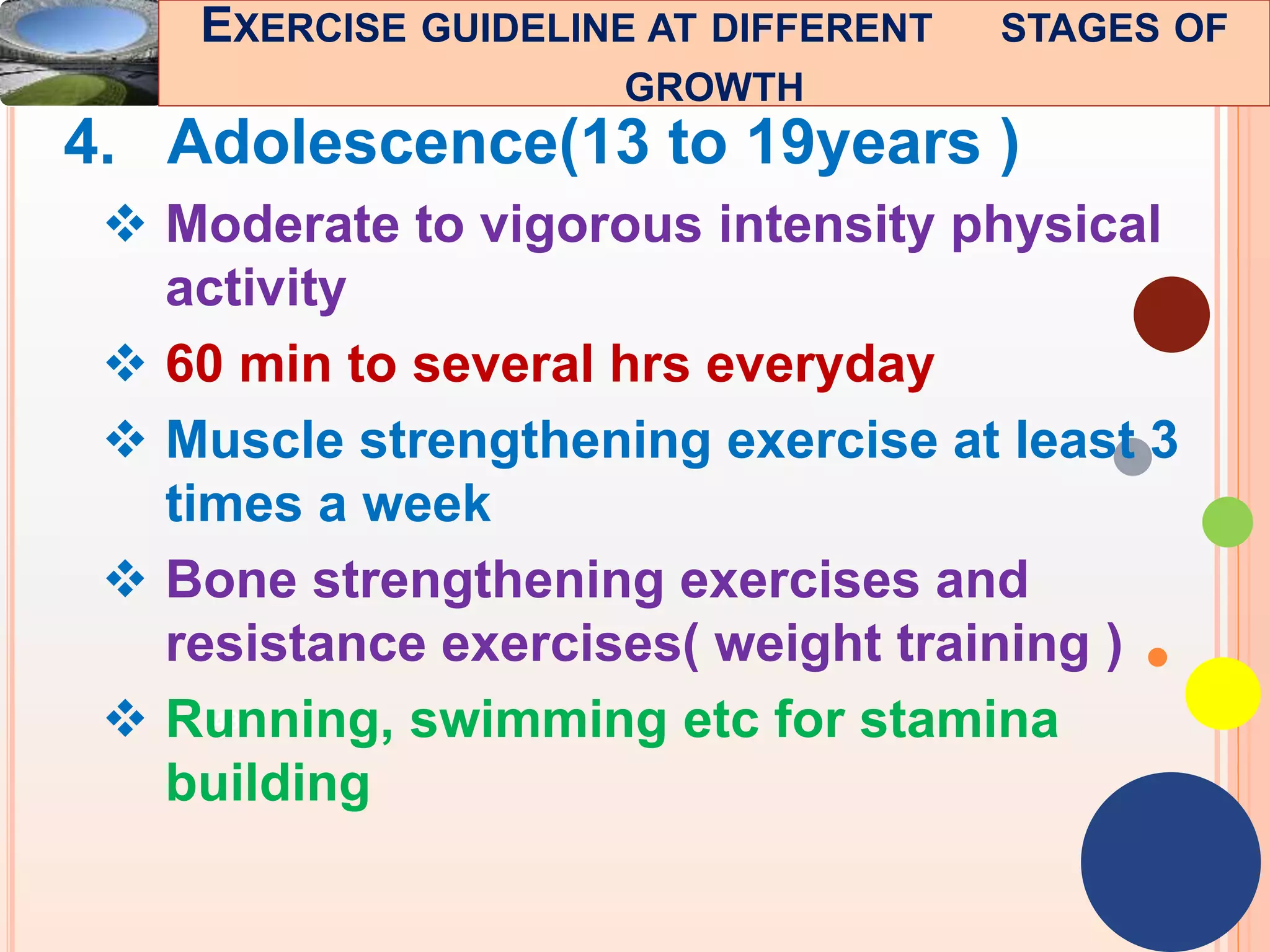
4. Adolescence(13 to 19years )
 Moderate to vigorous intensity physical
activity
 60 min to several hrs everyday
 Muscle strengthening exercise at least 3
times a week
 Bone strengthening exercises and
resistance exercises( weight training )
 Running, swimming etc for stamina
building
EXERCISE GUIDELINE AT DIFFERENT STAGES OF
GROWTH
49
5. Adulthood(above 19 years )
 Moderate intensity physical activity
everyday
 Muscle strengthening exercise at least 2
times a week
 Bone strengthening exercises and
resistance exercises
 Running, swimming etc for stamina
building
EXERCISE GUIDELINE AT DIFFERENT STAGES OF
GROWTH

Chapter 6 Physical Activity Environment

  • 1.
  • 2.
  • 3.
    3 Learning Objectives : 6.1Introduction to Physical Activity 6.2 Concept And Need of Sports Environment 6.3 Essential Elements of Positive Sports Environment 6.4 Principle of Physical Activity Environment 6.5 Components of Health Related Fitness 6.6 Behaviour Change Technique for Physical Activity 6.7 Exercise Guidelines at Different Stages of Growth PHYSICAL ACTIVITY ENVIRONMENT
  • 4.
    4 Intro  Important toPhysical and Mental health.  Regular exercise brings long term health benefit.  Reduces the risk of developing age related diseases.  Controls high BP, balance problems, Heart Disease, Diabetes etc. 6.1 INTRODUCTION TO PHYSICAL ACTIVITY
  • 5.
    5 Physical Activity : Physical activity is any body movement that makes the muscles work and requires more energy than resting.  Physical activity is defined as any bodily movement produced by skeletal muscles that requires energy expenditure.  Physical activity is mandatory for physical fitness as it strengthens muscles and makes body flexible  Different physical activity requirement for different age group.  Minimum 1 hr daily for children up to age group of 18 & 45 min daily for adults 6.1 INTRODUCTION TO PHYSICAL ACTIVITY
  • 6.
    6 Types of PhysicalActivities  Lifestyle Physical Activity: These activities are moderate in intensity. Can be done by the individuals on theirs own. Walking, stair climbing, daily household work and gardening etc 6.1 INTRODUCTION TO PHYSICAL ACTIVITY
  • 7.
    7  Difference betweenPhysical Exercise and Physical Activity : Exercise Exercise is a form of physical activity that is planned, structured and done to improve at least one aspect of physical fitness that is, strength, flexibility or aerobic endurance. Physical Activity Physical activity includes activity that is part of your daily life. Household, workplace and lifestyle physical activity are three of the most common types of physical activity:  Household physical activity, such as sweeping and cleaning. 6.1 INTRODUCTION TO PHYSICAL ACTIVITY
  • 8.
    8  Lifetime PhysicalActivity : Moderate in intensity. Can be done by people of all age group. Generally done in groups. Golf , tennis, bowling, swimming etc. 6.1 INTRODUCTION TO PHYSICAL ACTIVITY
  • 9.
    9  Vigorous PhysicalActivity:  Require more energy than moderate lifestyle activity. Good for building physical fitness specially cardio-vascular fitness.  Recommendation for children– 3 to 4 days a week for approx. half an hr.  Active aerobics activity such as athletics, gymnastics, swimming etc, Active sports activity such as Badminton, Basketball, Rugby etc , Active recreation such as rock climbing, hiking, cycling. 6.1 INTRODUCTION TO PHYSICAL ACTIVITY
  • 10.
    10 Physical Exercise : Aerobic Exercise:  Any activity that uses large muscle groups and causes the body to use more oxygen than at rest.  Increases Cardio- Vascular endurance.  Swimming, brisk walking, running, racket games.  Anaerobic Exercise  It is short-lasting, high-intensity activity, where body's demand for oxygen exceeds the oxygen supply available.  Relies on energy sources that are stored in the muscles.  Also called strength or resistance training.  Push-ups, weight training, eccentric training, functional training, interval training. 6.1 INTRODUCTION TO PHYSICAL ACTIVITY
  • 11.
    11  Muscles strengtheningExercise :  Activities to build body strength like, lifting weights , push- ups etc.  Flexibility Exercise:  It is the activity which make joints to move freely  Increases mobility of the muscles to allow more movement around the joint.  Improved flexibility enhances performance in aerobic training and muscular conditioning. 6.1 INTRODUCTION TO PHYSICAL ACTIVITY
  • 12.
    12  Flexibility Exercise(cont.):  It reduces the chances of injury.  Physical exercise includes training that focuses on accuracy , agility , power and speed. 6.1 INTRODUCTION TO PHYSICAL ACTIVITY
  • 13.
    13 Need for PhysicalActivity :  Helps us to be healthy and have good physical fitness with various social benefits. How to start Physical Activity :  Start with warm up exercise.  Warm up exercises prevents injuries.  General Warm up / Heart Warm up – Exercises like slow jogging or brisk walking.  After general warm up focus on specific muscles. 6.1 INTRODUCTION TO PHYSICAL ACTIVITY
  • 14.
    14 Benefits of PhysicalActivity : 1. Helps to live longer, prevents many chronic diseases such as heart diseases, High B.P., abnormal blood lipid, diabetes etc. 2. Improves cardio respiratory and muscular fitness. 3. Increases bone density. 4. Helps in digestion and regular bowl movement. 5. Helps in maintaining body posture and agility in old age. 6. Improves metabolism and helps to loose weight easily 7. Reduces stress , anxiety and depression. 8. Helps to maintain brain function in old age. 9. Improves sleep quality and quality of life. 6.1 INTRODUCTION TO PHYSICAL ACTIVITY
  • 15.
    15 6.1 BENEFITS OFPHYSICAL ACTIVITY
  • 16.
    16 6.2 CONCEPT AND NEEDOF SPORTS ENVIRONMENT
  • 17.
    17  Physical Environment Social Environment  Factors that encourages participation and promotion of sports.  It requires proper infrastructure, modern equipment ,qualified coach and qualified physio trainer.  Motivation from parents, society and the government improves sports environment.  Sports person can perform their best in a healthy sports environment. 6.2 CONCEPT AND NEED OF SPORTS ENVIRONMENT
  • 18.
    18 NEED OF SPORTSENVIRONMENT : 1. For Raising the Standard of Sports 2. For Proper Growth & Development 3. For Avoiding Physical health Risk 4. For Avoiding Sports Injuries 5. For Avoiding Mental Health Risks 6. For Enhancing Mass Participation 6.2 CONCEPT AND NEED OF SPORTS ENVIRONMENT
  • 19.
    19 1. Sports Stadiumsor Sorts Complexes 2. Playgrounds/Courts 3. Sports Equipments, Training Equipments & Protective Equipments 4. Normal Climatic Conditions 5. Culture & Tradition of Society 6. Attitude & Behaviour of Officials & Spectators 7. Attitude & Behaviour of Parents & Players 8. Drugs, Tobacco & Alcohol Free Environment 6.3 ESSENTIAL ELEMENTS OF POSITIVE SPORTS ENVIRONMENT
  • 20.
    20 In elaborate words: 1. Provision of Proper Sports Facilities:  Well maintained playgrounds  Indoor and outdoor courts  International swimming pools  Sport specific equipment and apparatus of standard weight and size  Safety equipments like helmets, chest guard, gloves etc.  Qualified coaches 6.3 ESSENTIAL ELEMENTS OF POSITIVE SPORTS ENVIRONMENT
  • 21.
    21 2. Encouragement bythe Parents :  Proper and timely encouragement and guidance.  Parents inclination in specific sport influences the child.  Financial support from parents. 6.3 ESSENTIAL ELEMENTS OF POSITIVE SPORTS ENVIRONMENT
  • 22.
    22 3.Sports Environment inthe Schools and Colleges:  Proper curriculum of physical education and sports is required in education system .  Various techniques and sports skill can be learnt by the children easily in their formative years.  Organize sports program for students to learn sports skill and techniques. 6.3 ESSENTIAL ELEMENTS OF POSITIVE SPORTS ENVIRONMENT
  • 23.
    23 4. Influence ofCommunity :  Popularity of a sport in community promotes it in all aspects.  Traditional sports are promoted in a particular areas or by particular community. For e.g. Wrestling promoted in Haryana, Archery promoted in tribal areas , Hockey in Punjab .  Efforts should be made for the adoption of sports by the communities / area. 6.3 ESSENTIAL ELEMENTS OF POSITIVE SPORTS ENVIRONMENT
  • 24.
    24 Influence of Community: 6.3 ESSENTIAL ELEMENTS OF POSITIVE SPORTS ENVIRONMENT Wrestling in Haryana Archery in Chhattisgarh
  • 25.
    25 5. Impact ofSpectators :  Large number of spectators motivates sports person and promote sports. E.g. Love for cricket in India. 6. Impact of Regular Tournaments :  Regular tournaments create a healthy sports environment  Federations / Associations should organize tournament at regular intervals at various level. E.g. School level, District Level, Zonal level, State level, National Level etc.  Training / Coaching Camps at various level should be organized .  Awards and incentives for best sports person . 6.3 ESSENTIAL ELEMENTS OF POSITIVE SPORTS ENVIRONMENT
  • 26.
    26 1. Location ofthe place of physical activity 2. Pollute less environment for physical activity 3. Proper facilities for physical activities 4. Proper playgrounds & courts 5. Proper climatic conditions 6. Existing infrastructure should be well maintained 7. Physical activity environment should be safe & clean 6.4 PRINCIPLES OF PHYSICAL ACTIVITY ENVIRONMENT
  • 27.
    27 Sports : Cover arange of physical activities performed within a set of rules. Undertaken as part of leisure or competition Involves teams or individuals. Supported by an institutional framework. 6.4 PRINCIPLES OF PHYSICAL ACTIVITY ENVIRONMENT
  • 28.
    28 Sports : Seven principlesof physical activity known as PROVRBS should be followed during activity or exercise program. PROVRBS P :Progression R : Regularity : O :Overload : V :Variety R : Recovery B :Balance S : Specificity 6.4 PRINCIPLES OF PHYSICAL ACTIVITY ENVIRONMENT
  • 29.
    29 Environment Wind speed : Itcan present an unsettling element to athletes. Running , cycling and ball sport played in open grounds are exposed to the winds. Adverse wind condition affects the performance of sailors. Rain : Environment conditions change dramatically in rain combined with wind. It changes the playing surface of ground requiring to change the footwear particularly nails length of spikes. Rain changes the characteristics of the equipment such as football hence due importance is given during training. 6.4 PRINCIPLES OF PHYSICAL ACTIVITY ENVIRONMENT
  • 30.
    30 Environment Crowd Noise : Itis a particular issue when visiting team plays at a large indoor or outdoor stadium where the team can not hear its own signals. Team requires regular exposure to such conditions. Warm Weather : Most common adverse environment factor encountered by athletes. Hot weather accompanied with high humidity affects the health of the athletes. It can be readily adopted through a gradual introduction of the body to the unaccustomed heat. 6.4 PRINCIPLES OF PHYSICAL ACTIVITY ENVIRONMENT
  • 31.
    31 Environment Cold Weather : Itrequires the provisioning of protective clothing barriers to keep the environment out. Cold weather accompanied with snow, makes condition adverse and need to provide better clothing. High Altitude : Oxygen availability is less. Altitudes above 6500 ft present environmental challenges to peak athletic performance. At high altitude, body is forced to produce larger number of RBC to transport oxygen to fulfill the oxygen deficit in air. 6.4 PRINCIPLES OF PHYSICAL ACTIVITY ENVIRONMENT
  • 32.
    32 1. Cardio RespiratoryEndurance : It is the ability of the body’s circulatory and respiratory system to supply oxygen during sustained physical activity. To improve CRE activities that keep heart rate elevated at a safe level for a sustained period should be taken up. Intensity of the activity should be progressively increased. Running , Cycling , swimming etc.. 6.5 COMPONENTS OF HEALTH RELATED FITNESS
  • 33.
    33 2. Muscular Strength: It is the ability of the muscles to exert force during an activity. To make muscle stronger ,muscles should be worked against resistance. Weight lifting , running on the stairs etc.. 6.5 COMPONENTS OF HEALTH RELATED FITNESS
  • 34.
    34 3. Muscular Endurance: Ability of the muscles to continue to perform without fatigue. Cardio respiratory activities such as walking , jogging , swimming improve muscle endurance. 4. Body Composition : It describes the percentages of fat, bone, water and muscle in human body. It is important for health and managing the weight. 6.5 COMPONENTS OF HEALTH RELATED FITNESS
  • 35.
    35 5. Flexibility : Itis the range of motion around a joint. Good flexibility in the joints can prevent injuries through all stages of life. To improve flexibility basic stretching activities should be taken up. 6.5 COMPONENTS OF HEALTH RELATED FITNESS
  • 36.
    36 BENEFITS OF HEALTHRELATED FITNESS 1. Improved Health : Increase efficiency of heart and lungs. Reduce cholesterol level. Balanced blood pressure. Reduce risk of major illness. Balanced weight. 2. Improved Sense of Well Being : More energy ,less stress Improved ability to cope with stress. Increased mental sharpness. 3. Improved Appearance : Balanced weight , toned muscles Improved posture. 6.5 COMPONENTS OF HEALTH RELATED FITNESS
  • 37.
    37 BENEFITS OF HEALTHRELATED FITNESS 4. Enhanced Social Life : Improved self image. Increased opportunity to make friends . Increased opportunity to share activities with family. 5. Increased Stamina : Increased productivity . Increased physical capabilities. Less frequent injuries. Improved immunity to minor illness. 6.5 COMPONENTS OF HEALTH RELATED FITNESS
  • 38.
    38 Behaviour Change Technique:  To enhance the psychological component of physical activity, mental skills training has been recognised as an effective method.  A process that can influence psychological determinants.  Psychological determinants are theoretical variables in peoples’ mind, comparable to risk factors in epidemiology. . 6.6 BEHAVIOUR CHANGE TECHNIQUE FOR PHYSICAL ACTIVITY
  • 39.
    39 1. SELF –MONITORING 2.GOAL SETTING 3. CORRECTIVE FEEDBACK 4. BOOSTING PERFORMANCE 6.6 BEHAVIOUR CHANGE TECHNIQUE FOR PHYSICAL ACTIVITY
  • 40.
    40 1. Intervention Method: Theory based method for changing psychological determinants of behaviour of the person’s attitude or self-efficiency  Includes the concept of parameters of effectiveness  Develops a generic, abstract vocabulary to facilitate discussion of active ingredients of intervention  Emphasise the distinction between behaviour change method and practical application of these method 6.6 BEHAVIOUR CHANGE TECHNIQUE FOR PHYSICAL ACTIVITY
  • 41.
    41 2. Trial andError :  Process of experimenting with various activities till the most successful is found  Different techniques for different individuals  Jumps, Throws, Running actions can be corrected 3. Cognitive Behavioural Technique:  Examines the relationship between thoughts, feelings and behaviour  Problem focused and goal oriented  Useful for anxiety disorders, panic attacks 6.6 BEHAVIOUR CHANGE TECHNIQUE FOR PHYSICAL ACTIVITY
  • 42.
    42 4. Observation Technique: Changes that take place by observing other person( called model).  Also known as imitation, vicarious learning, social learning  Children model their parents, student model their teacher 5. Punishment:  Administration of aversive stimulus to reduce unwanted behaviour  May be physical or non- physical  Behaviour not the person is punished  Positive and Negative Punishment  Used in extreme cases 6.6 BEHAVIOUR CHANGE TECHNIQUE FOR PHYSICAL ACTIVITY
  • 43.
    43 Growth: It refers toincrease in size and weight, becoming larger and heavier. Can be viewed as physical changes that occurs from conception to maturity It can also be defined as a progressive development of a living thing, specially the process by which the body reaches its point of complete physical development. Human growth from infancy to maturity involves major changes in body size and appearance, including the development of several characteristics. Individual pattern of growth vary widely due to difference in hereditary and environment. 6.7 DIFFERENT STAGES OF GROWTH
  • 44.
    44 Stages of Growth: 1.Infancy (1 to 3 years ) 2. Early Childhood ( 3 to 8 years ) 3. Later Childhood ( 8 to 12 years ) 4. Adolescence ( 13 to 19 years ) 5. Adulthood ( Above 19 years ) EXERCISE GUIDELINE AT DIFFERENT STAGES OF GROWTH
  • 45.
    45 1. Infancy (1to 3 years )  Exercise to develop head control, sitting & crawling  Gross motor activities should be promoted  Exercise for moving arms, legs & reaching to objects  Exercise like throwing, catching & kicking a ball EXERCISE GUIDELINE AT DIFFERENT STAGES OF GROWTH
  • 46.
    46 2. Early Childhood(3to 8 years )  Exercise to develop competence in movement skills  Emphasis on participation & not on competition  Activities related to fine motor skills  Structured & unstructured physical activities for at least 60 min daily  Recreative & enjoyable methods of physical activities  Clean and safe environment EXERCISE GUIDELINE AT DIFFERENT STAGES OF GROWTH
  • 47.
    47 3. Later Childhood(8to 12years )  Exercise to develop body control, strength and co-ordination  Activities related to endurance should be avoided  Organized or team games to develop social-consciousness  Introduction to competitive sports  Teach basic rules of sports i.e. fair play, simple strategies & tactics  Introduction to concept of sports training EXERCISE GUIDELINE AT DIFFERENT STAGES OF GROWTH
  • 48.
    48 4. Adolescence(13 to19years )  Moderate to vigorous intensity physical activity  60 min to several hrs everyday  Muscle strengthening exercise at least 3 times a week  Bone strengthening exercises and resistance exercises( weight training )  Running, swimming etc for stamina building EXERCISE GUIDELINE AT DIFFERENT STAGES OF GROWTH
  • 49.
    49 5. Adulthood(above 19years )  Moderate intensity physical activity everyday  Muscle strengthening exercise at least 2 times a week  Bone strengthening exercises and resistance exercises  Running, swimming etc for stamina building EXERCISE GUIDELINE AT DIFFERENT STAGES OF GROWTH