

Test And Measurements In Sports
Lesson 7
Test And Measurements In Sports
Class XII
Lesson 7
7.1 Measurement ofMuscular Strength: Kraus- Weber
Test
7.2 MotorFitness Test AAPHER
7.3 Measurement of CardiovascularFitness:Harvard
Step Test/ RockportTest
7.4 Measurement of Flexibility:Sit andReach Test
7.5 RikliandJones : SeniorCitizen Fitness Test
Overview
1. Test maybe calledas tool,a question, set of questions, an
examination which is usedto measurea particularcharacteristicof
anindividual ora group of individuals.
2. Test is the formof questioning ormeasuring toolusedto access the
status of one’s skill,knowledge,attitude andfitness .
3. Test is aninstrument or activityused to accumulatedata ona person’s
ability to performa specified task.
TEST
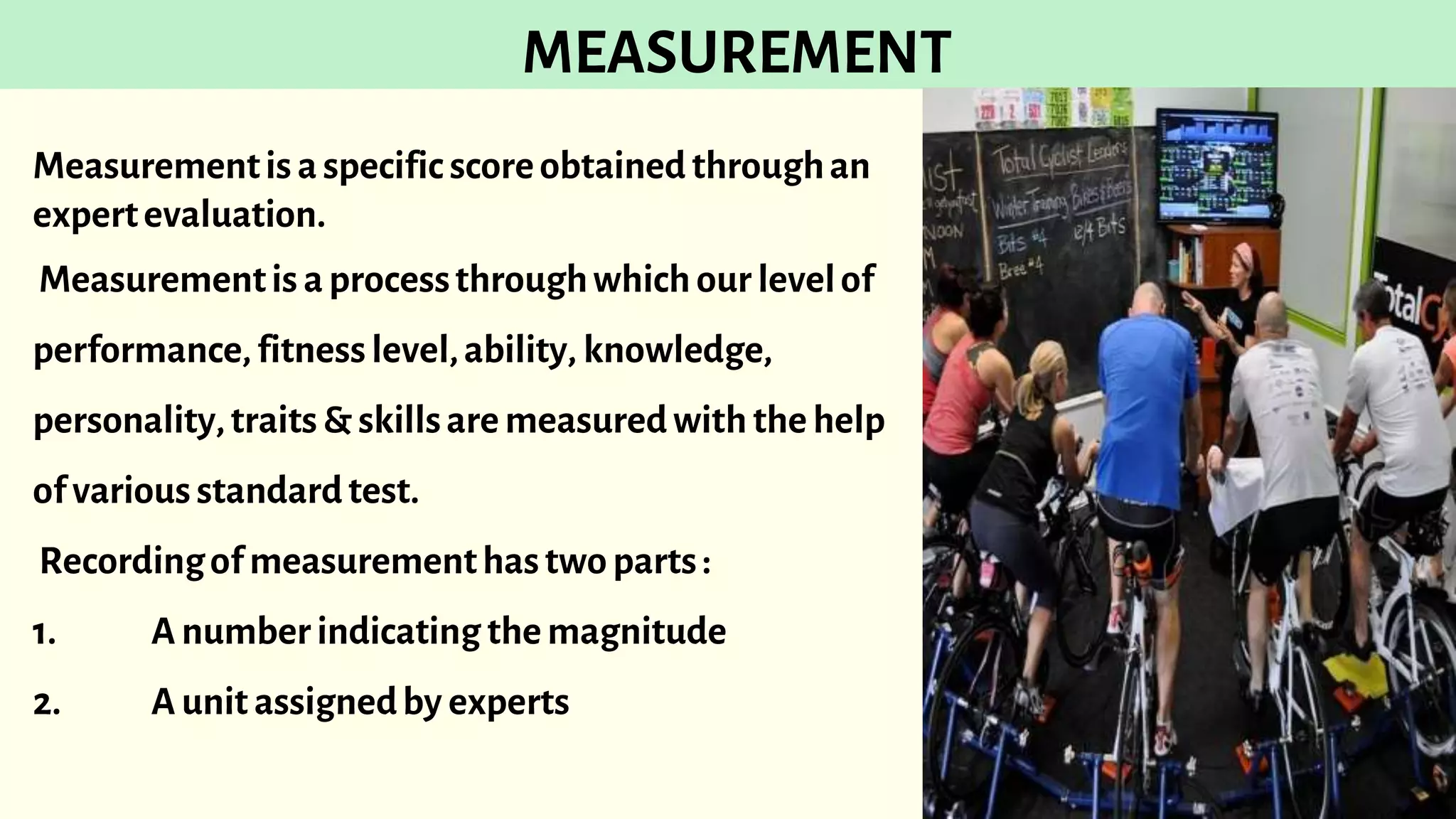
Measurementis aspecificscoreobtainedthroughan
expertevaluation.
Measurementis aprocessthroughwhich our levelof
performance,fitnesslevel,ability, knowledge,
personality,traits & skillsaremeasuredwith thehelp
ofvariousstandardtest.
Recordingof measurementhastwo parts:
1. A numberindicating themagnitude
2. A unit assignedby experts
MEASUREMENT
1. For gettingknowledgeabout theprogress
2. For preparationof effectiveplanning
3. For knowingthe abilities& capacities
4. For discoveringthe needs ofparticipants
5. For givingmotivation
6. For classificationofsports person
7. For knowingthe achievementsin future
8. For research& experimentation
IMPORTANCE OF TESTS AND MEASUREMENTS IN SPORTS
7.1 Measurement of Muscular Strength:
Kraus- Webar Test
• Muscular strength is the amount of force the muscles or
group of muscles can exert against resistance for short
duration.
• It is essential for maintaining good posture, avoiding
injuries and performing daily routine work.
• Muscular strength can be measured by Kraus-Weber Test.
• It measure the flexibility and strength of several large
muscles groups. It consists of a battery of six tests.
MUSCULAR STRENGTH
KRAUS-WEBER TEST
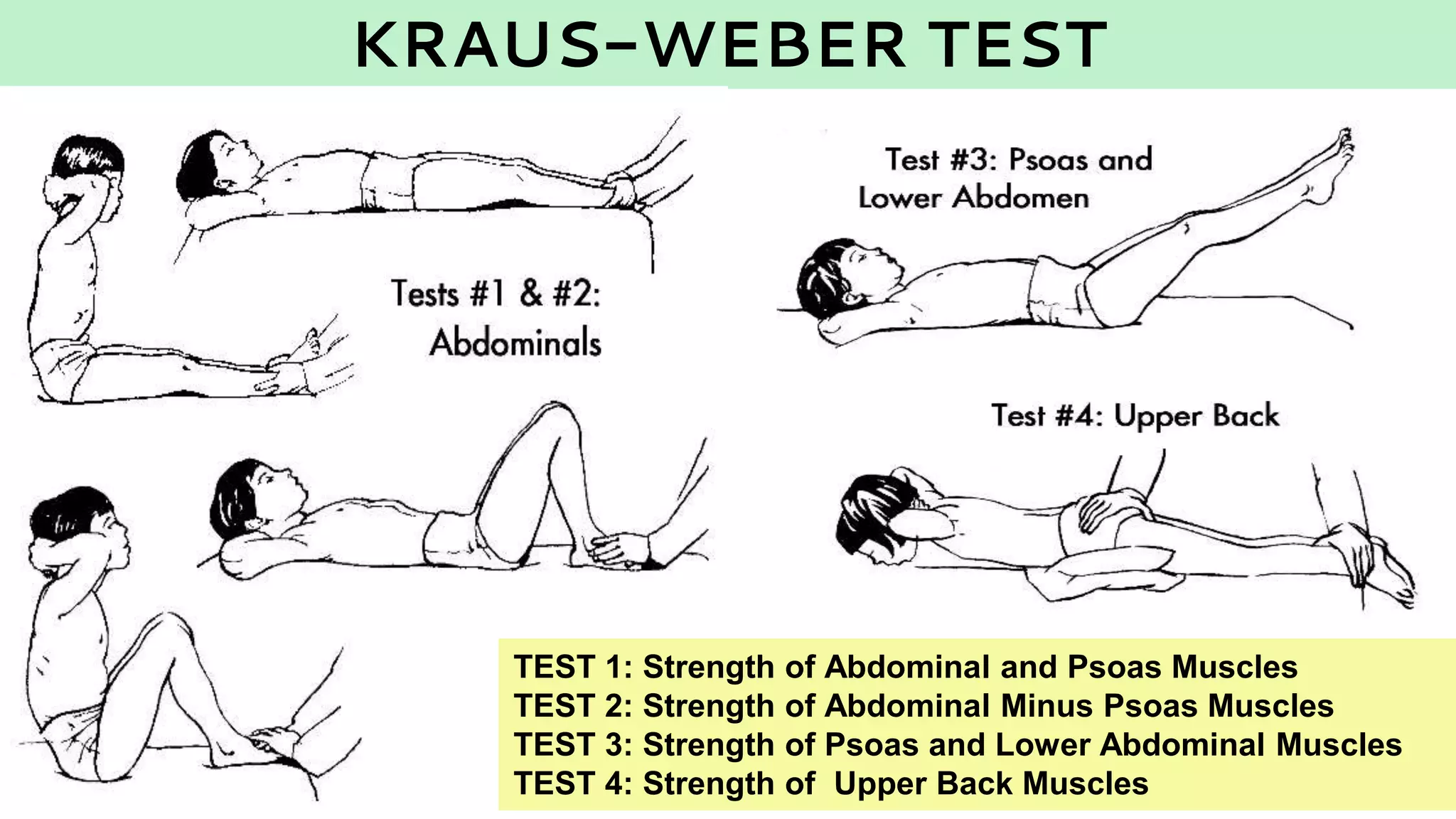
TEST 1: Strength of Abdominal and Psoas Muscles
TEST 2: Strength of Abdominal Minus Psoas Muscles
TEST 3: Strength of Psoas and Lower Abdominal Muscles
TEST 4: Strength of Upper Back Muscles
TEST 5: Strength of Lower Back
Muscles
TEST 6: Floor Touch Test
KRAUS-WEBER TEST
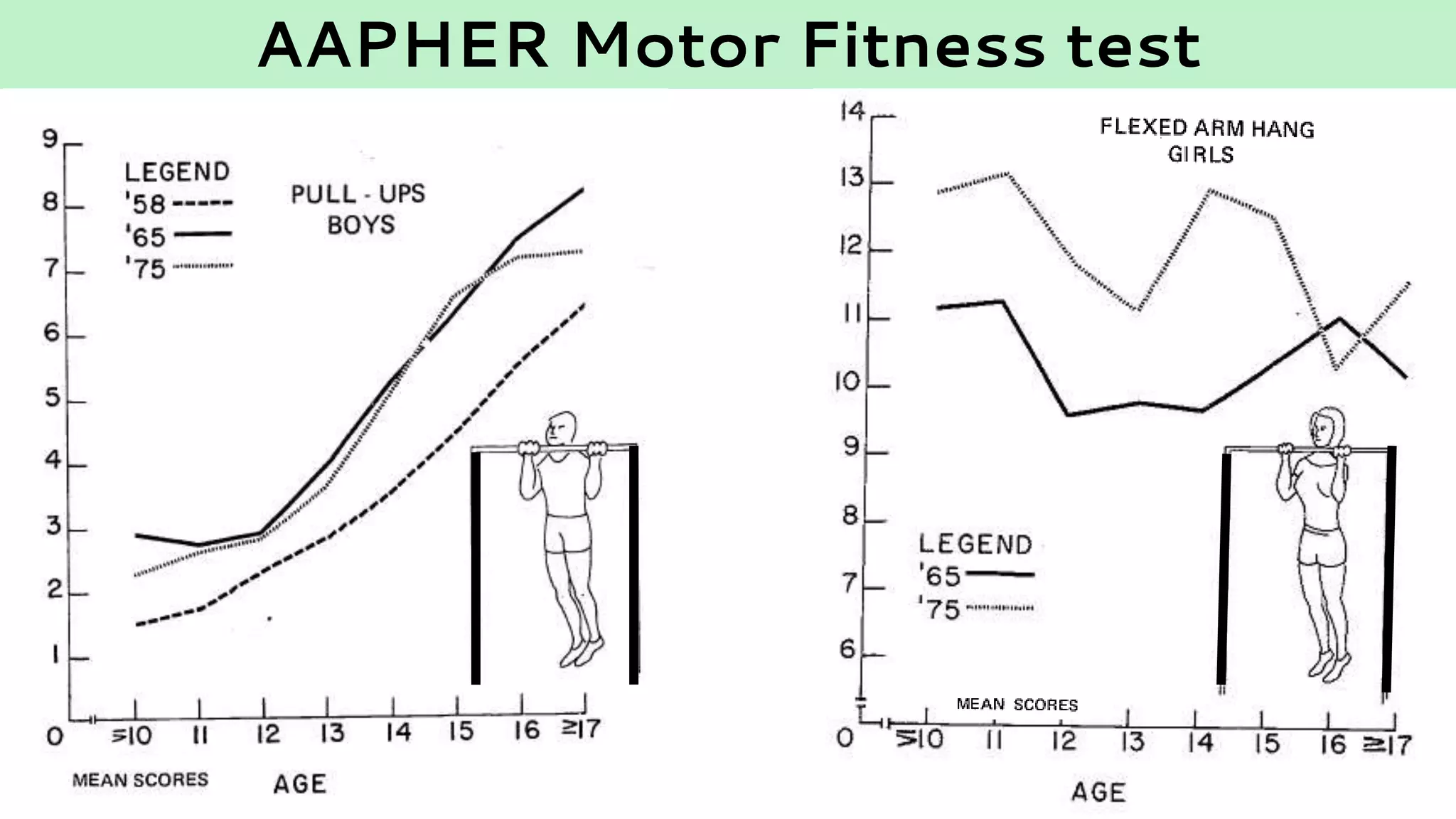
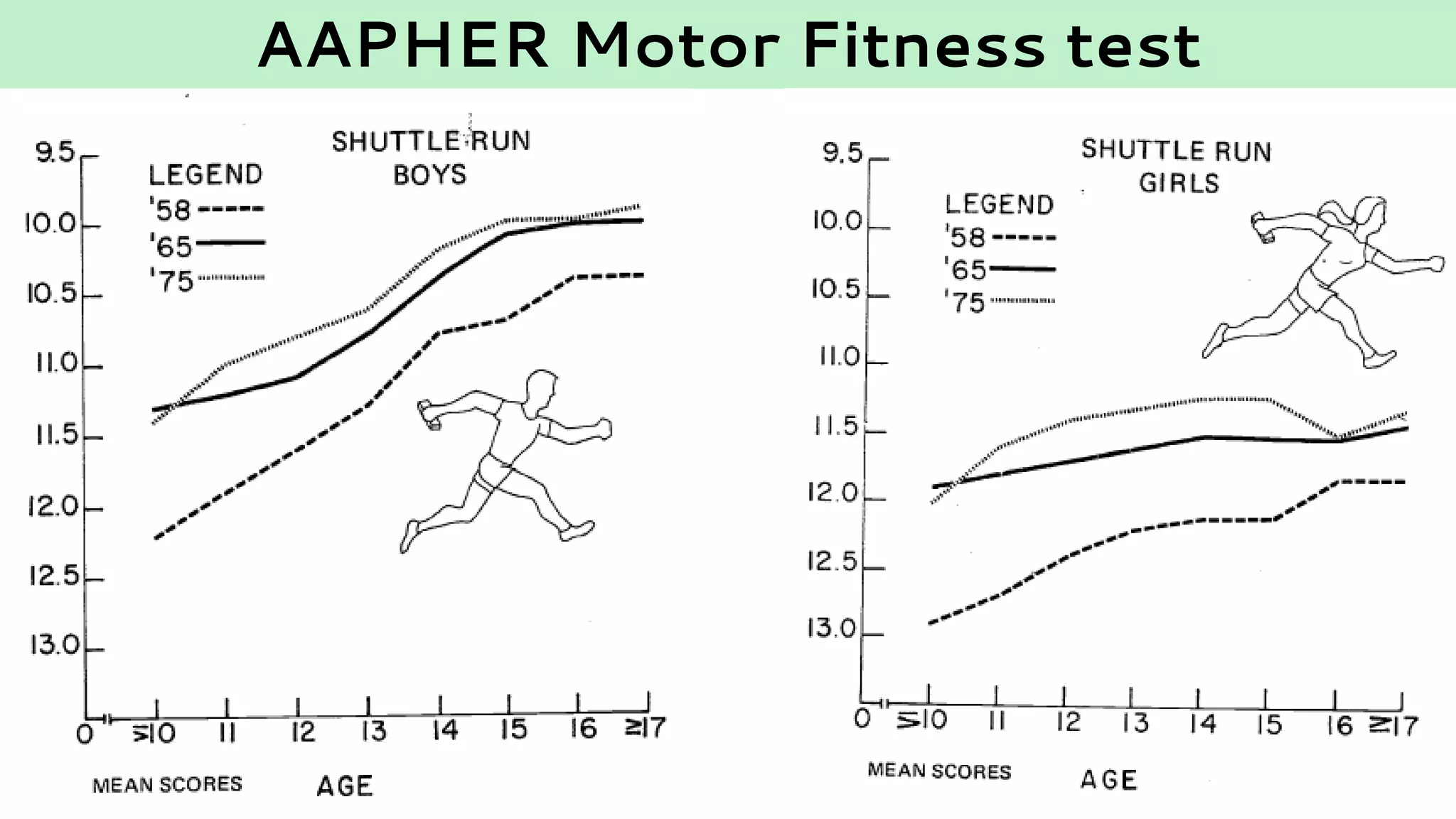
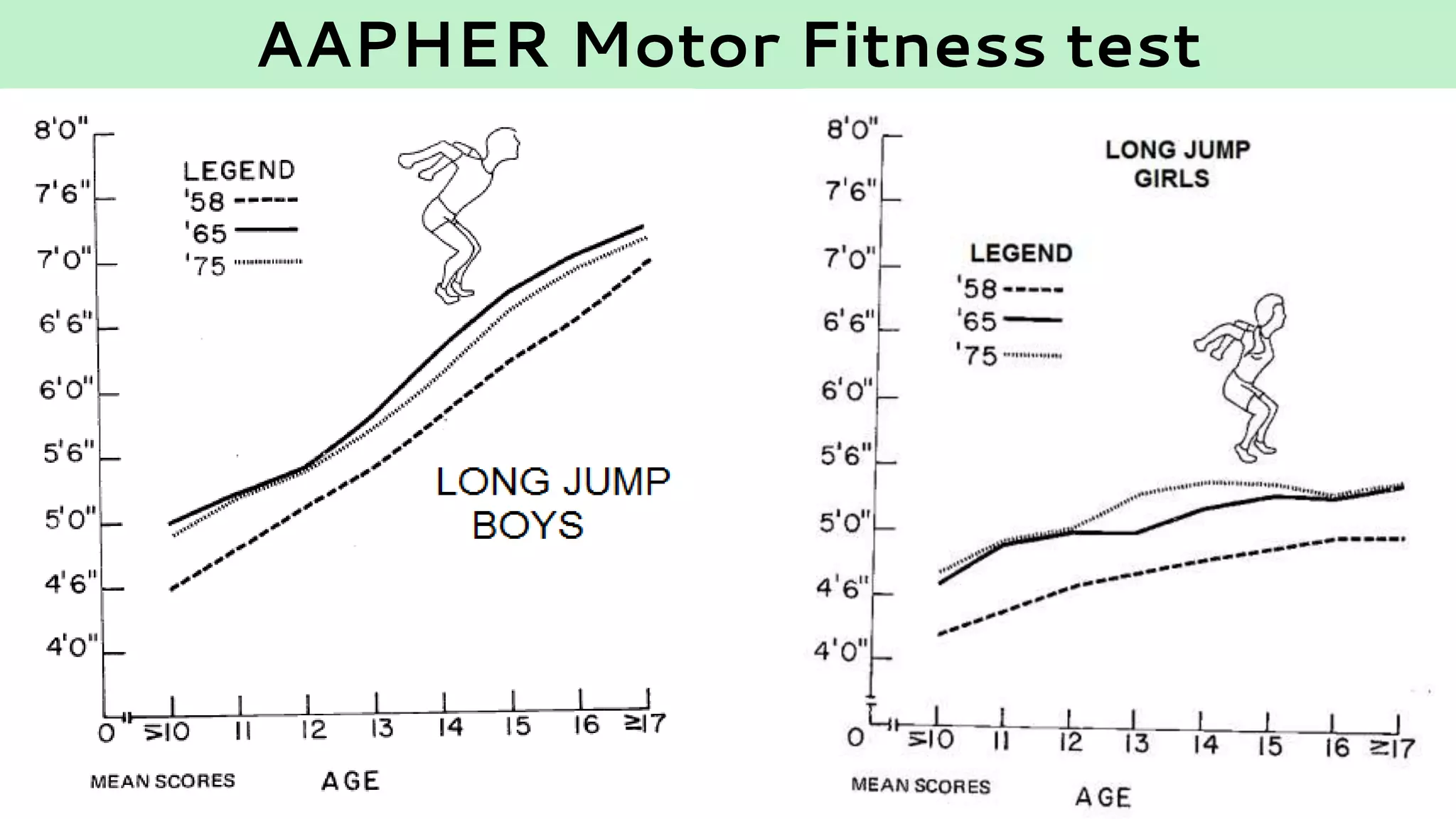
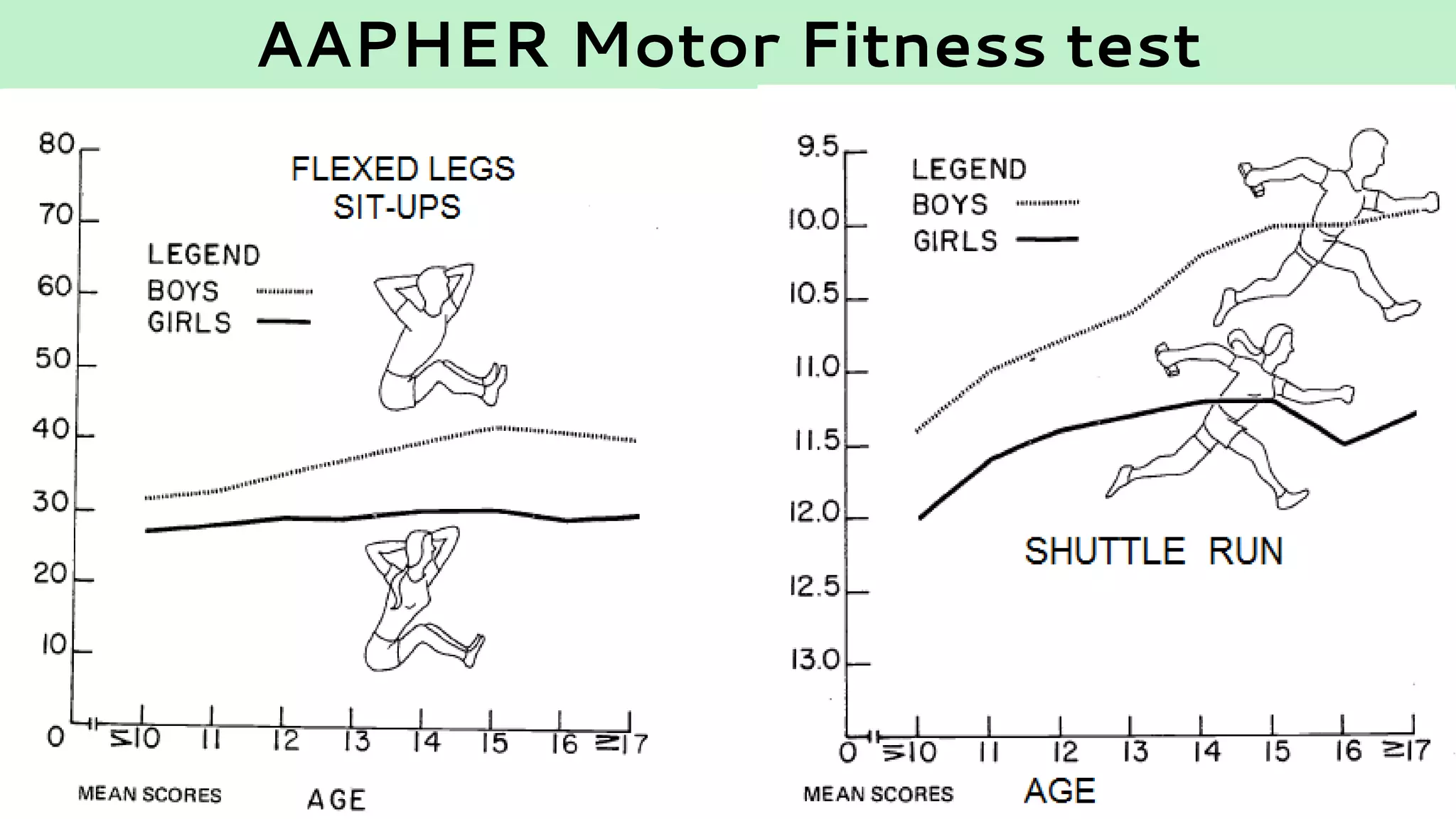
7.2 Motor Fitness Test: AAPHER
Motor fitness refers to a person's ability to perform physical
activities or the capability of an athlete to perform effectively
at his/her particular sport.
AAPHER motor fitness test
Following items are part of the test battery:
1. Pull - Ups (for boys) and Flexed - Arm hang (for girls).
2. Flexed - Leg Sit - Ups
3. Shuttle Run
4. Standing Long Jump
5. Fifty - Yard Dash
6. 600 - Yard Run- Walk
MOTOR FITNESS
AAPHER Motor Fitness test
7.3 Measurement of Cardiovascular Fitness:
Harvard Step Test/ Rockport Test
It is the ability of the heart & lungs to supply oxygen rich blood
to the working muscle tissues and the ability of the muscles to
use oxygen to produce energy for body movement.
Cardiovascular fitness is essential to perform aerobic activities.
Harvard Step Test:
It is used to measure the Cardiovascular fitness by checking the
recovery rate.
Rockport Test:
It is based on maximum rate of oxygen consumption measured
during incremental exercise.
CARDIOVASCULAR FITNESS
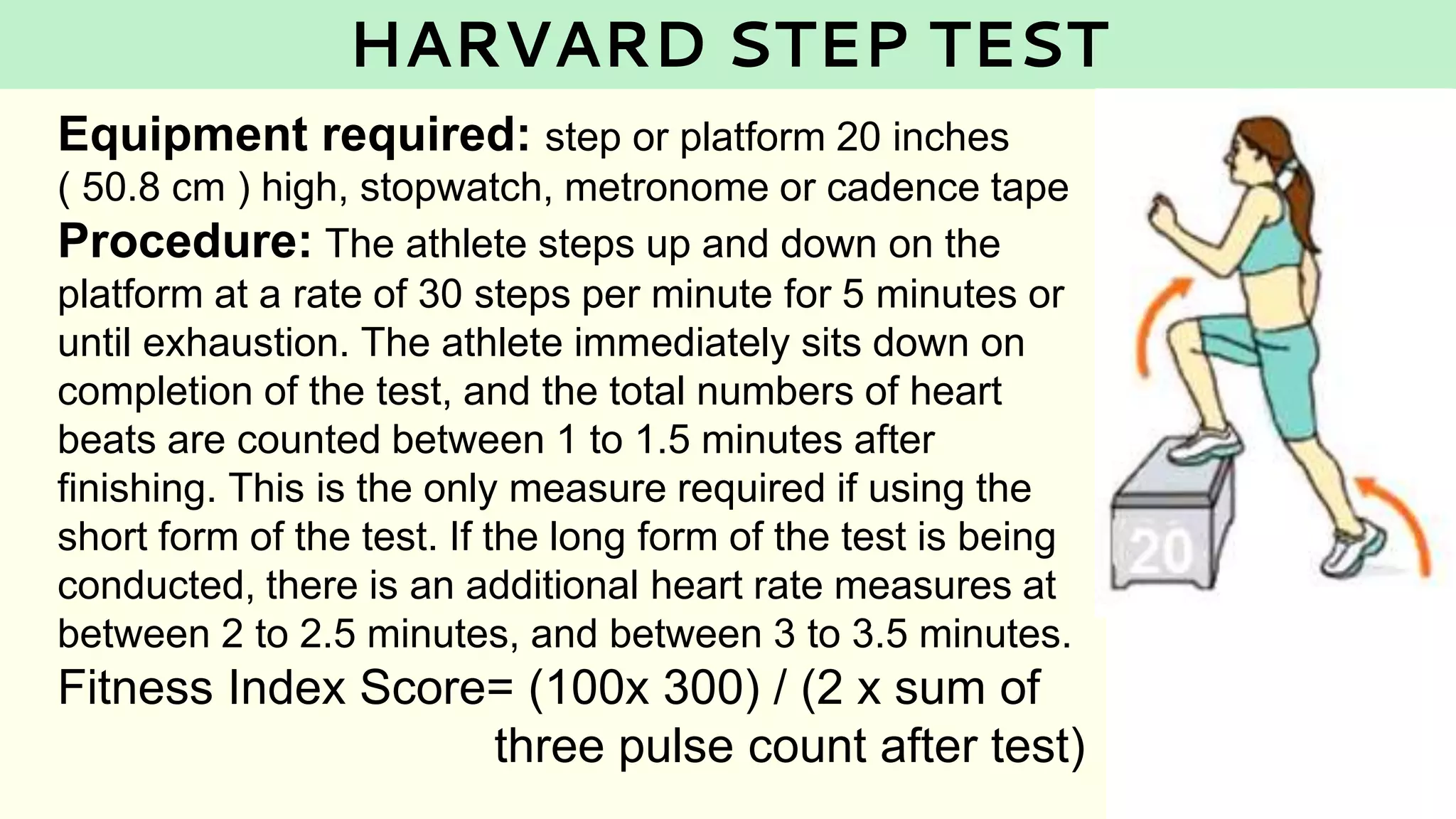
Equipment required: step or platform 20 inches
( 50.8 cm ) high, stopwatch, metronome or cadence tape
Procedure: The athlete steps up and down on the
platform at a rate of 30 steps per minute for 5 minutes or
until exhaustion. The athlete immediately sits down on
completion of the test, and the total numbers of heart
beats are counted between 1 to 1.5 minutes after
finishing. This is the only measure required if using the
short form of the test. If the long form of the test is being
conducted, there is an additional heart rate measures at
between 2 to 2.5 minutes, and between 3 to 3.5 minutes.
Fitness Index Score= (100x 300) / (2 x sum of
three pulse count after test)
HARVARD STEP TEST
FITNESS INDEX SCORE
For Men For Women
Excellent > 90 > 86
Good 80 – 89 76 – 85.9
High average 65 – 79 61 – 75.9
Low average 55 – 64 50 – 60.9
Poor < 55 < 50
Advantages
1. Procedure to conduct the test is simple.
2. It requires minimal cost.
3. Chances of making mistakes are minimum in conducting the
test and calculating the fitness index.
Disadvantages
1. Anthropometric measurements of individuals are different
but in the test, box of same height is used for all.
2. Body weight is not considered in this test.
HARVARD STEP TEST
Procedure: The purpose of this test is to walk as fast as
possible for 1 mile. After you have completed the mile,
immediately take your pulse rate. Note the time it took to
complete the mile. You will also need to know your body weight
for the VO2max calculation.
Scoring:
The formula used to calculate VO2 max is:
132.853 - (0.0769 × Weight) - (0.3877 × Age) + (6.315 × Gender) - (3.2649 ×
Time) - (0.1565 × Heart rate)
Where:
Weight is in pounds, Gender Male = 1 & Female = 0
Time in minutes and 100ths of minutes, Heart rate is in beats/minute
Age is in years
ROCKPORT ONE MILE TEST
Rockport One Mile Test
Advantages
1. Minimal equipment required
2. Simple to set up and conduct
3. More than one athlete can conduct the test at the same time
4. The test can be administered by the athlete
Disadvantages
1. Specific facilities required
2. Assistant required to administer the test
Advantage of Rockport One Mile Test
7.4 Measurement of Flexibility: Sit and Reach Test
• Flexibility is the range of movements of joints.
• It is affected by muscle length, joint structure, tendons, ligaments and
other factors.
• A person with good flexibility can move his body joints through a full
range of motion in work and play.
• It is beneficial in preventing injuries, improving posture, reducing low
back pain and improving balance.
Sit and Reach Test is conducted for measuring flexibility of
lower back and hamstring muscles.
FLEXIBILITY
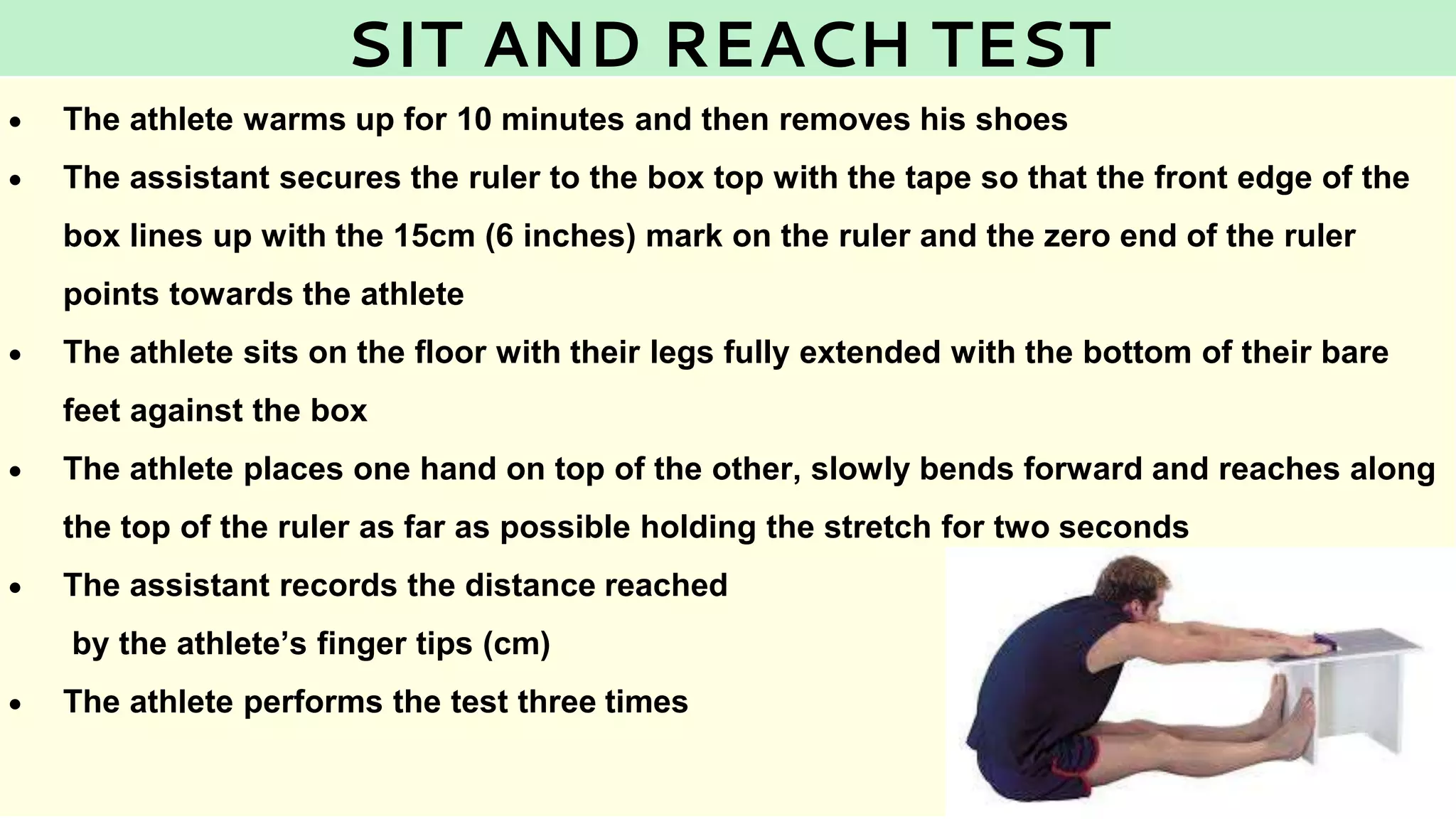
SIT AND REACH TEST
 The athlete warms up for 10 minutes and then removes his shoes
 The assistant secures the ruler to the box top with the tape so that the front edge of the
box lines up with the 15cm (6 inches) mark on the ruler and the zero end of the ruler
points towards the athlete
 The athlete sits on the floor with their legs fully extended with the bottom of their bare
feet against the box
 The athlete places one hand on top of the other, slowly bends forward and reaches along
the top of the ruler as far as possible holding the stretch for two seconds
 The assistant records the distance reached
by the athlete’s finger tips (cm)
 The athlete performs the test three times
Assessment of Sit and Reach Test
7.5 Rikli and Jones Senior Citizen Fitness Test
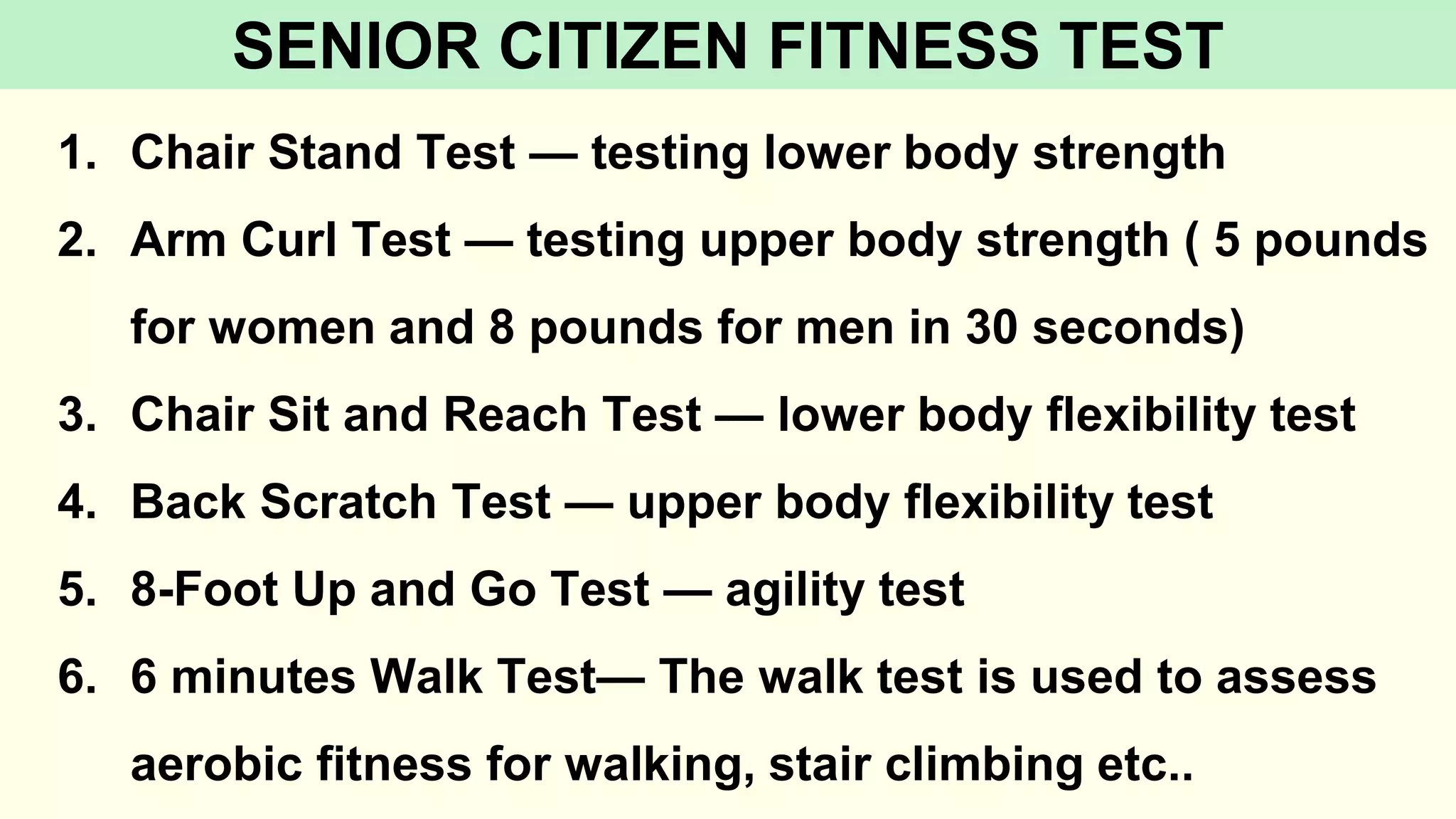
1. Chair Stand Test — testing lower body strength
2. Arm Curl Test — testing upper body strength ( 5 pounds
for women and 8 pounds for men in 30 seconds)
3. Chair Sit and Reach Test — lower body flexibility test
4. Back Scratch Test — upper body flexibility test
5. 8-Foot Up and Go Test — agility test
6. 6 minutes Walk Test— The walk test is used to assess
aerobic fitness for walking, stair climbing etc..
SENIOR CITIZEN FITNESS TEST
1. The participant should sit in the middle of the chair
2. Keep his hands on the opposite shoulder crossed at wrists
3. Feet flat on the floor
4. Back erect
5. Repeat sit up and down for 30 sec
CHAIR STAND TEST
SCORING OF CHAIR STAND TEST
Men’ Result Women’s Result
Age Below
Average
Average Above
Average
Below
Average
Average Above
Average
60-64 < 14 14 to 19 > 19 <12 12 to 17 > 17
65-69 < 12 12 to 18 > 18 < 11 11 to 16 >16
70-74 < 12 12 to 17 > 17 < 10 10 to 15 >15
75-79 < 11 11 to 17 > 17 < 10 10 to 15 >15
80-84 < 10 10 to 15 > 15 < 9 9 to 14 >14
85-89 < 8 8 to 14 > 14 < 8 8 to 13 >13
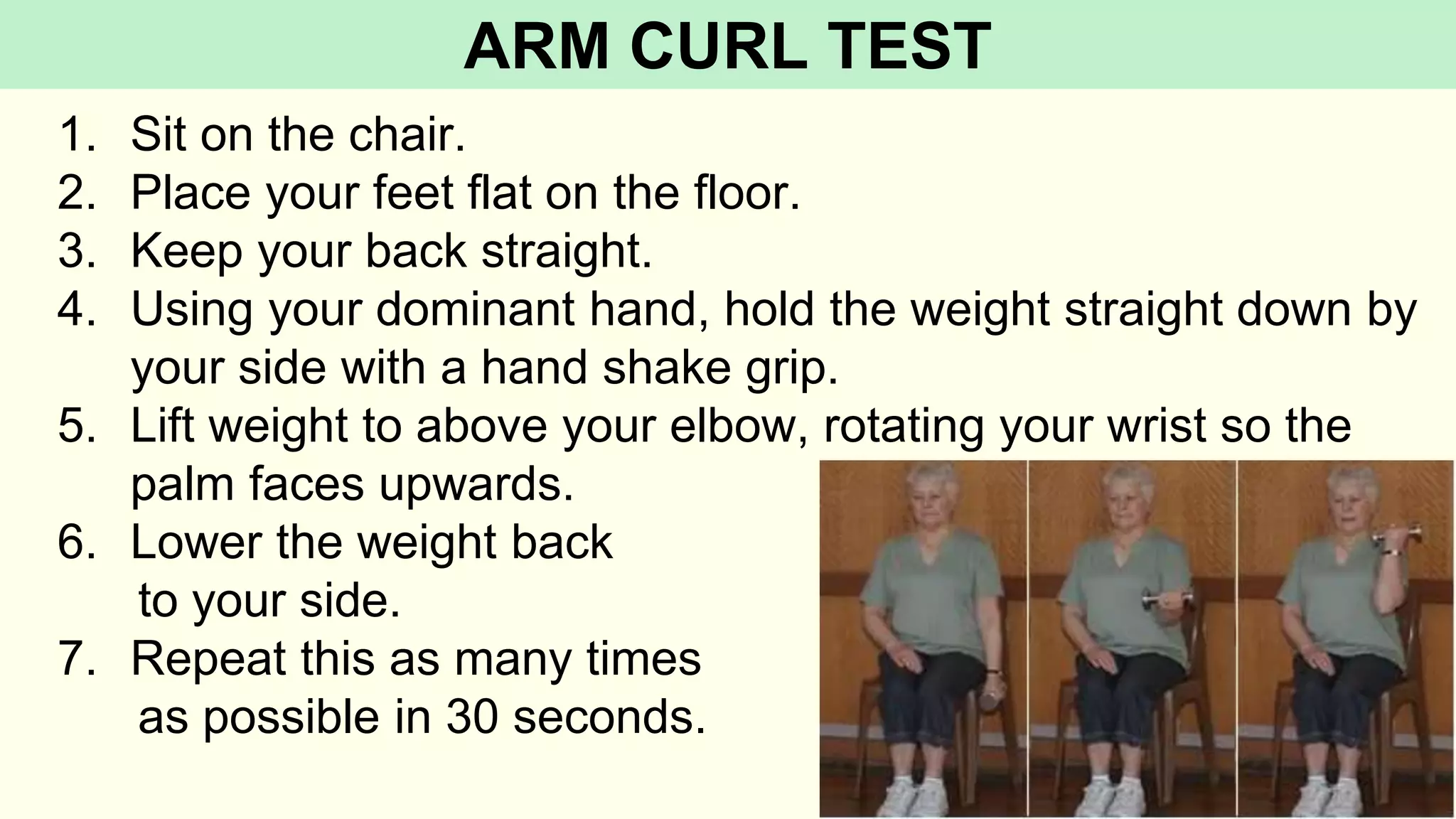
1. Sit on the chair.
2. Place your feet flat on the floor.
3. Keep your back straight.
4. Using your dominant hand, hold the weight straight down by
your side with a hand shake grip.
5. Lift weight to above your elbow, rotating your wrist so the
palm faces upwards.
6. Lower the weight back
to your side.
7. Repeat this as many times
as possible in 30 seconds.
ARM CURL TEST
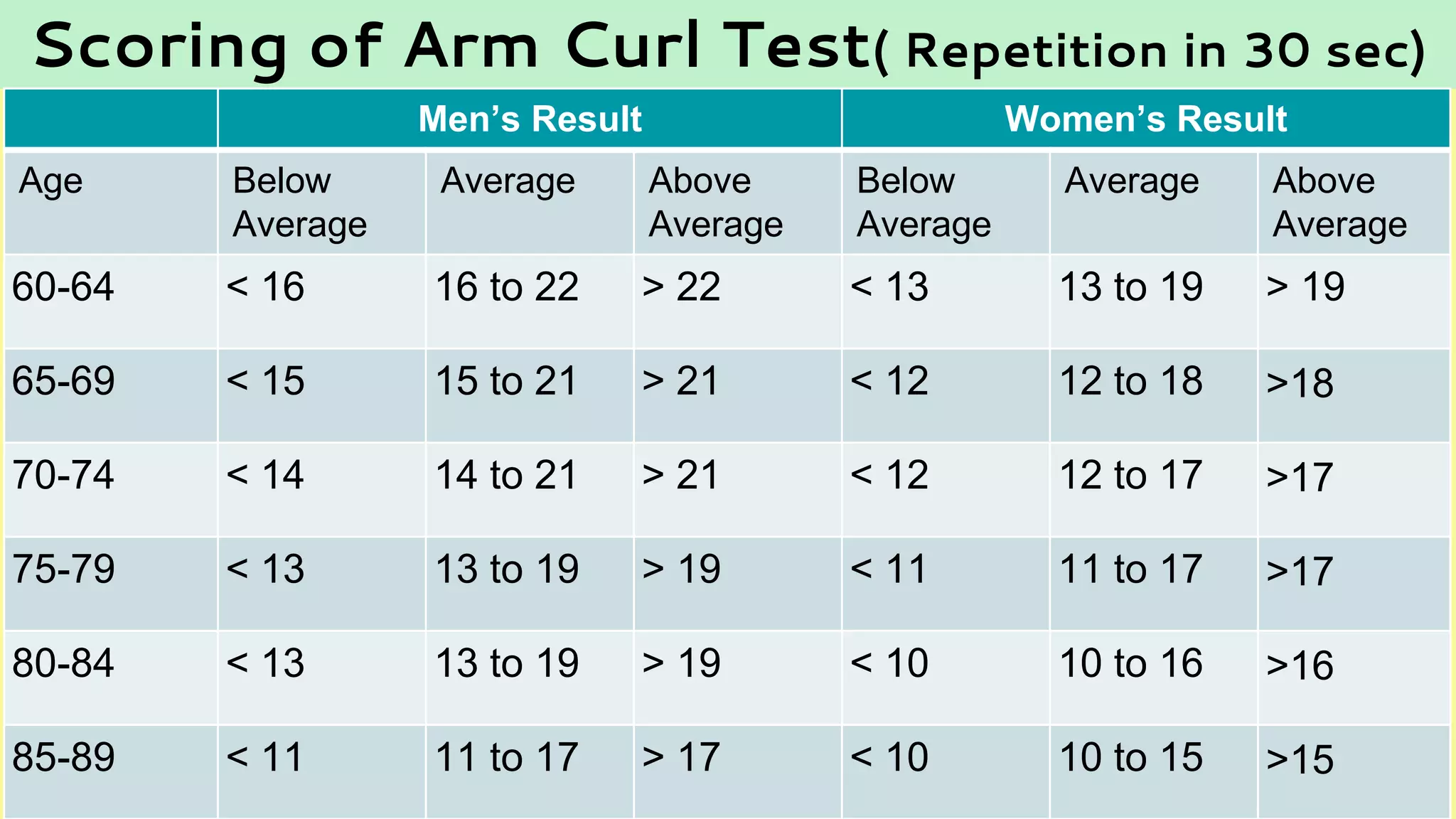
Scoring of Arm Curl Test( Repetition in 30 sec)
Men’s Result Women’s Result
Age Below
Average
Average Above
Average
Below
Average
Average Above
Average
60-64 < 16 16 to 22 > 22 < 13 13 to 19 > 19
65-69 < 15 15 to 21 > 21 < 12 12 to 18 >18
70-74 < 14 14 to 21 > 21 < 12 12 to 17 >17
75-79 < 13 13 to 19 > 19 < 11 11 to 17 >17
80-84 < 13 13 to 19 > 19 < 10 10 to 16 >16
85-89 < 11 11 to 17 > 17 < 10 10 to 15 >15
1. Sit close to the front of the seat
2. Have one leg extended straight with the heel on the floor and the
foot flexed at 90 degrees to the leg.
3. Have the other leg bent at right angles at the knee with the foot flat
on the floor.
4. Place one hand over the other with finger tips level.
5. Slowly reach forward as far as you can towards the toes in the
outstretched leg.
6. Hold the maximum reach for 2 seconds.
7. The distance is measured between
the tip of the fingertips and the toes.
If the fingertips touch the toes
then the score is zero
CHAIR SIT AND REACH TEST
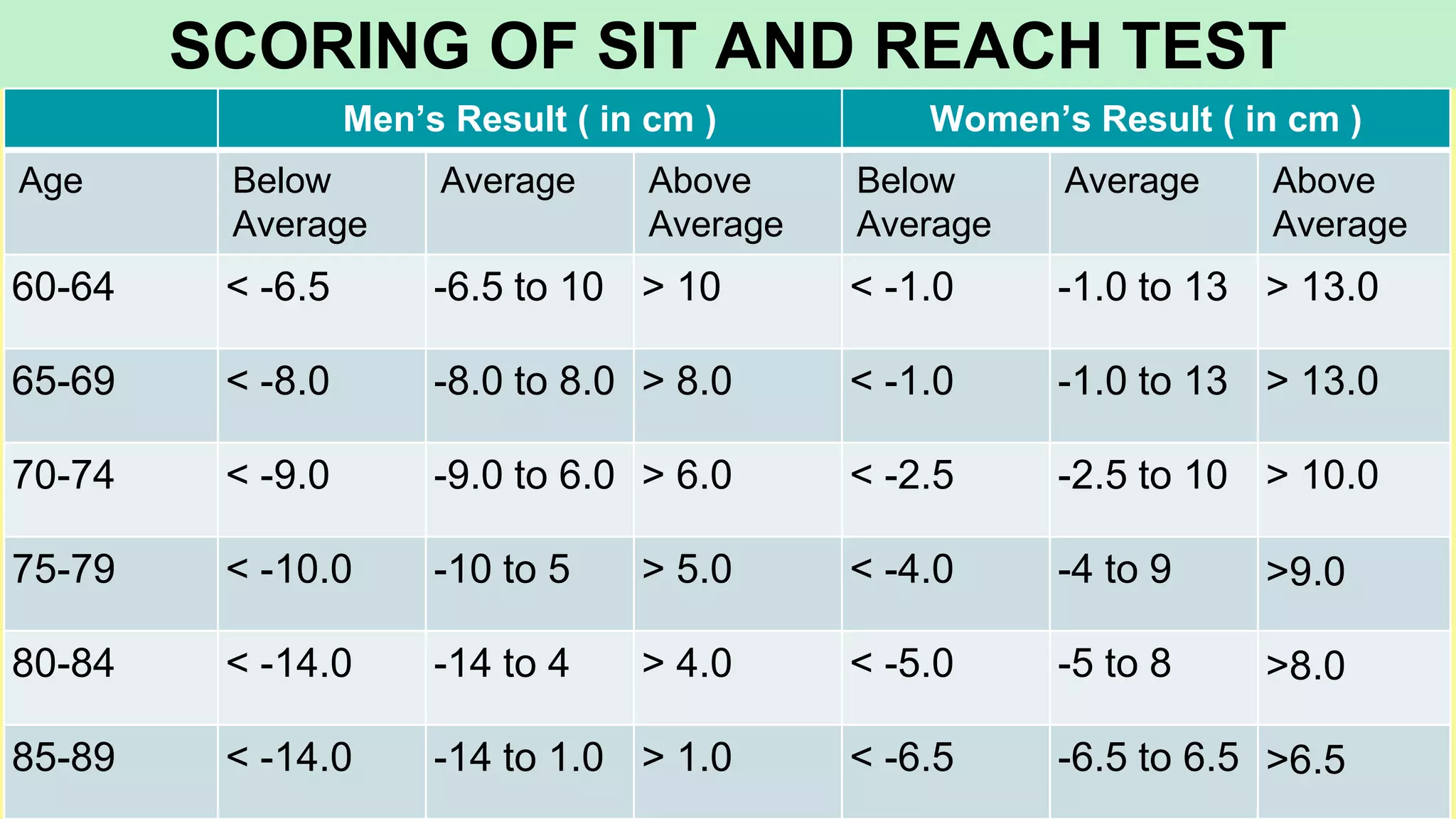
SCORING OF SIT AND REACH TEST
Men’s Result ( in cm ) Women’s Result ( in cm )
Age Below
Average
Average Above
Average
Below
Average
Average Above
Average
60-64 < -6.5 -6.5 to 10 > 10 < -1.0 -1.0 to 13 > 13.0
65-69 < -8.0 -8.0 to 8.0 > 8.0 < -1.0 -1.0 to 13 > 13.0
70-74 < -9.0 -9.0 to 6.0 > 6.0 < -2.5 -2.5 to 10 > 10.0
75-79 < -10.0 -10 to 5 > 5.0 < -4.0 -4 to 9 >9.0
80-84 < -14.0 -14 to 4 > 4.0 < -5.0 -5 to 8 >8.0
85-89 < -14.0 -14 to 1.0 > 1.0 < -6.5 -6.5 to 6.5 >6.5
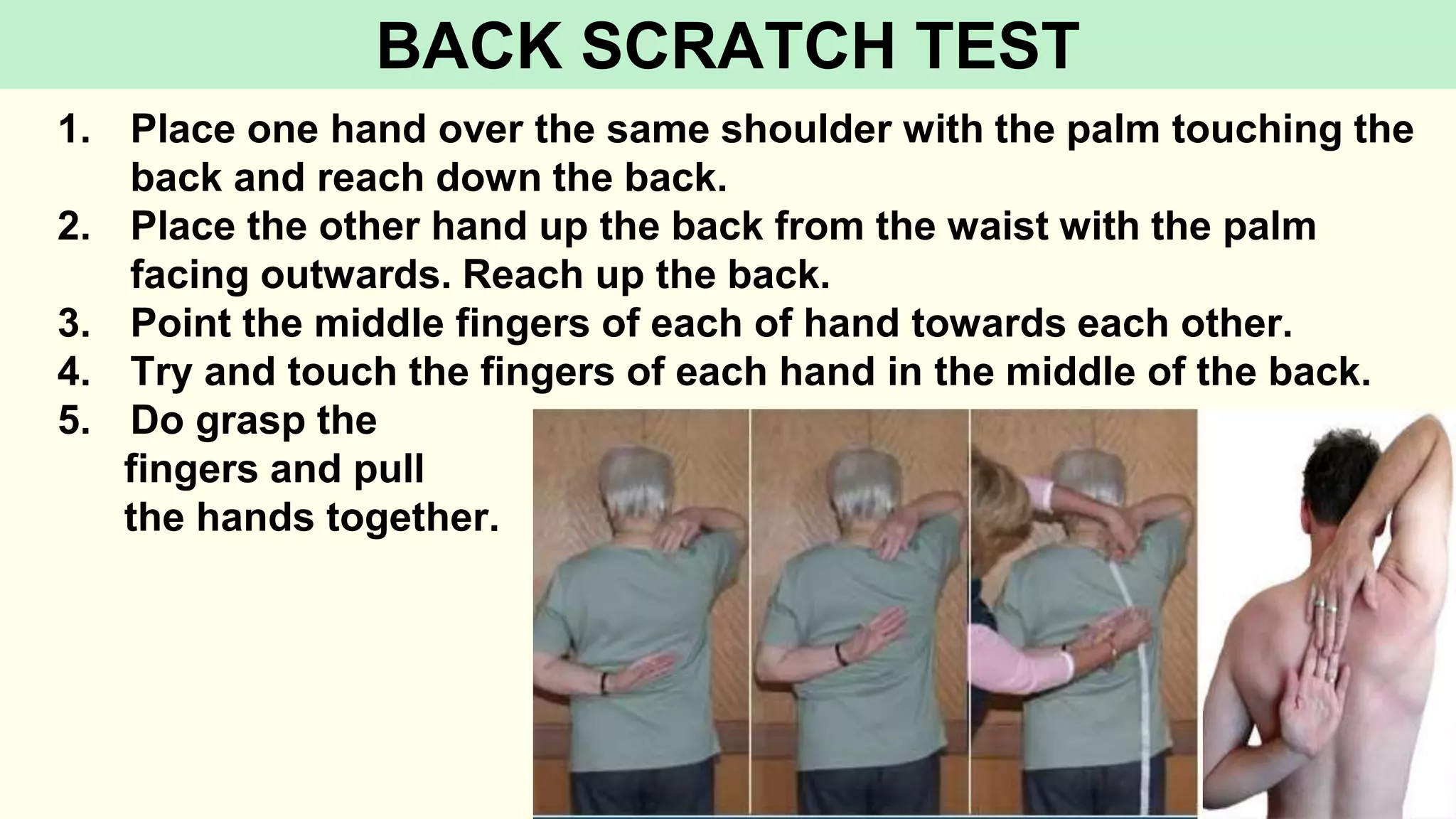
1. Place one hand over the same shoulder with the palm touching the
back and reach down the back.
2. Place the other hand up the back from the waist with the palm
facing outwards. Reach up the back.
3. Point the middle fingers of each of hand towards each other.
4. Try and touch the fingers of each hand in the middle of the back.
5. Do grasp the
fingers and pull
the hands together.
BACK SCRATCH TEST
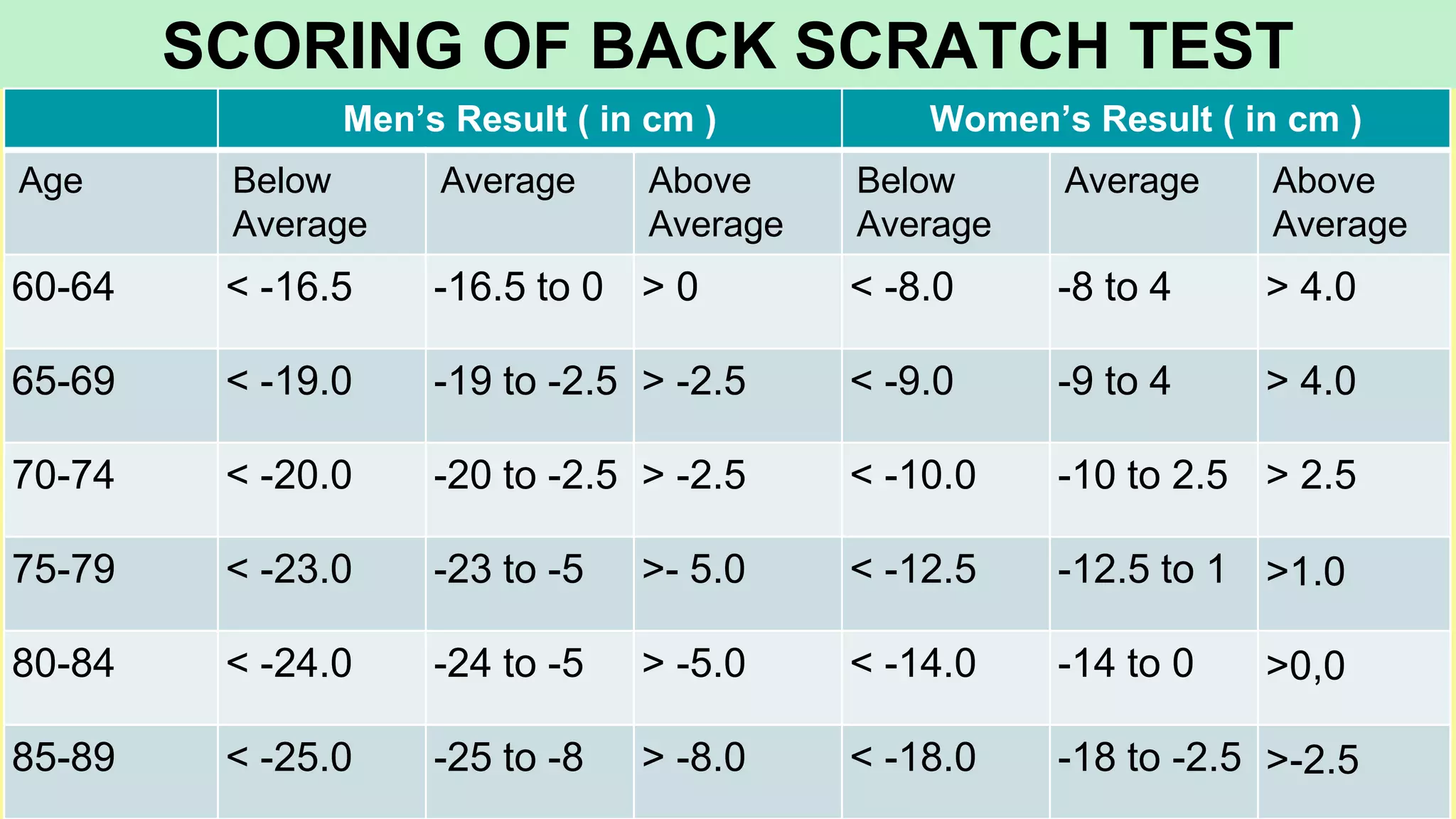
SCORING OF BACK SCRATCH TEST
Men’s Result ( in cm ) Women’s Result ( in cm )
Age Below
Average
Average Above
Average
Below
Average
Average Above
Average
60-64 < -16.5 -16.5 to 0 > 0 < -8.0 -8 to 4 > 4.0
65-69 < -19.0 -19 to -2.5 > -2.5 < -9.0 -9 to 4 > 4.0
70-74 < -20.0 -20 to -2.5 > -2.5 < -10.0 -10 to 2.5 > 2.5
75-79 < -23.0 -23 to -5 >- 5.0 < -12.5 -12.5 to 1 >1.0
80-84 < -24.0 -24 to -5 > -5.0 < -14.0 -14 to 0 >0,0
85-89 < -25.0 -25 to -8 > -8.0 < -18.0 -18 to -2.5 >-2.5
1. Sit in the middle of the chair with hands on thighs.
2. One foot can be placed slightly in front of the other but both must
be flat on the floor.
3. Lean slightly forward.
4. On the instruction to begin, stand up as quickly as possible.
5. Walk around the marker, return to the chair and sit down.
8 FOOT UP AND GO TEST
Scoring of 8 Foot Up and Go Test
Men’s Result ( in sec ) Women’s Result (in Sec )
Age Below
Average
Average Above
Average
Below
Average
Average Above
Average
60-64 > 5.6 5.6 to 3.8 < 3.8 > 6.0 6.0 to 4.4 < 4.4
65-69 > 5.7 5.7 to 4.3 < 4.3 > 6.4 6.4 to 4.8 < 4.8
70-74 > 6.0 6.0 to 4.2 < 4.2 > 7.1 7.1 to 4.9 < 4.9
75-79 > 7.2 7.2 to 4.6 < 4.6 > 7.4 7.4 to 5.2 < 5.2
80-84 > 7.6 7.6 to 5.2 < 5.2 > 8.7 8.7 to 5.7 < 5.7
85-89 > 8.9 8.9 to 5.3 < 5.3 > 9.6 9.6 to 6.2 < 6.2
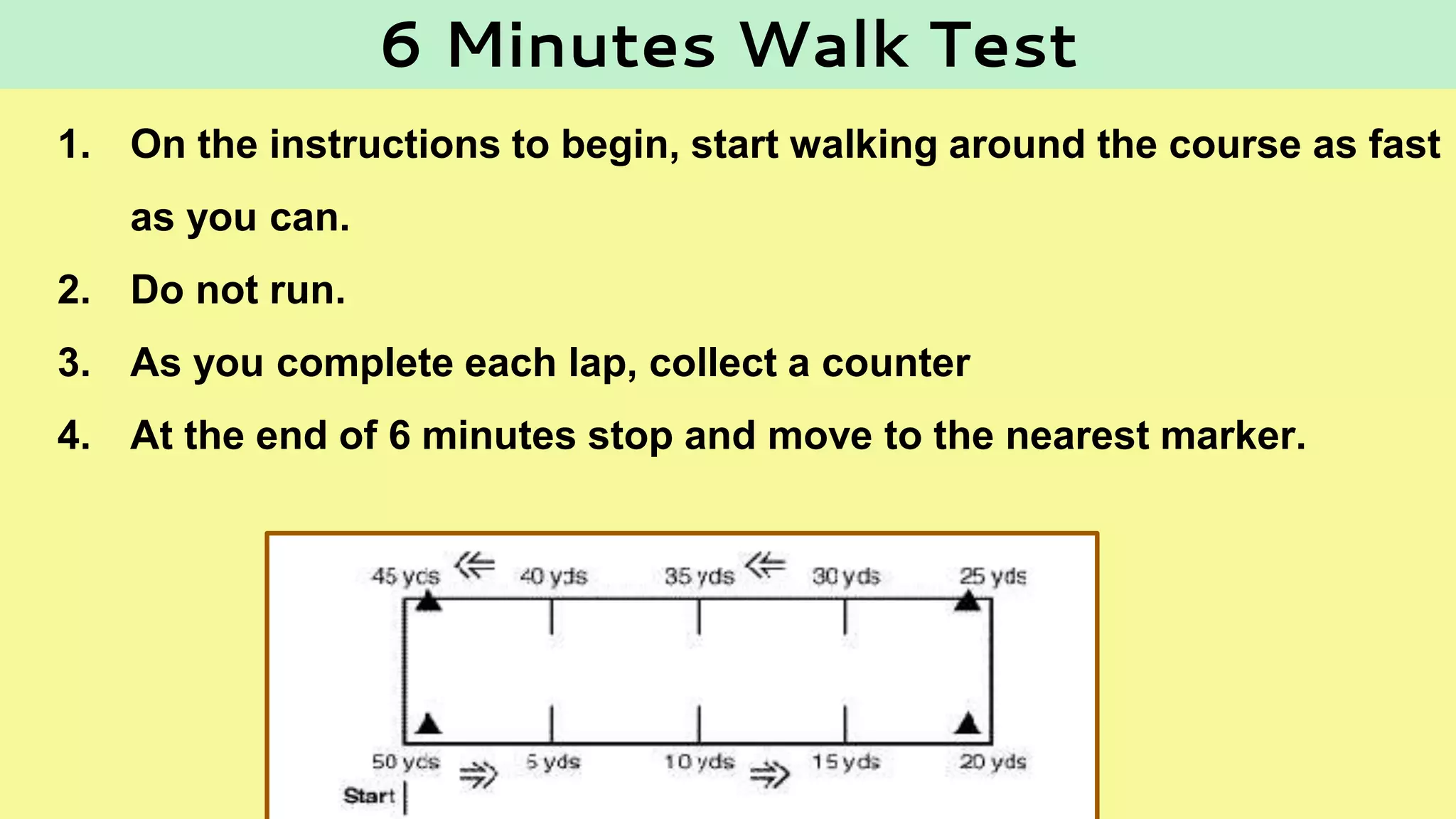
1. On the instructions to begin, start walking around the course as fast
as you can.
2. Do not run.
3. As you complete each lap, collect a counter
4. At the end of 6 minutes stop and move to the nearest marker.
6 Minutes Walk Test
6 Minutes WalkTest
Normal Range of Scores
Age Distance covered by Women in meters Distance covered by Men In
meters
60 - 64 498- 603 558 - 673
65 - 79 457 - 580 512 - 640
70 - 74 439 - 571 498 - 622
75 - 79 398- 535 430 - 585
80 - 84 352 - 454 407 - 553
85 - 90 311 - 466 347 - 521

Test and Measurement in Sports

  • 1.
    Test And MeasurementsIn Sports Lesson 7
  • 2.
    Test And MeasurementsIn Sports Class XII Lesson 7
  • 3.
    7.1 Measurement ofMuscularStrength: Kraus- Weber Test 7.2 MotorFitness Test AAPHER 7.3 Measurement of CardiovascularFitness:Harvard Step Test/ RockportTest 7.4 Measurement of Flexibility:Sit andReach Test 7.5 RikliandJones : SeniorCitizen Fitness Test Overview
  • 4.
    1. Test maybecalledas tool,a question, set of questions, an examination which is usedto measurea particularcharacteristicof anindividual ora group of individuals. 2. Test is the formof questioning ormeasuring toolusedto access the status of one’s skill,knowledge,attitude andfitness . 3. Test is aninstrument or activityused to accumulatedata ona person’s ability to performa specified task. TEST
  • 5.
    Measurementis aspecificscoreobtainedthroughan expertevaluation. Measurementis aprocessthroughwhichour levelof performance,fitnesslevel,ability, knowledge, personality,traits & skillsaremeasuredwith thehelp ofvariousstandardtest. Recordingof measurementhastwo parts: 1. A numberindicating themagnitude 2. A unit assignedby experts MEASUREMENT
  • 6.
    1. For gettingknowledgeabouttheprogress 2. For preparationof effectiveplanning 3. For knowingthe abilities& capacities 4. For discoveringthe needs ofparticipants 5. For givingmotivation 6. For classificationofsports person 7. For knowingthe achievementsin future 8. For research& experimentation IMPORTANCE OF TESTS AND MEASUREMENTS IN SPORTS
  • 7.
    7.1 Measurement ofMuscular Strength: Kraus- Webar Test
  • 8.
    • Muscular strengthis the amount of force the muscles or group of muscles can exert against resistance for short duration. • It is essential for maintaining good posture, avoiding injuries and performing daily routine work. • Muscular strength can be measured by Kraus-Weber Test. • It measure the flexibility and strength of several large muscles groups. It consists of a battery of six tests. MUSCULAR STRENGTH
  • 9.
    KRAUS-WEBER TEST TEST 1:Strength of Abdominal and Psoas Muscles TEST 2: Strength of Abdominal Minus Psoas Muscles TEST 3: Strength of Psoas and Lower Abdominal Muscles TEST 4: Strength of Upper Back Muscles
  • 10.
    TEST 5: Strengthof Lower Back Muscles TEST 6: Floor Touch Test KRAUS-WEBER TEST
  • 11.
    7.2 Motor FitnessTest: AAPHER
  • 12.
    Motor fitness refersto a person's ability to perform physical activities or the capability of an athlete to perform effectively at his/her particular sport. AAPHER motor fitness test Following items are part of the test battery: 1. Pull - Ups (for boys) and Flexed - Arm hang (for girls). 2. Flexed - Leg Sit - Ups 3. Shuttle Run 4. Standing Long Jump 5. Fifty - Yard Dash 6. 600 - Yard Run- Walk MOTOR FITNESS
  • 13.
  • 14.
  • 15.
  • 16.
  • 17.
  • 18.
  • 19.
    7.3 Measurement ofCardiovascular Fitness: Harvard Step Test/ Rockport Test
  • 20.
    It is theability of the heart & lungs to supply oxygen rich blood to the working muscle tissues and the ability of the muscles to use oxygen to produce energy for body movement. Cardiovascular fitness is essential to perform aerobic activities. Harvard Step Test: It is used to measure the Cardiovascular fitness by checking the recovery rate. Rockport Test: It is based on maximum rate of oxygen consumption measured during incremental exercise. CARDIOVASCULAR FITNESS
  • 21.
    Equipment required: stepor platform 20 inches ( 50.8 cm ) high, stopwatch, metronome or cadence tape Procedure: The athlete steps up and down on the platform at a rate of 30 steps per minute for 5 minutes or until exhaustion. The athlete immediately sits down on completion of the test, and the total numbers of heart beats are counted between 1 to 1.5 minutes after finishing. This is the only measure required if using the short form of the test. If the long form of the test is being conducted, there is an additional heart rate measures at between 2 to 2.5 minutes, and between 3 to 3.5 minutes. Fitness Index Score= (100x 300) / (2 x sum of three pulse count after test) HARVARD STEP TEST
  • 22.
    FITNESS INDEX SCORE ForMen For Women Excellent > 90 > 86 Good 80 – 89 76 – 85.9 High average 65 – 79 61 – 75.9 Low average 55 – 64 50 – 60.9 Poor < 55 < 50
  • 23.
    Advantages 1. Procedure toconduct the test is simple. 2. It requires minimal cost. 3. Chances of making mistakes are minimum in conducting the test and calculating the fitness index. Disadvantages 1. Anthropometric measurements of individuals are different but in the test, box of same height is used for all. 2. Body weight is not considered in this test. HARVARD STEP TEST
  • 24.
    Procedure: The purposeof this test is to walk as fast as possible for 1 mile. After you have completed the mile, immediately take your pulse rate. Note the time it took to complete the mile. You will also need to know your body weight for the VO2max calculation. Scoring: The formula used to calculate VO2 max is: 132.853 - (0.0769 × Weight) - (0.3877 × Age) + (6.315 × Gender) - (3.2649 × Time) - (0.1565 × Heart rate) Where: Weight is in pounds, Gender Male = 1 & Female = 0 Time in minutes and 100ths of minutes, Heart rate is in beats/minute Age is in years ROCKPORT ONE MILE TEST
  • 25.
  • 26.
    Advantages 1. Minimal equipmentrequired 2. Simple to set up and conduct 3. More than one athlete can conduct the test at the same time 4. The test can be administered by the athlete Disadvantages 1. Specific facilities required 2. Assistant required to administer the test Advantage of Rockport One Mile Test
  • 27.
    7.4 Measurement ofFlexibility: Sit and Reach Test
  • 28.
    • Flexibility isthe range of movements of joints. • It is affected by muscle length, joint structure, tendons, ligaments and other factors. • A person with good flexibility can move his body joints through a full range of motion in work and play. • It is beneficial in preventing injuries, improving posture, reducing low back pain and improving balance. Sit and Reach Test is conducted for measuring flexibility of lower back and hamstring muscles. FLEXIBILITY
  • 29.
    SIT AND REACHTEST  The athlete warms up for 10 minutes and then removes his shoes  The assistant secures the ruler to the box top with the tape so that the front edge of the box lines up with the 15cm (6 inches) mark on the ruler and the zero end of the ruler points towards the athlete  The athlete sits on the floor with their legs fully extended with the bottom of their bare feet against the box  The athlete places one hand on top of the other, slowly bends forward and reaches along the top of the ruler as far as possible holding the stretch for two seconds  The assistant records the distance reached by the athlete’s finger tips (cm)  The athlete performs the test three times
  • 30.
    Assessment of Sitand Reach Test
  • 31.
    7.5 Rikli andJones Senior Citizen Fitness Test
  • 32.
    1. Chair StandTest — testing lower body strength 2. Arm Curl Test — testing upper body strength ( 5 pounds for women and 8 pounds for men in 30 seconds) 3. Chair Sit and Reach Test — lower body flexibility test 4. Back Scratch Test — upper body flexibility test 5. 8-Foot Up and Go Test — agility test 6. 6 minutes Walk Test— The walk test is used to assess aerobic fitness for walking, stair climbing etc.. SENIOR CITIZEN FITNESS TEST
  • 33.
    1. The participantshould sit in the middle of the chair 2. Keep his hands on the opposite shoulder crossed at wrists 3. Feet flat on the floor 4. Back erect 5. Repeat sit up and down for 30 sec CHAIR STAND TEST
  • 34.
    SCORING OF CHAIRSTAND TEST Men’ Result Women’s Result Age Below Average Average Above Average Below Average Average Above Average 60-64 < 14 14 to 19 > 19 <12 12 to 17 > 17 65-69 < 12 12 to 18 > 18 < 11 11 to 16 >16 70-74 < 12 12 to 17 > 17 < 10 10 to 15 >15 75-79 < 11 11 to 17 > 17 < 10 10 to 15 >15 80-84 < 10 10 to 15 > 15 < 9 9 to 14 >14 85-89 < 8 8 to 14 > 14 < 8 8 to 13 >13
  • 35.
    1. Sit onthe chair. 2. Place your feet flat on the floor. 3. Keep your back straight. 4. Using your dominant hand, hold the weight straight down by your side with a hand shake grip. 5. Lift weight to above your elbow, rotating your wrist so the palm faces upwards. 6. Lower the weight back to your side. 7. Repeat this as many times as possible in 30 seconds. ARM CURL TEST
  • 36.
    Scoring of ArmCurl Test( Repetition in 30 sec) Men’s Result Women’s Result Age Below Average Average Above Average Below Average Average Above Average 60-64 < 16 16 to 22 > 22 < 13 13 to 19 > 19 65-69 < 15 15 to 21 > 21 < 12 12 to 18 >18 70-74 < 14 14 to 21 > 21 < 12 12 to 17 >17 75-79 < 13 13 to 19 > 19 < 11 11 to 17 >17 80-84 < 13 13 to 19 > 19 < 10 10 to 16 >16 85-89 < 11 11 to 17 > 17 < 10 10 to 15 >15
  • 37.
    1. Sit closeto the front of the seat 2. Have one leg extended straight with the heel on the floor and the foot flexed at 90 degrees to the leg. 3. Have the other leg bent at right angles at the knee with the foot flat on the floor. 4. Place one hand over the other with finger tips level. 5. Slowly reach forward as far as you can towards the toes in the outstretched leg. 6. Hold the maximum reach for 2 seconds. 7. The distance is measured between the tip of the fingertips and the toes. If the fingertips touch the toes then the score is zero CHAIR SIT AND REACH TEST
  • 38.
    SCORING OF SITAND REACH TEST Men’s Result ( in cm ) Women’s Result ( in cm ) Age Below Average Average Above Average Below Average Average Above Average 60-64 < -6.5 -6.5 to 10 > 10 < -1.0 -1.0 to 13 > 13.0 65-69 < -8.0 -8.0 to 8.0 > 8.0 < -1.0 -1.0 to 13 > 13.0 70-74 < -9.0 -9.0 to 6.0 > 6.0 < -2.5 -2.5 to 10 > 10.0 75-79 < -10.0 -10 to 5 > 5.0 < -4.0 -4 to 9 >9.0 80-84 < -14.0 -14 to 4 > 4.0 < -5.0 -5 to 8 >8.0 85-89 < -14.0 -14 to 1.0 > 1.0 < -6.5 -6.5 to 6.5 >6.5
  • 39.
    1. Place onehand over the same shoulder with the palm touching the back and reach down the back. 2. Place the other hand up the back from the waist with the palm facing outwards. Reach up the back. 3. Point the middle fingers of each of hand towards each other. 4. Try and touch the fingers of each hand in the middle of the back. 5. Do grasp the fingers and pull the hands together. BACK SCRATCH TEST
  • 40.
    SCORING OF BACKSCRATCH TEST Men’s Result ( in cm ) Women’s Result ( in cm ) Age Below Average Average Above Average Below Average Average Above Average 60-64 < -16.5 -16.5 to 0 > 0 < -8.0 -8 to 4 > 4.0 65-69 < -19.0 -19 to -2.5 > -2.5 < -9.0 -9 to 4 > 4.0 70-74 < -20.0 -20 to -2.5 > -2.5 < -10.0 -10 to 2.5 > 2.5 75-79 < -23.0 -23 to -5 >- 5.0 < -12.5 -12.5 to 1 >1.0 80-84 < -24.0 -24 to -5 > -5.0 < -14.0 -14 to 0 >0,0 85-89 < -25.0 -25 to -8 > -8.0 < -18.0 -18 to -2.5 >-2.5
  • 41.
    1. Sit inthe middle of the chair with hands on thighs. 2. One foot can be placed slightly in front of the other but both must be flat on the floor. 3. Lean slightly forward. 4. On the instruction to begin, stand up as quickly as possible. 5. Walk around the marker, return to the chair and sit down. 8 FOOT UP AND GO TEST
  • 42.
    Scoring of 8Foot Up and Go Test Men’s Result ( in sec ) Women’s Result (in Sec ) Age Below Average Average Above Average Below Average Average Above Average 60-64 > 5.6 5.6 to 3.8 < 3.8 > 6.0 6.0 to 4.4 < 4.4 65-69 > 5.7 5.7 to 4.3 < 4.3 > 6.4 6.4 to 4.8 < 4.8 70-74 > 6.0 6.0 to 4.2 < 4.2 > 7.1 7.1 to 4.9 < 4.9 75-79 > 7.2 7.2 to 4.6 < 4.6 > 7.4 7.4 to 5.2 < 5.2 80-84 > 7.6 7.6 to 5.2 < 5.2 > 8.7 8.7 to 5.7 < 5.7 85-89 > 8.9 8.9 to 5.3 < 5.3 > 9.6 9.6 to 6.2 < 6.2
  • 43.
    1. On theinstructions to begin, start walking around the course as fast as you can. 2. Do not run. 3. As you complete each lap, collect a counter 4. At the end of 6 minutes stop and move to the nearest marker. 6 Minutes Walk Test
  • 44.
    6 Minutes WalkTest NormalRange of Scores Age Distance covered by Women in meters Distance covered by Men In meters 60 - 64 498- 603 558 - 673 65 - 79 457 - 580 512 - 640 70 - 74 439 - 571 498 - 622 75 - 79 398- 535 430 - 585 80 - 84 352 - 454 407 - 553 85 - 90 311 - 466 347 - 521