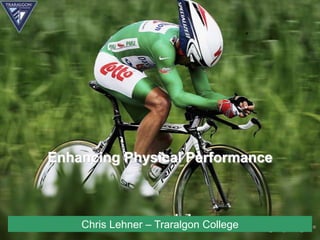
Enhancing Physical Performance


    Chris Lehner – Traralgon College
The Definition of Fitness &
      Components
Fitness definitions and components
The Definition of Fitness

What does it mean to be Fit?

Physical fitness can be defined as; ‘The ability to
  carry out tasks with vigour and alertness,
  without undue fatigue and with ample reserve
  energy to enjoy leisure time pursuits and to
  meet unforseen emergencies’.
  World Health Organisation

Health can be defined as; ‘The absence of
  disease or illness’. Also includes wellness
  (quality of life).

Obtaining an acceptable definition of fitness and
  being healthy is difficult as they are often
  vague and very generalised.
                            VCE Physical Education - Unit 4
Physical Fitness as a
    Continuum
Everyone has some form of fitness.
By training we can move towards the maximum
  end of the scale.
Less activity means a decreased fitness level.

    Low            Adequate                       Maximum


                VCE Physical Education - Unit 4
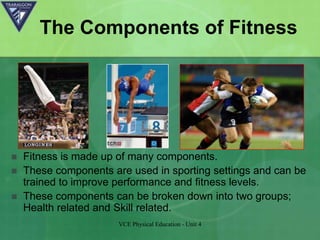
The Components of Fitness


   Fitness is made up of many components.
   These components are used in sporting settings and can be
    trained to improve performance and fitness levels.
   These components can be broken down into two groups;
    Health related and Skill related.
                       VCE Physical Education - Unit 4
Health and Motor-Skill
     Components
Health related                   Motor-skill
 Cardio-respiratory
                                  Muscular power
  endurance
 Muscular Strength               Agility
 Local Muscular                  Coordination
  endurance                       Balance
 Anaerobic power and
  speed                           Reaction time
 Flexibility
 Body composition


                VCE Physical Education - Unit 4
Fitness Components and Energy Systems

Anaerobic energy                        Aerobic energy
Sports which rely on rapid and           Prolonged and sub maximal
   explosive movements obtain              activities longer than 60
   their energy anaerobically.             seconds rely on aerobic
1. Anaerobic power and speed               energy production.
2. Local muscular endurance              Uses stored carbohydrates
3. Muscular strength
                                           and fat.
                                         The maximum amount of
4. Muscular power
                                           oxygen that the body can use
5. Agility                                 during aerobic activities is
6. Balance                                 called VO2 max.
7. Reaction time                        Aerobic sports require;
                                        Cardio respiratory endurance.


                       VCE Physical Education - Unit 4
Health Related Components of
           Fitness
Fitness definitions and components
Cardio-respiratory Endurance
Fitness level of the cardiovascular            Improvements: Cardio-respiratory
    system.                                       endurance is developed through the
 It delivers oxygenated blood to                 use of continuous and interval
    working muscles, and nutrients,               training. Thus improving VO2 max
    while performing and removes
                                                  (continuous), tolerance lactic acid
    wastes.
                                                  raising the Lactate Inflection Point
 Also know as aerobic endurance,
                                                  (LIP) and improving efficiency of the
    aerobic capacity, aerobic fitness or
    aerobic power.                                heart as a pump (interval).
 Most essential component at rest
    and during recovery.
 Examples: Team sports netball,
    football, hockey, soccer, volleyball,
    water, polo, basketball, lacrosse and
    rugby. Racquet sports such as
    tennis and squash. Extended athletic
    events such as the marathon,
    triathlons and cross country skiing.
                              VCE Physical Education - Unit 4
Muscular Strength
The force or tension a muscle or
  muscle group can exert against a
  resistance in one maximal
  contraction (1RM)
 It is an integral part of anaerobic
  power, muscular power and local
  muscular endurance and is
  rarely used in isolation.
Improvements; Circuit and weights
  training improves the explosive
  acceleration required for
  muscular strength.
                     VCE Physical Education - Unit 4
Factors Affecting
      Strength
1.   Age – Max strength obtained at 25-30 years of age and
     decreases thereafter.
2.   Gender – Same pre-pubescent, however females 2/3
     strength of males thereafter.
3.   Size (Cross-sectional area) – The larger the muscle, the
     more force it can apply
4.   Muscle shape – Strength is specific to specific
     muscles /groups. See picture next slide.
5.   Muscle fibre type – FT produce more force than ST. A
     muscle biopsy can determine percentage of FT fibres.
6.   Muscle fibre recruitment – The stronger the nerve
     impulse, the greater the amount of fibres contracted.
     Eg. 1RM all fibres recruited.
7.   Joint angle and muscle length – Max strength at 120o.
     See fig 7.8 p.155
8.   Speed of contraction – As speed increases, strength
     decreases.
9.   Type of contraction - isometric (static), isokinetic,
     isotonic (concentric and eccentric)
                            VCE Physical Education - Unit 4
Local Muscular Endurance
 The ability of a muscle or group of
  muscles to sustain an activity for a
  short time in the face of
  considerable local fatigue (eg
  push-ups).
 Tasks may require anaerobic
  energy in addition to aerobic
  because contraction of the muscle
  may occlude (block) the blood
  vessels that supply the muscle
  tissue.
 Closely linked with muscular
  strength.
Improvements; Continuos training or
  weight training
                         VCE Physical Education - Unit 4
Factors Affecting LME fatigue
1.    Inorganic phosphate – Rising levels of Pi is
      considered the major cause of fatigue. Note.
      Lactic acid is not directly associated with
      muscular fatigue.
2.    Age – Fatigue levels increase with age.
3. Temperature – Optimal muscle temperature is
      37oC. Temperatures outside this range will
      affect fatigue levels
4. Circulation – Improved circulation as a result of
      training can reduce fatigue levels. New
      clothing such as ‘Skins’ can also help.
5. Cross-education
   effect – Training one limb has the
   same effect in the other limb.


                               VCE Physical Education - Unit 4
Anaerobic Power and Speed
Anaerobic Power
Anaerobic power is required for most sports. It is explosive movements performed
   quickly.
 It produces its energy in the absence of oxygen. An athlete’s power is a
   measure of their anaerobic pathways.
Speed
Speed is the ability of the body to perform a task or movement quickly.
Power and speed are very closely related.
Improvements ;
 In sprint or high-level interval training (at least three times per week), keep the
   heart rate in the ‘training zone’ for at least 20 minutes.
 Undertake 20–80-metre interval running sprints, starting with a ‘walk back’
   recovery and progressing to a ‘jog back’ recovery.
 Undertake 300–600-metre running ‘cruises’
 The same interval concept will produce anaerobic gains, when used for related
   sports such as cycling or swimming.
 Weight training can also improve anaerobic power.

                               VCE Physical Education - Unit 4
Factors Affecting Speed

Speed can be affected by an athletes; Acceleration
  levels, initial velocity, strength and fatigue
  tolerance levels. Reaction time is an indirect factor.
Speed is also influenced by our genetics; Bone size,
  angle of joints, position of ligament and tendon
  attachments, muscle fibre types.


                     VCE Physical Education - Unit 4
Flexibility

Flexibility is the ability to gain the
   range of movement required for a
   particular sport.
 Flexibility is based on skeletal and
   muscular interaction.
 It is very important for injury
   prevention, ease of movement and
   aesthetic appearance.
 Flexibility can be static (Eg. Sit and
   reach test) or dynamic (Eg. Range
   of motion during a skill).
Improvements; Flexibility training.


                        VCE Physical Education - Unit 4
Factors Affecting Flexibility
   Joint Structure and capsule– The greater the
    stability of a joint, the less flexible it will be.
   Length of muscle at rest – Inactive people have
    shortened muscle length which reduces
    flexibility levels.
   Muscle temperature – Warming of the muscle to
    37oC and stretching will assist with flexibility.
   Specific flexibility - for particular sports
   Age – Lose flexibility with age
   Gender – Females more flexible than males
   Body build – Leaner people are generally more
    flexible
   Injury – Prior injuries reduce
    flexibility levels
   Skin and bone resistance
   Disease

                                VCE Physical Education - Unit 4
Body Composition
Proportion of bone, muscle and fat in an
     athlete.
Body composition can be measured three
     ways;
1.   Somatotypes
    Endomorph – Short/fat
    Mesomorph- muscular
    Ectomorph – Tall/thin
2. Body fat determination
    Densitometry – Submerging the athlete
     in water to determine lean body mass
     (LBM) in comparison to fat mass (FM)
    Skinfold measurements – Skin
     thickness is measured at various sites
     on the body.
3.   Body mass index (BMI)
    Height / weight2

                                VCE Physical Education - Unit 4
Body Mass Index (BMI)


       VCE Physical Education - Unit 4
Motor Skill Related
   Components of Fitness
Fitness definitions and components
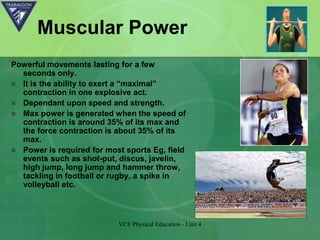
Muscular Power
Powerful movements lasting for a few
  seconds only.
 It is the ability to exert a “maximal”
  contraction in one explosive act.
 Dependant upon speed and strength.
 Max power is generated when the speed of
  contraction is around 35% of its max and
  the force contraction is about 35% of its
  max.
 Power is required for most sports Eg, field
  events such as shot-put, discus, javelin,
  high jump, long jump and hammer throw,
  tackling in football or rugby, a spike in
  volleyball etc.


                           VCE Physical Education - Unit 4
Agility
Ability to change direction with maximal speed and control
Combination of; power, speed, flexibility, balance and
  coordination.
Important in sports which require sudden changes of
  direction.
Improvements; Training can improve speed, reaction time,
  flexibility, coordination and balance – thus improving
  agility.


                     VCE Physical Education - Unit 4
Anaerobic Power and Speed
Anaerobic Power
Anaerobic power is required for most sports. It is explosive movements performed
   quickly.
 It produces its energy in the absence of oxygen. An athlete’s power is a
   measure of their anaerobic pathways.
Speed
Speed is the ability of the body to perform a task or movement quickly.
Power and speed are very closely related.
Improvements ;
 In sprint or high-level interval training (at least three times per week), keep the
   heart rate in the ‘training zone’ for at least 20 minutes.
 Undertake 20–80-metre interval running sprints, starting with a ‘walk back’
   recovery and progressing to a ‘jog back’ recovery.
 Undertake 300–600-metre running ‘cruises’
 The same interval concept will produce anaerobic gains, when used for related
   sports such as cycling or swimming.
 Weight training can also improve anaerobic power.

                               VCE Physical Education - Unit 4
Factors Affecting Speed

Speed can be affected by an athletes; Acceleration
  levels, initial velocity, strength and fatigue
  tolerance levels. Reaction time is an indirect factor.
Speed is also influenced by our genetics; Bone size,
  angle of joints, position of ligament and tendon
  attachments, muscle fibre types.


                     VCE Physical Education - Unit 4
Coordination

Ability to link muscle groups to appear
   well controlled and efficient.
 Involves the nervous system and
   muscular system working
   harmoniously in hand-eye and foot-
   eye coordination activities.
Improvements; Can be developed
   through specific skill training and
   through enhancement of core stability
   and balance.


                          VCE Physical Education - Unit 4
Balance & Reaction Time
Balance                                    Reaction Time
The ability to remain in a state of        Ability to react to an outside
   equilibrium while performing a            stimulus
   desired task.                           Improvements; Practice with starter
Dynamic – moving                             guns, overload with quicker
Static – Not moving                          stimuli (eg quicker squash balls).
Relies on core stability
Improvements; Training methods
   such as Pilates and Swiss
   balls.


                          VCE Physical Education - Unit 4
Web Links –
   •United States Department of Health and Human Services:
   •Australian Sports Commission: http://www.ausport.gov.au
   •Find 30 promotion (Government of WA Department of Health): http://www.find30.com.au
   •Walking School Bus promotion (UK): http://www.walkingbus.com

   http://www.os.dhhs.gov/
   •Ministry of Health (New Zealand) toolkits: http://www.newhealth.govt.nz
   •The 10,000 Steps Rockhampton project: http://www.10000steps.org.au/rockhampton/
   •Travelsmart Australia: http://www.travelsmart.gov.au
   •World Health Organisation (WHO) health topics:
   •World Health Organisation: http://www.who.int
   •Heart Foundation Australia: http://www.heartfoundation.com.au
   •VicHealth (The Victorian Health Promotion Foundation): http://www.vichealth.vic.gov.au
   http://www.who.int/topics/en/
   •Be Active promotion (Government of South Australia): http://www.beactive.com.au
   •Go For Your Life: http://www.goforyourlife.vic.gov.au

   •Sports Coach UK – conditioning:
   •Physical Activity Resources for Health Professionals – Introduction (Centre for disease control and prevention – USA):
   http://www.cdc.gov/nccdphp/dnpa/physical/health_professionals/index.htm
   •Health Promotion (Public Health Agency of Canada): http://www.phac-aspc.gc.ca/hp-ps/index.html
   http://www.brianmac.demon.co.uk/conditon.htm
   •Strategic Inter-Governmental Forum on Physical Activity and Health (SIGPAH): http://www.nphp.gov.au/workprog/sigpah/
   •Healthy youth (Centre for disease control and prevention (USA): http://www.cdc.gov/HealthyYouth/

   •Sports Coach UK – ideal weight:
   •America On The Move promotion: http://www.americaonthemove.org
   •Papers from the International Journal of Behavioural Nutrition and Physical Activity: http://www.ijbnpa.org/home
   •Department of health and aging (Australian government): http://www.health.gov.au/internet/wcms/publishing.nsf/content/home

   http://www.brianmac.demon.co.uk/idealw.htm#bmi
   •Building a healthy, active Australia (Australian government): http://www.healthyactive.gov.au
   •National Public Health Partnership: http://www.nphp.gov.au
   •Be Active promotion (Government of South Australia): http://www.beactive.com.au
   •International Association of Athletics Federations:
   •Sport and Recreation Australia: http://www.sport.vic.gov.au


   http://www.iaaf.org
   •Life coaching (UK): http://www.coaching-life.co.uk
•Athletics Australia: http://www.athletics.org.au/
                                                    VCE Physical Education - Unit 4

Fitness components

  • 1.
    Enhancing Physical Performance Chris Lehner – Traralgon College
  • 2.
    The Definition ofFitness & Components Fitness definitions and components
  • 3.
    The Definition ofFitness What does it mean to be Fit? Physical fitness can be defined as; ‘The ability to carry out tasks with vigour and alertness, without undue fatigue and with ample reserve energy to enjoy leisure time pursuits and to meet unforseen emergencies’. World Health Organisation Health can be defined as; ‘The absence of disease or illness’. Also includes wellness (quality of life). Obtaining an acceptable definition of fitness and being healthy is difficult as they are often vague and very generalised. VCE Physical Education - Unit 4
  • 4.
    Physical Fitness asa Continuum Everyone has some form of fitness. By training we can move towards the maximum end of the scale. Less activity means a decreased fitness level. Low Adequate Maximum VCE Physical Education - Unit 4
  • 5.
    The Components ofFitness  Fitness is made up of many components.  These components are used in sporting settings and can be trained to improve performance and fitness levels.  These components can be broken down into two groups; Health related and Skill related. VCE Physical Education - Unit 4
  • 6.
    Health and Motor-Skill Components Health related Motor-skill  Cardio-respiratory  Muscular power endurance  Muscular Strength  Agility  Local Muscular  Coordination endurance  Balance  Anaerobic power and speed  Reaction time  Flexibility  Body composition VCE Physical Education - Unit 4
  • 7.
    Fitness Components andEnergy Systems Anaerobic energy Aerobic energy Sports which rely on rapid and  Prolonged and sub maximal explosive movements obtain activities longer than 60 their energy anaerobically. seconds rely on aerobic 1. Anaerobic power and speed energy production. 2. Local muscular endurance  Uses stored carbohydrates 3. Muscular strength and fat.  The maximum amount of 4. Muscular power oxygen that the body can use 5. Agility during aerobic activities is 6. Balance called VO2 max. 7. Reaction time Aerobic sports require; Cardio respiratory endurance. VCE Physical Education - Unit 4
  • 8.
    Health Related Componentsof Fitness Fitness definitions and components
  • 9.
    Cardio-respiratory Endurance Fitness levelof the cardiovascular Improvements: Cardio-respiratory system. endurance is developed through the  It delivers oxygenated blood to use of continuous and interval working muscles, and nutrients, training. Thus improving VO2 max while performing and removes (continuous), tolerance lactic acid wastes. raising the Lactate Inflection Point  Also know as aerobic endurance, (LIP) and improving efficiency of the aerobic capacity, aerobic fitness or aerobic power. heart as a pump (interval).  Most essential component at rest and during recovery.  Examples: Team sports netball, football, hockey, soccer, volleyball, water, polo, basketball, lacrosse and rugby. Racquet sports such as tennis and squash. Extended athletic events such as the marathon, triathlons and cross country skiing. VCE Physical Education - Unit 4
  • 10.
    Muscular Strength The forceor tension a muscle or muscle group can exert against a resistance in one maximal contraction (1RM)  It is an integral part of anaerobic power, muscular power and local muscular endurance and is rarely used in isolation. Improvements; Circuit and weights training improves the explosive acceleration required for muscular strength. VCE Physical Education - Unit 4
  • 11.
    Factors Affecting Strength 1. Age – Max strength obtained at 25-30 years of age and decreases thereafter. 2. Gender – Same pre-pubescent, however females 2/3 strength of males thereafter. 3. Size (Cross-sectional area) – The larger the muscle, the more force it can apply 4. Muscle shape – Strength is specific to specific muscles /groups. See picture next slide. 5. Muscle fibre type – FT produce more force than ST. A muscle biopsy can determine percentage of FT fibres. 6. Muscle fibre recruitment – The stronger the nerve impulse, the greater the amount of fibres contracted. Eg. 1RM all fibres recruited. 7. Joint angle and muscle length – Max strength at 120o. See fig 7.8 p.155 8. Speed of contraction – As speed increases, strength decreases. 9. Type of contraction - isometric (static), isokinetic, isotonic (concentric and eccentric) VCE Physical Education - Unit 4
  • 12.
    Local Muscular Endurance The ability of a muscle or group of muscles to sustain an activity for a short time in the face of considerable local fatigue (eg push-ups).  Tasks may require anaerobic energy in addition to aerobic because contraction of the muscle may occlude (block) the blood vessels that supply the muscle tissue.  Closely linked with muscular strength. Improvements; Continuos training or weight training VCE Physical Education - Unit 4
  • 13.
    Factors Affecting LMEfatigue 1. Inorganic phosphate – Rising levels of Pi is considered the major cause of fatigue. Note. Lactic acid is not directly associated with muscular fatigue. 2. Age – Fatigue levels increase with age. 3. Temperature – Optimal muscle temperature is 37oC. Temperatures outside this range will affect fatigue levels 4. Circulation – Improved circulation as a result of training can reduce fatigue levels. New clothing such as ‘Skins’ can also help. 5. Cross-education effect – Training one limb has the same effect in the other limb. VCE Physical Education - Unit 4
  • 14.
    Anaerobic Power andSpeed Anaerobic Power Anaerobic power is required for most sports. It is explosive movements performed quickly.  It produces its energy in the absence of oxygen. An athlete’s power is a measure of their anaerobic pathways. Speed Speed is the ability of the body to perform a task or movement quickly. Power and speed are very closely related. Improvements ;  In sprint or high-level interval training (at least three times per week), keep the heart rate in the ‘training zone’ for at least 20 minutes.  Undertake 20–80-metre interval running sprints, starting with a ‘walk back’ recovery and progressing to a ‘jog back’ recovery.  Undertake 300–600-metre running ‘cruises’  The same interval concept will produce anaerobic gains, when used for related sports such as cycling or swimming.  Weight training can also improve anaerobic power. VCE Physical Education - Unit 4
  • 15.
    Factors Affecting Speed Speedcan be affected by an athletes; Acceleration levels, initial velocity, strength and fatigue tolerance levels. Reaction time is an indirect factor. Speed is also influenced by our genetics; Bone size, angle of joints, position of ligament and tendon attachments, muscle fibre types. VCE Physical Education - Unit 4
  • 16.
    Flexibility Flexibility is theability to gain the range of movement required for a particular sport.  Flexibility is based on skeletal and muscular interaction.  It is very important for injury prevention, ease of movement and aesthetic appearance.  Flexibility can be static (Eg. Sit and reach test) or dynamic (Eg. Range of motion during a skill). Improvements; Flexibility training. VCE Physical Education - Unit 4
  • 17.
    Factors Affecting Flexibility  Joint Structure and capsule– The greater the stability of a joint, the less flexible it will be.  Length of muscle at rest – Inactive people have shortened muscle length which reduces flexibility levels.  Muscle temperature – Warming of the muscle to 37oC and stretching will assist with flexibility.  Specific flexibility - for particular sports  Age – Lose flexibility with age  Gender – Females more flexible than males  Body build – Leaner people are generally more flexible  Injury – Prior injuries reduce flexibility levels  Skin and bone resistance  Disease VCE Physical Education - Unit 4
  • 18.
    Body Composition Proportion ofbone, muscle and fat in an athlete. Body composition can be measured three ways; 1. Somatotypes  Endomorph – Short/fat  Mesomorph- muscular  Ectomorph – Tall/thin 2. Body fat determination  Densitometry – Submerging the athlete in water to determine lean body mass (LBM) in comparison to fat mass (FM)  Skinfold measurements – Skin thickness is measured at various sites on the body. 3. Body mass index (BMI)  Height / weight2 VCE Physical Education - Unit 4
  • 19.
    Body Mass Index(BMI) VCE Physical Education - Unit 4
  • 20.
    Motor Skill Related Components of Fitness Fitness definitions and components
  • 21.
    Muscular Power Powerful movementslasting for a few seconds only.  It is the ability to exert a “maximal” contraction in one explosive act.  Dependant upon speed and strength.  Max power is generated when the speed of contraction is around 35% of its max and the force contraction is about 35% of its max.  Power is required for most sports Eg, field events such as shot-put, discus, javelin, high jump, long jump and hammer throw, tackling in football or rugby, a spike in volleyball etc. VCE Physical Education - Unit 4
  • 22.
    Agility Ability to changedirection with maximal speed and control Combination of; power, speed, flexibility, balance and coordination. Important in sports which require sudden changes of direction. Improvements; Training can improve speed, reaction time, flexibility, coordination and balance – thus improving agility. VCE Physical Education - Unit 4
  • 23.
    Anaerobic Power andSpeed Anaerobic Power Anaerobic power is required for most sports. It is explosive movements performed quickly.  It produces its energy in the absence of oxygen. An athlete’s power is a measure of their anaerobic pathways. Speed Speed is the ability of the body to perform a task or movement quickly. Power and speed are very closely related. Improvements ;  In sprint or high-level interval training (at least three times per week), keep the heart rate in the ‘training zone’ for at least 20 minutes.  Undertake 20–80-metre interval running sprints, starting with a ‘walk back’ recovery and progressing to a ‘jog back’ recovery.  Undertake 300–600-metre running ‘cruises’  The same interval concept will produce anaerobic gains, when used for related sports such as cycling or swimming.  Weight training can also improve anaerobic power. VCE Physical Education - Unit 4
  • 24.
    Factors Affecting Speed Speedcan be affected by an athletes; Acceleration levels, initial velocity, strength and fatigue tolerance levels. Reaction time is an indirect factor. Speed is also influenced by our genetics; Bone size, angle of joints, position of ligament and tendon attachments, muscle fibre types. VCE Physical Education - Unit 4
  • 25.
    Coordination Ability to linkmuscle groups to appear well controlled and efficient.  Involves the nervous system and muscular system working harmoniously in hand-eye and foot- eye coordination activities. Improvements; Can be developed through specific skill training and through enhancement of core stability and balance. VCE Physical Education - Unit 4
  • 26.
    Balance & ReactionTime Balance Reaction Time The ability to remain in a state of Ability to react to an outside equilibrium while performing a stimulus desired task. Improvements; Practice with starter Dynamic – moving guns, overload with quicker Static – Not moving stimuli (eg quicker squash balls). Relies on core stability Improvements; Training methods such as Pilates and Swiss balls. VCE Physical Education - Unit 4
  • 27.
    Web Links – •United States Department of Health and Human Services: •Australian Sports Commission: http://www.ausport.gov.au •Find 30 promotion (Government of WA Department of Health): http://www.find30.com.au •Walking School Bus promotion (UK): http://www.walkingbus.com http://www.os.dhhs.gov/ •Ministry of Health (New Zealand) toolkits: http://www.newhealth.govt.nz •The 10,000 Steps Rockhampton project: http://www.10000steps.org.au/rockhampton/ •Travelsmart Australia: http://www.travelsmart.gov.au •World Health Organisation (WHO) health topics: •World Health Organisation: http://www.who.int •Heart Foundation Australia: http://www.heartfoundation.com.au •VicHealth (The Victorian Health Promotion Foundation): http://www.vichealth.vic.gov.au http://www.who.int/topics/en/ •Be Active promotion (Government of South Australia): http://www.beactive.com.au •Go For Your Life: http://www.goforyourlife.vic.gov.au •Sports Coach UK – conditioning: •Physical Activity Resources for Health Professionals – Introduction (Centre for disease control and prevention – USA): http://www.cdc.gov/nccdphp/dnpa/physical/health_professionals/index.htm •Health Promotion (Public Health Agency of Canada): http://www.phac-aspc.gc.ca/hp-ps/index.html http://www.brianmac.demon.co.uk/conditon.htm •Strategic Inter-Governmental Forum on Physical Activity and Health (SIGPAH): http://www.nphp.gov.au/workprog/sigpah/ •Healthy youth (Centre for disease control and prevention (USA): http://www.cdc.gov/HealthyYouth/ •Sports Coach UK – ideal weight: •America On The Move promotion: http://www.americaonthemove.org •Papers from the International Journal of Behavioural Nutrition and Physical Activity: http://www.ijbnpa.org/home •Department of health and aging (Australian government): http://www.health.gov.au/internet/wcms/publishing.nsf/content/home http://www.brianmac.demon.co.uk/idealw.htm#bmi •Building a healthy, active Australia (Australian government): http://www.healthyactive.gov.au •National Public Health Partnership: http://www.nphp.gov.au •Be Active promotion (Government of South Australia): http://www.beactive.com.au •International Association of Athletics Federations: •Sport and Recreation Australia: http://www.sport.vic.gov.au http://www.iaaf.org •Life coaching (UK): http://www.coaching-life.co.uk •Athletics Australia: http://www.athletics.org.au/ VCE Physical Education - Unit 4