Strong relationship with good health  Related to performing daily activities with vigor Associated with low risk of premature development of the hypokinetic diseases
Educate participants of health-related fitness status Provide data helpful in development of exercise prescriptions Collecting baseline that allow evaluation of exercise program Motivational tool--establish reasonable and attainable fitness goals Stratifying cardiovascular risk
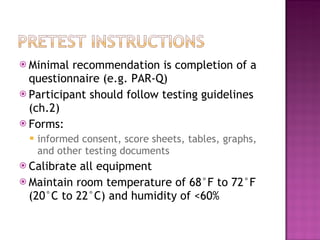
Minimal recommendation is completion of a questionnaire (e.g. PAR-Q)  Participant should follow testing guidelines (ch.2) Forms: informed consent, score sheets, tables, graphs, and other testing documents Calibrate all equipment Maintain room temperature of 68°F to 72°F (20°C to 22°C) and humidity of <60%
Prescreening/risk stratification Resting HR, BP, height, weight, body mass index, ECG (if appropriate) Body composition Cardiorespiratory fitness Muscular strength Muscular endurance Flexibility
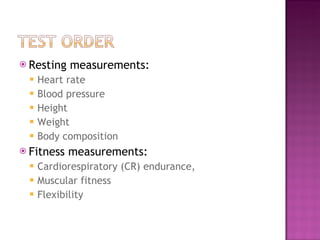
Resting measurements: Heart rate  Blood pressure  Height Weight  Body composition  Fitness measurements:  Cardiorespiratory (CR) endurance, Muscular fitness Flexibility
Anthropometric methods Body mass index Circumferences Skinfold measurements Densitometry Hydrodensitometry (underwater) weighing Plethysmography Other Dual energy x-ray absorptiometry Total body electrical conductivity Bioelectrical impedance analysis  Near-infrared intercadence
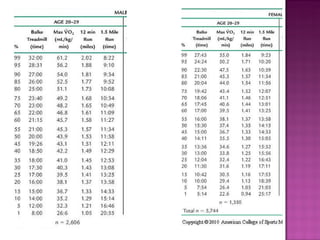
Table 4-2
Table 4-5
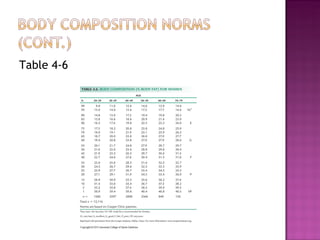
Table 4-6
Low levels of CR fitness associated increased risk of premature death from all causes and specifically from cardiovascular disease. Assessment of CR fitness is an important part of a primary or secondary prevention program Commonly modes for exercise testing :  cycle ergometry tests, treadmill tests, and step tests
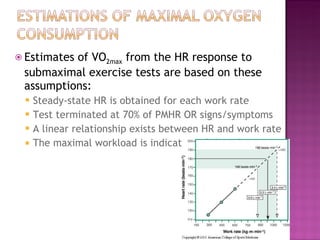
Estimates of VO 2max  from the HR response to submaximal exercise tests are based on these assumptions: Steady-state HR is obtained for each work rate Test terminated at 70% of PMHR OR signs/symptoms A linear relationship exists between HR and work rate The maximal workload is indicative of the VO 2max . .
 
The ability to carry out the activities of daily living, which is related to self-esteem The fat-free mass and resting metabolic rate, which are related to weight management
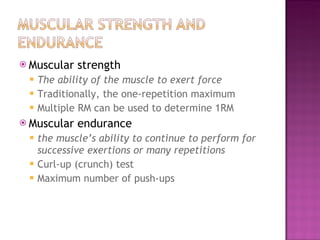
Muscular strength  The ability of the muscle to exert force Traditionally, the one-repetition maximum Multiple RM can be used to determine 1RM  Muscular endurance  the muscle’s ability to continue to perform for successive exertions or many repetitions Curl-up (crunch) test Maximum number of push-ups
Flexibility is the ability to move a joint through its complete range of motion.  Normal Range of Motion for common joints Sit and Reach
The exercise test may be used for diagnostic, prognostic, and therapeutic applications, especially in regard to exercise prescription.
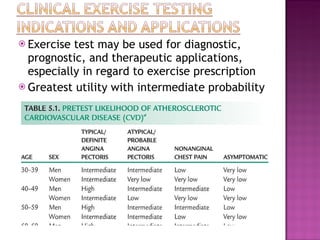
Exercise test may be used for diagnostic, prognostic, and therapeutic applications, especially in regard to exercise prescription Greatest utility with intermediate probability
magnitude of ischemia is proportional to the degree of ST-segment depression high probability of disease to assess residual myocardial ischemia to assess threatening ventricular arrhythmias prognosis rather than for diagnostic purposes Low-level testing provides sufficient data to make recommendations about ability to safely perform activities of daily living
Exercise testing after myocardial infarction can be performed: before or soon after hospital discharge for prognostic assessment, for activity prescription, for evaluation of further medical therapy, and for interventions, including coronary revascularization.
Most common clinical exercise testing treadmill, cycle ergometer, arm ergometer Treadmill testing provides a more common form of physiologic stress handrails for balance and stability, but can reduce the accuracy ECG recording emergency stop button Cycle ergometers  electronically or mechanically braked less movement =better-quality ECG unfamiliar method of exercise  localized leg fatigue=early end Lower values for maximal oxygen consumption Arm ergometry  alternative method  smaller muscle mass =20% to 30% lower V02
Protocol employed should consider:  purpose of the evaluation specific outcomes desired characteristics of the individual being tested (e.g., age, symptomatology) Most common exercise test protocols Bruce Ellestadt Naughton Balke-Ware Ramp
Common variables assessed during clinical exercise testing include:  heart rate and blood pressure ECG changes subjective ratings signs and symptoms expired gases and ventilatory response
Heart rate and blood pressure responses should be measured before, during, and after the GXT. A standardized procedure should be adopted for each laboratory so that baseline measures can be assessed more accurately when repeat testing is performed.
The measurement of perceptual responses during exercise testing can provide useful clinical information.  Ratings of perceived exertion (RPE) and/or specific symptomatic complaints include: degree of chest pain, burning, and discomfort dyspnea lightheadedness leg discomfort/pain.
Situations in which gas exchange and ventilation measurements are appropriate include the following: When a precise cardiopulmonary response to a specific therapeutic intervention is required When the etiology of exercise limitation or dyspnea is uncertain When evaluation of exercise capacity in patients with heart failure is used to assist in the estimation of prognosis and assess the need for cardiac transplantation
If maximal sensitivity is to be achieved with an exercise test, patients should assume a supine position during the postexercise period. In patients who are severely dyspneic, the supine posture may exacerbate the condition, and sitting may be a more appropriate posture.  When the test is being performed for nondiagnostic purposes, an active cool-down usually is preferable. Monitoring should continue for at least 5 minutes after exercise or until ECG changes return to baseline and significant signs and symptoms resolve.
Exercise echocardiography Exercise nuclear imaging Pharmacologic stress testing Computed tomography

Physical Fitness Testing

  • 1.
  • 2.
    Strong relationship withgood health Related to performing daily activities with vigor Associated with low risk of premature development of the hypokinetic diseases
  • 3.
    Educate participants ofhealth-related fitness status Provide data helpful in development of exercise prescriptions Collecting baseline that allow evaluation of exercise program Motivational tool--establish reasonable and attainable fitness goals Stratifying cardiovascular risk
  • 4.
    Minimal recommendation is completionof a questionnaire (e.g. PAR-Q) Participant should follow testing guidelines (ch.2) Forms: informed consent, score sheets, tables, graphs, and other testing documents Calibrate all equipment Maintain room temperature of 68°F to 72°F (20°C to 22°C) and humidity of <60%
  • 5.
    Prescreening/risk stratification RestingHR, BP, height, weight, body mass index, ECG (if appropriate) Body composition Cardiorespiratory fitness Muscular strength Muscular endurance Flexibility
  • 6.
    Resting measurements: Heartrate Blood pressure Height Weight Body composition Fitness measurements: Cardiorespiratory (CR) endurance, Muscular fitness Flexibility
  • 7.
    Anthropometric methods Bodymass index Circumferences Skinfold measurements Densitometry Hydrodensitometry (underwater) weighing Plethysmography Other Dual energy x-ray absorptiometry Total body electrical conductivity Bioelectrical impedance analysis Near-infrared intercadence
  • 8.
  • 9.
  • 10.
  • 11.
    Low levels ofCR fitness associated increased risk of premature death from all causes and specifically from cardiovascular disease. Assessment of CR fitness is an important part of a primary or secondary prevention program Commonly modes for exercise testing : cycle ergometry tests, treadmill tests, and step tests
  • 12.
    Estimates of VO2max from the HR response to submaximal exercise tests are based on these assumptions: Steady-state HR is obtained for each work rate Test terminated at 70% of PMHR OR signs/symptoms A linear relationship exists between HR and work rate The maximal workload is indicative of the VO 2max . .
  • 13.
  • 14.
    The ability tocarry out the activities of daily living, which is related to self-esteem The fat-free mass and resting metabolic rate, which are related to weight management
  • 15.
    Muscular strength The ability of the muscle to exert force Traditionally, the one-repetition maximum Multiple RM can be used to determine 1RM Muscular endurance the muscle’s ability to continue to perform for successive exertions or many repetitions Curl-up (crunch) test Maximum number of push-ups
  • 16.
    Flexibility is theability to move a joint through its complete range of motion. Normal Range of Motion for common joints Sit and Reach
  • 17.
    The exercise testmay be used for diagnostic, prognostic, and therapeutic applications, especially in regard to exercise prescription.
  • 18.
    Exercise test maybe used for diagnostic, prognostic, and therapeutic applications, especially in regard to exercise prescription Greatest utility with intermediate probability
  • 19.
    magnitude of ischemiais proportional to the degree of ST-segment depression high probability of disease to assess residual myocardial ischemia to assess threatening ventricular arrhythmias prognosis rather than for diagnostic purposes Low-level testing provides sufficient data to make recommendations about ability to safely perform activities of daily living
  • 20.
    Exercise testing aftermyocardial infarction can be performed: before or soon after hospital discharge for prognostic assessment, for activity prescription, for evaluation of further medical therapy, and for interventions, including coronary revascularization.
  • 21.
    Most common clinicalexercise testing treadmill, cycle ergometer, arm ergometer Treadmill testing provides a more common form of physiologic stress handrails for balance and stability, but can reduce the accuracy ECG recording emergency stop button Cycle ergometers electronically or mechanically braked less movement =better-quality ECG unfamiliar method of exercise localized leg fatigue=early end Lower values for maximal oxygen consumption Arm ergometry alternative method smaller muscle mass =20% to 30% lower V02
  • 22.
    Protocol employed shouldconsider: purpose of the evaluation specific outcomes desired characteristics of the individual being tested (e.g., age, symptomatology) Most common exercise test protocols Bruce Ellestadt Naughton Balke-Ware Ramp
  • 23.
    Common variables assessedduring clinical exercise testing include: heart rate and blood pressure ECG changes subjective ratings signs and symptoms expired gases and ventilatory response
  • 24.
    Heart rate andblood pressure responses should be measured before, during, and after the GXT. A standardized procedure should be adopted for each laboratory so that baseline measures can be assessed more accurately when repeat testing is performed.
  • 25.
    The measurement ofperceptual responses during exercise testing can provide useful clinical information. Ratings of perceived exertion (RPE) and/or specific symptomatic complaints include: degree of chest pain, burning, and discomfort dyspnea lightheadedness leg discomfort/pain.
  • 26.
    Situations in whichgas exchange and ventilation measurements are appropriate include the following: When a precise cardiopulmonary response to a specific therapeutic intervention is required When the etiology of exercise limitation or dyspnea is uncertain When evaluation of exercise capacity in patients with heart failure is used to assist in the estimation of prognosis and assess the need for cardiac transplantation
  • 27.
    If maximal sensitivityis to be achieved with an exercise test, patients should assume a supine position during the postexercise period. In patients who are severely dyspneic, the supine posture may exacerbate the condition, and sitting may be a more appropriate posture. When the test is being performed for nondiagnostic purposes, an active cool-down usually is preferable. Monitoring should continue for at least 5 minutes after exercise or until ECG changes return to baseline and significant signs and symptoms resolve.
  • 28.
    Exercise echocardiography Exercisenuclear imaging Pharmacologic stress testing Computed tomography

Editor's Notes

  • #7 Testing CR endurance after assessing muscular fitness (which elevates HR) can produce inaccurate results about an individual’s CR endurance status, particularly when tests using HR to predict aerobic fitness are used. Dehydration resulting from CR endurance tests might influence body composition values if measured by bioelectrical impedance analysis (BIA). Because certain medications, such as beta-blockers, which lower HR, will affect some fitness test results, use of these medications should be noted.