
1
Saad Abdul Wahab
M.Sc Applied Chemistry & Chemical Technology | Sp. In Petroleum & Petrochemicals
IOSH, IRCA LA OHSAS, HABC, Authorized Safety Trainer GI-123 by DG FCD, HIRARC by NILAT
Awareness Certifications of EMS-14001, OSHAS-18001, QMS-9001:2008, FSMS-
22000:2005, SSCL (17025) by SGS, MATLAB, PM by ICCBS,
Recognized from FCDTS, NILAT, SGS, PHMA, NFEH, EVI, SFTI, IOSH, HABC
 Safety in the workplace is an important issue
for small businesses. With the rising cost of
workers' compensation insurance and the
need to keep employees happy and
healthy, taking precautions to reduce
workplace accidents is a vital part of running
a small business. No matter what industry
you are in, workers have the potential of
being injured. By following set protocols and
identifying potential risks, you can reduce the
number of accidents and make the
workplace safer.
2
 One of the social consequences of work-
related musculo-skeletal disorders
(MSDs) is a decrease in workers' ability to
provide care to family outside of work.
 Study participants reported a significant
reduction in the amount of time spent in
unpaid caregiving activities while they
recovered from a work-related MSD.
3
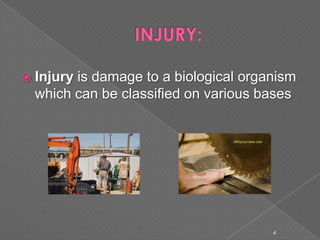
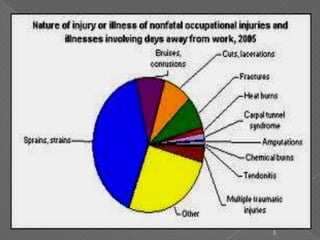
 Injury is damage to a biological organism
which can be classified on various bases
4
5
 There are five categories of incidents you
may have to report on:
 Near miss – an incident or accident in
which a person just avoids being injured
 Damage to plant or equipment – a serious
occurrence but one in which n-one is hurt
 Minor injury – this could highlight a more
serious safety problem
 Major injury – a serious incident
 Work-related travel injury – occurs while a
worker is travelling to or from work
6
Workplace injuries can happen to anyone in any
field, which is why even small offices carry workers’
comp insurance. If you are hurt at work in the course of
your duties, your company’s workers’ comp benefits
may cover the cost of your care. To ensure your ability
to receive coverage however, you must follow proper
procedures from the moment a workplace injury
occurs.
7
In cases of serious injury requiring immediate
treatment, you may inform your employer after
your situation has stabilized. If
possible, however, you should notify your
employer in writing prior to seeking treatment.
Workers’ comp insurance plans vary, and some
may require you to see a specific provider or
undergo certain tests. Seeking treatment without
following these guidelines can hurt your ability to
receive workers’ compensation benefits.
8
Both you and your employer should write down
every relevant detail throughout the process of filing
your workers’ compensation claim. If your workers’
compensation insurance policy has restrictions,
your employer is required by law to outline those for
you. This can be done verbally, but must be backed
up in writing within a specific time frame. This is
usually a week or less, but laws vary by state.
9
Although state laws are different, your ability to
receive workman’s compensation for an on-the-job
injury is protected nationally. If you follow
procedure by documenting everything and visiting
only approved providers and your employer still
attempts to deny your claim, you may require a
workers’ comp lawyer.
10
Ideally your workplace injury will be covered and
your medical bills paid without too much
hassle, however that isn’t necessarily the case. For
example, carpal tunnel and other repetitive use
injuries, by their nature, can’t be reported at the
moment they begin. A workers’ comp lawyer can
expertly help you obtain and organize your medical
records to prove your diagnosis resulted from a
workplace injury.
11
If your employer attempts to dissuade you from
filing a claim, consider this a red flag, and consult a
workers’ comp lawyer. Your boss may say that the
health insurance he provides should cover your
workplace injury, but it usually won’t. Health care
providers are trained to recognize workplace
injuries, and these will be denied by health
insurance if there is another insuring body
responsible.
12
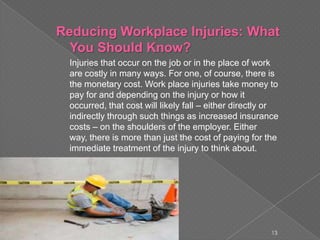
Reducing Workplace Injuries: What
You Should Know?
Injuries that occur on the job or in the place of work
are costly in many ways. For one, of course, there is
the monetary cost. Work place injuries take money to
pay for and depending on the injury or how it
occurred, that cost will likely fall – either directly or
indirectly through such things as increased insurance
costs – on the shoulders of the employer. Either
way, there is more than just the cost of paying for the
immediate treatment of the injury to think about.
13
Workplace Injury Prevention:
 Clear all physical obstacles:
Don’t let something that would have been easily preventable now
become something that is difficult to deal with later. Make sure there are
no cords across walkways, slick floors that could have water spilled on
them and become a slippery hazard, etc.
 Mix up tasks for employees:
Give people some variety in their daily life at work. Not only will it
stimulate their minds better but it will keep them from getting a repetitive
stress injury. This can apply to both people who have to do heavy lifting
every day to keep them from hurting their backs or desk workers.
 Have an on-site clinic and medical staff:
Even if it’s only a small facility, having a well-stocked on-site work clinic
with a properly trained doctor or nurse available to treat minor injuries or
medical emergencies can be a great help to keep a small issue from
becoming a big one. At the very least, ensuring the proper medical
equipment are on hand is a must.
 Properly train all employees:
With proper training you’re doing your due diligence to keep your
employees safe. Have monthly meetings to teach new
practices, monitor the safety of employees regularly, discipline
employees who are not taking proper precautions, and developing the
proper manuals for new employees to gain information about your
safety practices.
14
By law the types of injuries that must be reported include:
 Injury that results in the death of an employee
 Fracture of the skull, spine or pelvis
 Fracture of any bone in the arm or leg
 Loss of sight
 Injury resulting in a likely absence from work of 10 or more
working days
15
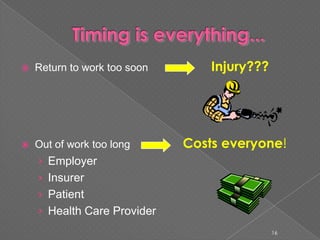
 Return to work too soon Injury???
 Out of work too long Costs everyone!
› Employer
› Insurer
› Patient
› Health Care Provider
16
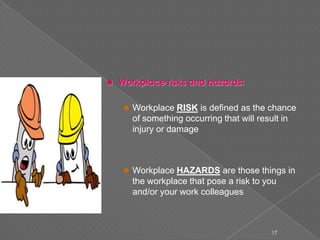
 Workplace risks and hazards:
 Workplace RISK is defined as the chance
of something occurring that will result in
injury or damage
 Workplace HAZARDS are those things in
the workplace that pose a risk to you
and/or your work colleagues
17
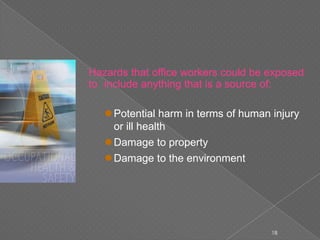
Hazards that office workers could be exposed
to include anything that is a source of:
Potential harm in terms of human injury
or ill health
Damage to property
Damage to the environment
18
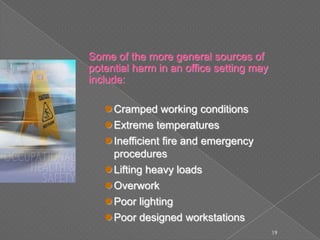
Some of the more general sources of
potential harm in an office setting may
include:
Cramped working conditions
Extreme temperatures
Inefficient fire and emergency
procedures
Lifting heavy loads
Overwork
Poor lighting
Poor designed workstations
19
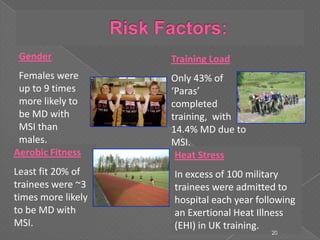
Gender
Females were
up to 9 times
more likely to
be MD with
MSI than
males.
Training Load
Only 43% of
‘Paras’
completed
training, with
14.4% MD due to
MSI.
Aerobic Fitness
Least fit 20% of
trainees were ~3
times more likely
to be MD with
MSI.
Heat Stress
In excess of 100 military
trainees were admitted to
hospital each year following
an Exertional Heat Illness
(EHI) in UK training.
20
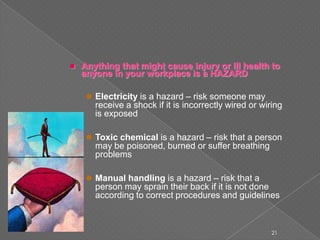
 Anything that might cause injury or ill health to
anyone in your workplace is a HAZARD
 Electricity is a hazard – risk someone may
receive a shock if it is incorrectly wired or wiring
is exposed
 Toxic chemical is a hazard – risk that a person
may be poisoned, burned or suffer breathing
problems
 Manual handling is a hazard – risk that a
person may sprain their back if it is not done
according to correct procedures and guidelines
21
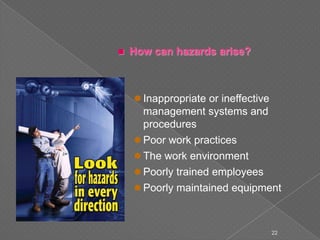
 How can hazards arise?
 Inappropriate or ineffective
management systems and
procedures
 Poor work practices
 The work environment
 Poorly trained employees
 Poorly maintained equipment
22
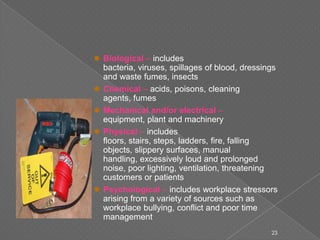
 Biological – includes
bacteria, viruses, spillages of blood, dressings
and waste fumes, insects
 Chemical – acids, poisons, cleaning
agents, fumes
 Mechanical and/or electrical –
equipment, plant and machinery
 Physical – includes
floors, stairs, steps, ladders, fire, falling
objects, slippery surfaces, manual
handling, excessively loud and prolonged
noise, poor lighting, ventilation, threatening
customers or patients
 Psychological – includes workplace stressors
arising from a variety of sources such as
workplace bullying, conflict and poor time
management
23
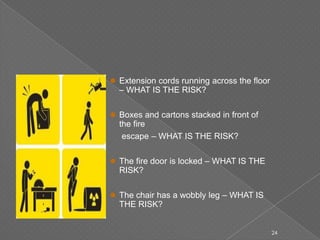
 Extension cords running across the floor
– WHAT IS THE RISK?
 Boxes and cartons stacked in front of
the fire
escape – WHAT IS THE RISK?
 The fire door is locked – WHAT IS THE
RISK?
 The chair has a wobbly leg – WHAT IS
THE RISK?
24
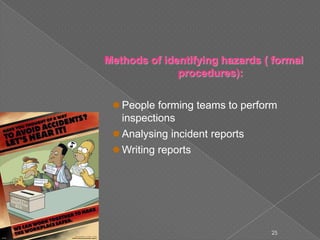
Methods of identifying hazards ( formal
procedures):
 People forming teams to perform
inspections
 Analysing incident reports
 Writing reports
25
Five types of activities to controlling risks:
 Hazard identification – finding the hazards that already
exist in your organisation
 Hazard elimination – reducing the potential for accidents
to occur
 Training – Induction training to show workers how to
operate machinery/equipment safely and to eliminate risks
 Monitoring – constantly checking to see that safe work
practices are been followed and procedures are updated
when required
 Reporting – Informing and writing down all OH&S issues
when they occur
26
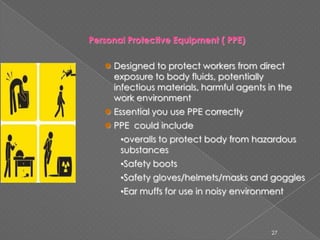
Personal Protective Equipment ( PPE)
 Designed to protect workers from direct
exposure to body fluids, potentially
infectious materials, harmful agents in the
work environment
 Essential you use PPE correctly
 PPE could include
•overalls to protect body from hazardous
substances
•Safety boots
•Safety gloves/helmets/masks and goggles
•Ear muffs for use in noisy environment
27
28
29
 Safety in the workplace is very important issue
for all businesses.
 We can reduce workplace injuries through
proper safety and prevention.
30
31

Reducing and minimizing workplace injuries

  • 1.
    1 Saad Abdul Wahab M.ScApplied Chemistry & Chemical Technology | Sp. In Petroleum & Petrochemicals IOSH, IRCA LA OHSAS, HABC, Authorized Safety Trainer GI-123 by DG FCD, HIRARC by NILAT Awareness Certifications of EMS-14001, OSHAS-18001, QMS-9001:2008, FSMS- 22000:2005, SSCL (17025) by SGS, MATLAB, PM by ICCBS, Recognized from FCDTS, NILAT, SGS, PHMA, NFEH, EVI, SFTI, IOSH, HABC
  • 2.
     Safety inthe workplace is an important issue for small businesses. With the rising cost of workers' compensation insurance and the need to keep employees happy and healthy, taking precautions to reduce workplace accidents is a vital part of running a small business. No matter what industry you are in, workers have the potential of being injured. By following set protocols and identifying potential risks, you can reduce the number of accidents and make the workplace safer. 2
  • 3.
     One ofthe social consequences of work- related musculo-skeletal disorders (MSDs) is a decrease in workers' ability to provide care to family outside of work.  Study participants reported a significant reduction in the amount of time spent in unpaid caregiving activities while they recovered from a work-related MSD. 3
  • 4.
     Injury isdamage to a biological organism which can be classified on various bases 4
  • 5.
  • 6.
     There arefive categories of incidents you may have to report on:  Near miss – an incident or accident in which a person just avoids being injured  Damage to plant or equipment – a serious occurrence but one in which n-one is hurt  Minor injury – this could highlight a more serious safety problem  Major injury – a serious incident  Work-related travel injury – occurs while a worker is travelling to or from work 6
  • 7.
    Workplace injuries canhappen to anyone in any field, which is why even small offices carry workers’ comp insurance. If you are hurt at work in the course of your duties, your company’s workers’ comp benefits may cover the cost of your care. To ensure your ability to receive coverage however, you must follow proper procedures from the moment a workplace injury occurs. 7
  • 8.
    In cases ofserious injury requiring immediate treatment, you may inform your employer after your situation has stabilized. If possible, however, you should notify your employer in writing prior to seeking treatment. Workers’ comp insurance plans vary, and some may require you to see a specific provider or undergo certain tests. Seeking treatment without following these guidelines can hurt your ability to receive workers’ compensation benefits. 8
  • 9.
    Both you andyour employer should write down every relevant detail throughout the process of filing your workers’ compensation claim. If your workers’ compensation insurance policy has restrictions, your employer is required by law to outline those for you. This can be done verbally, but must be backed up in writing within a specific time frame. This is usually a week or less, but laws vary by state. 9
  • 10.
    Although state lawsare different, your ability to receive workman’s compensation for an on-the-job injury is protected nationally. If you follow procedure by documenting everything and visiting only approved providers and your employer still attempts to deny your claim, you may require a workers’ comp lawyer. 10
  • 11.
    Ideally your workplaceinjury will be covered and your medical bills paid without too much hassle, however that isn’t necessarily the case. For example, carpal tunnel and other repetitive use injuries, by their nature, can’t be reported at the moment they begin. A workers’ comp lawyer can expertly help you obtain and organize your medical records to prove your diagnosis resulted from a workplace injury. 11
  • 12.
    If your employerattempts to dissuade you from filing a claim, consider this a red flag, and consult a workers’ comp lawyer. Your boss may say that the health insurance he provides should cover your workplace injury, but it usually won’t. Health care providers are trained to recognize workplace injuries, and these will be denied by health insurance if there is another insuring body responsible. 12
  • 13.
    Reducing Workplace Injuries:What You Should Know? Injuries that occur on the job or in the place of work are costly in many ways. For one, of course, there is the monetary cost. Work place injuries take money to pay for and depending on the injury or how it occurred, that cost will likely fall – either directly or indirectly through such things as increased insurance costs – on the shoulders of the employer. Either way, there is more than just the cost of paying for the immediate treatment of the injury to think about. 13
  • 14.
    Workplace Injury Prevention: Clear all physical obstacles: Don’t let something that would have been easily preventable now become something that is difficult to deal with later. Make sure there are no cords across walkways, slick floors that could have water spilled on them and become a slippery hazard, etc.  Mix up tasks for employees: Give people some variety in their daily life at work. Not only will it stimulate their minds better but it will keep them from getting a repetitive stress injury. This can apply to both people who have to do heavy lifting every day to keep them from hurting their backs or desk workers.  Have an on-site clinic and medical staff: Even if it’s only a small facility, having a well-stocked on-site work clinic with a properly trained doctor or nurse available to treat minor injuries or medical emergencies can be a great help to keep a small issue from becoming a big one. At the very least, ensuring the proper medical equipment are on hand is a must.  Properly train all employees: With proper training you’re doing your due diligence to keep your employees safe. Have monthly meetings to teach new practices, monitor the safety of employees regularly, discipline employees who are not taking proper precautions, and developing the proper manuals for new employees to gain information about your safety practices. 14
  • 15.
    By law thetypes of injuries that must be reported include:  Injury that results in the death of an employee  Fracture of the skull, spine or pelvis  Fracture of any bone in the arm or leg  Loss of sight  Injury resulting in a likely absence from work of 10 or more working days 15
  • 16.
     Return towork too soon Injury???  Out of work too long Costs everyone! › Employer › Insurer › Patient › Health Care Provider 16
  • 17.
     Workplace risksand hazards:  Workplace RISK is defined as the chance of something occurring that will result in injury or damage  Workplace HAZARDS are those things in the workplace that pose a risk to you and/or your work colleagues 17
  • 18.
    Hazards that officeworkers could be exposed to include anything that is a source of: Potential harm in terms of human injury or ill health Damage to property Damage to the environment 18
  • 19.
    Some of themore general sources of potential harm in an office setting may include: Cramped working conditions Extreme temperatures Inefficient fire and emergency procedures Lifting heavy loads Overwork Poor lighting Poor designed workstations 19
  • 20.
    Gender Females were up to9 times more likely to be MD with MSI than males. Training Load Only 43% of ‘Paras’ completed training, with 14.4% MD due to MSI. Aerobic Fitness Least fit 20% of trainees were ~3 times more likely to be MD with MSI. Heat Stress In excess of 100 military trainees were admitted to hospital each year following an Exertional Heat Illness (EHI) in UK training. 20
  • 21.
     Anything thatmight cause injury or ill health to anyone in your workplace is a HAZARD  Electricity is a hazard – risk someone may receive a shock if it is incorrectly wired or wiring is exposed  Toxic chemical is a hazard – risk that a person may be poisoned, burned or suffer breathing problems  Manual handling is a hazard – risk that a person may sprain their back if it is not done according to correct procedures and guidelines 21
  • 22.
     How canhazards arise?  Inappropriate or ineffective management systems and procedures  Poor work practices  The work environment  Poorly trained employees  Poorly maintained equipment 22
  • 23.
     Biological –includes bacteria, viruses, spillages of blood, dressings and waste fumes, insects  Chemical – acids, poisons, cleaning agents, fumes  Mechanical and/or electrical – equipment, plant and machinery  Physical – includes floors, stairs, steps, ladders, fire, falling objects, slippery surfaces, manual handling, excessively loud and prolonged noise, poor lighting, ventilation, threatening customers or patients  Psychological – includes workplace stressors arising from a variety of sources such as workplace bullying, conflict and poor time management 23
  • 24.
     Extension cordsrunning across the floor – WHAT IS THE RISK?  Boxes and cartons stacked in front of the fire escape – WHAT IS THE RISK?  The fire door is locked – WHAT IS THE RISK?  The chair has a wobbly leg – WHAT IS THE RISK? 24
  • 25.
    Methods of identifyinghazards ( formal procedures):  People forming teams to perform inspections  Analysing incident reports  Writing reports 25
  • 26.
    Five types ofactivities to controlling risks:  Hazard identification – finding the hazards that already exist in your organisation  Hazard elimination – reducing the potential for accidents to occur  Training – Induction training to show workers how to operate machinery/equipment safely and to eliminate risks  Monitoring – constantly checking to see that safe work practices are been followed and procedures are updated when required  Reporting – Informing and writing down all OH&S issues when they occur 26
  • 27.
    Personal Protective Equipment( PPE)  Designed to protect workers from direct exposure to body fluids, potentially infectious materials, harmful agents in the work environment  Essential you use PPE correctly  PPE could include •overalls to protect body from hazardous substances •Safety boots •Safety gloves/helmets/masks and goggles •Ear muffs for use in noisy environment 27
  • 28.
  • 29.
  • 30.
     Safety inthe workplace is very important issue for all businesses.  We can reduce workplace injuries through proper safety and prevention. 30
  • 31.