6.1 The nature of energy and types of energy
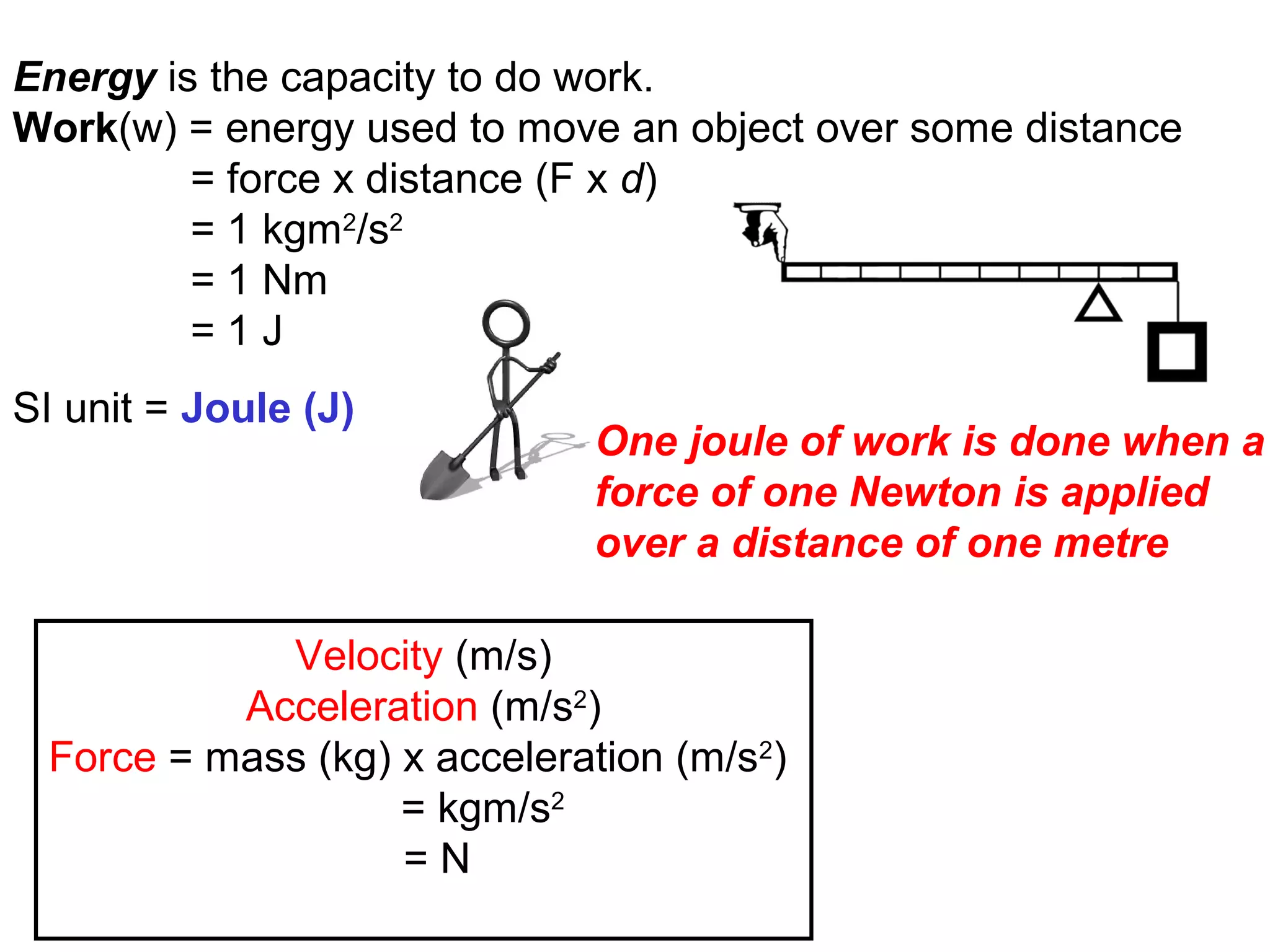
Energy is the capacity to do work.
Work(w) = energy used to move an object over some distance
= force x distance (F x d)
= 1 kgm2
/s2
= 1 Nm
= 1 J
SI unit = Joule (J)
Velocity (m/s)
Acceleration (m/s2
)
Force = mass (kg) x acceleration (m/s2
)
= kgm/s2
= N
One joule of work is done when a
force of one Newton is applied
over a distance of one metre
Types of energy
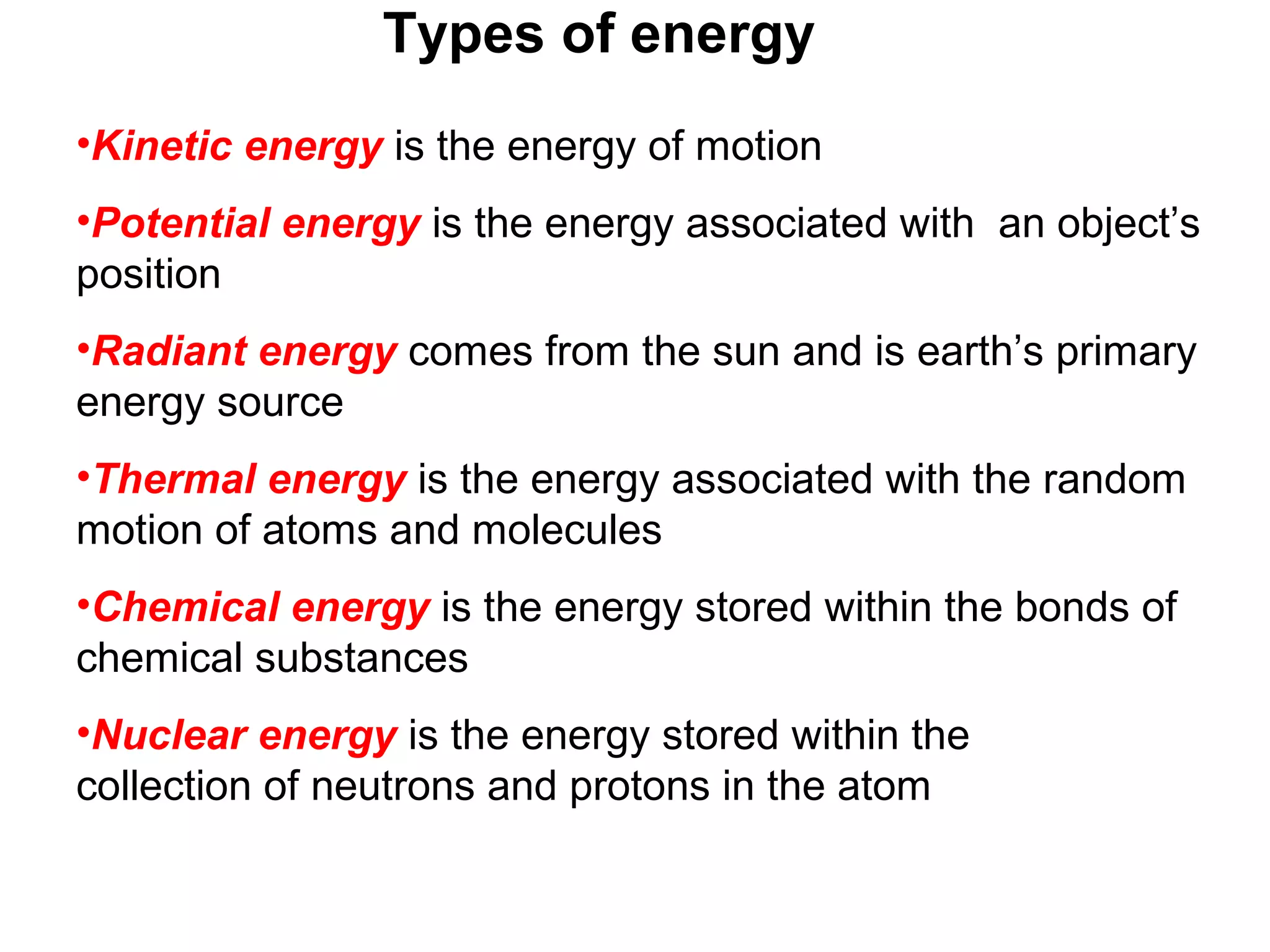
•Kinetic energy is the energy of motion
•Potential energy is the energy associated with an object’s
position
•Radiant energy comes from the sun and is earth’s primary
energy source
•Thermal energy is the energy associated with the random
motion of atoms and molecules
•Chemical energy is the energy stored within the bonds of
chemical substances
•Nuclear energy is the energy stored within the
collection of neutrons and protons in the atom
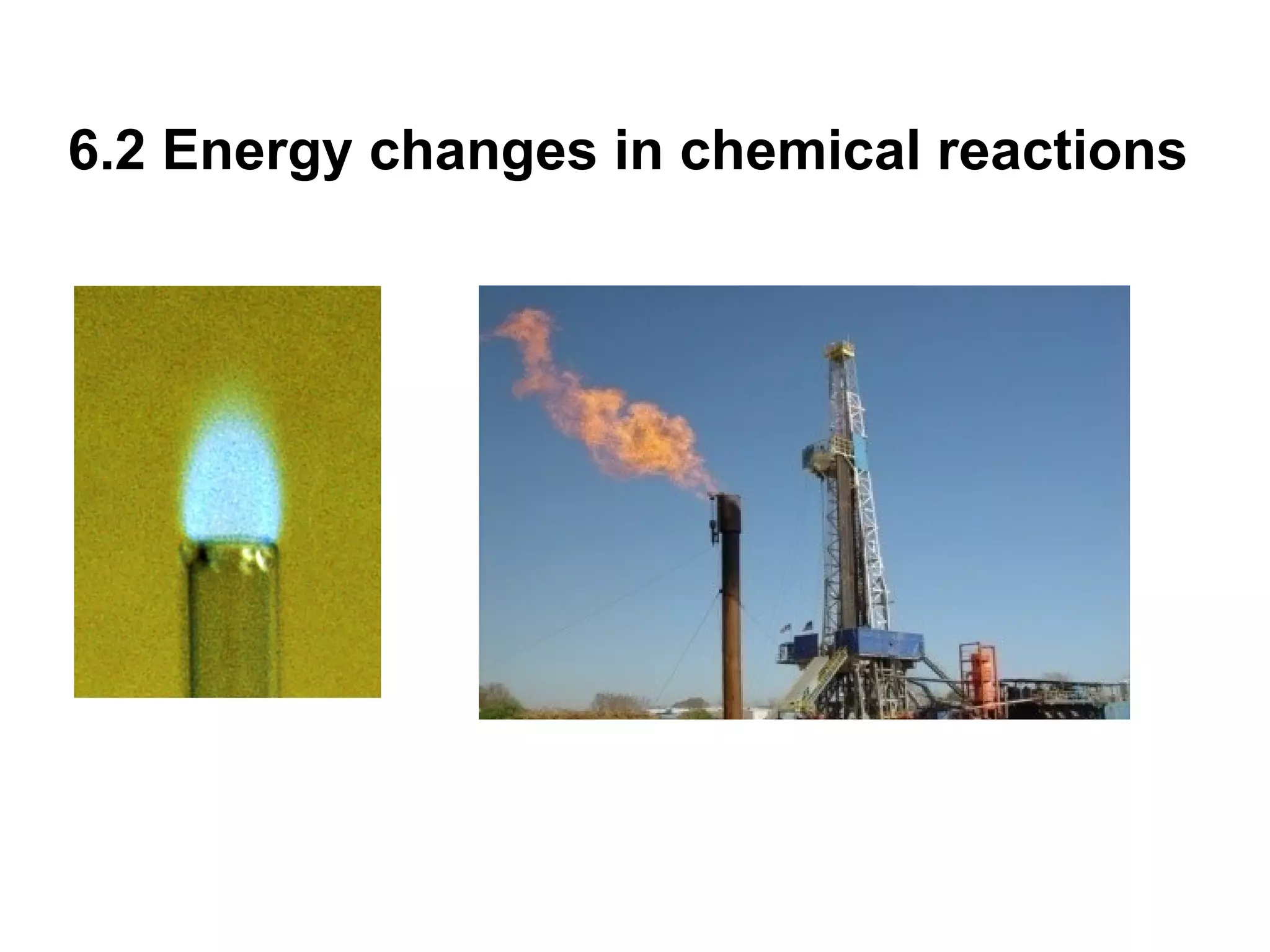
6.2 Energy changes in chemical reactions
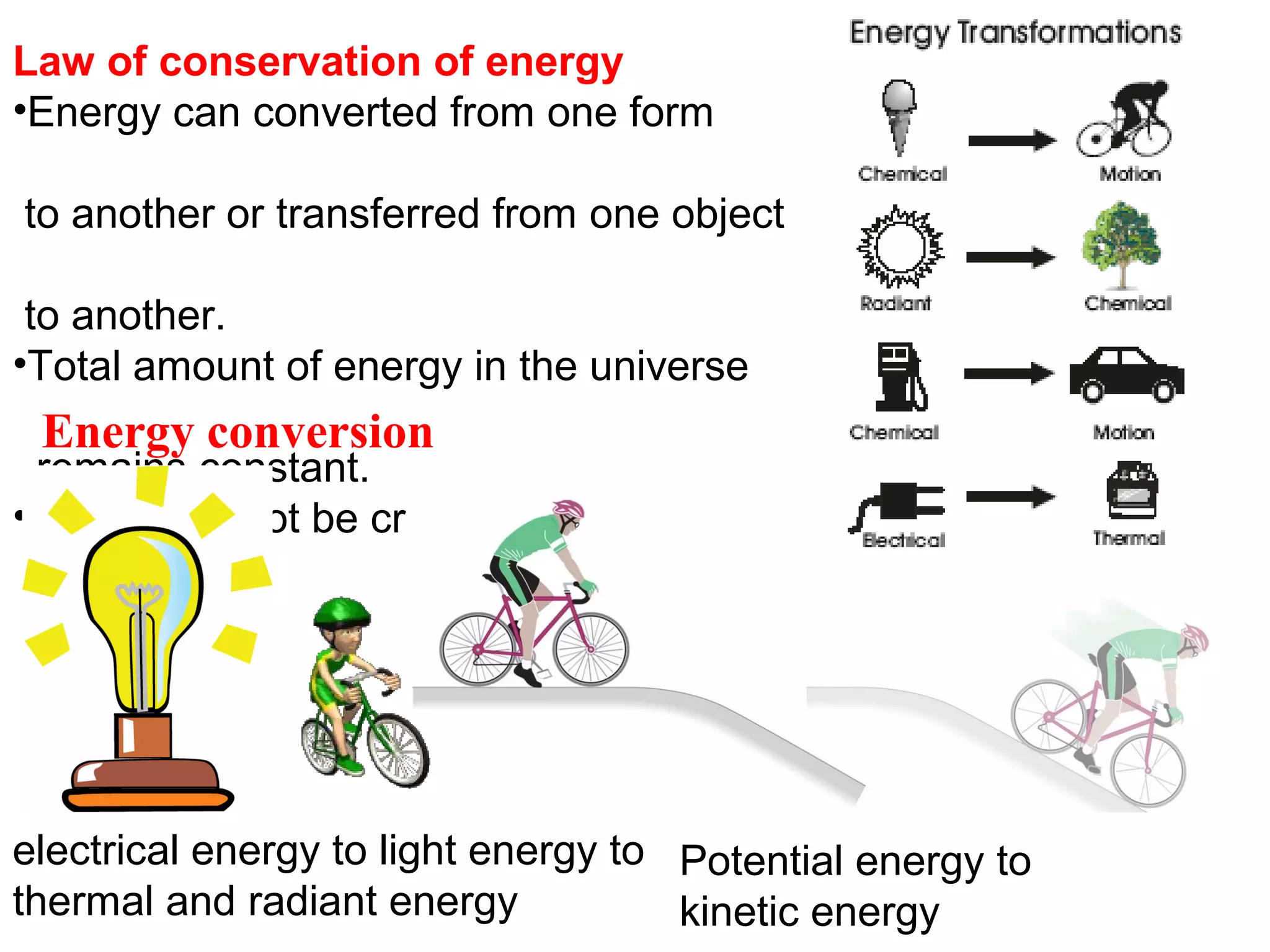
Law of conservation of energy
•Energy can converted from one form
to another or transferred from one object
to another.
•Total amount of energy in the universe
remains constant.
•Energy cannot be created or destroyed.
electrical energy to light energy to
thermal and radiant energy
Potential energy to
kinetic energy
Energy conversion
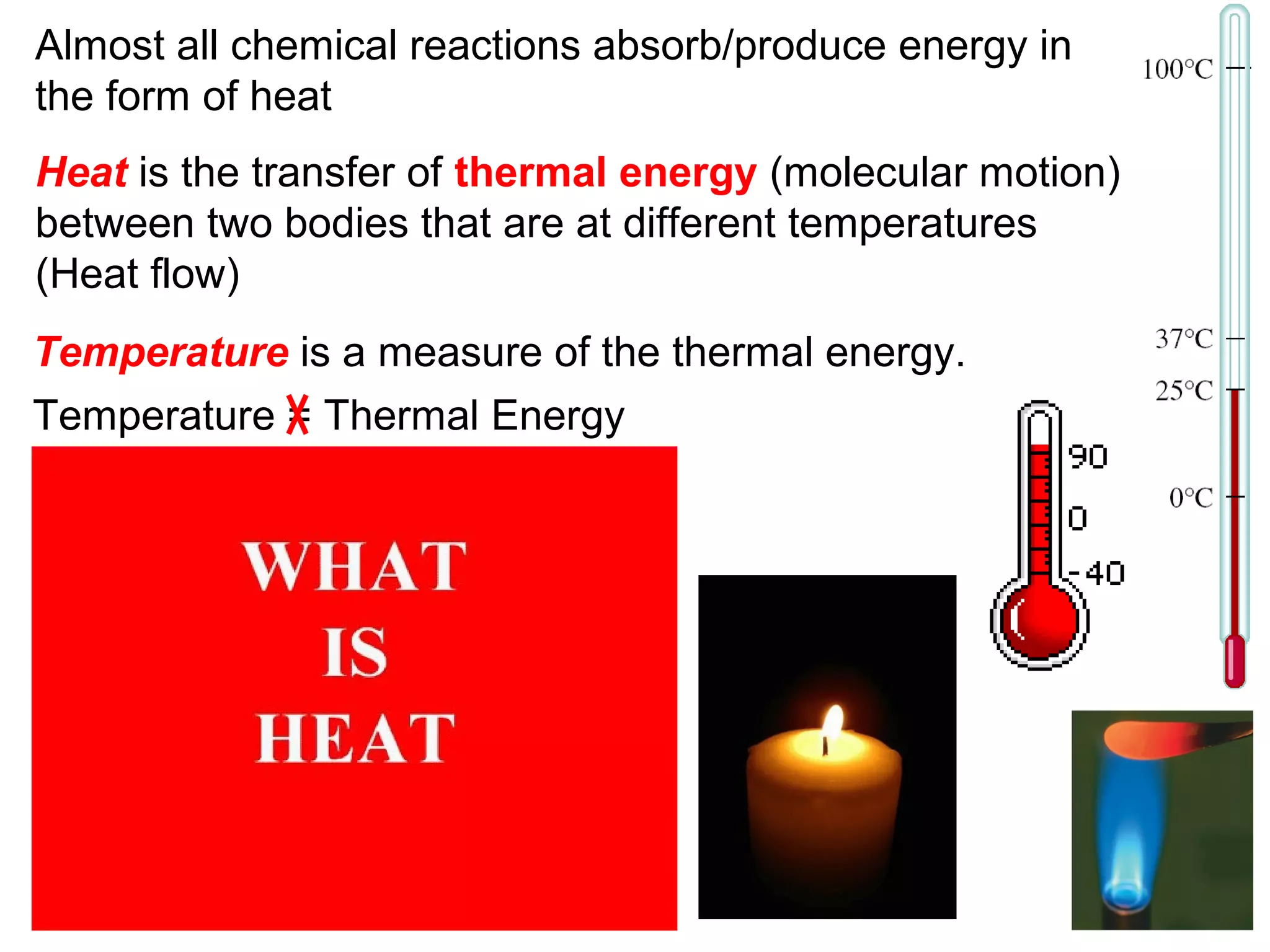
Heat is the transfer of thermal energy (molecular motion)
between two bodies that are at different temperatures
(Heat flow)
Temperature is a measure of the thermal energy.
Temperature = Thermal Energy
Almost all chemical reactions absorb/produce energy in
the form of heat
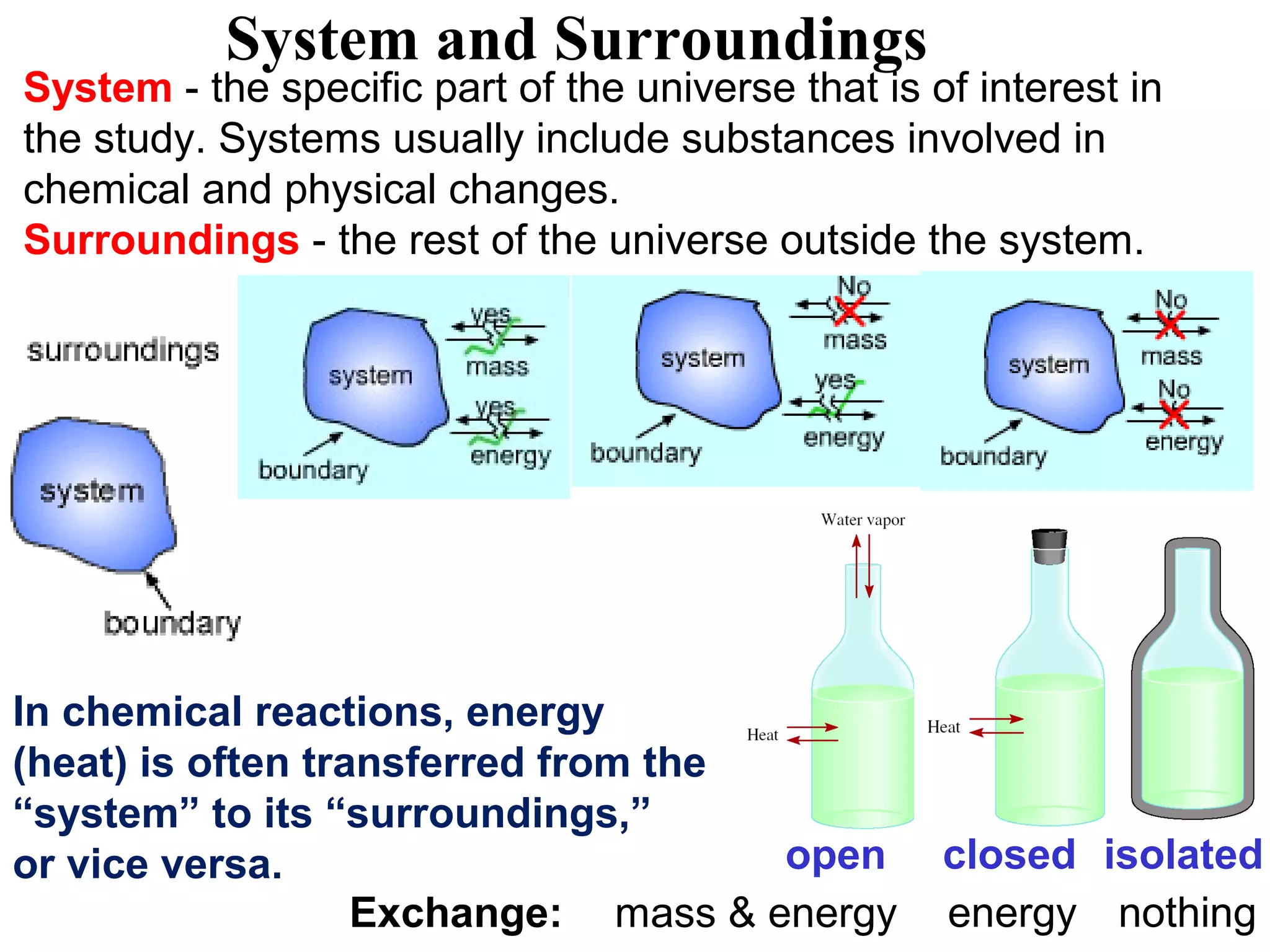
open
mass & energyExchange:
closed
energy
isolated
nothing
In chemical reactions, energy
(heat) is often transferred from the
“system” to its “surroundings,”
or vice versa.
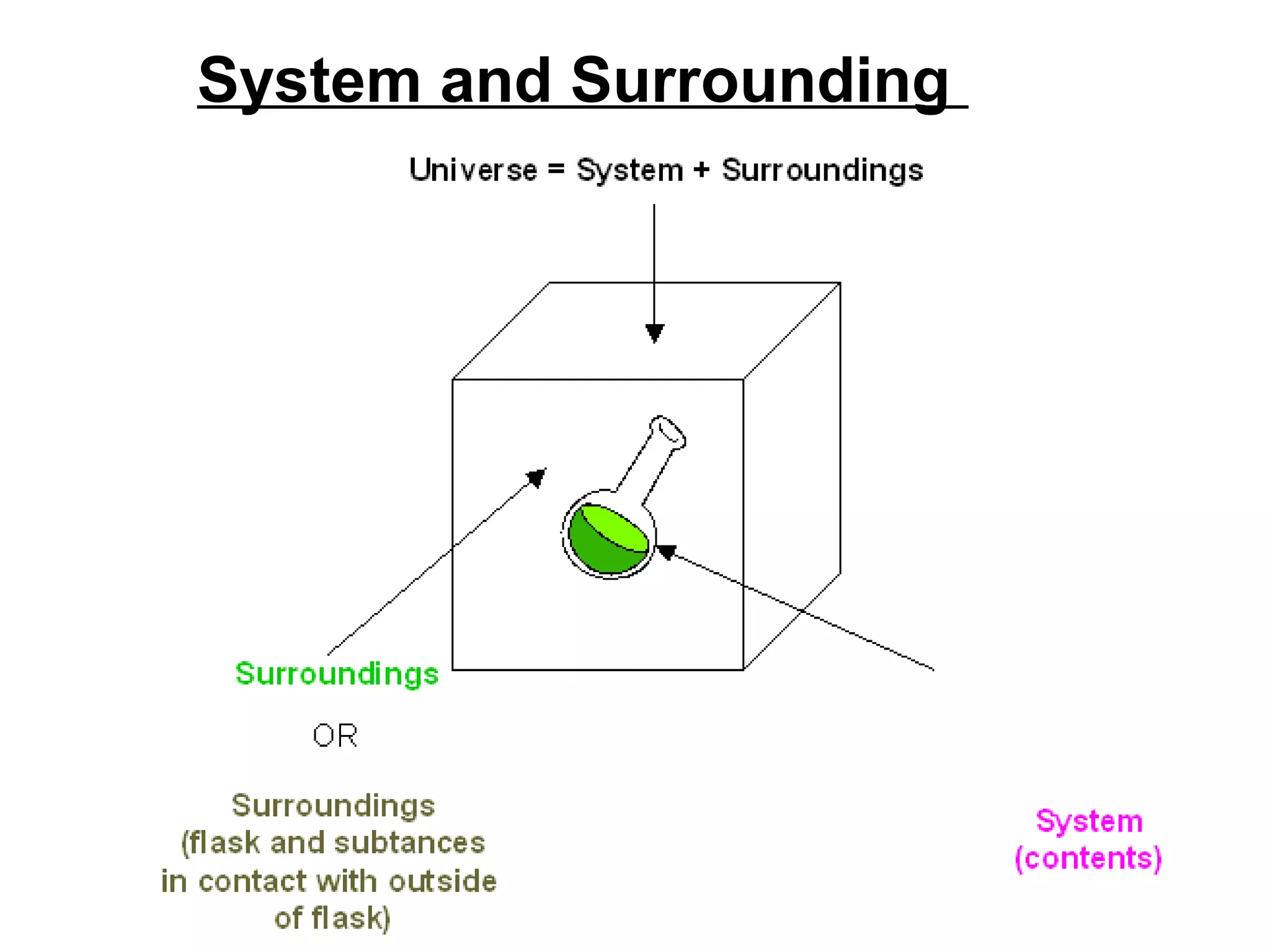
System and Surroundings
System - the specific part of the universe that is of interest in
the study. Systems usually include substances involved in
chemical and physical changes.
Surroundings - the rest of the universe outside the system.
System and Surrounding
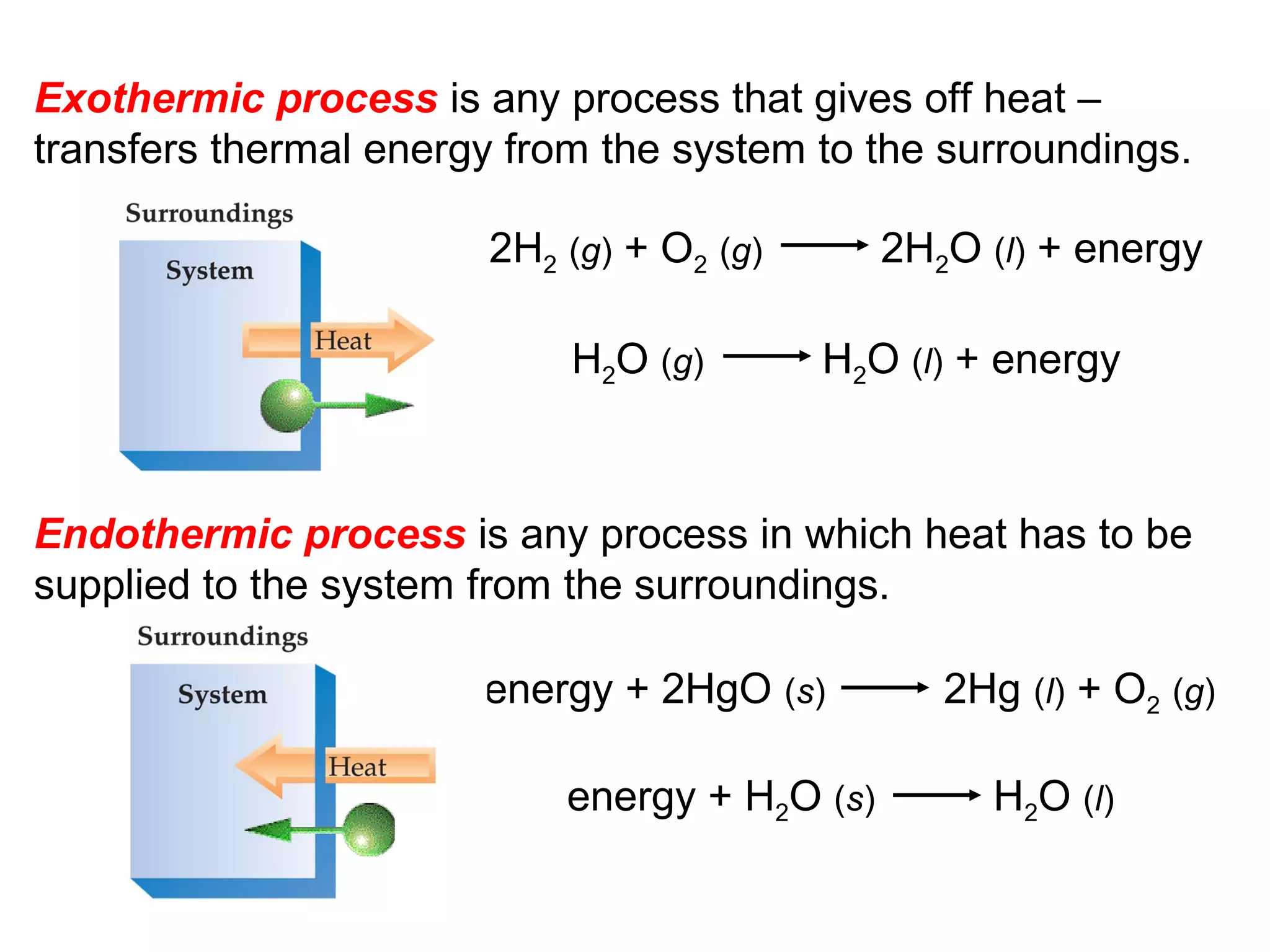
Exothermic process is any process that gives off heat –
transfers thermal energy from the system to the surroundings.
Endothermic process is any process in which heat has to be
supplied to the system from the surroundings.
2H2 (g) + O2 (g) 2H2O (l) + energy
H2O (g) H2O (l) + energy
energy + 2HgO (s) 2Hg (l) + O2 (g)
energy + H2O (s) H2O (l)
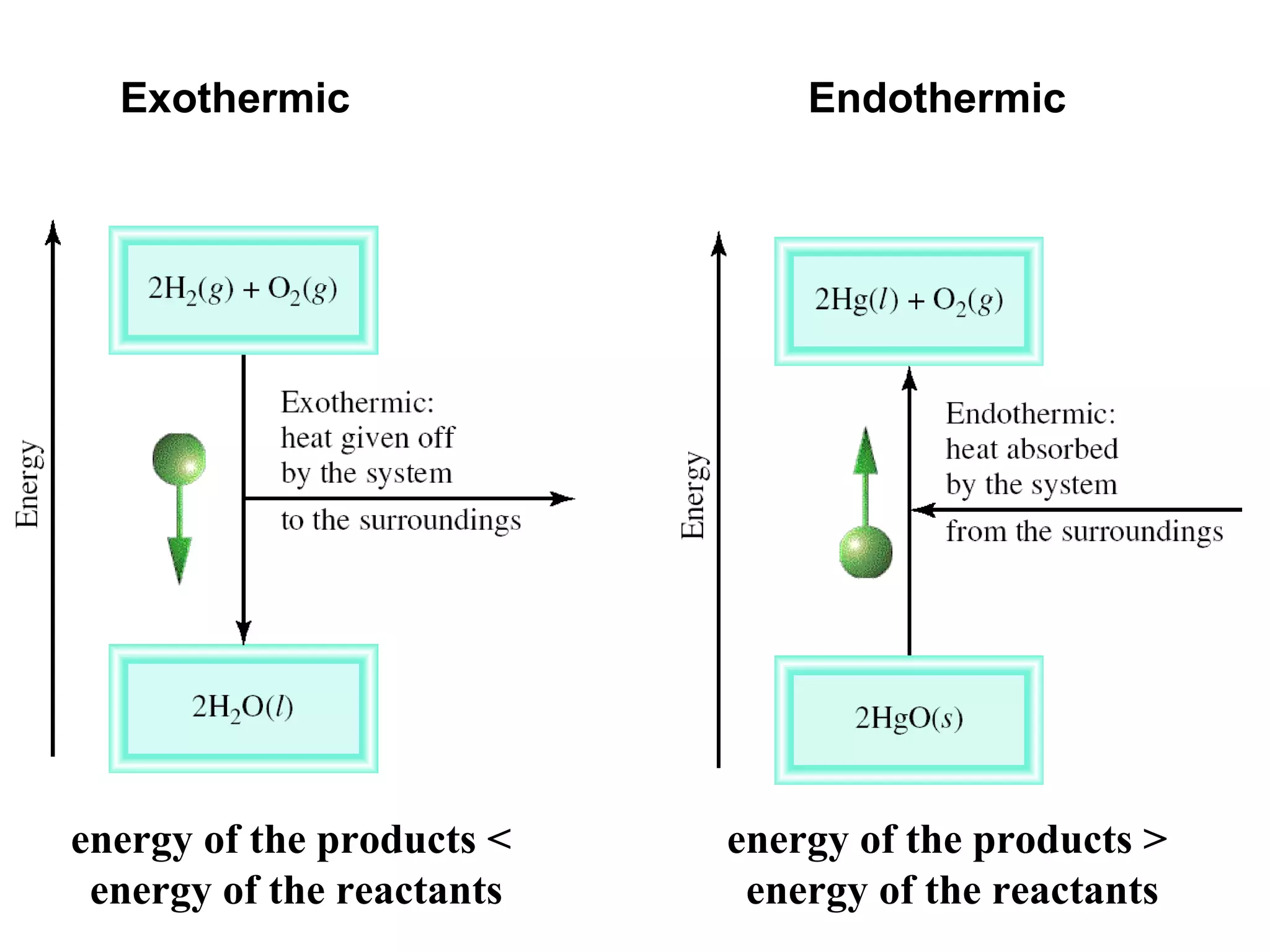
Exothermic Endothermic
energy of the products >
energy of the reactants
energy of the products <
energy of the reactants
6.3 Introduction to thermodynamics
Thermodynamic = scientific study of the interconversion of
heat and other kinds of energy
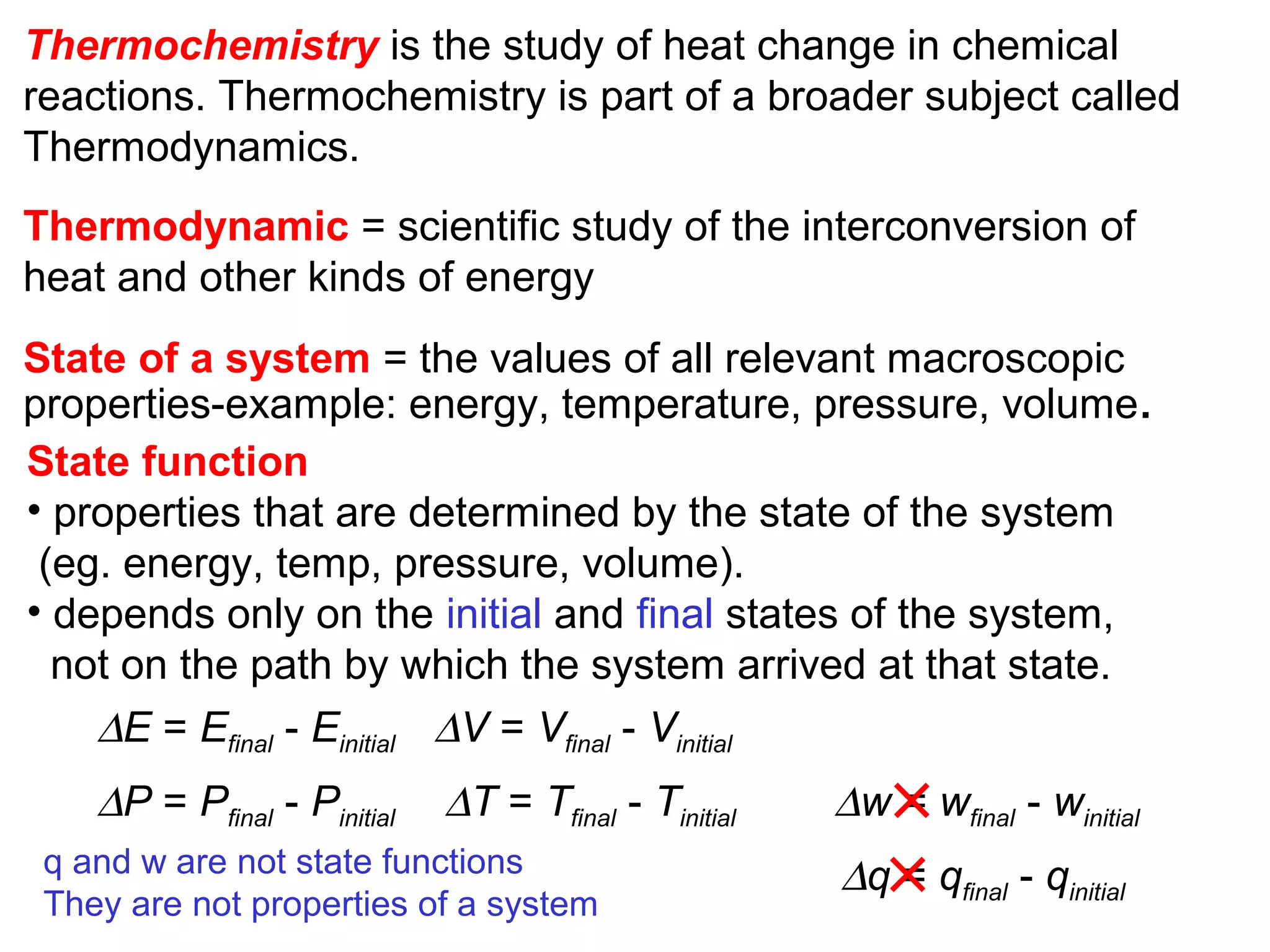
State function
• properties that are determined by the state of the system
(eg. energy, temp, pressure, volume).
• depends only on the initial and final states of the system,
not on the path by which the system arrived at that state.
∆E = Efinal - Einitial
∆P = Pfinal - Pinitial
∆V = Vfinal - Vinitial
∆T = Tfinal - Tinitial
State of a system = the values of all relevant macroscopic
properties-example: energy, temperature, pressure, volume.
Thermochemistry is the study of heat change in chemical
reactions. Thermochemistry is part of a broader subject called
Thermodynamics.
q and w are not state functions
They are not properties of a system
∆w = wfinal - winitial
∆q = qfinal - qinitial
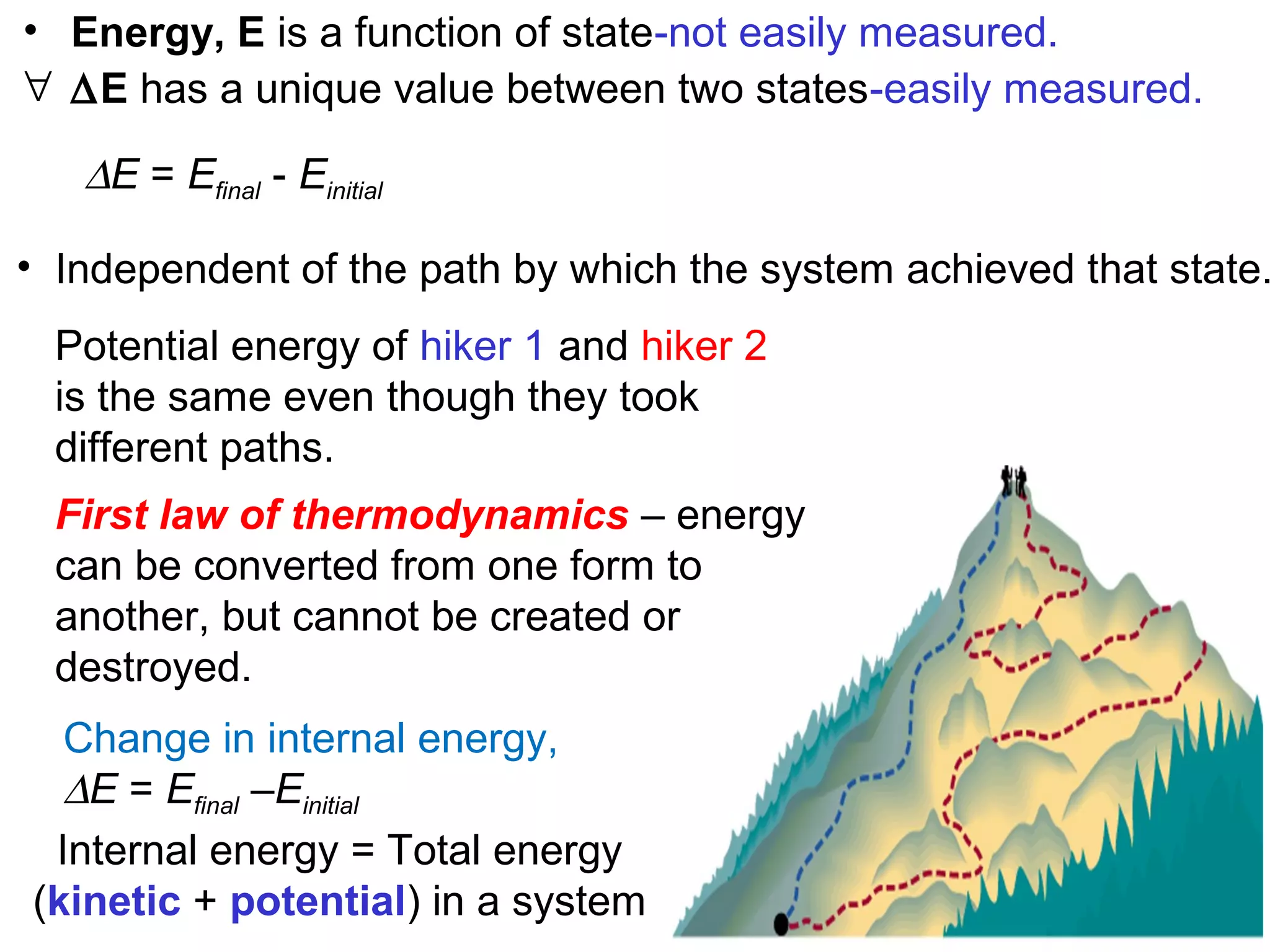
Potential energy of hiker 1 and hiker 2
is the same even though they took
different paths.
∆E = Efinal - Einitial
• Independent of the path by which the system achieved that state.
• Energy, E is a function of state-not easily measured.
∀ ∆E has a unique value between two states-easily measured.
First law of thermodynamics – energy
can be converted from one form to
another, but cannot be created or
destroyed.
Change in internal energy,
∆E = Efinal –Einitial
Internal energy = Total energy
(kinetic + potential) in a system
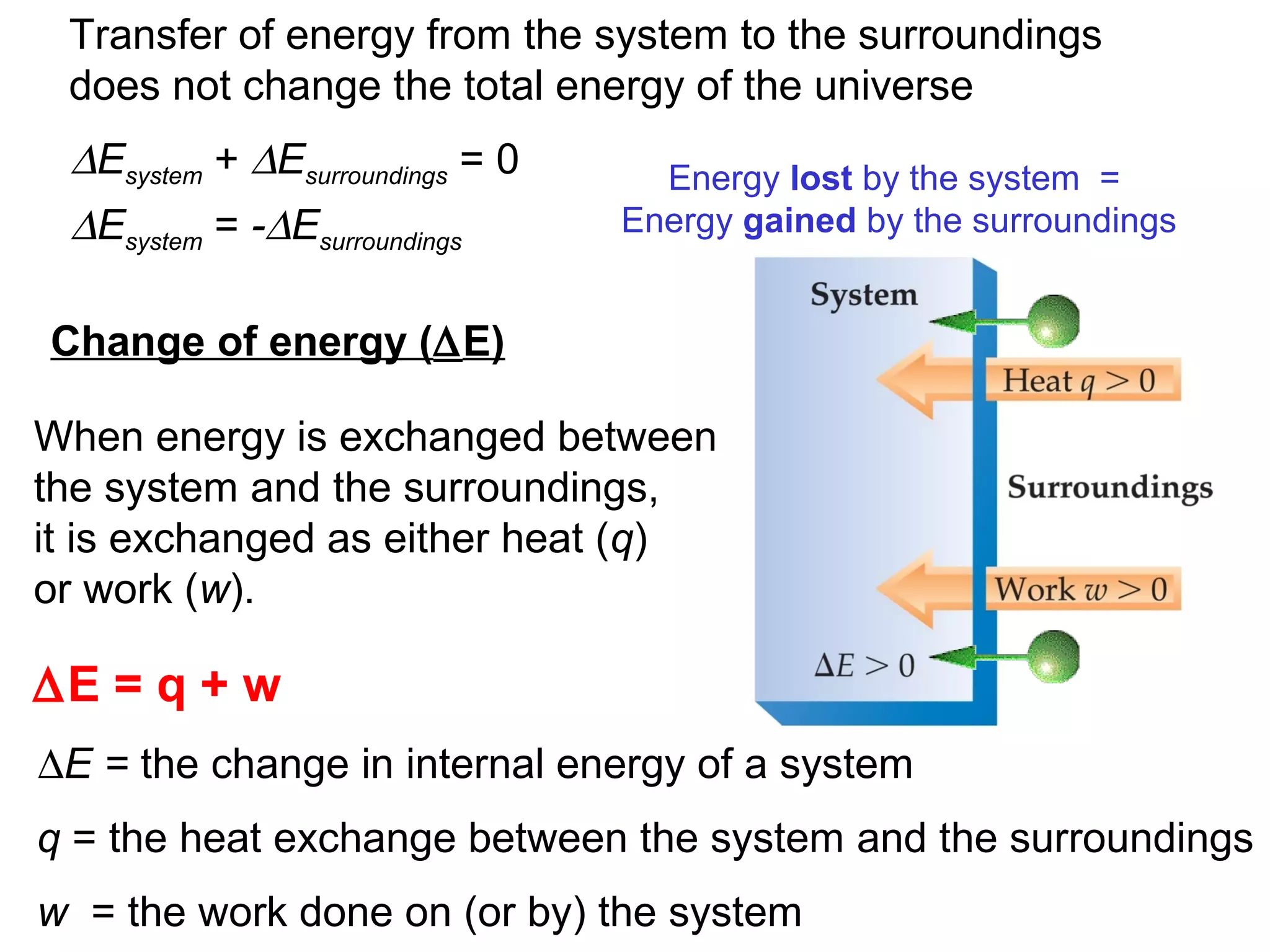
∆Esystem + ∆Esurroundings = 0
∆Esystem = -∆Esurroundings
Energy lost by the system =
Energy gained by the surroundings
Transfer of energy from the system to the surroundings
does not change the total energy of the universe
Change of energy (∆E)
∆E = q + w
∆E = the change in internal energy of a system
q = the heat exchange between the system and the surroundings
w = the work done on (or by) the system
When energy is exchanged between
the system and the surroundings,
it is exchanged as either heat (q)
or work (w).
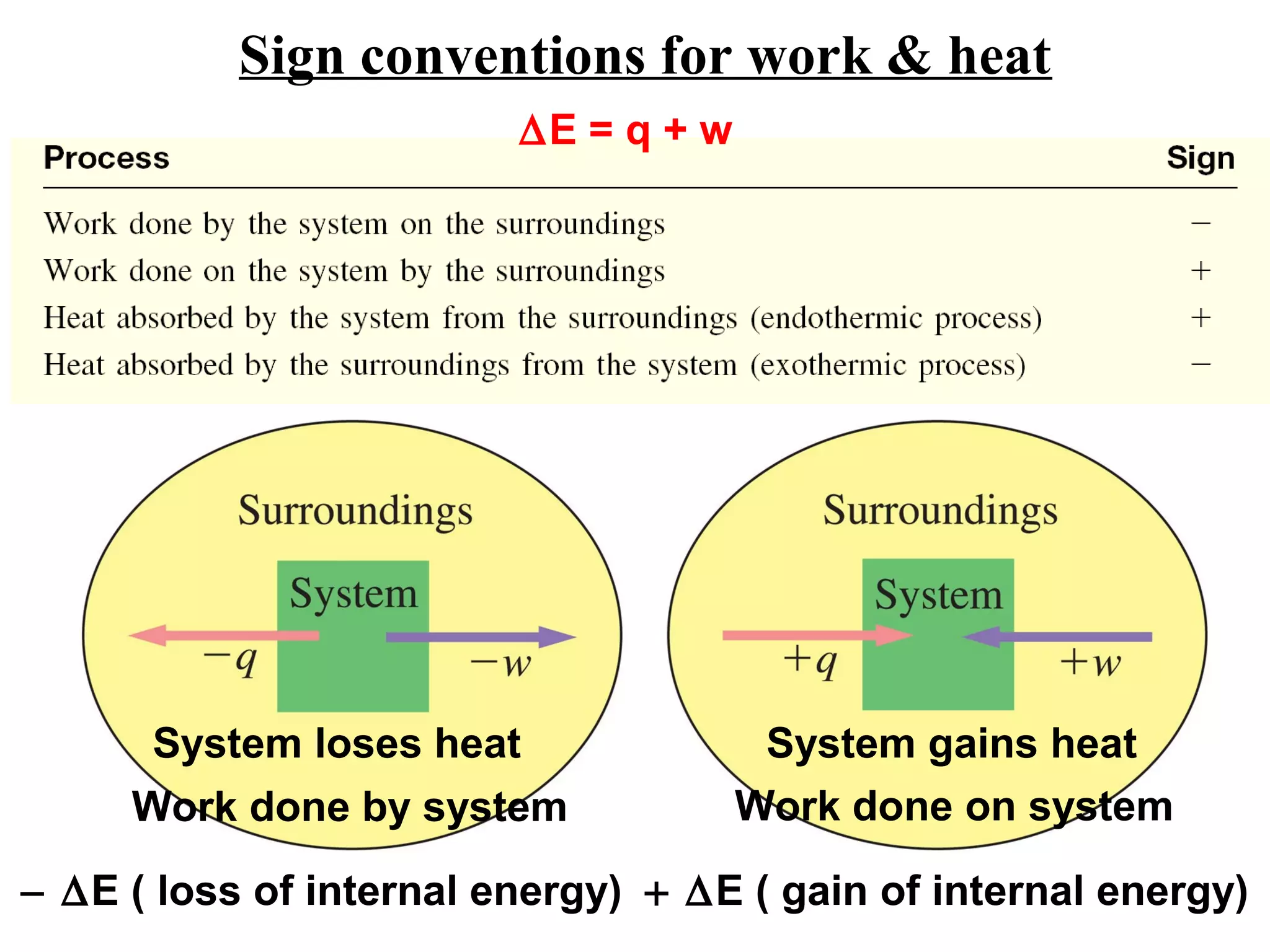
Sign conventions for work & heat
∆E = q + w
System gains heatSystem loses heat
Work done on systemWork done by system
+ ∆E ( gain of internal energy)− ∆E ( loss of internal energy)
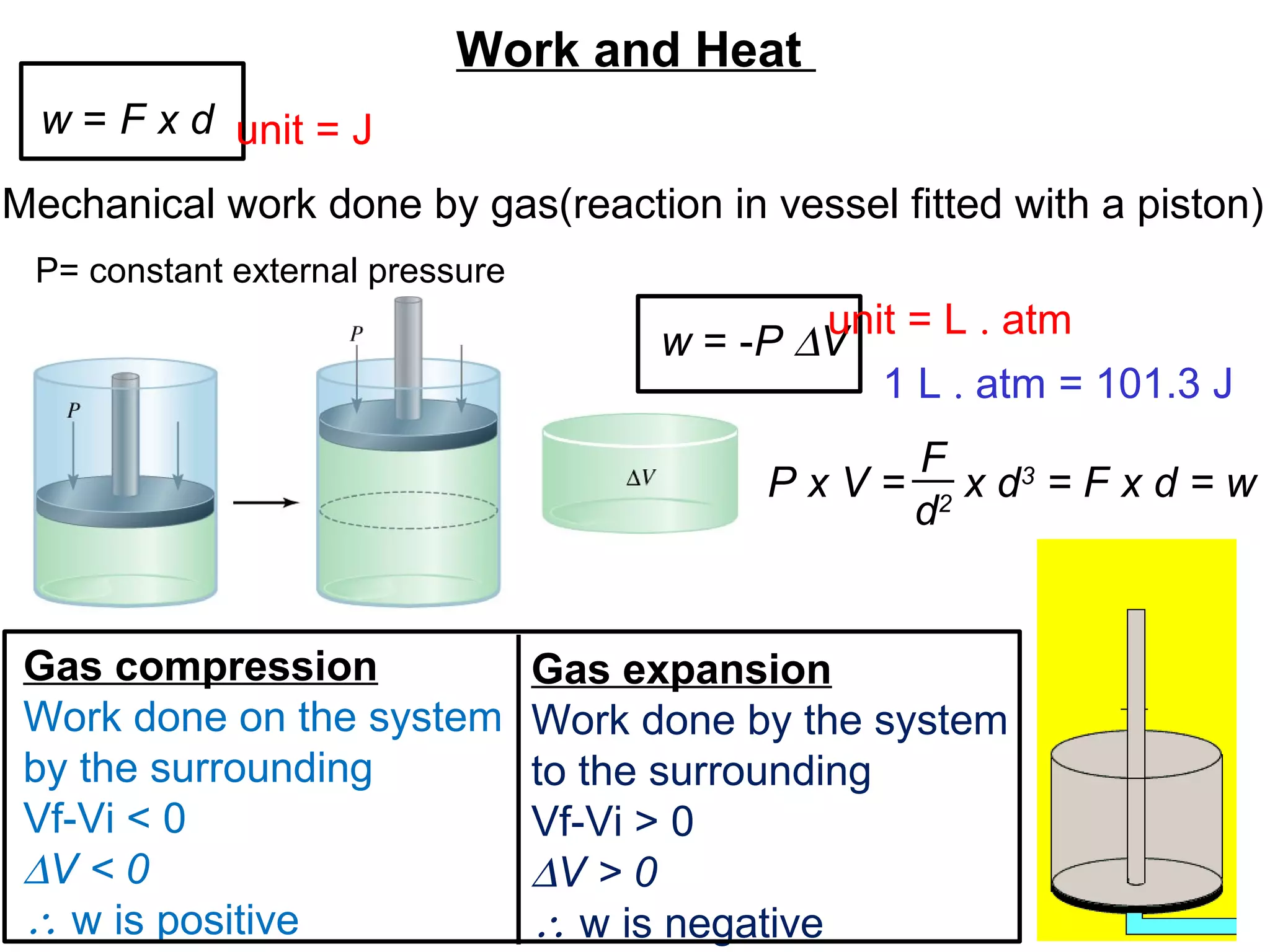
Work and Heat
w = F x d
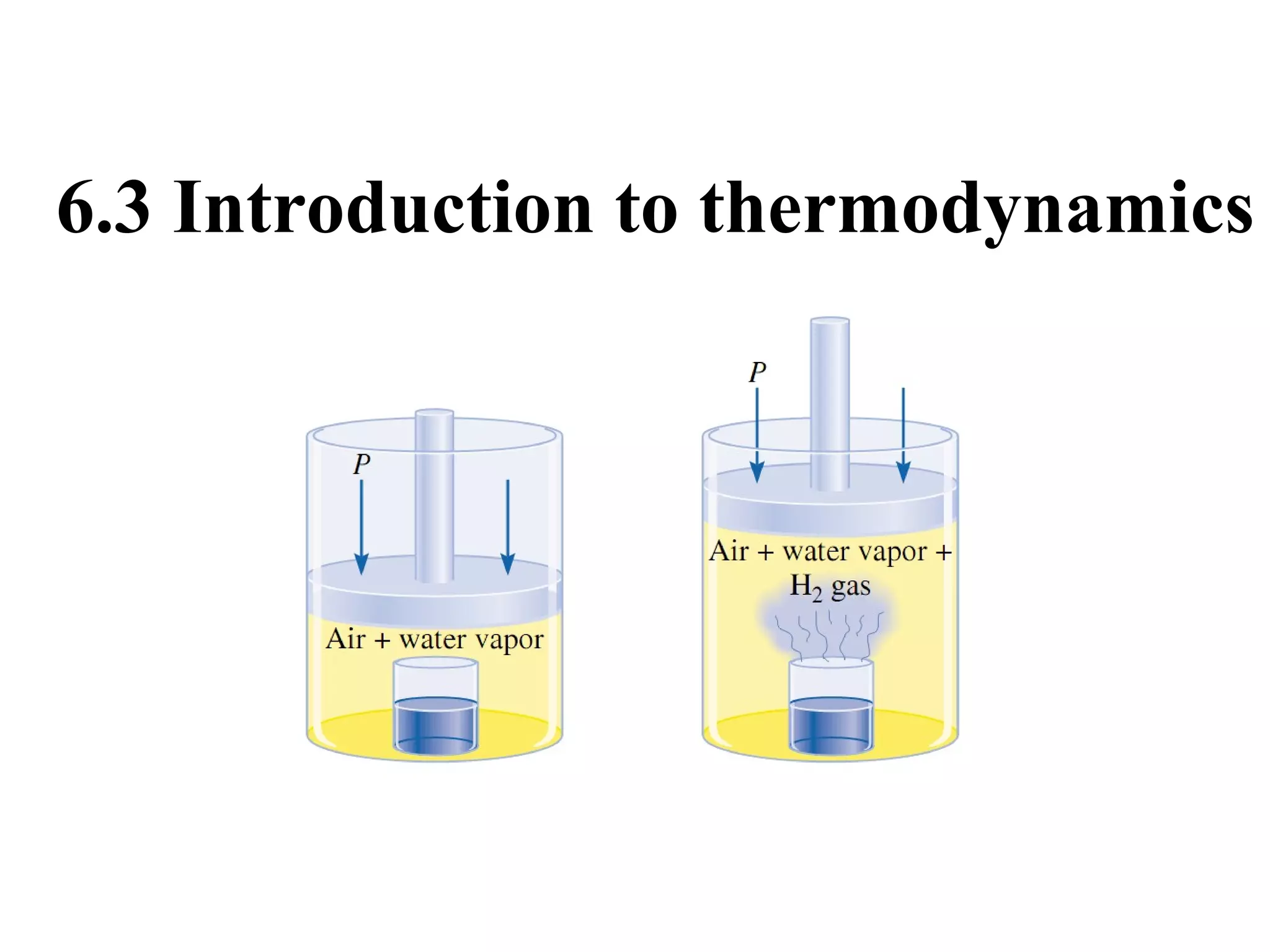
Mechanical work done by gas(reaction in vessel fitted with a piston)
P x V = x d3
= F x d = w
F
d2
Gas expansion
Work done by the system
to the surrounding
Vf-Vi > 0
∆V > 0
∴ w is negative
Gas compression
Work done on the system
by the surrounding
Vf-Vi < 0
∆V < 0
∴ w is positive
unit = J
1 L . atm = 101.3 J
w = -P ∆V
unit = L . atm
P= constant external pressure
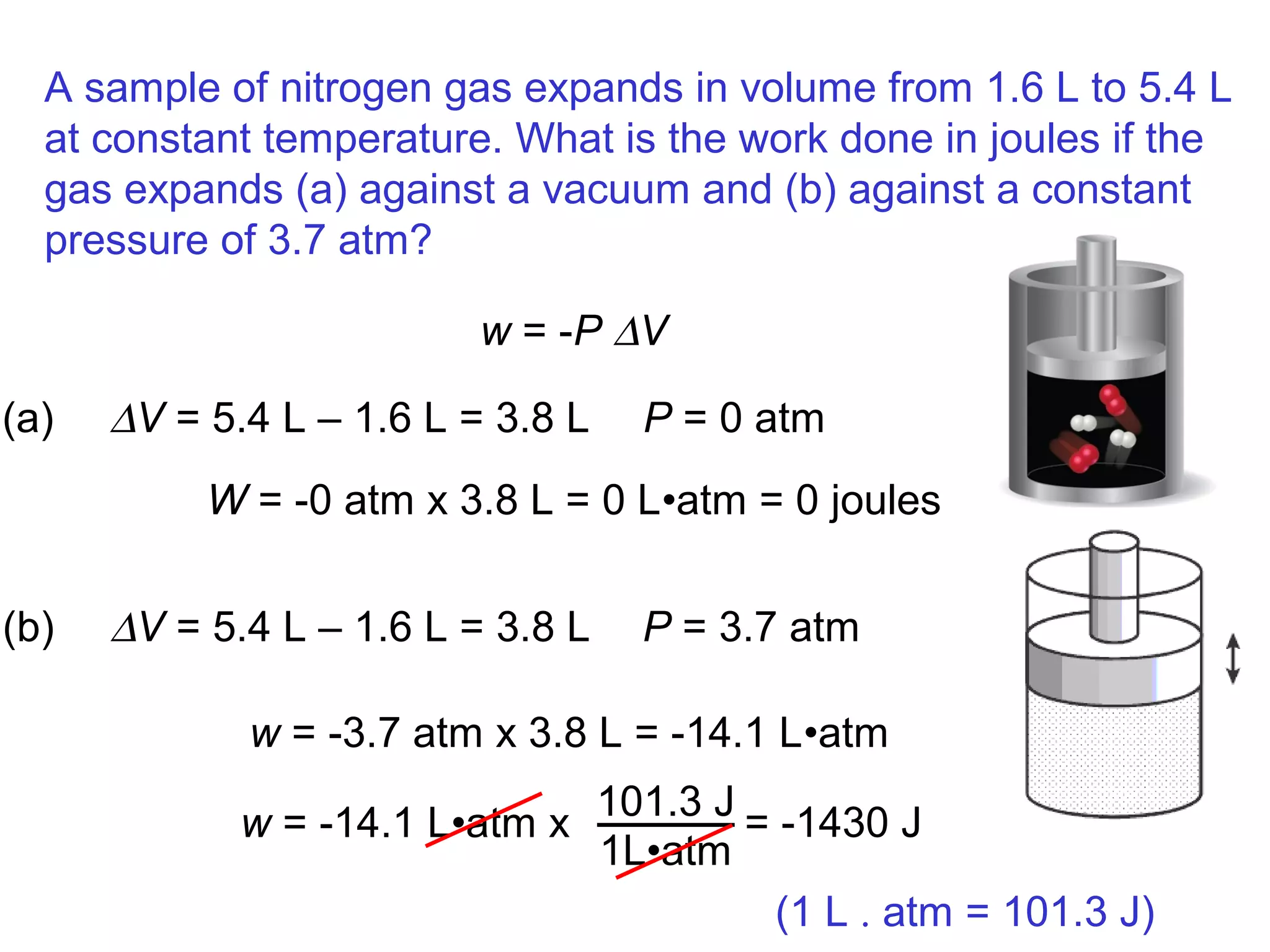
A sample of nitrogen gas expands in volume from 1.6 L to 5.4 L
at constant temperature. What is the work done in joules if the
gas expands (a) against a vacuum and (b) against a constant
pressure of 3.7 atm?
w = -P ∆V
(a) ∆V = 5.4 L – 1.6 L = 3.8 L P = 0 atm
W = -0 atm x 3.8 L = 0 L•atm = 0 joules
(b) ∆V = 5.4 L – 1.6 L = 3.8 L P = 3.7 atm
w = -3.7 atm x 3.8 L = -14.1 L•atm
w = -14.1 L•atm x
101.3 J
1L•atm
= -1430 J
(1 L . atm = 101.3 J)
6.4 Enthalpy
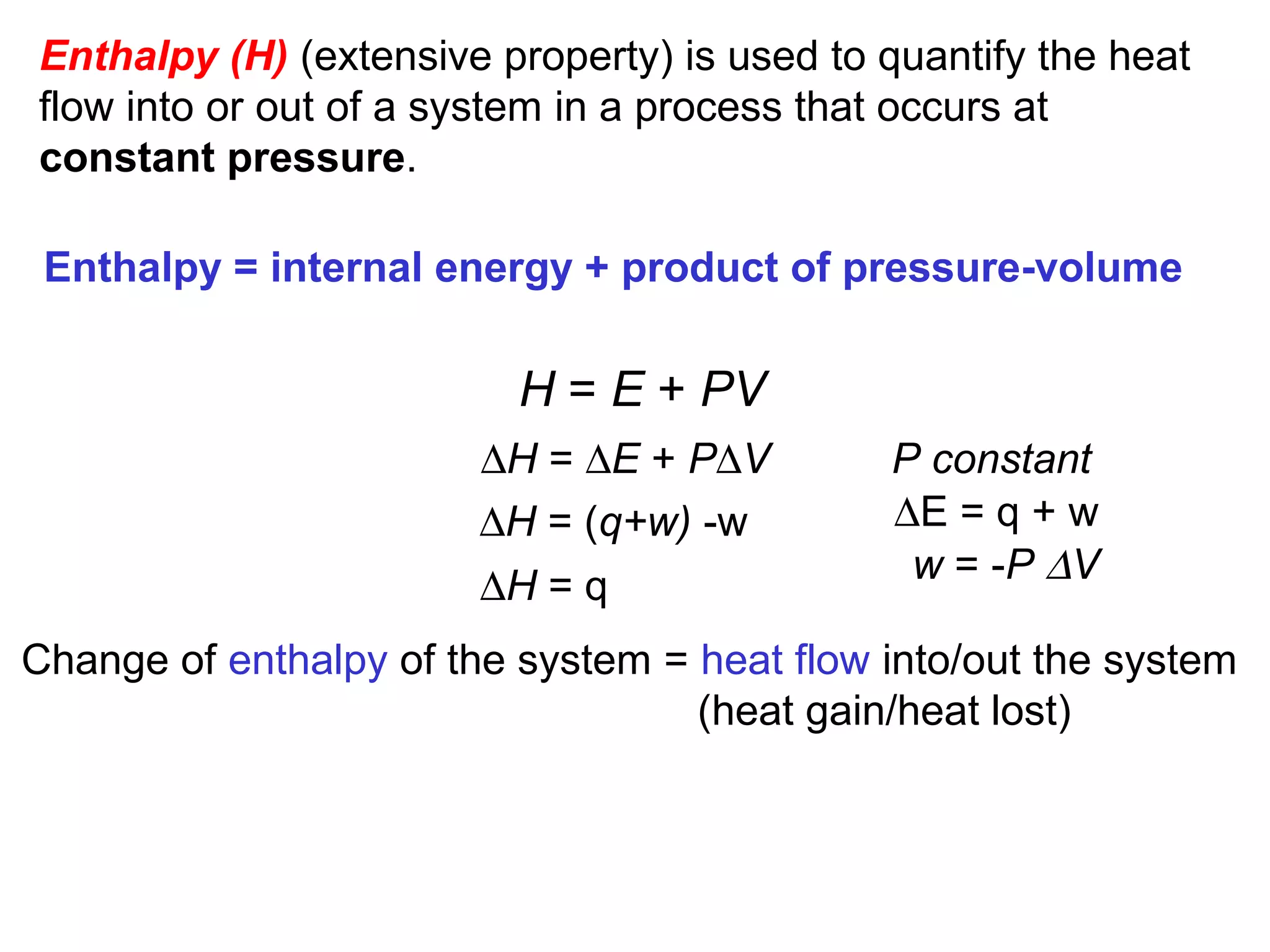
Enthalpy (H) (extensive property) is used to quantify the heat
flow into or out of a system in a process that occurs at
constant pressure.
H = E + PV
∆H = ∆E + P∆V
Enthalpy = internal energy + product of pressure-volume
∆H = (q+w) -w
∆H = q
Change of enthalpy of the system = heat flow into/out the system
(heat gain/heat lost)
P constant
w = -P ∆V
∆E = q + w
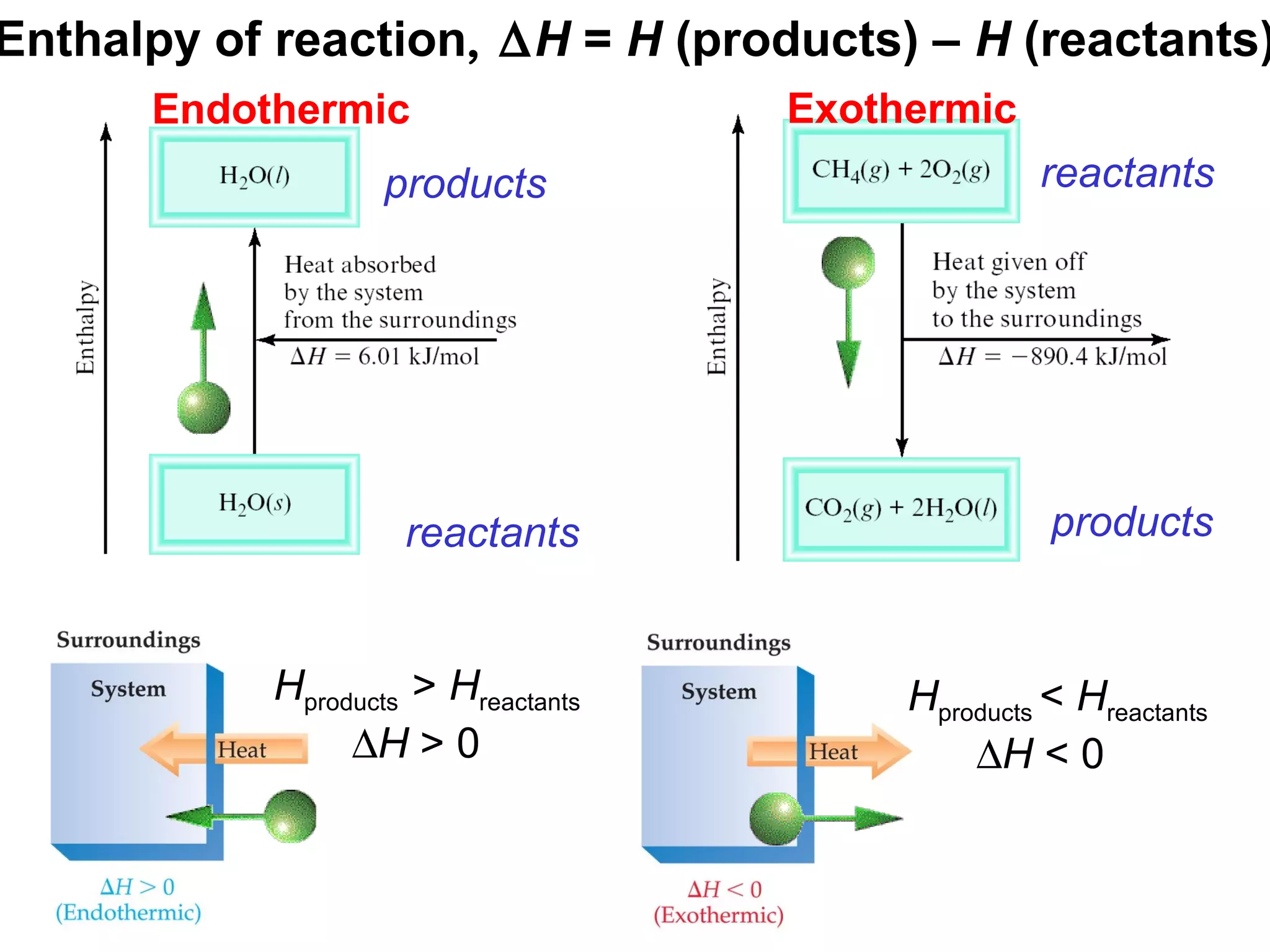
Enthalpy of reaction, ∆H = H (products) – H (reactants)
Hproducts > Hreactants
∆H > 0
Hproducts < Hreactants
∆H < 0
ExothermicEndothermic
products reactants
reactants products
22
Thermochemical Equations
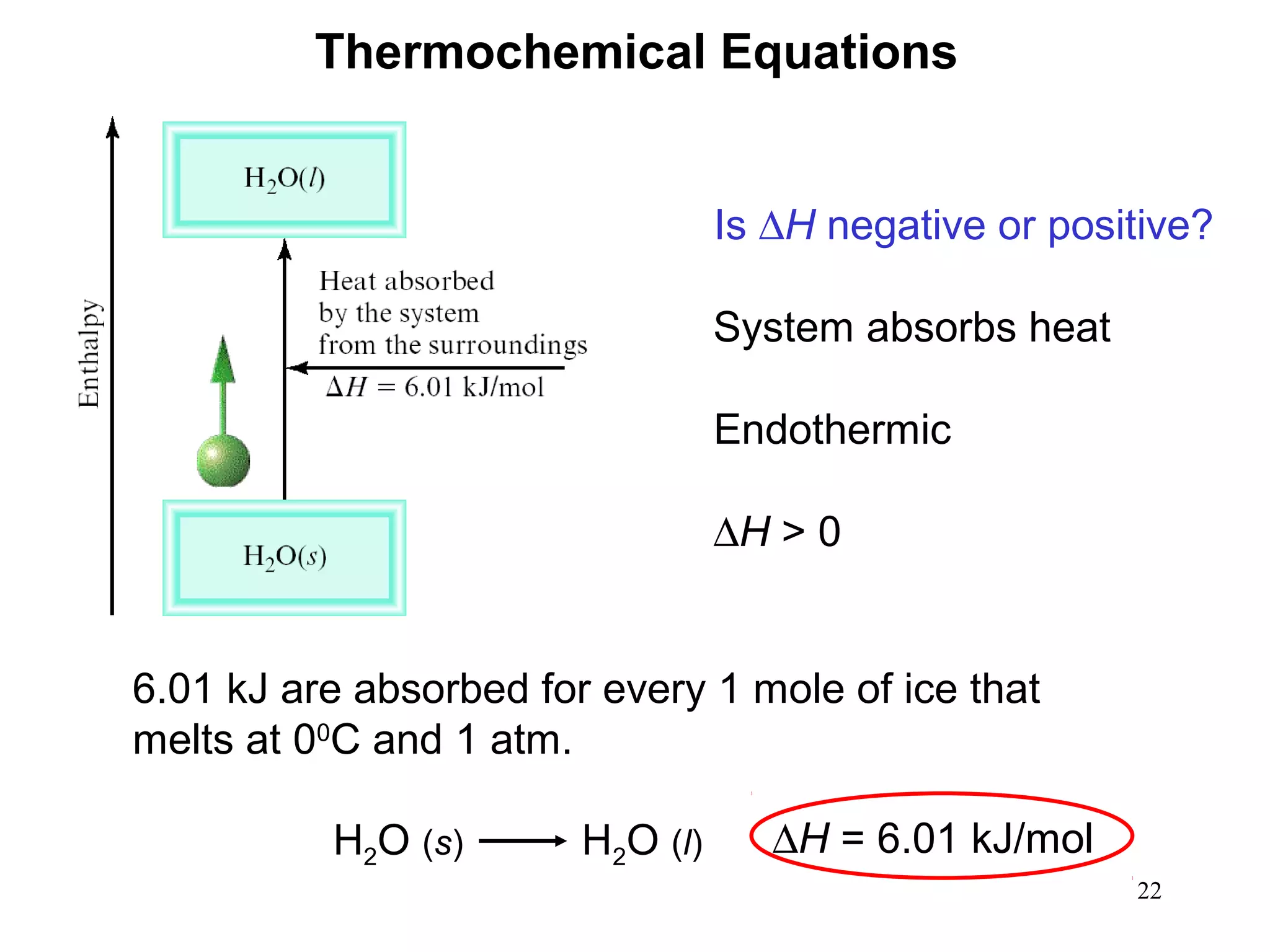
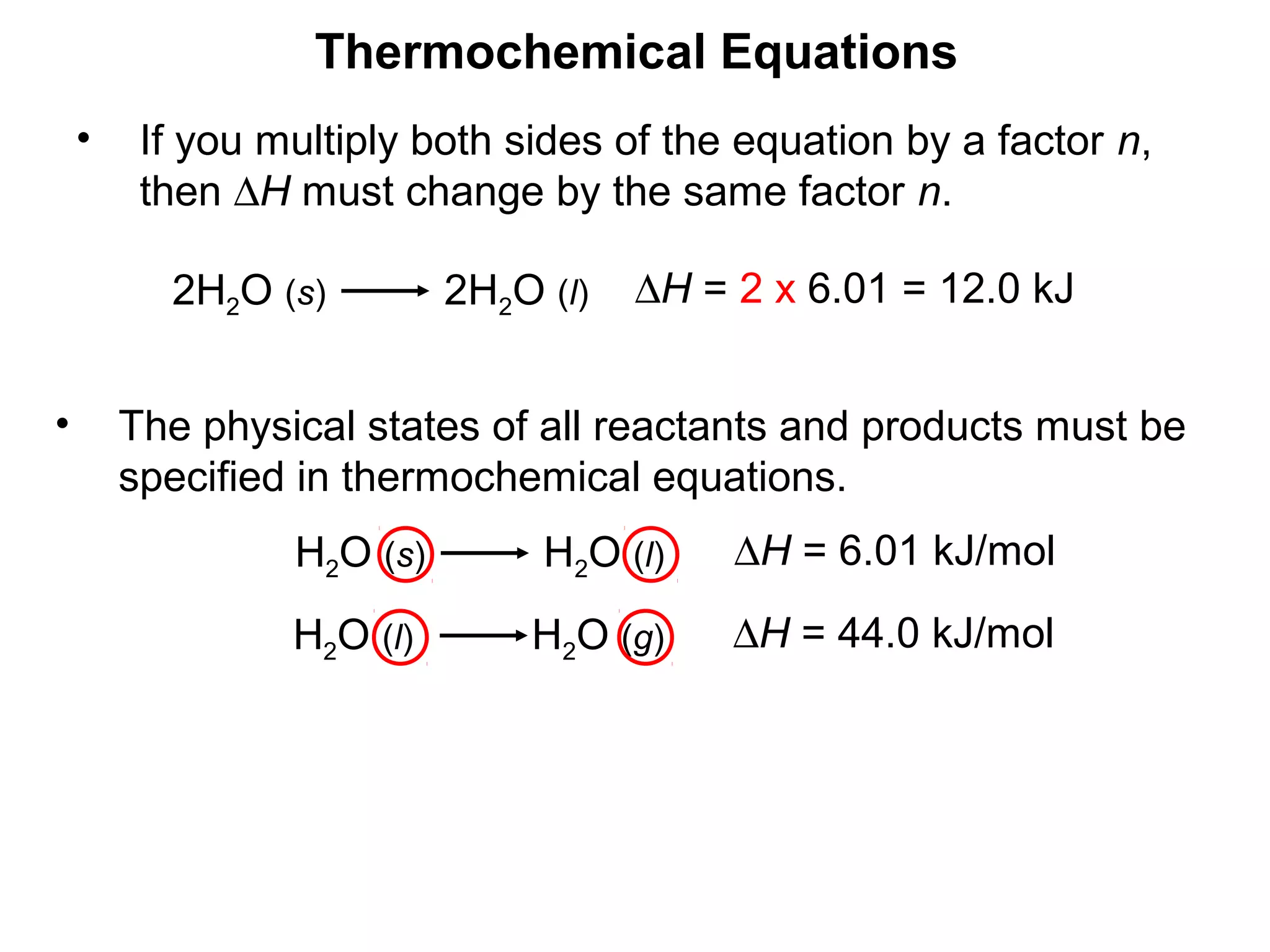
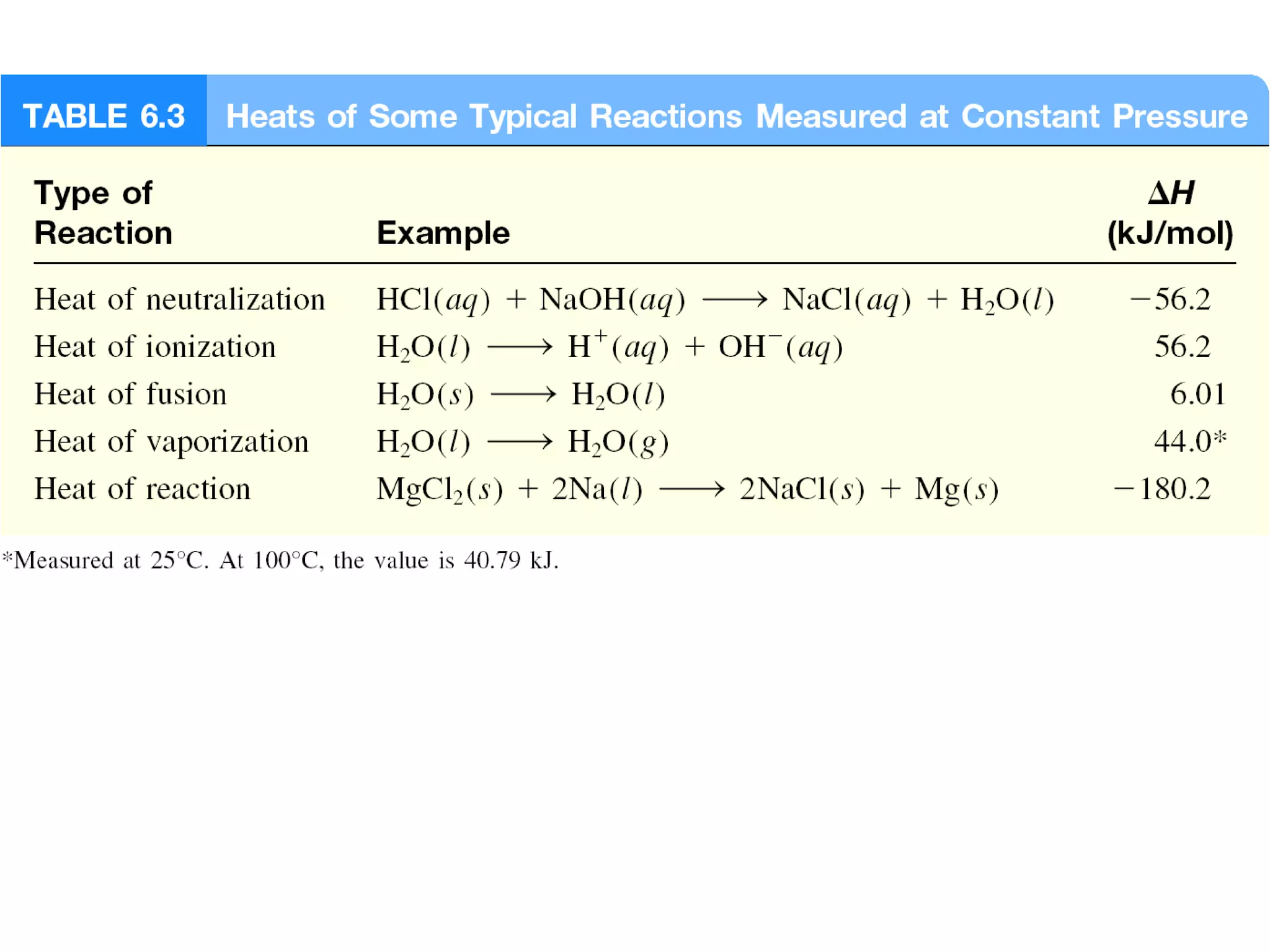
H2O (s) H2O (l) ∆H = 6.01 kJ/mol
Is ∆H negative or positive?
System absorbs heat
Endothermic
∆H > 0
6.01 kJ are absorbed for every 1 mole of ice that
melts at 00
C and 1 atm.
23
Thermochemical Equations
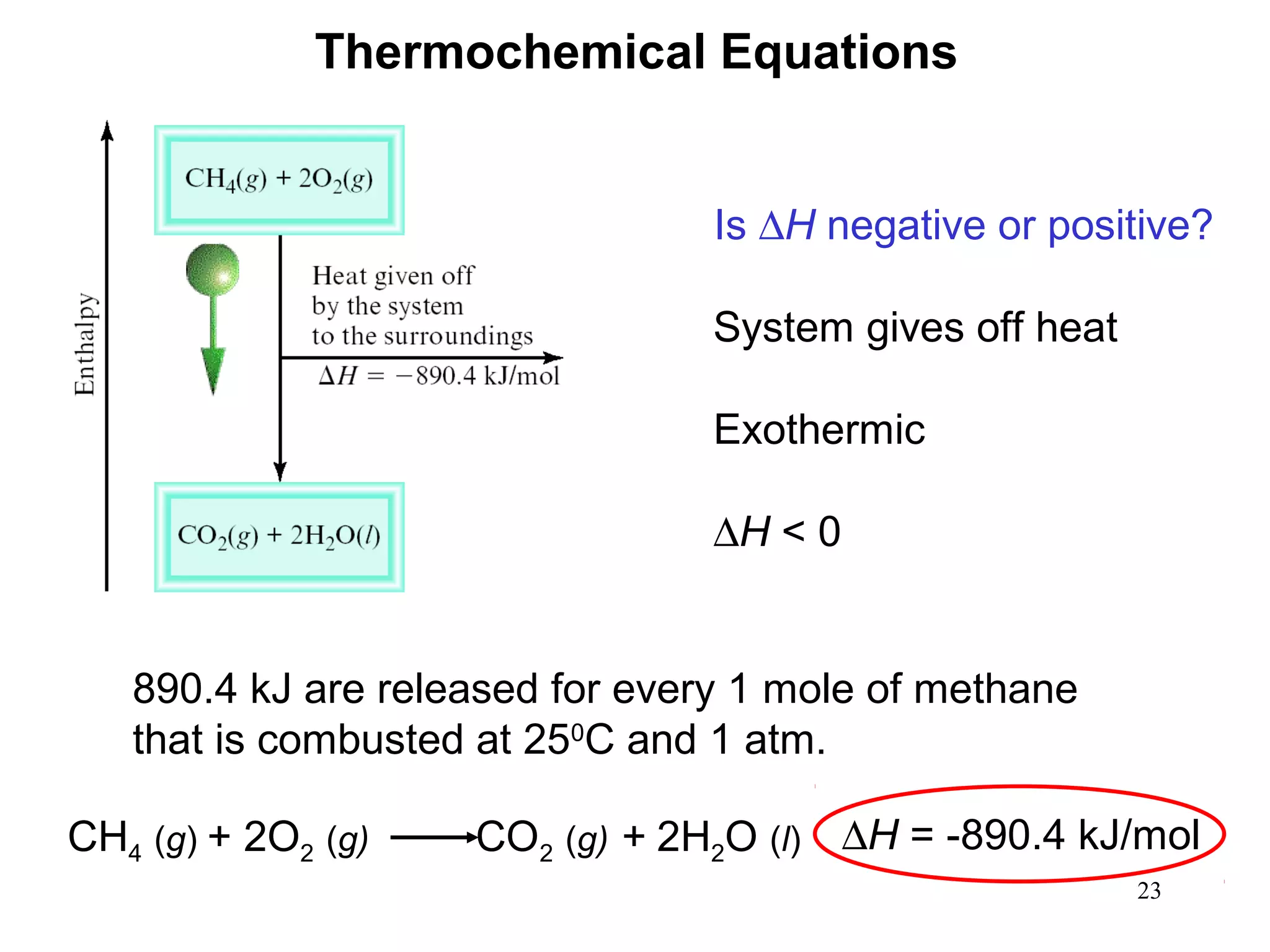
CH4 (g) + 2O2 (g) CO2 (g) + 2H2O (l) ∆H = -890.4 kJ/mol
Is ∆H negative or positive?
System gives off heat
Exothermic
∆H < 0
890.4 kJ are released for every 1 mole of methane
that is combusted at 250
C and 1 atm.
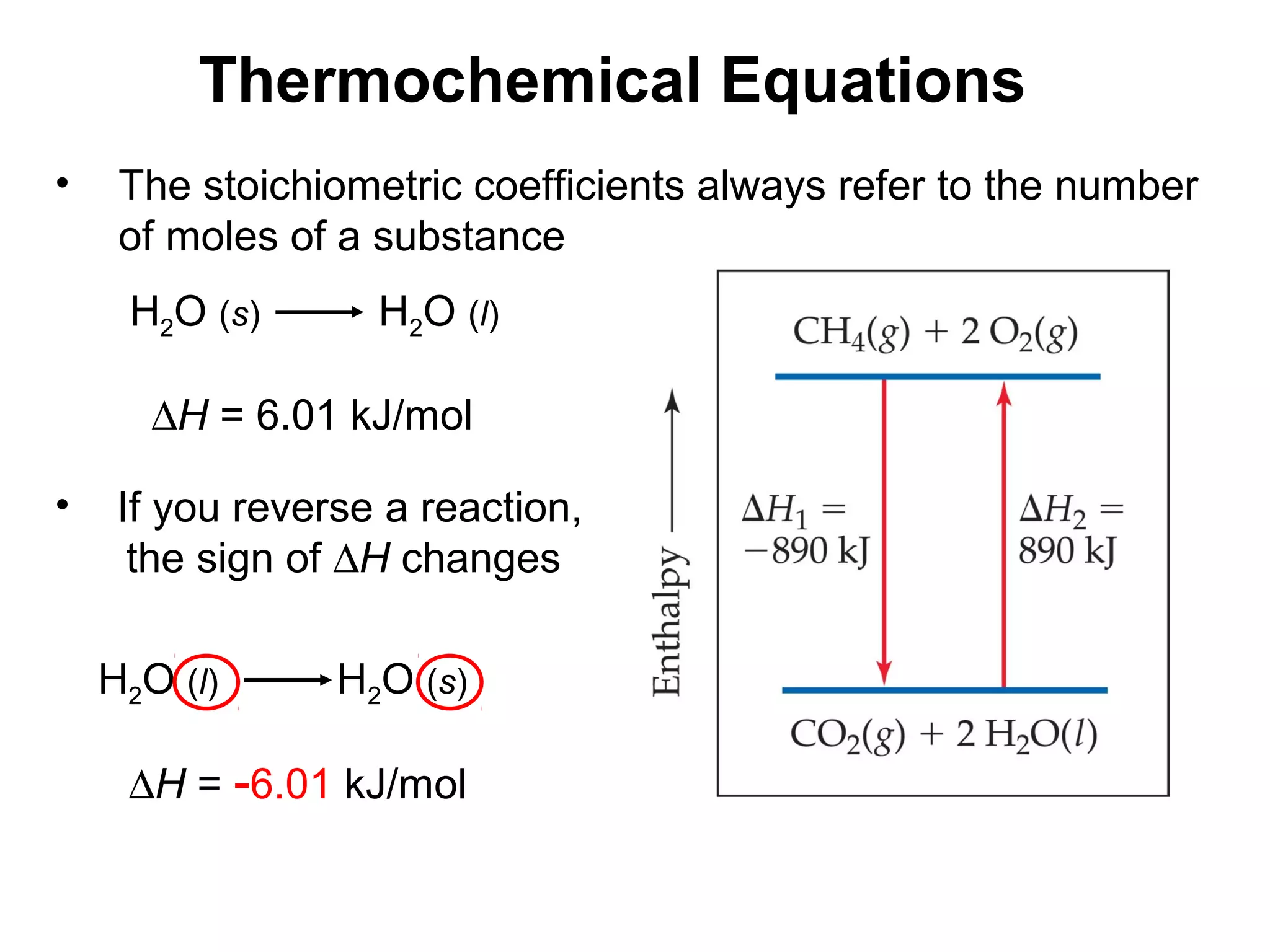
H2O (s) H2O (l)
∆H = 6.01 kJ/mol
• The stoichiometric coefficients always refer to the number
of moles of a substance
Thermochemical Equations
• If you reverse a reaction,
the sign of ∆H changes
H2O (l) H2O (s)
∆H = -6.01 kJ/mol
H2O (s) H2O (l) ∆H = 6.01 kJ/mol
• The physical states of all reactants and products must be
specified in thermochemical equations.
Thermochemical Equations
H2O (l) H2O (g) ∆H = 44.0 kJ/mol
• If you multiply both sides of the equation by a factor n,
then ∆H must change by the same factor n.
2H2O (s) 2H2O (l) ∆H = 2 x 6.01 = 12.0 kJ
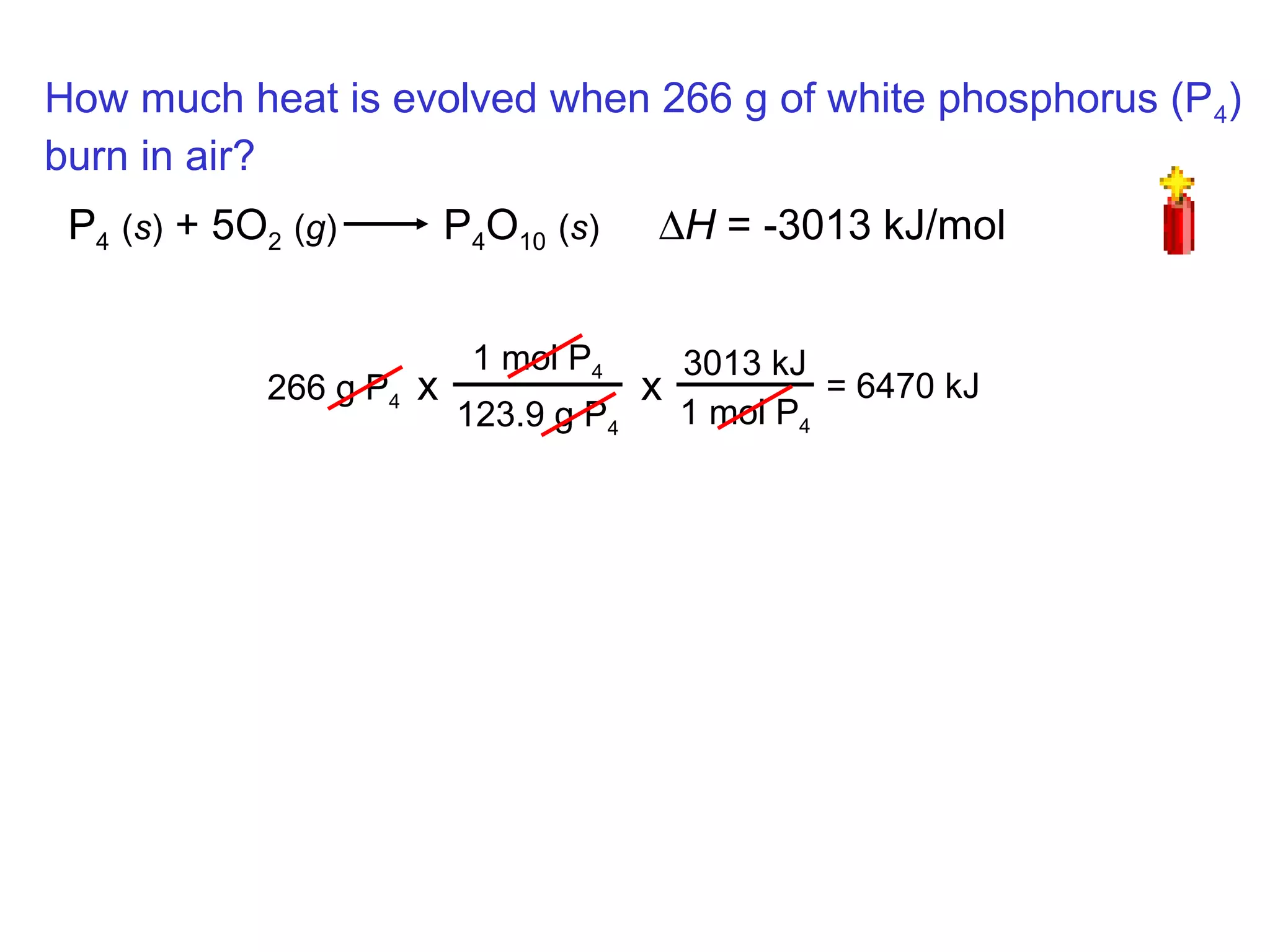
How much heat is evolved when 266 g of white phosphorus (P4)
burn in air?
P4 (s) + 5O2 (g) P4O10 (s) ∆H = -3013 kJ/mol
266 g P4
1 mol P4
123.9 g P4
x
3013 kJ
1 mol P4
x = 6470 kJ
6.4 Calorimetry
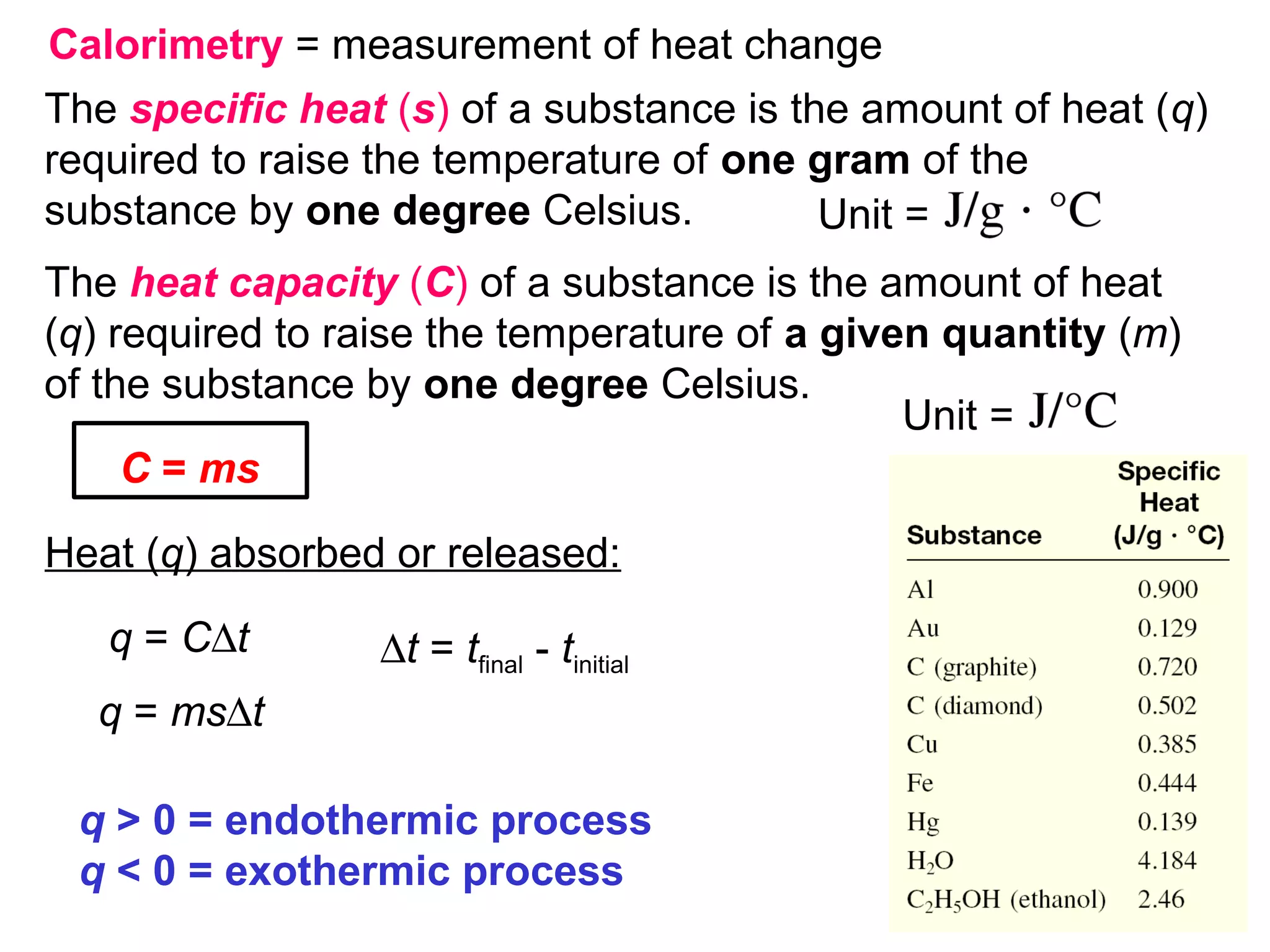
The specific heat (s) of a substance is the amount of heat (q)
required to raise the temperature of one gram of the
substance by one degree Celsius.
The heat capacity (C) of a substance is the amount of heat
(q) required to raise the temperature of a given quantity (m)
of the substance by one degree Celsius.
C = ms
Heat (q) absorbed or released:
q = ms∆t
q = C∆t ∆t = tfinal - tinitial
Calorimetry = measurement of heat change
Unit =
Unit =
q > 0 = endothermic process
q < 0 = exothermic process
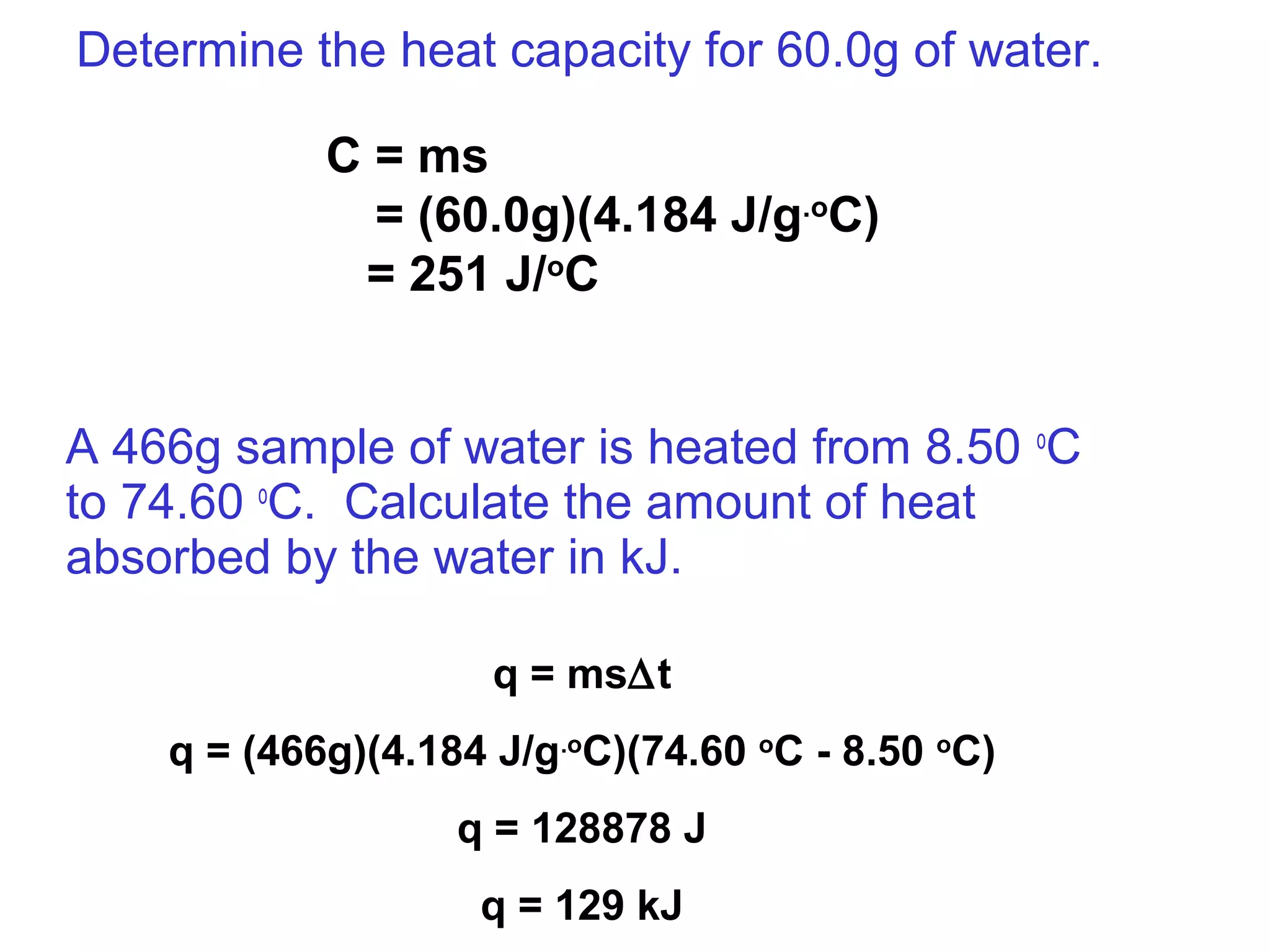
A 466g sample of water is heated from 8.50 o
C
to 74.60 o
C. Calculate the amount of heat
absorbed by the water in kJ.
q = ms∆t
q = (466g)(4.184 J/g.o
C)(74.60 o
C - 8.50 o
C)
q = 128878 J
q = 129 kJ
Determine the heat capacity for 60.0g of water.
C = ms
= (60.0g)(4.184 J/g.o
C)
= 251 J/o
C
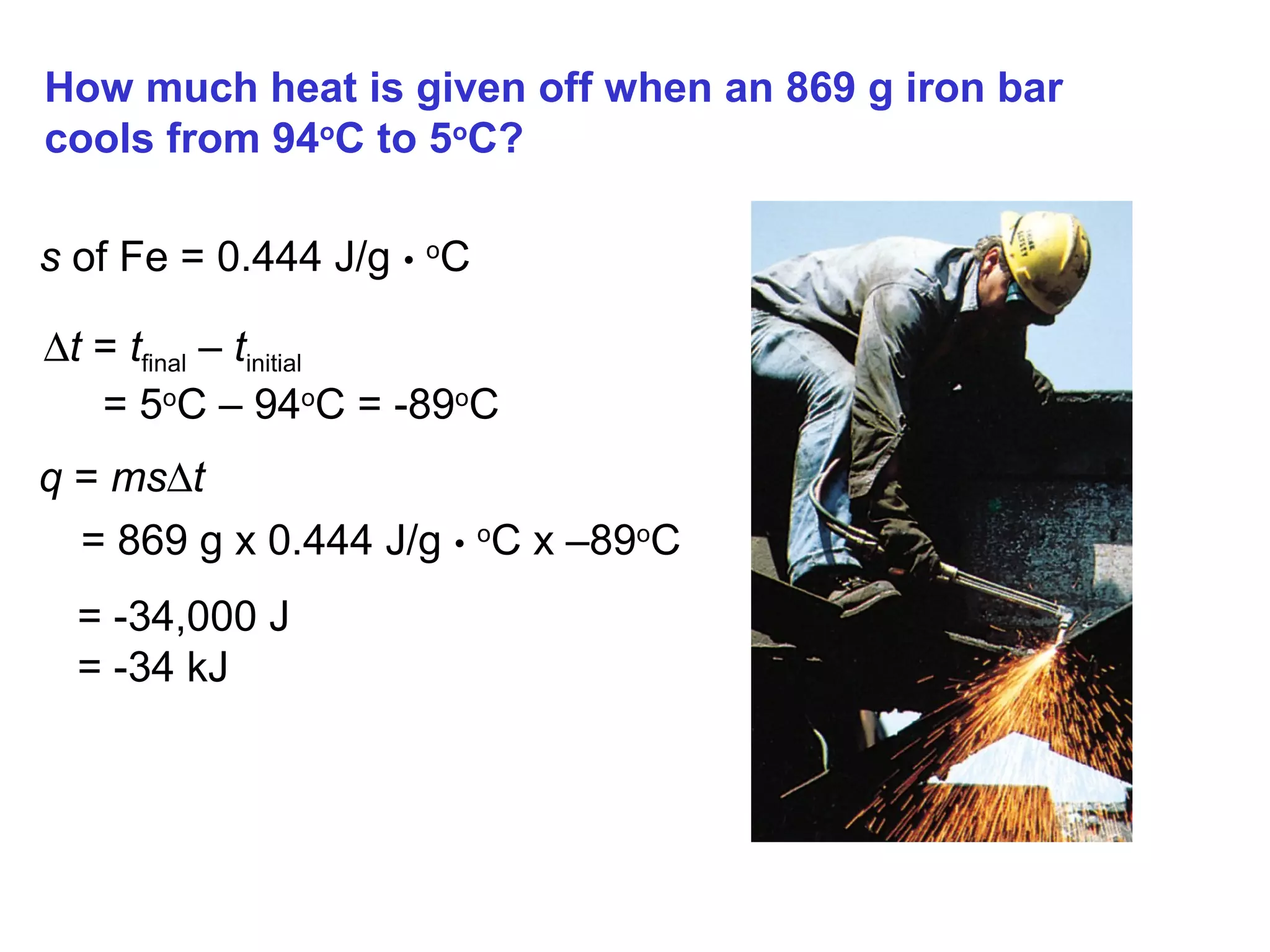
How much heat is given off when an 869 g iron bar
cools from 94o
C to 5o
C?
s of Fe = 0.444 J/g • o
C
∆t = tfinal – tinitial
= 5o
C – 94o
C = -89o
C
q = ms∆t
= 869 g x 0.444 J/g • o
C x –89o
C
= -34,000 J
= -34 kJ
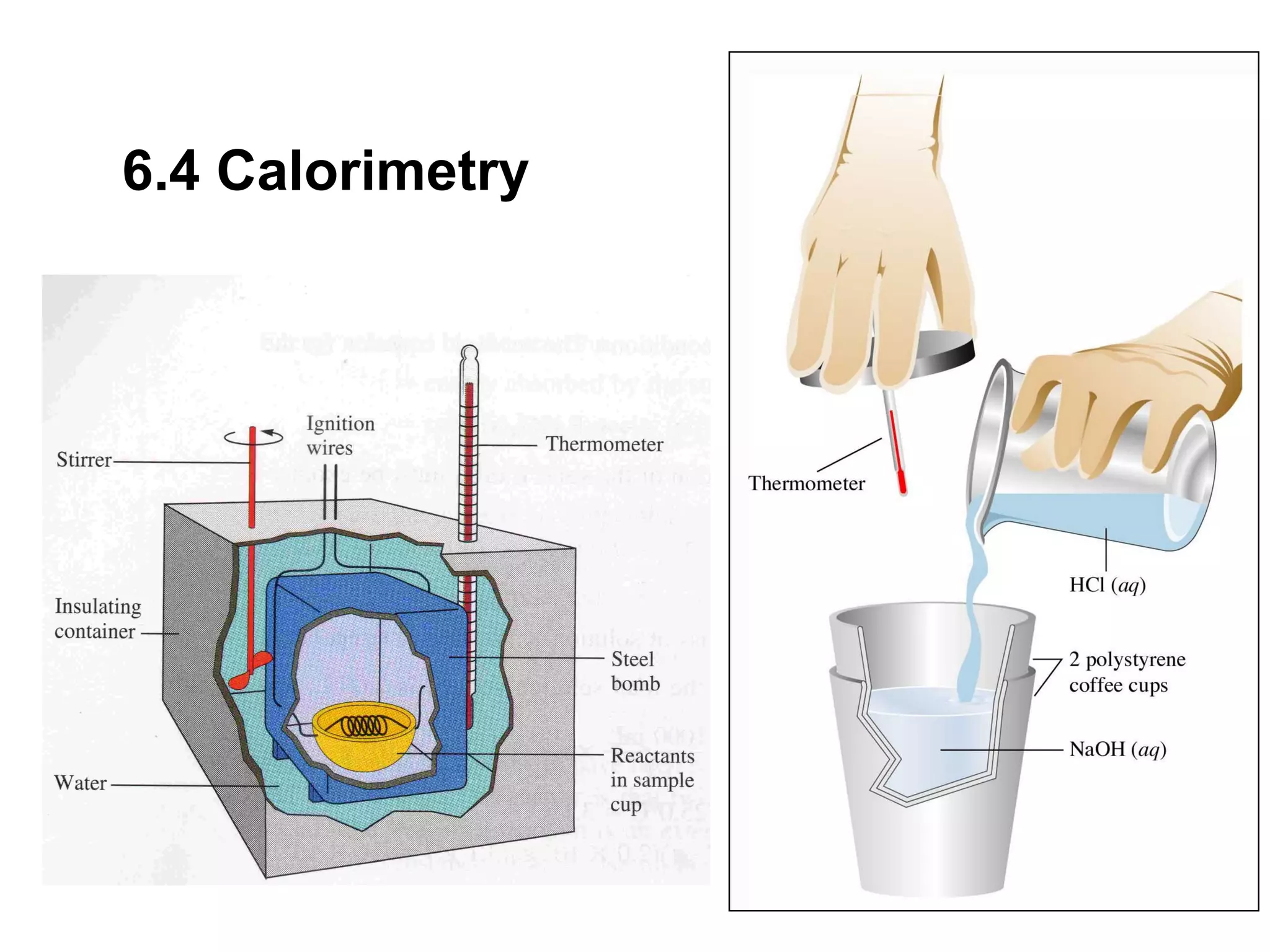
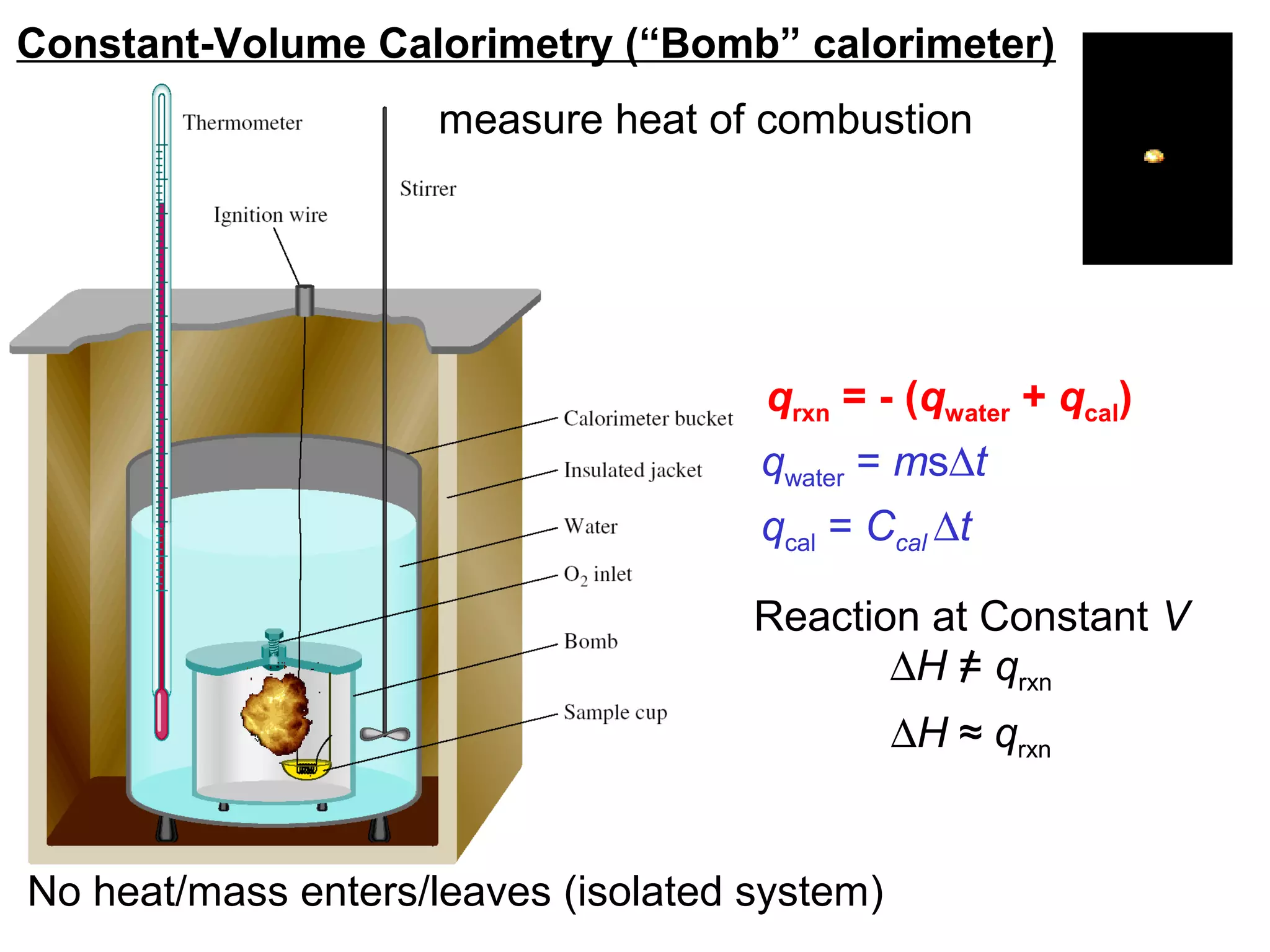
Constant-Volume Calorimetry (“Bomb” calorimeter)
No heat/mass enters/leaves (isolated system)
qrxn = - (qwater + qcal)
qwater = ms∆t
qcal = Ccal ∆t
Reaction at Constant V
∆H ≈ qrxn
∆H = qrxn
measure heat of combustion
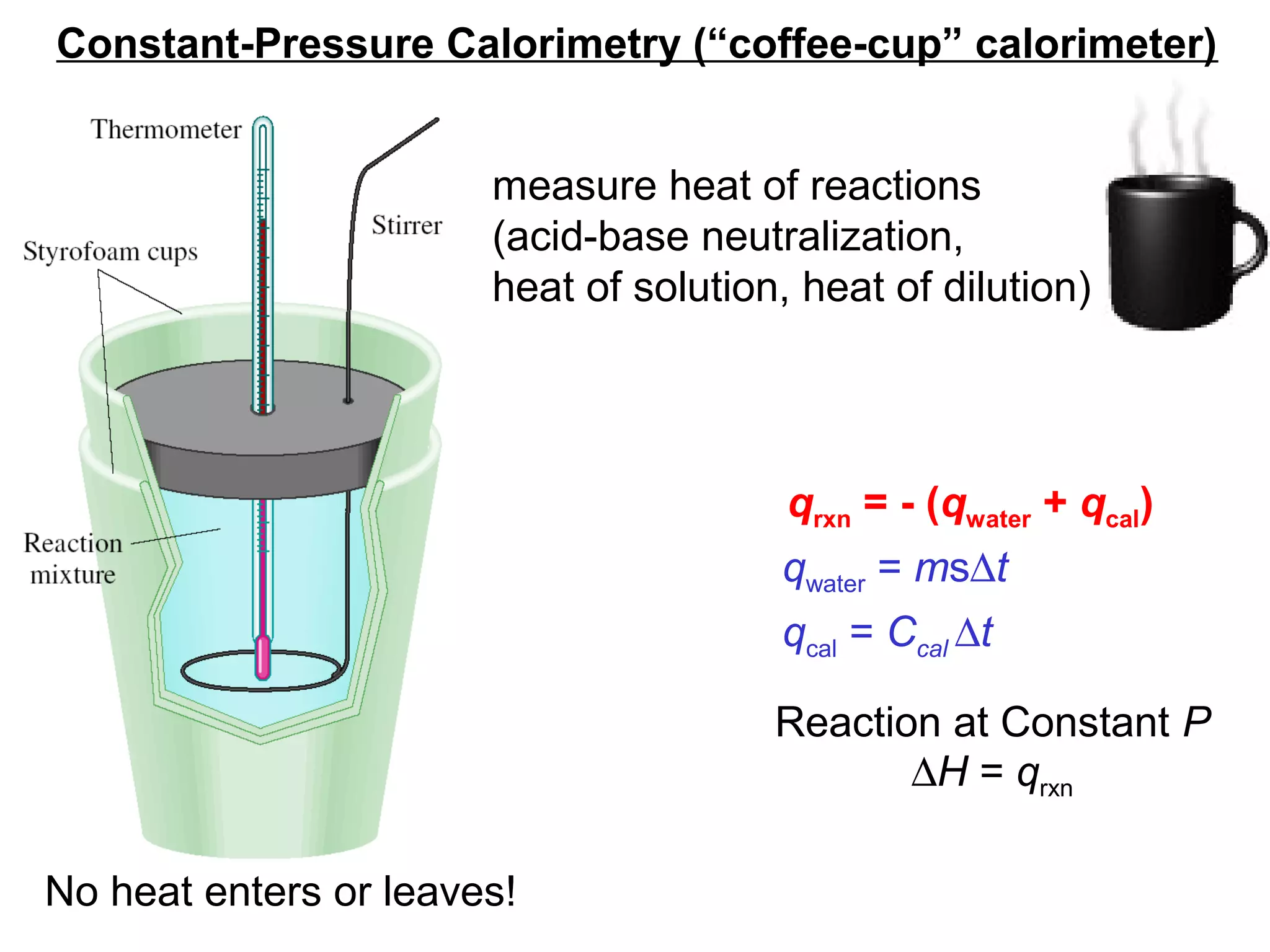
Constant-Pressure Calorimetry (“coffee-cup” calorimeter)
No heat enters or leaves!
qrxn = - (qwater + qcal)
qwater = ms∆t
qcal = Ccal ∆t
Reaction at Constant P
∆H = qrxn
measure heat of reactions
(acid-base neutralization,
heat of solution, heat of dilution)
34
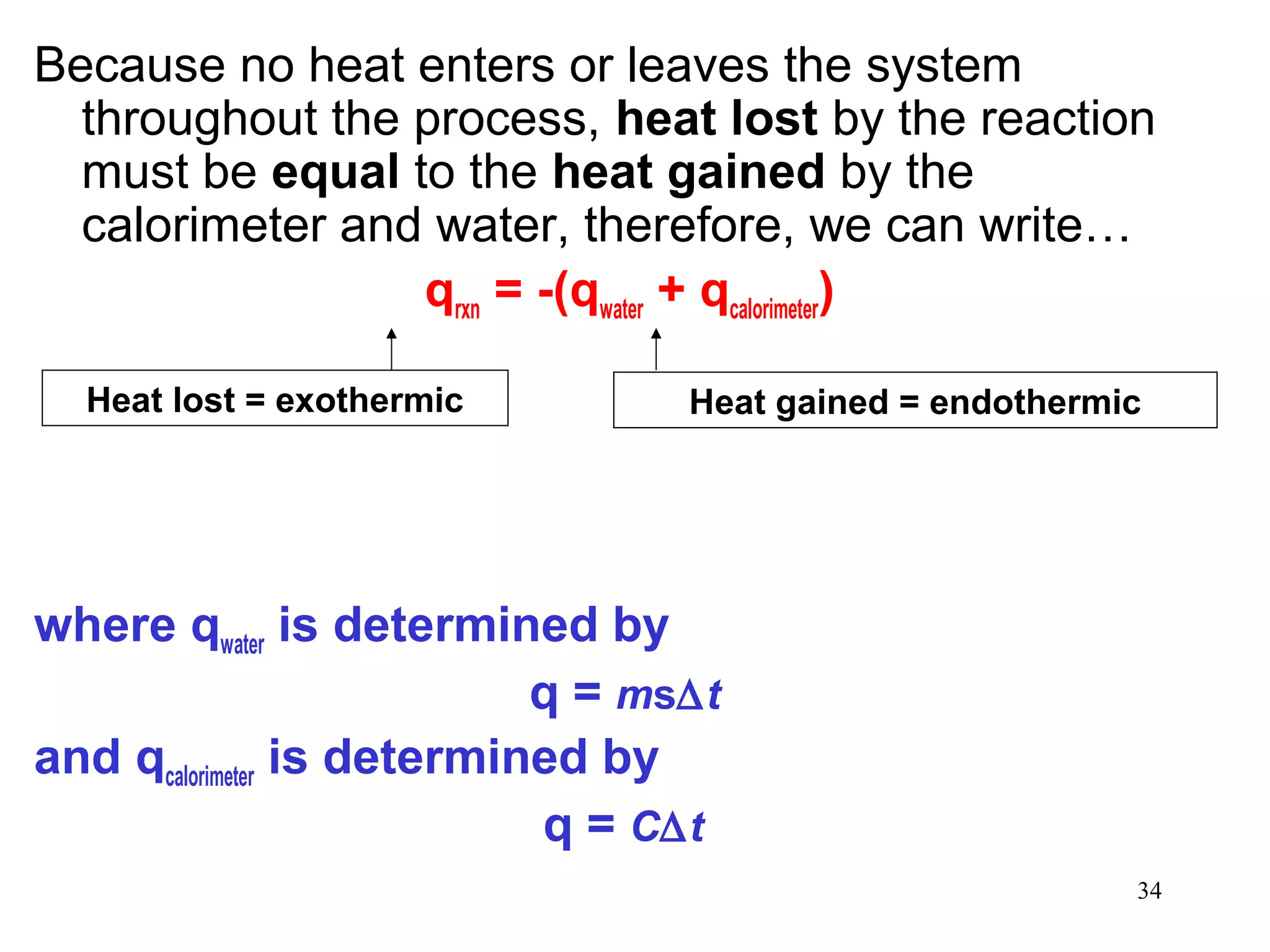
Because no heat enters or leaves the system
throughout the process, heat lost by the reaction
must be equal to the heat gained by the
calorimeter and water, therefore, we can write…
qrxn = -(qwater + qcalorimeter)
where qwater is determined by
q = ms∆t
and qcalorimeter is determined by
q = C∆t
Heat lost = exothermic Heat gained = endothermic
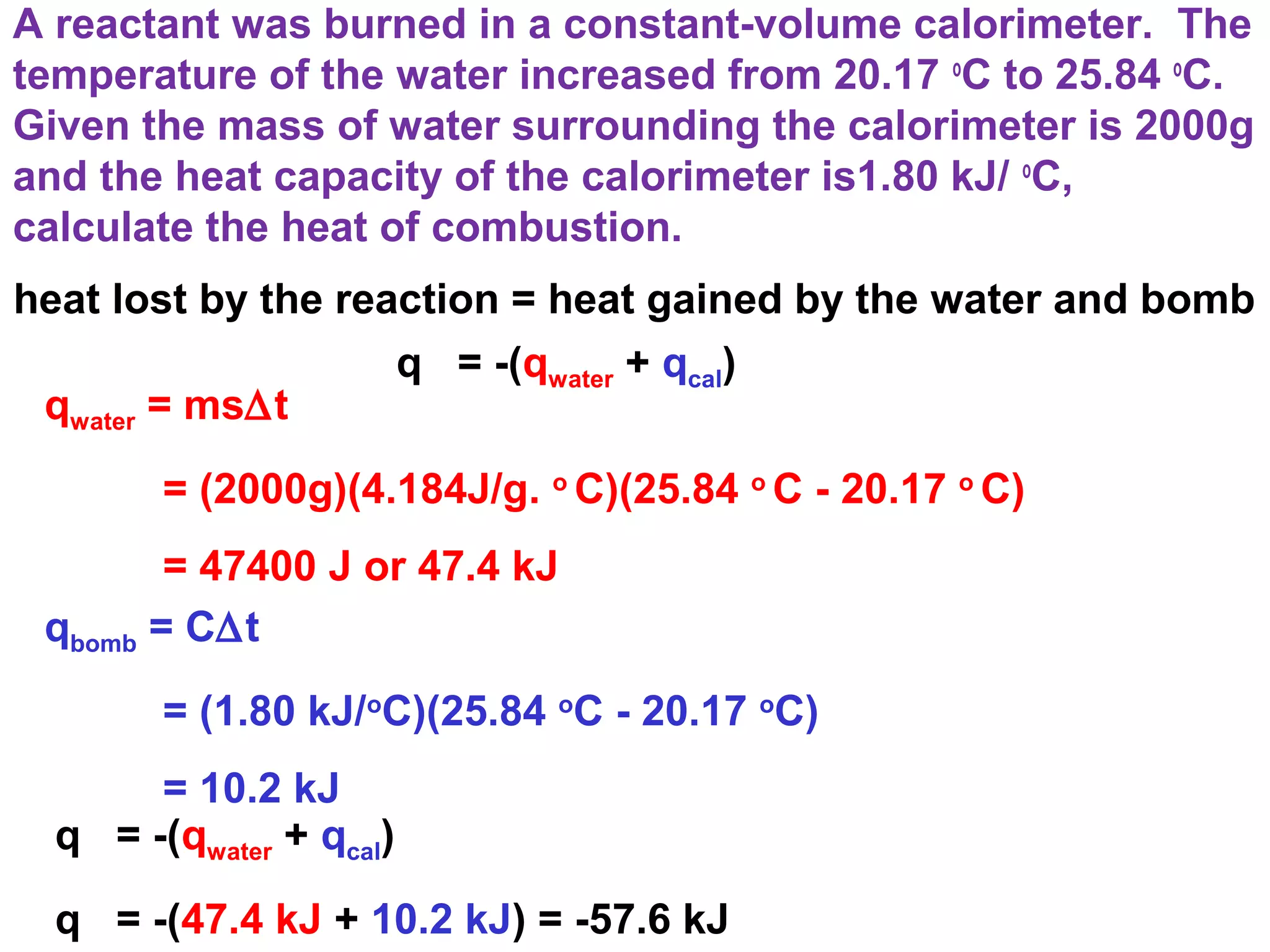
A reactant was burned in a constant-volume calorimeter. The
temperature of the water increased from 20.17 o
C to 25.84 o
C.
Given the mass of water surrounding the calorimeter is 2000g
and the heat capacity of the calorimeter is1.80 kJ/ o
C,
calculate the heat of combustion.
q = -(qwater + qcal)
heat lost by the reaction = heat gained by the water and bomb
qwater = ms∆t
= (2000g)(4.184J/g. o
C)(25.84 o
C - 20.17 o
C)
= 47400 J or 47.4 kJ
qbomb = C∆t
= (1.80 kJ/o
C)(25.84 o
C - 20.17 o
C)
= 10.2 kJ
q = -(qwater + qcal)
q = -(47.4 kJ + 10.2 kJ) = -57.6 kJ
6.5 Standard enthalpy of formation and reaction
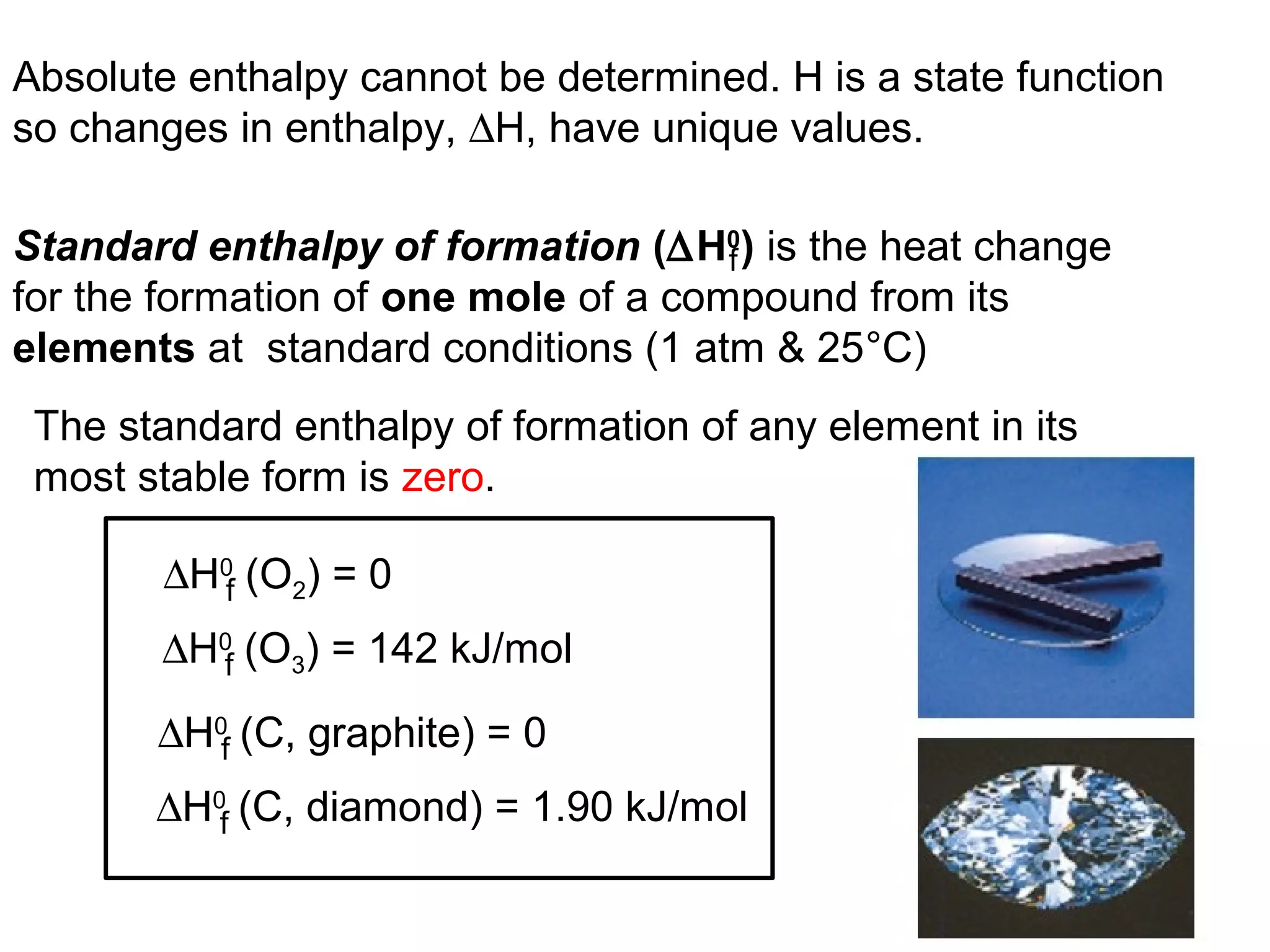
Standard enthalpy of formation (∆H0
) is the heat change
for the formation of one mole of a compound from its
elements at standard conditions (1 atm & 25°C)
f
The standard enthalpy of formation of any element in its
most stable form is zero.
∆H0
(O2) = 0f
∆H0
(O3) = 142 kJ/molf
∆H0
(C, graphite) = 0f
∆H0
(C, diamond) = 1.90 kJ/molf
Absolute enthalpy cannot be determined. H is a state function
so changes in enthalpy, ∆H, have unique values.
The standard enthalpy of reaction (∆H0
) is the enthalpy of
a reaction carried out at 1 atm.
rxn
aA + bB cC + dD
∆H0
rxn d∆H0
(D)fc∆H0
(C)f= [ + ] - b∆H0
(B)fa∆H0
(A)f[ + ]
∆H0
rxn n∆H0
(products)f= Σ m∆H0
(reactants)fΣ-
∆H0
can be determined using the direct method or
the indirect method.
The Direct Method for Determining ∆H 0
• Calculation of the enthalpy of formation of solid
calcium oxide.
CaO(s) + CO2(g) CaCO3(s) ∆Ho
rxn = -177.8 kJ/mol
∆Ho
rxn = Σn∆Ho
f(products) - Σn∆Ho
f(reactants)
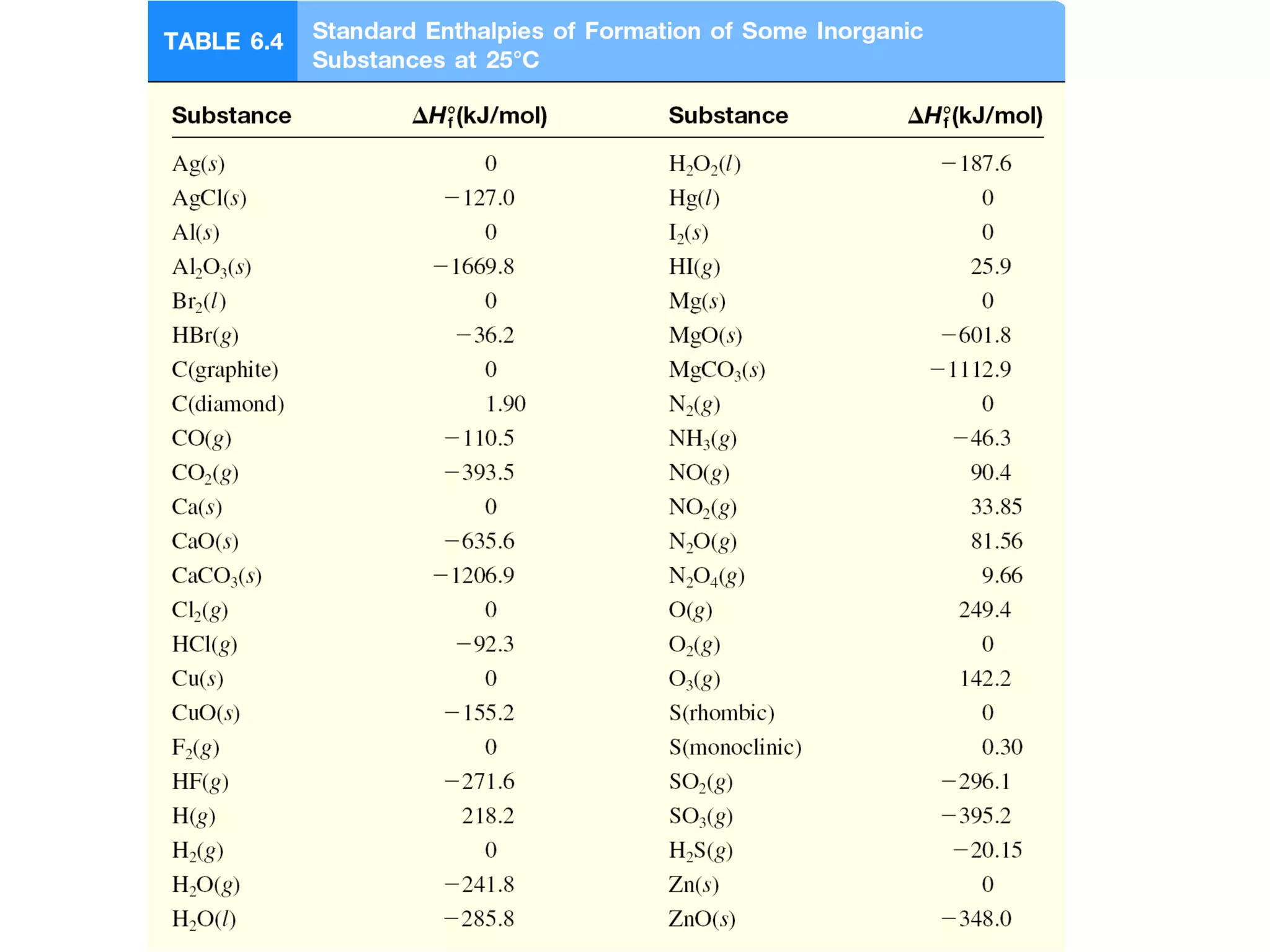
-177.8 kJ/mol =1 mol(-1206.9) - [1 mol(x) + 1 mol(-393.5)]
∆Hf
o
forCaO(s)= -635.6 kJ
The Indirect Method for Determining ∆H0
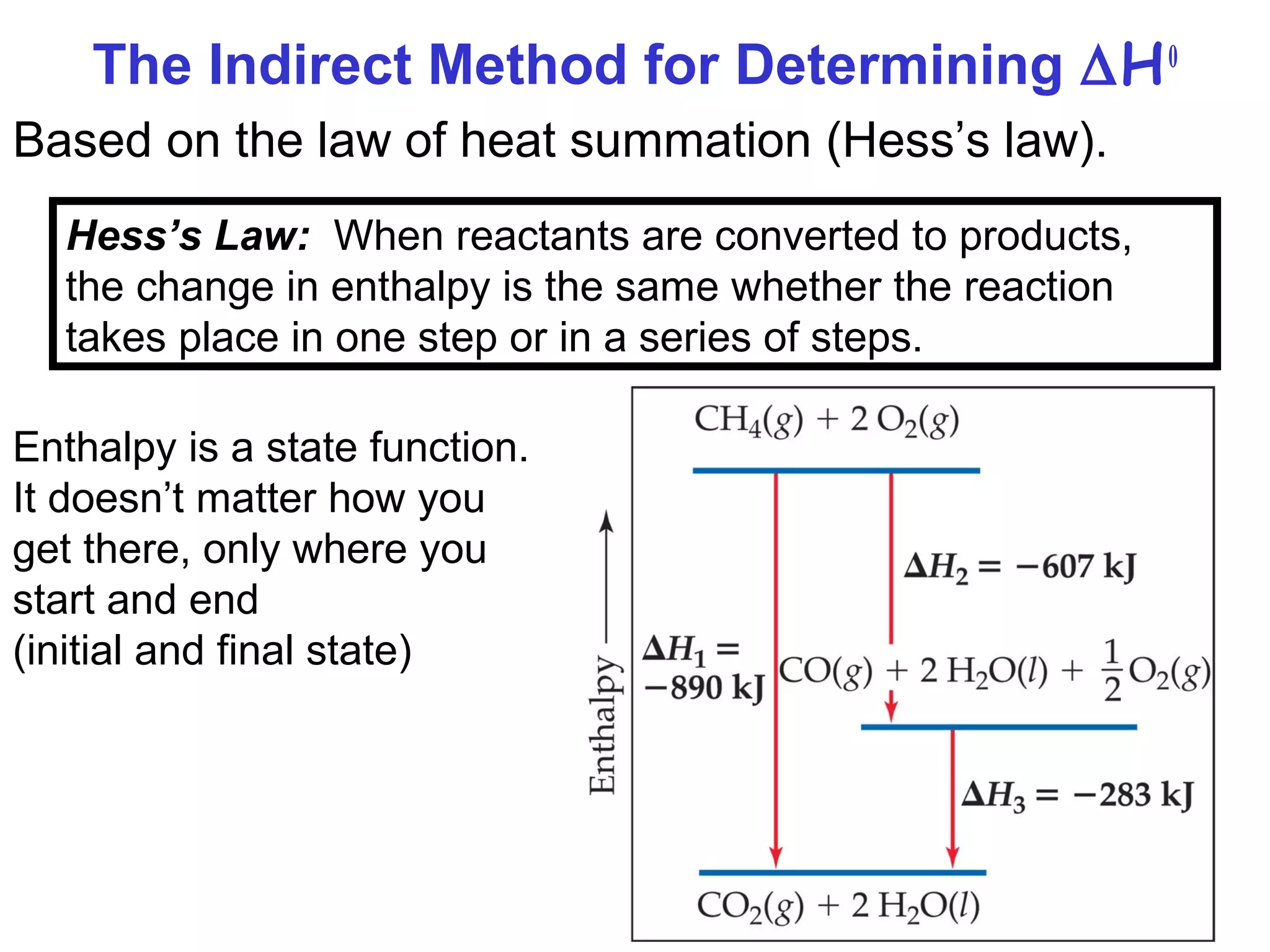
Based on the law of heat summation (Hess’s law).
Hess’s Law: When reactants are converted to products,
the change in enthalpy is the same whether the reaction
takes place in one step or in a series of steps.
Enthalpy is a state function.
It doesn’t matter how you
get there, only where you
start and end
(initial and final state)
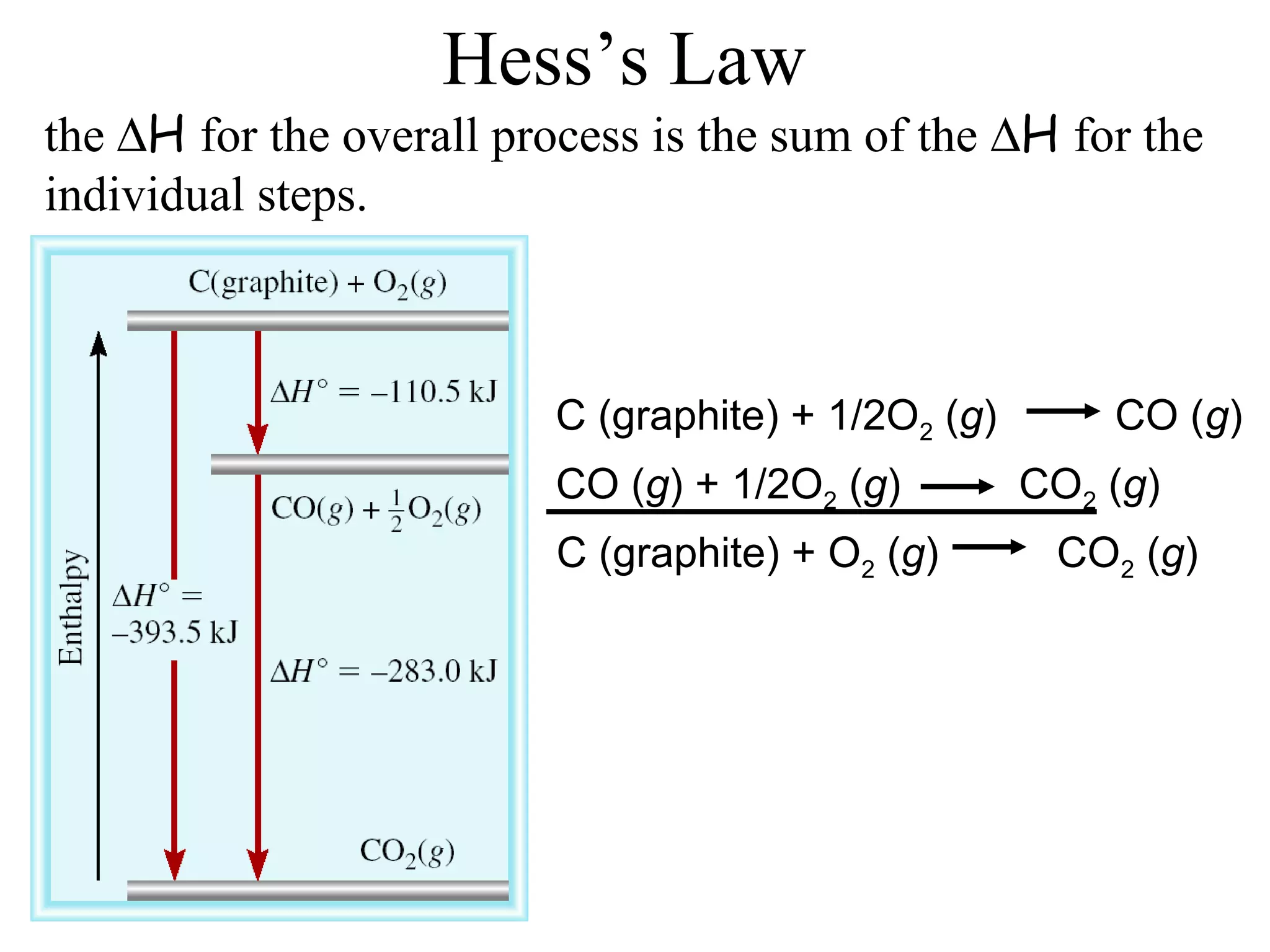
C (graphite) + 1/2O2 (g) CO (g)
CO (g) + 1/2O2 (g) CO2 (g)
C (graphite) + O2 (g) CO2 (g)
Hess’s Law
the ∆H for the overall process is the sum of the ∆H for the
individual steps.
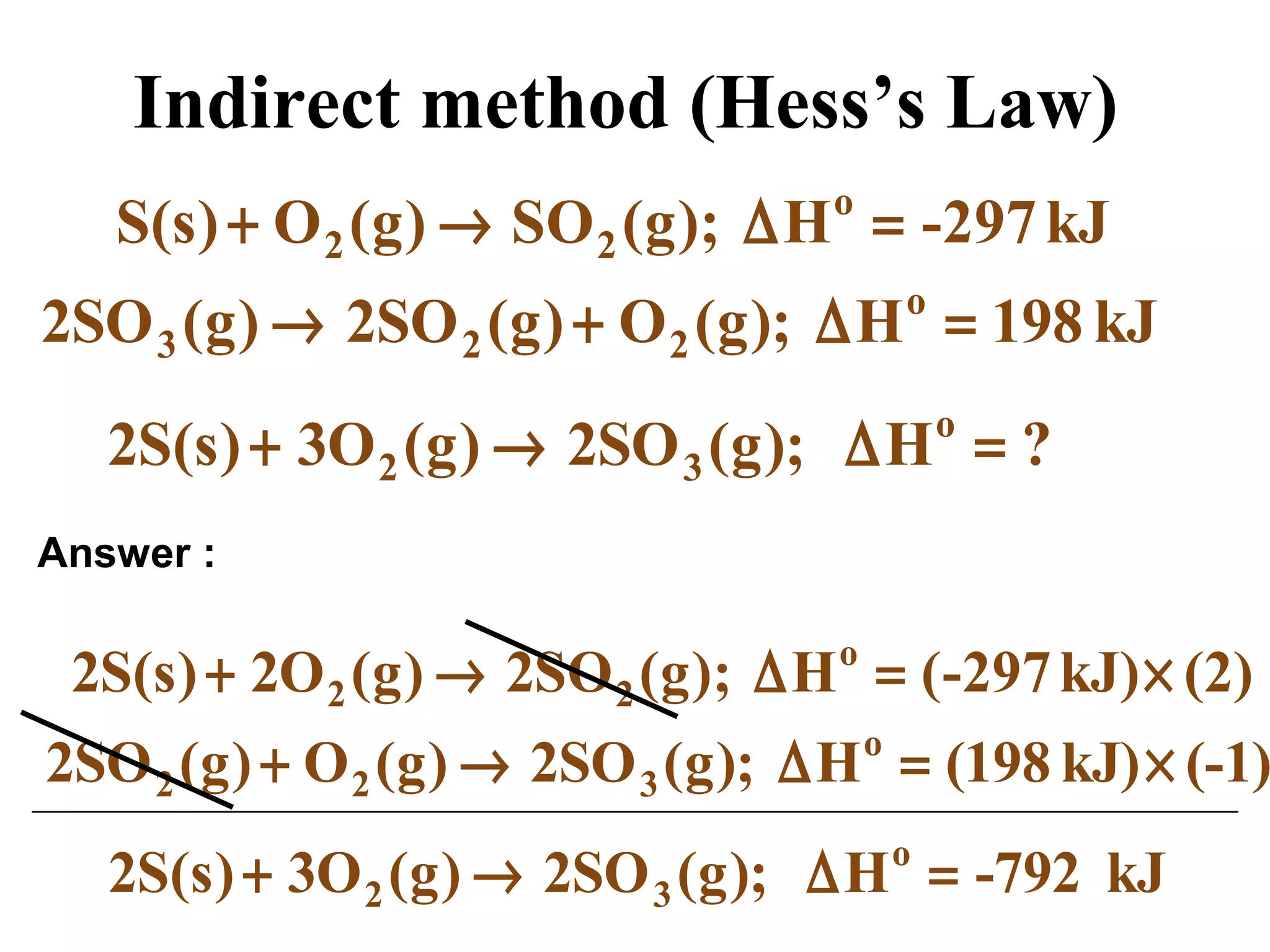
Indirect method (Hess’s Law)
kJ-297H);g(SO)g(O)s(S o
22 =∆→+
kJ198H);g(O)g(SO2)g(SO2 o
223 =∆+→
?H);g(SO2)g(O3)s(S2 o
32 =∆→+
(2)kJ)-297(H);g(SO2)g(O2)s(S2 o
22 ×=∆→+
(-1)kJ)198(H);g(SO2)g(O)g(SO2 o
322 ×=∆→+
kJ-792H);g(SO2)g(O3)s(S2 o
32 =∆→+
Answer :
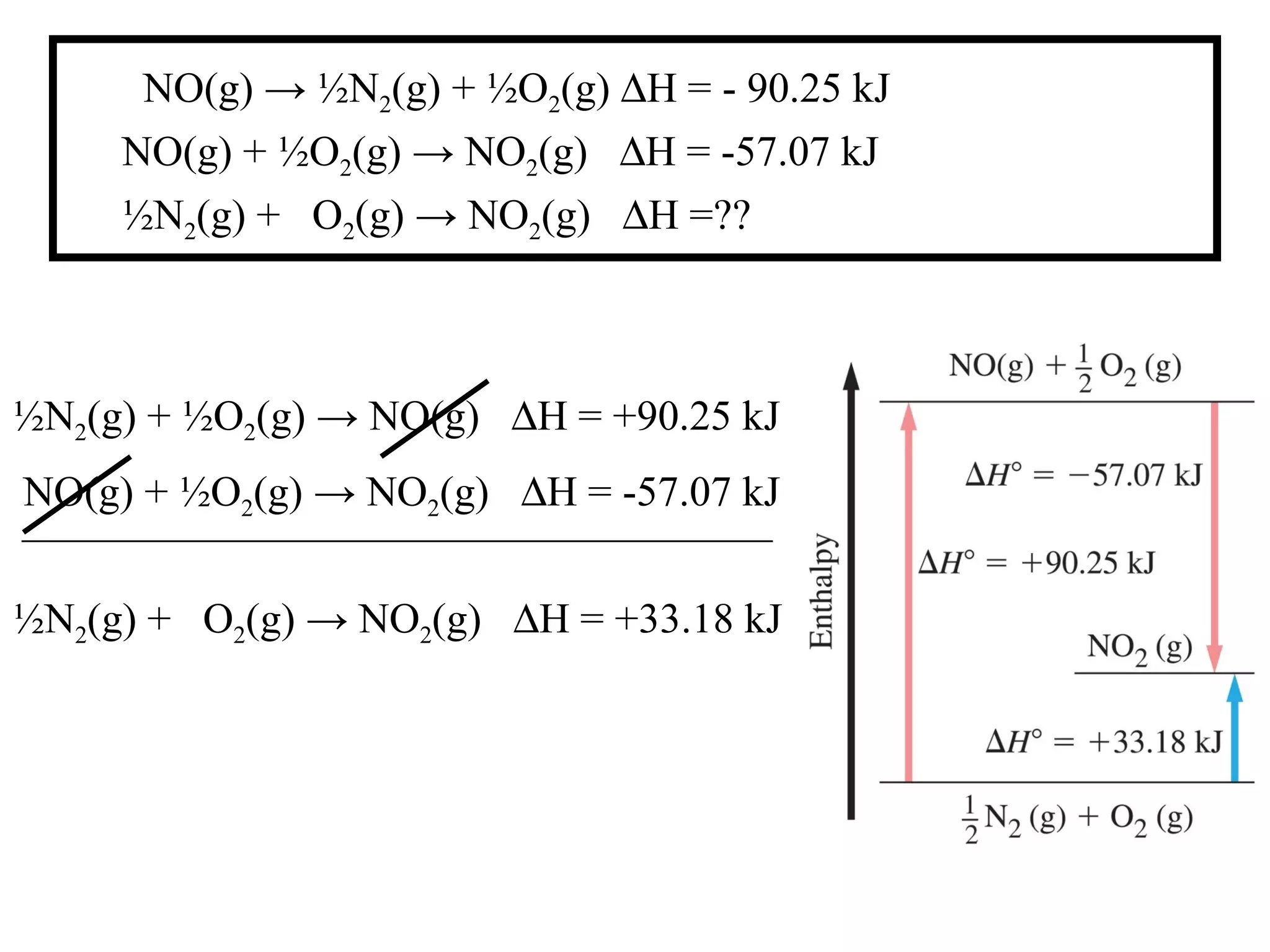
½N2(g) + O2(g) → NO2(g) ∆H = +33.18 kJ
½N2(g) + ½O2(g) → NO(g) ∆H = +90.25 kJ
NO(g) + ½O2(g) → NO2(g) ∆H = -57.07 kJ
½N2(g) + O2(g) → NO2(g) ∆H =??
NO(g) → ½N2(g) + ½O2(g) ∆H = - 90.25 kJ
NO(g) + ½O2(g) → NO2(g) ∆H = -57.07 kJ
45
Benzene (C6H6) burns in air to produce carbon dioxide and
liquid water. How much heat is released per mole of
benzene combusted? The standard enthalpy of formation
of benzene is 49.04 kJ/mol.
2C6H6 (l) + 15O2 (g) 12CO2 (g) + 6H2O (l)
∆H0
rxn n∆H0
(products)f= Σ m∆H0
(reactants)fΣ-
∆H0
rxn 6∆H0
(H2O)f12∆H0
(CO2)f= [ + ] - 2∆H0
(C6H6)f[ ]
∆H0
rxn = [ 12x–393.5 + 6x–187.6 ] – [ 2x49.04 ] = -5946 kJ
-5946 kJ
2 mol
= - 2973 kJ/mol C6H6
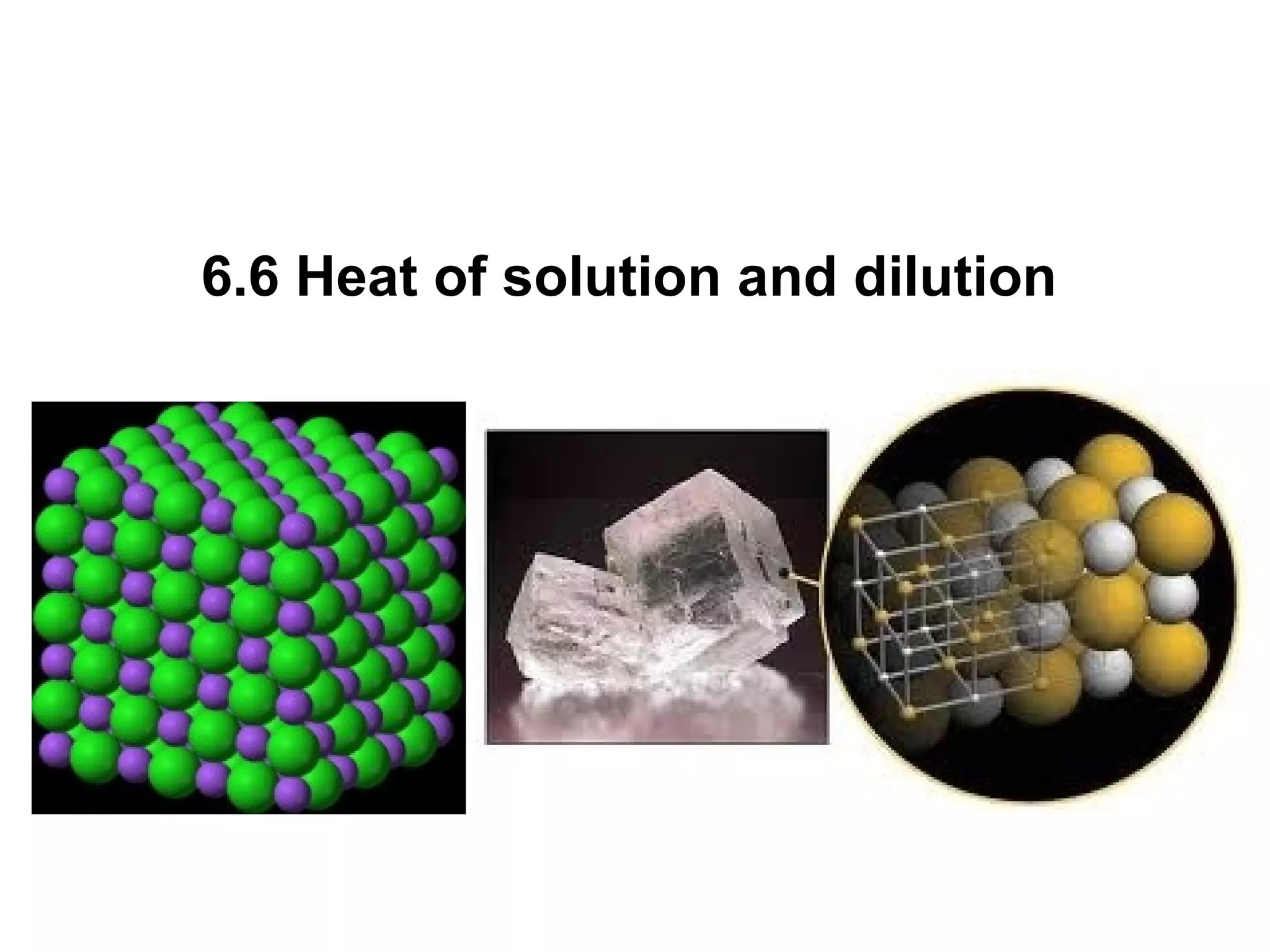
6.6 Heat of solution and dilution
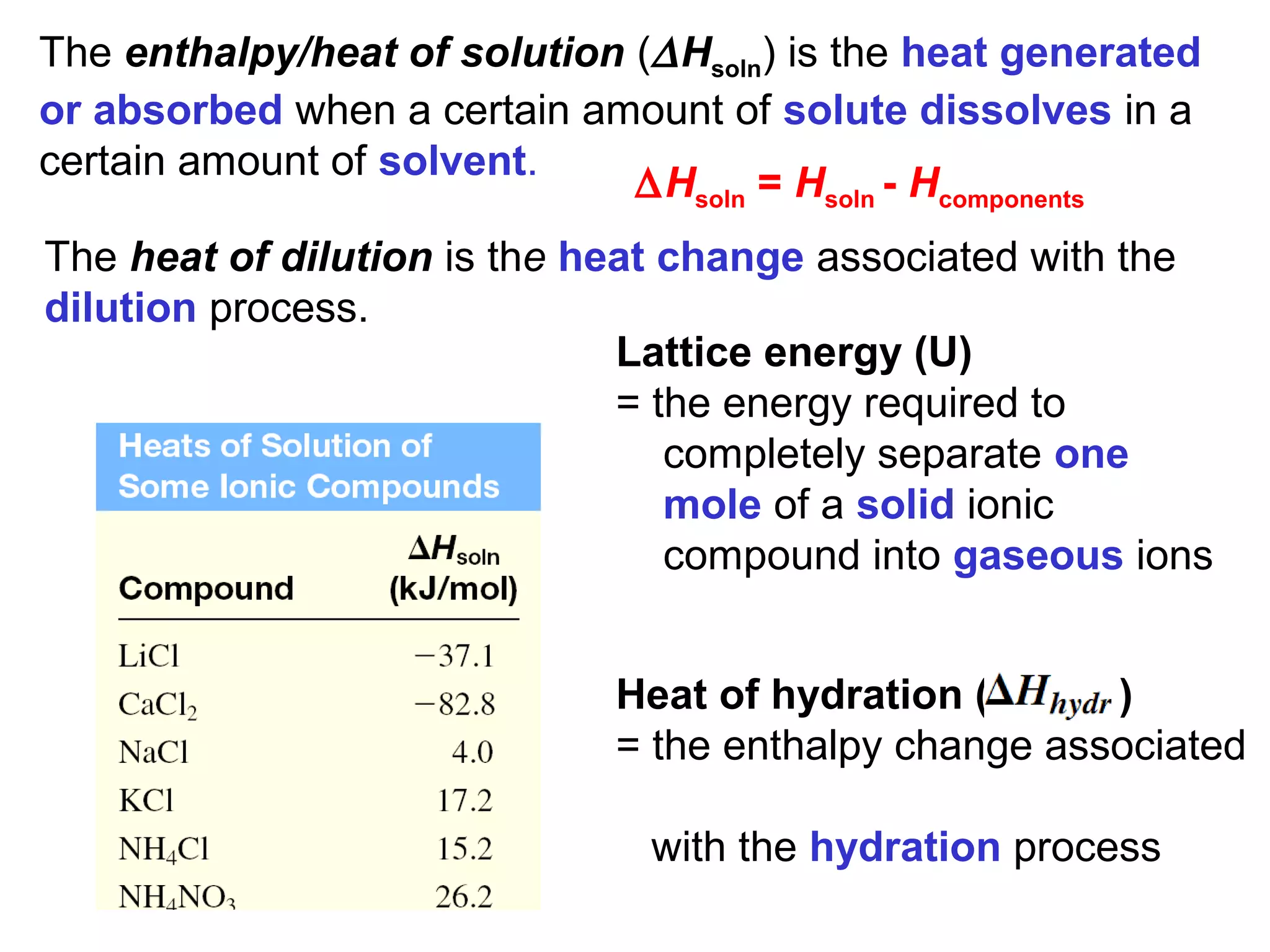
The enthalpy/heat of solution (∆Hsoln) is the heat generated
or absorbed when a certain amount of solute dissolves in a
certain amount of solvent.
∆Hsoln = Hsoln - Hcomponents
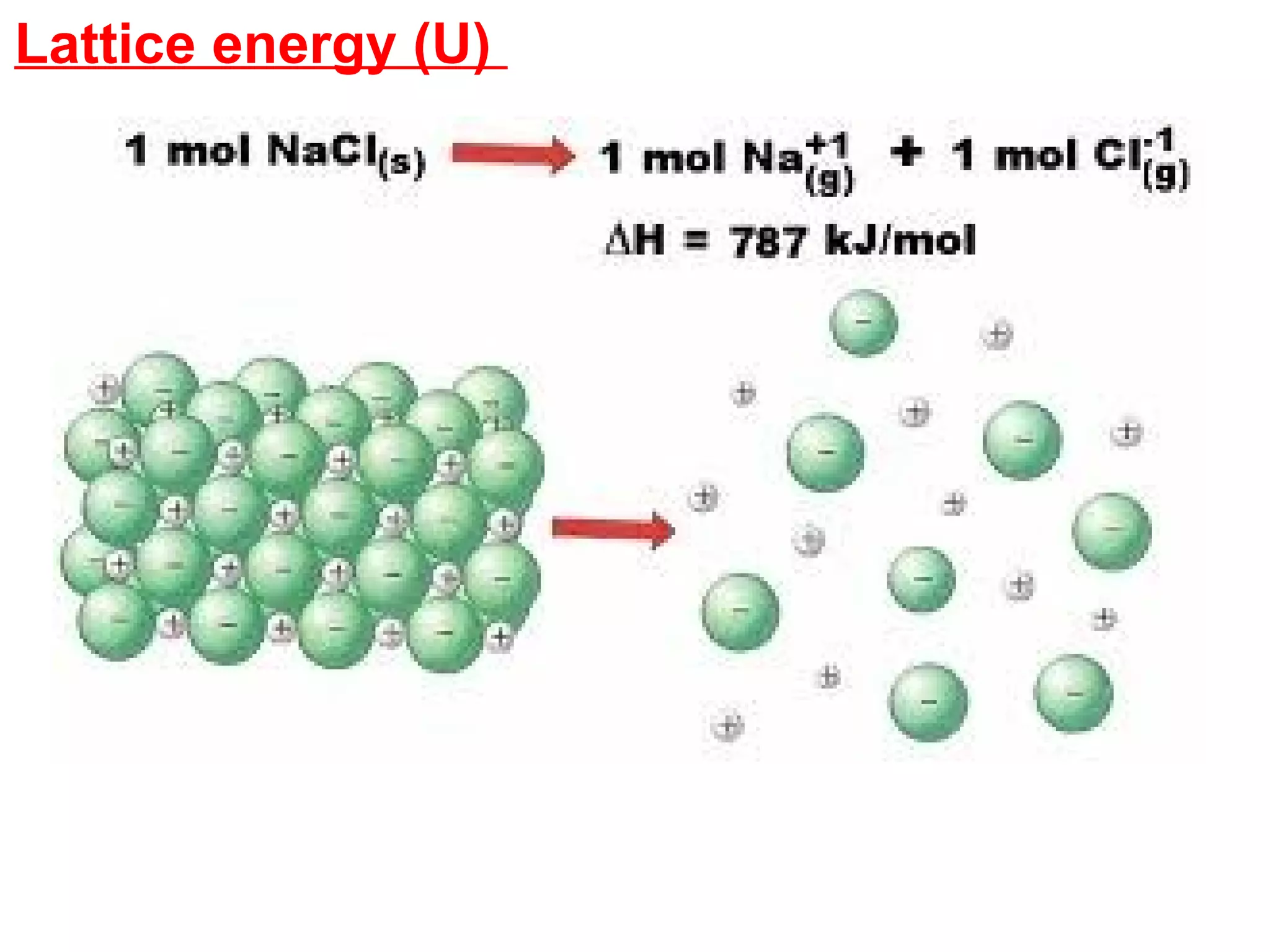
Lattice energy (U)
= the energy required to
completely separate one
mole of a solid ionic
compound into gaseous ions
Heat of hydration ( )
= the enthalpy change associated
with the hydration process
The heat of dilution is the heat change associated with the
dilution process.
Lattice energy (U)
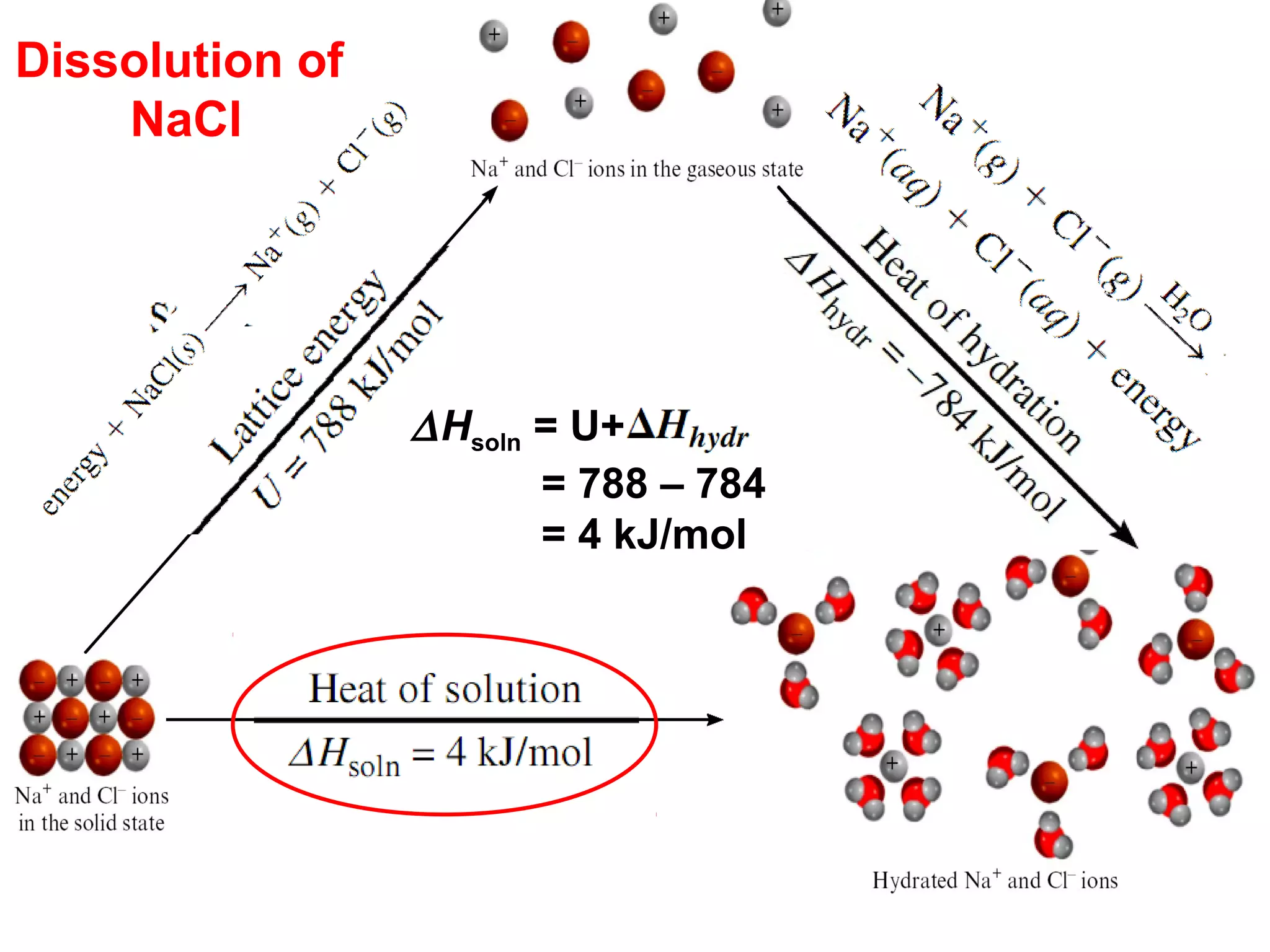
Dissolution of
NaCl
∆Hsoln = U+
= 788 – 784
= 4 kJ/mol
Chapter 6 notes

Chapter 6 notes

  • 2.
    6.1 The natureof energy and types of energy
  • 3.
    Energy is thecapacity to do work. Work(w) = energy used to move an object over some distance = force x distance (F x d) = 1 kgm2 /s2 = 1 Nm = 1 J SI unit = Joule (J) Velocity (m/s) Acceleration (m/s2 ) Force = mass (kg) x acceleration (m/s2 ) = kgm/s2 = N One joule of work is done when a force of one Newton is applied over a distance of one metre
  • 4.
    Types of energy •Kineticenergy is the energy of motion •Potential energy is the energy associated with an object’s position •Radiant energy comes from the sun and is earth’s primary energy source •Thermal energy is the energy associated with the random motion of atoms and molecules •Chemical energy is the energy stored within the bonds of chemical substances •Nuclear energy is the energy stored within the collection of neutrons and protons in the atom
  • 5.
    6.2 Energy changesin chemical reactions
  • 6.
    Law of conservationof energy •Energy can converted from one form to another or transferred from one object to another. •Total amount of energy in the universe remains constant. •Energy cannot be created or destroyed. electrical energy to light energy to thermal and radiant energy Potential energy to kinetic energy Energy conversion
  • 7.
    Heat is thetransfer of thermal energy (molecular motion) between two bodies that are at different temperatures (Heat flow) Temperature is a measure of the thermal energy. Temperature = Thermal Energy Almost all chemical reactions absorb/produce energy in the form of heat
  • 8.
    open mass & energyExchange: closed energy isolated nothing Inchemical reactions, energy (heat) is often transferred from the “system” to its “surroundings,” or vice versa. System and Surroundings System - the specific part of the universe that is of interest in the study. Systems usually include substances involved in chemical and physical changes. Surroundings - the rest of the universe outside the system.
  • 9.
  • 10.
    Exothermic process isany process that gives off heat – transfers thermal energy from the system to the surroundings. Endothermic process is any process in which heat has to be supplied to the system from the surroundings. 2H2 (g) + O2 (g) 2H2O (l) + energy H2O (g) H2O (l) + energy energy + 2HgO (s) 2Hg (l) + O2 (g) energy + H2O (s) H2O (l)
  • 11.
    Exothermic Endothermic energy ofthe products > energy of the reactants energy of the products < energy of the reactants
  • 12.
    6.3 Introduction tothermodynamics
  • 13.
    Thermodynamic = scientificstudy of the interconversion of heat and other kinds of energy State function • properties that are determined by the state of the system (eg. energy, temp, pressure, volume). • depends only on the initial and final states of the system, not on the path by which the system arrived at that state. ∆E = Efinal - Einitial ∆P = Pfinal - Pinitial ∆V = Vfinal - Vinitial ∆T = Tfinal - Tinitial State of a system = the values of all relevant macroscopic properties-example: energy, temperature, pressure, volume. Thermochemistry is the study of heat change in chemical reactions. Thermochemistry is part of a broader subject called Thermodynamics. q and w are not state functions They are not properties of a system ∆w = wfinal - winitial ∆q = qfinal - qinitial
  • 14.
    Potential energy ofhiker 1 and hiker 2 is the same even though they took different paths. ∆E = Efinal - Einitial • Independent of the path by which the system achieved that state. • Energy, E is a function of state-not easily measured. ∀ ∆E has a unique value between two states-easily measured. First law of thermodynamics – energy can be converted from one form to another, but cannot be created or destroyed. Change in internal energy, ∆E = Efinal –Einitial Internal energy = Total energy (kinetic + potential) in a system
  • 15.
    ∆Esystem + ∆Esurroundings= 0 ∆Esystem = -∆Esurroundings Energy lost by the system = Energy gained by the surroundings Transfer of energy from the system to the surroundings does not change the total energy of the universe Change of energy (∆E) ∆E = q + w ∆E = the change in internal energy of a system q = the heat exchange between the system and the surroundings w = the work done on (or by) the system When energy is exchanged between the system and the surroundings, it is exchanged as either heat (q) or work (w).
  • 16.
    Sign conventions forwork & heat ∆E = q + w System gains heatSystem loses heat Work done on systemWork done by system + ∆E ( gain of internal energy)− ∆E ( loss of internal energy)
  • 17.
    Work and Heat w= F x d Mechanical work done by gas(reaction in vessel fitted with a piston) P x V = x d3 = F x d = w F d2 Gas expansion Work done by the system to the surrounding Vf-Vi > 0 ∆V > 0 ∴ w is negative Gas compression Work done on the system by the surrounding Vf-Vi < 0 ∆V < 0 ∴ w is positive unit = J 1 L . atm = 101.3 J w = -P ∆V unit = L . atm P= constant external pressure
  • 18.
    A sample ofnitrogen gas expands in volume from 1.6 L to 5.4 L at constant temperature. What is the work done in joules if the gas expands (a) against a vacuum and (b) against a constant pressure of 3.7 atm? w = -P ∆V (a) ∆V = 5.4 L – 1.6 L = 3.8 L P = 0 atm W = -0 atm x 3.8 L = 0 L•atm = 0 joules (b) ∆V = 5.4 L – 1.6 L = 3.8 L P = 3.7 atm w = -3.7 atm x 3.8 L = -14.1 L•atm w = -14.1 L•atm x 101.3 J 1L•atm = -1430 J (1 L . atm = 101.3 J)
  • 19.
  • 20.
    Enthalpy (H) (extensiveproperty) is used to quantify the heat flow into or out of a system in a process that occurs at constant pressure. H = E + PV ∆H = ∆E + P∆V Enthalpy = internal energy + product of pressure-volume ∆H = (q+w) -w ∆H = q Change of enthalpy of the system = heat flow into/out the system (heat gain/heat lost) P constant w = -P ∆V ∆E = q + w
  • 21.
    Enthalpy of reaction,∆H = H (products) – H (reactants) Hproducts > Hreactants ∆H > 0 Hproducts < Hreactants ∆H < 0 ExothermicEndothermic products reactants reactants products
  • 22.
    22 Thermochemical Equations H2O (s)H2O (l) ∆H = 6.01 kJ/mol Is ∆H negative or positive? System absorbs heat Endothermic ∆H > 0 6.01 kJ are absorbed for every 1 mole of ice that melts at 00 C and 1 atm.
  • 23.
    23 Thermochemical Equations CH4 (g)+ 2O2 (g) CO2 (g) + 2H2O (l) ∆H = -890.4 kJ/mol Is ∆H negative or positive? System gives off heat Exothermic ∆H < 0 890.4 kJ are released for every 1 mole of methane that is combusted at 250 C and 1 atm.
  • 24.
    H2O (s) H2O(l) ∆H = 6.01 kJ/mol • The stoichiometric coefficients always refer to the number of moles of a substance Thermochemical Equations • If you reverse a reaction, the sign of ∆H changes H2O (l) H2O (s) ∆H = -6.01 kJ/mol
  • 25.
    H2O (s) H2O(l) ∆H = 6.01 kJ/mol • The physical states of all reactants and products must be specified in thermochemical equations. Thermochemical Equations H2O (l) H2O (g) ∆H = 44.0 kJ/mol • If you multiply both sides of the equation by a factor n, then ∆H must change by the same factor n. 2H2O (s) 2H2O (l) ∆H = 2 x 6.01 = 12.0 kJ
  • 26.
    How much heatis evolved when 266 g of white phosphorus (P4) burn in air? P4 (s) + 5O2 (g) P4O10 (s) ∆H = -3013 kJ/mol 266 g P4 1 mol P4 123.9 g P4 x 3013 kJ 1 mol P4 x = 6470 kJ
  • 27.
  • 28.
    The specific heat(s) of a substance is the amount of heat (q) required to raise the temperature of one gram of the substance by one degree Celsius. The heat capacity (C) of a substance is the amount of heat (q) required to raise the temperature of a given quantity (m) of the substance by one degree Celsius. C = ms Heat (q) absorbed or released: q = ms∆t q = C∆t ∆t = tfinal - tinitial Calorimetry = measurement of heat change Unit = Unit = q > 0 = endothermic process q < 0 = exothermic process
  • 29.
    A 466g sampleof water is heated from 8.50 o C to 74.60 o C. Calculate the amount of heat absorbed by the water in kJ. q = ms∆t q = (466g)(4.184 J/g.o C)(74.60 o C - 8.50 o C) q = 128878 J q = 129 kJ Determine the heat capacity for 60.0g of water. C = ms = (60.0g)(4.184 J/g.o C) = 251 J/o C
  • 30.
    How much heatis given off when an 869 g iron bar cools from 94o C to 5o C? s of Fe = 0.444 J/g • o C ∆t = tfinal – tinitial = 5o C – 94o C = -89o C q = ms∆t = 869 g x 0.444 J/g • o C x –89o C = -34,000 J = -34 kJ
  • 31.
    Constant-Volume Calorimetry (“Bomb”calorimeter) No heat/mass enters/leaves (isolated system) qrxn = - (qwater + qcal) qwater = ms∆t qcal = Ccal ∆t Reaction at Constant V ∆H ≈ qrxn ∆H = qrxn measure heat of combustion
  • 32.
    Constant-Pressure Calorimetry (“coffee-cup”calorimeter) No heat enters or leaves! qrxn = - (qwater + qcal) qwater = ms∆t qcal = Ccal ∆t Reaction at Constant P ∆H = qrxn measure heat of reactions (acid-base neutralization, heat of solution, heat of dilution)
  • 34.
    34 Because no heatenters or leaves the system throughout the process, heat lost by the reaction must be equal to the heat gained by the calorimeter and water, therefore, we can write… qrxn = -(qwater + qcalorimeter) where qwater is determined by q = ms∆t and qcalorimeter is determined by q = C∆t Heat lost = exothermic Heat gained = endothermic
  • 35.
    A reactant wasburned in a constant-volume calorimeter. The temperature of the water increased from 20.17 o C to 25.84 o C. Given the mass of water surrounding the calorimeter is 2000g and the heat capacity of the calorimeter is1.80 kJ/ o C, calculate the heat of combustion. q = -(qwater + qcal) heat lost by the reaction = heat gained by the water and bomb qwater = ms∆t = (2000g)(4.184J/g. o C)(25.84 o C - 20.17 o C) = 47400 J or 47.4 kJ qbomb = C∆t = (1.80 kJ/o C)(25.84 o C - 20.17 o C) = 10.2 kJ q = -(qwater + qcal) q = -(47.4 kJ + 10.2 kJ) = -57.6 kJ
  • 36.
    6.5 Standard enthalpyof formation and reaction
  • 37.
    Standard enthalpy offormation (∆H0 ) is the heat change for the formation of one mole of a compound from its elements at standard conditions (1 atm & 25°C) f The standard enthalpy of formation of any element in its most stable form is zero. ∆H0 (O2) = 0f ∆H0 (O3) = 142 kJ/molf ∆H0 (C, graphite) = 0f ∆H0 (C, diamond) = 1.90 kJ/molf Absolute enthalpy cannot be determined. H is a state function so changes in enthalpy, ∆H, have unique values.
  • 39.
    The standard enthalpyof reaction (∆H0 ) is the enthalpy of a reaction carried out at 1 atm. rxn aA + bB cC + dD ∆H0 rxn d∆H0 (D)fc∆H0 (C)f= [ + ] - b∆H0 (B)fa∆H0 (A)f[ + ] ∆H0 rxn n∆H0 (products)f= Σ m∆H0 (reactants)fΣ- ∆H0 can be determined using the direct method or the indirect method.
  • 40.
    The Direct Methodfor Determining ∆H 0 • Calculation of the enthalpy of formation of solid calcium oxide. CaO(s) + CO2(g) CaCO3(s) ∆Ho rxn = -177.8 kJ/mol ∆Ho rxn = Σn∆Ho f(products) - Σn∆Ho f(reactants) -177.8 kJ/mol =1 mol(-1206.9) - [1 mol(x) + 1 mol(-393.5)] ∆Hf o forCaO(s)= -635.6 kJ
  • 41.
    The Indirect Methodfor Determining ∆H0 Based on the law of heat summation (Hess’s law). Hess’s Law: When reactants are converted to products, the change in enthalpy is the same whether the reaction takes place in one step or in a series of steps. Enthalpy is a state function. It doesn’t matter how you get there, only where you start and end (initial and final state)
  • 42.
    C (graphite) +1/2O2 (g) CO (g) CO (g) + 1/2O2 (g) CO2 (g) C (graphite) + O2 (g) CO2 (g) Hess’s Law the ∆H for the overall process is the sum of the ∆H for the individual steps.
  • 43.
    Indirect method (Hess’sLaw) kJ-297H);g(SO)g(O)s(S o 22 =∆→+ kJ198H);g(O)g(SO2)g(SO2 o 223 =∆+→ ?H);g(SO2)g(O3)s(S2 o 32 =∆→+ (2)kJ)-297(H);g(SO2)g(O2)s(S2 o 22 ×=∆→+ (-1)kJ)198(H);g(SO2)g(O)g(SO2 o 322 ×=∆→+ kJ-792H);g(SO2)g(O3)s(S2 o 32 =∆→+ Answer :
  • 44.
    ½N2(g) + O2(g)→ NO2(g) ∆H = +33.18 kJ ½N2(g) + ½O2(g) → NO(g) ∆H = +90.25 kJ NO(g) + ½O2(g) → NO2(g) ∆H = -57.07 kJ ½N2(g) + O2(g) → NO2(g) ∆H =?? NO(g) → ½N2(g) + ½O2(g) ∆H = - 90.25 kJ NO(g) + ½O2(g) → NO2(g) ∆H = -57.07 kJ
  • 45.
    45 Benzene (C6H6) burnsin air to produce carbon dioxide and liquid water. How much heat is released per mole of benzene combusted? The standard enthalpy of formation of benzene is 49.04 kJ/mol. 2C6H6 (l) + 15O2 (g) 12CO2 (g) + 6H2O (l) ∆H0 rxn n∆H0 (products)f= Σ m∆H0 (reactants)fΣ- ∆H0 rxn 6∆H0 (H2O)f12∆H0 (CO2)f= [ + ] - 2∆H0 (C6H6)f[ ] ∆H0 rxn = [ 12x–393.5 + 6x–187.6 ] – [ 2x49.04 ] = -5946 kJ -5946 kJ 2 mol = - 2973 kJ/mol C6H6
  • 46.
    6.6 Heat ofsolution and dilution
  • 47.
    The enthalpy/heat ofsolution (∆Hsoln) is the heat generated or absorbed when a certain amount of solute dissolves in a certain amount of solvent. ∆Hsoln = Hsoln - Hcomponents Lattice energy (U) = the energy required to completely separate one mole of a solid ionic compound into gaseous ions Heat of hydration ( ) = the enthalpy change associated with the hydration process The heat of dilution is the heat change associated with the dilution process.
  • 48.
  • 49.
    Dissolution of NaCl ∆Hsoln =U+ = 788 – 784 = 4 kJ/mol