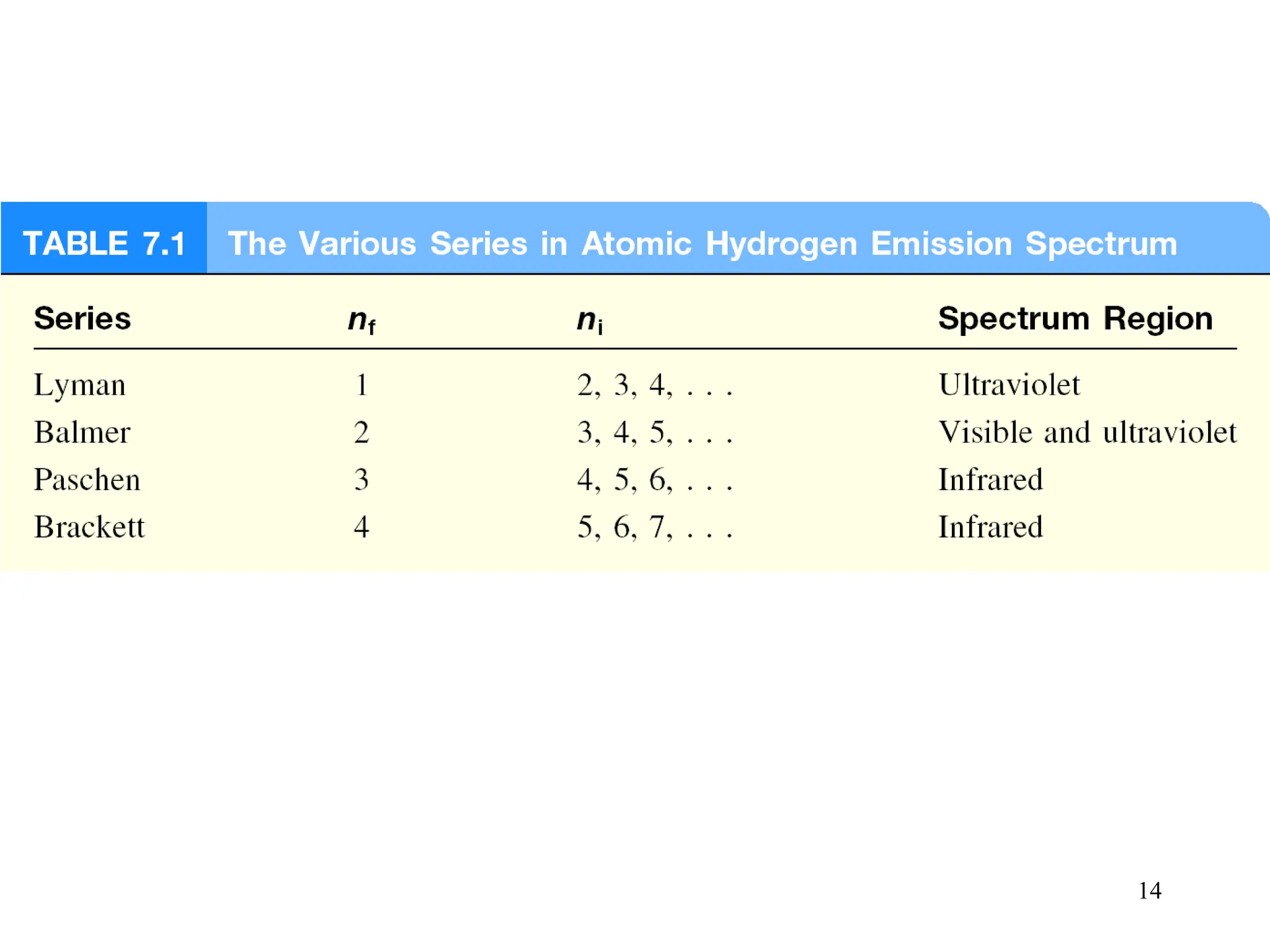
1
Chapter 7
Copyright © The McGraw-Hill Companies, Inc. Permission required for reproduction or display.
Quantum Theory and the
Electronic Structure of Atoms
2
Properties of Waves
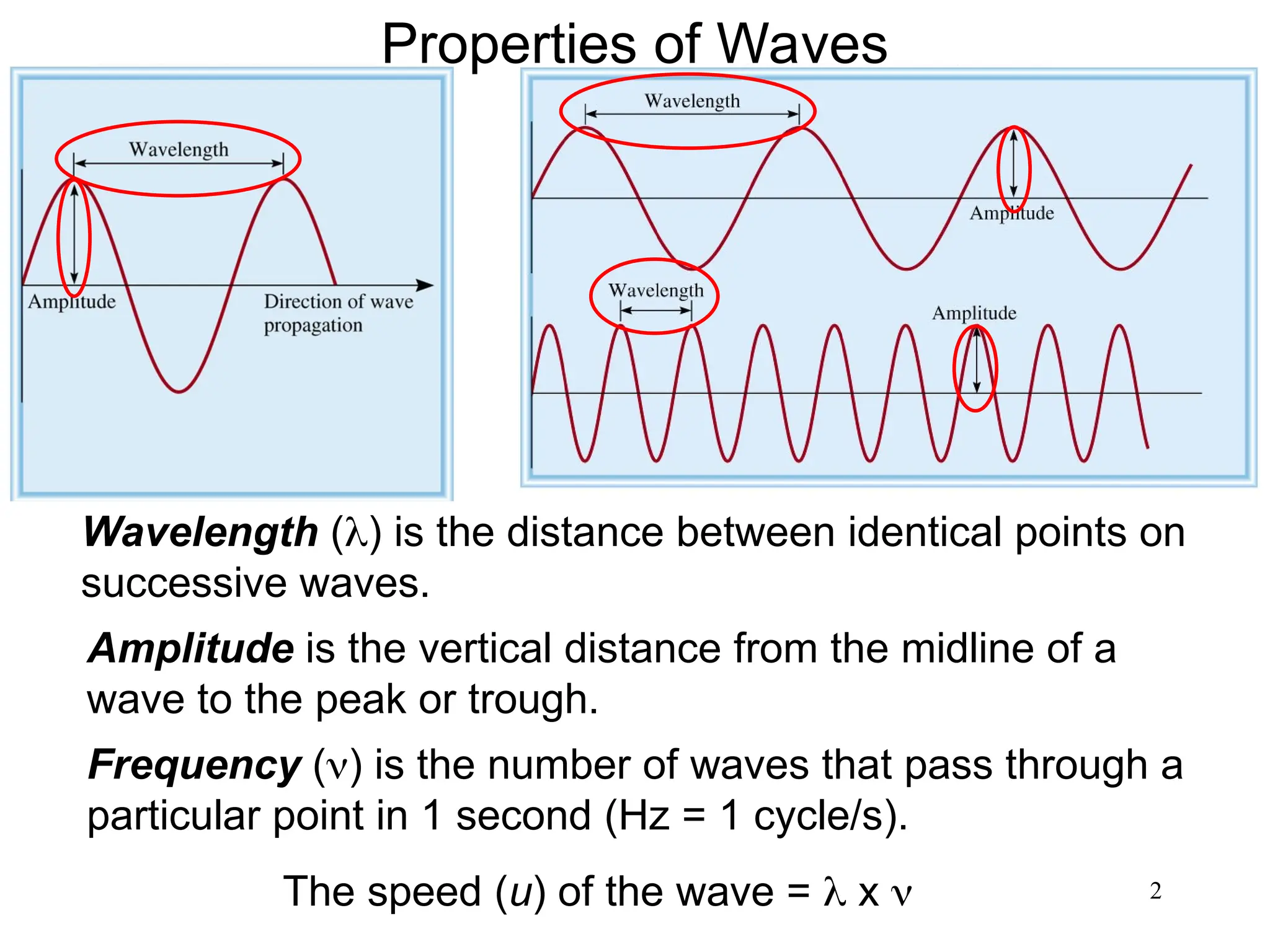
Wavelength () is the distance between identical points on
successive waves.
Amplitude is the vertical distance from the midline of a
wave to the peak or trough.
Frequency () is the number of waves that pass through a
particular point in 1 second (Hz = 1 cycle/s).
The speed (u) of the wave =  x 
3
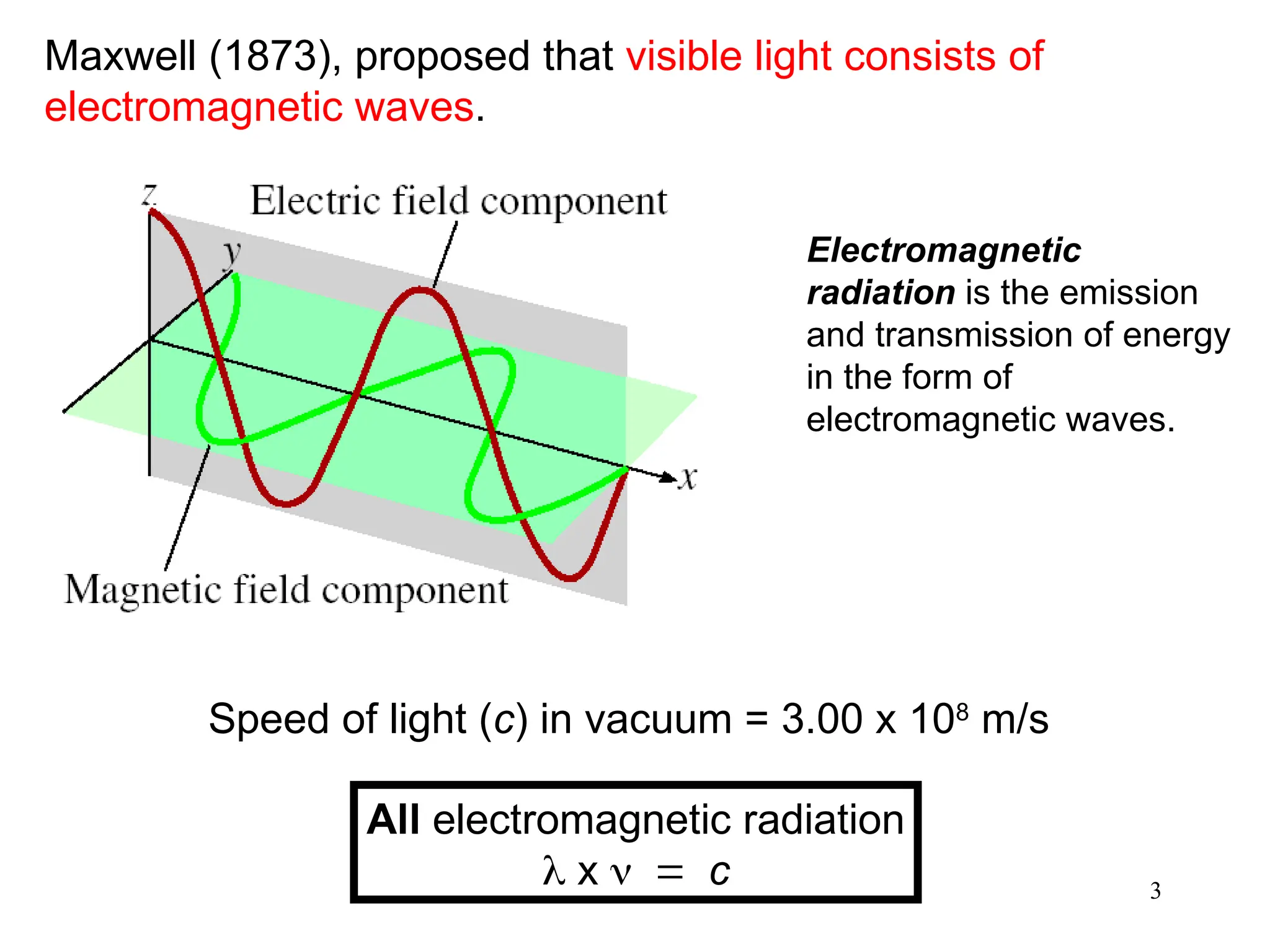
Maxwell (1873), proposed that visible light consists of
electromagnetic waves.
Electromagnetic
radiation is the emission
and transmission of energy
in the form of
electromagnetic waves.
Speed of light (c) in vacuum = 3.00 x 10⁸
m/s
All electromagnetic radiation
 x c
4
5
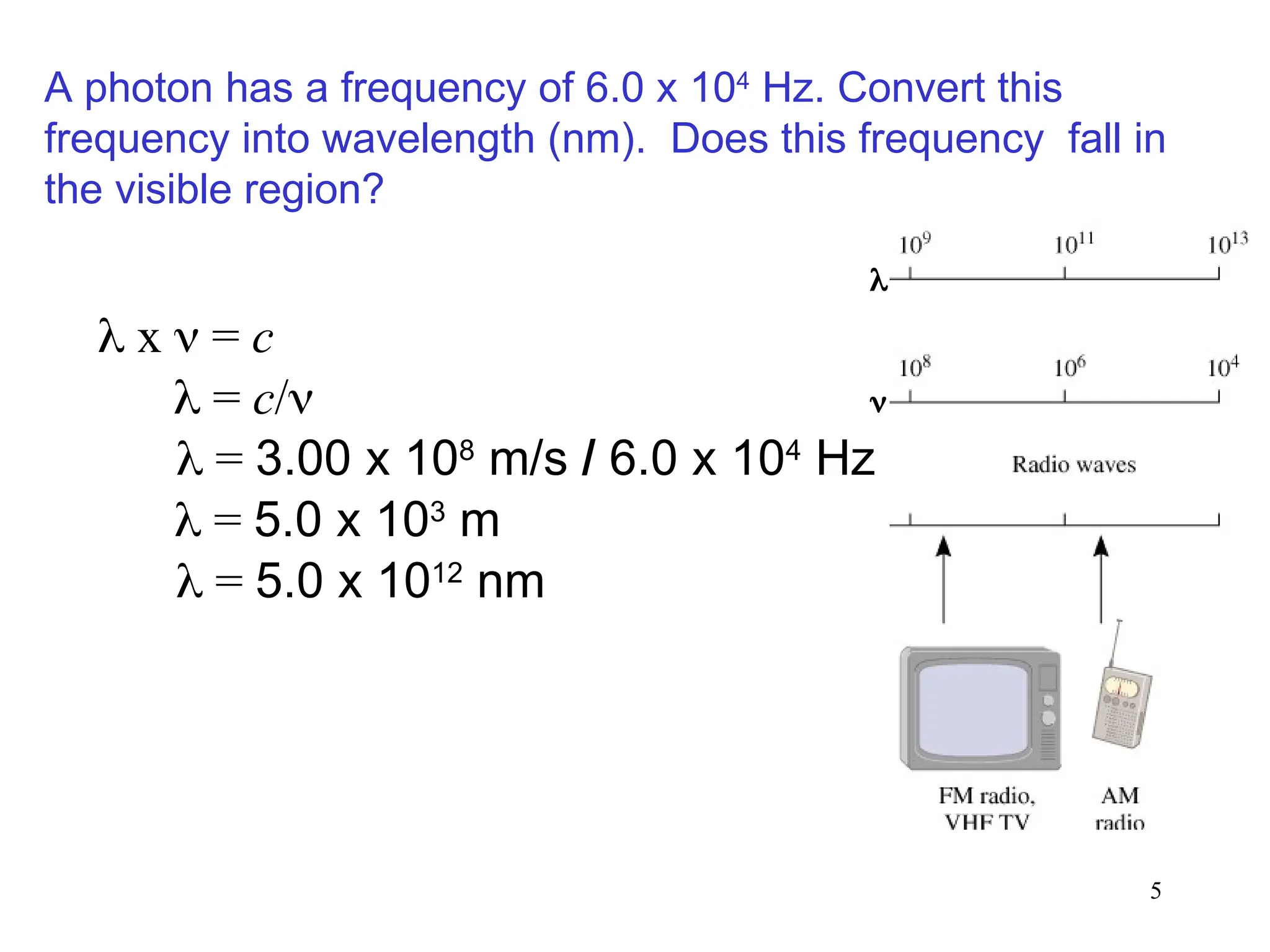
 x  = c
 = c/
 = 3.00 x 10⁸
m/s / 6.0 x 10⁴
Hz
 = 5.0 x 10³
m
A photon has a frequency of 6.0 x 10⁴
Hz. Convert this
frequency into wavelength (nm). Does this frequency fall in
the visible region?
 = 5.0 x 10¹²
nm


6
Mystery #1, “Heated Solids Problem”
Solved by Planck in 1900
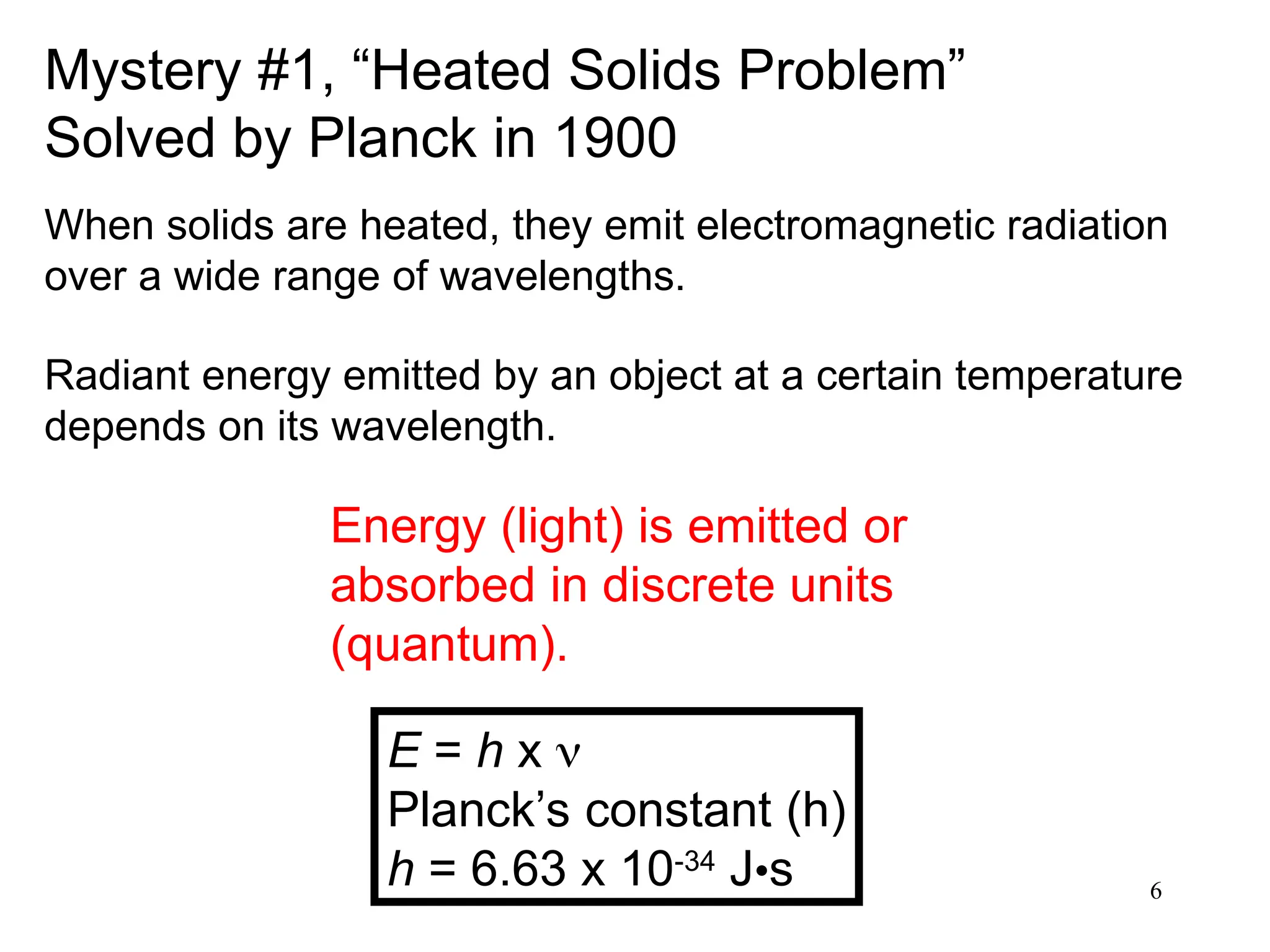
Energy (light) is emitted or
absorbed in discrete units
(quantum).
E = h x 
Planck’s constant (h)
h = 6.63 x 10⁻³⁴
J•s
When solids are heated, they emit electromagnetic radiation
over a wide range of wavelengths.
Radiant energy emitted by an object at a certain temperature
depends on its wavelength.
7
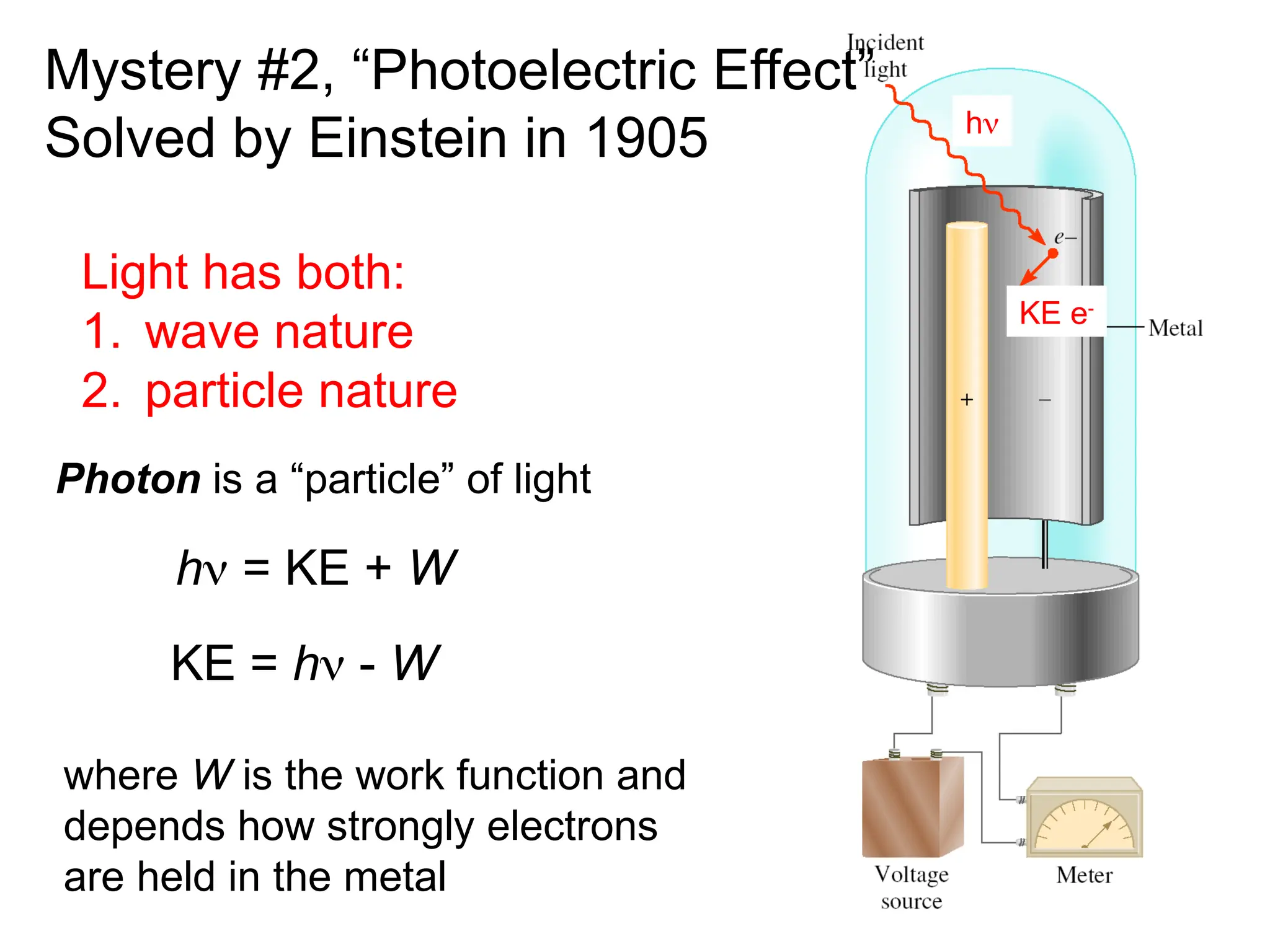
Light has both:
1. wave nature
2. particle nature
h = KE + W
Mystery #2, “Photoelectric Effect”
Solved by Einstein in 1905
Photon is a “particle” of light
KE = h - W
h
KE e-
where W is the work function and
depends how strongly electrons
are held in the metal
8
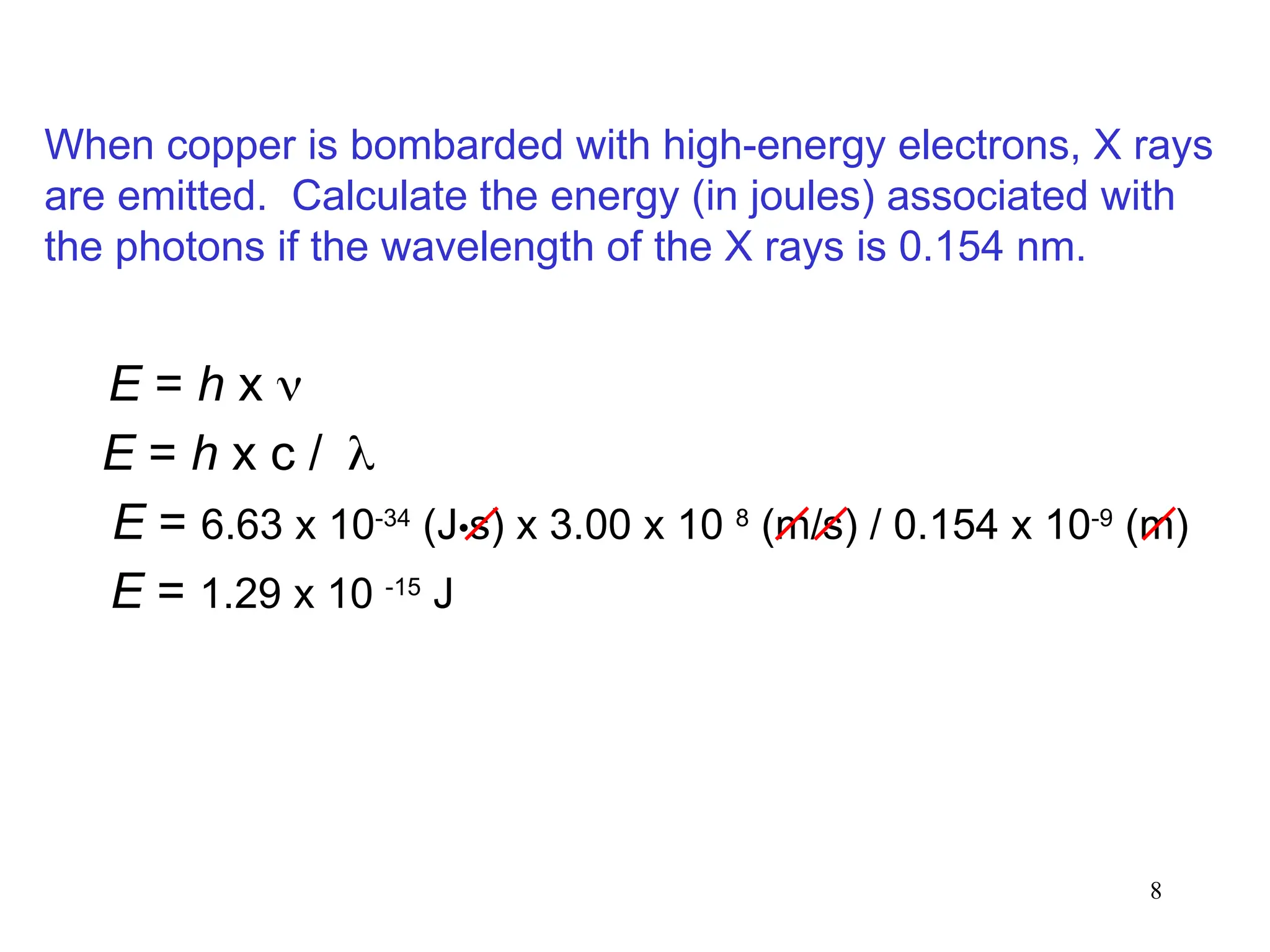
E = h x 
E = 6.63 x 10⁻³⁴
(J•s) x 3.00 x 10 8
(m/s) / 0.154 x 10⁻⁹
(m)
E = 1.29 x 10 -15
J
E = h x c /
When copper is bombarded with high-energy electrons, X rays
are emitted. Calculate the energy (in joules) associated with
the photons if the wavelength of the X rays is 0.154 nm.
9
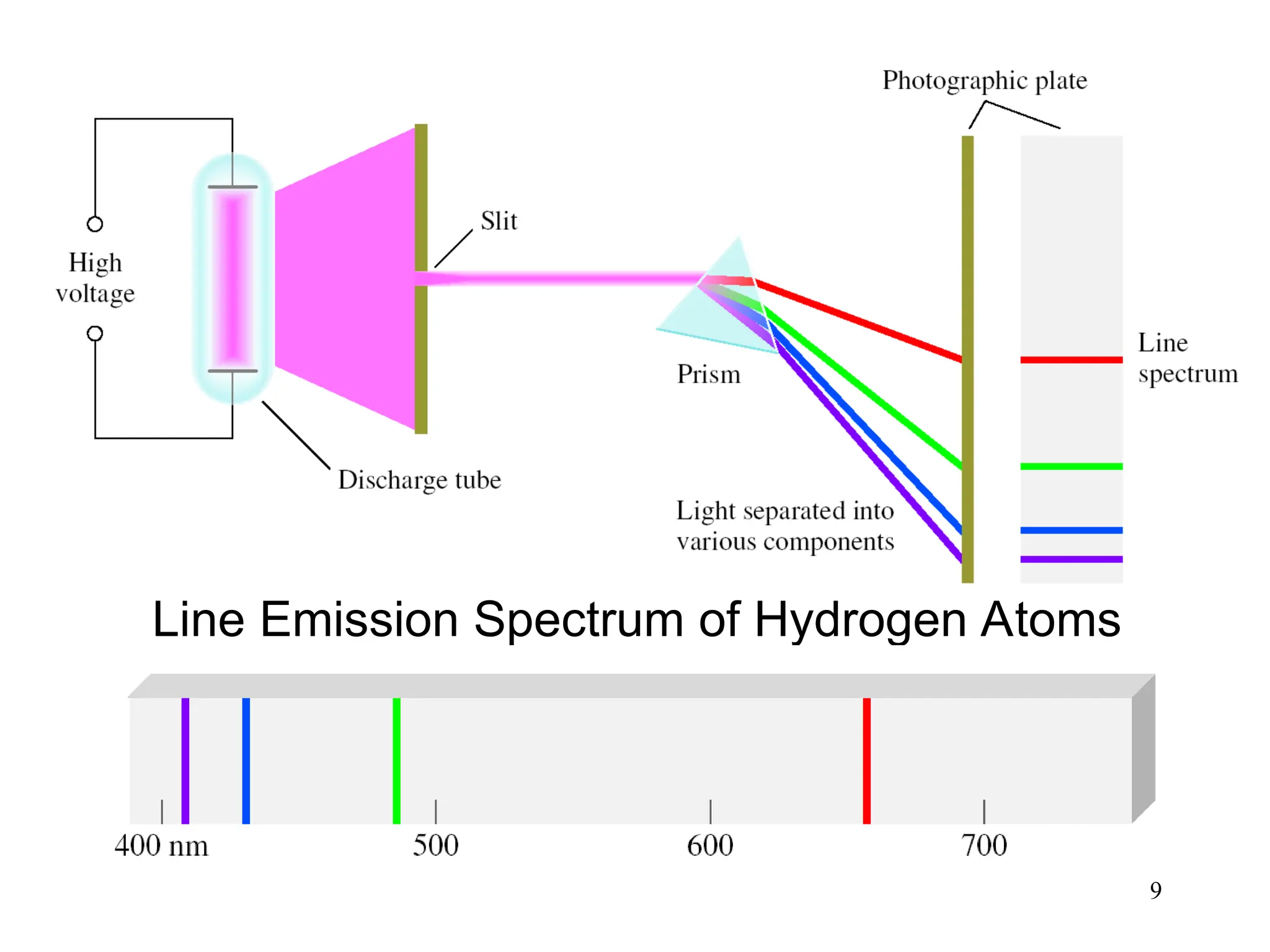
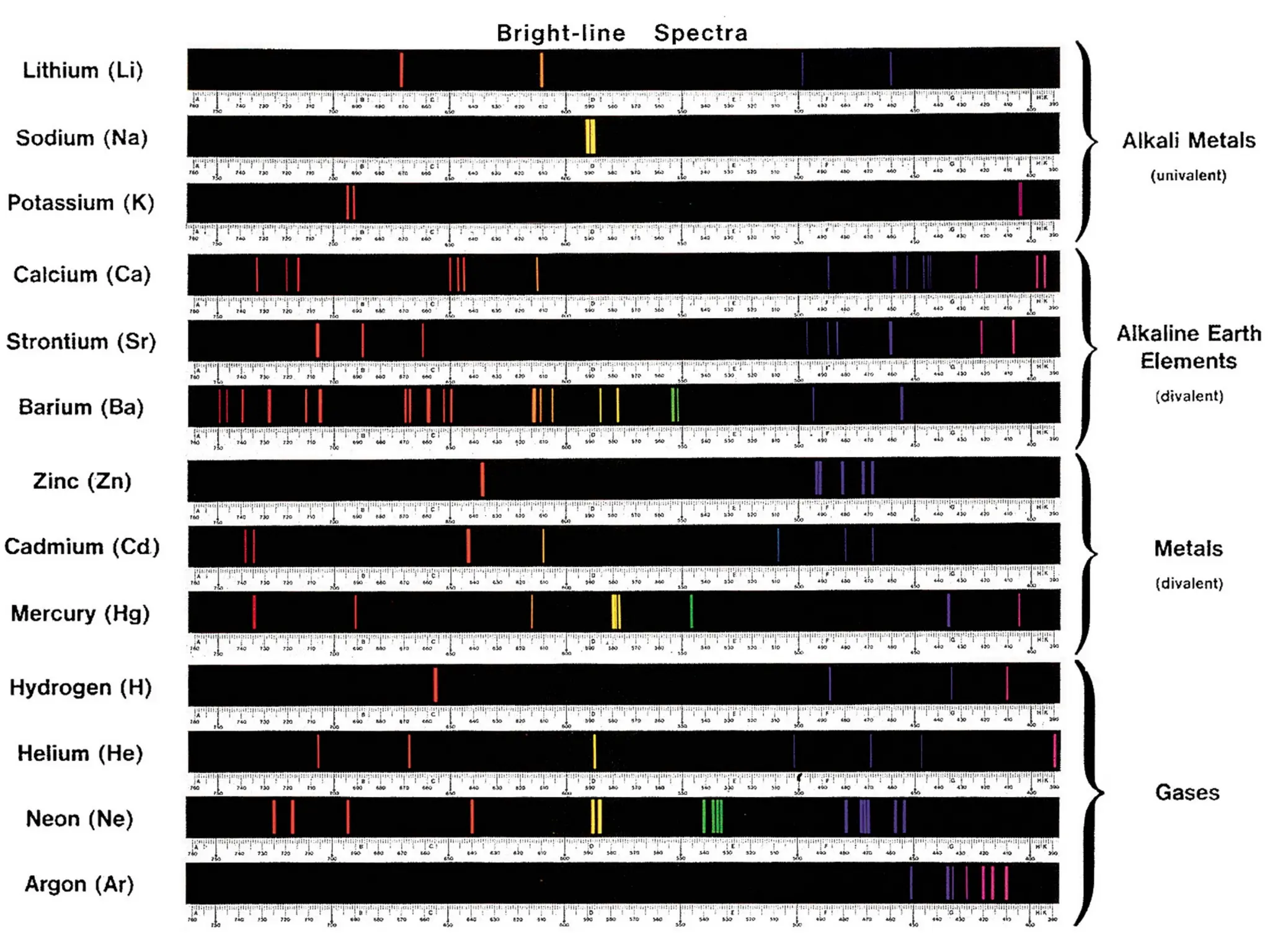
Line Emission Spectrum of Hydrogen Atoms
10
11
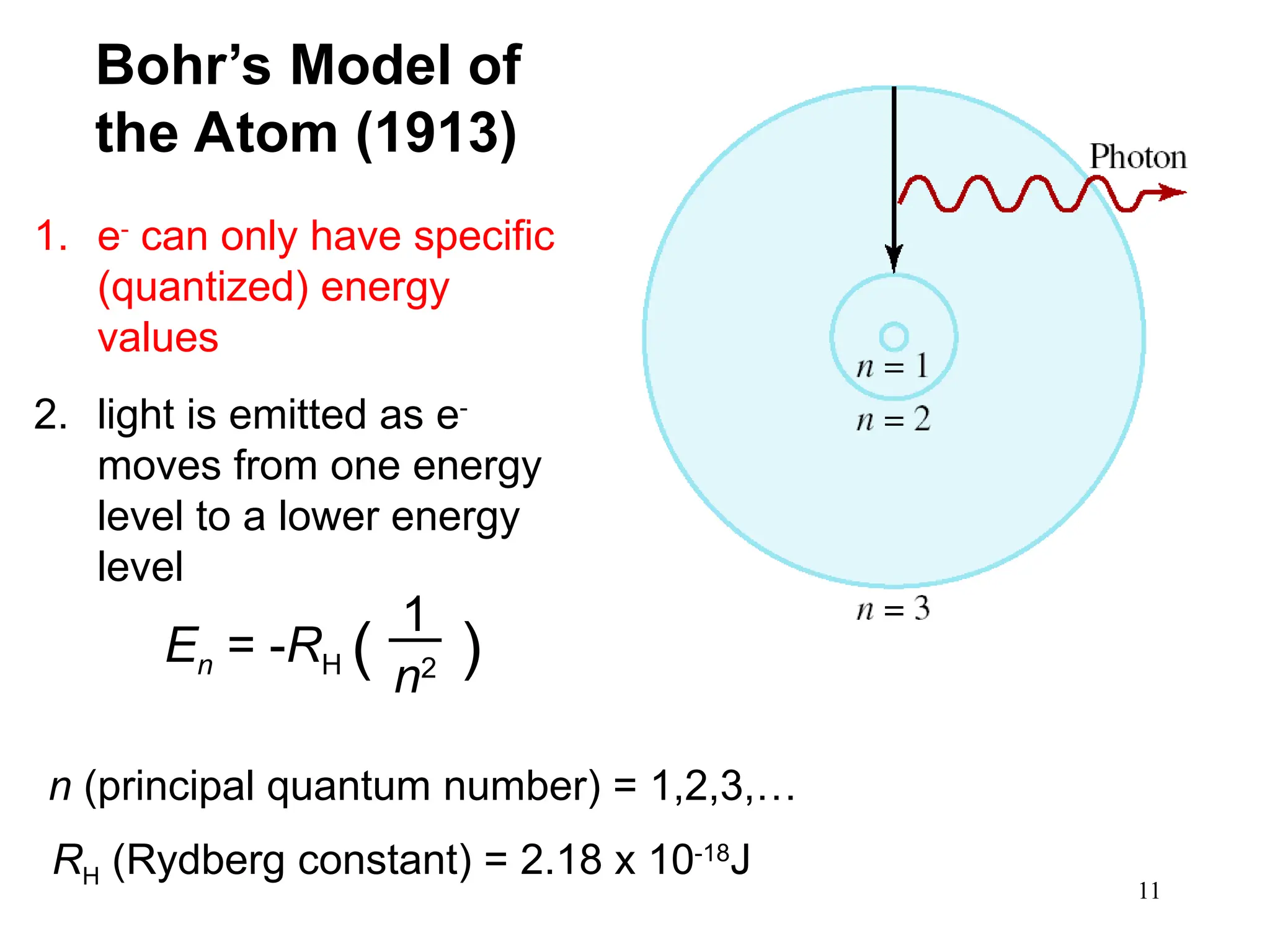
1. e-
can only have specific
(quantized) energy
values
2. light is emitted as e-
moves from one energy
level to a lower energy
level
Bohr’s Model of
the Atom (1913)
En = -RH ( )
1
n2
n (principal quantum number) = 1,2,3,…
RH (Rydberg constant) = 2.18 x 10⁻¹⁸
J
12
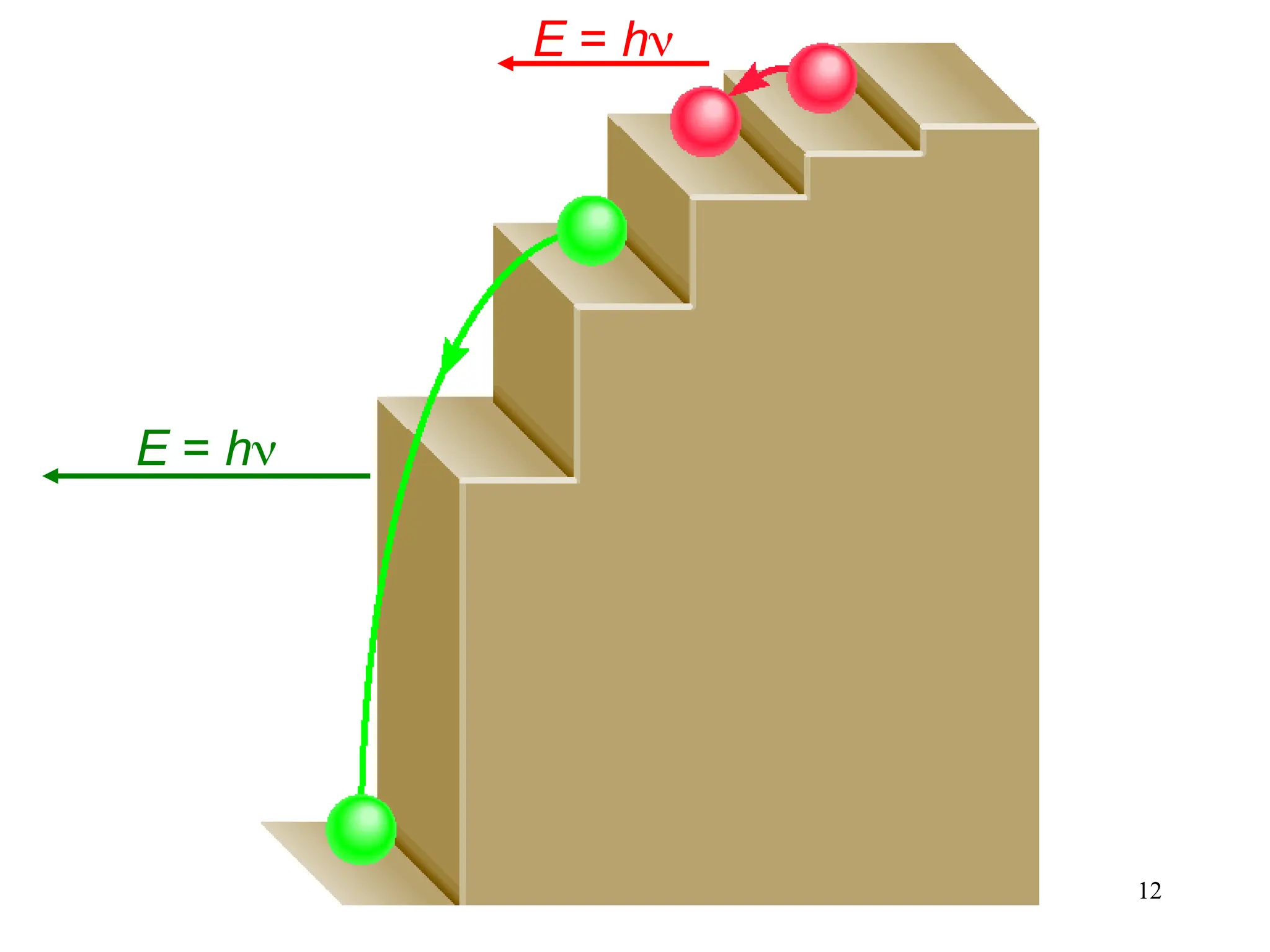
E = h
E = h
13
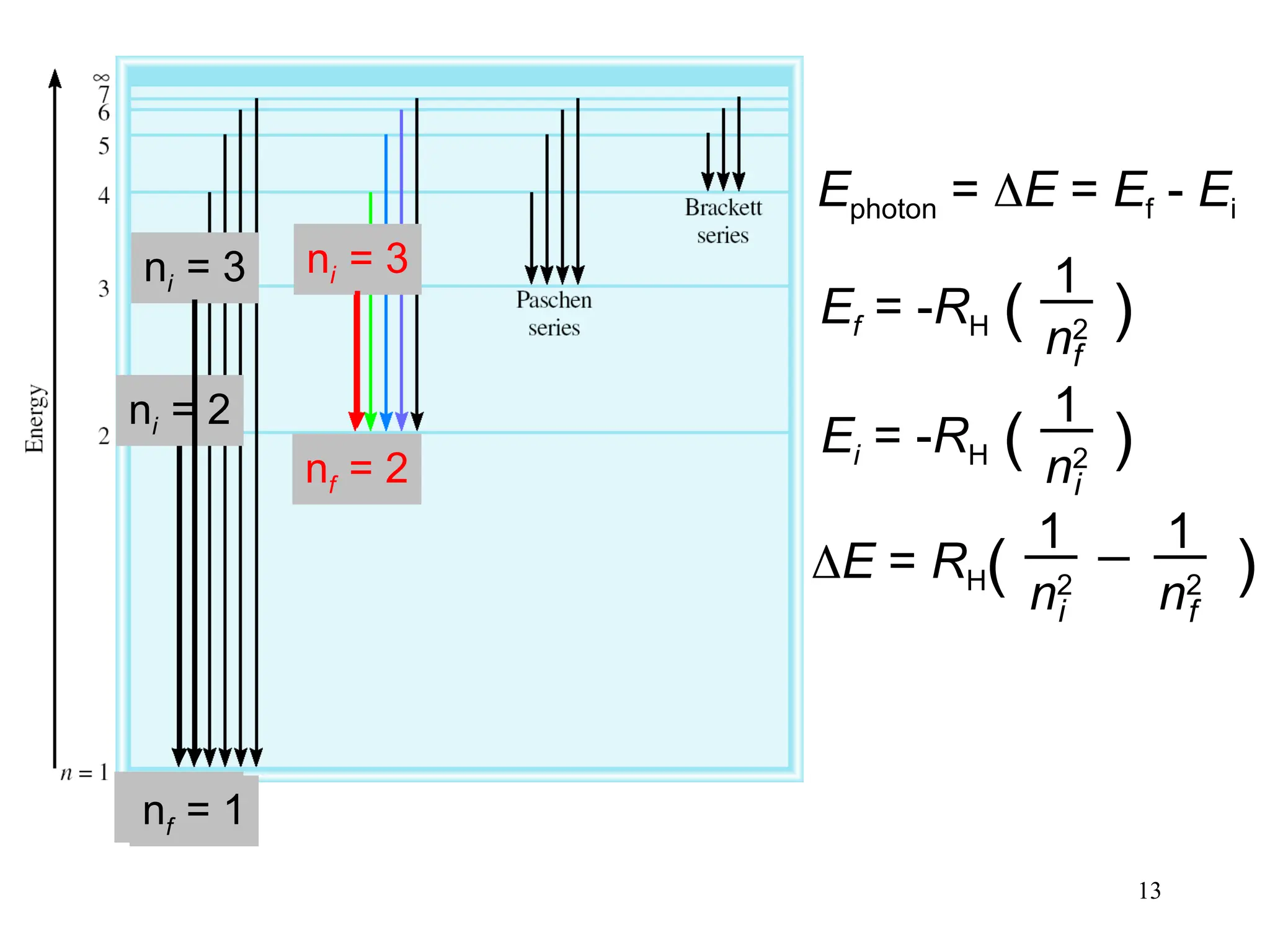
Ephoton = E = Ef - Ei
Ef = -RH ( )
1
n2
f
Ei = -RH ( )
1
n2
i
i f
E = RH( )
1
n2
1
n2
nf = 1
ni = 2
nf = 1
ni = 3
nf = 2
ni = 3
14
15
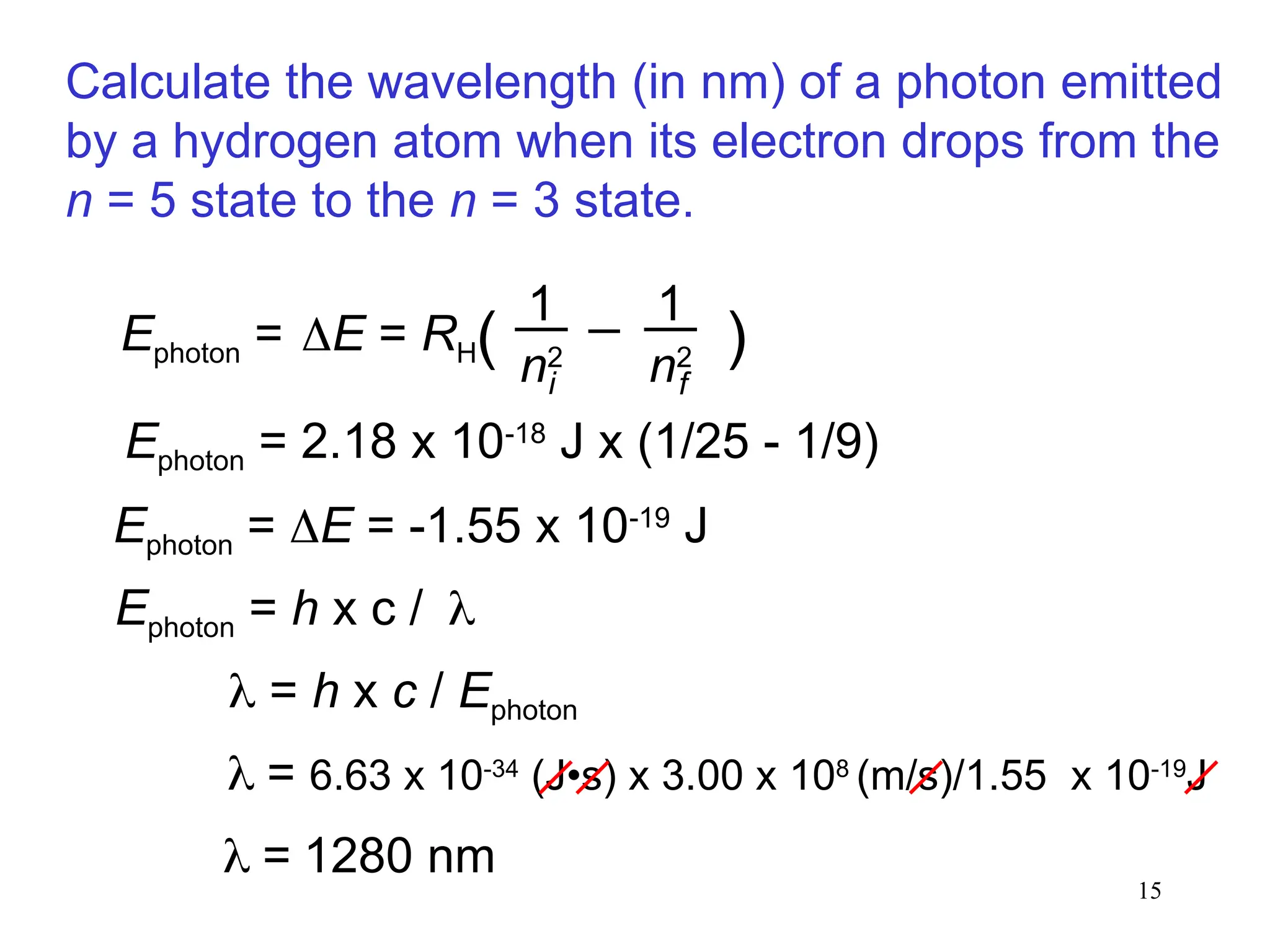
Ephoton = 2.18 x 10-18
J x (1/25 - 1/9)
Ephoton = E = -1.55 x 10⁻¹⁹
J
 = 6.63 x 10⁻³⁴
(J•s) x 3.00 x 10⁸
(m/s)/1.55 x 10-19
J
 = 1280 nm
Calculate the wavelength (in nm) of a photon emitted
by a hydrogen atom when its electron drops from the
n = 5 state to the n = 3 state.
Ephoton = h x c /
 = h x c / Ephoton
i f
E = RH( )
1
n2
1
n2
Ephoton =
16
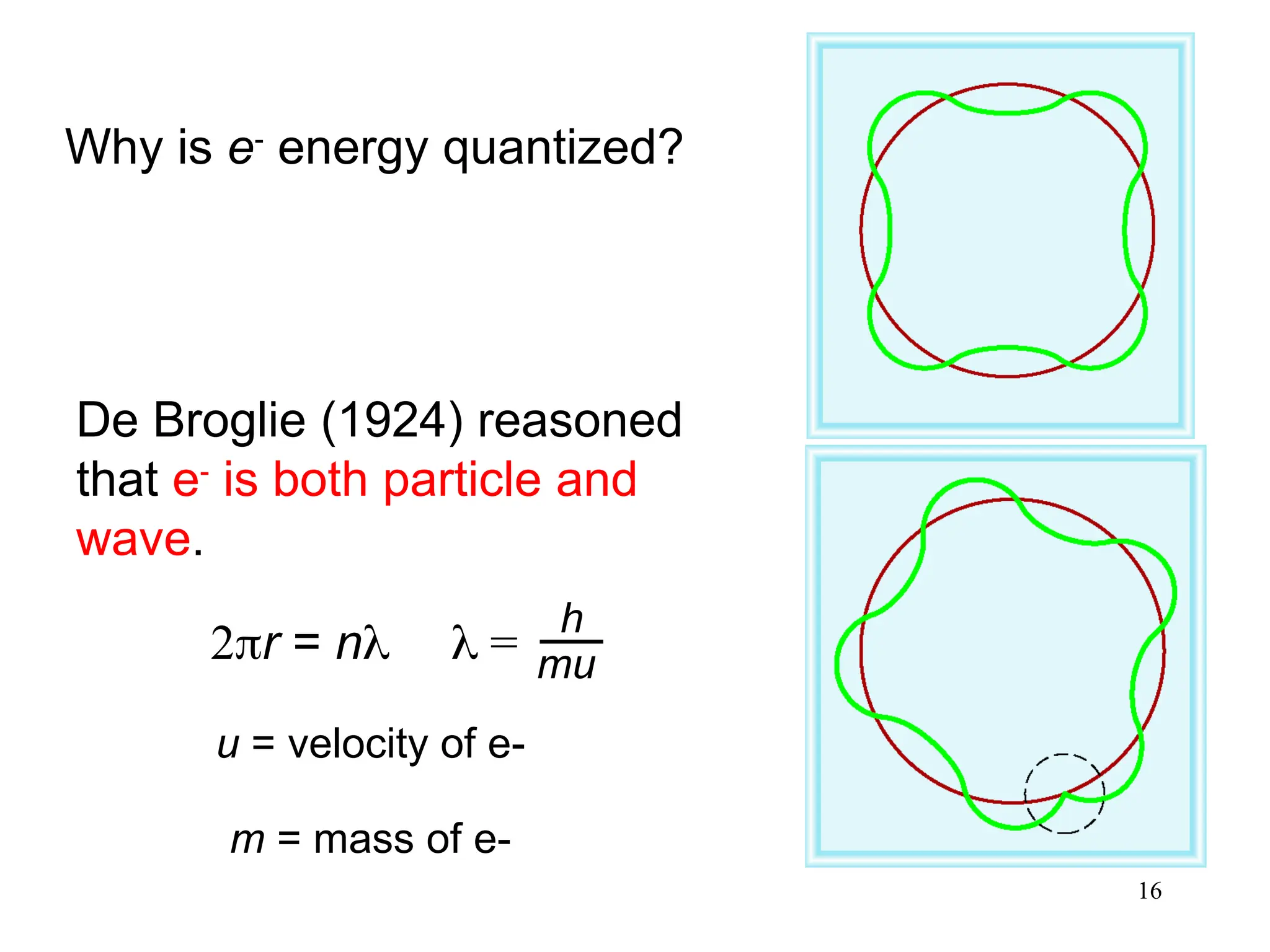
De Broglie (1924) reasoned
that e-
is both particle and
wave.
Why is e-
energy quantized?
u = velocity of e-
m = mass of e-
2r = n  =
h
mu
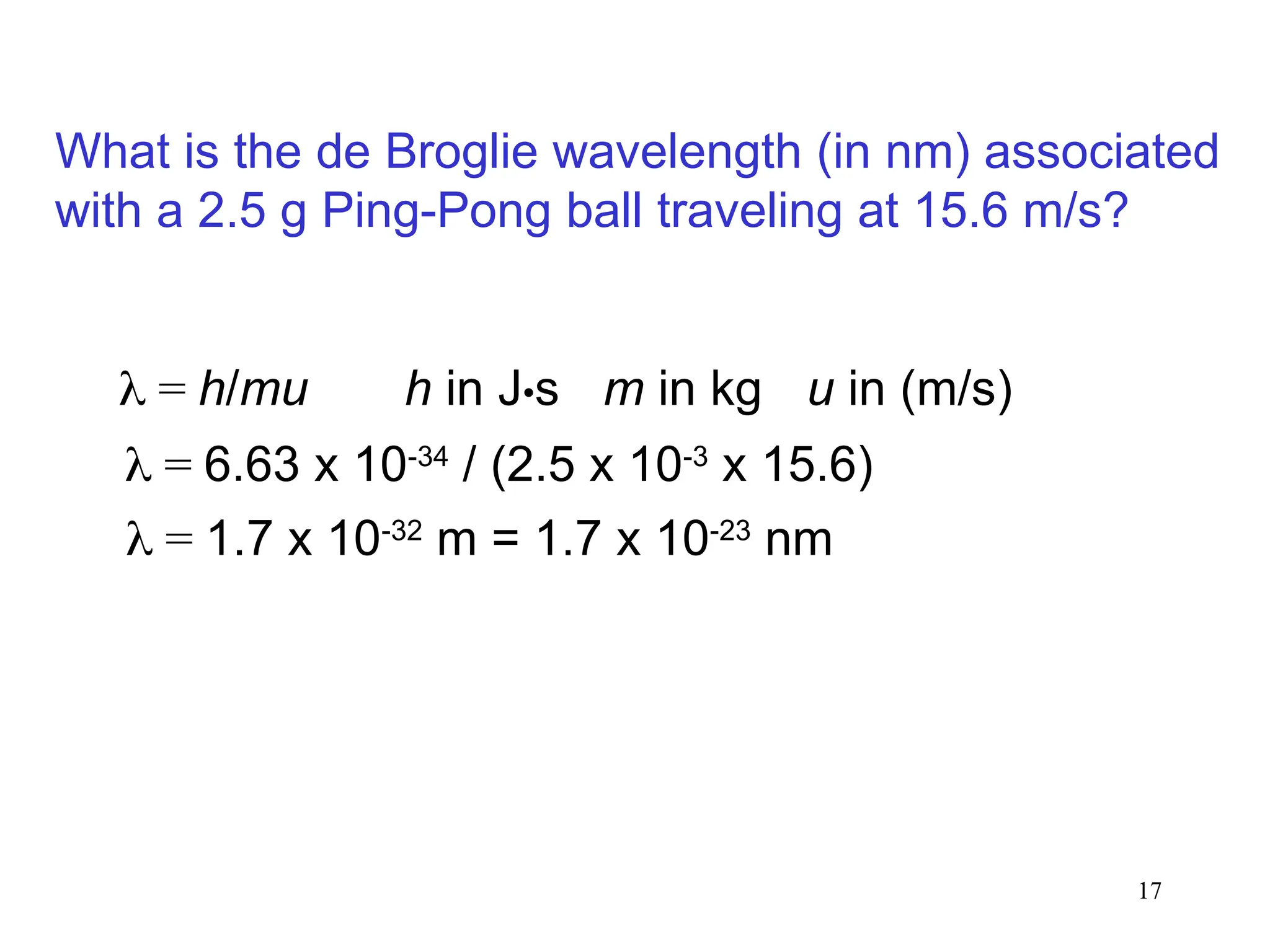
17
 = h/mu
 = 6.63 x 10⁻³⁴
/ (2.5 x 10-3
x 15.6)
 = 1.7 x 10⁻³²
m = 1.7 x 10⁻²³
nm
What is the de Broglie wavelength (in nm) associated
with a 2.5 g Ping-Pong ball traveling at 15.6 m/s?
m in kg
h in J•s u in (m/s)
18
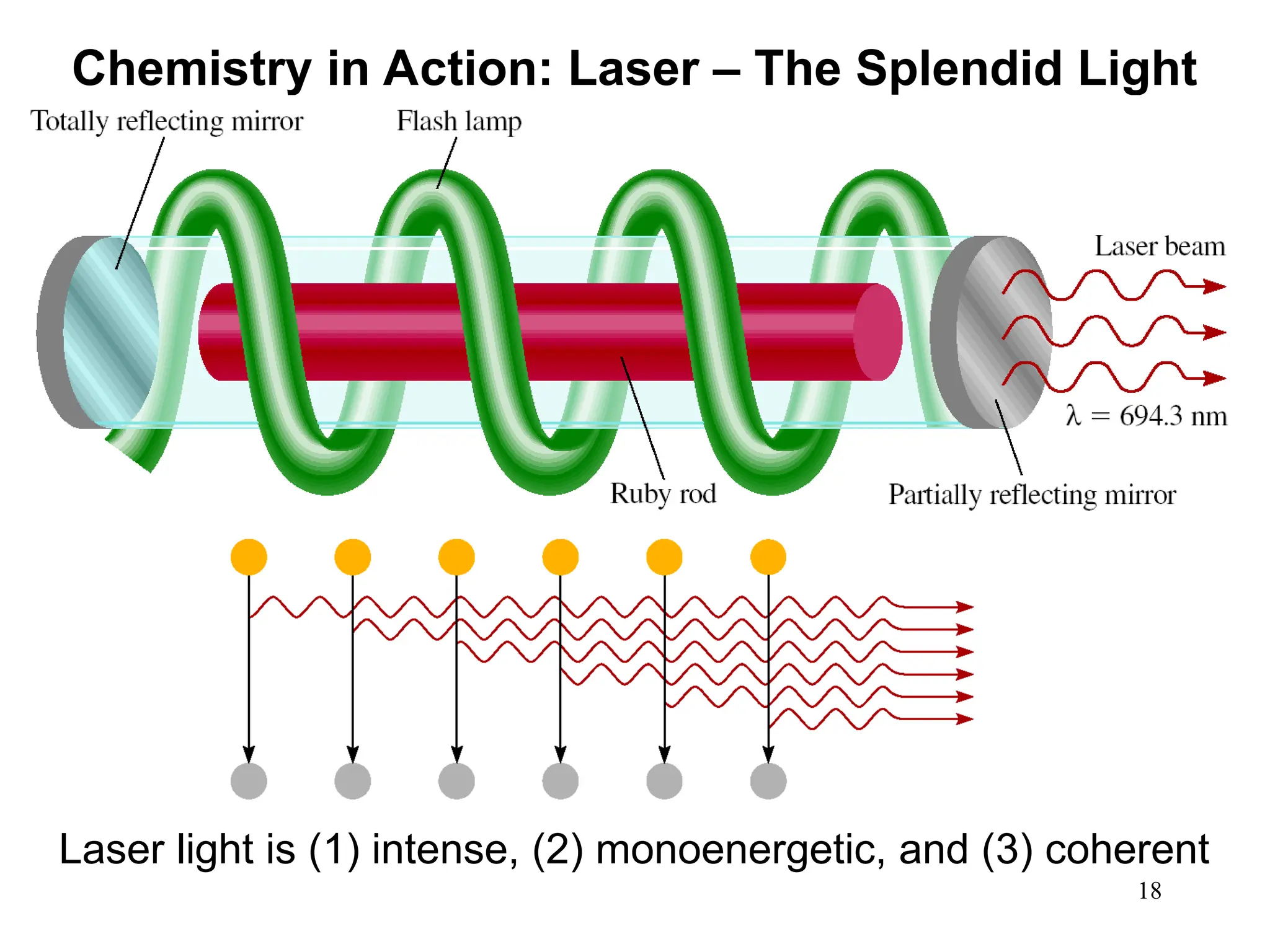
Chemistry in Action: Laser – The Splendid Light
Laser light is (1) intense, (2) monoenergetic, and (3) coherent
19
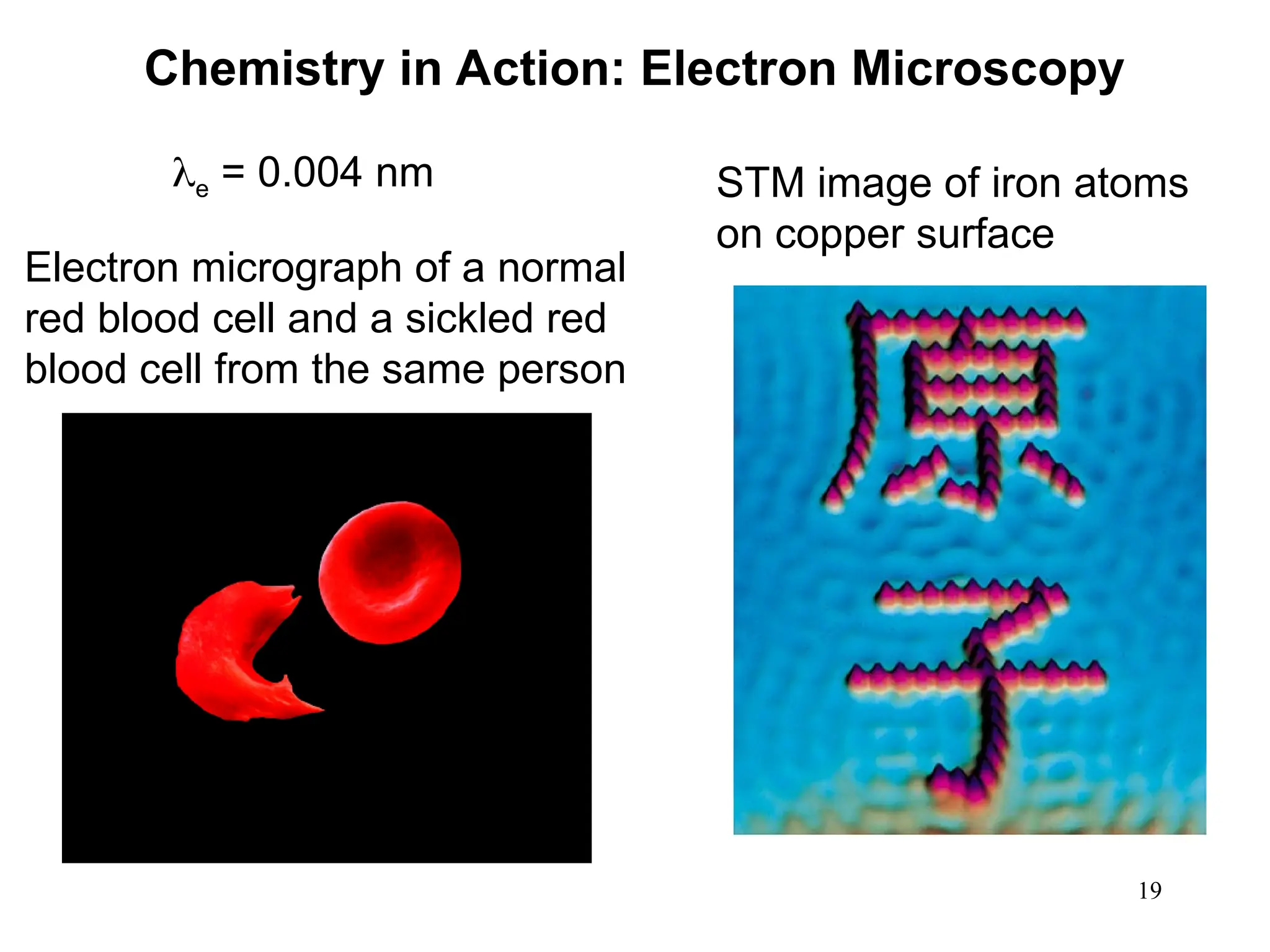
Chemistry in Action: Electron Microscopy
STM image of iron atoms
on copper surface
e = 0.004 nm
Electron micrograph of a normal
red blood cell and a sickled red
blood cell from the same person
20
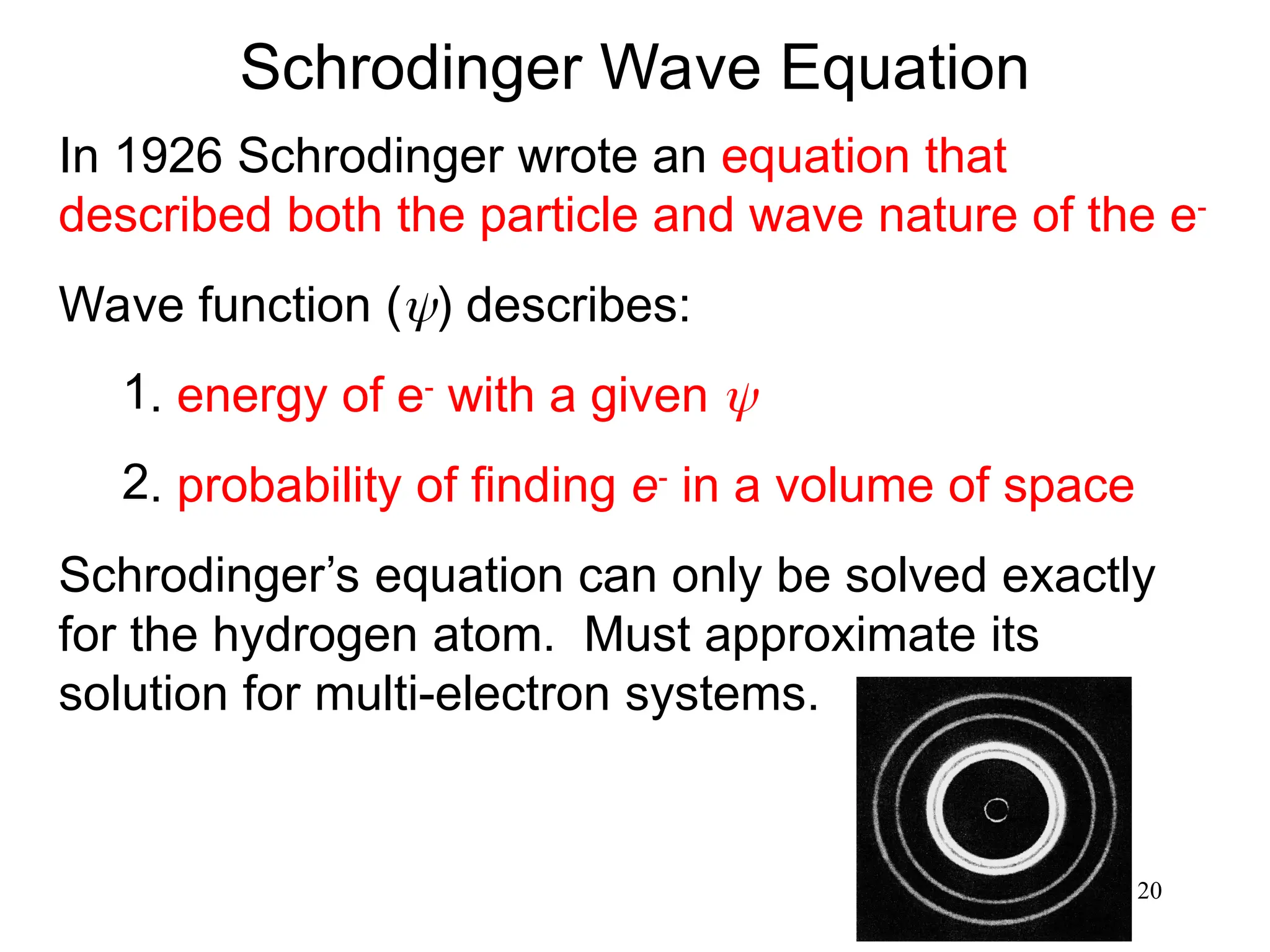
Schrodinger Wave Equation
In 1926 Schrodinger wrote an equation that
described both the particle and wave nature of the e-
Wave function () describes:
1. energy of e-
with a given 
2. probability of finding e-
in a volume of space
Schrodinger’s equation can only be solved exactly
for the hydrogen atom. Must approximate its
solution for multi-electron systems.
21
Schrodinger Wave Equation
 is a function of four numbers called
quantum numbers (n, l, ml, ms)
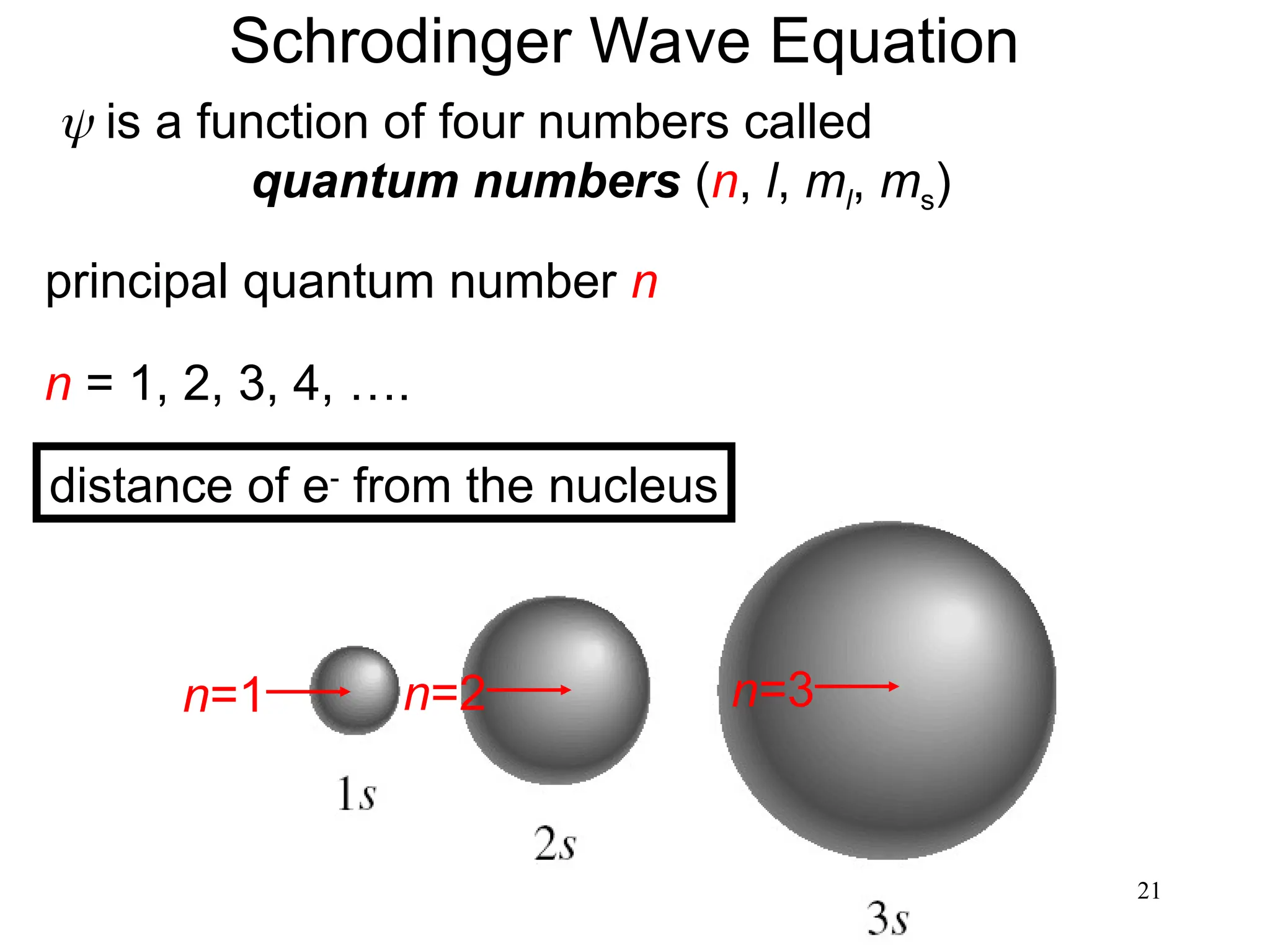
principal quantum number n
n = 1, 2, 3, 4, ….
n=1 n=2 n=3
distance of e-
from the nucleus
22
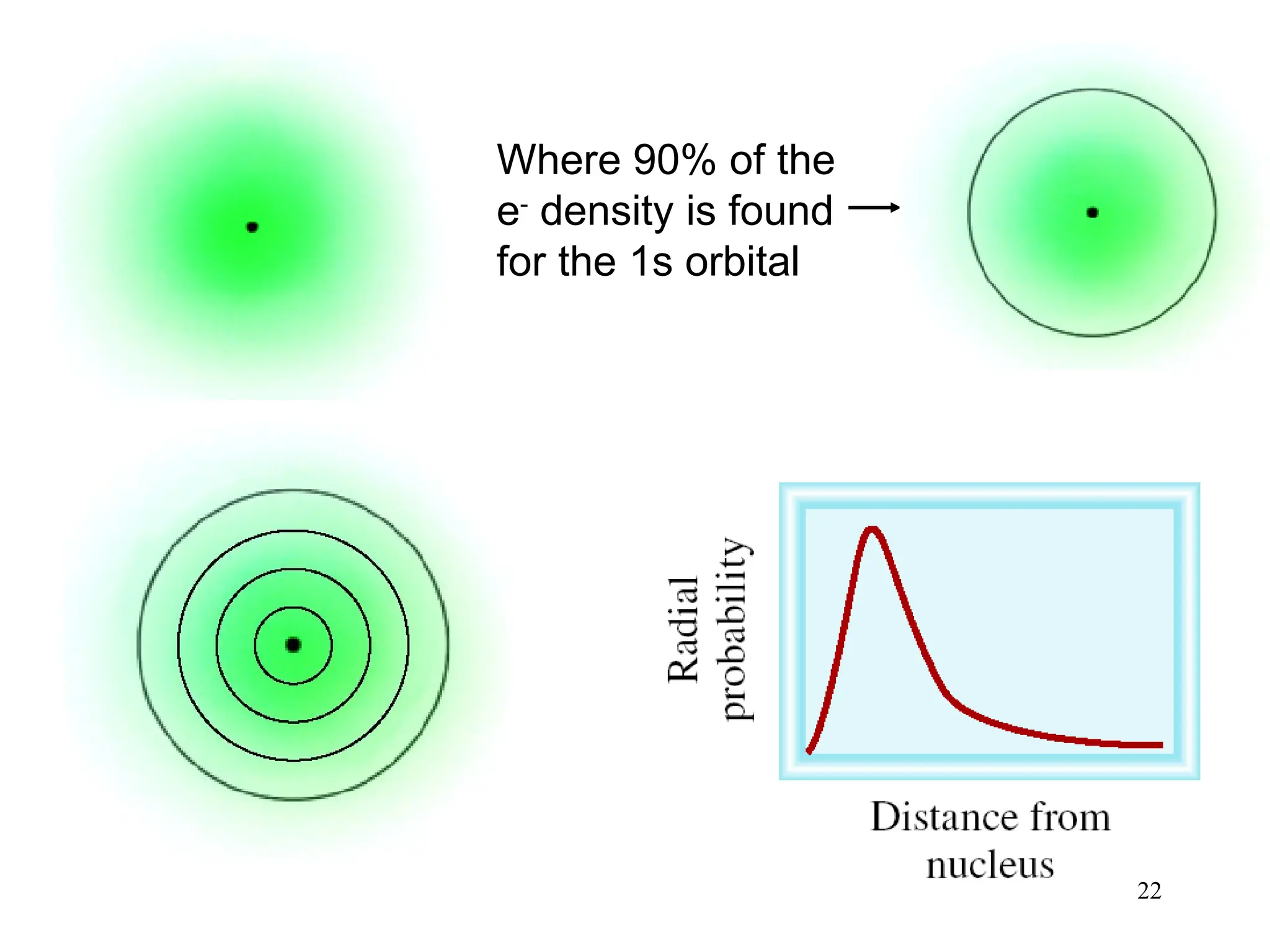
Where 90% of the
e-
density is found
for the 1s orbital
23
quantum numbers: (n, l, ml, ms)
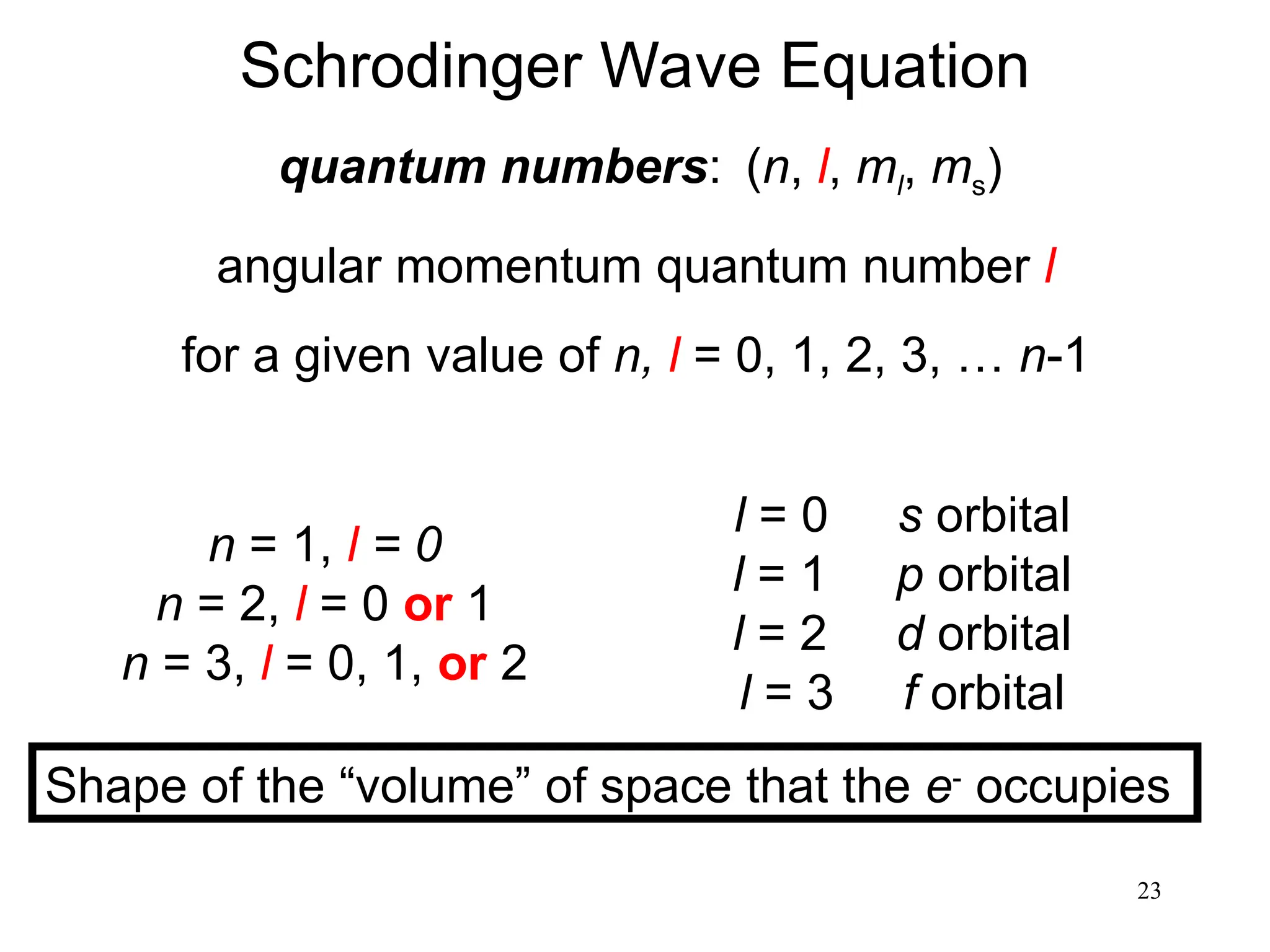
angular momentum quantum number l
for a given value of n, l = 0, 1, 2, 3, … n-1
n = 1, l = 0
n = 2, l = 0 or 1
n = 3, l = 0, 1, or 2
Shape of the “volume” of space that the e-
occupies
l = 0 s orbital
l = 1 p orbital
l = 2 d orbital
l = 3 f orbital
Schrodinger Wave Equation
24
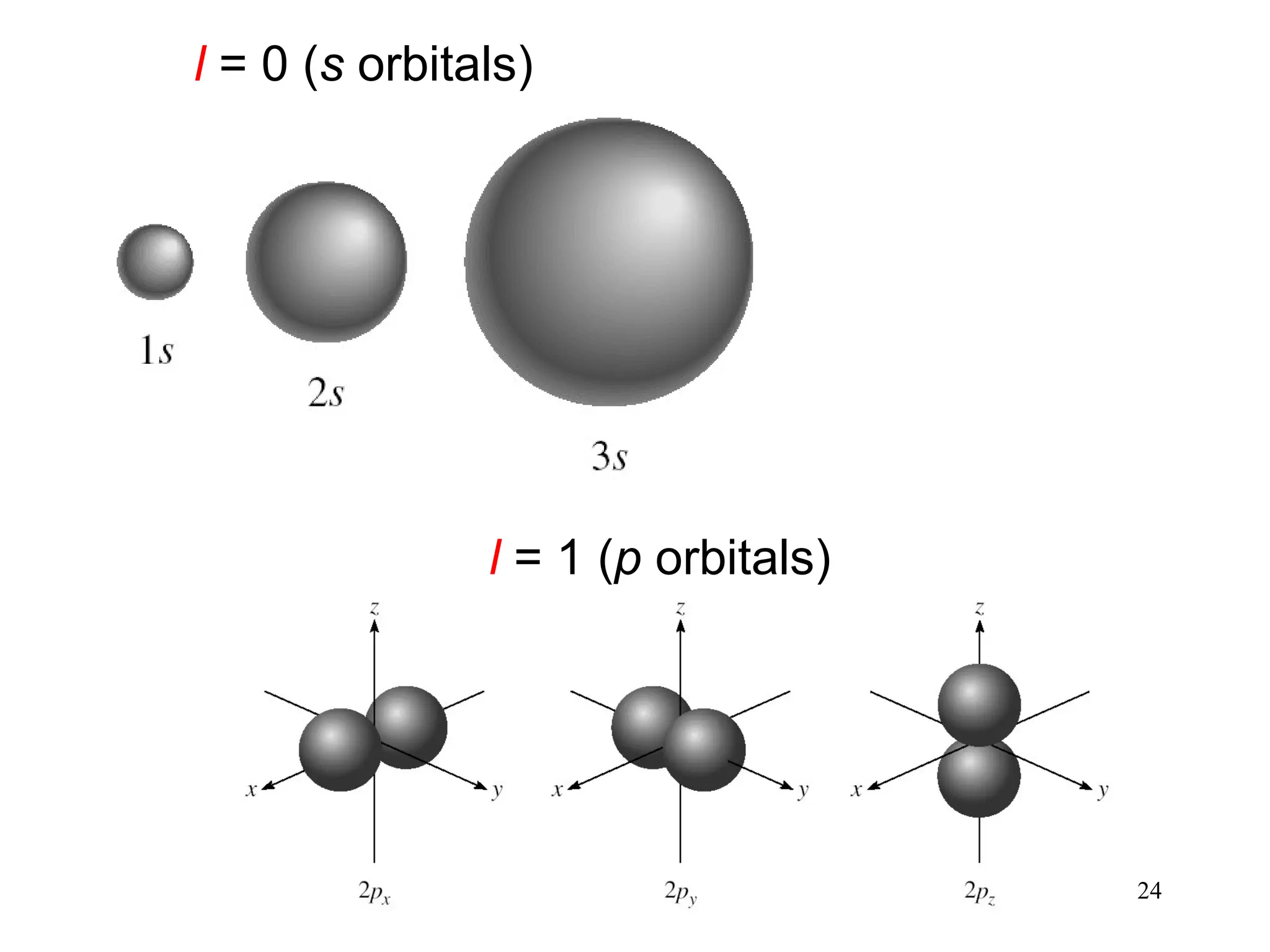
l = 0 (s orbitals)
l = 1 (p orbitals)
25
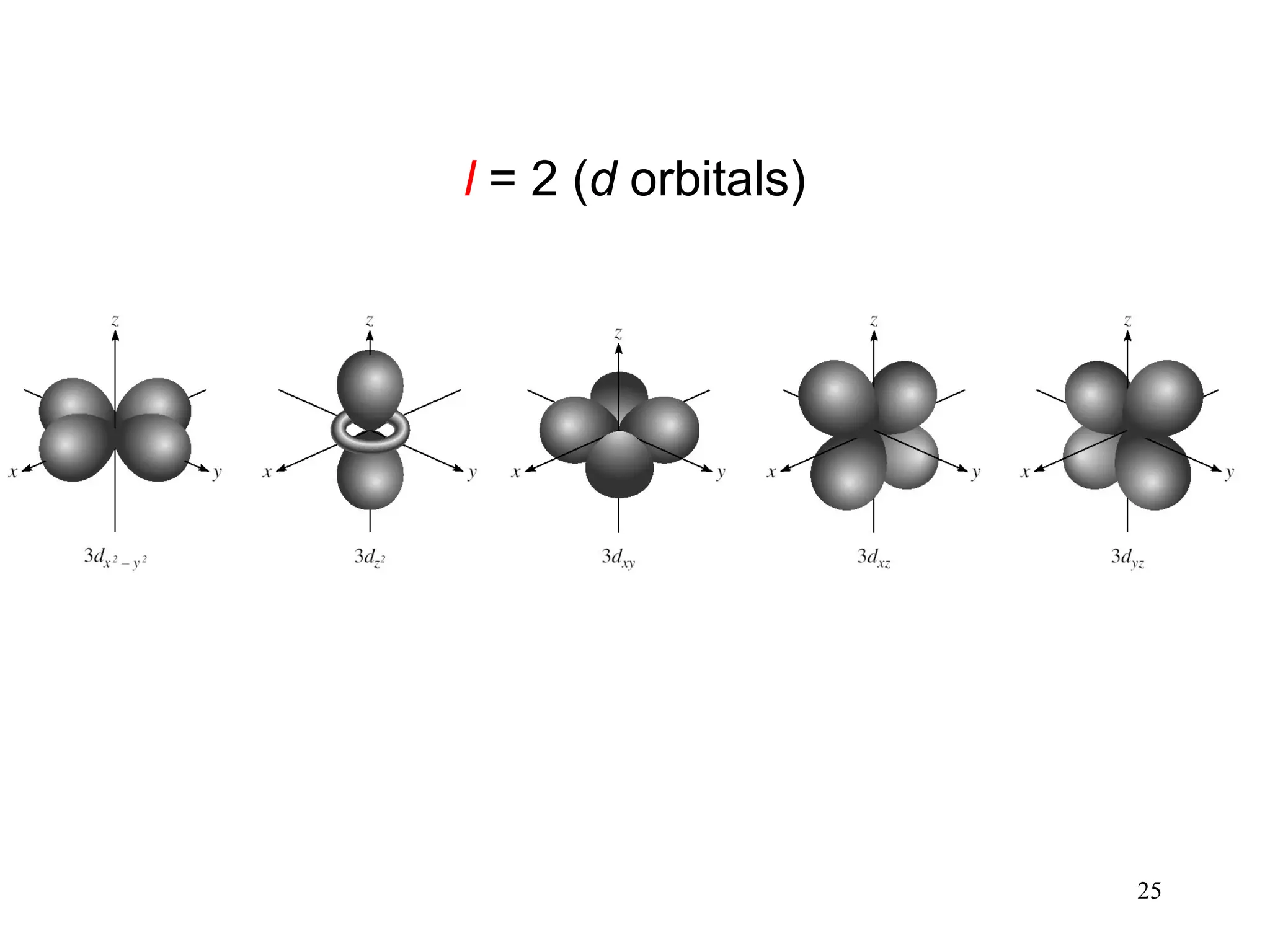
l = 2 (d orbitals)
26
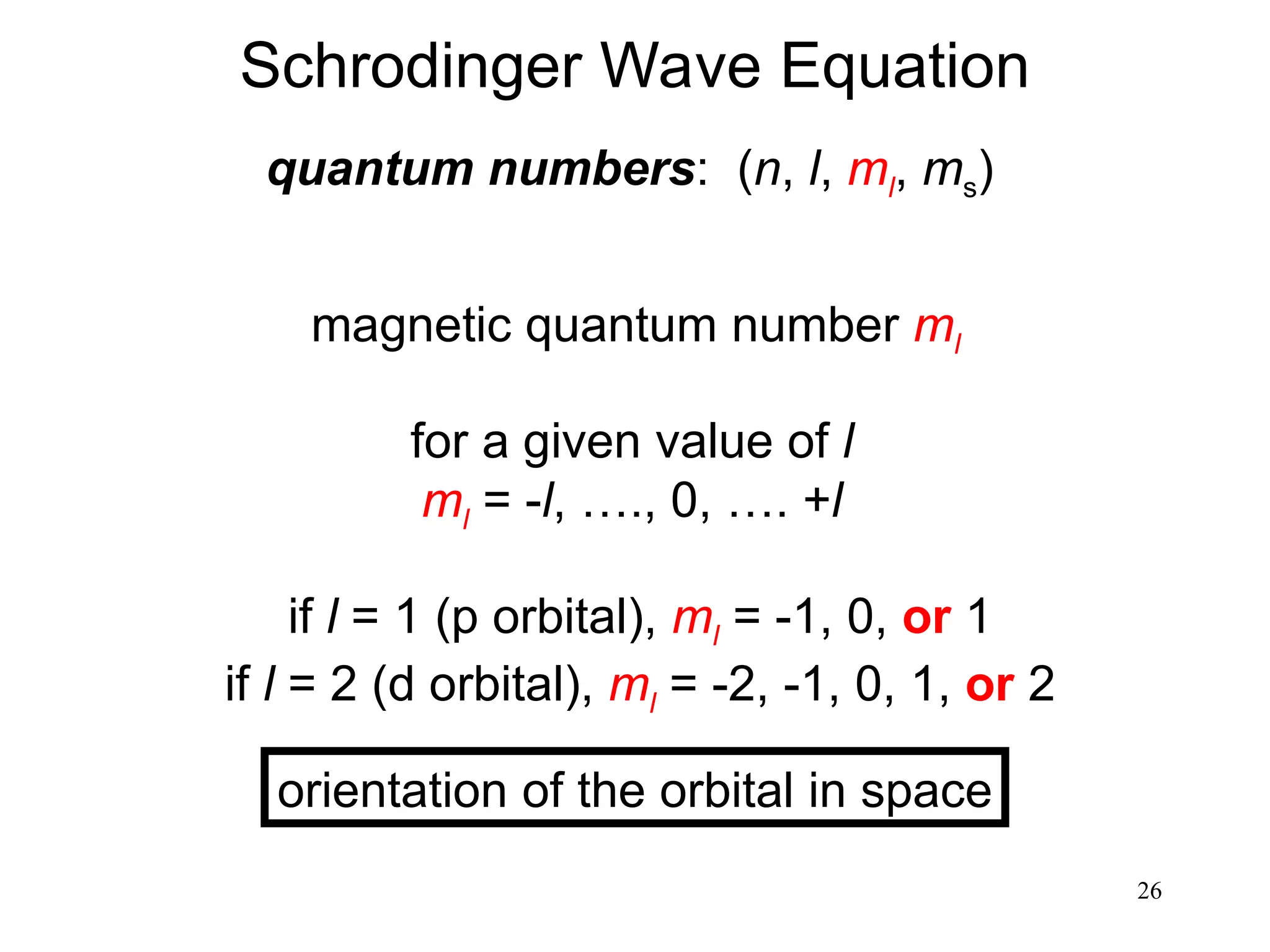
quantum numbers: (n, l, ml, ms)
magnetic quantum number ml
for a given value of l
ml = -l, …., 0, …. +l
orientation of the orbital in space
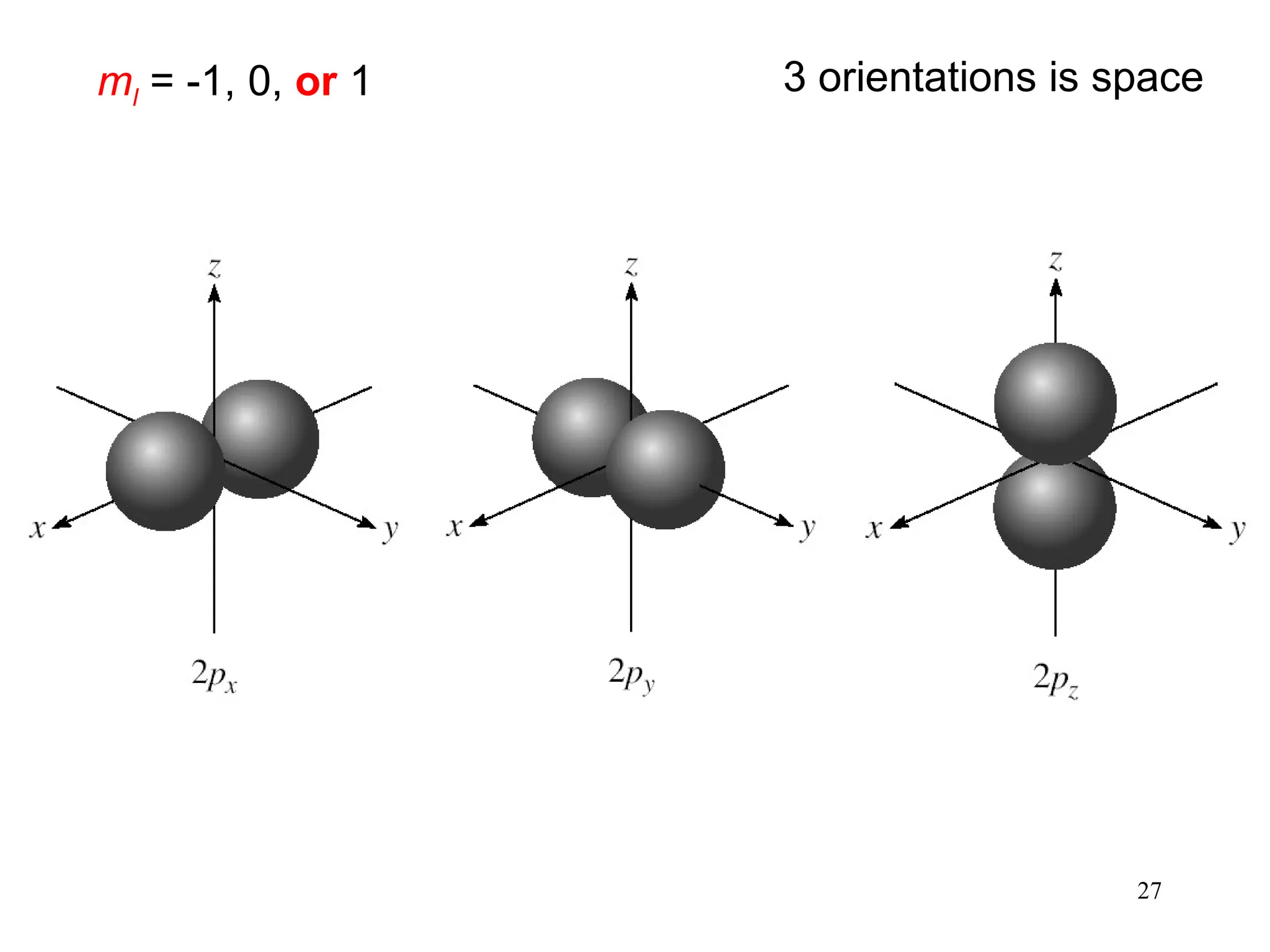
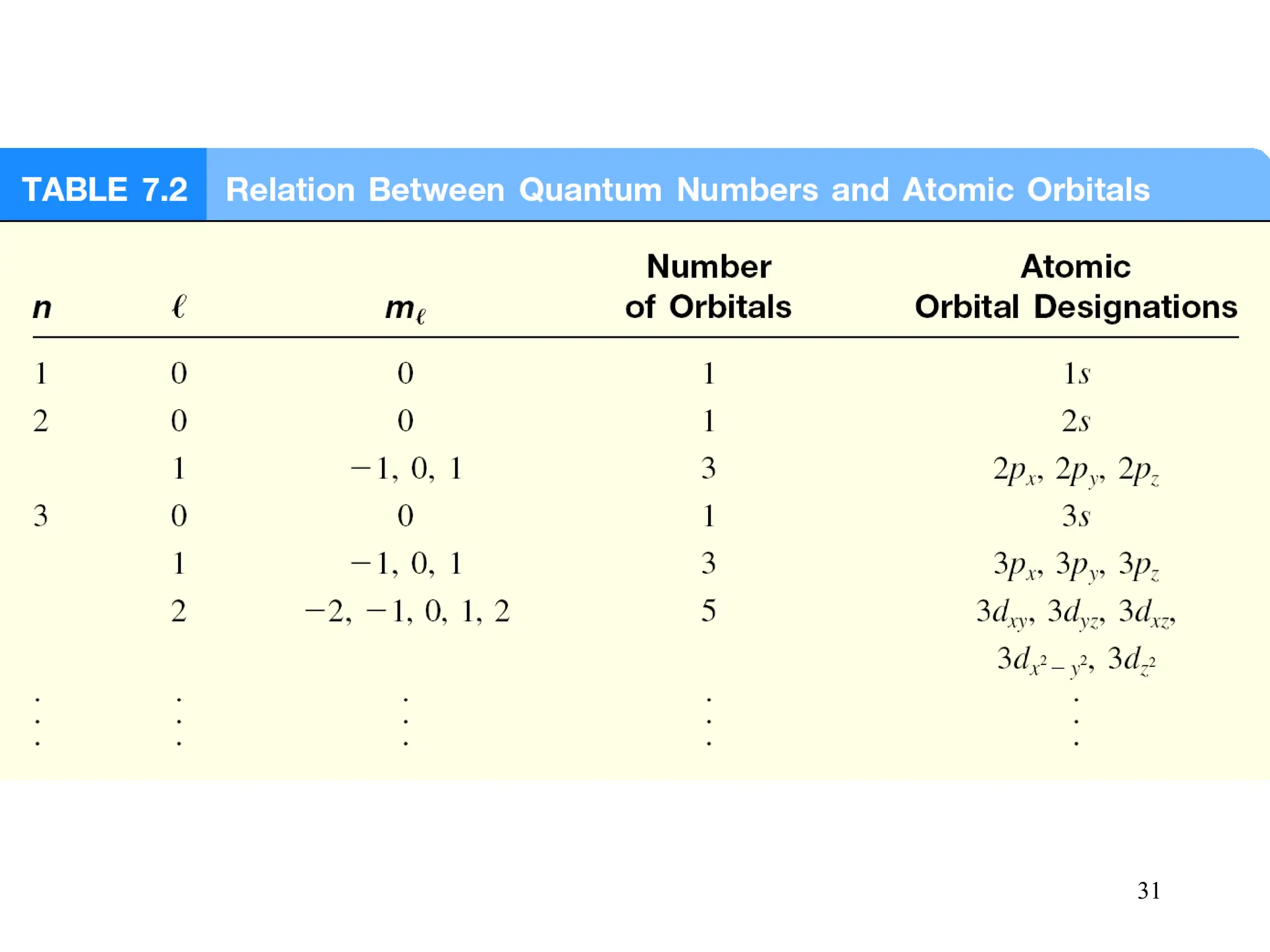
if l = 1 (p orbital), ml = -1, 0, or 1
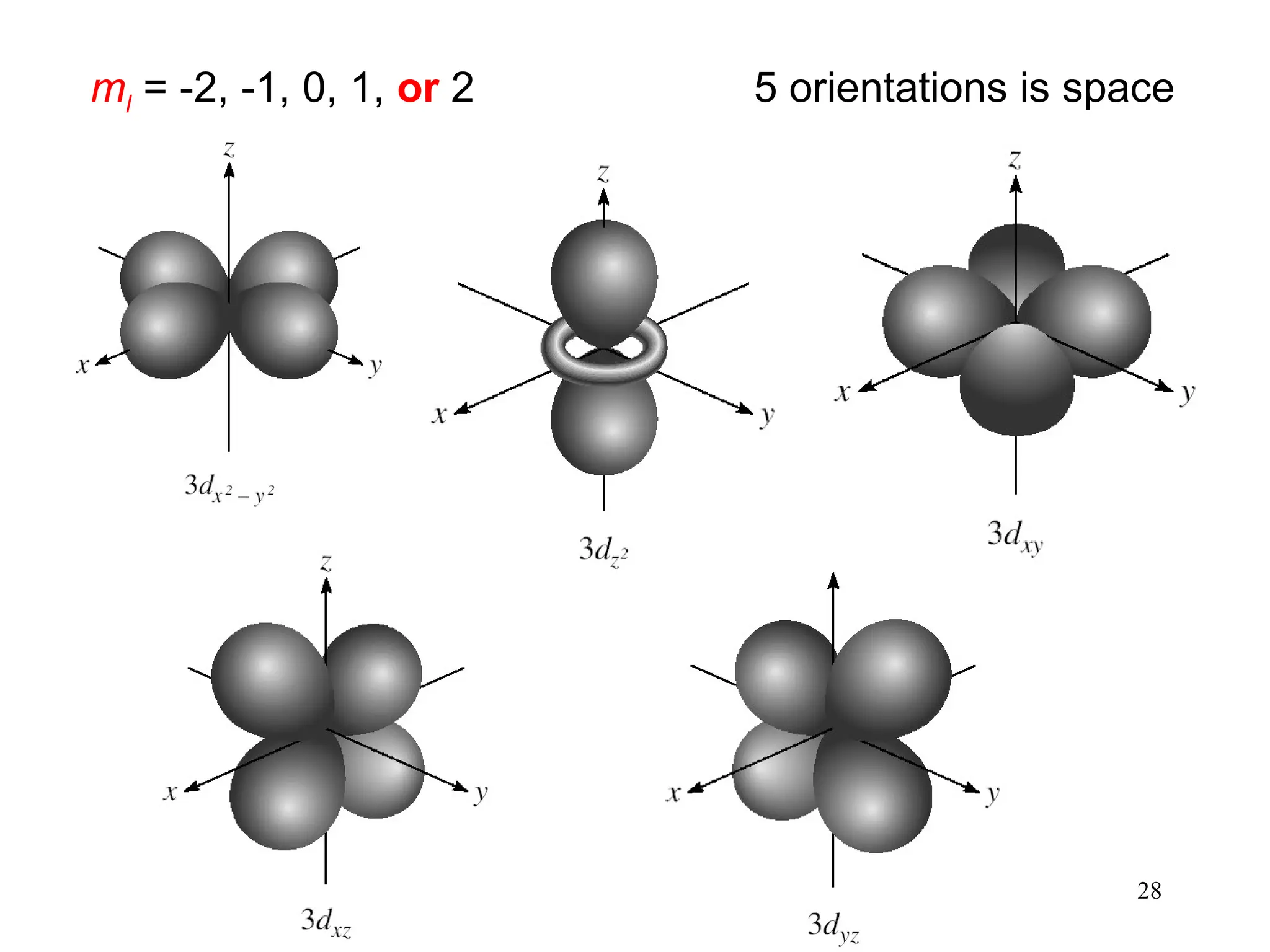
if l = 2 (d orbital), ml = -2, -1, 0, 1, or 2
Schrodinger Wave Equation
27
ml = -1, 0, or 1 3 orientations is space
28
ml = -2, -1, 0, 1, or 2 5 orientations is space
29
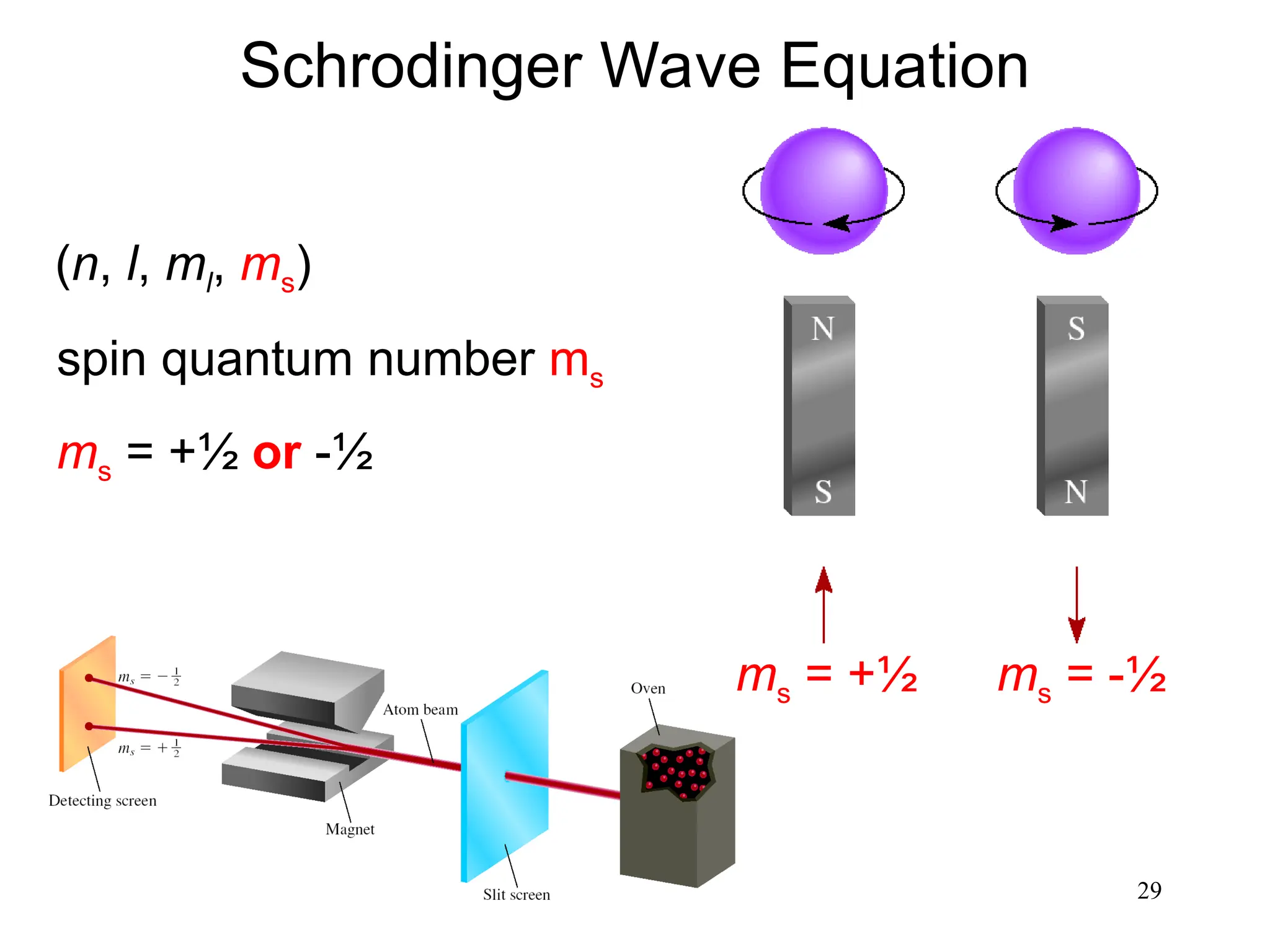
(n, l, ml, ms)
spin quantum number ms
ms = +½ or -½
Schrodinger Wave Equation
ms = -½
ms = +½
30
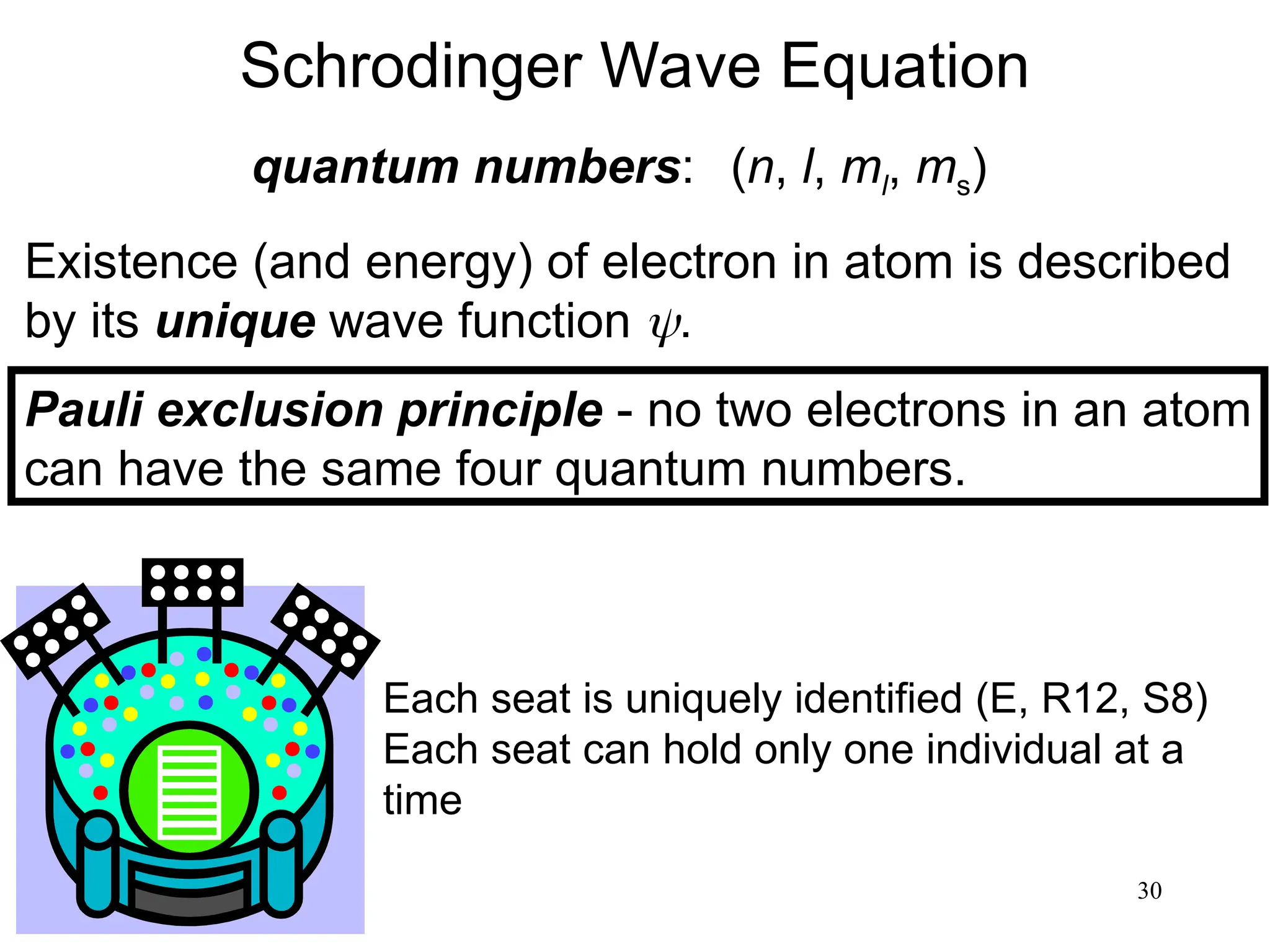
Existence (and energy) of electron in atom is described
by its unique wave function .
Pauli exclusion principle - no two electrons in an atom
can have the same four quantum numbers.
Schrodinger Wave Equation
quantum numbers: (n, l, ml, ms)
Each seat is uniquely identified (E, R12, S8)
Each seat can hold only one individual at a
time
31
32
Schrodinger Wave Equation
quantum numbers: (n, l, ml, ms)
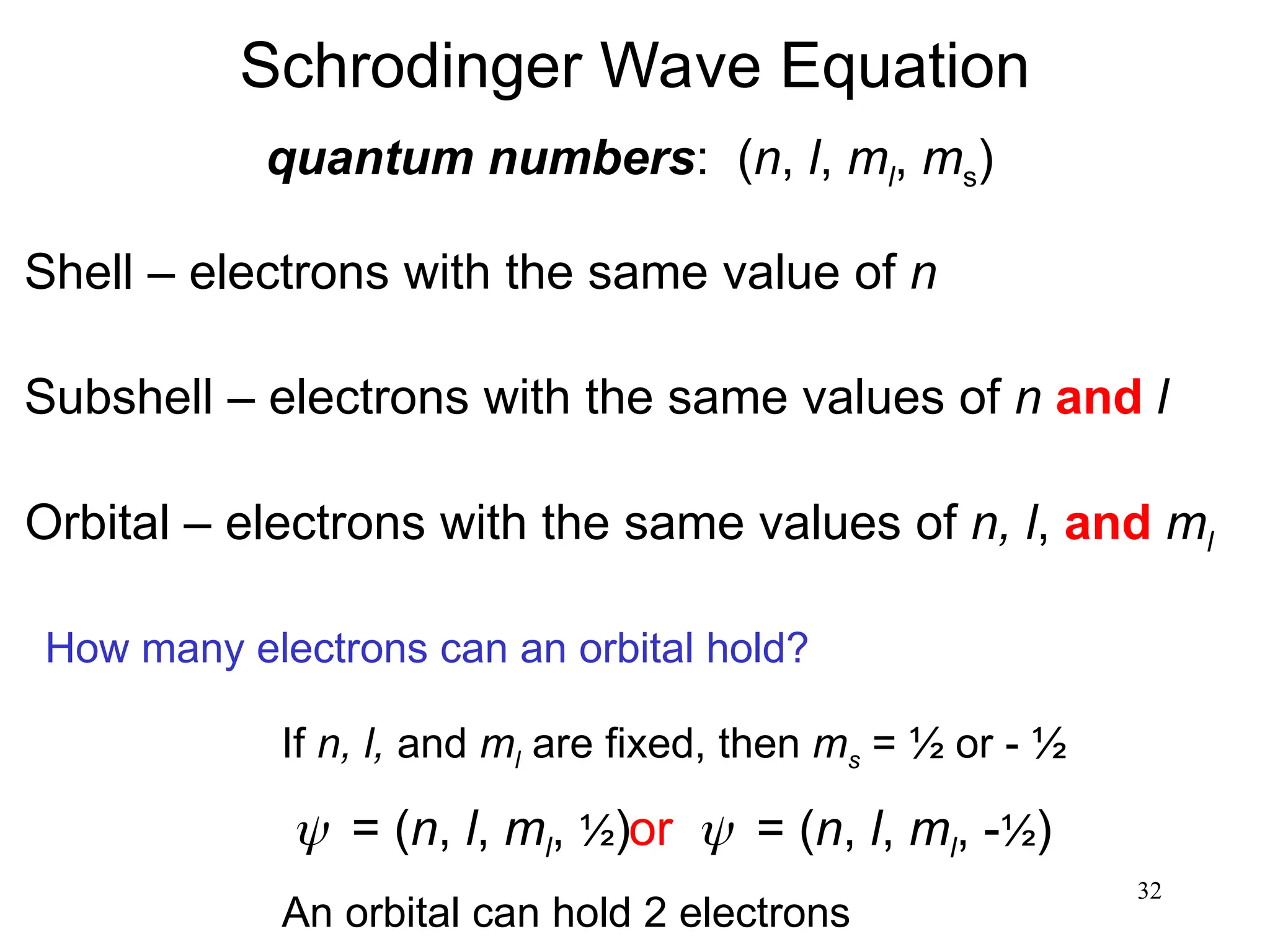
Shell – electrons with the same value of n
Subshell – electrons with the same values of n and l
Orbital – electrons with the same values of n, l, and ml
How many electrons can an orbital hold?
If n, l, and ml are fixed, then ms = ½ or - ½
= (n, l, ml, ½)or= (n, l, ml, -½)
An orbital can hold 2 electrons
33
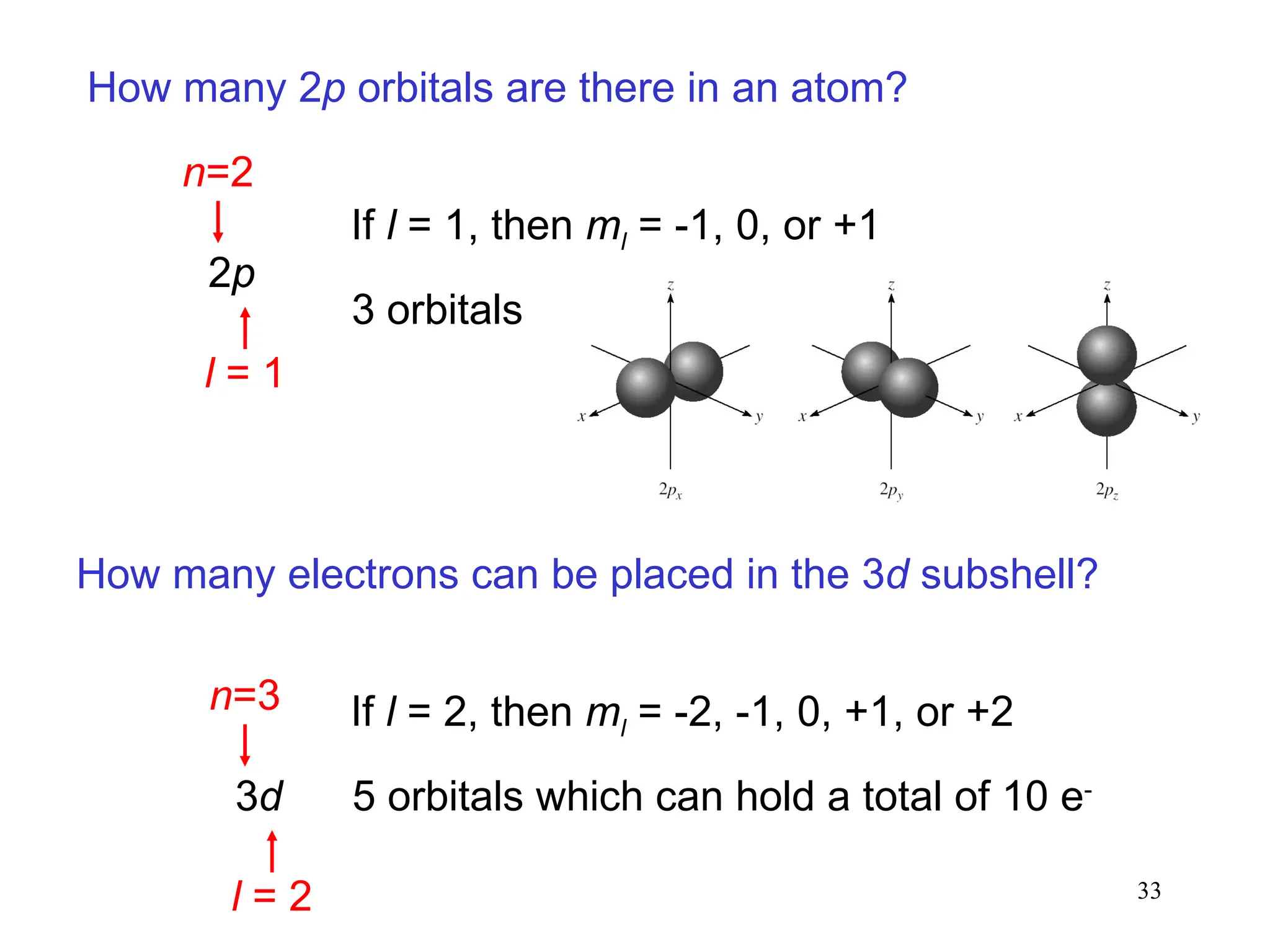
How many 2p orbitals are there in an atom?
2p
n=2
l = 1
If l = 1, then ml = -1, 0, or +1
3 orbitals
How many electrons can be placed in the 3d subshell?
3d
n=3
l = 2
If l = 2, then ml = -2, -1, 0, +1, or +2
5 orbitals which can hold a total of 10 e-
34
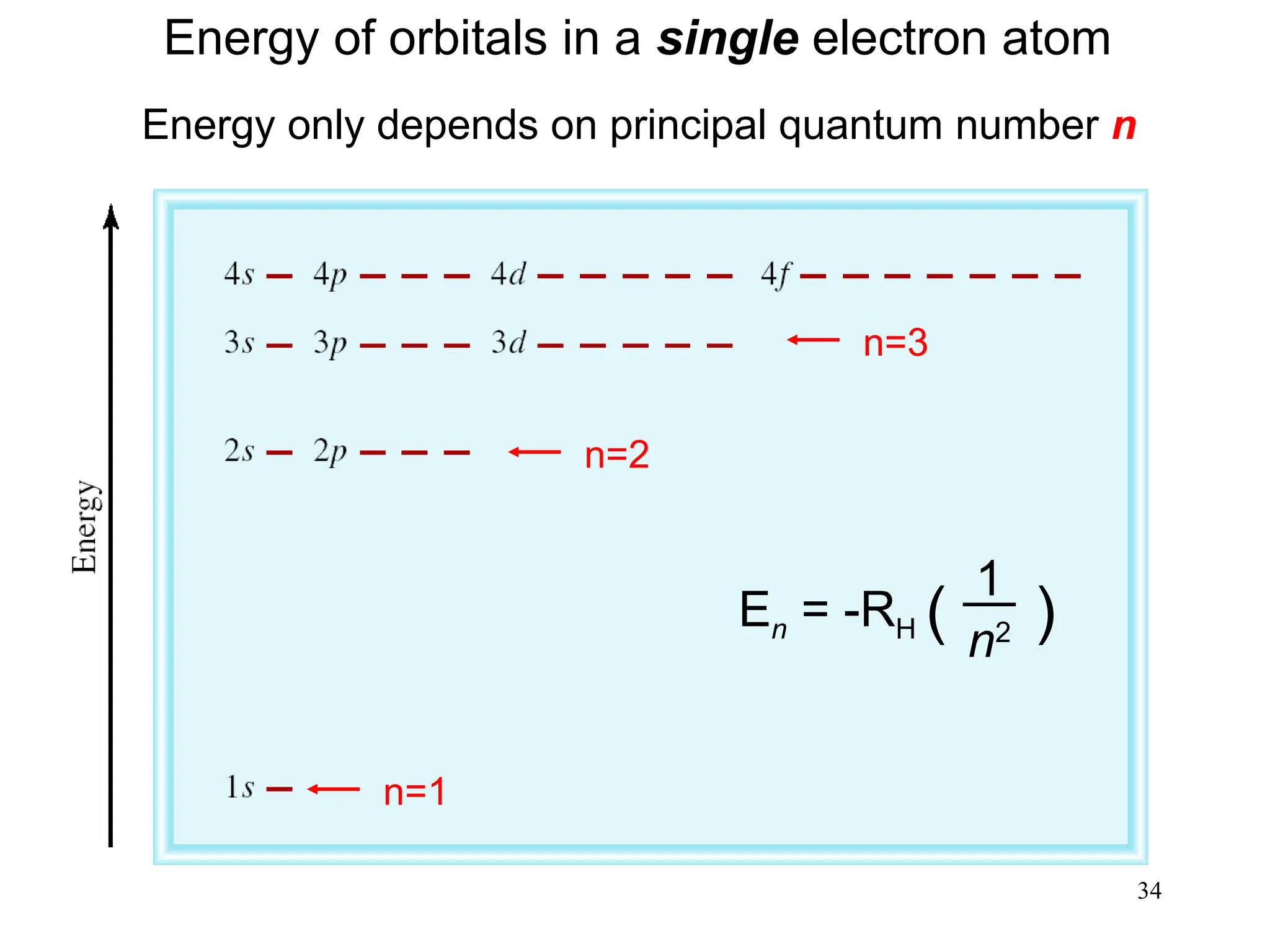
Energy of orbitals in a single electron atom
Energy only depends on principal quantum number n
En = -RH ( )
1
n2
n=1
n=2
n=3
35
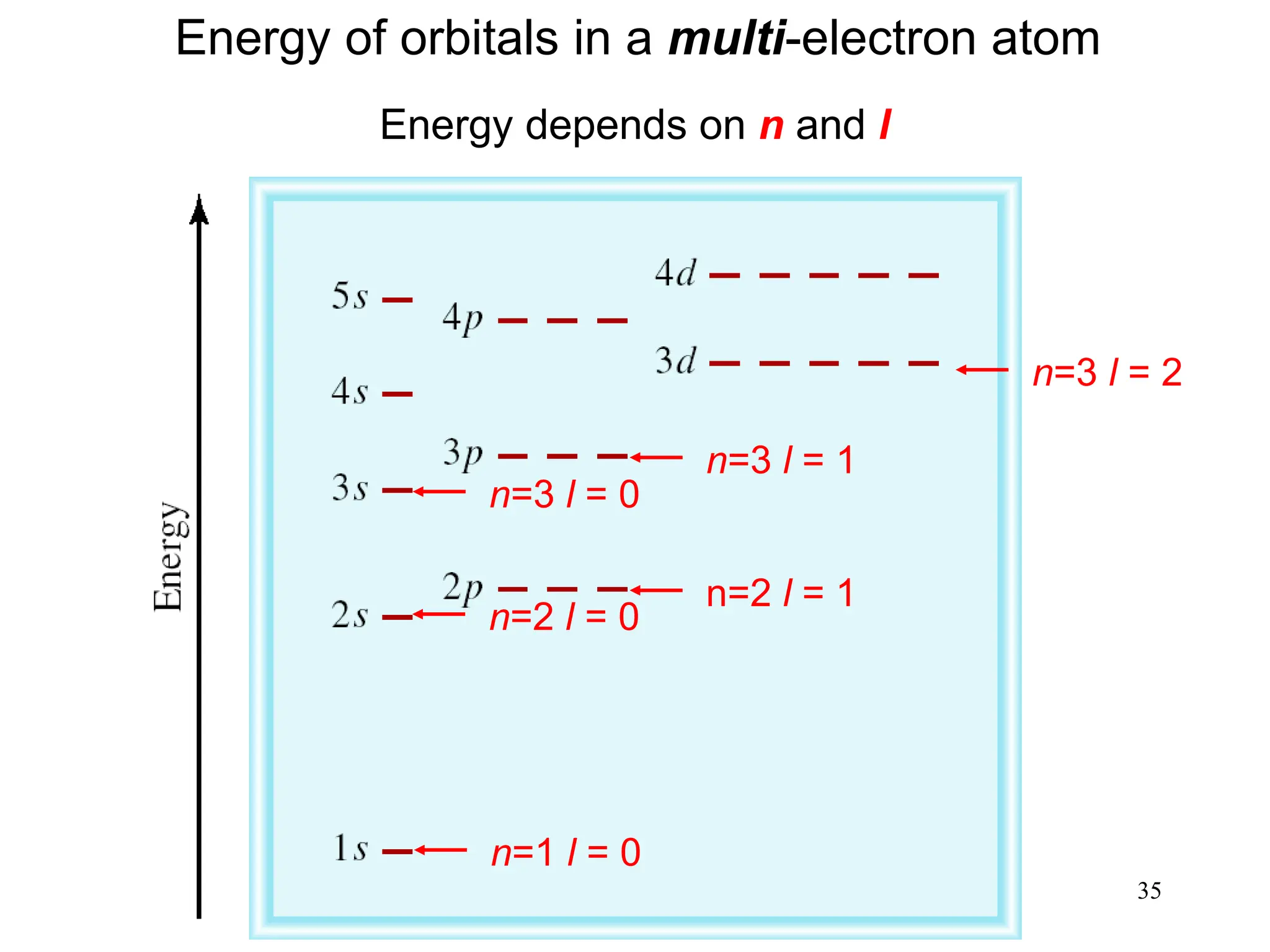
Energy of orbitals in a multi-electron atom
Energy depends on n and l
n=1 l = 0
n=2 l = 0
n=2 l = 1
n=3 l = 0
n=3 l = 1
n=3 l = 2
36
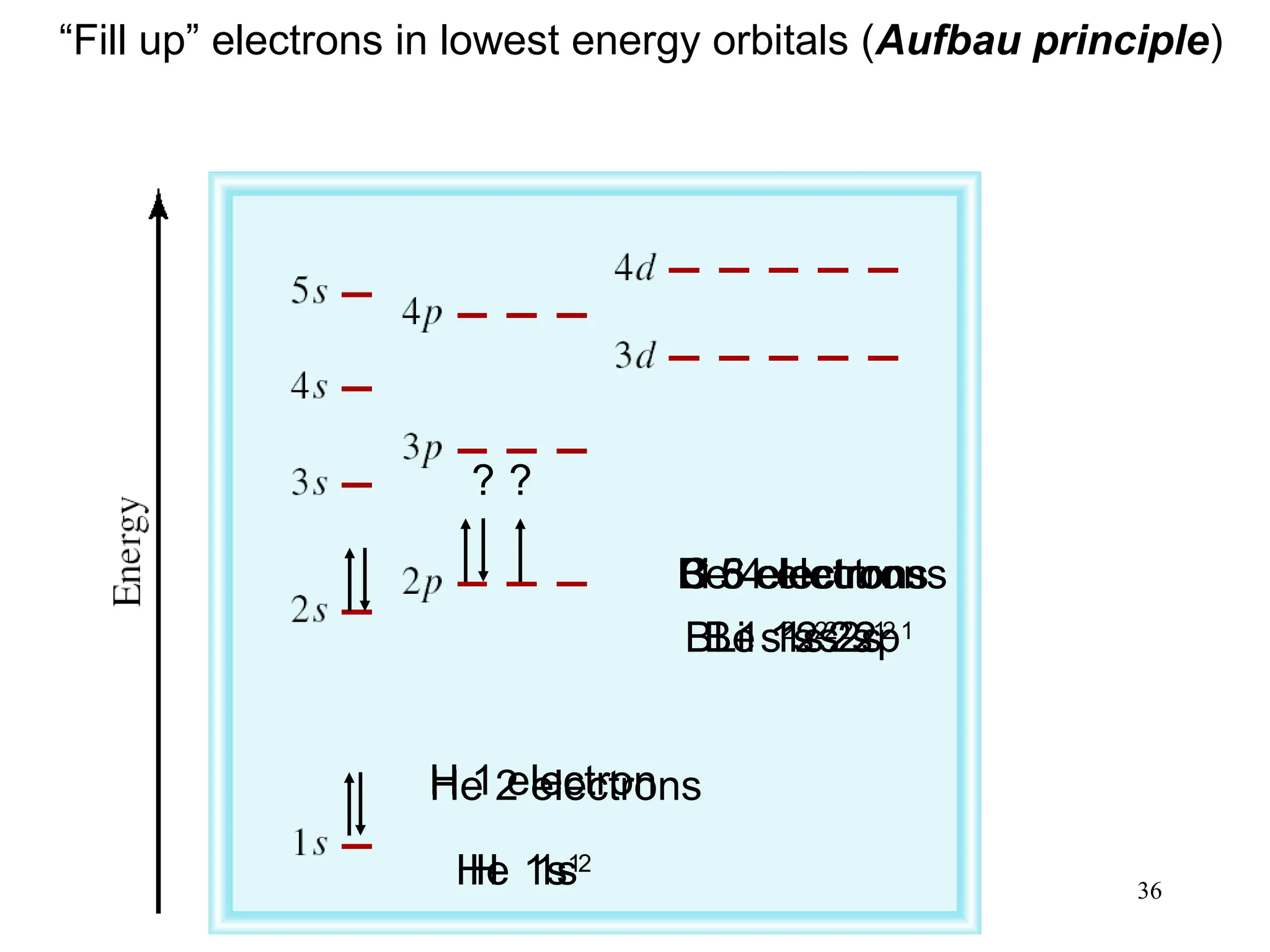
“Fill up” electrons in lowest energy orbitals (Aufbau principle)
H 1 electron
H 1s1
He 2 electrons
He 1s2
Li 3 electrons
Li 1s2
2s1
Be 4 electrons
Be 1s2
2s2
B 5 electrons
B 1s2
2s2
2p1
C 6 electrons
? ?
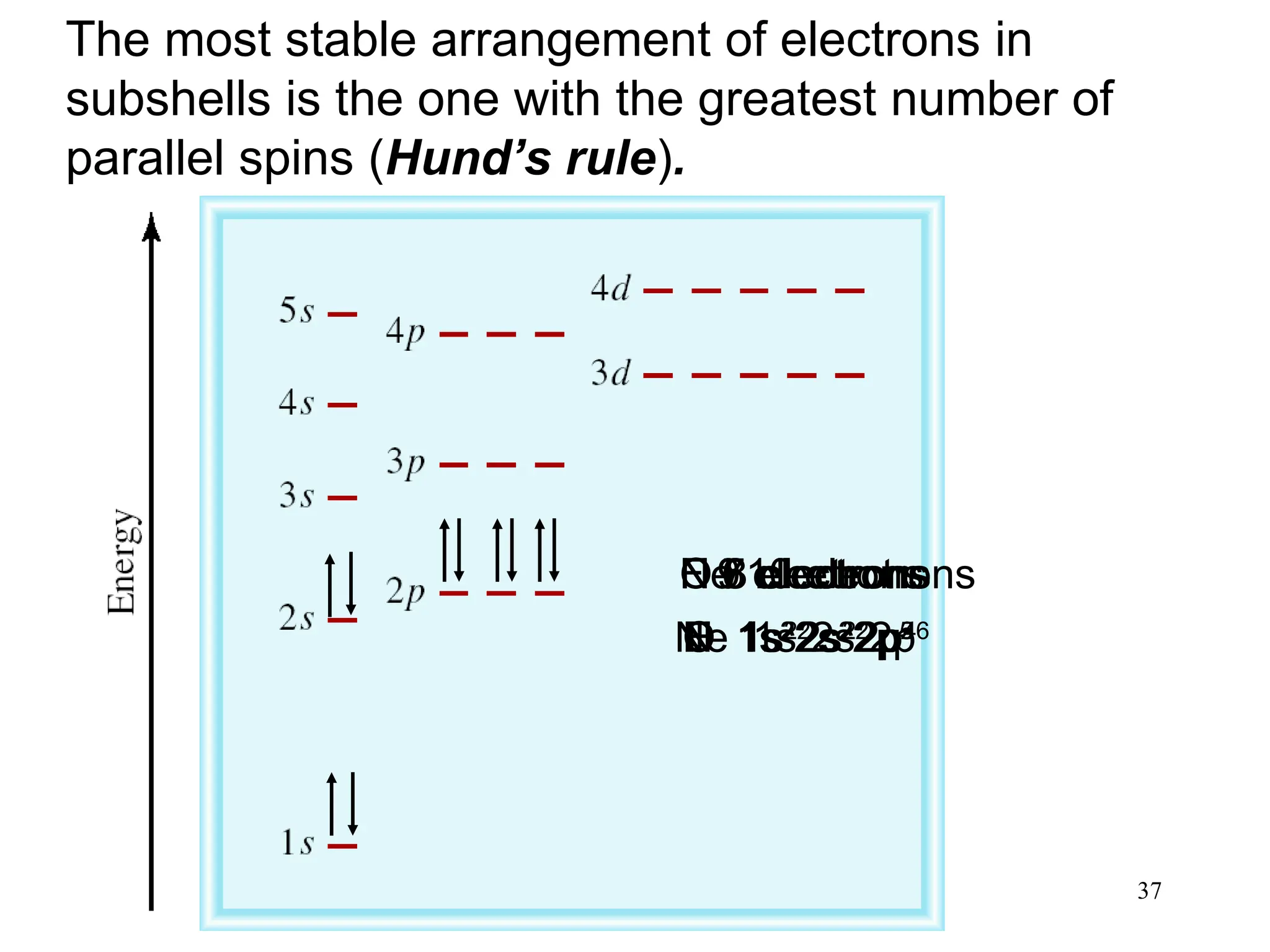
37
C 6 electrons
The most stable arrangement of electrons in
subshells is the one with the greatest number of
parallel spins (Hund’s rule).
C 1s2
2s2
2p2
N 7 electrons
N 1s2
2s2
2p3
O 8 electrons
O 1s2
2s2
2p4
F 9 electrons
F 1s2
2s2
2p5
Ne 10 electrons
Ne 1s2
2s2
2p6
38
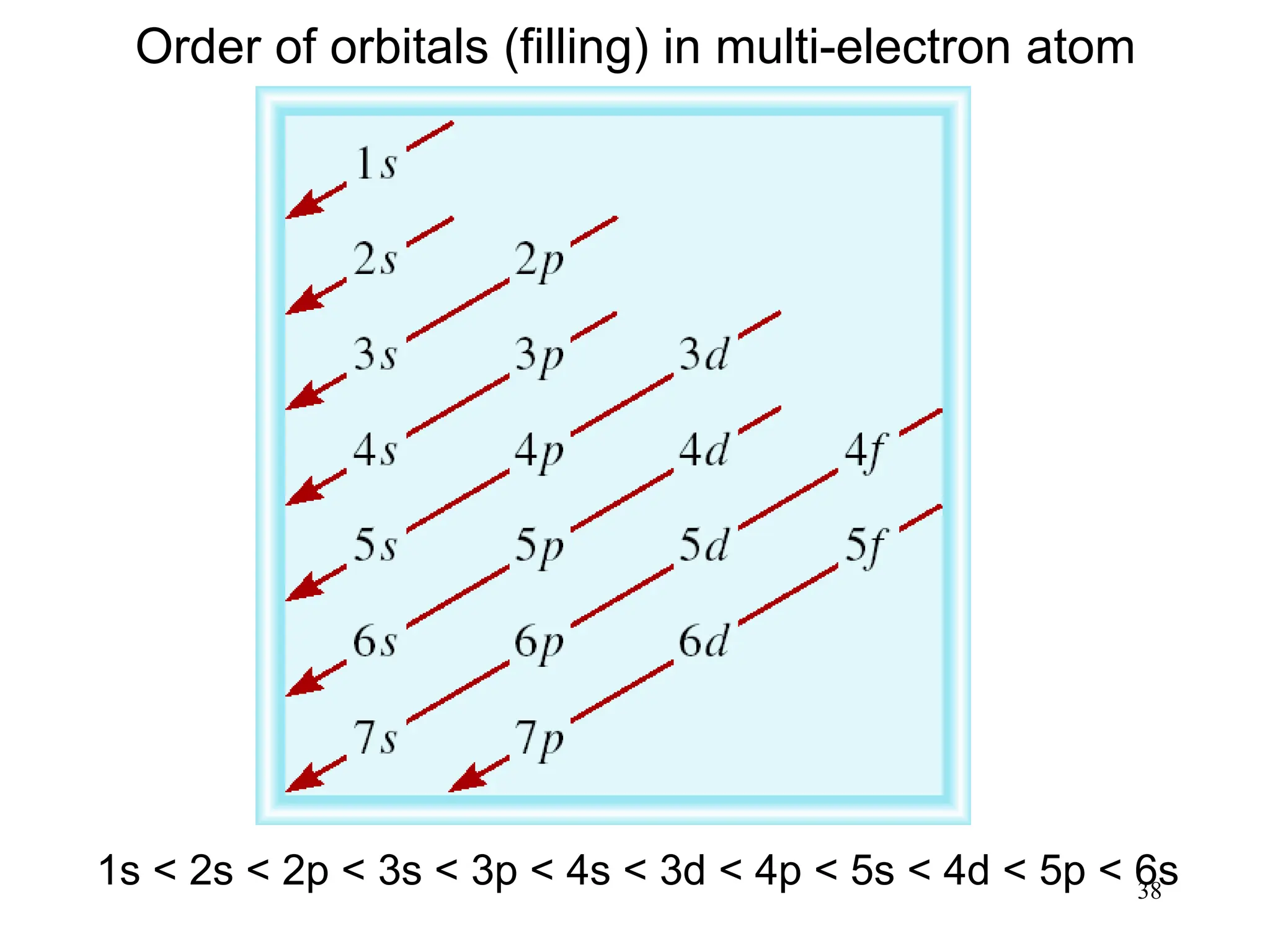
Order of orbitals (filling) in multi-electron atom
1s < 2s < 2p < 3s < 3p < 4s < 3d < 4p < 5s < 4d < 5p < 6s
39
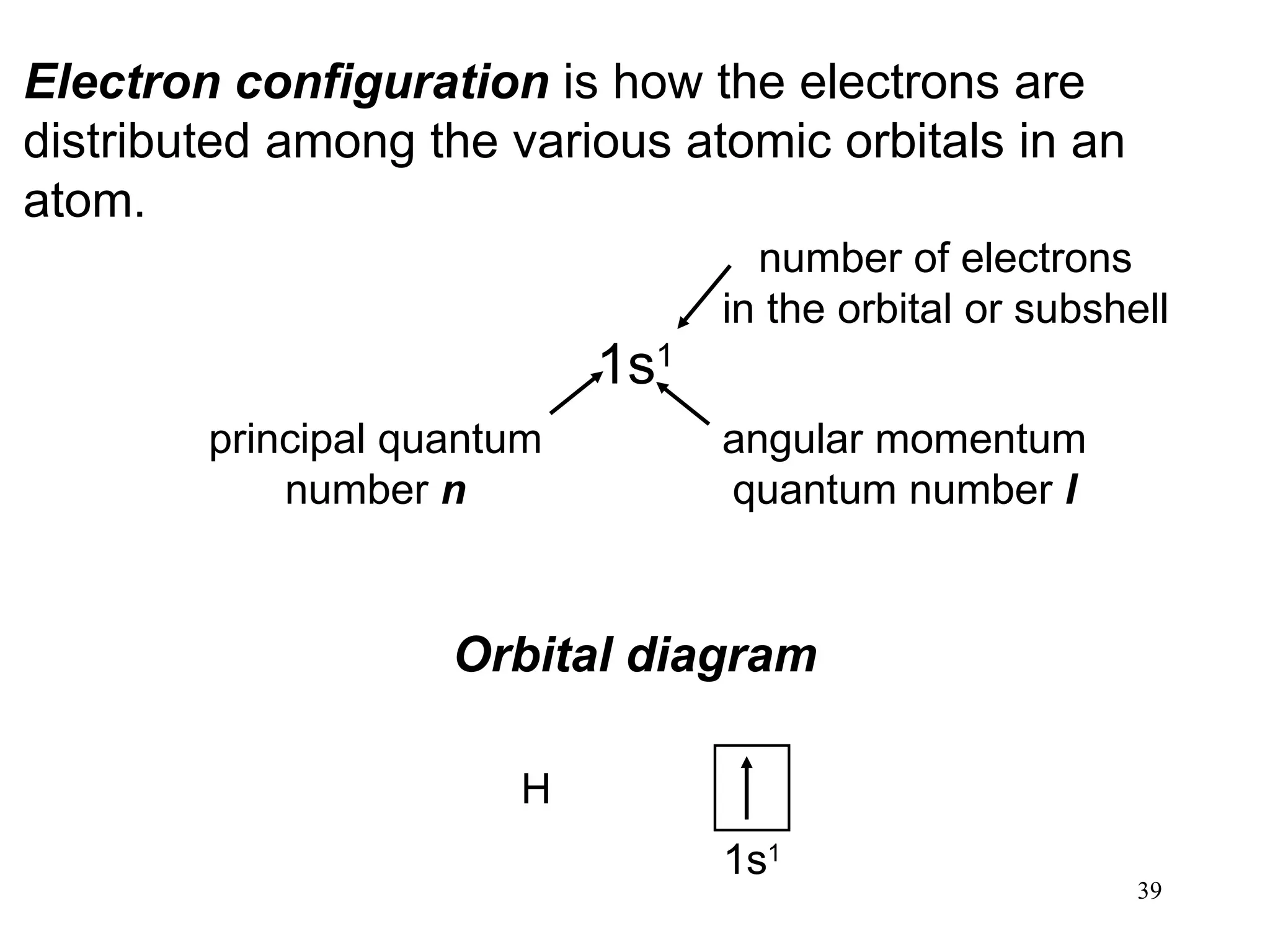
Electron configuration is how the electrons are
distributed among the various atomic orbitals in an
atom.
1s1
principal quantum
number n
angular momentum
quantum number l
number of electrons
in the orbital or subshell
Orbital diagram
H
1s1
40
What is the electron configuration of Mg?
Mg 12 electrons
1s < 2s < 2p < 3s < 3p < 4s
1s2
2s2
2p6
3s2
2 + 2 + 6 + 2 = 12 electrons
Abbreviated as [Ne]3s2
[Ne] 1s2
2s2
2p6
What are the possible quantum numbers for the last
(outermost) electron in Cl?
Cl 17 electrons 1s < 2s < 2p < 3s < 3p < 4s
1s2
2s2
2p6
3s2
3p5
2 + 2 + 6 + 2 + 5 = 17 electrons
Last electron added to 3p orbital
n = 3 l = 1 ml = -1, 0, or +1 ms = ½ or -½
41
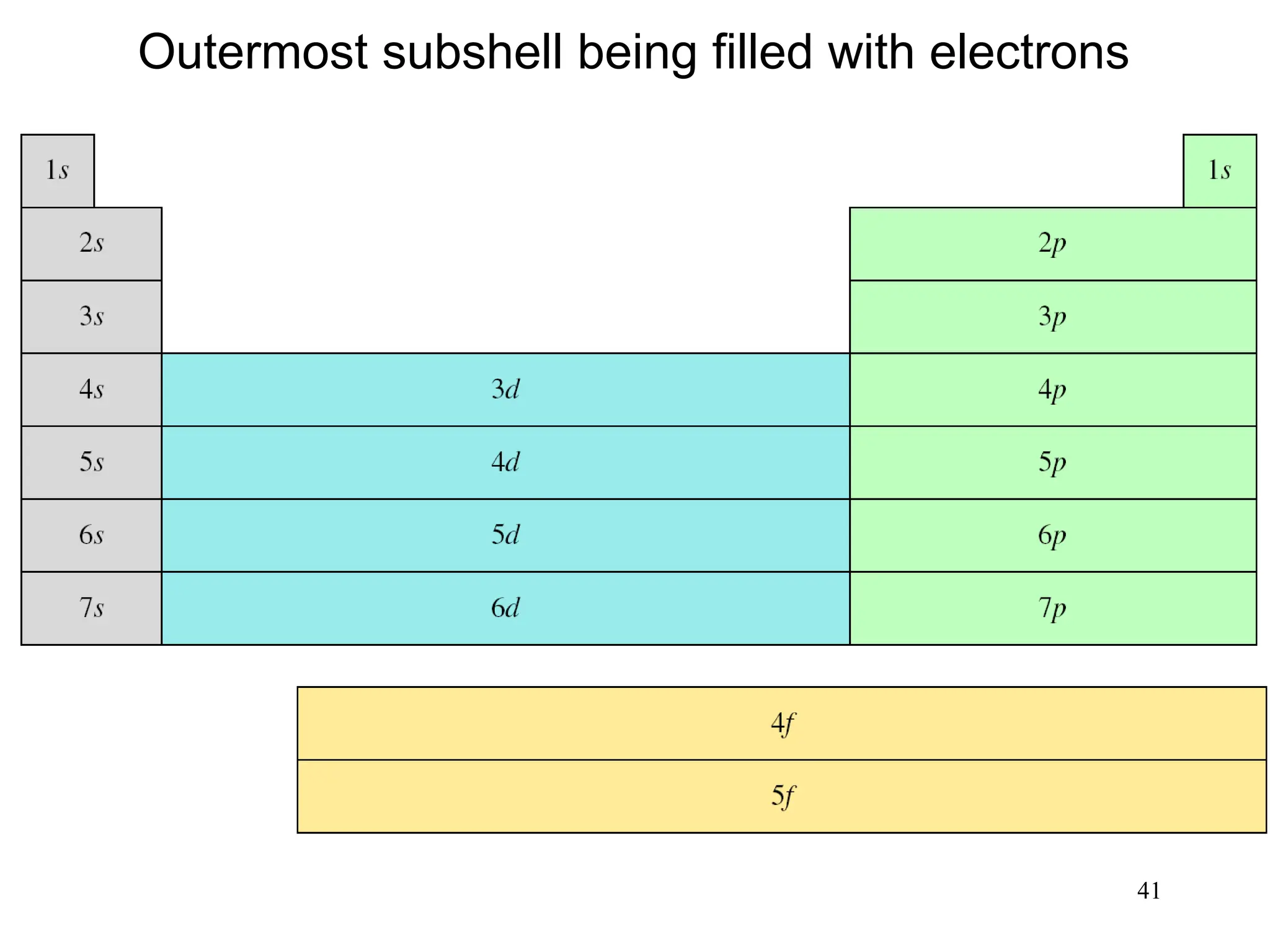
Outermost subshell being filled with electrons
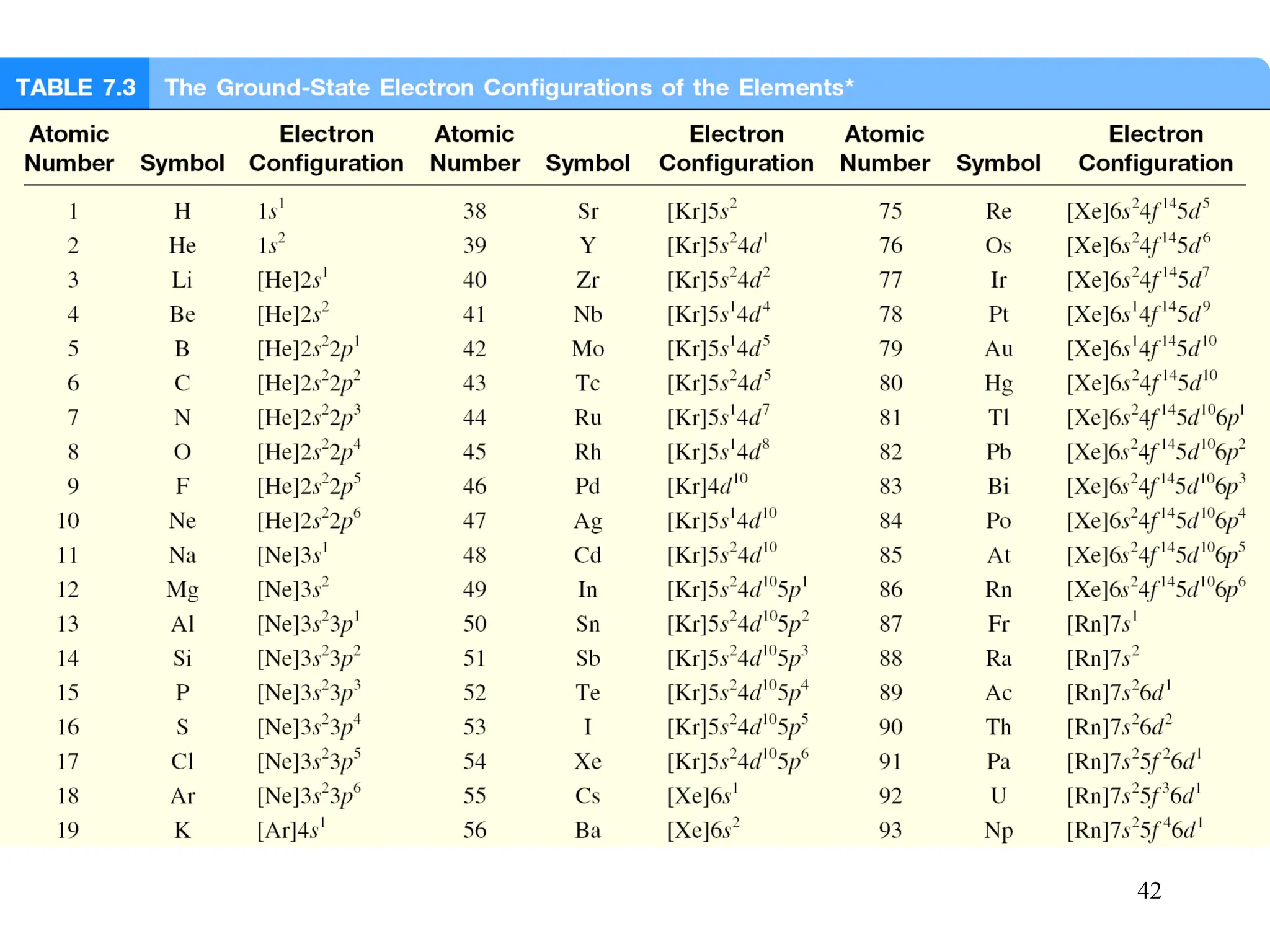
42
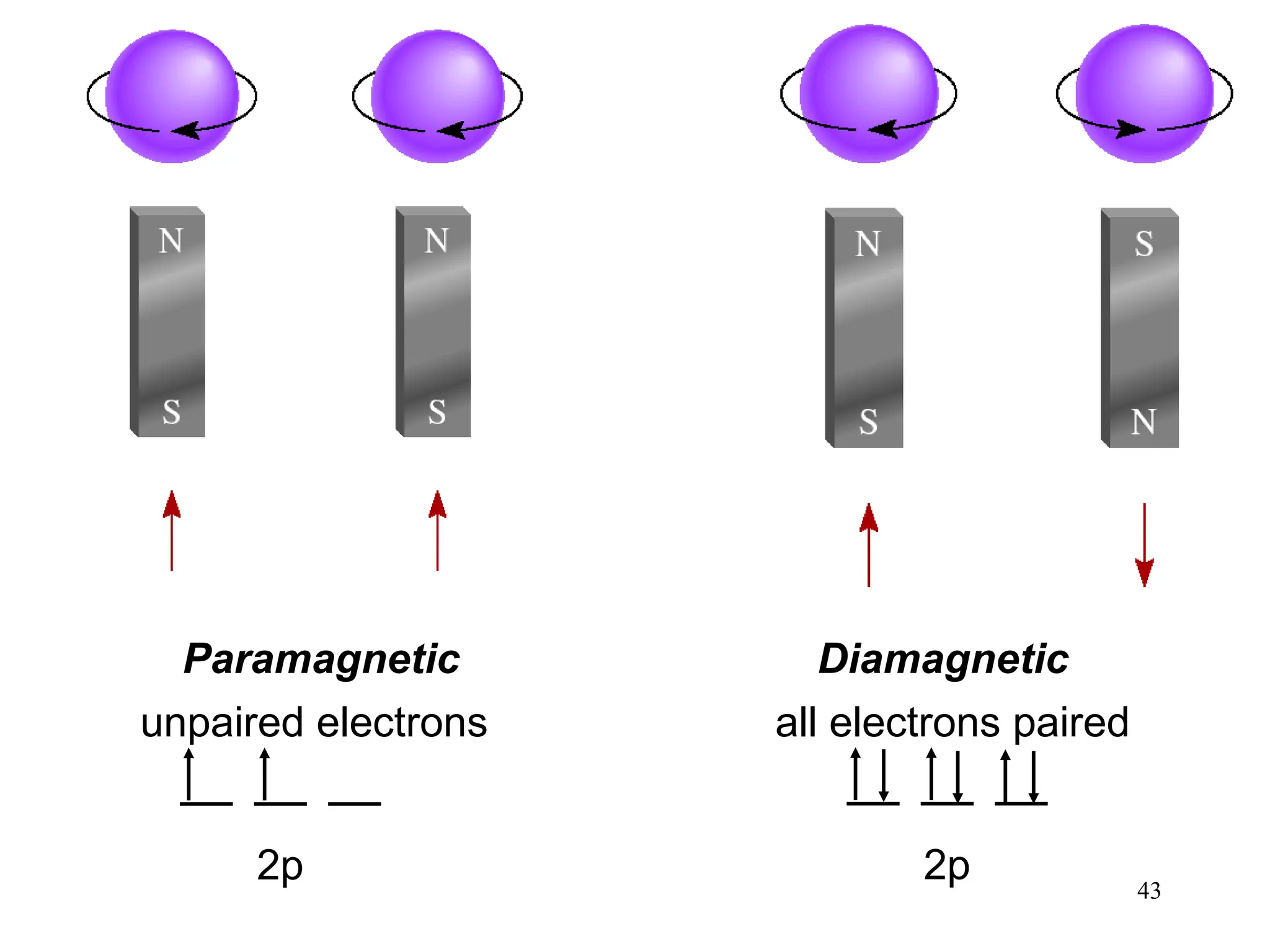
43
Paramagnetic
unpaired electrons
2p
Diamagnetic
all electrons paired
2p

chapter 7 quantum theory and the electronic structure

  • 1.
    1 Chapter 7 Copyright ©The McGraw-Hill Companies, Inc. Permission required for reproduction or display. Quantum Theory and the Electronic Structure of Atoms
  • 2.
    2 Properties of Waves Wavelength() is the distance between identical points on successive waves. Amplitude is the vertical distance from the midline of a wave to the peak or trough. Frequency () is the number of waves that pass through a particular point in 1 second (Hz = 1 cycle/s). The speed (u) of the wave =  x 
  • 3.
    3 Maxwell (1873), proposedthat visible light consists of electromagnetic waves. Electromagnetic radiation is the emission and transmission of energy in the form of electromagnetic waves. Speed of light (c) in vacuum = 3.00 x 10⁸ m/s All electromagnetic radiation  x c
  • 4.
  • 5.
    5  x = c  = c/  = 3.00 x 10⁸ m/s / 6.0 x 10⁴ Hz  = 5.0 x 10³ m A photon has a frequency of 6.0 x 10⁴ Hz. Convert this frequency into wavelength (nm). Does this frequency fall in the visible region?  = 5.0 x 10¹² nm  
  • 6.
    6 Mystery #1, “HeatedSolids Problem” Solved by Planck in 1900 Energy (light) is emitted or absorbed in discrete units (quantum). E = h x  Planck’s constant (h) h = 6.63 x 10⁻³⁴ J•s When solids are heated, they emit electromagnetic radiation over a wide range of wavelengths. Radiant energy emitted by an object at a certain temperature depends on its wavelength.
  • 7.
    7 Light has both: 1.wave nature 2. particle nature h = KE + W Mystery #2, “Photoelectric Effect” Solved by Einstein in 1905 Photon is a “particle” of light KE = h - W h KE e- where W is the work function and depends how strongly electrons are held in the metal
  • 8.
    8 E = hx  E = 6.63 x 10⁻³⁴ (J•s) x 3.00 x 10 8 (m/s) / 0.154 x 10⁻⁹ (m) E = 1.29 x 10 -15 J E = h x c / When copper is bombarded with high-energy electrons, X rays are emitted. Calculate the energy (in joules) associated with the photons if the wavelength of the X rays is 0.154 nm.
  • 9.
    9 Line Emission Spectrumof Hydrogen Atoms
  • 10.
  • 11.
    11 1. e- can onlyhave specific (quantized) energy values 2. light is emitted as e- moves from one energy level to a lower energy level Bohr’s Model of the Atom (1913) En = -RH ( ) 1 n2 n (principal quantum number) = 1,2,3,… RH (Rydberg constant) = 2.18 x 10⁻¹⁸ J
  • 12.
  • 13.
    13 Ephoton = E= Ef - Ei Ef = -RH ( ) 1 n2 f Ei = -RH ( ) 1 n2 i i f E = RH( ) 1 n2 1 n2 nf = 1 ni = 2 nf = 1 ni = 3 nf = 2 ni = 3
  • 14.
  • 15.
    15 Ephoton = 2.18x 10-18 J x (1/25 - 1/9) Ephoton = E = -1.55 x 10⁻¹⁹ J  = 6.63 x 10⁻³⁴ (J•s) x 3.00 x 10⁸ (m/s)/1.55 x 10-19 J  = 1280 nm Calculate the wavelength (in nm) of a photon emitted by a hydrogen atom when its electron drops from the n = 5 state to the n = 3 state. Ephoton = h x c /  = h x c / Ephoton i f E = RH( ) 1 n2 1 n2 Ephoton =
  • 16.
    16 De Broglie (1924)reasoned that e- is both particle and wave. Why is e- energy quantized? u = velocity of e- m = mass of e- 2r = n  = h mu
  • 17.
    17  = h/mu = 6.63 x 10⁻³⁴ / (2.5 x 10-3 x 15.6)  = 1.7 x 10⁻³² m = 1.7 x 10⁻²³ nm What is the de Broglie wavelength (in nm) associated with a 2.5 g Ping-Pong ball traveling at 15.6 m/s? m in kg h in J•s u in (m/s)
  • 18.
    18 Chemistry in Action:Laser – The Splendid Light Laser light is (1) intense, (2) monoenergetic, and (3) coherent
  • 19.
    19 Chemistry in Action:Electron Microscopy STM image of iron atoms on copper surface e = 0.004 nm Electron micrograph of a normal red blood cell and a sickled red blood cell from the same person
  • 20.
    20 Schrodinger Wave Equation In1926 Schrodinger wrote an equation that described both the particle and wave nature of the e- Wave function () describes: 1. energy of e- with a given  2. probability of finding e- in a volume of space Schrodinger’s equation can only be solved exactly for the hydrogen atom. Must approximate its solution for multi-electron systems.
  • 21.
    21 Schrodinger Wave Equation is a function of four numbers called quantum numbers (n, l, ml, ms) principal quantum number n n = 1, 2, 3, 4, …. n=1 n=2 n=3 distance of e- from the nucleus
  • 22.
    22 Where 90% ofthe e- density is found for the 1s orbital
  • 23.
    23 quantum numbers: (n,l, ml, ms) angular momentum quantum number l for a given value of n, l = 0, 1, 2, 3, … n-1 n = 1, l = 0 n = 2, l = 0 or 1 n = 3, l = 0, 1, or 2 Shape of the “volume” of space that the e- occupies l = 0 s orbital l = 1 p orbital l = 2 d orbital l = 3 f orbital Schrodinger Wave Equation
  • 24.
    24 l = 0(s orbitals) l = 1 (p orbitals)
  • 25.
    25 l = 2(d orbitals)
  • 26.
    26 quantum numbers: (n,l, ml, ms) magnetic quantum number ml for a given value of l ml = -l, …., 0, …. +l orientation of the orbital in space if l = 1 (p orbital), ml = -1, 0, or 1 if l = 2 (d orbital), ml = -2, -1, 0, 1, or 2 Schrodinger Wave Equation
  • 27.
    27 ml = -1,0, or 1 3 orientations is space
  • 28.
    28 ml = -2,-1, 0, 1, or 2 5 orientations is space
  • 29.
    29 (n, l, ml,ms) spin quantum number ms ms = +½ or -½ Schrodinger Wave Equation ms = -½ ms = +½
  • 30.
    30 Existence (and energy)of electron in atom is described by its unique wave function . Pauli exclusion principle - no two electrons in an atom can have the same four quantum numbers. Schrodinger Wave Equation quantum numbers: (n, l, ml, ms) Each seat is uniquely identified (E, R12, S8) Each seat can hold only one individual at a time
  • 31.
  • 32.
    32 Schrodinger Wave Equation quantumnumbers: (n, l, ml, ms) Shell – electrons with the same value of n Subshell – electrons with the same values of n and l Orbital – electrons with the same values of n, l, and ml How many electrons can an orbital hold? If n, l, and ml are fixed, then ms = ½ or - ½ = (n, l, ml, ½)or= (n, l, ml, -½) An orbital can hold 2 electrons
  • 33.
    33 How many 2porbitals are there in an atom? 2p n=2 l = 1 If l = 1, then ml = -1, 0, or +1 3 orbitals How many electrons can be placed in the 3d subshell? 3d n=3 l = 2 If l = 2, then ml = -2, -1, 0, +1, or +2 5 orbitals which can hold a total of 10 e-
  • 34.
    34 Energy of orbitalsin a single electron atom Energy only depends on principal quantum number n En = -RH ( ) 1 n2 n=1 n=2 n=3
  • 35.
    35 Energy of orbitalsin a multi-electron atom Energy depends on n and l n=1 l = 0 n=2 l = 0 n=2 l = 1 n=3 l = 0 n=3 l = 1 n=3 l = 2
  • 36.
    36 “Fill up” electronsin lowest energy orbitals (Aufbau principle) H 1 electron H 1s1 He 2 electrons He 1s2 Li 3 electrons Li 1s2 2s1 Be 4 electrons Be 1s2 2s2 B 5 electrons B 1s2 2s2 2p1 C 6 electrons ? ?
  • 37.
    37 C 6 electrons Themost stable arrangement of electrons in subshells is the one with the greatest number of parallel spins (Hund’s rule). C 1s2 2s2 2p2 N 7 electrons N 1s2 2s2 2p3 O 8 electrons O 1s2 2s2 2p4 F 9 electrons F 1s2 2s2 2p5 Ne 10 electrons Ne 1s2 2s2 2p6
  • 38.
    38 Order of orbitals(filling) in multi-electron atom 1s < 2s < 2p < 3s < 3p < 4s < 3d < 4p < 5s < 4d < 5p < 6s
  • 39.
    39 Electron configuration ishow the electrons are distributed among the various atomic orbitals in an atom. 1s1 principal quantum number n angular momentum quantum number l number of electrons in the orbital or subshell Orbital diagram H 1s1
  • 40.
    40 What is theelectron configuration of Mg? Mg 12 electrons 1s < 2s < 2p < 3s < 3p < 4s 1s2 2s2 2p6 3s2 2 + 2 + 6 + 2 = 12 electrons Abbreviated as [Ne]3s2 [Ne] 1s2 2s2 2p6 What are the possible quantum numbers for the last (outermost) electron in Cl? Cl 17 electrons 1s < 2s < 2p < 3s < 3p < 4s 1s2 2s2 2p6 3s2 3p5 2 + 2 + 6 + 2 + 5 = 17 electrons Last electron added to 3p orbital n = 3 l = 1 ml = -1, 0, or +1 ms = ½ or -½
  • 41.
    41 Outermost subshell beingfilled with electrons
  • 42.
  • 43.