Business
Psychology
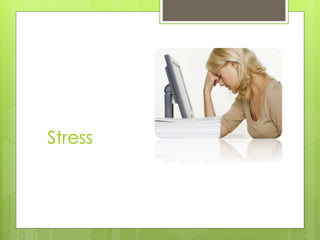
Stress
Learning Objectives
 What is Stress?
 Stressors
 Internal and External Stressors
 Causes of Stress
 Depression
 Burnout
 Common Stress Reactions
 Stress Signals
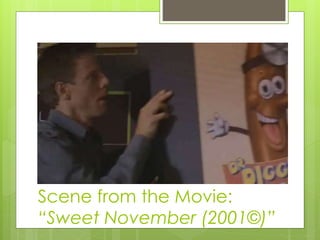
Scene from the Movie:
“Sweet November (2001©)”
Student Participation
What give you
stress?
What is Stress?
 Is a feeling that's created when we react
to particular events. It's the body's way of
rising to a challenge and preparing to
meet a tough situation with focus,
strength, stamina, and heightened
alertness.
What is Stress?
 The emotional and physical strain caused
by our response to pressure from the
outside world.
 Is your body's way of responding to any
kind of demand. It can be caused by
both good and bad experiences.
What is Stress?
 Stress is defined as the process by which
the individual responds to environmental
and psychological events that are
perceived as threatening or challenging.
What is Stress?
 Gatchel and Baum 1983
 It can be defined as “the demand
place on a person to adapt, adjust
and to cope”
Stressors
 Are agents or event that cause a stress.
 Divided into:
 Internal Stressors
 External Stressors
Internal Stressor
 Stressors inside us.
 These are stressors that have been in our
minds and bodies for many years of our
lives.
External Stressors
 Stressors are the sources of stress that we
are aware of around us.
 These stressors are things that create a
situation of perceived threat in our minds
and bodies.
Causes of Stress
 Change
 Anxiety
 Frustration
 Conflict (Psychological Stressors)
 Pressure
Common Stress Reactions
 Tension
 Irritated
 Unable to concentrate
 Physical symptoms
Stress Signals
 Acts as a red light or warning bell to tell us
that action is needed to prevent more
serious problems developing.
Examples of Stress Signals
 Physical Aspect
 Mental Aspect
 Emotional Aspect
 Behavioral Aspect
Physical Aspect
 Changes in breathing rhythm
 Tense and aching muscles
 Headaches
 Sweating
 Cold hands and feet
 Stomach problems
Mental Aspects
 Lack of concentration
 More frequent mistakes
 Forgetfulness
 Poorer judgment
Emotional Aspects
 Irritation
 Nervousness
 Depression
 Crying
Behavioral Aspects
 Insomnia
 Increased drinking/eating/smoking
 Absenteeism
 Clumsiness
Depression
 Hopelessness in response to real or
imagined loss or failure.
Burnout
 Occurs when a person who has been
experiencing a high level of stress hasn't
been able to cope with.
Stress at Work
Managing Stress:
How to deal with stress?
Stress at Work
 JOB STRESS OR WORK STRESS
 it is defined as the harmful physical
and emotional responses that occur
when the requirements of the job do
not match the capabilities, resources or
needs of the worker.
 Work stress can lead to poor health and
even injury.
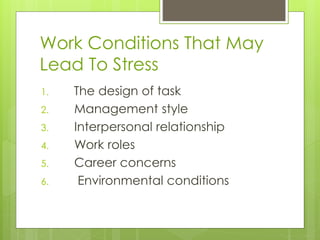
Work Conditions That May
Lead To Stress
1. The design of task
2. Management style
3. Interpersonal relationship
4. Work roles
5. Career concerns
6. Environmental conditions
Stages in
coping with
Stress
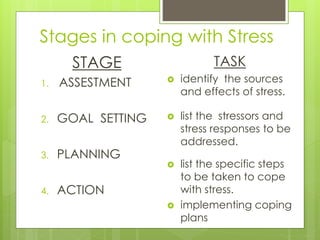
Stages in coping with Stress
STAGE
1. ASSESTMENT
2. GOAL SETTING
3. PLANNING
4. ACTION
TASK
 identify the sources
and effects of stress.
 list the stressors and
stress responses to be
addressed.
 list the specific steps
to be taken to cope
with stress.
 implementing coping
plans
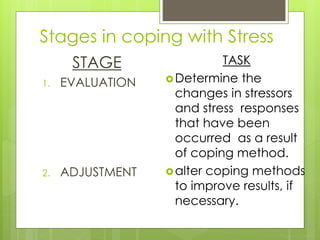
Stages in coping with Stress
STAGE
1. EVALUATION
2. ADJUSTMENT
TASK
Determine the
changes in stressors
and stress responses
that have been
occurred as a result
of coping method.
alter coping methods
to improve results, if
necessary.
The End
Chapter 6

Chapter 6 business psychology

  • 1.
  • 2.
  • 3.
    Learning Objectives  Whatis Stress?  Stressors  Internal and External Stressors  Causes of Stress  Depression  Burnout  Common Stress Reactions  Stress Signals
  • 4.
    Scene from theMovie: “Sweet November (2001©)”
  • 5.
  • 6.
    What is Stress? Is a feeling that's created when we react to particular events. It's the body's way of rising to a challenge and preparing to meet a tough situation with focus, strength, stamina, and heightened alertness.
  • 7.
    What is Stress? The emotional and physical strain caused by our response to pressure from the outside world.  Is your body's way of responding to any kind of demand. It can be caused by both good and bad experiences.
  • 8.
    What is Stress? Stress is defined as the process by which the individual responds to environmental and psychological events that are perceived as threatening or challenging.
  • 9.
    What is Stress? Gatchel and Baum 1983  It can be defined as “the demand place on a person to adapt, adjust and to cope”
  • 10.
    Stressors  Are agentsor event that cause a stress.  Divided into:  Internal Stressors  External Stressors
  • 11.
    Internal Stressor  Stressorsinside us.  These are stressors that have been in our minds and bodies for many years of our lives.
  • 12.
    External Stressors  Stressorsare the sources of stress that we are aware of around us.  These stressors are things that create a situation of perceived threat in our minds and bodies.
  • 13.
    Causes of Stress Change  Anxiety  Frustration  Conflict (Psychological Stressors)  Pressure
  • 14.
    Common Stress Reactions Tension  Irritated  Unable to concentrate  Physical symptoms
  • 15.
    Stress Signals  Actsas a red light or warning bell to tell us that action is needed to prevent more serious problems developing.
  • 16.
    Examples of StressSignals  Physical Aspect  Mental Aspect  Emotional Aspect  Behavioral Aspect
  • 17.
    Physical Aspect  Changesin breathing rhythm  Tense and aching muscles  Headaches  Sweating  Cold hands and feet  Stomach problems
  • 18.
    Mental Aspects  Lackof concentration  More frequent mistakes  Forgetfulness  Poorer judgment
  • 19.
    Emotional Aspects  Irritation Nervousness  Depression  Crying
  • 20.
    Behavioral Aspects  Insomnia Increased drinking/eating/smoking  Absenteeism  Clumsiness
  • 21.
    Depression  Hopelessness inresponse to real or imagined loss or failure.
  • 22.
    Burnout  Occurs whena person who has been experiencing a high level of stress hasn't been able to cope with.
  • 23.
  • 24.
    Managing Stress: How todeal with stress?
  • 25.
    Stress at Work JOB STRESS OR WORK STRESS  it is defined as the harmful physical and emotional responses that occur when the requirements of the job do not match the capabilities, resources or needs of the worker.  Work stress can lead to poor health and even injury.
  • 26.
    Work Conditions ThatMay Lead To Stress 1. The design of task 2. Management style 3. Interpersonal relationship 4. Work roles 5. Career concerns 6. Environmental conditions
  • 27.
  • 28.
    Stages in copingwith Stress STAGE 1. ASSESTMENT 2. GOAL SETTING 3. PLANNING 4. ACTION TASK  identify the sources and effects of stress.  list the stressors and stress responses to be addressed.  list the specific steps to be taken to cope with stress.  implementing coping plans
  • 29.
    Stages in copingwith Stress STAGE 1. EVALUATION 2. ADJUSTMENT TASK Determine the changes in stressors and stress responses that have been occurred as a result of coping method. alter coping methods to improve results, if necessary.
  • 30.

Editor's Notes

  • #6 In Business, what do you think are the common problems that give causes a person to have stress?
  • #14 1. Change. Today we are living in a world of high technology. It is ever-changing society. Job skills become obsolete, and we have to learn new methods and skills or change jobs. 2. Anxiety. this is a feeling similar to fear, except that you don’t not know what you are afraid of. You feel uneasy and experience a sense of foreboding 3. Frustration. This occurs when one’s strivings are thwarted either by obstacles that block progress toward a desire goal. When one is prevented from attaining a goal or motive it causes frustration. 4. Conflict. Conflicts are also psychological stressors. Since we live and work with other people, it is inevitable that conflict occasionally arises. 5. Pressures. Stress may not only stem from frustrations and conflicts but also from pressures to achieve goals or to behave in particular ways. In general, pressure, forces a person to speed up intensity or change the direction of a goal-oriented behavior.
  • #29 Many employers have recently become aware of the harmful effects of job-induced stress on the mental and physical health of their employees. Stress can interfere with production and efficiency on the job and can debilitate persons to the point of requiring medical or psychological treatment. Today, organizations that attempt to deal with the effects of stress through psychological counseling programs are increasing in number. Researches are being conducted by psychologist and behavioral scientist to determine the aspects of work life that induce stress and how the job and job environment can be redesigned to be less stressful.
  • #30 1.Heavy workload, infrequent, long work hours, and shiftwork. Do not utilize worker’s skills and provide little sense of control. 2. Lack of participation by workers in decision making, poor communication in the organization. 3. poor social environment and lack of support or help from coworkers and supervisors. 4. Conflicting or uncertain job expectations, too much responsibility, too many ‘hats to wear 5. job insecurity and lack of opportunity for growth and advancement or promotion or even rapid changes for w/c workers are unprepared. 6. - unpleasant or dangerous physical condition such as crowding, noise, air pollution, or ergonomic problems.
  • #32 > many successful programs for coping with stress systematically guide people through several stages and are aimed at removing stressors that can be changed and at tempering responses to stressors that cannot be changed.
  • #33 > many successful programs for coping with stress systematically guide people through several stages and are aimed at removing stressors that can be changed and at tempering responses to stressors that cannot be changed.