People and the Environment Environmental Science Spring 2011
What is Environmental Science? Environmental Science is the study of the air, land, and water of an ecosystem AND the impact humans have on the environment It is considered an  applied science  – meaning that it focuses on tangible problems more than theoretical ideas
Environmental Science is also  interdisciplinary  – it involves many areas of study Some of the sciences that are a part of environmental science are: Ecology , chemistry, geology, botany, zoology, paleontology Economics, law, politics, and geography
Goals of Environmental Science A major goal of environmental science is to understand and solve environmental problems. To accomplish this goal, environmental scientists study two main types of interactions between humans and their environment: The use of natural resources. How our actions alter our environment.
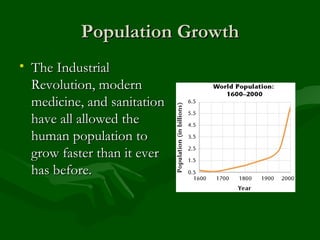
Population Growth The Industrial Revolution, modern medicine, and sanitation have all allowed the human population to grow faster than it ever has before.
Population Growth In the past 50 years, nations have used vast amounts of resources to meet the worlds need for food. Producing enough food for large populations has environmental consequences such as habitat destruction and pesticide pollution.
Population Growth Most scientists think that the human population will almost double in the 21st century before it begins to stabilize. Because of these predictions, we can expect the pressure on the environment will continue to increase and the human population and its need for food and resources grow.
What environmental problems have heard of?
3 Categories of Environmental Problems Resource Depletion Pollution Loss of Biodiversity
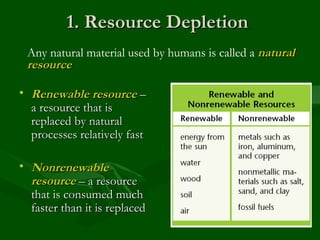
1. Resource Depletion Renewable resource  – a resource that is replaced by natural processes relatively fast Nonrenewable resource  – a resource that is consumed much faster than it is replaced Any natural material used by humans is called a  natural resource
A resource is  depleted  if a large fraction of the resource is used up much faster than it can be replaced Can nonrenewable resources be depleted? Can renewable resources be depleted?
2. Pollution Pollution  is an undesired change in air, water, or soil that adversely affects health, survival, or activities of humans, or other organisms Pollution happens when wastes are produced faster than can be disposed of and accumulate in the environment
Biodegradable v. Non-biodegradable Pollutants that can be broken down in the environment are called  biodegradable These become a problem when they accumulate faster than the environment can break them down Can you name some biodegradable pollutants?
Biodegradable v. Non-biodegradable Non-biodegradable  pollutants are those that cannot be broken down easily or at all in the environment  Because they do not break down it’s easy for them to build up to dangerous levels in the environment Can you name some non-biodegradable pollutants?
3. Loss of Biodiversity Biodiversity  – the number and variety of species that live in an area Any organisms we share the world with can be considered natural resources. We depend on them for food, medicine, shelter, the oxygen we breathe, and many other things.
Loss of Biodiversity Only a fraction of the hundreds of millions species that have ever lived on earth are still alive – most are  extinct Extinction is a natural process – so why should people be concerned about modern extinction of species?

3 people and the environment

  • 1.
    People and theEnvironment Environmental Science Spring 2011
  • 2.
    What is EnvironmentalScience? Environmental Science is the study of the air, land, and water of an ecosystem AND the impact humans have on the environment It is considered an applied science – meaning that it focuses on tangible problems more than theoretical ideas
  • 3.
    Environmental Science isalso interdisciplinary – it involves many areas of study Some of the sciences that are a part of environmental science are: Ecology , chemistry, geology, botany, zoology, paleontology Economics, law, politics, and geography
  • 4.
    Goals of EnvironmentalScience A major goal of environmental science is to understand and solve environmental problems. To accomplish this goal, environmental scientists study two main types of interactions between humans and their environment: The use of natural resources. How our actions alter our environment.
  • 5.
    Population Growth TheIndustrial Revolution, modern medicine, and sanitation have all allowed the human population to grow faster than it ever has before.
  • 6.
    Population Growth Inthe past 50 years, nations have used vast amounts of resources to meet the worlds need for food. Producing enough food for large populations has environmental consequences such as habitat destruction and pesticide pollution.
  • 7.
    Population Growth Mostscientists think that the human population will almost double in the 21st century before it begins to stabilize. Because of these predictions, we can expect the pressure on the environment will continue to increase and the human population and its need for food and resources grow.
  • 8.
  • 9.
    3 Categories ofEnvironmental Problems Resource Depletion Pollution Loss of Biodiversity
  • 10.
    1. Resource DepletionRenewable resource – a resource that is replaced by natural processes relatively fast Nonrenewable resource – a resource that is consumed much faster than it is replaced Any natural material used by humans is called a natural resource
  • 11.
    A resource is depleted if a large fraction of the resource is used up much faster than it can be replaced Can nonrenewable resources be depleted? Can renewable resources be depleted?
  • 12.
    2. Pollution Pollution is an undesired change in air, water, or soil that adversely affects health, survival, or activities of humans, or other organisms Pollution happens when wastes are produced faster than can be disposed of and accumulate in the environment
  • 13.
    Biodegradable v. Non-biodegradablePollutants that can be broken down in the environment are called biodegradable These become a problem when they accumulate faster than the environment can break them down Can you name some biodegradable pollutants?
  • 14.
    Biodegradable v. Non-biodegradableNon-biodegradable pollutants are those that cannot be broken down easily or at all in the environment Because they do not break down it’s easy for them to build up to dangerous levels in the environment Can you name some non-biodegradable pollutants?
  • 15.
    3. Loss ofBiodiversity Biodiversity – the number and variety of species that live in an area Any organisms we share the world with can be considered natural resources. We depend on them for food, medicine, shelter, the oxygen we breathe, and many other things.
  • 16.
    Loss of BiodiversityOnly a fraction of the hundreds of millions species that have ever lived on earth are still alive – most are extinct Extinction is a natural process – so why should people be concerned about modern extinction of species?