


L/O/G/O
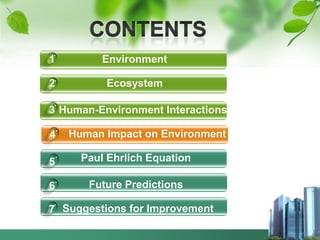
1         Environment

2         Ecosystem

3 Human-Environment Interactions

4   Human Impact on Environment

5     Paul Ehrlich Equation

6      Future Predictions

7 Suggestions for Improvement
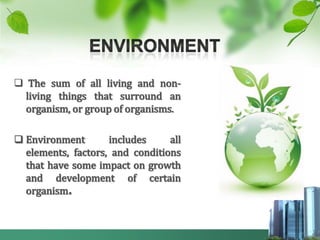
 The sum of all living and non-
  living things that surround an
  organism, or group of organisms.

 Environment       includes     all
  elements, factors, and conditions
  that have some impact on growth
  and development of certain
  organism.
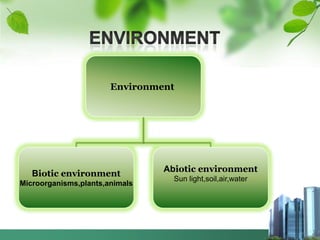
Environment


                                Abiotic environment
   Biotic environment
                                  Sun light,soil,air,water
Microorganisms,plants,animals
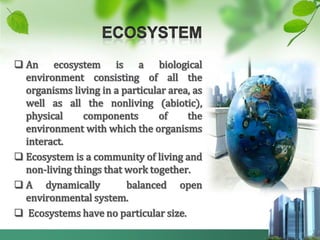
 An ecosystem is a biological
  environment consisting of all the
  organisms living in a particular area, as
  well as all the nonliving (abiotic),
  physical     components       of     the
  environment with which the organisms
  interact.
 Ecosystem is a community of living and
  non-living things that work together.
 A dynamically          balanced open
  environmental system.
 Ecosystems have no particular size.
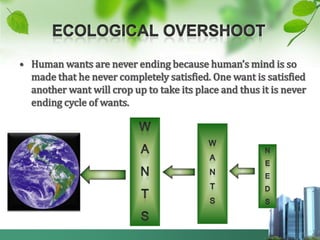
• Human wants are never ending because human’s mind is so
  made that he never completely satisfied. One want is satisfied
  another want will crop up to take its place and thus it is never
  ending cycle of wants.
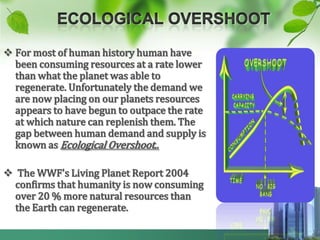
 For most of human history human have
  been consuming resources at a rate lower
  than what the planet was able to
  regenerate. Unfortunately the demand we
  are now placing on our planets resources
  appears to have begun to outpace the rate
  at which nature can replenish them. The
  gap between human demand and supply is
  known as Ecological Overshoot..

 The WWF's Living Planet Report 2004
  confirms that humanity is now consuming
  over 20 % more natural resources than
  the Earth can regenerate.
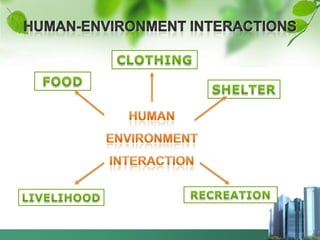
 It means the interaction of human and the environment, how
  human adapt to the environment, and how human change
  the environment to meet their needs and wants.

 The natural environment affects human’s lives in many
  fundamental ways, and human in turn affect the environment
  through their policies and activities.

 Natural ecosystems also perform fundamental life-support
  e.g. purification of air and water, detoxification and
  decomposition of wastes, regulation of climate, regeneration
  of soil fertility, and production and maintenance of
  biodiversity.
 Human use the natural ecosystem to derive many
  essential goods and life supportive products. Human
  dominates the world and exploits all available resources.
 Human activity is a major cause of environmental
  change
 He works as the agent of all environmental degradation
  and becomes its prime victim
 Environment degradation has an impact not only on
  human beings but on all species and most natural
  systems.
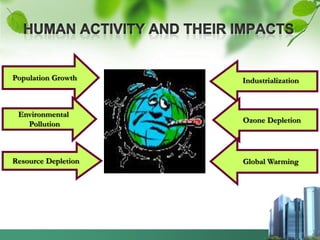
Population Growth    Industrialization


 Environmental
   Pollution         Ozone Depletion


Resource Depletion   Global Warming
 Population growth is the central
 cause of the environmental crisis.

 Humane population is rising
 rapidly beyond the Earth’s ability
 to support life . Population is
 exceeding the carrying capacity of
 Earth.

 This rapid increase in population
 due to medical advances and
 massive increase in agricultural
 productivity.
 The CIA World Fact book gives the world annual
  birthrate, mortality rate, and growth rate as 1.915%,
  0.812%, and 1.092% respectively.

 In 1962 and 1963 growth rate was peaking at 2.20%
  per annum. But in 2008, it was estimated at 1.1%.

 The world population is presently growing at a rate
  of 1.1% or approximately 250,00 people per day.

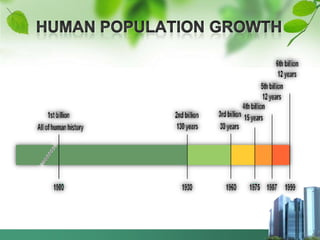
 Population is doubling nearly every 40 years.
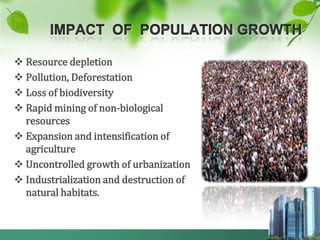
 Resource depletion
 Pollution, Deforestation
 Loss of biodiversity
 Rapid mining of non-biological
  resources
 Expansion and intensification of
  agriculture
 Uncontrolled growth of urbanization
 Industrialization and destruction of
  natural habitats.
 Industrialization (industrialization) is the process of social
  and economic change that transforms a human group from an
  agrarian society into an industrial one.

 It is the extensive organization of an economy for the purpose
  of manufacturing.

 The environmental costs of industrialization are mind
  boggling.

 The industrial pollution is investing the relationships between
  man and the nature with new complexities.
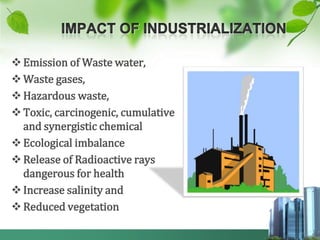
 Emission of Waste water,
 Waste gases,
 Hazardous waste,
 Toxic, carcinogenic, cumulative
  and synergistic chemical
 Ecological imbalance
 Release of Radioactive rays
  dangerous for health
 Increase salinity and
 Reduced vegetation
 Every environmental system has a carrying capacity .When the
  environment can not process the load of pollutants , pollution
  takes place .

 Environmental pollution is a global problem. It has affected the life
  of millions of people and cause several deaths and health
  problems.
 WHO has estimated that around quarter of the global disease
  burden is associated with the environmental pollution.

 Increasing with every passing year and causing grave and
  irreparable damage to the earth.
 Environmental pollution consists of three basic types of pollution,
  namely, air, water and land.
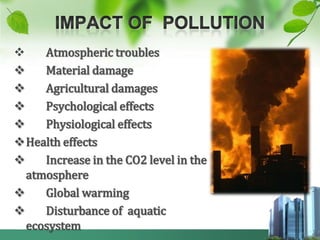
    Atmospheric troubles
    Material damage
    Agricultural damages
    Psychological effects
    Physiological effects
Health effects
    Increase in the CO2 level in the
  atmosphere
    Global warming
    Disturbance of aquatic
  ecosystem
 Global warming refers to the rising average temperature of
  Earth's atmosphere and oceans and its projected
  continuation.

 In the last 100 years, Earth's average surface temperature
  increased by about 0.8 °C (1.4 °F) with about two thirds of
  the increase occurring over just the last three decades.

 scientists are more than 90% certain most of it is caused by
  increasing concentrations of greenhouse gases produced by
  human activities
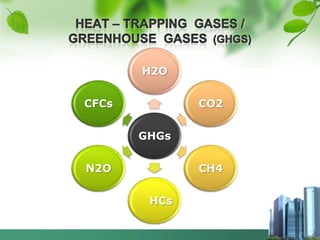
H2O


CFCs          CO2


       GHGs


N2O           CH4


        HCs
 Temperature extremes

 Rise in sea level, and change in precipitation

 Storms, coastal flooding

 Contamination of drinking water

 Drought

 Air pollution ( made worse by warming)

 Strain on public health systems

 Increased need to population migrations
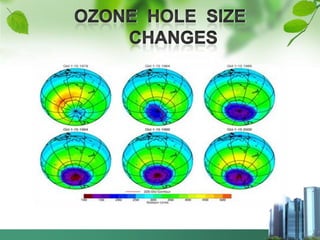
 It is caused by the release of chlorofluorocarbons (CFCs), hydrofluorocarbons
  (HCFCs), and other ozone-depleting substances (ODS), which were used widely
  as refrigerants, insulating foams, and solvents.
 When CFCs and HCFCs reach the stratosphere, the ultraviolet radiation from
  the sun causes them to break apart and release chlorine atoms which react
  with ozone, starting chemical cycles of ozone destruction that deplete the
  ozone layer. One chlorine atom can break apart more than 100,000 ozone
  molecules
 The fact that the ozone layer was being depleted was discovered in the mid-
  1980s. The main cause of this is the release of CFCs, chlorofluorocarbons.
  Antarctica was an early victim of ozone destruction.
 About 90 percent of CFCs currently in the atmosphere were emitted by
  industrialized countries in the Northern Hemisphere, including the United
  States and Europe. These countries banned CFCs by 1996, and the amount of
  chlorine in the atmosphere is falling now. But scientists estimate it will take
  another 50 years for chlorine levels to return to their natural levels.
 Cortical cataracts
 Skin cancer
 Increased tropospheric ozone
 Increased production of Vitamin D
 Effects on plants and crops
 Immunological effects.
 A variety of biological consequences may result from the
increased UV exposure due to ozone depletion.
 The equation was developed in the 1970s during the course of a
  debate between Barry Commoner, Paul R. Ehrlich and John Holdren.

                              I=PAT
 The IPAT equation, though phrased mathematically, is a simple
  conceptual expression of the factors that create environmental
  impact.
 I=Impact
 P=Population
 A=Affluence
 T=Technology
 Though this isn’t an exact equation in a mathematical
  sense, it does give an insight into how these factors
  combine together to define the limits of sustainability.
 The most important conclusions deriving from this
  relationship are :
    The Earth can support only a limited number of people in a
     sustainable manner.
    Humanity has a clear choice: between more people with
     poorer lifestyles and fewer people with a better quality of
     life.
    Obviously, a high number in any one of the terms
     (Population. Affluence or Technology) produce a large
     impact
 Scarce Water - Currently, 434 million people face either water
  stress or scarcity. By 2025 it may increase between 2.6 billion and
  3.1 billion people.

 Scarce Cropland -The number of people living in countries where
  cultivated land is critically scarce is projected to increase between
  600 million and 986 million in 2025.

 Fisheries - The capacity of coastal and marine ecosystems to
  produce fish for human harvest is highly degraded by over-fishing,
  destructive trawling techniques, and loss of coastal nursery areas.
  Seventy-five percent of all fish stocks are in urgent need of better
  management.
 Forests – Past Land cover of forests in India is 33%-
  Present Land cover of forests in India is 12%- Global rate
  of deforestation is 10 million hectares per year .

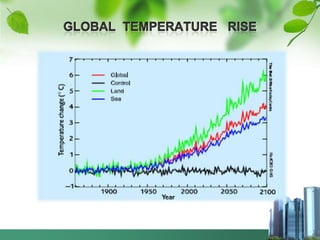
 Global Warming –Average surface temperature of the
  earth is 15 degrees C. It has risen by 0.6 degrees C. Global
  temperature will rise by 1.4 to 5.8 degrees C. An increase
  in global temperature will cause sea levels to rise and will
  change the amount and pattern of precipitation, and a
  probable expansion of subtropical deserts.

 Species Extinction –Present rate of extinction is 1000-
  10,000 times higher than the natural extinction. Earth
  may lose upto 50% of the species by the end of 21
  century. In tropical forests the extinction is 2-5 species
  per hour.
 Prevent pollution.
 Reduce waste.
 Use water, energy and other resources efficiently.
 Manage the use of natural resources prudently.
 Maintain the diversity of life.
 Protect and respect the world's natural, cultural,
  indigenous and historical heritage.
 Support environmental education and training.
 Support local action and community participation.
 Promote practices, methods and technologies that
  reduce negative impacts on the environment.
Thank   U
For Watching


    L/O/G/O

How humans are engaged in altering the environment

  • 1.
  • 2.
    1 Environment 2 Ecosystem 3 Human-Environment Interactions 4 Human Impact on Environment 5 Paul Ehrlich Equation 6 Future Predictions 7 Suggestions for Improvement
  • 3.
     The sumof all living and non- living things that surround an organism, or group of organisms.  Environment includes all elements, factors, and conditions that have some impact on growth and development of certain organism.
  • 4.
    Environment Abiotic environment Biotic environment Sun light,soil,air,water Microorganisms,plants,animals
  • 5.
     An ecosystemis a biological environment consisting of all the organisms living in a particular area, as well as all the nonliving (abiotic), physical components of the environment with which the organisms interact.  Ecosystem is a community of living and non-living things that work together.  A dynamically balanced open environmental system.  Ecosystems have no particular size.
  • 6.
    • Human wantsare never ending because human’s mind is so made that he never completely satisfied. One want is satisfied another want will crop up to take its place and thus it is never ending cycle of wants.
  • 7.
     For mostof human history human have been consuming resources at a rate lower than what the planet was able to regenerate. Unfortunately the demand we are now placing on our planets resources appears to have begun to outpace the rate at which nature can replenish them. The gap between human demand and supply is known as Ecological Overshoot..  The WWF's Living Planet Report 2004 confirms that humanity is now consuming over 20 % more natural resources than the Earth can regenerate.
  • 8.
     It meansthe interaction of human and the environment, how human adapt to the environment, and how human change the environment to meet their needs and wants.  The natural environment affects human’s lives in many fundamental ways, and human in turn affect the environment through their policies and activities.  Natural ecosystems also perform fundamental life-support e.g. purification of air and water, detoxification and decomposition of wastes, regulation of climate, regeneration of soil fertility, and production and maintenance of biodiversity.
  • 11.
     Human usethe natural ecosystem to derive many essential goods and life supportive products. Human dominates the world and exploits all available resources.  Human activity is a major cause of environmental change  He works as the agent of all environmental degradation and becomes its prime victim  Environment degradation has an impact not only on human beings but on all species and most natural systems.
  • 12.
    Population Growth Industrialization Environmental Pollution Ozone Depletion Resource Depletion Global Warming
  • 13.
     Population growthis the central cause of the environmental crisis.  Humane population is rising rapidly beyond the Earth’s ability to support life . Population is exceeding the carrying capacity of Earth.  This rapid increase in population due to medical advances and massive increase in agricultural productivity.
  • 14.
     The CIAWorld Fact book gives the world annual birthrate, mortality rate, and growth rate as 1.915%, 0.812%, and 1.092% respectively.  In 1962 and 1963 growth rate was peaking at 2.20% per annum. But in 2008, it was estimated at 1.1%.  The world population is presently growing at a rate of 1.1% or approximately 250,00 people per day.  Population is doubling nearly every 40 years.
  • 16.
     Resource depletion Pollution, Deforestation  Loss of biodiversity  Rapid mining of non-biological resources  Expansion and intensification of agriculture  Uncontrolled growth of urbanization  Industrialization and destruction of natural habitats.
  • 17.
     Industrialization (industrialization)is the process of social and economic change that transforms a human group from an agrarian society into an industrial one.  It is the extensive organization of an economy for the purpose of manufacturing.  The environmental costs of industrialization are mind boggling.  The industrial pollution is investing the relationships between man and the nature with new complexities.
  • 18.
     Emission ofWaste water,  Waste gases,  Hazardous waste,  Toxic, carcinogenic, cumulative and synergistic chemical  Ecological imbalance  Release of Radioactive rays dangerous for health  Increase salinity and  Reduced vegetation
  • 19.
     Every environmentalsystem has a carrying capacity .When the environment can not process the load of pollutants , pollution takes place .  Environmental pollution is a global problem. It has affected the life of millions of people and cause several deaths and health problems.  WHO has estimated that around quarter of the global disease burden is associated with the environmental pollution.  Increasing with every passing year and causing grave and irreparable damage to the earth.  Environmental pollution consists of three basic types of pollution, namely, air, water and land.
  • 20.
    Atmospheric troubles  Material damage  Agricultural damages  Psychological effects  Physiological effects Health effects  Increase in the CO2 level in the atmosphere  Global warming  Disturbance of aquatic ecosystem
  • 21.
     Global warmingrefers to the rising average temperature of Earth's atmosphere and oceans and its projected continuation.  In the last 100 years, Earth's average surface temperature increased by about 0.8 °C (1.4 °F) with about two thirds of the increase occurring over just the last three decades.  scientists are more than 90% certain most of it is caused by increasing concentrations of greenhouse gases produced by human activities
  • 22.
    H2O CFCs CO2 GHGs N2O CH4 HCs
  • 24.
     Temperature extremes Rise in sea level, and change in precipitation  Storms, coastal flooding  Contamination of drinking water  Drought  Air pollution ( made worse by warming)  Strain on public health systems  Increased need to population migrations
  • 25.
     It iscaused by the release of chlorofluorocarbons (CFCs), hydrofluorocarbons (HCFCs), and other ozone-depleting substances (ODS), which were used widely as refrigerants, insulating foams, and solvents.  When CFCs and HCFCs reach the stratosphere, the ultraviolet radiation from the sun causes them to break apart and release chlorine atoms which react with ozone, starting chemical cycles of ozone destruction that deplete the ozone layer. One chlorine atom can break apart more than 100,000 ozone molecules  The fact that the ozone layer was being depleted was discovered in the mid- 1980s. The main cause of this is the release of CFCs, chlorofluorocarbons. Antarctica was an early victim of ozone destruction.  About 90 percent of CFCs currently in the atmosphere were emitted by industrialized countries in the Northern Hemisphere, including the United States and Europe. These countries banned CFCs by 1996, and the amount of chlorine in the atmosphere is falling now. But scientists estimate it will take another 50 years for chlorine levels to return to their natural levels.
  • 27.
     Cortical cataracts Skin cancer  Increased tropospheric ozone  Increased production of Vitamin D  Effects on plants and crops  Immunological effects.  A variety of biological consequences may result from the increased UV exposure due to ozone depletion.
  • 29.
     The equationwas developed in the 1970s during the course of a debate between Barry Commoner, Paul R. Ehrlich and John Holdren. I=PAT  The IPAT equation, though phrased mathematically, is a simple conceptual expression of the factors that create environmental impact.  I=Impact  P=Population  A=Affluence  T=Technology
  • 30.
     Though thisisn’t an exact equation in a mathematical sense, it does give an insight into how these factors combine together to define the limits of sustainability.  The most important conclusions deriving from this relationship are :  The Earth can support only a limited number of people in a sustainable manner.  Humanity has a clear choice: between more people with poorer lifestyles and fewer people with a better quality of life.  Obviously, a high number in any one of the terms (Population. Affluence or Technology) produce a large impact
  • 32.
     Scarce Water- Currently, 434 million people face either water stress or scarcity. By 2025 it may increase between 2.6 billion and 3.1 billion people.  Scarce Cropland -The number of people living in countries where cultivated land is critically scarce is projected to increase between 600 million and 986 million in 2025.  Fisheries - The capacity of coastal and marine ecosystems to produce fish for human harvest is highly degraded by over-fishing, destructive trawling techniques, and loss of coastal nursery areas. Seventy-five percent of all fish stocks are in urgent need of better management.
  • 33.
     Forests –Past Land cover of forests in India is 33%- Present Land cover of forests in India is 12%- Global rate of deforestation is 10 million hectares per year .  Global Warming –Average surface temperature of the earth is 15 degrees C. It has risen by 0.6 degrees C. Global temperature will rise by 1.4 to 5.8 degrees C. An increase in global temperature will cause sea levels to rise and will change the amount and pattern of precipitation, and a probable expansion of subtropical deserts.  Species Extinction –Present rate of extinction is 1000- 10,000 times higher than the natural extinction. Earth may lose upto 50% of the species by the end of 21 century. In tropical forests the extinction is 2-5 species per hour.
  • 34.
     Prevent pollution. Reduce waste.  Use water, energy and other resources efficiently.  Manage the use of natural resources prudently.  Maintain the diversity of life.  Protect and respect the world's natural, cultural, indigenous and historical heritage.  Support environmental education and training.  Support local action and community participation.  Promote practices, methods and technologies that reduce negative impacts on the environment.
  • 35.
    Thank U For Watching L/O/G/O