Immunologic system Tianjin general hospital  JiangLihong
Characteristics of the immunologic system Immunodeficiency diseases
Characteristics of the immunologic system Definition  Classification Nonspecific immunity Specific immunity
Immunodeficiency diseases Classification Some common diseases due to immunodeficiency in children (congenital hypogammaglobulinemia, infant transient hypogammaglobulinemia, selective IgA deficiency, congenital thymus dysplasia [DiGeorge’s syndrome], AIDS)
Definition Immunity is a protective reaction of the body, which could keep the body in a  sound  and  stable  status. The immunologic system is that part of a host defense mechanism.
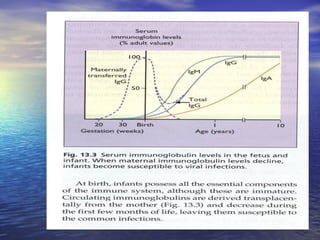
The genesis and development of the human immune system arises in the early embryo, but it is still not completely mature at birth. It develops gradually up to adult level with increasing age. Therefore, in children, especially infants, there is a  physiologic hypoimmunity  state.
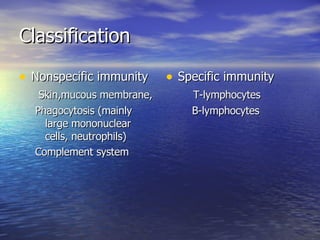
Classification Nonspecific immunity Skin,mucous membrane, Phagocytosis (mainly large mononuclear cells, neutrophils) Complement system Specific immunity T-lymphocytes B-lymphocytes
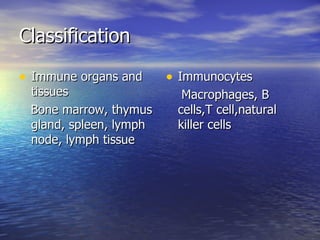
Classification Immune organs and tissues Bone marrow, thymus gland, spleen, lymph node, lymph tissue Immunocytes Macrophages, B cells,T cell,natural killer cells
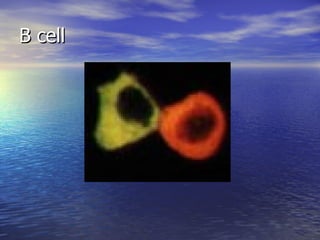
B cell
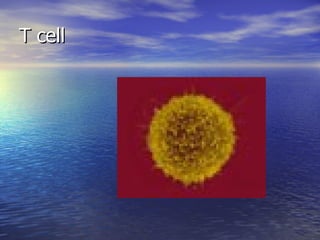
T cell
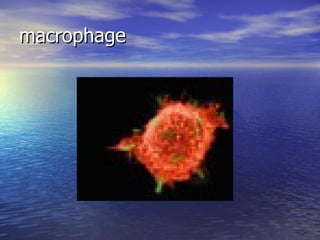
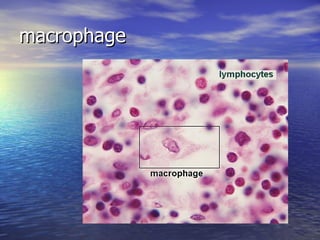
macrophage
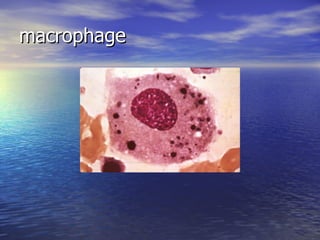
macrophage
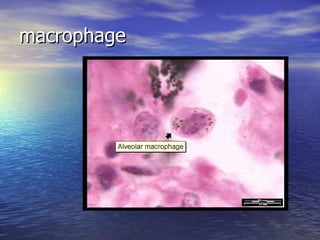
macrophage
macrophage
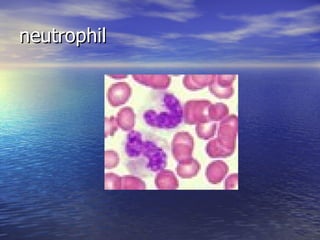
neutrophil
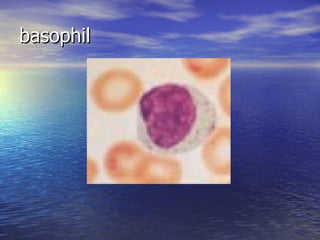
basophil
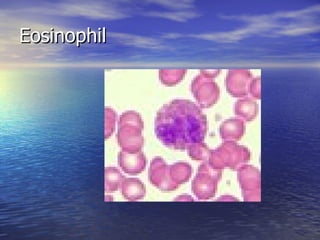
Eosinophil
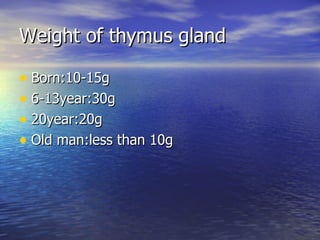
Weight of thymus gland Born:10-15g 6-13year:30g 20year:20g Old man:less than 10g
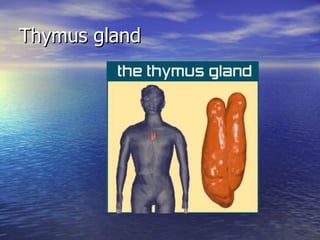
Thymus gland
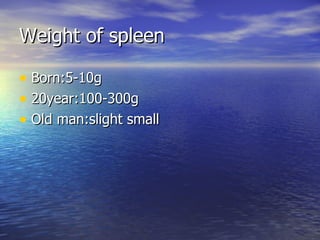
Weight of spleen Born:5-10g 20year:100-300g Old man:slight small
appenditis
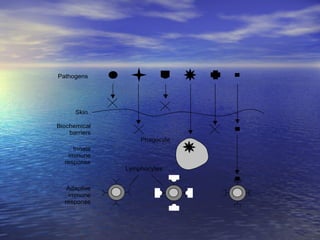
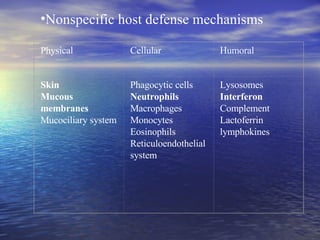
Nonspecific defense mechanisms Nonspecific defense mechanisms are primitive in phylogenetic sense but remain highly effective in protecting humans from the environment . The nonspecific defense system can be thought of as consisting of three components:physical,cellular,and humoral.
Nonspecific defense mechanisms The first line of host defense is the mechanical barrier represented by the skin and mucous membranes lining the respiratory and gastrointestinal tracts. Nonspecific factors such as the unsaturated fatty acids in the skin, gastric secretions in the stomach, and cilia lining the respiratory tree may contribute to the overall barrier effect.
Nonspecific defense mechanisms If the mechanical barriers are penetrated, both nonspecific cellular and humoral factors contribute to protection of the host. particular importance are the phagocytic cells and humoral factors such as complement, interferon,and lymphokines.
 
Nonspecific host defense mechanisms Physical Cellular Humoral Skin Mucous  membranes Mucociliary system Phagocytic cells Neutrophils Macrophages Monocytes Eosinophils Reticuloendothelial system Lysosomes Interferon Complement Lactoferrin lymphokines
Character of nonspecific immunity in children Nonspecific immunity plays a role in the immune system by presenting a physical barrier such as phagocytosis and the complement system which consists of more 20 serum proteins.
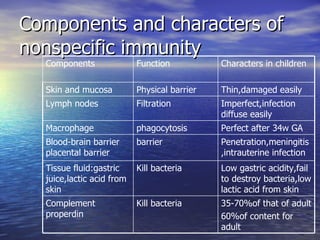
Components and characters of nonspecific immunity Thin,damaged easily Physical barrier Skin and mucosa 35-70%of that of adult 60%of content for adult Kill bacteria Complement properdin Low gastric acidity,fail to destroy bacteria,low lactic acid from skin Kill bacteria  Tissue fluid:gastric juice,lactic acid from skin Penetration,meningitis,intrauterine infection barrier Blood-brain barrier placental barrier Perfect after 34w GA phagocytosis Macrophage  Imperfect,infection diffuse easily Filtration Lymph nodes Characters in children Function Components
Specific immunity The human immune system arises in the embryo from gut-associated tissue. Pluripotential hematopoietic stem cells first appear in the yolk sac at 2.5-3weeks of GA and migrate to the fetal liver at  the fifth week of gestation;later they reside in the bone marrow, where they remain throughout life. Lymphoid stem cells develop from such precursor cells and differentiate into T and B cells. T and B-lymphocytes are the only components of the immune system that have antigen-specific recognition capabilities.
Specific immune mechanisms It is now evident that the lymphocyte is the cell line responsible for most immune reactions. Two main types of immunity are now recognized: cell-mediated immunity and humoral immunity
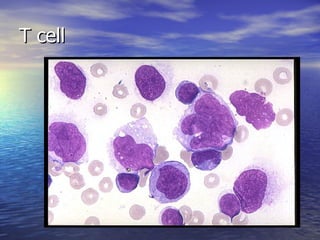
Specific Cellular Immunity The T cell is an effector cell of cyto-immunity. The major T cell subgroups currently are defined helper, suppressor and killer populations.
T cell
T-cell functions Microbial resistance particularly for intracellular parasites, virus and fungi. Transplantation immunity. Tumor rejection . Skin delayed hypersensitivity.
Characteristics of T-cell in children During the fetal period the T cell system is undeveloped, fetal intrauterine infection is not rare. During the neonatal period the T cell system is well developed.
Specific Humoral Immunity B-cell development begins in the fetal liver before 7 weeks of gestation. B-cell have an important function in microbial resistance ,especially to bacteria. B-cell products, immunoglobulins, can be divided into 5 major classes.
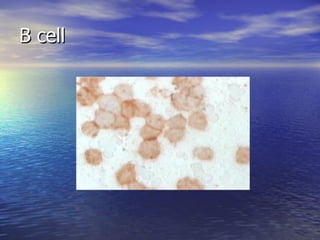
B cell
The 5 major classes of immunoglobulins  IgG IgM IgA IgD IgE
IgG It is the  most abundant  Ig of the body. The only Ig  can cross the placenta . The level in a premature infant is low, because IgG gets through the placenta from mother mainly after  32 weeks  of gestation.  Maternal IgG plays an important role in infection resistance within the 6 months of life. There is  physiological hypogammaglobulinemia  period. It has a half-life of 21 days and is the principal type of antibody appearing in a secondary immune response.
IgM It is the major antibody resisting Gram negative bacilli infections. It can not cross the placenta.If IgM in the umbilical blood is at the level of more than 20mg/dl ,it indicates there has been an intrauterine infection. It has a half-life of 4 to 5 days.
IgA It is produced by the lymphoid tissues which lining the gastrointestinal, respiratory and genitourinary tracts coming in contact with antigen after birth. It is an important factor for resisting mucosal infections. It is in high concentration in the colostrum. IgA exist in 2 forms: monomeric in the serum and dimeric in the secretion.
IgD The IgD exists in minute quantities in the circulation. Along with IgM, it is the immunoglobulin found most frequently on B lymphocytes. Its exact function is not well understood at present. IgD crosses the placenta with difficult. The amount of IgD is low in the blood of the neonate, reaching to 20% of the adult when 5 years.
IgE The IgE is associated with immediate hypersensitivity reaction. It exists in small quantities in the circulation. Through its Fc fragment it binds to tissue mast cells and circulating basophils. When two IgE molecules bound to these receptors are bridged by an antigen such as ragweed pollen, the cells then can release the mediators characteristic of the allergic response, such as histamine and slow reactive substance of anaphylaxis.(next)
IgE IgE crosses the placenta with difficult. The amount of IgE is also very low in the neonate. It may be obtained from breast milk, and reach to the level of the adult by about 7 years age.  IgE is an antibody which bring a type I allergic reaction .
 
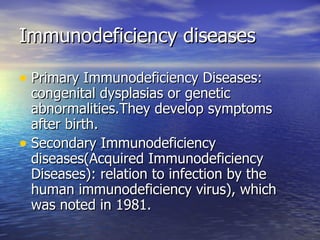
Immunodeficiency diseases Primary Immunodeficiency Diseases: congenital dysplasias or genetic abnormalities.They develop symptoms after birth. Secondary Immunodeficiency diseases(Acquired Immunodeficiency Diseases): relation to infection by the human immunodeficiency virus), which was noted in 1981.
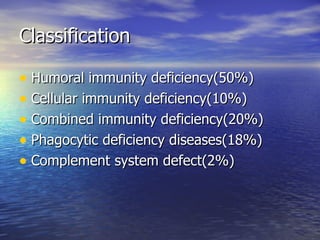
Classification Humoral immunity deficiency(50%) Cellular immunity deficiency(10%) Combined immunity deficiency(20%) Phagocytic deficiency diseases(18%) Complement system defect(2%)
Primary immunodeficincy disease common manifestation
Recurrent infection and chronic infection infection site :respiratory Pathogen: humoral immunity deficincy : pyogenic cellular immunitydeficiency: virus, tuberculosis,fungi complement system:Neisseria Course of infection: recurrent or chronic
Autoimmunologic disease and lymphoma Lymphoma,especially B lymphoma(50%) Lymphocyte leukemia(12.6%) Lymphoma and Hodgkin’s(8.6%) Glandular tumor(9.2%) Others(19.2%) Hemolytic anemia, thrombocytopenic purpura, systemic lupus erythematous, type I diabetes
Congenital hypogammaglobulinemia Onset: after 6 months of age when the IgG from mother has been exhausted. Sex:because it has two hereditary modes, the disease might occurs in males or females.  X-linked  hypogammaglobulinemia also called Bruton’s disease, which only occurs in boys. Recurrent infection: mainly bacterial infection. Autoimmune disease such as rheumatoid arthritis. Malignant tumor: leukemia.
Congenital hypogammaglobulinemia Small or absent tonsil, lymph node, but normal thymus Lab finding: the tests of humoral-immunity are of low functional status, the tests for cellular-immunity are normal. Treatment: IVIG 400mg/kg /3-4week until IgG concentration is 1000mg/dl
Infant transient hypogammaglobulinemia Production of immune globulin is delayed to 9-21 months after birth. Clinical features are similar to congenital hypogammaglobulinemia. Self-limited: the level of Ig increasing with increasing age. It does not relapse after revival. Bone marrow smear or lymphonodus biopsy could show plasmacyte. (the key point different from congenital hypogammaglobulinemia)
Selective IgA deficiency It has a high incidence in PID, about is 1/500-1/700. Slight symptoms of recurrent respiratory infections and chronic diarrhea, the patient may be alive to adult even old. Associated with autoimmune disorders, especially systemic lupus erythematous and rheumatoid arthritis. (next)
Selective IgA deficiency Occasionally occur malignant tumor. Serum IgA is low, other Igs are normal. Avoid utilizing IgA containing agent in treatment. Now ,there is no satisfactory therapy for this disease.
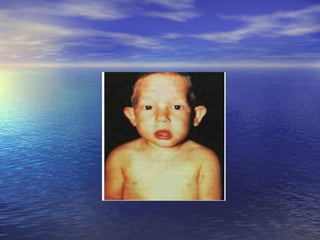
Congenital thymus dysplasia In 1965, DiGeorge first discovered this disease, so called DiGeorge syndrome, including thymus dysplasia, hypocalcemia, congenital heart disease and facial deformities.
 
Congenital thymus dysplasia Hypocalcemia during the neonatal period frequently is the initial presentation. Special facial features: fish-like mouth , short philtrum, small mandible, defective ears. Congenital defect of the aorta and heart. Recurrent severe infection s of fungi or virus appear soon after birth.(next)
Congenital thymus dysplasia No thymic shadow is shown in a chest X-ray film. Lb exam reveals a poor cellular-immune function and a normal humoral-immune function. Avoid attenuated alive vaccines and blood transfusion. Treatment: thymus transplantation.
Treatment of PID General treatment: take care of patient specially precaution and treat infection Substitutive therapy: IVIG; plasma:20mg/dl Immune rebuild: 1)Thymus tissue transplantation: not good 2)Stem cell transplantation Gene treatment
HIV infection
HIV(human immunodeficiency virus) First reported in 1981,USA Can damage helper T cell,lead to opportunist infection and tumor Has ten genes: gag, pol, env, vif, vpr, tat, rev, vpu, nef, vpx
Transmission route to children Intrapartum Intrauterine Breast-feeding(25-40%) Infected blood products and contaminated needles
Reduction of vertical transmission of HIV Avoidance of breast-feeding Use of antenatal, perinatal and postnatal antiretroviral drugs to reduce viral load Avoidance of labor and contact with the birth canal by selective cesarean section delivery
HIV-infected children Infected children may remain asymptomatic for months or years before progressing to severe disease and immunodeficiency. Clinical presentation varies with the degree of immunosuppression. Mild: lymphadenopathy Moderate: recurrent bacterial infections, candidiasis, chronic diarrhea Severe: opportunist infections, severe failure to thrive, encephalopathy
diagnosis PCR find HIV DNA
Treatment-antivirus NRTI: nucleoside reverse transcriptase NNRTI:non nucleoside reverse transcriptase Proteinase inhibitor
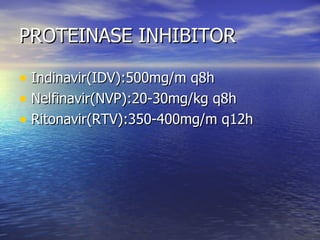
PROTEINASE INHIBITOR Indinavir(IDV):500mg/m q8h Nelfinavir(NVP):20-30mg/kg q8h Ritonavir(RTV):350-400mg/m q12h
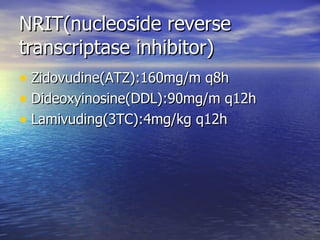
NRIT(nucleoside reverse transcriptase inhibitor) Zidovudine(ATZ):160mg/m q8h Dideoxyinosine(DDL):90mg/m q12h Lamivuding(3TC):4mg/kg q12h
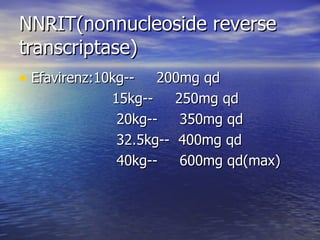
NNRIT(nonnucleoside reverse transcriptase) Efavirenz:10kg--  200mg qd 15kg--  250mg qd 20kg--  350mg qd 32.5kg--  400mg qd 40kg--  600mg qd(max)
Questions Definition: immunologic system Specific immunity includes: cellular immunity and humoral immunity The 5 major classes of immunoglobulins are denoted: IgG, IgM, IgA, IgD, IgA. Which is the most abundant Ig of the body Which Ig can cross the placenta? Classification of PID
Thanks

Chapter 4 Immunologic System

  • 1.
    Immunologic system Tianjingeneral hospital JiangLihong
  • 2.
    Characteristics of theimmunologic system Immunodeficiency diseases
  • 3.
    Characteristics of theimmunologic system Definition Classification Nonspecific immunity Specific immunity
  • 4.
    Immunodeficiency diseases ClassificationSome common diseases due to immunodeficiency in children (congenital hypogammaglobulinemia, infant transient hypogammaglobulinemia, selective IgA deficiency, congenital thymus dysplasia [DiGeorge’s syndrome], AIDS)
  • 5.
    Definition Immunity isa protective reaction of the body, which could keep the body in a sound and stable status. The immunologic system is that part of a host defense mechanism.
  • 6.
    The genesis anddevelopment of the human immune system arises in the early embryo, but it is still not completely mature at birth. It develops gradually up to adult level with increasing age. Therefore, in children, especially infants, there is a physiologic hypoimmunity state.
  • 7.
    Classification Nonspecific immunitySkin,mucous membrane, Phagocytosis (mainly large mononuclear cells, neutrophils) Complement system Specific immunity T-lymphocytes B-lymphocytes
  • 8.
    Classification Immune organsand tissues Bone marrow, thymus gland, spleen, lymph node, lymph tissue Immunocytes Macrophages, B cells,T cell,natural killer cells
  • 9.
  • 10.
  • 11.
  • 12.
  • 13.
  • 14.
  • 15.
  • 16.
  • 17.
  • 18.
    Weight of thymusgland Born:10-15g 6-13year:30g 20year:20g Old man:less than 10g
  • 19.
  • 20.
    Weight of spleenBorn:5-10g 20year:100-300g Old man:slight small
  • 21.
  • 22.
    Nonspecific defense mechanismsNonspecific defense mechanisms are primitive in phylogenetic sense but remain highly effective in protecting humans from the environment . The nonspecific defense system can be thought of as consisting of three components:physical,cellular,and humoral.
  • 23.
    Nonspecific defense mechanismsThe first line of host defense is the mechanical barrier represented by the skin and mucous membranes lining the respiratory and gastrointestinal tracts. Nonspecific factors such as the unsaturated fatty acids in the skin, gastric secretions in the stomach, and cilia lining the respiratory tree may contribute to the overall barrier effect.
  • 24.
    Nonspecific defense mechanismsIf the mechanical barriers are penetrated, both nonspecific cellular and humoral factors contribute to protection of the host. particular importance are the phagocytic cells and humoral factors such as complement, interferon,and lymphokines.
  • 25.
  • 26.
    Nonspecific host defensemechanisms Physical Cellular Humoral Skin Mucous membranes Mucociliary system Phagocytic cells Neutrophils Macrophages Monocytes Eosinophils Reticuloendothelial system Lysosomes Interferon Complement Lactoferrin lymphokines
  • 27.
    Character of nonspecificimmunity in children Nonspecific immunity plays a role in the immune system by presenting a physical barrier such as phagocytosis and the complement system which consists of more 20 serum proteins.
  • 28.
    Components and charactersof nonspecific immunity Thin,damaged easily Physical barrier Skin and mucosa 35-70%of that of adult 60%of content for adult Kill bacteria Complement properdin Low gastric acidity,fail to destroy bacteria,low lactic acid from skin Kill bacteria Tissue fluid:gastric juice,lactic acid from skin Penetration,meningitis,intrauterine infection barrier Blood-brain barrier placental barrier Perfect after 34w GA phagocytosis Macrophage Imperfect,infection diffuse easily Filtration Lymph nodes Characters in children Function Components
  • 29.
    Specific immunity Thehuman immune system arises in the embryo from gut-associated tissue. Pluripotential hematopoietic stem cells first appear in the yolk sac at 2.5-3weeks of GA and migrate to the fetal liver at the fifth week of gestation;later they reside in the bone marrow, where they remain throughout life. Lymphoid stem cells develop from such precursor cells and differentiate into T and B cells. T and B-lymphocytes are the only components of the immune system that have antigen-specific recognition capabilities.
  • 30.
    Specific immune mechanismsIt is now evident that the lymphocyte is the cell line responsible for most immune reactions. Two main types of immunity are now recognized: cell-mediated immunity and humoral immunity
  • 31.
    Specific Cellular ImmunityThe T cell is an effector cell of cyto-immunity. The major T cell subgroups currently are defined helper, suppressor and killer populations.
  • 32.
  • 33.
    T-cell functions Microbialresistance particularly for intracellular parasites, virus and fungi. Transplantation immunity. Tumor rejection . Skin delayed hypersensitivity.
  • 34.
    Characteristics of T-cellin children During the fetal period the T cell system is undeveloped, fetal intrauterine infection is not rare. During the neonatal period the T cell system is well developed.
  • 35.
    Specific Humoral ImmunityB-cell development begins in the fetal liver before 7 weeks of gestation. B-cell have an important function in microbial resistance ,especially to bacteria. B-cell products, immunoglobulins, can be divided into 5 major classes.
  • 36.
  • 37.
    The 5 majorclasses of immunoglobulins IgG IgM IgA IgD IgE
  • 38.
    IgG It isthe most abundant Ig of the body. The only Ig can cross the placenta . The level in a premature infant is low, because IgG gets through the placenta from mother mainly after 32 weeks of gestation. Maternal IgG plays an important role in infection resistance within the 6 months of life. There is physiological hypogammaglobulinemia period. It has a half-life of 21 days and is the principal type of antibody appearing in a secondary immune response.
  • 39.
    IgM It isthe major antibody resisting Gram negative bacilli infections. It can not cross the placenta.If IgM in the umbilical blood is at the level of more than 20mg/dl ,it indicates there has been an intrauterine infection. It has a half-life of 4 to 5 days.
  • 40.
    IgA It isproduced by the lymphoid tissues which lining the gastrointestinal, respiratory and genitourinary tracts coming in contact with antigen after birth. It is an important factor for resisting mucosal infections. It is in high concentration in the colostrum. IgA exist in 2 forms: monomeric in the serum and dimeric in the secretion.
  • 41.
    IgD The IgDexists in minute quantities in the circulation. Along with IgM, it is the immunoglobulin found most frequently on B lymphocytes. Its exact function is not well understood at present. IgD crosses the placenta with difficult. The amount of IgD is low in the blood of the neonate, reaching to 20% of the adult when 5 years.
  • 42.
    IgE The IgEis associated with immediate hypersensitivity reaction. It exists in small quantities in the circulation. Through its Fc fragment it binds to tissue mast cells and circulating basophils. When two IgE molecules bound to these receptors are bridged by an antigen such as ragweed pollen, the cells then can release the mediators characteristic of the allergic response, such as histamine and slow reactive substance of anaphylaxis.(next)
  • 43.
    IgE IgE crossesthe placenta with difficult. The amount of IgE is also very low in the neonate. It may be obtained from breast milk, and reach to the level of the adult by about 7 years age. IgE is an antibody which bring a type I allergic reaction .
  • 44.
  • 45.
    Immunodeficiency diseases PrimaryImmunodeficiency Diseases: congenital dysplasias or genetic abnormalities.They develop symptoms after birth. Secondary Immunodeficiency diseases(Acquired Immunodeficiency Diseases): relation to infection by the human immunodeficiency virus), which was noted in 1981.
  • 46.
    Classification Humoral immunitydeficiency(50%) Cellular immunity deficiency(10%) Combined immunity deficiency(20%) Phagocytic deficiency diseases(18%) Complement system defect(2%)
  • 47.
    Primary immunodeficincy diseasecommon manifestation
  • 48.
    Recurrent infection andchronic infection infection site :respiratory Pathogen: humoral immunity deficincy : pyogenic cellular immunitydeficiency: virus, tuberculosis,fungi complement system:Neisseria Course of infection: recurrent or chronic
  • 49.
    Autoimmunologic disease andlymphoma Lymphoma,especially B lymphoma(50%) Lymphocyte leukemia(12.6%) Lymphoma and Hodgkin’s(8.6%) Glandular tumor(9.2%) Others(19.2%) Hemolytic anemia, thrombocytopenic purpura, systemic lupus erythematous, type I diabetes
  • 50.
    Congenital hypogammaglobulinemia Onset:after 6 months of age when the IgG from mother has been exhausted. Sex:because it has two hereditary modes, the disease might occurs in males or females. X-linked hypogammaglobulinemia also called Bruton’s disease, which only occurs in boys. Recurrent infection: mainly bacterial infection. Autoimmune disease such as rheumatoid arthritis. Malignant tumor: leukemia.
  • 51.
    Congenital hypogammaglobulinemia Smallor absent tonsil, lymph node, but normal thymus Lab finding: the tests of humoral-immunity are of low functional status, the tests for cellular-immunity are normal. Treatment: IVIG 400mg/kg /3-4week until IgG concentration is 1000mg/dl
  • 52.
    Infant transient hypogammaglobulinemiaProduction of immune globulin is delayed to 9-21 months after birth. Clinical features are similar to congenital hypogammaglobulinemia. Self-limited: the level of Ig increasing with increasing age. It does not relapse after revival. Bone marrow smear or lymphonodus biopsy could show plasmacyte. (the key point different from congenital hypogammaglobulinemia)
  • 53.
    Selective IgA deficiencyIt has a high incidence in PID, about is 1/500-1/700. Slight symptoms of recurrent respiratory infections and chronic diarrhea, the patient may be alive to adult even old. Associated with autoimmune disorders, especially systemic lupus erythematous and rheumatoid arthritis. (next)
  • 54.
    Selective IgA deficiencyOccasionally occur malignant tumor. Serum IgA is low, other Igs are normal. Avoid utilizing IgA containing agent in treatment. Now ,there is no satisfactory therapy for this disease.
  • 55.
    Congenital thymus dysplasiaIn 1965, DiGeorge first discovered this disease, so called DiGeorge syndrome, including thymus dysplasia, hypocalcemia, congenital heart disease and facial deformities.
  • 56.
  • 57.
    Congenital thymus dysplasiaHypocalcemia during the neonatal period frequently is the initial presentation. Special facial features: fish-like mouth , short philtrum, small mandible, defective ears. Congenital defect of the aorta and heart. Recurrent severe infection s of fungi or virus appear soon after birth.(next)
  • 58.
    Congenital thymus dysplasiaNo thymic shadow is shown in a chest X-ray film. Lb exam reveals a poor cellular-immune function and a normal humoral-immune function. Avoid attenuated alive vaccines and blood transfusion. Treatment: thymus transplantation.
  • 59.
    Treatment of PIDGeneral treatment: take care of patient specially precaution and treat infection Substitutive therapy: IVIG; plasma:20mg/dl Immune rebuild: 1)Thymus tissue transplantation: not good 2)Stem cell transplantation Gene treatment
  • 60.
  • 61.
    HIV(human immunodeficiency virus)First reported in 1981,USA Can damage helper T cell,lead to opportunist infection and tumor Has ten genes: gag, pol, env, vif, vpr, tat, rev, vpu, nef, vpx
  • 62.
    Transmission route tochildren Intrapartum Intrauterine Breast-feeding(25-40%) Infected blood products and contaminated needles
  • 63.
    Reduction of verticaltransmission of HIV Avoidance of breast-feeding Use of antenatal, perinatal and postnatal antiretroviral drugs to reduce viral load Avoidance of labor and contact with the birth canal by selective cesarean section delivery
  • 64.
    HIV-infected children Infectedchildren may remain asymptomatic for months or years before progressing to severe disease and immunodeficiency. Clinical presentation varies with the degree of immunosuppression. Mild: lymphadenopathy Moderate: recurrent bacterial infections, candidiasis, chronic diarrhea Severe: opportunist infections, severe failure to thrive, encephalopathy
  • 65.
  • 66.
    Treatment-antivirus NRTI: nucleosidereverse transcriptase NNRTI:non nucleoside reverse transcriptase Proteinase inhibitor
  • 67.
    PROTEINASE INHIBITOR Indinavir(IDV):500mg/mq8h Nelfinavir(NVP):20-30mg/kg q8h Ritonavir(RTV):350-400mg/m q12h
  • 68.
    NRIT(nucleoside reverse transcriptaseinhibitor) Zidovudine(ATZ):160mg/m q8h Dideoxyinosine(DDL):90mg/m q12h Lamivuding(3TC):4mg/kg q12h
  • 69.
    NNRIT(nonnucleoside reverse transcriptase)Efavirenz:10kg-- 200mg qd 15kg-- 250mg qd 20kg-- 350mg qd 32.5kg-- 400mg qd 40kg-- 600mg qd(max)
  • 70.
    Questions Definition: immunologicsystem Specific immunity includes: cellular immunity and humoral immunity The 5 major classes of immunoglobulins are denoted: IgG, IgM, IgA, IgD, IgA. Which is the most abundant Ig of the body Which Ig can cross the placenta? Classification of PID
  • 71.