Surgical Nutritional Support
OVERVIEW Artificial Nutrition: Importance and History   antibiotics, blood transfusion, critical care monitoring, advances in anesthesia, organ transplantation, and cardiopulmonary bypass  hyperalimentation   moderate nutritional supply nutritional pharmacology parenteral   parenteral & enteral
OVERVIEW Clinical Sequelae of Impaired Nutrition Impaire the body's ability to heal wounds and to support normal immune function reduced  ventilation due to wasting of muscle limiting to all aggressive surgical and medical therapies  Incidence of Malnutrition in Hospitalized Patients  as many as 50% of hospitalized patients may be malnourished
Surgical Nutritional Support : Provide adequate and proper nutrients to support the metabolism of the body, and to maintain the function and structure of the organs, to accelerate the recovery.
Questions Why should we provide nutritional support When it is provided What kind and amount of nutrients How to administrate the nutrients
METABOLIC  ADAPTATIONS IN CATABOLIC STATES AND REGULATION OF  NITROGEN BALANCE
Regulation of Intracellular Protein Synthesis and Degradation
Metabolic Changes in state of starving   secretion of insulin declines; secretion of glycagon, growth factor, catecholamine increase; utilization of glucose is accelerated; gluconeogenesis continues proteolysis is initiated to provide energy lipid is oxidized to ketones consume great amount of protein
 
Metabolic changes in stress (trauma, sepsis)   trauma activating the sympathetic nerve utilization of carbohydrates are inhibited, hyperglycemia is produced  the secretion of insulin declines the blood level of glycagon, growth factor, catecholamine, thyroid hormone, ACTH, antidiuretic hormone increase  The lipolysis is activated, gluconeogenesis and proteolysis is accelerated, large amount of protein are consumed to provide energy supply.
FUNDAMENTALS OF ARTIFICIAL NUTRITION
General Indications for Nutrition Support and Choice of Route of Administration The pre-morbid state (healthy or otherwise)  Poor nutritional status (the current oral intake meets <50% of total energy needs)  Significant weight loss (initial body weight less than the usual body weight by ≥10%, or a decrease in inpatient weight by >10% of the admission weight)  The duration of starvation (>7 days' inanition)  An anticipated duration of artificial nutrition (particularly for total parenteral nutrition [TPN]) of more than 7 days  The degree of the anticipated insult, surgical or otherwise  A serum albumin value less than 3.0 g/100 mL measured in the absence of an inflammatory state
Route of Administration Enteral nutrition (EN)   more physiologic, and safe PARENTERAL ROUTE Parenteral nutrition (PN)   Total parenteral nutrition (TPN)
Mulnutrtion Kwashiorkor (Protein Malnutrition) Adequate fat reserves with significant protein deficits Slight or no weight loss Low visceral proteins (albumin, prealbumin, transferrin) Edema often present Seen in acutely stressed patients Marasmus (Protein—Calorie Malnutrition) Weight loss with fat and muscle wasting Visceral proteins normal or slightly low Seen in chronic malnutrition
Nutritional Assessment Clinical History  Body Composition Analysis  Indirect Calorimetry  Anthropomorphic Measurements  Functional Studies of Muscle Function  Biochemical Measurements
Nitrogen Balance total nitrogen intake – nitrogen expiration (most of it are excreted from urine, plus approximately 2~3gm for fecal and others lost of nitrogen)
Plasma proteins <1.6 1.6~1.8 1.8~2.0 2.0~2.5 Transferrin (g/L) <21 21~27 28~34 >35 Albumin (g/L) Severe Moderate Light Malnutrition Normal
Estimation of Energy Needs
Harris-Benedict equation BEE = 66.5 + (13.7 X weight [kg]) + (5.0 X height [cm]) - (6.8 X age [yr] [male]) BEE = 655.1 + (9.56 X weight [kg]) + (1.85 X height [cm]) - (4.68 X age [yr] [female]) (BEE = basal energy expenditure)
Calories Requirements   The three major sources of energy are protein, carbohydrate, and fat. amino acids, 15%  fat, 25 to 50% Carbohydrate, 35 to 65%
Nutrients Specific Fuels Carbohydrate Lipid Protein Plasma Electrolytes Vitamins and Micronutrients
Protein Requirements  70-kg man has between 10 and 11 kg of protein. Daily protein turnover is 250 to 300 g, or 3%  the gut , blood system, skin daily requirement 0.8 to 1.0 grams per kg per day, or 150 mg of nitrogen per kg per day 200 to 250 mg of nitrogen per kg of body weight or 1.7 g of protein per kg per day for patients in stress state
Calorie-Nitrogen Ratio 150:1 (150 nonpro-tein calories per gram of nitrogen) is required for protein synthesis in healthy persons 100:1 in sepsis 300:1 ~ 400:1 in uremia
PRACTICAL APPROACH TO ARTIFICIAL NUTRITION
Enteral Nutrtion Indications for Enteral Feeding Routes for Administration of Enteral Feeding Administration Enteral Formulas
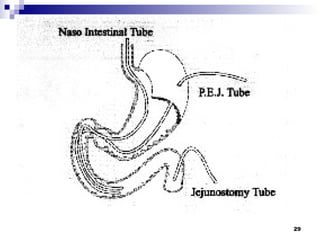
Indications and Routes of EN Indications  Gut works Oral intake not possible—altered mental state, ventilator, oral/pharyngeal/esophageal disorders Oral intake not sufficient for metabolic requirements—anorexia, sepsis, severe trauma/burns Presence of malnutrition and wasting Routes of administration  Nasogastric tube, ending in stomach, duodenum or intestine; gastrostomy ; jejunostomy


Administration Osmolality ,  volume , and speed Enteral Formulas All nutrients, degraded products of protein Complications of Enteral Administration Tube, infection, diarriah, dilatation
Parenteral Nutrtion Indications for Parenteral Feeding Practical Approach to Calculation of the Ideal Parenteral Formula Catheter Issues in Parenteral Nutrition Metabolic Complications of Long-Term Parenteral Nutrition Administration
Indications of PN Enteral feeding not possible—GI obstruction, ileus Enteral intake not sufficient for metabolic requirements—chronic diarrhea/emesis, malabsorption, fistulas, chemotherapy, irradiation therapy Risk of aspiration Adjunctive support necessary for managing disease—pancreatitis, hepatic failure, renal failure, chylothorax Presence of malnutrition and wasting
Routes of PN Peripheral Administration Peripheral vein. Central Approach Subclavian vein internal jugular vein
Formula Glucose, 35~65% of energy expenditure. Lipid, 25~50% of energy expenditure. Amino acid, non protein energy: nitrogen=150: 1 Electrolyte: k, Na, Cl, Ca, Mg, P Vitamin: Vit A, Vit Bs, Vit E Trace metals: Zinc, Copper, Iron Water: 2500~3000ml
Complications of Parenteral and Enteral Nutrition Due to improper formula and administration Catheter relative Metabolic complications of long-term PN If the gut can be used, use it.
Summary History of artificial nutrition Metabolism Nutritional Assessment and Administration
Metabolism Metabolism of protein, carbohydrate, fat and energy production Stress metabolism
Nutritional Assessment Types of malnutrition Evaluation of the preexisting deficits Estimation of caloric and protein requirements
Administration of nutrition Indications Enteral Nutrition Parenteral Nutrition
Complications Due to improper formula and administration Catheter relative Metabolic complications of long-term PN
Thank You For Attention

Surg. Nutritional Supp.

  • 1.
  • 2.
    OVERVIEW Artificial Nutrition:Importance and History antibiotics, blood transfusion, critical care monitoring, advances in anesthesia, organ transplantation, and cardiopulmonary bypass hyperalimentation  moderate nutritional supply nutritional pharmacology parenteral  parenteral & enteral
  • 3.
    OVERVIEW Clinical Sequelaeof Impaired Nutrition Impaire the body's ability to heal wounds and to support normal immune function reduced ventilation due to wasting of muscle limiting to all aggressive surgical and medical therapies Incidence of Malnutrition in Hospitalized Patients as many as 50% of hospitalized patients may be malnourished
  • 4.
    Surgical Nutritional Support: Provide adequate and proper nutrients to support the metabolism of the body, and to maintain the function and structure of the organs, to accelerate the recovery.
  • 5.
    Questions Why shouldwe provide nutritional support When it is provided What kind and amount of nutrients How to administrate the nutrients
  • 6.
    METABOLIC ADAPTATIONSIN CATABOLIC STATES AND REGULATION OF NITROGEN BALANCE
  • 7.
    Regulation of IntracellularProtein Synthesis and Degradation
  • 8.
    Metabolic Changes instate of starving secretion of insulin declines; secretion of glycagon, growth factor, catecholamine increase; utilization of glucose is accelerated; gluconeogenesis continues proteolysis is initiated to provide energy lipid is oxidized to ketones consume great amount of protein
  • 9.
  • 10.
    Metabolic changes instress (trauma, sepsis) trauma activating the sympathetic nerve utilization of carbohydrates are inhibited, hyperglycemia is produced the secretion of insulin declines the blood level of glycagon, growth factor, catecholamine, thyroid hormone, ACTH, antidiuretic hormone increase The lipolysis is activated, gluconeogenesis and proteolysis is accelerated, large amount of protein are consumed to provide energy supply.
  • 11.
  • 12.
    General Indications forNutrition Support and Choice of Route of Administration The pre-morbid state (healthy or otherwise) Poor nutritional status (the current oral intake meets <50% of total energy needs) Significant weight loss (initial body weight less than the usual body weight by ≥10%, or a decrease in inpatient weight by >10% of the admission weight) The duration of starvation (>7 days' inanition) An anticipated duration of artificial nutrition (particularly for total parenteral nutrition [TPN]) of more than 7 days The degree of the anticipated insult, surgical or otherwise A serum albumin value less than 3.0 g/100 mL measured in the absence of an inflammatory state
  • 13.
    Route of AdministrationEnteral nutrition (EN) more physiologic, and safe PARENTERAL ROUTE Parenteral nutrition (PN) Total parenteral nutrition (TPN)
  • 14.
    Mulnutrtion Kwashiorkor (ProteinMalnutrition) Adequate fat reserves with significant protein deficits Slight or no weight loss Low visceral proteins (albumin, prealbumin, transferrin) Edema often present Seen in acutely stressed patients Marasmus (Protein—Calorie Malnutrition) Weight loss with fat and muscle wasting Visceral proteins normal or slightly low Seen in chronic malnutrition
  • 15.
    Nutritional Assessment ClinicalHistory Body Composition Analysis Indirect Calorimetry Anthropomorphic Measurements Functional Studies of Muscle Function Biochemical Measurements
  • 16.
    Nitrogen Balance totalnitrogen intake – nitrogen expiration (most of it are excreted from urine, plus approximately 2~3gm for fecal and others lost of nitrogen)
  • 17.
    Plasma proteins <1.61.6~1.8 1.8~2.0 2.0~2.5 Transferrin (g/L) <21 21~27 28~34 >35 Albumin (g/L) Severe Moderate Light Malnutrition Normal
  • 18.
  • 19.
    Harris-Benedict equation BEE= 66.5 + (13.7 X weight [kg]) + (5.0 X height [cm]) - (6.8 X age [yr] [male]) BEE = 655.1 + (9.56 X weight [kg]) + (1.85 X height [cm]) - (4.68 X age [yr] [female]) (BEE = basal energy expenditure)
  • 20.
    Calories Requirements The three major sources of energy are protein, carbohydrate, and fat. amino acids, 15% fat, 25 to 50% Carbohydrate, 35 to 65%
  • 21.
    Nutrients Specific FuelsCarbohydrate Lipid Protein Plasma Electrolytes Vitamins and Micronutrients
  • 22.
    Protein Requirements 70-kg man has between 10 and 11 kg of protein. Daily protein turnover is 250 to 300 g, or 3% the gut , blood system, skin daily requirement 0.8 to 1.0 grams per kg per day, or 150 mg of nitrogen per kg per day 200 to 250 mg of nitrogen per kg of body weight or 1.7 g of protein per kg per day for patients in stress state
  • 23.
    Calorie-Nitrogen Ratio 150:1(150 nonpro-tein calories per gram of nitrogen) is required for protein synthesis in healthy persons 100:1 in sepsis 300:1 ~ 400:1 in uremia
  • 24.
    PRACTICAL APPROACH TOARTIFICIAL NUTRITION
  • 25.
    Enteral Nutrtion Indicationsfor Enteral Feeding Routes for Administration of Enteral Feeding Administration Enteral Formulas
  • 26.
    Indications and Routesof EN Indications Gut works Oral intake not possible—altered mental state, ventilator, oral/pharyngeal/esophageal disorders Oral intake not sufficient for metabolic requirements—anorexia, sepsis, severe trauma/burns Presence of malnutrition and wasting Routes of administration Nasogastric tube, ending in stomach, duodenum or intestine; gastrostomy ; jejunostomy
  • 27.
  • 28.
  • 29.
  • 30.
    Administration Osmolality , volume , and speed Enteral Formulas All nutrients, degraded products of protein Complications of Enteral Administration Tube, infection, diarriah, dilatation
  • 31.
    Parenteral Nutrtion Indicationsfor Parenteral Feeding Practical Approach to Calculation of the Ideal Parenteral Formula Catheter Issues in Parenteral Nutrition Metabolic Complications of Long-Term Parenteral Nutrition Administration
  • 32.
    Indications of PNEnteral feeding not possible—GI obstruction, ileus Enteral intake not sufficient for metabolic requirements—chronic diarrhea/emesis, malabsorption, fistulas, chemotherapy, irradiation therapy Risk of aspiration Adjunctive support necessary for managing disease—pancreatitis, hepatic failure, renal failure, chylothorax Presence of malnutrition and wasting
  • 33.
    Routes of PNPeripheral Administration Peripheral vein. Central Approach Subclavian vein internal jugular vein
  • 34.
    Formula Glucose, 35~65%of energy expenditure. Lipid, 25~50% of energy expenditure. Amino acid, non protein energy: nitrogen=150: 1 Electrolyte: k, Na, Cl, Ca, Mg, P Vitamin: Vit A, Vit Bs, Vit E Trace metals: Zinc, Copper, Iron Water: 2500~3000ml
  • 35.
    Complications of Parenteraland Enteral Nutrition Due to improper formula and administration Catheter relative Metabolic complications of long-term PN If the gut can be used, use it.
  • 36.
    Summary History ofartificial nutrition Metabolism Nutritional Assessment and Administration
  • 37.
    Metabolism Metabolism ofprotein, carbohydrate, fat and energy production Stress metabolism
  • 38.
    Nutritional Assessment Typesof malnutrition Evaluation of the preexisting deficits Estimation of caloric and protein requirements
  • 39.
    Administration of nutritionIndications Enteral Nutrition Parenteral Nutrition
  • 40.
    Complications Due toimproper formula and administration Catheter relative Metabolic complications of long-term PN
  • 41.
    Thank You ForAttention