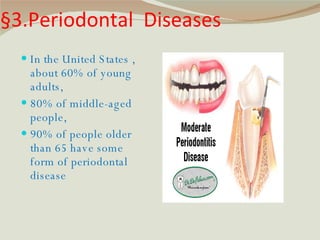
§3.Periodontal  Diseases In the United States , about 60% of young adults,  80% of middle-aged people,  90% of people older than 65 have some form of periodontal disease
Content Definition  of periodontal diseases Aetiology  and pathogenesis of  periodontal diseases  Classification   of  periodontal diseases Manifestation   of  periodontal diseases Treatment  of  periodontal diseases
Definition of periodontal diseases Periodontal diseases  can be defined as any pathological process affecting the periodontal tissues, but invariably refers to inflammatory disease, gingivitis and periodontitis
1.Initial factor-----Pathogenic microorganism New laboratory techniques show that  over 530 species and subspecies have been isolated and classified from subgingival and supragingival bacterial samples. Aetiology - How does periodontal disease start?
530
These bacteria possess biochemical capacities for the pathogenesis of inflammatory periodontal diseases  .
Dental plaque   is a sticky, colorless deposit of bacteria that constantly forms on the teeth. Saliva, food and fluids combine to produce this plaque. If it is not removed by regular brushing and flossing, it hardens and calcifies to form a stone like crusty deposit, commonly referred to as  tartar  or  calculus .
Calculus  is a hardened substance that comes from a combination of minerals in the saliva and from the dead plaque bacterial cells. They precipitate a crusty deposit  that, once mineralized, can grow rather quickly.  .
There are two types of calculus: Supragingival calculus  is the hard deposit on top of the teeth, the kind we can see and feel.  Subgingival calculus  forms below the gums. It is just as hard and adherent as supragingival calculus, this allows the bacteria to congregate in greater numbers.  Though it is difficult to remove plaque formed on top of/within subgingival calculus, it is necessary to do because these pathogens cause more periodontal tissue breakdown.
Dental plaque forms soon after it is removed.  Some studies report that it starts forming as soon as five minutes after it is removed.  Regardless of how quickly it begins reforming, effective plaque control will keep it to a minimum.
Supragingival dental plaque, early stage in formation. Supragingival dental plaque, late stage in formation.
If  plaque is allowed to build up on the teeth,  toxin  or  enzymes  produced by the bacteria can  damage the attachment of the gums, periodontal ligament, and bone to the teeth.
Healthy gums should fit snugly around the teeth. But as periodontal bacteria make their way beneath the gums, they create  periodontal pocket  which are unwanted gaps around the teeth. Teeth with pockets around them may eventually loosen or fall out.
If the inflammation is allowed to continue, the bone will begin to demineralize and dissolve. This stage is known as periodontitis . As the bone dissolves around the teeth, the teeth become unsupported and will fall out.
As more bone is destroyed, the tooth begins to loosen and, as the pockets get deeper, abscesses often occur.  Sometimes the gum will shrink as bone underneath is destroyed so that part of the root will become visible in the mouth
Unfortunately, pain does not  occur  until  the final stages of the disease and treatment at that time has very little chance of being successful .
2.Local contributing  factors may increase the risk or severity of  periodontal disease: 1.Oral hygiene: 2.Food impaction 3.Tauma  from occlusion
3.Systemic factor:   1. Smoking : a major risk factor for increasing the prevalence and severity of periodontal destruction. 2.  Genetics : some  factors can increase the sensibility that the host responds to  periodontal disease. 3.Pregnancy :   gingiva is a target organ for female sex hormones. 4. Stress : stress can increase the release of  hormones and immune medium ,which can reduce defense function of the host. 5.Systemic disease:
 
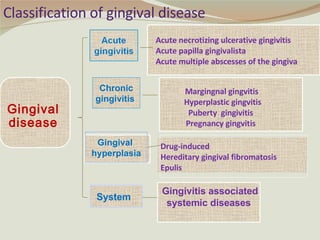
Classification of gingival disease Gingival disease Chronic gingivitis  Gingival  hyperplasia System  Acute necrotizing ulcerative gingivitis Acute  papilla gingivalista Acute multiple abscesses of the gingiva Margingnal gingvitis Hyperplastic gingvitis  Puberty  gingivitis  Pregnancy gingvitis  Drug-induced Hereditary gingival fibromatosis Epulis Gingivitis associated systemic diseases
Classification of periodontitis
1.  Acute necrotizing ulcerative  gingivitis (also named Vincent gingivitis ----- ANUG ) Acute necrotizing inflammation occurring on marginal gingiva and papillae. Acute necrotizing ulcerative  gingivitis Acute  papilla gingivalista Acute multiple abscesses of the gingiva
Eatiology Smear for fusospirochaetal bacteria  fusospirochaetal  bacteria  Some  reasons Defense  of  host  ANUG
Existing  gingivitis and periodontitis are important contributing factor   Deep pocket are suitable for bacteria growth Local or systemic factor  make bacteria grow
Clinical features Age :young and middle aged people (18-30) smoking male  weaken child Size: lower anterior teeth ANUG
Severe  soreness Profuse gingival  bleeding Halitosis  and a bad  taste Interdental papillae  ulcerated  with necrotic slough ANUG
2.Acute  papilla gingivalista Acute inflammation  localized in certain interdental papillae  Acute  papilla  gingivalista Acute necrotizing ulcerative  gingivitis Acute  papilla gingivalista Acute multiple abscesses of the gingiva
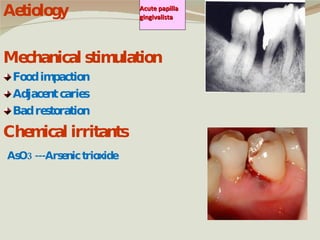
Acute  papilla  gingivalista Aetiology  Mechanical stimulation Food impaction Adjacent caries Bad restoration Chemical irritants AsO3 ---Arsenic trioxide
Clinical features Spontaneous, lasting pain Short  onset Single papilla--- bright, red, swelling, soft texture Severe bleeding  and pain while probing Percussion  (+), loose  (—) X-ray Acute  papilla  gingivalista
Multiple papillae Acute suppurative inflammation 3.Acute multiple abscesses of the gingivae Acute necrotizing ulcerative  gingivitis Acute  papilla gingivalista Acute multiple abscesses of the gingivae
clinical features Throbbing pain. Red swelling  Small abscess Subsequent rupture Halitosis
1.Margingnal gingivitis Almost universal in adults to some degree Dental plaque(main cause) Erythema, edema and painless swelling of marginal gingivae with bleeding on brushing or eating hard food Chronic gingivitis  Margingnal gingvitis Hyperplastic gingvitis  Puberty  gingvitis  Pregnancy gingivitis
2. Hyperplastic gingivitis  May occur following prolonged accumulation of dental plaque Firm ,pink gingival enlargement, particularly at interdental sites. May cover the  crowns of teeth, resulting in aesthetic  and cleaning difficulties.
3.Puberty  gingivitis  Tooth arrangement is not good, fixed orthodontic appliance, the eruption of teeth in teenagers, bad habit of oral hygiene are all contributing factors Less calculus, much dental plaque Gingiva is the target tissue of sexual hormone, and the change of sex hormone in teenagers is great ,which can easily result in inflammation of gingivae.
4.Pregnancy gingivitis  Common Exacerbation of chronic gingivitis mainly after 2 nd  month of pregnancy Erythema, swelling and liability to bleed Chronic gingivitis  Margingnal gingvitis Hyperplastic gingivitis  Puberty  gingivitis  Pregnancy gingvitis
1.Drug-induced hyperplasia Usually aggravated by poor oral hygiene It starts interdentally ,especially liabially Papillae firm, pale and enlarge to form  false vertical clefts Gingival  hyperplasia Drug-induced gingival hyperplasia Hereditary  gingival fibromatosis Epulis
2.Hereditary  gingival fibromatosis
3.Epulis Localized gingival swelling Fibrous are most common Local gingival irritation leading to fibrous hyperplasia Gingival  hyperplasia Drug-induced gingiva hyperplasia Hereditary  gingival fibromatosis Epulis
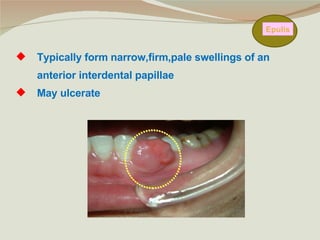
Epulis Typically form narrow,firm,pale swellings of an anterior interdental papillae May ulcerate
Leukemia  Most common in adults Characterized by swelling haemorrhage and ulceration  Leukemia  Gingivitis associated systemic diseases
Treatment of gingival diseases includes Oral hygiene---Plaque control to a meticulous standard  R insing  Tooth brushing  Interdentally brushing  Scaling  The use of antibiotic treatment Excision
 
The main topic  Definition : Dental plaque Calculus Classification of periodontal diseases

张结 3 1 1

  • 1.
    §3.Periodontal DiseasesIn the United States , about 60% of young adults, 80% of middle-aged people, 90% of people older than 65 have some form of periodontal disease
  • 2.
    Content Definition of periodontal diseases Aetiology and pathogenesis of periodontal diseases Classification of periodontal diseases Manifestation of periodontal diseases Treatment of periodontal diseases
  • 3.
    Definition of periodontaldiseases Periodontal diseases can be defined as any pathological process affecting the periodontal tissues, but invariably refers to inflammatory disease, gingivitis and periodontitis
  • 4.
    1.Initial factor-----Pathogenic microorganismNew laboratory techniques show that over 530 species and subspecies have been isolated and classified from subgingival and supragingival bacterial samples. Aetiology - How does periodontal disease start?
  • 5.
  • 6.
    These bacteria possessbiochemical capacities for the pathogenesis of inflammatory periodontal diseases .
  • 7.
    Dental plaque is a sticky, colorless deposit of bacteria that constantly forms on the teeth. Saliva, food and fluids combine to produce this plaque. If it is not removed by regular brushing and flossing, it hardens and calcifies to form a stone like crusty deposit, commonly referred to as tartar or calculus .
  • 8.
    Calculus isa hardened substance that comes from a combination of minerals in the saliva and from the dead plaque bacterial cells. They precipitate a crusty deposit that, once mineralized, can grow rather quickly. .
  • 9.
    There are twotypes of calculus: Supragingival calculus is the hard deposit on top of the teeth, the kind we can see and feel. Subgingival calculus forms below the gums. It is just as hard and adherent as supragingival calculus, this allows the bacteria to congregate in greater numbers. Though it is difficult to remove plaque formed on top of/within subgingival calculus, it is necessary to do because these pathogens cause more periodontal tissue breakdown.
  • 10.
    Dental plaque formssoon after it is removed. Some studies report that it starts forming as soon as five minutes after it is removed. Regardless of how quickly it begins reforming, effective plaque control will keep it to a minimum.
  • 11.
    Supragingival dental plaque,early stage in formation. Supragingival dental plaque, late stage in formation.
  • 12.
    If plaqueis allowed to build up on the teeth, toxin or enzymes produced by the bacteria can damage the attachment of the gums, periodontal ligament, and bone to the teeth.
  • 13.
    Healthy gums shouldfit snugly around the teeth. But as periodontal bacteria make their way beneath the gums, they create periodontal pocket which are unwanted gaps around the teeth. Teeth with pockets around them may eventually loosen or fall out.
  • 14.
    If the inflammationis allowed to continue, the bone will begin to demineralize and dissolve. This stage is known as periodontitis . As the bone dissolves around the teeth, the teeth become unsupported and will fall out.
  • 15.
    As more boneis destroyed, the tooth begins to loosen and, as the pockets get deeper, abscesses often occur. Sometimes the gum will shrink as bone underneath is destroyed so that part of the root will become visible in the mouth
  • 16.
    Unfortunately, pain doesnot occur until the final stages of the disease and treatment at that time has very little chance of being successful .
  • 17.
    2.Local contributing factors may increase the risk or severity of periodontal disease: 1.Oral hygiene: 2.Food impaction 3.Tauma from occlusion
  • 18.
    3.Systemic factor:  1. Smoking : a major risk factor for increasing the prevalence and severity of periodontal destruction. 2.  Genetics : some factors can increase the sensibility that the host responds to periodontal disease. 3.Pregnancy : gingiva is a target organ for female sex hormones. 4. Stress : stress can increase the release of hormones and immune medium ,which can reduce defense function of the host. 5.Systemic disease:
  • 19.
  • 20.
    Classification of gingivaldisease Gingival disease Chronic gingivitis Gingival hyperplasia System Acute necrotizing ulcerative gingivitis Acute papilla gingivalista Acute multiple abscesses of the gingiva Margingnal gingvitis Hyperplastic gingvitis Puberty gingivitis Pregnancy gingvitis Drug-induced Hereditary gingival fibromatosis Epulis Gingivitis associated systemic diseases
  • 21.
  • 22.
    1. Acutenecrotizing ulcerative gingivitis (also named Vincent gingivitis ----- ANUG ) Acute necrotizing inflammation occurring on marginal gingiva and papillae. Acute necrotizing ulcerative gingivitis Acute papilla gingivalista Acute multiple abscesses of the gingiva
  • 23.
    Eatiology Smear forfusospirochaetal bacteria fusospirochaetal bacteria Some reasons Defense of host ANUG
  • 24.
    Existing gingivitisand periodontitis are important contributing factor Deep pocket are suitable for bacteria growth Local or systemic factor make bacteria grow
  • 25.
    Clinical features Age:young and middle aged people (18-30) smoking male weaken child Size: lower anterior teeth ANUG
  • 26.
    Severe sorenessProfuse gingival bleeding Halitosis and a bad taste Interdental papillae ulcerated with necrotic slough ANUG
  • 27.
    2.Acute papillagingivalista Acute inflammation localized in certain interdental papillae Acute papilla gingivalista Acute necrotizing ulcerative gingivitis Acute papilla gingivalista Acute multiple abscesses of the gingiva
  • 28.
    Acute papilla gingivalista Aetiology Mechanical stimulation Food impaction Adjacent caries Bad restoration Chemical irritants AsO3 ---Arsenic trioxide
  • 29.
    Clinical features Spontaneous,lasting pain Short onset Single papilla--- bright, red, swelling, soft texture Severe bleeding and pain while probing Percussion (+), loose (—) X-ray Acute papilla gingivalista
  • 30.
    Multiple papillae Acutesuppurative inflammation 3.Acute multiple abscesses of the gingivae Acute necrotizing ulcerative gingivitis Acute papilla gingivalista Acute multiple abscesses of the gingivae
  • 31.
    clinical features Throbbingpain. Red swelling Small abscess Subsequent rupture Halitosis
  • 32.
    1.Margingnal gingivitis Almostuniversal in adults to some degree Dental plaque(main cause) Erythema, edema and painless swelling of marginal gingivae with bleeding on brushing or eating hard food Chronic gingivitis Margingnal gingvitis Hyperplastic gingvitis Puberty gingvitis Pregnancy gingivitis
  • 33.
    2. Hyperplastic gingivitis May occur following prolonged accumulation of dental plaque Firm ,pink gingival enlargement, particularly at interdental sites. May cover the crowns of teeth, resulting in aesthetic and cleaning difficulties.
  • 34.
    3.Puberty gingivitis Tooth arrangement is not good, fixed orthodontic appliance, the eruption of teeth in teenagers, bad habit of oral hygiene are all contributing factors Less calculus, much dental plaque Gingiva is the target tissue of sexual hormone, and the change of sex hormone in teenagers is great ,which can easily result in inflammation of gingivae.
  • 35.
    4.Pregnancy gingivitis Common Exacerbation of chronic gingivitis mainly after 2 nd month of pregnancy Erythema, swelling and liability to bleed Chronic gingivitis Margingnal gingvitis Hyperplastic gingivitis Puberty gingivitis Pregnancy gingvitis
  • 36.
    1.Drug-induced hyperplasia Usuallyaggravated by poor oral hygiene It starts interdentally ,especially liabially Papillae firm, pale and enlarge to form false vertical clefts Gingival hyperplasia Drug-induced gingival hyperplasia Hereditary gingival fibromatosis Epulis
  • 37.
  • 38.
    3.Epulis Localized gingivalswelling Fibrous are most common Local gingival irritation leading to fibrous hyperplasia Gingival hyperplasia Drug-induced gingiva hyperplasia Hereditary gingival fibromatosis Epulis
  • 39.
    Epulis Typically formnarrow,firm,pale swellings of an anterior interdental papillae May ulcerate
  • 40.
    Leukemia Mostcommon in adults Characterized by swelling haemorrhage and ulceration Leukemia Gingivitis associated systemic diseases
  • 41.
    Treatment of gingivaldiseases includes Oral hygiene---Plaque control to a meticulous standard R insing Tooth brushing Interdentally brushing Scaling The use of antibiotic treatment Excision
  • 42.
  • 43.
    The main topic Definition : Dental plaque Calculus Classification of periodontal diseases